







Highlights
-
Statistical uncertainty quantification for multireference covariant density functional theory
2026, 50(10): 104107. doi: 10.1088/1674-1137/ae8e63
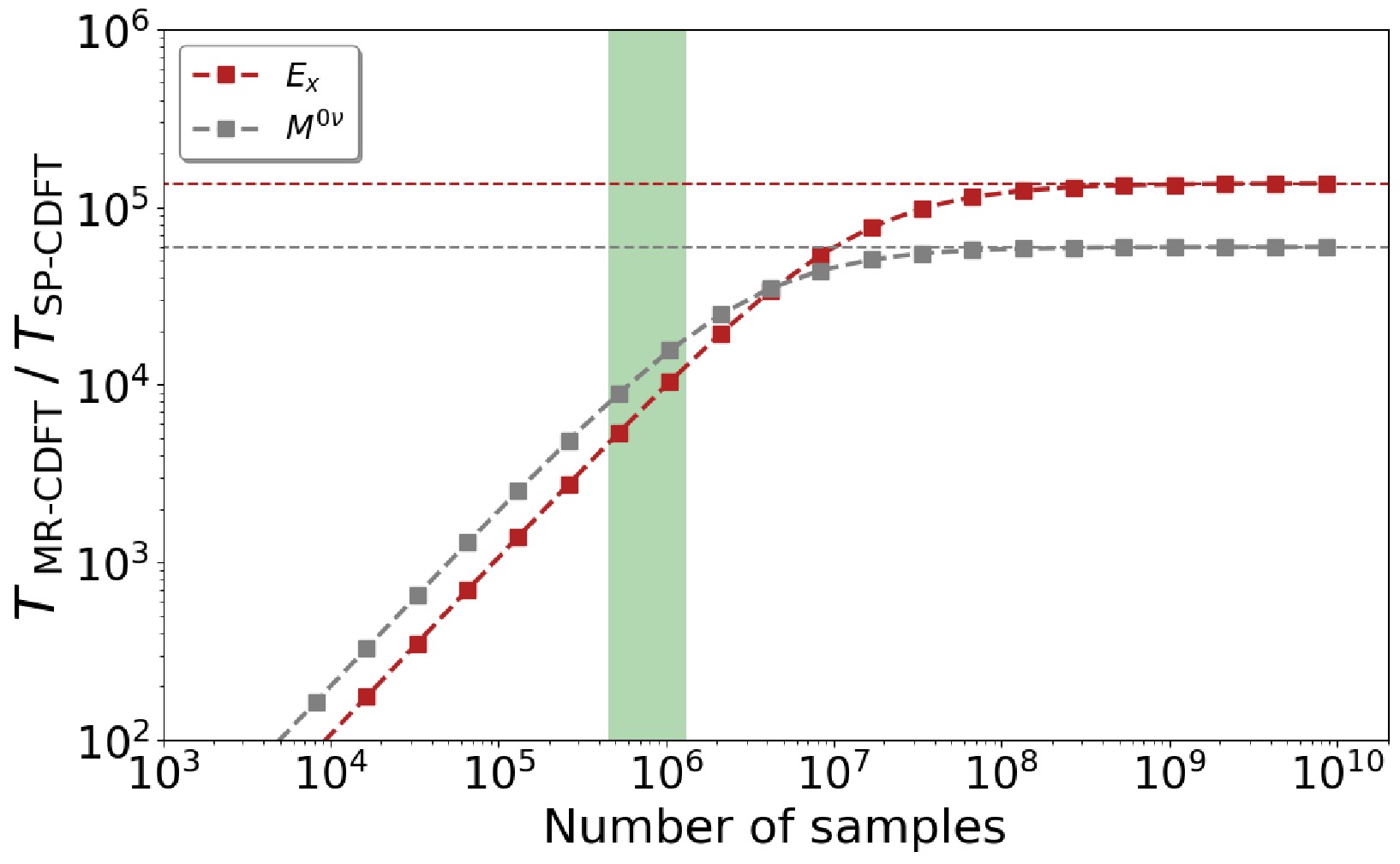 We present a theoretical framework for quantifying statistical uncertainties in covariant density functional theory (CDFT) for both nuclear matter and finite nuclei, based on a relativistic point-coupling energy density functional (EDF). By sampling approximately one million parameter sets, with nine parameters varied around their values in the PC-PK1 functional, we construct a probability density function for nuclear matter properties. Incorporating empirical values of nuclear matter at saturation density, predictions from chiral nuclear forces, and measured $ B(E2) $ values of finite nuclei, we infer posterior distributions for the model parameters within a Bayesian framework. These posterior distributions are then propagated to the low-lying states of finite nuclei using the newly developed subspace-projected (SP)-CDFT approach, in which the wave functions of target EDF parameter sets are expanded in a subspace spanned by low-lying states obtained from a set of training parameterizations. We find that the observables of low-lying states in deformed nuclei 150Nd and 150Sm are well reproduced once statistical uncertainties are taken into account. In contrast, those of near-spherical nuclei 136Xe and 136Ba remain difficult to describe within the present framework, a limitation expected to be alleviated by extending the model space to include quasiparticle excitations.
 -
Cluster radioactivity in extreme laser fields: A study for nuclear structure properties
2026, 50(10): 104103. doi: 10.1088/1674-1137/ae84aa
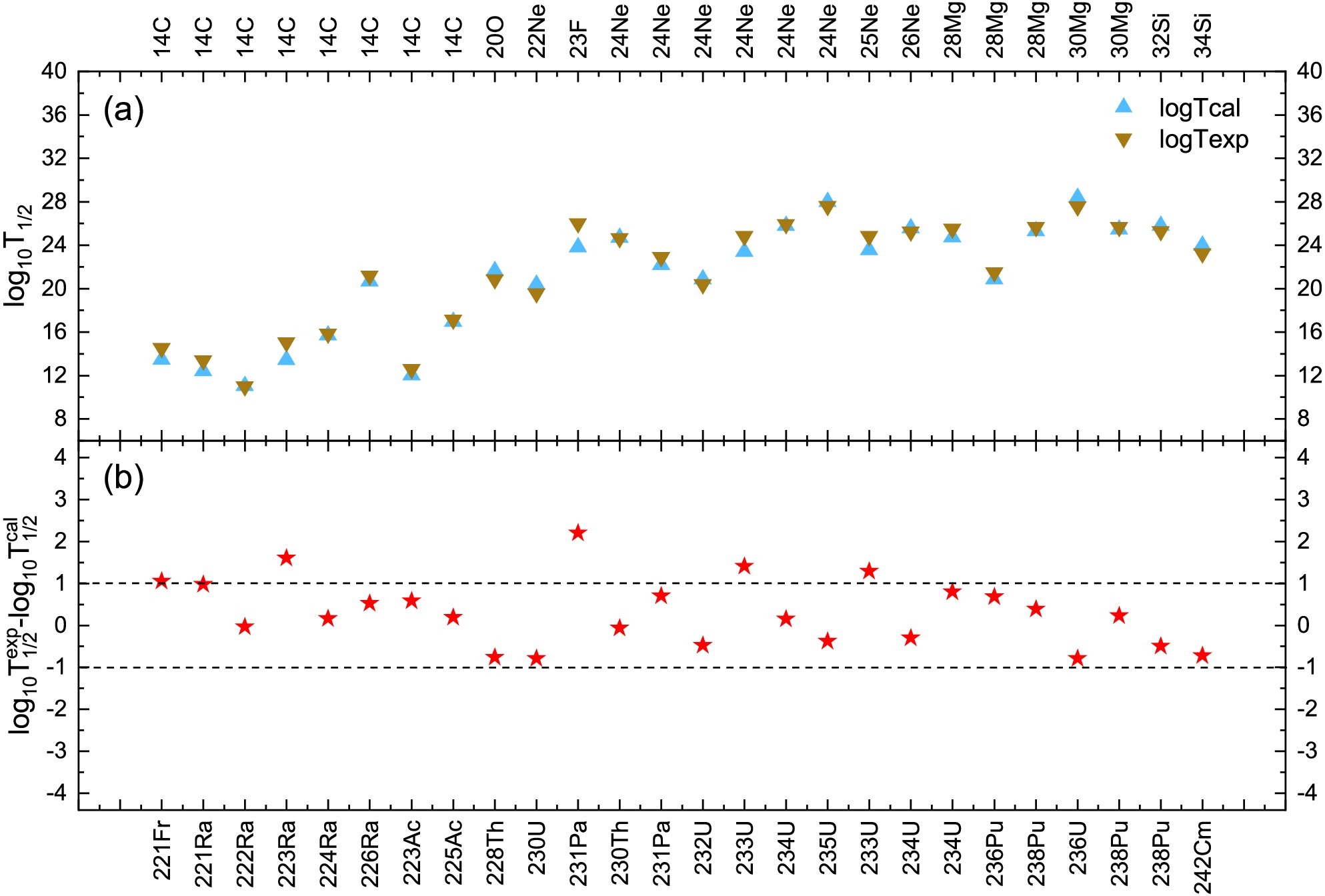 In the present work, we investigate the effect of ultra-intense laser fields on cluster radioactivity from a nuclear-structure perspective. Specifically, we examine the relationship between the maximum instantaneous rate of change of the penetration probability and the proton number of the emitted cluster. Subsequently, based on the characteristics of cluster-radioactive nuclei, we investigate the correlation between the rate of change of the penetration probability and the neutron number of the daughter nuclei for the emission of $ ^{14} {\rm{C}}$ from Ra, $ ^{20} {\rm{O}}$ from Th, $ ^{23} {\rm{F}}$ from Pa, $ ^{24} {\rm{Ne}}$ from U, $ ^{28} {\rm{Mg}}$ from Pu, and $ ^{34} {\rm{Si}}$ from Cm isotopes. The results demonstrate that shell effects contribute to the rate of change of the penetration probability. Notably, the influence of the neutron shell effect on this rate diminishes as the number of valence protons increases. In addition, the rate of change exhibits an overall linear increase with the quadrupole deformation parameter of the parent nucleus. Finally, the effect of odd-even staggering on laser-assisted cluster radioactivity is revealed. This research provides valuable insights for future laser-nuclear physics experiments.
 -
Analysis of H → J/ψ + γ up to Next-to-Next-to-Leading order QCD corrections
2026, 50(10): 103108. doi: 10.1088/1674-1137/ae823e
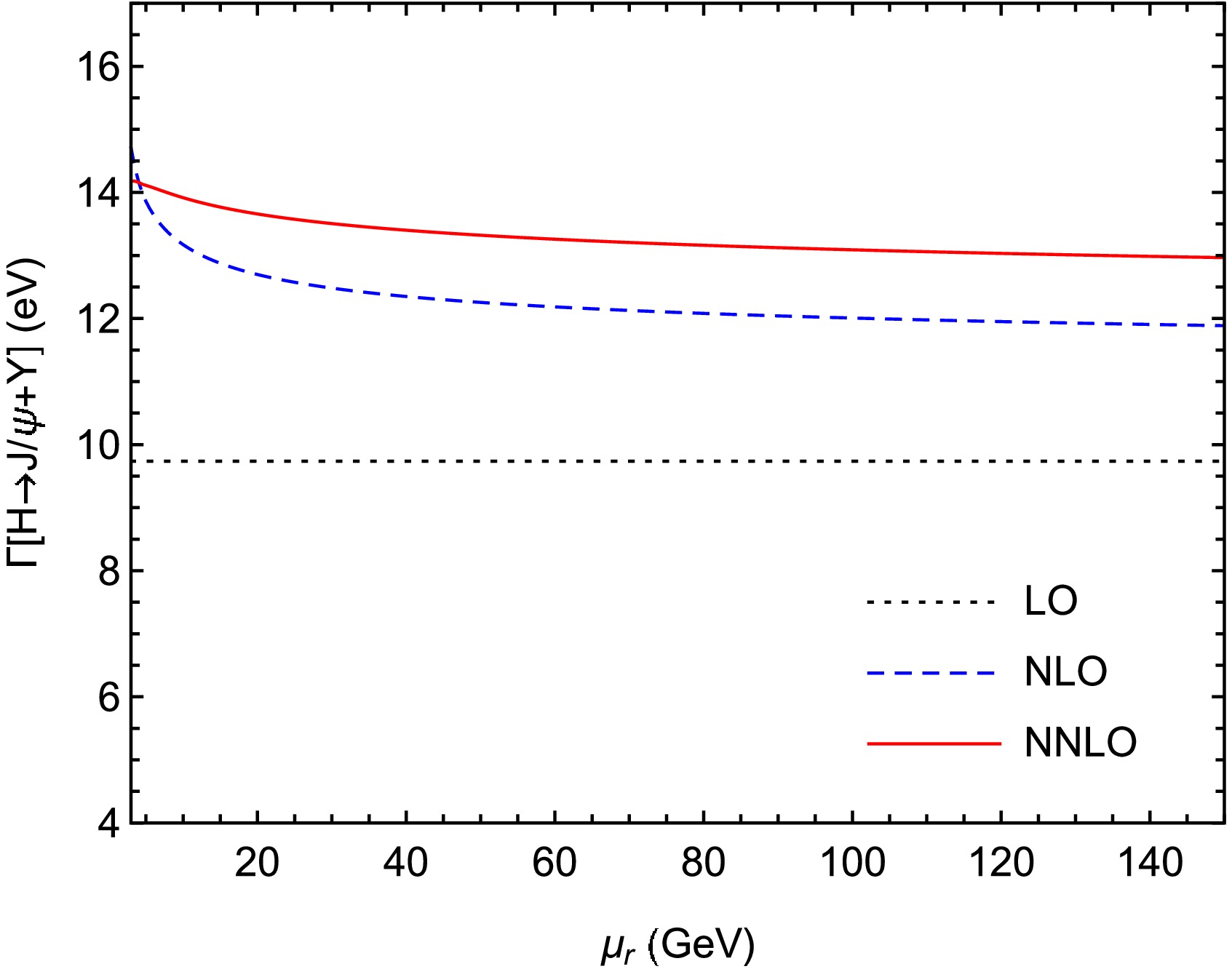 The rare exclusive decay of the Higgs boson, $ H \to J/\psi + \gamma $, is a crucial channel for assessing the Yukawa coupling of the charm quark. In this article, we examine this process up to the next-to-next-to-leading order (NNLO) in QCD utilizing the Principle of Maximum Conformality (PMC). The PMC offers a systematic approach to eliminate renormalization scale uncertainties by resumming non-conformal β contributions into the QCD running coupling through the renormalization group equation (RGE). A PMC scale of $ Q_\star = 3.29\ {\rm{GeV}} $ is obtained, which reflects the low virtuality of the underlying QCD dynamics in the $ H \to J/\psi + \gamma $ process. Notably, this is an order of magnitude smaller than the scale estimated using the conventional method, i.e., $ \mu_r = m_H/2 $. By removing the non-conformal $ \{\beta_i\} $-terms from the perturbative QCD (pQCD) series, we observe that the PMC NLO QCD correction term is significantly enhanced, while the PMC NNLO QCD correction is suppressed. This indicates improved convergence of the pQCD series up to NNLO. Finally, we calculate the decay width $ \Gamma(H \to J/\psi + \gamma) = $$ 14.183^{+0.249}_{-0.347} \pm 0.022 $ eV, where the first uncertainty arises from the factorization scale $ \mu_\Lambda \in [1, 2]\ {\rm{GeV}} $, and the second is due to the estimation of unknown higher-order terms using the Pad$ \acute{e} $ approximant approach. The corresponding branching fraction is $ {\cal{B}}(H \to J/\psi + \gamma) = 3.485_{-0.161}^{+0.152} \times 10^{-6} $.


Just Accepted
More >
-
Decoherence Effects on Primordial Black Holes and Scalar-Induced Gravitational Waves
Published: 2026-10-27, doi: 10.1088/1674-1137/aeabfb
-
Quantum Correlations of Neutrinos in the Kerr-Newman Space-time
Published: 2026-10-27, doi: 10.1088/1674-1137/aeaa12
-
Hawking radiation from non-minimal Einstein–Yang–Mills black holes
Published: 2026-10-27, doi: 10.1088/1674-1137/aeaa11
Recent
More >
-
Quasinormal frequencies and greybody factors for axial perturbations of dilaton–Euler–Heisenberg de Sitter black holes
2027, 51(1): 013107-013107-15. doi: 10.1088/1674-1137/ae9e9cShow AbstractWe investigate the quasinormal modes (QNMs) and greybody factors of dilaton–Euler–Heisenberg (dEH) de Sitter (dS) black holes in string-inspired Euler–Heisenberg gravity. Since the axial gravitational and electromagnetic perturbations decouple, we analyze them independently. By applying the asymptotic iteration method (AIM) together with a sixth-order WKB approximation, we compute the quasinormal frequencies and find excellent agreement between the two methods. We also find that the QNM spectra depend sensitively on the magnetic charge $Q_{\text{m}}$, cosmological constant Λ, and nonlinear coupling $\epsilon$, with a notable topological anomaly appearing in the electromagnetic frequency trajectories. Additionally, larger values of $Q_{\text{m}}$ or the multipole number l generally suppress wave transmission, while the electromagnetic sector with $\epsilon=1$ exhibits an anomalous response.
-
Study of radiative proton capture by the 7Be nucleus with the use of ab initio approaches
2026, 50(11): 114102-114102-11. doi: 10.1088/1674-1137/ae836eShow AbstractA theoretical study of the 7Be(p, γ)8B reaction in the "astrophysical" energy range with the use of ab initio methods is presented. The used approaches are No-Core Shell Model and Cluster Channels Orthogonal Functions Method. The scheme also contains elements of R-matrix theory and procedures for extrapolating various data obtained in ab initio computations. The developed approach as a whole allows one not only to calculate the astrophysical S-factor and all nuclear characteristics that determine its value, but also to evaluate the reliability of the obtained results and to identify the dominant reaction mechanisms against a background of insignificant ones. The high accuracy of the obtained results and has been demonstrated.
-
Observational constraints on fractional holographic dark energy in the light of DESI DR2
2026, 50(11): 115104-115104-12. doi: 10.1088/1674-1137/ae9926Show AbstractBased on the fractional entropy from fractional quantum mechanics, fractional holographic dark energy (FHDE) has been proposed with the Hubble horizon as the IR cutoff (FHDEH). We extend this framework by adopting the future event horizon and the particle horizon as the IR cutoff and proposing the FHDEF and FHDEP models. Using the SN+OHD+DESI DR2 dataset to constrain these models, we find that all three models provide a marginally lower $\chi^{2}_{\min}$ compared to ΛCDM but without significant preference according to AIC and BIC. When CMB distance priors are included, the FHDEH and FHDEP models are strongly ruled out. We further analyze the cosmological evolution for these models, and find that only the FHDEF model predicts nearly identical evolutions of $ \Omega_{m} $ and $ \Omega_{\rm de} $ to those of the ΛCDM model across cosmic history, but its deceleration parameter q deviates from the ΛCDM model in the future, indicating richer late time dynamics beyond the standard ΛCDM cosmology.
Current Issued

2026 Vol. 50, No. 10
Published: 29 September 2026
Published: 29 September 2026
Archive
IF: 3.0
Monthly issued, founded in 1977
Sponsored by:
ISSN 1674-1137 CN 11-5641/O4
Original research articles, Ietters and reviews Covering theory and experiments in the fieids of
- Particle physics
- Nuclear physics
- Particle and nuclear astrophysics
- Cosmology
Author benefits
- A SCOAP3 participating journal - free Open Access publication for qualifying articles
- Average 24 days to first decision
- Fast-track publication for selected articles
- Subscriptions at over 3000 institutions worldwide
- Free English editing on all accepted articles
News
- Chinese Physics C Best Paper Awards 2026 Announced
- Editorial Office Closed
- CPC Announces 2025 Outstanding Reviewers
- Chinese Physics C Outstanding Reviewer Award 2023
- Impact factor of Chinese Physics C is 3.6 in 2022
Cover Story
- Cover Story (Issue 9, 2026): Charge Separation Measurements in Au+Au collisions at \sqrt{S_{NN}} = 7.7-200 GeV in Search of the Chiral Magnetic Effect
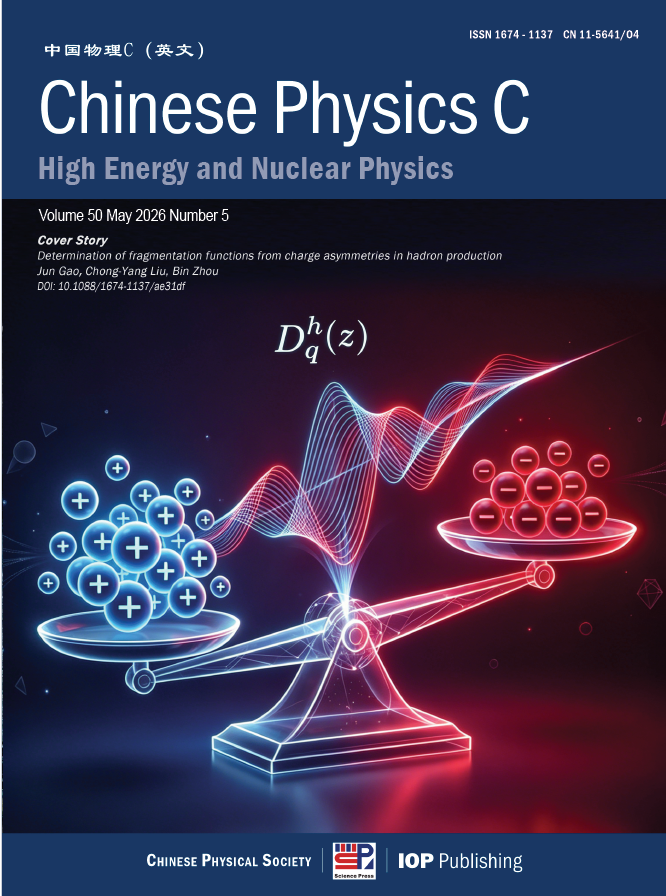
- Cover Story (Issue 5, 2026): Determination of Fragmentation Functions from Charge Asymmetries in Hadron Production
- Cover Story (Issue 4, 2026): Initial performance results of the JUNO detector
- Cover Story (Issue 3, 2026): Comprehensive investigation on baryon number violating nucleon decays involving an axion-like particle
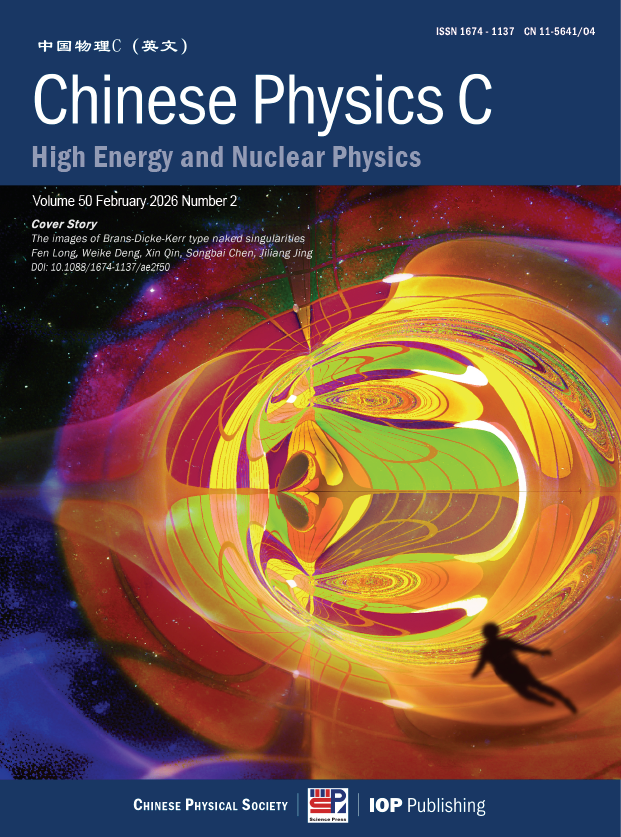
- Cover Story (Issue 2, 2026) |The images of Brans-Dicke-Kerr type naked singularities
Advertising