


 Abstract
 HTML
HTML Reference
 Related
 PDF
PDF




-
The fundamental distinction between quantum and classical correlations remains a cornerstone of quantum mechanics [1–3]. Quantum correlations, an essential concept for understanding quantum information processing [4], have been successfully applied to frontiers in optical lattices [5, 6], trapped ions [7, 8], and superconducting qubits [9, 10], where high-fidelity entanglement generation and manipulation are now routine. In recent years, high-energy physics has emerged as a compelling arena for probing quantum correlations in relativistic regimes. Notably, spin entanglement in top-quark pairs has been experimentally investigated at the Large Hadron Collider [11]. Beyond top quarks, entanglement has been theoretically explored in a variety of collider processes involving leptons [12–14], massive gauge bosons [15], hyperons [16–26], and different quark flavors [27–30]. Much attention is paid to the hyperon–antihyperon system in charmonium decays, where hyperon decay serves as a self-polarimeter [31–34], enabling the reconstruction of spin correlations from the decay products. Capitalizing on this advantage, the BESIII collaboration recently reported a clean probe of quantum entanglement [35].
The investigation of quantum entanglement in relativistic regimes has gained significant traction, particularly as a means to understand the strong force from alternative perspectives and to scrutinize the feasibility of Bell tests at high-energy colliders [33, 36–44]. As another central concept in the context of quantum information, entanglement distillation is the probabilistic conversion of a large ensemble of mixed entangled states into a smaller set of maximally entangled pure states [45, 46]. While conventional distillation relies on Local collective Operations and Classical Communication (LOCC), particle physics offers a unique parallel where the entanglement between daughter particles can spontaneously increase relative to the initial mother system. This phenomenon, termed entanglement autodistillation [47], arises because the decay process functions as a Stochastic LOCC (SLOCC) process [48]. Recently, this idea has been applied to various collider processes, including top quark [49, 50], muon [51], and hyperon-antihyperon pairs [52]. However, as decay acts as a local manipulation within an expanding phase space, it may also inherently diminish the system's entanglement [47, 52]. While previous studies have largely focused on the amplification of entanglement, the potential for its reduction remains largely unquantified. This paper aims to fill that gap by numerically investigating the conditions under which entanglement is diminished or redistributed during sequential hyperon decays.
To address the characterization of the quantum correlations, one usually works within the widely used entanglement-separability dichotomy first formalized by Werner [53]. Among the various measures of quantum correlations, entanglement — an inseparable, strong form of correlation — has been studied most extensively. Practical quantifiers are developed such as concurrence [54] (based on entanglement of formation) and negativity [55] (based on the positive partial transpose criterion). In the context of quantum information, ''quantumness" is a heuristic term capturing how much a physical system's state deviates from classical descriptions. This deviation typically manifests through entanglement, superposition, or other intrinsic quantum features. While useful in qualitative discussions, precise analyses typically rely on well-defined measures like entanglement entropy or quantum discord. Discord quantifies the difference between two quantum generalizations of classical mutual information [56, 57]. Crucially, it can capture non-classical correlations even in separable states that lack entanglement, providing a broader and more comprehensive framework for identifying and quantifying useful resources in quantum information and complex systems.
The study of quantum entanglement at high-energy colliders has a long history, dating back to analyses of entangled photons and neutral kaon pairs [58]. Today, using entanglement as both a test of Bell locality [40, 59] and a probe of new physics [60] motivates a core and active research direction. Produced via electron-positron annihilation, a spin-entangled hyperon-antihyperon pair as a massive qubit system is proposed as a unique platform to investigate the entanglement at the hadronic scale [31]. In particle physics, the angular distribution of decay products is leveraged as spin analyzers. The characteristic weak decays of hyperons (e.g.,
$ \Xi^- \to \Lambda \pi^- $ ), yielding a final state consisting of a spin-1/2 baryon and a spinless pseudoscalar meson, ensure that the complete spin information of the mother hyperon is cleanly transferred to the daughter baryon [61]. By using the decay of daughter baryons as spin analyzers, their entanglement can be reconstructed as well. Therefore, a direct comparison of the aforementioned entanglement measure of mother hyperon-antihyperon pairs and daughter baryon-antibaryon pairs allows for the investigation of entanglement evolution through sequential hyperon decays, where entanglement increase in certain decay chains is referred to as entanglement autodistillation [47, 52]. This paper pays special attention to the entanglement decrease arising from the local nature of the decay and the inherent enlargement of phase-space. Specifically, these factors drive the non-unitary evolution of the spin density matrix (SDM) and lead to an overall dilution of the quantum resources [62, 63]. Nevertheless, this evolution produces a distinct correlation profile in the daughter pairs, which serves as a sensitive diagnostic tool. This profile offers further insights into the underlying decay amplitudes and the efficiency of entanglement autodistillation within high-energy environments. The phase-space averaged profiles by an integration over helicity angles of daughter baryons are also shown as an interesting comparison.This paper is organized as follows. Sec. II gives the spin density matrix of hyperon pairs and Sec. III presents the numerical results of concurrence, negativity, and discord. Sec. IV discusses the underlying mechanism of entanglement redistribution and experimental prospects, and Sec. V briefly summarizes the results.
-
The fundamental distinction between quantum and classical correlations remains a cornerstone of quantum mechanics [1–3]. Quantum correlations, an essential concept for understanding quantum information processing [4], have been successfully applied to frontiers in optical lattices [5, 6], trapped ions [7, 8], and superconducting qubits [9, 10], where high-fidelity entanglement generation and manipulation are now routine. In recent years, high-energy physics has emerged as a compelling arena for probing quantum correlations in relativistic regimes. Notably, spin entanglement in top-quark pairs has been experimentally investigated at the Large Hadron Collider [11]. Beyond top quarks, entanglement has been theoretically explored in a variety of collider processes involving leptons [12–14], massive gauge bosons [15], hyperons [16–26], and different quark flavors [27–30]. Much attention is paid to the hyperon–antihyperon system in charmonium decays, where hyperon decay serves as a self-polarimeter [31–34], enabling the reconstruction of spin correlations from the decay products. Capitalizing on this advantage, the BESIII collaboration recently reported a clean probe of quantum entanglement [35].
The investigation of quantum entanglement in relativistic regimes has gained significant traction, particularly as a means to understand the strong force from alternative perspectives and to scrutinize the feasibility of Bell tests at high-energy colliders [33, 36–44]. As another central concept in the context of quantum information, entanglement distillation is the probabilistic conversion of a large ensemble of mixed entangled states into a smaller set of maximally entangled pure states [45, 46]. While conventional distillation relies on Local collective Operations and Classical Communication (LOCC), particle physics offers a unique parallel where the entanglement between daughter particles can spontaneously increase relative to the initial mother system. This phenomenon, termed entanglement autodistillation [47], arises because the decay process functions as a Stochastic LOCC (SLOCC) process [48]. Recently, this idea has been applied to various collider processes, including top quark [49, 50], muon [51], and hyperon-antihyperon pairs [52]. However, as decay acts as a local manipulation within an expanding phase space, it may also inherently diminish the system's entanglement [47, 52]. While previous studies have largely focused on the amplification of entanglement, the potential for its reduction remains largely unquantified. This paper aims to fill that gap by numerically investigating the conditions under which entanglement is diminished or redistributed during sequential hyperon decays.
To address the characterization of the quantum correlations, one usually works within the widely used entanglement-separability dichotomy first formalized by Werner [53]. Among the various measures of quantum correlations, entanglement — an inseparable, strong form of correlation — has been studied most extensively. Practical quantifiers are developed such as concurrence [54] (based on entanglement of formation) and negativity [55] (based on the positive partial transpose criterion). In the context of quantum information, ''quantumness" is a heuristic term capturing how much a physical system's state deviates from classical descriptions. This deviation typically manifests through entanglement, superposition, or other intrinsic quantum features. While useful in qualitative discussions, precise analyses typically rely on well-defined measures like entanglement entropy or quantum discord. Discord quantifies the difference between two quantum generalizations of classical mutual information [56, 57]. Crucially, it can capture non-classical correlations even in separable states that lack entanglement, providing a broader and more comprehensive framework for identifying and quantifying useful resources in quantum information and complex systems.
The study of quantum entanglement at high-energy colliders has a long history, dating back to analyses of entangled photons and neutral kaon pairs [58]. Today, using entanglement as both a test of Bell locality [40, 59] and a probe of new physics [60] motivates a core and active research direction. Produced via electron-positron annihilation, a spin-entangled hyperon-antihyperon pair as a massive qubit system is proposed as a unique platform to investigate the entanglement at the hadronic scale [31]. In particle physics, the angular distribution of decay products is leveraged as spin analyzers. The characteristic weak decays of hyperons (e.g.,
$ \Xi^- \to \Lambda \pi^- $ ), yielding a final state consisting of a spin-1/2 baryon and a spinless pseudoscalar meson, ensure that the complete spin information of the mother hyperon is cleanly transferred to the daughter baryon [61]. By using the decay of daughter baryons as spin analyzers, their entanglement can be reconstructed as well. Therefore, a direct comparison of the aforementioned entanglement measure of mother hyperon-antihyperon pairs and daughter baryon-antibaryon pairs allows for the investigation of entanglement evolution through sequential hyperon decays, where entanglement increase in certain decay chains is referred to as entanglement autodistillation [47, 52]. This paper pays special attention to the entanglement decrease arising from the local nature of the decay and the inherent enlargement of phase-space. Specifically, these factors drive the non-unitary evolution of the spin density matrix (SDM) and lead to an overall dilution of the quantum resources [62, 63]. Nevertheless, this evolution produces a distinct correlation profile in the daughter pairs, which serves as a sensitive diagnostic tool. This profile offers further insights into the underlying decay amplitudes and the efficiency of entanglement autodistillation within high-energy environments. The phase-space averaged profiles by an integration over helicity angles of daughter baryons are also shown as an interesting comparison.This paper is organized as follows. Sec. II gives the spin density matrix of hyperon pairs and Sec. III presents the numerical results of concurrence, negativity, and discord. Sec. IV discusses the underlying mechanism of entanglement redistribution and experimental prospects, and Sec. V briefly summarizes the results.
-
The fundamental distinction between quantum and classical correlations remains a cornerstone of quantum mechanics [1–3]. Quantum correlations, an essential concept for understanding quantum information processing [4], have been successfully applied to frontiers in optical lattices [5, 6], trapped ions [7, 8], and superconducting qubits [9, 10], where high-fidelity entanglement generation and manipulation are now routine. In recent years, high-energy physics has emerged as a compelling arena for probing quantum correlations in relativistic regimes. Notably, spin entanglement in top-quark pairs has been experimentally investigated at the Large Hadron Collider [11]. Beyond top quarks, entanglement has been theoretically explored in a variety of collider processes involving leptons [12–14], massive gauge bosons [15], hyperons [16–26], and different quark flavors [27–30]. Much attention is paid to the hyperon–antihyperon system in charmonium decays, where hyperon decay serves as a self-polarimeter [31–34], enabling the reconstruction of spin correlations from the decay products. Capitalizing on this advantage, the BESIII collaboration recently reported a clean probe of quantum entanglement [35].
The investigation of quantum entanglement in relativistic regimes has gained significant traction, particularly as a means to understand the strong force from alternative perspectives and to scrutinize the feasibility of Bell tests at high-energy colliders [33, 36–44]. As another central concept in the context of quantum information, entanglement distillation is the probabilistic conversion of a large ensemble of mixed entangled states into a smaller set of maximally entangled pure states [45, 46]. While conventional distillation relies on Local collective Operations and Classical Communication (LOCC), particle physics offers a unique parallel where the entanglement between daughter particles can spontaneously increase relative to the initial mother system. This phenomenon, termed entanglement autodistillation [47], arises because the decay process functions as a Stochastic LOCC (SLOCC) process [48]. Recently, this idea has been applied to various collider processes, including top quark [49, 50], muon [51], and hyperon-antihyperon pairs [52]. However, as decay acts as a local manipulation within an expanding phase space, it may also inherently diminish the system's entanglement [47, 52]. While previous studies have largely focused on the amplification of entanglement, the potential for its reduction remains largely unquantified. This paper aims to fill that gap by numerically investigating the conditions under which entanglement is diminished or redistributed during sequential hyperon decays.
To address the characterization of the quantum correlations, one usually works within the widely used entanglement-separability dichotomy first formalized by Werner [53]. Among the various measures of quantum correlations, entanglement — an inseparable, strong form of correlation — has been studied most extensively. Practical quantifiers are developed such as concurrence [54] (based on entanglement of formation) and negativity [55] (based on the positive partial transpose criterion). In the context of quantum information, “quantumness" is a heuristic term capturing how much a physical system's state deviates from classical descriptions. This deviation typically manifests through entanglement, superposition, or other intrinsic quantum features. While useful in qualitative discussions, precise analyses typically rely on well-defined measures like entanglement entropy or quantum discord. Discord quantifies the difference between two quantum generalizations of classical mutual information [56, 57]. Crucially, it can capture non-classical correlations even in separable states that lack entanglement, providing a broader and more comprehensive framework for identifying and quantifying useful resources in quantum information and complex systems.
The study of quantum entanglement at high-energy colliders has a long history, dating back to analyses of entangled photons and neutral kaon pairs [58]. Today, using entanglement as both a test of Bell locality [40, 59] and a probe of new physics [60] motivates a core and active research direction. Produced via electron-positron annihilation, a spin-entangled hyperon-antihyperon pair as a massive qubit system is proposed as a unique platform to investigate the entanglement at the hadronic scale [31]. In particle physics, the angular distribution of decay products is leveraged as spin analyzers. The characteristic weak decays of hyperons (e.g.,
$ \Xi^- \to \Lambda \pi^- $ ), yielding a final state consisting of a spin-1/2 baryon and a spinless pseudoscalar meson, ensure that the complete spin information of the mother hyperon is cleanly transferred to the daughter baryon [61]. By using the decay of daughter baryons as spin analyzers, their entanglement can be reconstructed as well. Therefore, a direct comparison of the aforementioned entanglement measure of mother hyperon-antihyperon pairs and daughter baryon-antibaryon pairs allows for the investigation of entanglement evolution through sequential hyperon decays, where entanglement increase in certain decay chains is referred to as entanglement autodistillation [47, 52]. This paper pays special attention to the entanglement decrease arising from the local nature of the decay and the inherent enlargement of phase-space. Specifically, these factors drive the non-unitary evolution of the spin density matrix (SDM) and lead to an overall dilution of the quantum resources [62, 63]. Nevertheless, this evolution produces a distinct correlation profile in the daughter pairs, which serves as a sensitive diagnostic tool. This profile offers further insights into the underlying decay amplitudes and the efficiency of entanglement autodistillation within high-energy environments. The phase-space averaged profiles by an integration over helicity angles of daughter baryons are also shown as an interesting comparison.This paper is organized as follows. Sec. II gives the spin density matrix of hyperon pairs and Sec. III presents the numerical results of concurrence, negativity, and discord. Sec. IV discusses the underlying mechanism of entanglement redistribution and experimental prospects, and Sec. V briefly summarizes the results.
-
This paper considers the
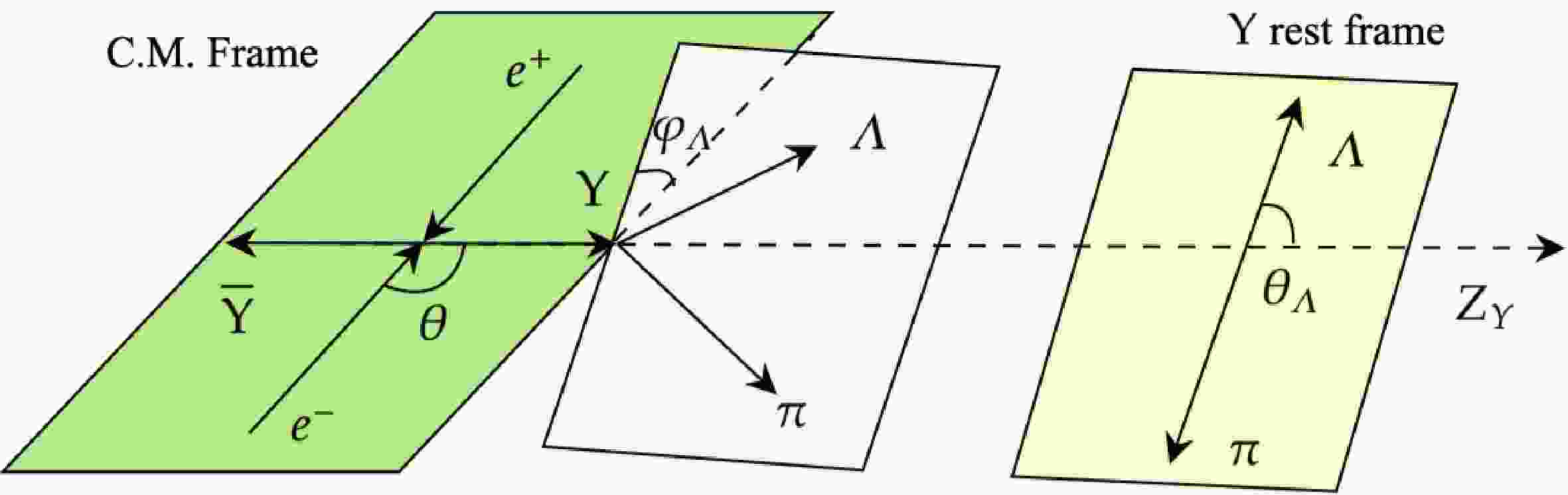
$ e^+e^- \to \psi \to Y \bar{Y} $ processes following the sequential decay of octet baryons$ Y \rightarrow \Lambda \pi $ and$ \bar Y \rightarrow \bar{\Lambda} \pi $ , particularly for$ Y = \Xi^- $ or$ \Xi^0 $ . The helicity framework is employed and can be easily extended to the annihilation of electron-positron to a pair of other hyperon-antihyperon through a virtual photon or vector charmonium. The helicity angles are constructed as illustrated in Fig. 1. The polar angle θ is the angle between the Y momentum direction and the$ e^+ $ beam direction in the centre-of-mass (C.M.) frame of the electron-positron system. The angles$ \theta_{\Lambda} $ and$ \varphi_{\Lambda} $ are the polar and azimuthal angles of the Λ momentum direction in the Y helicity system. In this system, the coordinate axis$ z_{Y} $ is defined along the Y momentum direction in the$ e^{+}e^{-} $ C.M. frame, and the corresponding angles of the antiparticle decay sequence are obtained analogously. The SDM of$ Y \bar{Y} $ mother pairs is explicitly written down within the helicity formalism [64–70]: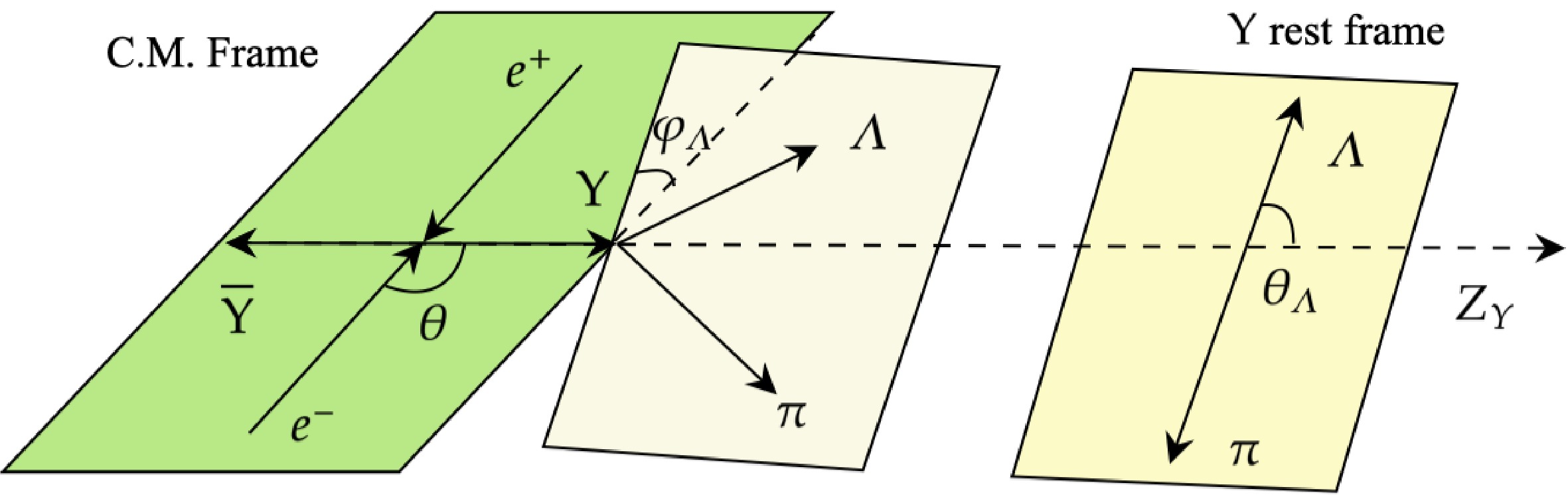
Figure 1. (color online) Definitions of the helicity angles for
$ e^+e^- \to Y \bar{Y} $ and the sequential decay$ Y \rightarrow \Lambda \pi $ are presented. The helicity angles of$ \bar{Y} \rightarrow \bar{\Lambda} \pi $ , defined in the same manner, are omitted.$ \Theta_{\mu\nu}^{Y \bar{Y}} = \left(\begin{array}{*{20}{c}}{ 1+ \alpha_{\psi}\cos^2\theta }&{ 0 }&{ \beta_\psi \cos\theta \sin\theta }&{ 0 }\\{ 0 }&{ \sin^2\theta }&{ 0 }&{ \gamma_\psi \cos\theta \sin\theta }\\{ -\beta_\psi \cos\theta \sin\theta }&{ 0 }&{ \alpha_\psi \sin^2\theta }&{ 0 }\\{ 0 }&{ -\gamma_\psi \cos\theta \sin\theta }&{ 0 }&{-\alpha_\psi-\cos^2\theta} \end{array}\right), $
(1) with
$ \alpha_\psi \in [-1, +1] $ being the angular distribution parameter of the vector charmonium state and$ \beta_\psi = \sqrt{1 - \alpha_\psi^2} \sin(\Delta\Phi) $ ,$ \gamma_\psi = \sqrt{1 - \alpha_\psi^2} \cos(\Delta\Phi) $ . Here,$ \Delta\Phi \in [-\pi, +\pi] $ is the relative phase between the electric and magnetic form factors of Y. The parameters for$ J/\psi $ and$ \psi(2S) $ are given in Table 1. The coordinate system$ \{x_Y, y_Y, z_Y\} $ in the helicity system of Y and$ \bar{Y} $ is consistent with that in Refs. [65, 71]. The entanglement measures are frame-independent and do not depend on the choice of other coordinates [68]. As can be seen, the produced hyperon is transversely polarized, in contrast to structureless particles, which exhibit null polarization.Decay $ \alpha_\psi $ $ \Delta\Phi / $ rad$ J/\psi \to \Xi^0 \bar \Xi^0 $ 0.514±0.006±0.015 [74] 1.168±0.019±0.018 [74] $ J/\psi \to \Xi^- \bar \Xi^+ $ 0.586±0.012±0.010 [72] 1.213±0.046±0.016 [72] $ \psi(2S) \to \Xi^0 \bar \Xi^0 $ 0.768±0.029±0.025 [75] 0.257±0.061±0.009 [75] $ \psi(2S) \to \Xi^- \bar \Xi^+ $ 0.693±0.048±0.049 [73] 0.667±0.111±0.058 [73] Table 1. The angular distribution parameter
$ \alpha_\psi $ and the relative phase$ \Delta\Phi $ of$ J/\psi $ and$ \psi(2S) \to Y \bar{Y} $ are measured for$ Y = \Xi^0 $ or$ \Xi^- $ . The first and second uncertainties are statistical and systematic, respectively.With the help of the decay matrix of hyperons, the SDM for the daughter baryon-antibaryon pairs (herein
$ \Lambda \bar{\Lambda} $ ) can be directly calculated as [64, 65, 67, 69–71].$ \Theta_{\mu\nu}^{\Lambda \bar{\Lambda}} = \left(\begin{array}{*{20}{c}} \Theta_{11} & \Theta_{12} & \Theta_{13} & \Theta_{14} \\ \Theta_{21} & \Theta_{22} & \Theta_{23} & \Theta_{24} \\ \Theta_{31} & \Theta_{32} & \Theta_{33} & \Theta_{34} \\ \Theta_{41} & \Theta_{42} & \Theta_{43} & \Theta_{44} \end{array}\right), $
(2) which is positive semi-definite with
$ \Theta_{ij} = \Theta_{ji} (Y \leftrightarrow \bar{Y}, \Lambda \leftrightarrow \bar{\Lambda}, \theta_Y \leftrightarrow \pi - \theta_{\bar{Y}}) $ when$ i \neq j $ . The detailed expressions for the independent ten matrix elements in Eq. (2) are given in Appendix A in terms of the decay parameters ($ \alpha_{\Xi} $ ,$ \phi_{\Xi} $ ) for the$ \Xi \to \Lambda \pi $ as well as ($ \alpha_{\bar \Xi} $ ,$ \phi_{\bar \Xi} $ ) for its charge-conjugated mode$ \bar \Xi \to \bar \Lambda \pi $ in Table 2. The related parameters$ \beta_\Xi $ and$ \gamma_\Xi $ are given by$ \beta_\Xi = \sqrt{1 - \alpha_\Xi^2}\sin(\phi_{\Xi}) $ and$ \gamma_\Xi = \sqrt{1 - \alpha_\Xi^2} \cos(\phi_\Xi) $ . Note that relatively large uncertainties of$ \phi_{\Xi} $ and$ \phi_{\bar \Xi} $ are present in different processes [72–75], but they do not influence the final results as discussed in Ref. [52] and Sec. IV.Decay $ \alpha_Y $ $ \phi_Y $ $ \Xi^0 \to \Lambda \pi^0 $ −0.349±0.009 0.3±0.6° $ \bar{\Xi}^0 \to \bar{\Lambda} \pi^0 $ 0.379±0.004 −0.3±0.6° $ \Xi^- \to \Lambda \pi^- $ −0.390±0.007 −1.2±1.0° $ \bar{\Xi}^+ \to \bar{\Lambda} \pi^+ $ 0.371±0.007 −1.2±1.2° Table 2. The decay parameters for the
$ \Xi \to \Lambda \pi $ and$ \bar \Xi \to \bar \Lambda \pi $ [76].Those SDMs in Eqs. (1) and (2) are the starting point to investigate the entanglement of mother and daughter systems. If considering a pair of spin-half baryon-antibaryon as a massive two-qubit quantum system, the density matrix can be expressed as:
$ \begin{aligned}[b] \rho_{Y\bar{Y}} =\;& \frac{1}{4} \bigl[ 1 \otimes 1 + {\bf{P}}^+ \cdot {\bf{\sigma}} \otimes 1 + 1 \otimes {\bf{P}}^- \cdot {\bf{\sigma}} \\ & + \sum_{i,j} C_{ij} \, \sigma_i \otimes \sigma_j \bigr], \end{aligned} $
(3) with
$ {\bf{\sigma}} = (\sigma_1, \sigma_2, \sigma_3) $ being the Pauli matrices.$ {\bf{P}}^\pm $ are the polarization vectors of the hyperon and the antihyperon, and$ C_{ij} $ is their polarization correlation matrix. Eq. (3) can be expressed more compactly in the form$ \rho_{Y\bar{Y}} = \dfrac{1}{4} \, \Theta_{\mu\nu} \, \sigma_\mu \otimes \sigma_\nu \quad \text{with} \quad \Theta_{00}=1, \; \Theta_{i0}=P_i^+, \; \Theta_{0j}=P_j^-, \; \Theta_{ij}=C_{ij}. $ Here,$ \sigma_0 $ is defined as the$ 2 \times 2 $ identity matrix. -
This paper considers the
$ e^+e^- \to \psi \to Y \bar{Y} $ processes following the sequential decay of octet baryons$ Y \rightarrow \Lambda \pi $ and$ \bar Y \rightarrow \bar{\Lambda} \pi $ , particularly for$ Y = \Xi^- $ or$ \Xi^0 $ . The helicity framework is employed and can be easily extended to the annihilation of electron-positron to a pair of other hyperon-antihyperon through a virtual photon or vector charmonium. The helicity angles are constructed as illustrated in Fig. 1. The polar angle θ is the angle between the Y momentum direction and the$ e^+ $ beam direction in the centre-of-mass (C.M.) frame of the electron-positron system. The angles$ \theta_{\Lambda} $ and$ \varphi_{\Lambda} $ are the polar and azimuthal angles of the Λ momentum direction in the Y helicity system. In this system, the coordinate axis$ z_{Y} $ is defined along the Y momentum direction in the$ e^{+}e^{-} $ C.M. frame, and the corresponding angles of the antiparticle decay sequence are obtained analogously. The SDM of$ Y \bar{Y} $ mother pairs is explicitly written down within the helicity formalism [64–70]:
Figure 1. (color online) Definitions of the helicity angles for
$ e^+e^- \to Y \bar{Y} $ and the sequential decay$ Y \rightarrow \Lambda \pi $ are presented. The helicity angles of$ \bar{Y} \rightarrow \bar{\Lambda} \pi $ , defined in the same manner, are omitted.$ \Theta_{\mu\nu}^{Y \bar{Y}} = \left(\begin{array}{*{20}{c}}{ 1+ \alpha_{\psi}\cos^2\theta }&{ 0 }&{ \beta_\psi \cos\theta \sin\theta }&{ 0 }\\{ 0 }&{ \sin^2\theta }&{ 0 }&{ \gamma_\psi \cos\theta \sin\theta }\\{ -\beta_\psi \cos\theta \sin\theta }&{ 0 }&{ \alpha_\psi \sin^2\theta }&{ 0 }\\{ 0 }&{ -\gamma_\psi \cos\theta \sin\theta }&{ 0 }&{-\alpha_\psi-\cos^2\theta} \end{array}\right), $
(1) with
$ \alpha_\psi \in [-1, +1] $ being the angular distribution parameter of the vector charmonium state and$ \beta_\psi = \sqrt{1 - \alpha_\psi^2}\times \sin(\Delta\Phi) $ ,$ \gamma_\psi = \sqrt{1 - \alpha_\psi^2} \cos(\Delta\Phi) $ . Here,$ \Delta\Phi \in [-\pi, +\pi] $ is the relative phase between the electric and magnetic form factors of Y. The parameters for$ J/\psi $ and$ \psi(2S) $ are given in Table 1. The coordinate system$ \{x_Y, y_Y, z_Y\} $ in the helicity system of Y and$ \bar{Y} $ is consistent with that in Refs. [65, 75]. The entanglement measures are frame-independent and do not depend on the choice of other coordinates [68]. As can be seen, the produced hyperon is transversely polarized, in contrast to structureless particles, which exhibit null polarization.Decay $ \alpha_\psi $ $ \Delta\Phi / $ rad$ J/\psi \to \Xi^0 \bar \Xi^0 $ 0.514±0.006±0.015 [71] 1.168±0.019±0.018 [71] $ J/\psi \to \Xi^- \bar \Xi^+ $ 0.586±0.012±0.010 [72] 1.213±0.046±0.016 [72] $ \psi(2S) \to \Xi^0 \bar \Xi^0 $ 0.768±0.029±0.025 [73] 0.257±0.061±0.009 [73] $ \psi(2S) \to \Xi^- \bar \Xi^+ $ 0.693±0.048±0.049 [74] 0.667±0.111±0.058 [74] Table 1. The angular distribution parameter
$ \alpha_\psi $ and the relative phase$ \Delta\Phi $ of$ J/\psi $ and$ \psi(2S) \to Y \bar{Y} $ are measured for$ Y = \Xi^0 $ or$ \Xi^- $ . The first and second uncertainties are statistical and systematic, respectively.With the help of the decay matrix of hyperons, the SDM for the daughter baryon-antibaryon pairs (herein
$ \Lambda \bar{\Lambda} $ ) can be directly calculated as [64, 65, 67, 69–75].$ \Theta_{\mu\nu}^{\Lambda \bar{\Lambda}} = \left(\begin{array}{*{20}{c}} \Theta_{11} & \Theta_{12} & \Theta_{13} & \Theta_{14} \\ \Theta_{21} & \Theta_{22} & \Theta_{23} & \Theta_{24} \\ \Theta_{31} & \Theta_{32} & \Theta_{33} & \Theta_{34} \\ \Theta_{41} & \Theta_{42} & \Theta_{43} & \Theta_{44} \end{array}\right), $
(2) which is positive semi-definite with
$ \Theta_{ij} = \Theta_{ji} (Y \leftrightarrow \bar{Y}, \Lambda \leftrightarrow \bar{\Lambda}, \theta_Y \leftrightarrow \pi - \theta_{\bar{Y}}) $ when$ i \neq j $ . The detailed expressions for the independent ten matrix elements in Eq. (2) are given in Appendix A in terms of the decay parameters ($ \alpha_{\Xi} $ ,$ \phi_{\Xi} $ ) for the$ \Xi \to \Lambda \pi $ as well as ($ \alpha_{\bar \Xi} $ ,$ \phi_{\bar \Xi} $ ) for its charge-conjugated mode$ \bar \Xi \to \bar \Lambda \pi $ in Table 2. The related parameters$ \beta_\Xi $ and$ \gamma_\Xi $ are given by$ \beta_\Xi = \sqrt{1 - \alpha_\Xi^2}\sin(\phi_{\Xi}) $ and$ \gamma_\Xi = \sqrt{1 - \alpha_\Xi^2} \cos(\phi_\Xi) $ . Note that relatively large uncertainties of$ \phi_{\Xi} $ and$ \phi_{\bar \Xi} $ are present in different processes [72–73], but they do not influence the final results as discussed in Ref. [52] and Sec. IV.Decay $ \alpha_Y $ $ \phi_Y $ $ \Xi^0 \to \Lambda \pi^0 $ −0.349±0.009 0.3±0.6° $ \bar{\Xi}^0 \to \bar{\Lambda} \pi^0 $ 0.379±0.004 −0.3±0.6° $ \Xi^- \to \Lambda \pi^- $ −0.390±0.007 −1.2±1.0° $ \bar{\Xi}^+ \to \bar{\Lambda} \pi^+ $ 0.371±0.007 −1.2±1.2° Table 2. The decay parameters for the
$ \Xi \to \Lambda \pi $ and$ \bar \Xi \to \bar \Lambda \pi $ [76].Those SDMs in Eqs. (1) and (2) are the starting point to investigate the entanglement of mother and daughter systems. If considering a pair of spin-half baryon-antibaryon as a massive two-qubit quantum system, the density matrix can be expressed as:
$ \begin{aligned}[b] \rho_{Y\bar{Y}} =\;& \frac{1}{4} \bigl[ 1 \otimes 1 + {\bf{P}}^+ \cdot {\bf{\sigma}} \otimes 1 + 1 \otimes {\bf{P}}^- \cdot {\bf{\sigma}} \\ & + \sum_{i,j} C_{ij} \, \sigma_i \otimes \sigma_j \bigr], \end{aligned} $
(3) with
$ {\bf{\sigma}} = (\sigma_1, \sigma_2, \sigma_3) $ being the Pauli matrices.$ {\bf{P}}^\pm $ are the polarization vectors of the hyperon and the antihyperon, and$ C_{ij} $ is their polarization correlation matrix. Eq. (3) can be expressed more compactly in the form$ \rho_{Y\bar{Y}} = \dfrac{1}{4} \; \Theta_{\mu\nu} \; \sigma_\mu \otimes \sigma_\nu \quad \text{with} \quad \Theta_{00}=1, \; \Theta_{i0}=P_i^+, \; \Theta_{0j}=P_j^-, \; \Theta_{ij}=C_{ij}. $ Here,$ \sigma_0 $ is defined as the$ 2 \times 2 $ identity matrix. -
This paper considers the
$ e^+e^- \to \psi \to Y \bar{Y} $ processes following the sequential decay of octet baryons$ Y \rightarrow \Lambda \pi $ and$ \bar Y \rightarrow \bar{\Lambda} \pi $ , particularly for$ Y = \Xi^- $ or$ \Xi^0 $ . The helicity framework is employed and can be easily extended to the annihilation of electron-positron to a pair of other hyperon-antihyperon through a virtual photon or vector charmonium. The helicity angles are constructed as illustrated in Fig. 1. The polar angle θ is the angle between the Y momentum direction and the$ e^+ $ beam direction in the centre-of-mass (C.M.) frame of the electron-positron system. The angles$ \theta_{\Lambda} $ and$ \varphi_{\Lambda} $ are the polar and azimuthal angles of the Λ momentum direction in the Y helicity system. In this system, the coordinate axis$ z_{Y} $ is defined along the Y momentum direction in the$ e^{+}e^{-} $ C.M. frame, and the corresponding angles of the antiparticle decay sequence are obtained analogously. The SDM of$ Y \bar{Y} $ mother pairs is explicitly written down within the helicity formalism [64–70]:
Figure 1. (color online) Definitions of the helicity angles for
$ e^+e^- \to Y \bar{Y} $ and the sequential decay$ Y \rightarrow \Lambda \pi $ are presented. The helicity angles of$ \bar{Y} \rightarrow \bar{\Lambda} \pi $ , defined in the same manner, are omitted.$ \Theta_{\mu\nu}^{Y \bar{Y}} = \left(\begin{array}{*{20}{c}}{ 1+ \alpha_{\psi}\cos^2\theta }&{ 0 }&{ \beta_\psi \cos\theta \sin\theta }&{ 0 }\\{ 0 }&{ \sin^2\theta }&{ 0 }&{ \gamma_\psi \cos\theta \sin\theta }\\{ -\beta_\psi \cos\theta \sin\theta }&{ 0 }&{ \alpha_\psi \sin^2\theta }&{ 0 }\\{ 0 }&{ -\gamma_\psi \cos\theta \sin\theta }&{ 0 }&{-\alpha_\psi-\cos^2\theta} \end{array}\right), $
(1) with
$ \alpha_\psi \in [-1, +1] $ being the angular distribution parameter of the vector charmonium state and$ \beta_\psi = \sqrt{1 - \alpha_\psi^2}\times \sin(\Delta\Phi) $ ,$ \gamma_\psi = \sqrt{1 - \alpha_\psi^2} \cos(\Delta\Phi) $ . Here,$ \Delta\Phi \in [-\pi, +\pi] $ is the relative phase between the electric and magnetic form factors of Y. The parameters for$ J/\psi $ and$ \psi(2S) $ are given in Table 1. The coordinate system$ \{x_Y, y_Y, z_Y\} $ in the helicity system of Y and$ \bar{Y} $ is consistent with that in Refs. [65, 75]. The entanglement measures are frame-independent and do not depend on the choice of other coordinates [68]. As can be seen, the produced hyperon is transversely polarized, in contrast to structureless particles, which exhibit null polarization.Decay $ \alpha_\psi $ $ \Delta\Phi / $ rad$ J/\psi \to \Xi^0 \bar \Xi^0 $ 0.514±0.006±0.015 [71] 1.168±0.019±0.018 [71] $ J/\psi \to \Xi^- \bar \Xi^+ $ 0.586±0.012±0.010 [72] 1.213±0.046±0.016 [72] $ \psi(2S) \to \Xi^0 \bar \Xi^0 $ 0.768±0.029±0.025 [73] 0.257±0.061±0.009 [73] $ \psi(2S) \to \Xi^- \bar \Xi^+ $ 0.693±0.048±0.049 [74] 0.667±0.111±0.058 [74] Table 1. The angular distribution parameter
$ \alpha_\psi $ and the relative phase$ \Delta\Phi $ of$ J/\psi $ and$ \psi(2S) \to Y \bar{Y} $ are measured for$ Y = \Xi^0 $ or$ \Xi^- $ . The first and second uncertainties are statistical and systematic, respectively.With the help of the decay matrix of hyperons, the SDM for the daughter baryon-antibaryon pairs (herein
$ \Lambda \bar{\Lambda} $ ) can be directly calculated as [64, 65, 67, 69–75].$ \Theta_{\mu\nu}^{\Lambda \bar{\Lambda}} = \left(\begin{array}{*{20}{c}} \Theta_{11} & \Theta_{12} & \Theta_{13} & \Theta_{14} \\ \Theta_{21} & \Theta_{22} & \Theta_{23} & \Theta_{24} \\ \Theta_{31} & \Theta_{32} & \Theta_{33} & \Theta_{34} \\ \Theta_{41} & \Theta_{42} & \Theta_{43} & \Theta_{44} \end{array}\right), $
(2) which is positive semi-definite with
$ \Theta_{ij} = \Theta_{ji} (Y \leftrightarrow \bar{Y}, \Lambda \leftrightarrow \bar{\Lambda}, \theta_Y \leftrightarrow \pi - \theta_{\bar{Y}}) $ when$ i \neq j $ . The detailed expressions for the independent ten matrix elements in Eq. (2) are given in Appendix A in terms of the decay parameters ($ \alpha_{\Xi} $ ,$ \phi_{\Xi} $ ) for the$ \Xi \to \Lambda \pi $ as well as ($ \alpha_{\bar \Xi} $ ,$ \phi_{\bar \Xi} $ ) for its charge-conjugated mode$ \bar \Xi \to \bar \Lambda \pi $ in Table 2. The related parameters$ \beta_\Xi $ and$ \gamma_\Xi $ are given by$ \beta_\Xi = \sqrt{1 - \alpha_\Xi^2}\sin(\phi_{\Xi}) $ and$ \gamma_\Xi = \sqrt{1 - \alpha_\Xi^2} \cos(\phi_\Xi) $ . Note that relatively large uncertainties of$ \phi_{\Xi} $ and$ \phi_{\bar \Xi} $ are present in different processes [72–73], but they do not influence the final results as discussed in Ref. [52] and Sec. IV.Decay $ \alpha_Y $ $ \phi_Y $ $ \Xi^0 \to \Lambda \pi^0 $ −0.349±0.009 0.3±0.6° $ \bar{\Xi}^0 \to \bar{\Lambda} \pi^0 $ 0.379±0.004 −0.3±0.6° $ \Xi^- \to \Lambda \pi^- $ −0.390±0.007 −1.2±1.0° $ \bar{\Xi}^+ \to \bar{\Lambda} \pi^+ $ 0.371±0.007 −1.2±1.2° Table 2. The decay parameters for the
$ \Xi \to \Lambda \pi $ and$ \bar \Xi \to \bar \Lambda \pi $ [76].Those SDMs in Eqs. (1) and (2) are the starting point to investigate the entanglement of mother and daughter systems. If considering a pair of spin-half baryon-antibaryon as a massive two-qubit quantum system, the density matrix can be expressed as:
$ \begin{aligned}[b] \rho_{Y\bar{Y}} =\;& \frac{1}{4} \bigl[ 1 \otimes 1 + {\bf{P}}^+ \cdot {\bf{\sigma}} \otimes 1 + 1 \otimes {\bf{P}}^- \cdot {\bf{\sigma}} \\ & + \sum_{i,j} C_{ij} \, \sigma_i \otimes \sigma_j \bigr], \end{aligned} $
(3) with
$ {\bf{\sigma}} = (\sigma_1, \sigma_2, \sigma_3) $ being the Pauli matrices.$ {\bf{P}}^\pm $ are the polarization vectors of the hyperon and the antihyperon, and$ C_{ij} $ is their polarization correlation matrix. Eq. (3) can be expressed more compactly in the form$ \rho_{Y\bar{Y}} = \dfrac{1}{4} \; \Theta_{\mu\nu} \; \sigma_\mu \otimes \sigma_\nu \quad \text{with} \quad \Theta_{00}=1, \; \Theta_{i0}=P_i^+, \; \Theta_{0j}=P_j^-, \; \Theta_{ij}=C_{ij}. $ Here,$ \sigma_0 $ is defined as the$ 2 \times 2 $ identity matrix. -
Quantum entanglement is a quintessential feature of quantum mechanics that has no counterpart in classical physics [3, 77]. For mixed states of two qubits, concurrence and negativity serve as practical and widely adopted entanglement measures; the latter is also a monotone applicable to arbitrary dimensions of a bipartite system. For two-qubit systems, concurrence is directly related to the entanglement of formation, and negativity is derived from the Positive Partial Transpose (PPT) criterion for separability [2]. Together, they effectively characterize the entanglement resource of the system.
Based on the study of different measures of quantum information, entanglement does not capture all non-classical correlations, and even separable states usually contain correlations, known as quantum discord, that are not entirely classical [4]. In this paper, concurrence
$ C(\rho) $ , negativity$ N(\rho) $ , and quantum discord$ D^{Y}[\rho] $ are used to aptly assess the evolution of quantum entanglement during the hyperon decay process. Their values are bounded by$ 0 \le C(\rho) \le 1 $ ,$ 0 \le N(\rho) \le 1/2 $ , and$ 0 \leq D^{Y}[\rho] \leq 1 $ as detailed in the following subsections. Both concurrence and negativity indicate the separability of the system when they are zero, and the presence of entanglement whenever they are non-zero. For two-qubit pure states or Bell diagonal states, concurrence and negativity are closely related by the relation$ C(\rho) = 2 N(\rho) $ , but for mixed states, they can differ. Quantum discord can be non-zero even for separable states, which explains the key observation in Sec. III.D. -
Quantum entanglement is a quintessential feature of quantum mechanics that has no counterpart in classical physics [3, 77]. For mixed states of two qubits, concurrence and negativity serve as practical and widely adopted entanglement measures; the latter is also a monotone applicable to arbitrary dimensions of a bipartite system. For two-qubit systems, concurrence is directly related to the entanglement of formation, and negativity is derived from the Positive Partial Transpose (PPT) criterion for separability [2]. Together, they effectively characterize the entanglement resource of the system.
Based on the study of different measures of quantum information, entanglement does not capture all non-classical correlations, and even separable states usually contain correlations, known as quantum discord, that are not entirely classical [4]. In this paper, concurrence
$ C(\rho) $ , negativity$ N(\rho) $ , and quantum discord$ D^{Y}[\rho] $ are used to aptly assess the evolution of quantum entanglement during the hyperon decay process. Their values are bounded by$ 0 \le C(\rho) \le 1 $ ,$ 0 \le N(\rho) \le 1/2 $ , and$ 0 \leq D^{Y}[\rho] \leq 1 $ as detailed in the following subsections. Both concurrence and negativity indicate the separability of the system when they are zero, and the presence of entanglement whenever they are non-zero. For two-qubit pure states or Bell diagonal states, concurrence and negativity are closely related by the relation$ C(\rho) = 2 N(\rho) $ , but for mixed states, they can differ. Quantum discord can be non-zero even for separable states, which explains the key observation in Sec. III.D. -
Quantum entanglement is a quintessential feature of quantum mechanics that has no counterpart in classical physics [3, 77]. For mixed states of two qubits, concurrence and negativity serve as practical and widely adopted entanglement measures; the latter is also a monotone applicable to arbitrary dimensions of a bipartite system. For two-qubit systems, concurrence is directly related to the entanglement of formation, and negativity is derived from the Positive Partial Transpose (PPT) criterion for separability [2]. Together, they effectively characterize the entanglement resource of the system.
Based on the study of different measures of quantum information, entanglement does not capture all non-classical correlations, and even separable states usually contain correlations, known as quantum discord, that are not entirely classical [4]. In this paper, concurrence
$ C(\rho) $ , negativity$ N(\rho) $ , and quantum discord$ D^{Y}[\rho] $ are used to aptly assess the evolution of quantum entanglement during the hyperon decay process. Their values are bounded by$ 0 \le C(\rho) \le 1 $ ,$ 0 \le N(\rho) \le 1/2 $ , and$ 0 \leq D^{Y}[\rho] \leq 1 $ as detailed in the following subsections. Both concurrence and negativity indicate the separability of the system when they are zero, and the presence of entanglement whenever they are non-zero. For two-qubit pure states or Bell diagonal states, concurrence and negativity are closely related by the relation$ C(\rho) = 2 N(\rho) $ , but for mixed states, they can differ. Quantum discord can be non-zero even for separable states, which explains the key observation in Sec. III D. -
A state (
$ Y \bar{Y} $ here) is called separable if and only if its representing density matrix ρ can be written as a convex linear combination of tensor products of density matrices for the subsystems, e.g.,$ \rho = \sum_{ij} p_{ij} \,\rho_i^{Y} \otimes \rho_j^{\bar{Y}} $ ; otherwise, states exhibiting quantum correlations are called entangled or non-separable [53].The eigenvalues
$ \lambda_i $ of a generic density matrix ρ satisfy$ 0 \leq \lambda_i \leq 1 $ with$ \sum_i \lambda_i = 1 $ and Tr$ [\rho^2] \leq 1 $ . For pure states,$ \lambda_i $ are 1 (non-degenerate) and 0 ($ n-1 $ times degenerate), such that Tr$ [\rho^2] $ reaches the upper bound. The concurrence of pure states in arbitrary dimensions is$ C(\rho) = \sqrt{2(1-{\rm{Tr}}[(\rho_Y)^2])} = \sqrt{2(1-{\rm{Tr}}[(\rho_{\bar{Y}})^2])} $ , with$ \rho_Y $ and$ \rho_{\bar{Y}} $ being the reduced density matrices of the subsystems. In principle, the concurrence of any mixed state ρ can be defined by decomposing it into a set of pure states, but only for two-dimensional systems does it have a simple analytic solution with respect to the associated spin-flipped density matrix$ \sqrt{ \sqrt{\rho} (\sigma_y \otimes \sigma_y) \rho^* (\sigma_y \otimes \sigma_y) \sqrt{\rho} } $ . Here,$ \rho^* $ denotes the complex conjugate of ρ taken in the$ \sigma_z $ eigenbasis. The eigenvalues of the above Hermitian matrix are denoted as$ r_i $ ,$ i = 1, 2, 3, 4 $ , in decreasing order. The concurrence of the bipartite system is then defined as [54]:$ C(\rho) \equiv \max\left(r_1 - r_2 - r_3 - r_4, 0\right), $
(4) with
$ 0 \le C(\rho) \le 1 $ . The system is separable if$ C(\rho) = 0 $ ; otherwise, it is entangled. After some local unitary transformation, the SDM of the$ Y \bar{Y} $ system in Eq. (1) can be written as a symmetric$ X $ state, the concurrence of which is in analytical form [17].The concurrence of
$ Y \bar{Y} $ and$ \Lambda\bar{\Lambda} $ in the$ e^+e^- \to \psi \to Y (\to \Lambda \pi) \bar{Y} (\to \bar{\Lambda}\pi) $ process is shown as a function of the scattering angle$ \theta $ in Figs. 2 and 3 for$ \psi = J/\psi $ or$ \psi(2S) $ and$ Y = \Xi^- $ or$ \Xi^0 $ . As noted in Appendix A, besides depending on$ \theta $ , the$ \Lambda\bar{\Lambda} $ concurrence is also a function of the helicity angles of both hyperons, denoted as$ (\theta_\Lambda, \varphi_\Lambda) $ and$ (\theta_{\bar{\Lambda}}, \varphi_{\bar{\Lambda}}) $ , respectively. The labels Final_Max (red dotted line) and Final_Min (blue dot-dashed line) denote the upper and lower boundaries of the concurrence for the$ \Lambda\bar{\Lambda} $ system obtained by scanning over the full phase space of these four angular variables at each fixed scattering angle$ \theta $ . The Final_Mean is the concurrence for the$ \Lambda\bar{\Lambda} $ system obtained by an integration over the helicity angles$ (\theta_\Lambda, \varphi_\Lambda) $ and$ (\theta_{\bar{\Lambda}}, \varphi_{\bar{\Lambda}}) $ , which can be viewed as phase-space-averaged values. The results of the black curves are consistent with those reported in Refs. [17, 24], and the red lines of$ J/\psi \to \Xi^0 \bar \Xi^0 $ ,$ J/\psi \to \Xi^- \bar \Xi^+ $ , and$ \psi(2S) \to \Xi^- \bar \Xi^+ $ are compatible with those in Ref. [52]. The light blue region between the red and blue lines reveals the entanglement redistribution across the phase space of daughter$ \Lambda\bar{\Lambda} $ : whereas the mother$ Y \bar{Y} $ system is characterized by a single concurrence value at each fixed$ \theta $ , the daughter system exhibits a range of concurrence values spanning the kinematically allowed region. It is addressed that the light blue areas above black lines signify the increase of entanglement after hyperon decay, or the so-called quantum entanglement autodistillation. It is significant for$ J/\psi $ but less pronounced for$ e^+e^-\to \psi(2S) \to \Xi^{-} (\to \Lambda \pi^-) \bar{\Xi}^{+} (\to \bar{\Lambda}\pi^+) $ , and even disappears for$ e^+e^-\to \psi(2S) \to \Xi^{0} (\to \Lambda \pi^0) \bar{\Xi}^{0} (\to \bar{\Lambda}\pi^0) $ . The light blue areas below black lines indicate the probabilistic reduction of entanglement between mother and daughter systems. The autodistillation fails completely in the$ e^+e^-\to \psi(2S) \to \Xi^{0} (\to \Lambda \pi^0) \bar{\Xi}^{0} (\to \bar{\Lambda}\pi^0) $ process, as quantified by the concurrence. In all cases, the phase-space-averaged concurrence stays closer to their respective lower boundary, indicating that entanglement autodistillation does not occur for these averaged quantities.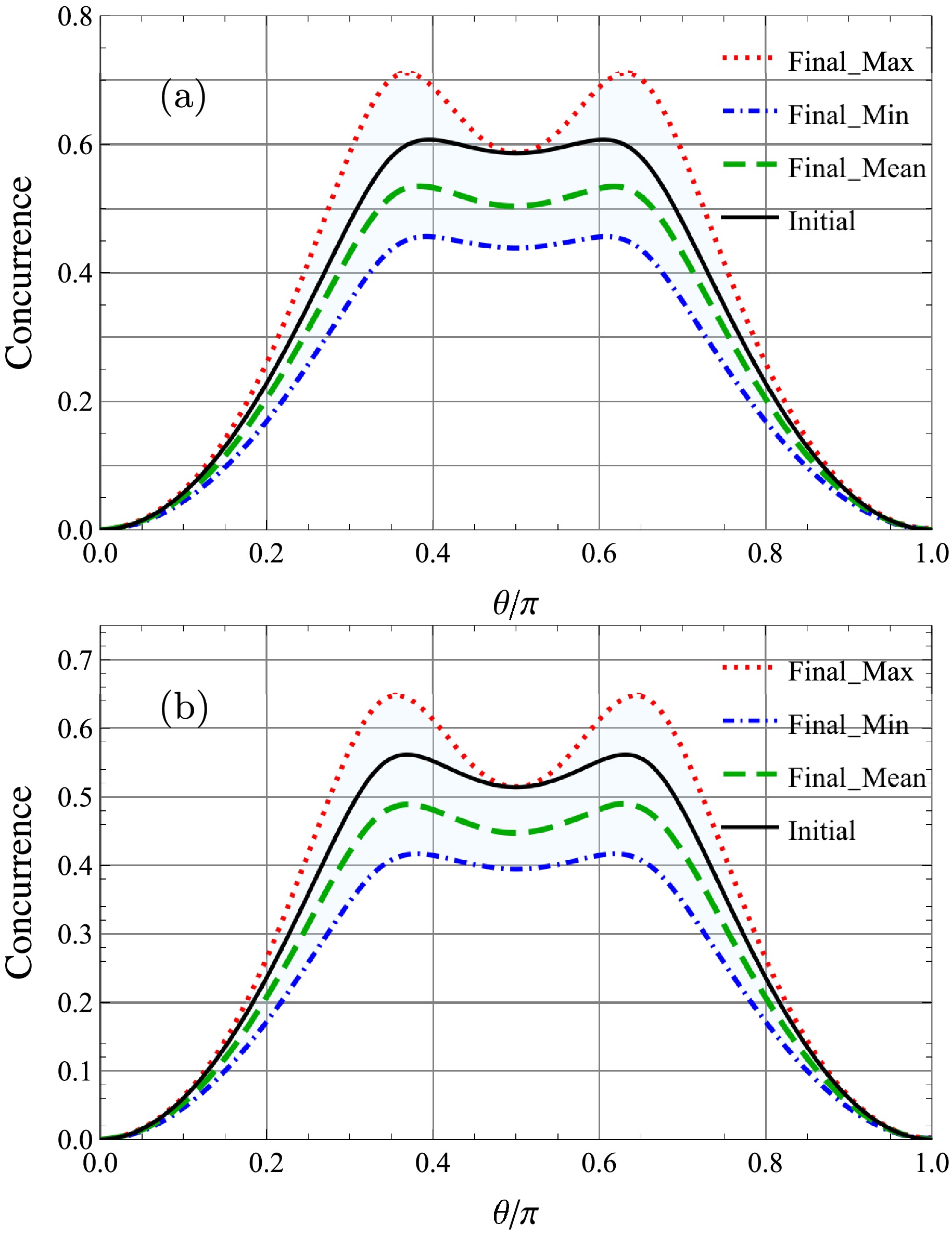
Figure 2. (color online) Concurrence of
$ \Xi \bar{\Xi} $ (solid black line) and$ \Lambda\bar{\Lambda} $ (light blue shaded area between the red dotted line and blue dot-dashed line) in the (a)$ e^+e^-\to J/\psi \to \Xi^{-} $ $ (\to \Lambda \pi^-)\; \bar{\Xi}^{+} (\to \bar{\Lambda}\pi^+) $ and (b)$ e^+e^-\to J/\psi \to \Xi^{0} (\to \Lambda \pi^0)\; \bar{\Xi}^{0} $ $ (\to \bar{\Lambda}\pi^0) $ processes. The green long-dashed line represents the phase-space-averaged values.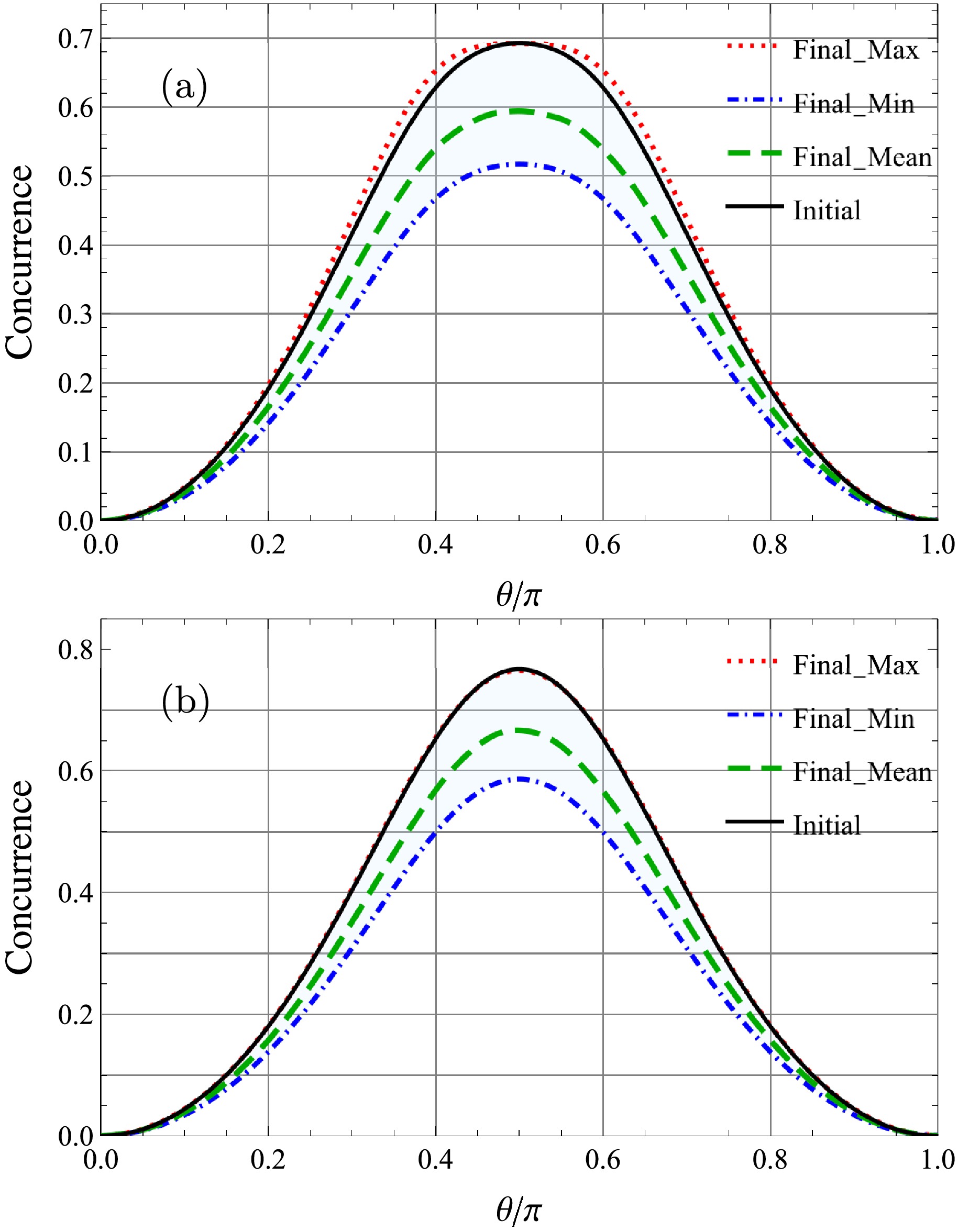
Figure 3. (color online) Concurrence of
$ \Xi \bar{\Xi} $ (solid black line) and$ \Lambda\bar{\Lambda} $ (light blue shaded area between red dotted line and blue dot-dashed line) in the (a)$ e^+e^-\to \psi(2S) \to \Xi^{-} (\to \Lambda \pi^-) $ $ \bar{\Xi}^{+} (\to \bar{\Lambda}\pi^+) $ and (b)$ e^+e^-\to \psi(2S) \to \Xi^{0} (\to \Lambda \pi^0) \bar{\Xi}^{0} (\to \bar{\Lambda}\pi^0) $ process is shown. Note that the black and red curves are nearly superimposed, rendering them visually indistinguishable in (b). The green long-dashed line represents the phase-space-averaged values.The mother system
$ Y\bar{Y} $ is in a separable mixed state without entanglement when$ \theta = 0 $ and$ \pi $ , at which angles the daughter state of$ \Lambda\bar{\Lambda} $ is also separable without entanglement redistribution. The entanglement has no possibility to increase during the decay process but necessarily decreases when$ \theta = \pi/2 $ . It is noted that the mother system$ Y\bar{Y} $ has neither polarization nor non-diagonal correlations at$ \theta = 0 $ ,$ \pi/2 $ , and$ \pi $ as seen in Eq. (1).The
$ \theta $ -dependence of concurrence exhibits different patterns for the$ J/\psi $ and$ \psi(2S) $ . The largest concurrence occurs at$ \theta = \pi/2 $ for$ \psi(2S) $ , and the concurrence for the$ J/\psi $ has two local maxima at certain angles$ \theta_{max} $ symmetric with respect to$ \pi/2 $ . The underlying mechanism has been investigated in the literature [17] so will not be discussed herein. Compared to the initial value, the peak values$ \theta_{max} $ for both Final_Max and Final_Min move a bit from 69.1° (or$ 65.5^\circ $ ) to 69.8° (or 69.8°) and 66.1° (or 62.5°) for$ \Xi^{-}\bar{\Xi}^{+} $ (or$ \Xi^{0}\bar{\Xi}^{0} $ ) respectively. These scattering angles do not align with the electron beam direction, highlighting the potential for experimental observation of entanglement redistribution. In Sec. IV, the$ (\theta_\Lambda, \varphi_\Lambda) $ and$ (\theta_{\bar{\Lambda}}, \varphi_{\bar{\Lambda}}) $ at$ \theta_{max} $ will be further examined to confirm that they all fall within the acceptance of the central detector. -
A state (
$ Y \bar{Y} $ here) is called separable if and only if its representing density matrix ρ can be written as a convex linear combination of tensor products of density matrices for the subsystems, e.g.,$ \rho = \sum_{ij} p_{ij} \,\rho_i^{Y} \otimes \rho_j^{\bar{Y}} $ ; otherwise, states exhibiting quantum correlations are called entangled or non-separable [53].The eigenvalues
$ \lambda_i $ of a generic density matrix ρ satisfy$ 0 \leq \lambda_i \leq 1 $ with$ \sum_i \lambda_i = 1 $ and Tr$ [\rho^2] \leq 1 $ . For pure states,$ \lambda_i $ are 1 (non-degenerate) and 0 ($ n-1 $ times degenerate), such that Tr$ [\rho^2] $ reaches the upper bound. The concurrence of pure states in arbitrary dimensions is$ C(\rho) = \sqrt{2(1-{\rm{Tr}}[(\rho_Y)^2])} = \sqrt{2(1-{\rm{Tr}}[(\rho_{\bar{Y}})^2])} $ , with$ \rho_Y $ and$ \rho_{\bar{Y}} $ being the reduced density matrices of the subsystems. In principle, the concurrence of any mixed state ρ can be defined by decomposing it into a set of pure states, but only for two-dimensional systems does it have a simple analytic solution with respect to the associated spin-flipped density matrix$ \sqrt{ \sqrt{\rho} (\sigma_y \otimes \sigma_y) \rho^* (\sigma_y \otimes \sigma_y) \sqrt{\rho} } $ . Here,$ \rho^* $ denotes the complex conjugate of ρ taken in the$ \sigma_z $ eigenbasis. The eigenvalues of the above Hermitian matrix are denoted as$ r_i $ ,$ i = 1, 2, 3, 4 $ , in decreasing order. The concurrence of the bipartite system is then defined as [54]:$ C(\rho) \equiv \max\left(r_1 - r_2 - r_3 - r_4, 0\right), $
(4) with
$ 0 \le C(\rho) \le 1 $ . The system is separable if$ C(\rho) = 0 $ ; otherwise, it is entangled. After some local unitary transformation, the SDM of the$ Y \bar{Y} $ system in Eq. (1) can be written as a symmetric$ X $ state, the concurrence of which is in analytical form [17].The concurrence of
$ Y \bar{Y} $ and$ \Lambda\bar{\Lambda} $ in the$ e^+e^- \to \psi \to Y (\to \Lambda \pi) \bar{Y} (\to \bar{\Lambda}\pi) $ process is shown as a function of the scattering angle$ \theta $ in Figs. 2 and 3 for$ \psi = J/\psi $ or$ \psi(2S) $ and$ Y = \Xi^- $ or$ \Xi^0 $ . As noted in Appendix A, besides depending on$ \theta $ , the$ \Lambda\bar{\Lambda} $ concurrence is also a function of the helicity angles of both hyperons, denoted as$ (\theta_\Lambda, \varphi_\Lambda) $ and$ (\theta_{\bar{\Lambda}}, \varphi_{\bar{\Lambda}}) $ , respectively. The labels Final_Max (red dotted line) and Final_Min (blue dot-dashed line) denote the upper and lower boundaries of the concurrence for the$ \Lambda\bar{\Lambda} $ system obtained by scanning over the full phase space of these four angular variables at each fixed scattering angle$ \theta $ . The Final_Mean is the concurrence for the$ \Lambda\bar{\Lambda} $ system obtained by an integration over the helicity angles$ (\theta_\Lambda, \varphi_\Lambda) $ and$ (\theta_{\bar{\Lambda}}, \varphi_{\bar{\Lambda}}) $ , which can be viewed as phase-space-averaged values. The results of the black curves are consistent with those reported in Refs. [17, 24], and the red lines of$ J/\psi \to \Xi^0 \bar \Xi^0 $ ,$ J/\psi \to \Xi^- \bar \Xi^+ $ , and$ \psi(2S) \to \Xi^- \bar \Xi^+ $ are compatible with those in Ref. [52]. The light blue region between the red and blue lines reveals the entanglement redistribution across the phase space of daughter$ \Lambda\bar{\Lambda} $ : whereas the mother$ Y \bar{Y} $ system is characterized by a single concurrence value at each fixed$ \theta $ , the daughter system exhibits a range of concurrence values spanning the kinematically allowed region. It is addressed that the light blue areas above black lines signify the increase of entanglement after hyperon decay, or the so-called quantum entanglement autodistillation. It is significant for$ J/\psi $ but less pronounced for$ e^+e^-\to \psi(2S) \to \Xi^{-} (\to \Lambda \pi^-) \bar{\Xi}^{+} (\to \bar{\Lambda}\pi^+) $ , and even disappears for$ e^+e^-\to \psi(2S) \to \Xi^{0} (\to \Lambda \pi^0) \bar{\Xi}^{0} (\to \bar{\Lambda}\pi^0) $ . The light blue areas below black lines indicate the probabilistic reduction of entanglement between mother and daughter systems. The autodistillation fails completely in the$ e^+e^-\to \psi(2S) \to \Xi^{0} (\to \Lambda \pi^0) \bar{\Xi}^{0} (\to \bar{\Lambda}\pi^0) $ process, as quantified by the concurrence. In all cases, the phase-space-averaged concurrence stays closer to their respective lower boundary, indicating that entanglement autodistillation does not occur for these averaged quantities.
Figure 2. (color online) Concurrence of
$ \Xi \bar{\Xi} $ (solid black line) and$ \Lambda\bar{\Lambda} $ (light blue shaded area between the red dotted line and blue dot-dashed line) in the (a)$ e^+e^-\to J/\psi \to \Xi^{-} $ $ (\to \Lambda \pi^-)\; \bar{\Xi}^{+} (\to \bar{\Lambda}\pi^+) $ and (b)$ e^+e^-\to J/\psi \to \Xi^{0} (\to \Lambda \pi^0)\; \bar{\Xi}^{0} $ $ (\to \bar{\Lambda}\pi^0) $ processes. The green long-dashed line represents the phase-space-averaged values.
Figure 3. (color online) Concurrence of
$ \Xi \bar{\Xi} $ (solid black line) and$ \Lambda\bar{\Lambda} $ (light blue shaded area between red dotted line and blue dot-dashed line) in the (a)$ e^+e^-\to \psi(2S) \to \Xi^{-} (\to \Lambda \pi^-) $ $ \bar{\Xi}^{+} (\to \bar{\Lambda}\pi^+) $ and (b)$ e^+e^-\to \psi(2S) \to \Xi^{0} (\to \Lambda \pi^0) \bar{\Xi}^{0} (\to \bar{\Lambda}\pi^0) $ process is shown. Note that the black and red curves are nearly superimposed, rendering them visually indistinguishable in (b). The green long-dashed line represents the phase-space-averaged values.The mother system
$ Y\bar{Y} $ is in a separable mixed state without entanglement when$ \theta = 0 $ and$ \pi $ , at which angles the daughter state of$ \Lambda\bar{\Lambda} $ is also separable without entanglement redistribution. The entanglement has no possibility to increase during the decay process but necessarily decreases when$ \theta = \pi/2 $ . It is noted that the mother system$ Y\bar{Y} $ has neither polarization nor non-diagonal correlations at$ \theta = 0 $ ,$ \pi/2 $ , and$ \pi $ as seen in Eq. (1).The
$ \theta $ -dependence of concurrence exhibits different patterns for the$ J/\psi $ and$ \psi(2S) $ . The largest concurrence occurs at$ \theta = \pi/2 $ for$ \psi(2S) $ , and the concurrence for the$ J/\psi $ has two local maxima at certain angles$ \theta_{\max} $ symmetric with respect to$ \pi/2 $ . The underlying mechanism has been investigated in the literature [17] so will not be discussed herein. Compared to the initial value, the peak values$ \theta_{\max} $ for both Final_Max and Final_Min move a bit from 69.1° (or$ 65.5^\circ $ ) to 69.8° (or 69.8°) and 66.1° (or 62.5°) for$ \Xi^{-}\bar{\Xi}^{+} $ (or$ \Xi^{0}\bar{\Xi}^{0} $ ) respectively. These scattering angles do not align with the electron beam direction, highlighting the potential for experimental observation of entanglement redistribution. In Sec. IV, the$ (\theta_\Lambda, \varphi_\Lambda) $ and$ (\theta_{\bar{\Lambda}}, \varphi_{\bar{\Lambda}}) $ at$ \theta_{\max} $ will be further examined to confirm that they all fall within the acceptance of the central detector. -
A state (
$ Y \bar{Y} $ here) is called separable if and only if its representing density matrix ρ can be written as a convex linear combination of tensor products of density matrices for the subsystems, e.g.,$ \rho = \sum_{ij} p_{ij} \,\rho_i^{Y} \otimes \rho_j^{\bar{Y}} $ ; otherwise, states exhibiting quantum correlations are called entangled or non-separable [53].The eigenvalues
$ \lambda_i $ of a generic density matrix ρ satisfy$ 0 \leq \lambda_i \leq 1 $ with$ \sum_i \lambda_i = 1 $ and Tr$ [\rho^2] \leq 1 $ . For pure states,$ \lambda_i $ are 1 (non-degenerate) and 0 ($ n-1 $ times degenerate), such that Tr$ [\rho^2] $ reaches the upper bound. The concurrence of pure states in arbitrary dimensions is$ C(\rho) = \sqrt{2(1-{\rm{Tr}}[(\rho_Y)^2])} = \sqrt{2(1-{\rm{Tr}}[(\rho_{\bar{Y}})^2])} $ , with$ \rho_Y $ and$ \rho_{\bar{Y}} $ being the reduced density matrices of the subsystems. In principle, the concurrence of any mixed state ρ can be defined by decomposing it into a set of pure states, but only for two-dimensional systems does it have a simple analytic solution with respect to the associated spin-flipped density matrix$ \sqrt{ \sqrt{\rho} (\sigma_y \otimes \sigma_y) \rho^* (\sigma_y \otimes \sigma_y) \sqrt{\rho} } $ . Here,$ \rho^* $ denotes the complex conjugate of ρ taken in the$ \sigma_z $ eigenbasis. The eigenvalues of the above Hermitian matrix are denoted as$ r_i $ ,$ i = 1, 2, 3, 4 $ , in decreasing order. The concurrence of the bipartite system is then defined as [54]:$ C(\rho) \equiv \max\left(r_1 - r_2 - r_3 - r_4, 0\right), $
(4) with
$ 0 \le C(\rho) \le 1 $ . The system is separable if$ C(\rho) = 0 $ ; otherwise, it is entangled. After some local unitary transformation, the SDM of the$ Y \bar{Y} $ system in Eq. (1) can be written as a symmetric$ X $ state, the concurrence of which is in analytical form [17].The concurrence of
$ Y \bar{Y} $ and$ \Lambda\bar{\Lambda} $ in the$ e^+e^- \to \psi \to Y (\to \Lambda \pi) \bar{Y} (\to \bar{\Lambda}\pi) $ process is shown as a function of the scattering angle$ \theta $ in Figs. 2 and 3 for$ \psi = J/\psi $ or$ \psi(2S) $ and$ Y = \Xi^- $ or$ \Xi^0 $ . As noted in Appendix A, besides depending on$ \theta $ , the$ \Lambda\bar{\Lambda} $ concurrence is also a function of the helicity angles of both hyperons, denoted as$ (\theta_\Lambda, \varphi_\Lambda) $ and$ (\theta_{\bar{\Lambda}}, \varphi_{\bar{\Lambda}}) $ , respectively. The labels Final_Max (red dotted line) and Final_Min (blue dot-dashed line) denote the upper and lower boundaries of the concurrence for the$ \Lambda\bar{\Lambda} $ system obtained by scanning over the full phase space of these four angular variables at each fixed scattering angle$ \theta $ . The Final_Mean is the concurrence for the$ \Lambda\bar{\Lambda} $ system obtained by an integration over the helicity angles$ (\theta_\Lambda, \varphi_\Lambda) $ and$ (\theta_{\bar{\Lambda}}, \varphi_{\bar{\Lambda}}) $ , which can be viewed as phase-space-averaged values. The results of the black curves are consistent with those reported in Refs. [17, 24], and the red lines of$ J/\psi \to \Xi^0 \bar \Xi^0 $ ,$ J/\psi \to \Xi^- \bar \Xi^+ $ , and$ \psi(2S) \to \Xi^- \bar \Xi^+ $ are compatible with those in Ref. [52]. The light blue region between the red and blue lines reveals the entanglement redistribution across the phase space of daughter$ \Lambda\bar{\Lambda} $ : whereas the mother$ Y \bar{Y} $ system is characterized by a single concurrence value at each fixed$ \theta $ , the daughter system exhibits a range of concurrence values spanning the kinematically allowed region. It is addressed that the light blue areas above black lines signify the increase of entanglement after hyperon decay, or the so-called quantum entanglement autodistillation. It is significant for$ J/\psi $ but less pronounced for$ e^+e^-\to \psi(2S) \to \Xi^{-} (\to \Lambda \pi^-) \bar{\Xi}^{+} (\to \bar{\Lambda}\pi^+) $ , and even disappears for$ e^+e^-\to \psi(2S) \to \Xi^{0} (\to \Lambda \pi^0) \bar{\Xi}^{0} (\to \bar{\Lambda}\pi^0) $ . The light blue areas below black lines indicate the probabilistic reduction of entanglement between mother and daughter systems. The autodistillation fails completely in the$ e^+e^-\to \psi(2S) \to \Xi^{0} (\to \Lambda \pi^0) \bar{\Xi}^{0} (\to \bar{\Lambda}\pi^0) $ process, as quantified by the concurrence. In all cases, the phase-space-averaged concurrence stays closer to their respective lower boundary, indicating that entanglement autodistillation does not occur for these averaged quantities.
Figure 2. (color online) Concurrence of
$ \Xi \bar{\Xi} $ (solid black line) and$ \Lambda\bar{\Lambda} $ (light blue shaded area between the red dotted line and blue dot-dashed line) in the (a)$ e^+e^-\to J/\psi \to \Xi^{-} $ $ (\to \Lambda \pi^-)\; \bar{\Xi}^{+} (\to \bar{\Lambda}\pi^+) $ and (b)$ e^+e^-\to J/\psi \to \Xi^{0} (\to \Lambda \pi^0)\; \bar{\Xi}^{0} $ $ (\to \bar{\Lambda}\pi^0) $ processes. The green long-dashed line represents the phase-space-averaged values.
Figure 3. (color online) Concurrence of
$ \Xi \bar{\Xi} $ (solid black line) and$ \Lambda\bar{\Lambda} $ (light blue shaded area between red dotted line and blue dot-dashed line) in the (a)$ e^+e^-\to \psi(2S) \to \Xi^{-} (\to \Lambda \pi^-) $ $ \bar{\Xi}^{+} (\to \bar{\Lambda}\pi^+) $ and (b)$ e^+e^-\to \psi(2S) \to \Xi^{0} (\to \Lambda \pi^0) \bar{\Xi}^{0} (\to \bar{\Lambda}\pi^0) $ process is shown. Note that the black and red curves are nearly superimposed, rendering them visually indistinguishable in (b). The green long-dashed line represents the phase-space-averaged values.The mother system
$ Y\bar{Y} $ is in a separable mixed state without entanglement when$ \theta = 0 $ and$ \pi $ , at which angles the daughter state of$ \Lambda\bar{\Lambda} $ is also separable without entanglement redistribution. The entanglement has no possibility to increase during the decay process but necessarily decreases when$ \theta = \pi/2 $ . It is noted that the mother system$ Y\bar{Y} $ has neither polarization nor non-diagonal correlations at$ \theta = 0 $ ,$ \pi/2 $ , and$ \pi $ as seen in Eq. (1).The
$ \theta $ -dependence of concurrence exhibits different patterns for the$ J/\psi $ and$ \psi(2S) $ . The largest concurrence occurs at$ \theta = \pi/2 $ for$ \psi(2S) $ , and the concurrence for the$ J/\psi $ has two local maxima at certain angles$ \theta_{\max} $ symmetric with respect to$ \pi/2 $ . The underlying mechanism has been investigated in the literature [17] so will not be discussed herein. Compared to the initial value, the peak values$ \theta_{\max} $ for both Final_Max and Final_Min move a bit from 69.1° (or$ 65.5^\circ $ ) to 69.8° (or 69.8°) and 66.1° (or 62.5°) for$ \Xi^{-}\bar{\Xi}^{+} $ (or$ \Xi^{0}\bar{\Xi}^{0} $ ) respectively. These scattering angles do not align with the electron beam direction, highlighting the potential for experimental observation of entanglement redistribution. In Sec. IV, the$ (\theta_\Lambda, \varphi_\Lambda) $ and$ (\theta_{\bar{\Lambda}}, \varphi_{\bar{\Lambda}}) $ at$ \theta_{\max} $ will be further examined to confirm that they all fall within the acceptance of the central detector. -
The bipartite system (
$ Y \bar{Y} $ here) is entangled if it does not remain positive under partial transposition with respect to any subsystem, as stated by the Peres-Horodecki criterion. Negativity, as another entanglement measure, is defined in terms of the absolute sum of the eigenvalues$ \kappa_i $ of the partially transposed density matrix$ \rho^{T_Y} $ or$ \rho^{T_{\bar Y}} $ :$ N(\rho) = \frac{\|\,\rho^{T_Y}\| - 1}{2} = \sum\limits_i \frac{ |\kappa_i| - \kappa_i}{2}, $
(5) where
$ \|\,\rho^{T_Y}\| $ is the trace norm or the sum of the singular values of$ \rho^{T_Y} $ . For separable states, the eigenvalues$ \kappa_i $ are non-negative, leading to vanishing$ N(\rho) $ , since their$ \rho^{T_Y} $ or$ \rho^{T_{\bar Y}} $ remains positive semidefinite. For entangled states, the appearance of negative eigenvalues forces$\sum_i |\kappa_i| \gt 1$ , so negativity quantifies the entanglement content of the system with$ 0 \le N(\rho) \le 1/2 $ .The negativity of
$ Y \bar{Y} $ and$ \Lambda\bar{\Lambda} $ for the$ e^+e^- \to \psi \to Y (\to \Lambda \pi^-)\ \bar{Y} (\to \bar{\Lambda}\pi^+) $ process is shown as a function of θ in Figs. 4 and 5, the latter of which ($ \Lambda\bar{\Lambda} $ ) are optimized or integrated with respect to helicity angles$ (\theta_\Lambda, \varphi_\Lambda) $ and$ (\theta_{\bar{\Lambda}}, \varphi_{\bar{\Lambda}}) $ . The main conclusion is quite similar to those evaluated by the concurrence. Negativity of$ \Lambda\bar{\Lambda} $ coming from the$ Y \bar{Y} $ decay is redistributed over the four-body phase space: it increases in part of the phase space and decreases in the rest, as shown by the light blue areas between red and blue curves. Entanglement autodistillation fails for phase-space-averaged negativity since the green dashed curves labeled as Final_Mean remain closer to their respective lower boundary.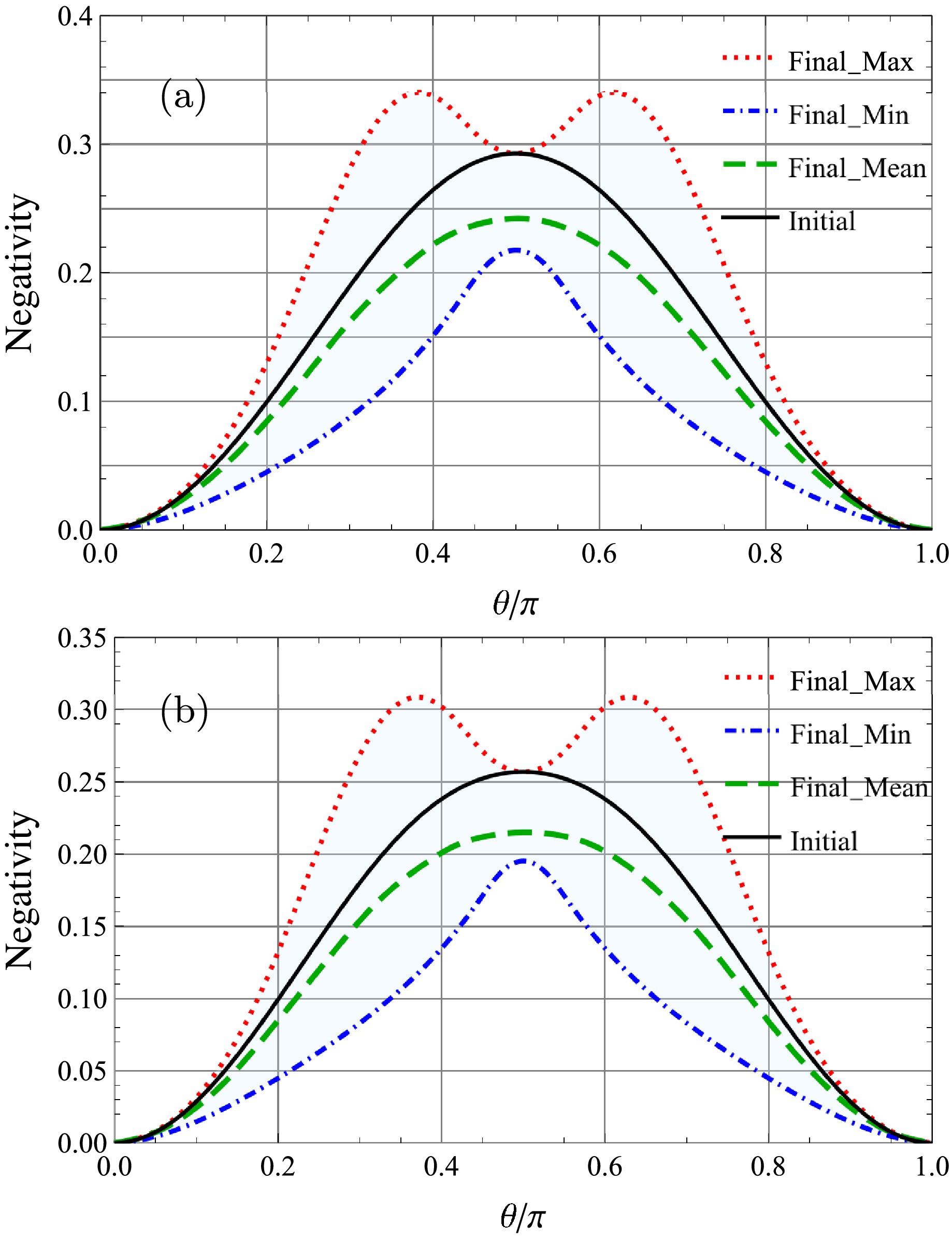
Figure 4. (color online) Negativity of
$ \Xi \bar{\Xi} $ (solid black line) and$ \Lambda\bar{\Lambda} $ (light blue shaded area between the red dotted line and the blue dot-dashed line) in the (a)$ e^+e^- \to J/\psi \to \Xi^{-} (\to \Lambda \pi^-)\; $ $ \bar{\Xi}^{+} (\to \bar{\Lambda} \pi^+) $ and (b)$ e^+e^- \to J/\psi \to \Xi^{0} (\to \Lambda \pi^0)\; \bar{\Xi}^{0} (\to \bar{\Lambda} \pi^0) $ processes. The green long-dashed line represents the phase-space-averaged values.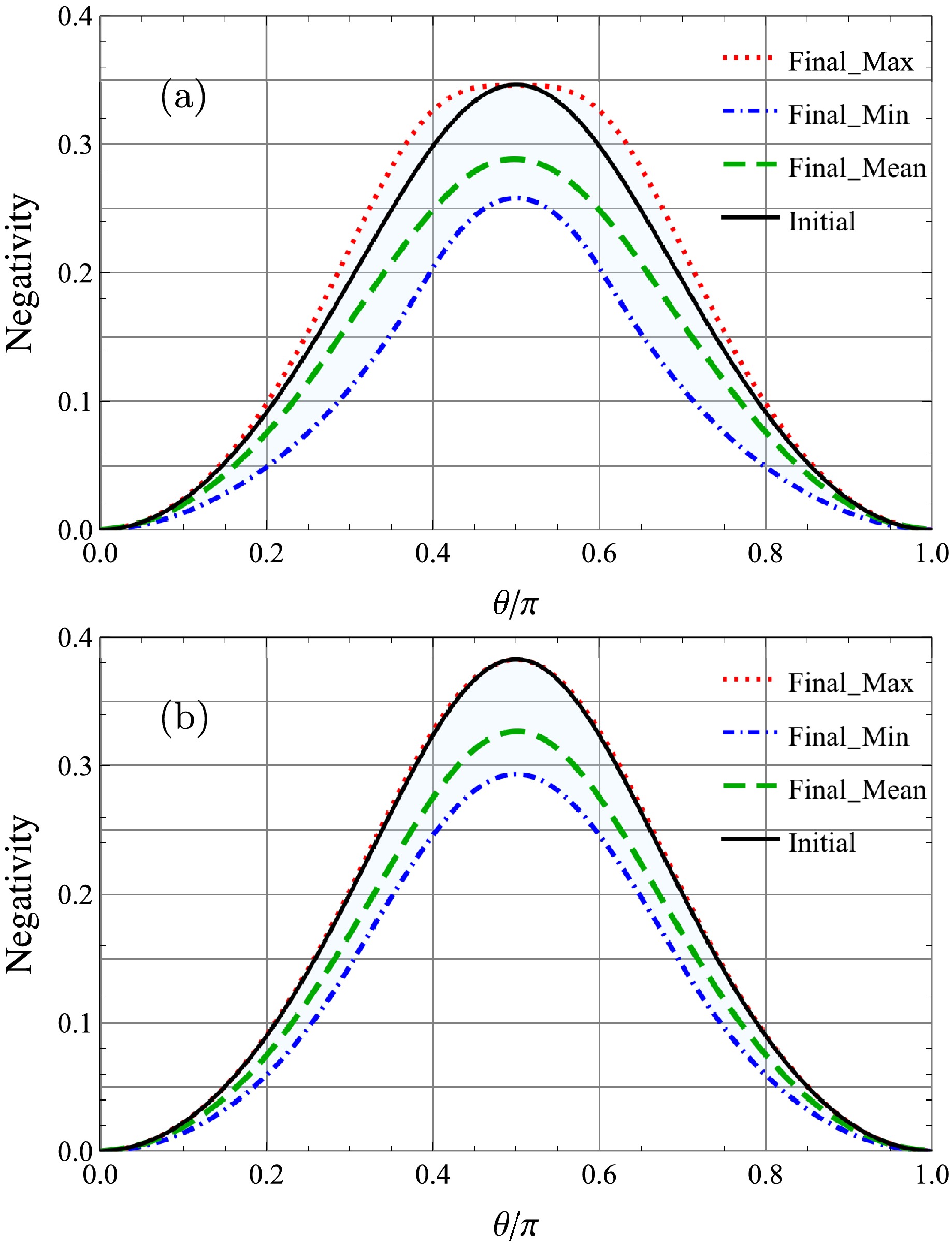
Figure 5. (color online) Negativity of
$ \Xi \bar{\Xi} $ (solid black line) and$ \Lambda\bar{\Lambda} $ (light blue shaded area between the red dotted line and the blue dot-dashed line) in the (a)$ e^+e^-\to \psi(2S) \to \Xi^{-} (\to \Lambda \pi^-) $ $ \bar{\Xi}^{+} (\to \bar{\Lambda}\pi^+) $ and (b)$ e^+e^-\to \psi(2S) \to \Xi^{0} (\to \Lambda \pi^0) \bar{\Xi}^{0} (\to \bar{\Lambda}\pi^0) $ processes. Note that the black and red curves are nearly superimposed, rendering them visually indistinguishable in (b). The green long-dashed line represents the phase-space-averaged values.It can be seen that the profiles of the lower and upper boundaries of the daughter system are similar to those of the mother system, both for negativity and concurrence (and also discord in Sec. III.D), with an exception of negativity in the
$ e^+e^- \to J/\psi \to Y (\to \Lambda \pi^-)\ \bar{Y} (\to \bar{\Lambda}\pi^+) $ process in Fig. 4. The upper boundary of negativity in this process has two local maxima at certain angles$ \theta_{max}= 69.8^{\circ} $ for$ \Xi^{-}\bar{\Xi}^{+} $ (or$ 66.1^\circ $ for$ \Xi^{0}\bar{\Xi}^{0} $ ) symmetric with respect to$ \pi/2 $ , and that of the mother system$ Y\bar{Y} $ reaches the peak at$ \theta = \pi/2 $ .Maximal enlargement is not achieved across full angles according to the calculation of negativity and concurrence of
$ Y \bar{Y} $ and$ \Lambda\bar{\Lambda} $ . It is interesting that the$ \eta_c $ and$ \chi_{c0} $ decays into hyperon-antihyperon pairs exhibit maximal entanglement due to the spinless nature of pseudoscalar charmonium [19, 24]. Thus, the entanglement of the daughter system, e.g.,$ p\bar{p} $ in the$ e^+e^-\to \gamma \eta_c \;(\rm{or}\; \chi_{c0}) \to \gamma \Lambda (\to p \pi^-)\ \bar{\Lambda} (\to \bar{p}\pi^+) $ process is postulated to always decrease in comparison to the mother system$ \Lambda\bar{\Lambda} $ , a phenomenon similar to the$ e^+e^-\to \psi(2S)\to \Xi^{0} (\to \Lambda \pi^0)\ \bar{\Xi}^{0} (\to \bar{\Lambda}\pi^0) $ process.The daughter systems
$ \Lambda\bar{\Lambda} $ are non-separable except at$ \theta = 0 $ and π, as shown by their lower boundaries of negativity and concurrence. Thus, the entanglement may decrease but will not be completely lost during the hyperon decay processes. -
The bipartite system (
$ Y \bar{Y} $ here) is entangled if it does not remain positive under partial transposition with respect to any subsystem, as stated by the Peres-Horodecki criterion. Negativity, as another entanglement measure, is defined in terms of the absolute sum of the eigenvalues$ \kappa_i $ of the partially transposed density matrix$ \rho^{T_Y} $ or$ \rho^{T_{\bar Y}} $ :$ N(\rho) = \frac{\|\rho^{T_Y}\| - 1}{2} = \sum\limits_i \frac{ |\kappa_i| - \kappa_i}{2}. $
(5) where
$ \|\rho^{T_Y}\| $ is the trace norm or the sum of the singular values of$ \rho^{T_Y} $ . For separable states, the eigenvalues$ \kappa_i $ are non-negative, leading to vanishing$ N(\rho) $ , since their$ \rho^{T_Y} $ or$ \rho^{T_{\bar Y}} $ remains positive semidefinite. For entangled states, the appearance of negative eigenvalues forces$\sum_i |\kappa_i| \gt 1$ , so negativity quantifies the entanglement content of the system with$ 0 \le N(\rho) \le 1/2 $ .The negativity of
$ Y \bar{Y} $ and$ \Lambda\bar{\Lambda} $ for the$ e^+e^- \to \psi \to Y (\to \Lambda \pi^-)\ \bar{Y} (\to \bar{\Lambda}\pi^+) $ process is shown as a function of θ in Figs. 4 and 5, the latter of which ($ \Lambda\bar{\Lambda} $ ) are optimized or integrated with respect to helicity angles$ (\theta_\Lambda, \varphi_\Lambda) $ and$ (\theta_{\bar{\Lambda}}, \varphi_{\bar{\Lambda}}) $ . The main conclusion is quite similar to those evaluated by the concurrence. Negativity of$ \Lambda\bar{\Lambda} $ coming from the$ Y \bar{Y} $ decay is redistributed over the four-body phase space: it increases in part of the phase space and decreases in the rest, as shown by the light blue areas between red and blue curves. Entanglement autodistillation fails for phase-space-averaged negativity since the green dashed curves labeled as Final_Mean remain closer to their respective lower boundary.
Figure 4. (color online) Negativity of
$ \Xi \bar{\Xi} $ (solid black line) and$ \Lambda\bar{\Lambda} $ (light blue shaded area between the red dotted line and the blue dot-dashed line) in the (a)$ e^+e^- \to J/\psi \to \Xi^{-} (\to \Lambda \pi^-)\; $ $ \bar{\Xi}^{+} (\to \bar{\Lambda} \pi^+) $ and (b)$ e^+e^- \to J/\psi \to \Xi^{0} (\to \Lambda \pi^0)\; \bar{\Xi}^{0} (\to \bar{\Lambda} \pi^0) $ processes. The green long-dashed line represents the phase-space-averaged values.
Figure 5. (color online) Negativity of
$ \Xi \bar{\Xi} $ (solid black line) and$ \Lambda\bar{\Lambda} $ (light blue shaded area between the red dotted line and the blue dot-dashed line) in the (a)$ e^+e^-\to \psi(2S) \to \Xi^{-} (\to \Lambda \pi^-) $ $ \bar{\Xi}^{+} (\to \bar{\Lambda}\pi^+) $ and (b)$ e^+e^-\to \psi(2S) \to \Xi^{0} (\to \Lambda \pi^0) \bar{\Xi}^{0} (\to \bar{\Lambda}\pi^0) $ processes. Note that the black and red curves are nearly superimposed, rendering them visually indistinguishable in (b). The green long-dashed line represents the phase-space-averaged values.It can be seen that the profiles of the lower and upper boundaries of the daughter system are similar to those of the mother system, both for negativity and concurrence (and also discord in Sec. III D), with an exception of negativity in the
$ e^+e^- \to J/\psi \to Y (\to \Lambda \pi^-)\ \bar{Y} (\to \bar{\Lambda}\pi^+) $ process in Fig. 4. The upper boundary of negativity in this process has two local maxima at certain angles$ \theta_{max}= 69.8^{\circ} $ for$ \Xi^{-}\bar{\Xi}^{+} $ (or$ 66.1^\circ $ for$ \Xi^{0}\bar{\Xi}^{0} $ ) symmetric with respect to$ \pi/2 $ , and that of the mother system$ Y\bar{Y} $ reaches the peak at$ \theta = \pi/2 $ .Maximal enlargement is not achieved across full angles according to the calculation of negativity and concurrence of
$ Y \bar{Y} $ and$ \Lambda\bar{\Lambda} $ . It is interesting that the$ \eta_c $ and$ \chi_{c0} $ decays into hyperon-antihyperon pairs exhibit maximal entanglement due to the spinless nature of pseudoscalar charmonium [19, 24]. Thus, the entanglement of the daughter system, e.g.,$ p\bar{p} $ in the$ e^+e^-\to \gamma \eta_c (\rm{or } \chi_{c0}) \to \gamma \Lambda (\to p \pi^-)\ \bar{\Lambda} (\to \bar{p}\pi^+) $ process is postulated to always decrease in comparison to the mother system$ \Lambda\bar{\Lambda} $ , a phenomenon similar to the$ e^+e^-\to \psi(2S)\to \Xi^{0} (\to \Lambda \pi^0)\ \bar{\Xi}^{0} (\to \bar{\Lambda}\pi^0) $ process.The daughter systems
$ \Lambda\bar{\Lambda} $ are non-separable except at$ \theta = 0 $ and π, as shown by their lower boundaries of negativity and concurrence. Thus, the entanglement may decrease but will not be completely lost during the hyperon decay processes. -
The bipartite system (
$ Y \bar{Y} $ here) is entangled if it does not remain positive under partial transposition with respect to any subsystem, as stated by the Peres-Horodecki criterion. Negativity, as another entanglement measure, is defined in terms of the absolute sum of the eigenvalues$ \kappa_i $ of the partially transposed density matrix$ \rho^{T_Y} $ or$ \rho^{T_{\bar Y}} $ :$ N(\rho) = \frac{\|\,\rho^{T_Y}\| - 1}{2} = \sum\limits_i \frac{ |\kappa_i| - \kappa_i}{2}, $
(5) where
$ \|\,\rho^{T_Y}\| $ is the trace norm or the sum of the singular values of$ \rho^{T_Y} $ . For separable states, the eigenvalues$ \kappa_i $ are non-negative, leading to vanishing$ N(\rho) $ , since their$ \rho^{T_Y} $ or$ \rho^{T_{\bar Y}} $ remains positive semidefinite. For entangled states, the appearance of negative eigenvalues forces$\sum_i |\kappa_i| \gt 1$ , so negativity quantifies the entanglement content of the system with$ 0 \le N(\rho) \le 1/2 $ .The negativity of
$ Y \bar{Y} $ and$ \Lambda\bar{\Lambda} $ for the$ e^+e^- \to \psi \to Y (\to \Lambda \pi^-)\ \bar{Y} (\to \bar{\Lambda}\pi^+) $ process is shown as a function of θ in Figs. 4 and 5, the latter of which ($ \Lambda\bar{\Lambda} $ ) are optimized or integrated with respect to helicity angles$ (\theta_\Lambda, \varphi_\Lambda) $ and$ (\theta_{\bar{\Lambda}}, \varphi_{\bar{\Lambda}}) $ . The main conclusion is quite similar to those evaluated by the concurrence. Negativity of$ \Lambda\bar{\Lambda} $ coming from the$ Y \bar{Y} $ decay is redistributed over the four-body phase space: it increases in part of the phase space and decreases in the rest, as shown by the light blue areas between red and blue curves. Entanglement autodistillation fails for phase-space-averaged negativity since the green dashed curves labeled as Final_Mean remain closer to their respective lower boundary.
Figure 4. (color online) Negativity of
$ \Xi \bar{\Xi} $ (solid black line) and$ \Lambda\bar{\Lambda} $ (light blue shaded area between the red dotted line and the blue dot-dashed line) in the (a)$ e^+e^- \to J/\psi \to \Xi^{-} (\to \Lambda \pi^-)\; $ $ \bar{\Xi}^{+} (\to \bar{\Lambda} \pi^+) $ and (b)$ e^+e^- \to J/\psi \to \Xi^{0} (\to \Lambda \pi^0)\; \bar{\Xi}^{0} (\to \bar{\Lambda} \pi^0) $ processes. The green long-dashed line represents the phase-space-averaged values.
Figure 5. (color online) Negativity of
$ \Xi \bar{\Xi} $ (solid black line) and$ \Lambda\bar{\Lambda} $ (light blue shaded area between the red dotted line and the blue dot-dashed line) in the (a)$ e^+e^-\to \psi(2S) \to \Xi^{-} (\to \Lambda \pi^-) $ $ \bar{\Xi}^{+} (\to \bar{\Lambda}\pi^+) $ and (b)$ e^+e^-\to \psi(2S) \to \Xi^{0} (\to \Lambda \pi^0) \bar{\Xi}^{0} (\to \bar{\Lambda}\pi^0) $ processes. Note that the black and red curves are nearly superimposed, rendering them visually indistinguishable in (b). The green long-dashed line represents the phase-space-averaged values.It can be seen that the profiles of the lower and upper boundaries of the daughter system are similar to those of the mother system, both for negativity and concurrence (and also discord in Sec. III.D), with an exception of negativity in the
$ e^+e^- \to J/\psi \to Y (\to \Lambda \pi^-)\ \bar{Y} (\to \bar{\Lambda}\pi^+) $ process in Fig. 4. The upper boundary of negativity in this process has two local maxima at certain angles$ \theta_{max}= 69.8^{\circ} $ for$ \Xi^{-}\bar{\Xi}^{+} $ (or$ 66.1^\circ $ for$ \Xi^{0}\bar{\Xi}^{0} $ ) symmetric with respect to$ \pi/2 $ , and that of the mother system$ Y\bar{Y} $ reaches the peak at$ \theta = \pi/2 $ .Maximal enlargement is not achieved across full angles according to the calculation of negativity and concurrence of
$ Y \bar{Y} $ and$ \Lambda\bar{\Lambda} $ . It is interesting that the$ \eta_c $ and$ \chi_{c0} $ decays into hyperon-antihyperon pairs exhibit maximal entanglement due to the spinless nature of pseudoscalar charmonium [19, 24]. Thus, the entanglement of the daughter system, e.g.,$ p\bar{p} $ in the$ e^+e^-\to \gamma \eta_c (\rm{or } \chi_{c0}) \to \gamma \Lambda (\to p \pi^-)\ \bar{\Lambda} (\to \bar{p}\pi^+) $ process is postulated to always decrease in comparison to the mother system$ \Lambda\bar{\Lambda} $ , a phenomenon similar to the$ e^+e^-\to \psi(2S)\to \Xi^{0} (\to \Lambda \pi^0)\ \bar{\Xi}^{0} (\to \bar{\Lambda}\pi^0) $ process.The daughter systems
$ \Lambda\bar{\Lambda} $ are non-separable except at$ \theta = 0 $ and π, as shown by their lower boundaries of negativity and concurrence. Thus, the entanglement may decrease but will not be completely lost during the hyperon decay processes. -
Quantum discord coincides with entanglement for pure states. It is more general than entanglement, considering that any entangled state shows discord, but the opposite is not true [78]. The definition of quantum discord requires the definition of the mutual information of a bipartite system:
$ I(\rho) \equiv S(\rho_A) + S(\rho_B) - S(\rho) = S(\rho_A) - S(\rho_{A|B}) $ . Here,$ S(\rho) \equiv -\text{Tr}(\rho \log_{2} \rho) $ denotes the von Neumann entropy [78, 79], and$ S(\rho_{A|B}) \equiv S(\rho_{B}) - S(\rho_{AB}) $ is the conditional entropy without measurement. The$ \rho_A = \text{Tr}_B(\rho_{AB}) $ and$ \rho_B = \text{Tr}_A(\rho_{AB}) $ are the reduced density matrices of the subsystems. In other terms, mutual information quantifies the amount of total correlations contained in the system.The amount of classical correlations can be obtained through local von Neumann measurements
$ \Pi^B $ performed on subsystem B. Conditioned on this projective measurement, the post-measurement state of subsystem A is described by an ensemble$ \rho_{A|\Pi_k^B} = \text{Tr}_{B} \left[ \frac{1}{{p_k}} (1^A \otimes \Pi_k^B) \rho_{AB} (1^A \otimes \Pi_k^B) \right], $
(6) with the probability
$ p_k = \text{Tr} \left[(1^A \otimes \Pi_k^B) \rho_{AB}(1^A \otimes \Pi_k^B) \right] $ and$ 1^A $ being the identity operator for subsystem A. For a qubit system in Eq. (3),$ k = \pm $ and$ p_\pm = (1 \pm \mathbf{\hat{n}} \cdot {\bf{P}}^-)/2 $ , with$ \mathbf{\hat{n}} $ corresponding to the axis along which the spin of$ B= \bar{Y} $ is measured. The corresponding classical mutual information is$ J^A(\rho) \equiv S(\rho_A) - \sum\limits_k p_k S(\rho_{A|\Pi_k^B}). $
(7) A measurement-independent quantification of classical correlations is obtained by maximizing over all local von Neumann measurements on subsystem B, labeled as
$ \max_{\{\Pi_k^B\}} $ .Discord is defined as the difference between the amount of total correlations and that of classical correlations:
$ D^A[\rho] \equiv I(\rho) - \max\limits_{\{\Pi_k^B\}} J^A(\rho), $
(8) with
$ 0 \leq D^A[\rho] \leq 1 $ as a measure of the content of non-classical correlations of a bipartite system. In this paper,$ D^{Y}[\rho] = D^{\bar{Y}}[\rho] $ since$\rm CP $ violation is not enforced. For a symmetric X state, by local unitary transformation on the$ Y \bar{Y} $ system in Eq. (1), the discord is of analytical form [21, 80–82].The discord of
$ Y \bar{Y} $ and$ \Lambda\bar{\Lambda} $ for the$e^+e^-\to $ $ \psi \to Y (\to \Lambda \pi^-)\; \bar{Y} (\to \bar{\Lambda}\pi^+) $ process is shown as a function of θ in Figs. 6 and 7. The former ($ Y \bar{Y} $ ) is consistent with the results reported in Ref. [21], and the latter ($ \Lambda\bar{\Lambda} $ ) is appropriately optimized (or integrated) with respect to the helicity angles of Λ and$ \bar{\Lambda} $ to identify the extreme values (or phase-space-averaged values). A prominent feature is that the discord of the daughter system has the potential to increase across the entire range of scattering angles for all channels in comparison to the mother system when evaluated against the upper and lower boundaries. As mentioned, the entanglement of the$ \Lambda\bar{\Lambda} $ system cannot increase at$ \theta = 0 $ ,$ \pi/2 $ , and π, but the discord has the potential to be enhanced. Thus, the quantumness of the system is increased even if the entanglement is not enhanced in certain phase spaces. This phenomenon occurs across the full phase space for$ e^+e^-\to \psi(2S) \to \Xi^{0} (\to \Lambda \pi^0)\; \bar{\Xi}^{0} (\to \bar{\Lambda}\pi^0) $ as shown in Fig. 7(b), in which process the entanglement of the$ \Lambda\bar{\Lambda} $ system does not increase at all. At$ \theta = 0 $ and π, the states with non-zero quantum discord but null entanglement possibly emerge. The phase-space-averaged discord (green dashed lines) is redistributed with respect to the scattering angle. It decreases along the beam direction ($ \theta = 0 $ and π) whereas it increases in other directions.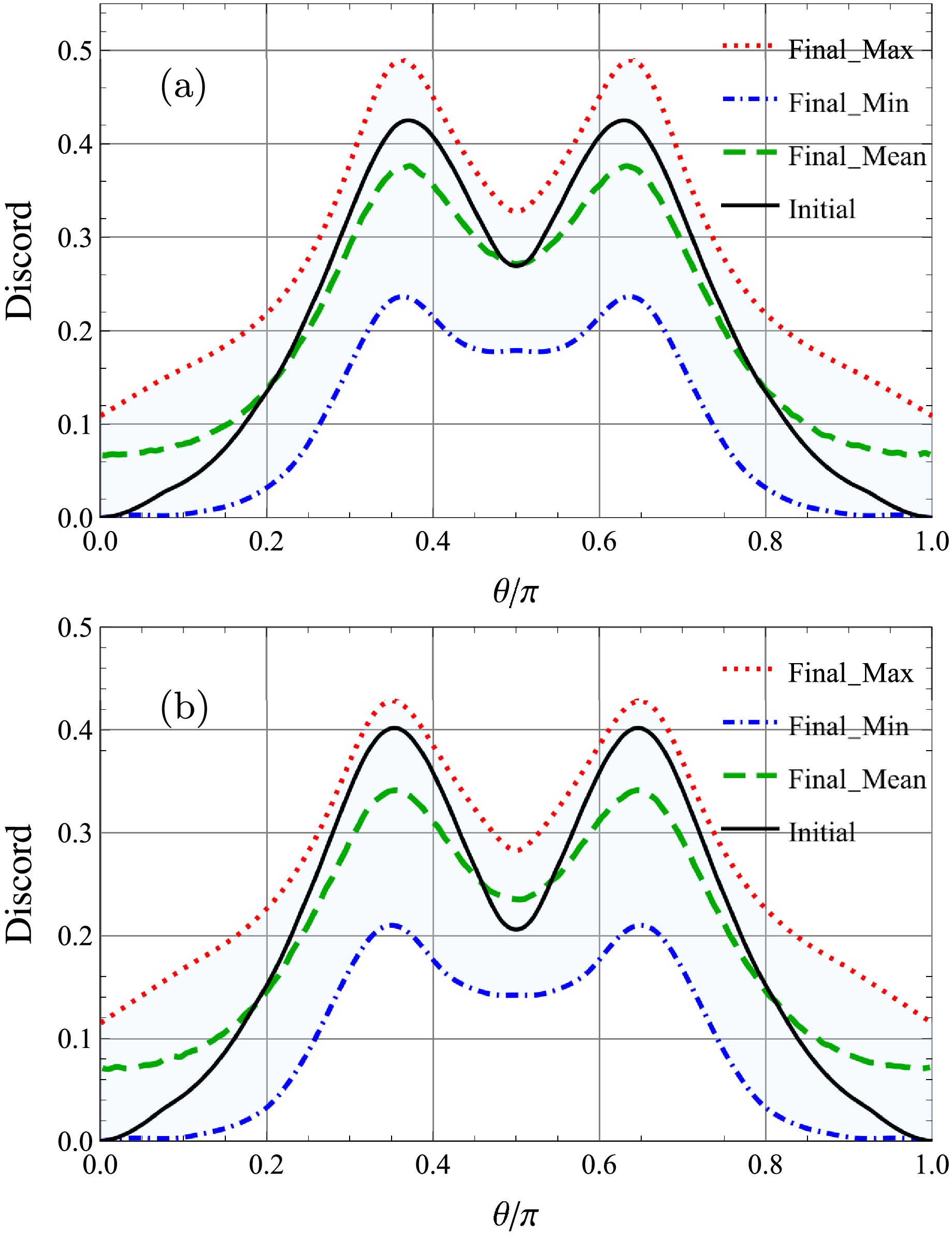
Figure 6. (color online) Discord of
$ \Xi \bar{\Xi} $ (solid black line) and$ \Lambda \bar{\Lambda} $ (light blue shaded area between the red dotted line and blue dot-dashed line) in the (a)$ e^+e^-\to J/\psi \to \Xi^{-} (\to \Lambda \pi^-)\; $ $ \bar{\Xi}^{+} (\to \bar{\Lambda} \pi^+) $ and (b)$ e^+e^-\to J/\psi \to \Xi^{0} (\to \Lambda \pi^0)\; \bar{\Xi}^{0} (\to \bar{\Lambda} \pi^0) $ processes. The green long-dashed line represents the phase-space-averaged values.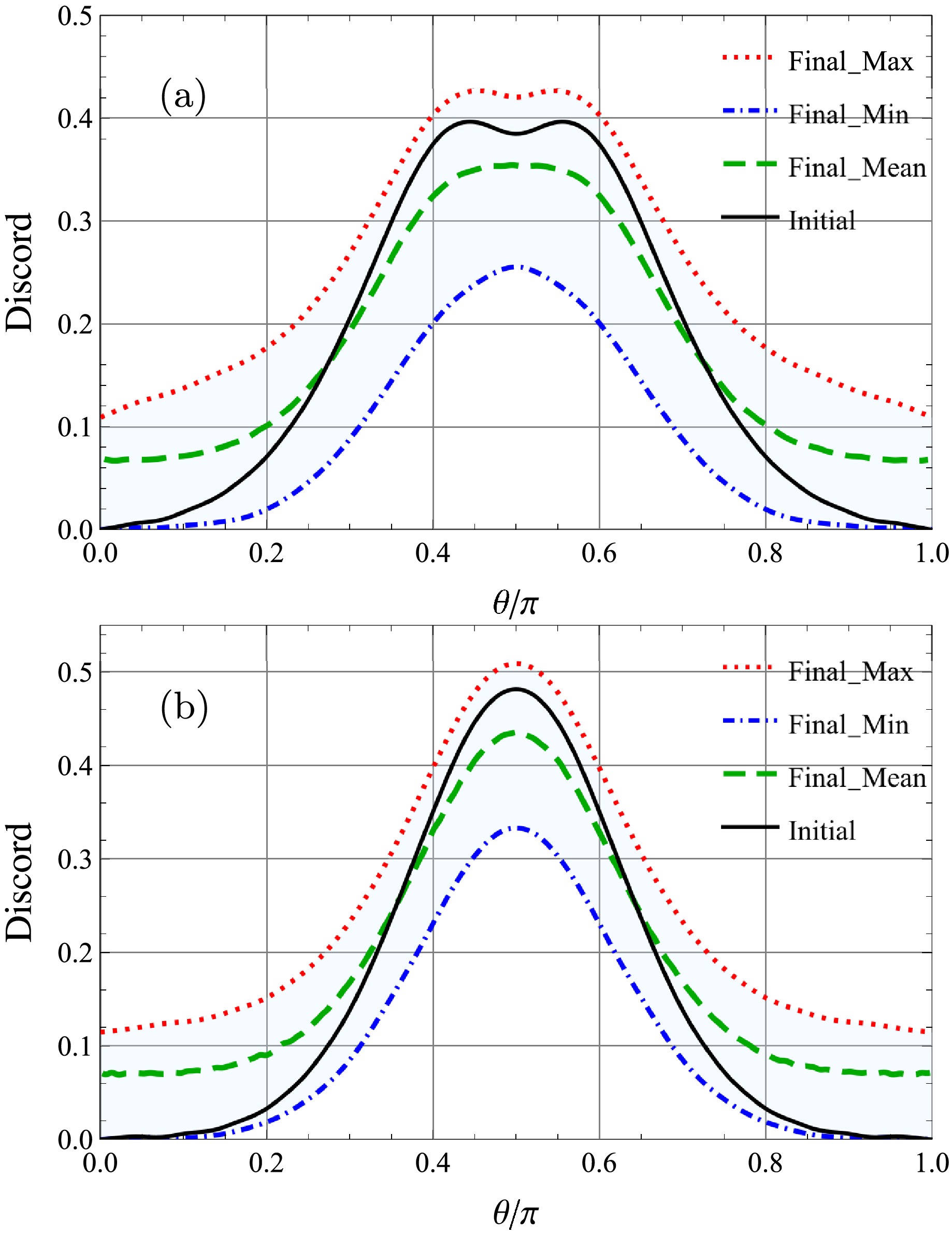
Figure 7. (color online) Discord of
$ \Xi \bar{\Xi} $ (solid black line) and$ \Lambda \bar{\Lambda} $ (light blue shaded area between red dotted line and blue dot-dashed line) in the (a)$ e^+e^- \to \psi(2S) \to \Xi^{-} (\to \Lambda \pi^-) $ $ \bar{\Xi}^{+} (\to \bar{\Lambda} \pi^+) $ and (b)$ e^+e^- \to \psi(2S) \to \Xi^{0} (\to \Lambda \pi^0) \bar{\Xi}^{0} (\to \bar{\Lambda} \pi^0) $ processes. The green long-dashed line represents the phase-space-averaged values.It is noted that the quantumness of these states manifests in the irreversibility of local measurements during correlation extraction, a feature distinct from entanglement, which characterizes the intrinsic nonseparability of the quantum state itself. Therefore, the non-classical correlations always have the potential to increase during decay processes. As another prominent feature, the discord of
$ \Lambda\bar{\Lambda} $ decreases to be close to zero in some regions approaching$ \theta = 0 $ and π, indicating few contents of non-classical correlations under certain phase spaces.It is pointed out that, for their respective initial values, the
$ \Xi^{-}\bar{\Xi}^{+} $ and$ \Xi^{0}\bar{\Xi}^{0} $ systems in the$ J/\psi $ channel (shown in Fig. 6) achieve their maximum discord at pairs of angles symmetric about$ \pi/2 $ , with the smaller angles given by$ \theta_{\text{max}} = 65.5^\circ $ and$ 63.7^\circ $ , respectively (see also Ref. [21]). The extreme boundary of the daughter$ \Lambda\bar{\Lambda} $ System reaches its maximum discord at$ \theta_{\text{max}} = 63.8^\circ $ , which differs insignificantly from that of the mother system. -
Quantum discord coincides with entanglement for pure states. It is more general than entanglement, considering that any entangled state shows discord, but the opposite is not true [78]. The definition of quantum discord requires the definition of the mutual information of a bipartite system:
$ I(\rho) \equiv S(\rho_A) + S(\rho_B) - S(\rho) = S(\rho_A) - S(\rho_{A|B}) $ . Here,$ S(\rho) \equiv -\text{Tr}(\rho \log_{2} \rho) $ denotes the von Neumann entropy [78, 79], and$ S(\rho_{A|B}) \equiv S(\rho_{B}) - S(\rho_{AB}) $ is the conditional entropy without measurement. The$ \rho_A = \text{Tr}_B(\rho_{AB}) $ and$ \rho_B = \text{Tr}_A(\rho_{AB}) $ are the reduced density matrices of the subsystems. In other terms, mutual information quantifies the amount of total correlations contained in the system.The amount of classical correlations can be obtained through local von Neumann measurements
$ \Pi^B $ performed on subsystem B. Conditioned on this projective measurement, the post-measurement state of subsystem A is described by an ensemble$ \rho_{A|\Pi_k^B} = \text{Tr}_{B} \left[ \frac{1}{{p_k}} (1^A \otimes \Pi_k^B) \rho_{AB} (1^A \otimes \Pi_k^B) \right], $
(6) with the probability
$ p_k = \text{Tr} \left[(1^A \otimes \Pi_k^B) \rho_{AB}(1^A \otimes \Pi_k^B) \right] $ and$ 1^A $ being the identity operator for subsystem A. For a qubit system in Eq. (3),$ k = \pm $ and$ p_\pm = (1 \pm \mathbf{\hat{n}} \cdot {\bf{P}}^-)/2 $ , with$ \mathbf{\hat{n}} $ corresponding to the axis along which the spin of$ B= \bar{Y} $ is measured. The corresponding classical mutual information is$ J^A(\rho) \equiv S(\rho_A) - \sum\limits_k p_k S(\rho_{A|\Pi_k^B}). $
(7) A measurement-independent quantification of classical correlations is obtained by maximizing over all local von Neumann measurements on subsystem B, labeled as
$ \max_{\{\Pi_k^B\}} $ .Discord is defined as the difference between the amount of total correlations and that of classical correlations:
$ D^A[\rho] \equiv I(\rho) - \max\limits_{\{\Pi_k^B\}} J^A(\rho), $
(8) with
$ 0 \leq D^A[\rho] \leq 1 $ as a measure of the content of non-classical correlations of a bipartite system. In this paper,$ D^{Y}[\rho] = D^{\bar{Y}}[\rho] $ since$\rm CP $ violation is not enforced. For a symmetric X state, by local unitary transformation on the$ Y \bar{Y} $ system in Eq. (1), the discord is of analytical form [21, 80–82].The discord of
$ Y \bar{Y} $ and$ \Lambda\bar{\Lambda} $ for the$e^+e^-\to $ $ \psi \to Y (\to \Lambda \pi^-)\; \bar{Y} (\to \bar{\Lambda}\pi^+) $ process is shown as a function of θ in Figs. 6 and 7. The former ($ Y \bar{Y} $ ) is consistent with the results reported in Ref. [21], and the latter ($ \Lambda\bar{\Lambda} $ ) is appropriately optimized (or integrated) with respect to the helicity angles of Λ and$ \bar{\Lambda} $ to identify the extreme values (or phase-space-averaged values). A prominent feature is that the discord of the daughter system has the potential to increase across the entire range of scattering angles for all channels in comparison to the mother system when evaluated against the upper and lower boundaries. As mentioned, the entanglement of the$ \Lambda\bar{\Lambda} $ system cannot increase at$ \theta = 0 $ ,$ \pi/2 $ , and π, but the discord has the potential to be enhanced. Thus, the quantumness of the system is increased even if the entanglement is not enhanced in certain phase spaces. This phenomenon occurs across the full phase space for$ e^+e^-\to \psi(2S) \to \Xi^{0} (\to \Lambda \pi^0)\; \bar{\Xi}^{0} (\to \bar{\Lambda}\pi^0) $ as shown in Fig. 7(b), in which process the entanglement of the$ \Lambda\bar{\Lambda} $ system does not increase at all. At$ \theta = 0 $ and π, the states with non-zero quantum discord but null entanglement possibly emerge. The phase-space-averaged discord (green dashed lines) is redistributed with respect to the scattering angle. It decreases along the beam direction ($ \theta = 0 $ and π) whereas it increases in other directions.
Figure 6. (color online) Discord of
$ \Xi \bar{\Xi} $ (solid black line) and$ \Lambda \bar{\Lambda} $ (light blue shaded area between the red dotted line and blue dot-dashed line) in the (a)$ e^+e^-\to J/\psi \to \Xi^{-} (\to \Lambda \pi^-)\; $ $ \bar{\Xi}^{+} (\to \bar{\Lambda} \pi^+) $ and (b)$ e^+e^-\to J/\psi \to \Xi^{0} (\to \Lambda \pi^0)\; \bar{\Xi}^{0} (\to \bar{\Lambda} \pi^0) $ processes. The green long-dashed line represents the phase-space-averaged values.
Figure 7. (color online) Discord of
$ \Xi \bar{\Xi} $ (solid black line) and$ \Lambda \bar{\Lambda} $ (light blue shaded area between red dotted line and blue dot-dashed line) in the (a)$ e^+e^- \to \psi(2S) \to \Xi^{-} (\to \Lambda \pi^-) $ $ \bar{\Xi}^{+} (\to \bar{\Lambda} \pi^+) $ and (b)$ e^+e^- \to \psi(2S) \to \Xi^{0} (\to \Lambda \pi^0) \bar{\Xi}^{0} (\to \bar{\Lambda} \pi^0) $ processes. The green long-dashed line represents the phase-space-averaged values.It is noted that the quantumness of these states manifests in the irreversibility of local measurements during correlation extraction, a feature distinct from entanglement, which characterizes the intrinsic nonseparability of the quantum state itself. Therefore, the non-classical correlations always have the potential to increase during decay processes. As another prominent feature, the discord of
$ \Lambda\bar{\Lambda} $ decreases to be close to zero in some regions approaching$ \theta = 0 $ and π, indicating few contents of non-classical correlations under certain phase spaces.It is pointed out that, for their respective initial values, the
$ \Xi^{-}\bar{\Xi}^{+} $ and$ \Xi^{0}\bar{\Xi}^{0} $ systems in the$ J/\psi $ channel (shown in Fig. 6) achieve their maximum discord at pairs of angles symmetric about$ \pi/2 $ , with the smaller angles given by$ \theta_{\text{max}} = 65.5^\circ $ and$ 63.7^\circ $ , respectively (see also Ref. [21]). The extreme boundary of the daughter$ \Lambda\bar{\Lambda} $ System reaches its maximum discord at$ \theta_{\text{max}} = 63.8^\circ $ , which differs insignificantly from that of the mother system. -
Quantum discord coincides with entanglement for pure states. It is more general than entanglement, considering that any entangled state shows discord, but the opposite is not true [78]. The definition of quantum discord requires the definition of the mutual information of a bipartite system:
$ I(\rho) \equiv S(\rho_A) + S(\rho_B) - S(\rho) = S(\rho_A) - S(\rho_{A|B}) $ . Here,$ S(\rho) \equiv -\text{Tr}(\rho \log_{2} \rho) $ denotes the von Neumann entropy [78, 79], and$ S(\rho_{A|B}) \equiv S(\rho_{B}) - S(\rho_{AB}) $ is the conditional entropy without measurement. The$ \rho_A = \text{Tr}_B(\rho_{AB}) $ and$ \rho_B = \text{Tr}_A(\rho_{AB}) $ are the reduced density matrices of the subsystems. In other terms, mutual information quantifies the amount of total correlations contained in the system.The amount of classical correlations can be obtained through local von Neumann measurements
$ \Pi^B $ performed on subsystem B. Conditioned on this projective measurement, the post-measurement state of subsystem A is described by an ensemble$ \rho_{A|\Pi_k^B} = \text{Tr}_{B} \left[ \frac{1}{{p_k}} (1^A \otimes \Pi_k^B) \rho_{AB} (1^A \otimes \Pi_k^B) \right], $
(6) with the probability
$ p_k = \text{Tr} \left[(1^A \otimes \Pi_k^B) \rho_{AB}(1^A \otimes \Pi_k^B) \right] $ and$ 1^A $ being the identity operator for subsystem A. For a qubit system in Eq. (3),$ k = \pm $ and$ p_\pm = (1 \pm \mathbf{\hat{n}} \cdot {\bf{P}}^-)/2 $ , with$ \mathbf{\hat{n}} $ corresponding to the axis along which the spin of$ B= \bar{Y} $ is measured. The corresponding classical mutual information is$ J^A(\rho) \equiv S(\rho_A) - \sum\limits_k p_k S(\rho_{A|\Pi_k^B}). $
(7) A measurement-independent quantification of classical correlations is obtained by maximizing over all local von Neumann measurements on subsystem B, labeled as
$ \max_{\{\Pi_k^B\}} $ .Discord is defined as the difference between the amount of total correlations and that of classical correlations:
$ D^A[\rho] \equiv I(\rho) - \max\limits_{\{\Pi_k^B\}} J^A(\rho), $
(8) with
$ 0 \leq D^A[\rho] \leq 1 $ as a measure of the content of non-classical correlations of a bipartite system. In this paper,$ D^{Y}[\rho] = D^{\bar{Y}}[\rho] $ since$ CP $ violation is not enforced. For a symmetric X state, by local unitary transformation on the$ Y \bar{Y} $ system in Eq. (1), the discord is of analytical form [21, 80–82].The discord of
$ Y \bar{Y} $ and$ \Lambda\bar{\Lambda} $ for the$ e^+e^-\to \psi \to Y (\to \Lambda \pi^-)\; \bar{Y} (\to \bar{\Lambda}\pi^+) $ process is shown as a function of θ in Figs. 6 and 7. The former ($ Y \bar{Y} $ ) is consistent with the results reported in Ref. [21], and the latter ($ \Lambda\bar{\Lambda} $ ) is appropriately optimized (or integrated) with respect to the helicity angles of Λ and$ \bar{\Lambda} $ to identify the extreme values (or phase-space-averaged values). A prominent feature is that the discord of the daughter system has the potential to increase across the entire range of scattering angles for all channels in comparison to the mother system when evaluated against the upper and lower boundaries. As mentioned, the entanglement of the$ \Lambda\bar{\Lambda} $ system cannot increase at$ \theta = 0 $ ,$ \pi/2 $ , and π, but the discord has the potential to be enhanced. Thus, the quantumness of the system is increased even if the entanglement is not enhanced in certain phase spaces. This phenomenon occurs across the full phase space for$ e^+e^-\to \psi(2S) \to \Xi^{0} (\to \Lambda \pi^0)\; \bar{\Xi}^{0} (\to \bar{\Lambda}\pi^0) $ as shown in Fig. 7(b), in which process the entanglement of the$ \Lambda\bar{\Lambda} $ system does not increase at all. At$ \theta = 0 $ and π, the states with non-zero quantum discord but null entanglement possibly emerge. The phase-space-averaged discord (green dashed lines) is redistributed with respect to the scattering angle. It decreases along the beam direction ($ \theta = 0 $ and π) whereas it increases in other directions.
Figure 6. (color online) Discord of
$ \Xi \bar{\Xi} $ (solid black line) and$ \Lambda \bar{\Lambda} $ (light blue shaded area between the red dotted line and blue dot-dashed line) in the (a)$ e^+e^-\to J/\psi \to \Xi^{-} (\to \Lambda \pi^-)\; $ $ \bar{\Xi}^{+} (\to \bar{\Lambda} \pi^+) $ and (b)$ e^+e^-\to J/\psi \to \Xi^{0} (\to \Lambda \pi^0)\; \bar{\Xi}^{0} (\to \bar{\Lambda} \pi^0) $ processes. The green long-dashed line represents the phase-space-averaged values.
Figure 7. (color online) Discord of
$ \Xi \bar{\Xi} $ (solid black line) and$ \Lambda \bar{\Lambda} $ (light blue shaded area between red dotted line and blue dot-dashed line) in the (a)$ e^+e^- \to \psi(2S) \to \Xi^{-} (\to \Lambda \pi^-) $ $ \bar{\Xi}^{+} (\to \bar{\Lambda} \pi^+) $ and (b)$ e^+e^- \to \psi(2S) \to \Xi^{0} (\to \Lambda \pi^0) \bar{\Xi}^{0} (\to \bar{\Lambda} \pi^0) $ processes. The green long-dashed line represents the phase-space-averaged values.It is noted that the quantumness of these states manifests in the irreversibility of local measurements during correlation extraction, a feature distinct from entanglement, which characterizes the intrinsic nonseparability of the quantum state itself. Therefore, the non-classical correlations always have the potential to increase during decay processes. As another prominent feature, the discord of
$ \Lambda\bar{\Lambda} $ decreases to be close to zero in some regions approaching$ \theta = 0 $ and π, indicating few contents of non-classical correlations under certain phase spaces.It is pointed out that, for their respective initial values, the
$ \Xi^{-}\bar{\Xi}^{+} $ and$ \Xi^{0}\bar{\Xi}^{0} $ systems in the$ J/\psi $ channel (shown in Fig. 6) achieve their maximum discord at pairs of angles symmetric about$ \pi/2 $ , with the smaller angles given by$ \theta_{\text{max}} = 65.5^\circ $ and$ 63.7^\circ $ , respectively (see also Ref. [21]). The extreme boundary of the daughter$ \Lambda\bar{\Lambda} $ System reaches its maximum discord at$ \theta_{\text{max}} = 63.8^\circ $ , which differs insignificantly from that of the mother system. -
The underlying mechanism responsible for the spontaneous entanglement change after the particles decay is attributed to the weak decay of hyperons, as explained in Ref. [52]. The non-zero decay parameter
$ \alpha_{Y} $ for$ Y = \Xi^- $ or$ \Xi^0 $ in Table 2 arises from the parity-violating amplitude of weak hadronic decay of hyperons. Therefore, the decay process as a local operator is not a unitary transformation, which no longer maps two orthogonal polarization states of the mother particles to two orthogonal states of the daughter particles. As a result, the entanglement of the decay product would differ from the mother system, exhibiting probabilistic increase or decrease as shown by the numerical calculation of the evolution of concurrence, negativity, and discord. On the other hand, the decay phase$ \phi_Y $ introduces only a phase difference between the two spin states, and as a local unitary transformation, it does not change the entanglement of quantum systems during the decay process. This explains its negligible impact on the upper and lower boundaries of concurrence, negativity, and discord.A mysterious discovery is that concurrence and negativity for the
$ e^+e^-\to \psi(2S) \to \Xi^{0} (\to \Lambda \pi^0)\; \bar{\Xi}^{0} (\to \bar{\Lambda}\pi^0) $ process are not enhanced at all when evaluated by the extreme values and phase-space-averaged quantities, although the non-classical correlations evaluated by discord have the possibility to increase. On the other hand, entanglement in the$ e^+e^-\to \psi(2S) \to \Xi^{-} (\to \Lambda \pi^-) \bar{\Xi}^{+} (\to \bar{\Lambda}\pi^+) $ process increases insignificantly, hinting at the key role of the relative phase$ \Delta\Phi $ between electric and magnetic form factors of Ξ. By adjusting the$ \Delta\Phi $ to unphysical values, it is found that the possibility of entanglement autodistillation of the bipartite system in this channel cannot increase below a critical$ \Delta\Phi = 0.3 $ rad across the full phase space, as shown in Fig. 8(a), (b). Since a small$ \Delta\Phi $ indicates small transverse polarization of hyperons, it is concluded that the transverse polarization of hyperons must be significant to generate the possibility of entanglement autodistillation in these processes.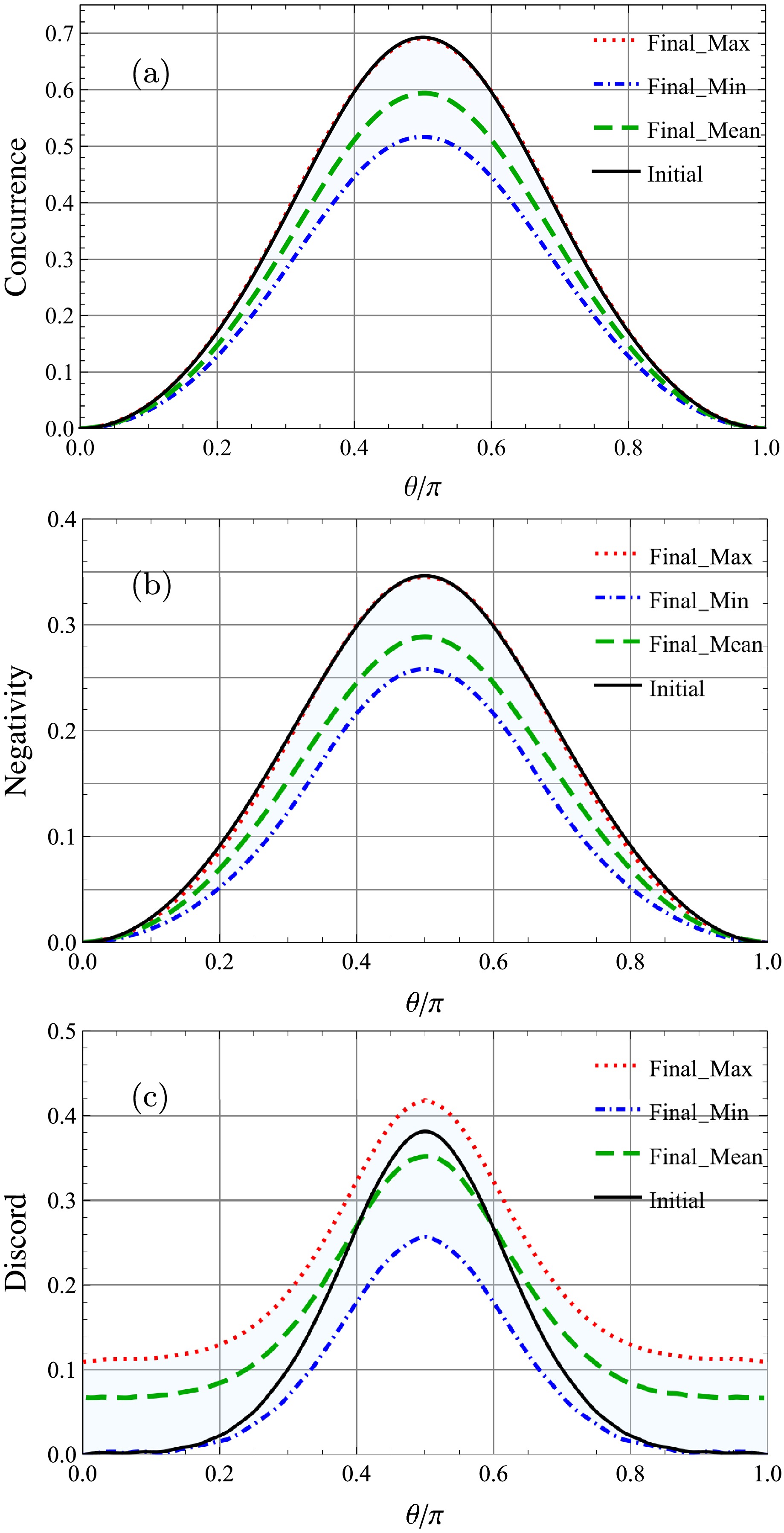
Figure 8. (color online) (a) Concurrence and (b) negativity for
$ \Xi^{-}\bar{\Xi}^{+} $ (solid black line) and$ \Lambda\bar{\Lambda} $ (light blue shaded area between the red dotted and blue dot-dashed lines) in the$ e^+e^-\to \psi(2S) \to \Xi^{-} \bar{\Xi}^{+} $ process. For these results,$ \Delta\Phi $ is set to 0.3 rad. Black and red curves are nearly identical and thus visually indistinguishable. (c) Quantum discord for the case where$ \Delta\Phi = 0 $ rad. The green long-dashed line represents the phase space-averaged values.It is also noted that the upper boundary of the daughter system never goes down to the corresponding concurrence and negativity of the mother system. The discord of the daughter system always has the possibility to increase during decay processes, even when the hyperons produced in the electron–positron annihilation are unpolarized, as shown by the upper boundary and phase-space-averaged values in Fig. 8(c).
For experimental prospects, the BESIII experiment has already accumulated a world-leading sample of 10 billion
$ J/\psi $ events and 2.7 billion$ \psi(2S) $ events. As demonstrated in recent hyperon studies involving multi-dimensional angular analysis [72, 71, 73], these datasets provide sufficient statistics to determine the elements of the spin density matrix with high precision. It is feasible to experimentally observe entanglement redistribution and autodistillation in the$ e^+e^- \to J/\psi \to \Xi (\to \Lambda \pi)\; \bar{\Xi} (\to \bar{\Lambda}\pi) $ process by using extreme values and phase-space-averaged quantities as tools. Looking forward, the proposed STCF is expected to deliver a luminosity two orders of magnitude higher than BESIII, potentially collecting trillions of$ J/\psi $ events [83]. Such an unprecedented dataset would enable a precise probe of entangled hyperon systems and the more subtle manifestations of quantum discord in particle physics, potentially offering deeper insights into the strong interaction in the non-perturbative regime.The boundary extrema — whether maxima or minima — of the concurrence, negativity, and quantum discord observed in the daughter systems arise purely from kinematic constraints within the available phase space. Tables 3 and 4 give the angles
$ \theta_{\max} $ ,$ (\theta_\Lambda, \varphi_\Lambda) $ , and$ (\theta_{\bar{\Lambda}}, \varphi_{\bar{\Lambda}}) $ that realize peak values of concurrence, negativity, and quantum discord for the$ e^+e^-\to J/\psi \to \Xi (\to \Lambda \pi)\; \bar{\Xi} (\to \bar{\Lambda}\pi) $ process. These values highlight a specific configuration of$ (\theta_\Lambda, \varphi_\Lambda) $ and$ (\theta_{\bar{\Lambda}}, \varphi_{\bar{\Lambda}}) $ associated with entanglement redistribution that lies within the central detector acceptance, suggesting its potential observability. Generating event distributions through toy Monte Carlo simulations that incorporate the maximum likelihood of the amplitude would be highly valuable, particularly for real data analysis, as it would help clarify the significance of entanglement redistribution. For quantum discord, however, this approach would be more involved. As noted in Eq. (7), computing quantum discord requires maximizing classical correlations over all local von Neumann measurements on one subsystem. This optimization is computationally intensive even for a modest event sample and demands substantial algorithmic and code-level optimization — a challenge that also affects future data analyses involving discord.$ \Xi^{-} \bar{\Xi}^{+} $ Discord ( $ 63.8^\circ $ )Concurrence ( $ 66.1^\circ $ )Negativity ( $ 69.8^\circ $ )$ \theta_\Lambda $ $ 284.2^\circ $ $ 270.0^\circ $ $ 270.0^\circ $ $ \varphi_\Lambda $ $ 104.2^\circ $ $ 90.0^\circ $ $ 90.0^\circ $ $ \theta_{\bar{\Lambda}} $ $ 246.3^\circ $ $ 270.0^\circ $ $ 270.0^\circ $ $ \varphi_{\bar{\Lambda}} $ $ 123.1^\circ $ $ 90.0^\circ $ $ 90.0^\circ $ $ \Xi^{0} \bar{\Xi}^{0} $ Discord ( $ 63.8^\circ $ )Concurrence ( $ 62.5^\circ $ )Negativity ( $ 66.1^\circ $ )$ \theta_\Lambda $ $ 246.3^\circ $ $ 270.0^\circ $ $ 270.0^\circ $ $ \varphi_\Lambda $ $ 75.8^\circ $ $ 90.0^\circ $ $ 90.0^\circ $ $ \theta_{\bar{\Lambda}} $ $ 322.1^\circ $ $ 270.0^\circ $ $ 270.0^\circ $ $ \varphi_{\bar{\Lambda}} $ $ 47.4^\circ $ $ 90.0^\circ $ $ 90.0^\circ $ Table 3. The angles
$ \theta_{max} $ ,$ (\theta_\Lambda, \varphi_\Lambda) $ , and$ (\theta_{\bar{\Lambda}}, \varphi_{\bar{\Lambda}}) $ realize the peak values of the upper boundary of concurrence, negativity, and quantum discord for the$ e^+e^-\to J/\psi \to \Xi (\to \Lambda \pi)\; \bar{\Xi} (\to \bar{\Lambda}\pi) $ process.$ \Xi^{-} \bar{\Xi}^{+} $ Discord ( $ 63.8^\circ $ )Concurrence ( $ 69.8^\circ $ )Negativity ( $ 90.0^\circ $ )$ \theta_\Lambda $ 94.8° $ 69.6^\circ $ $ 90.0^\circ $ $ \varphi_\Lambda $ 85.3° $ 149.5^\circ $ $ 0.0^\circ $ $ \theta_{\bar{\Lambda}} $ 265.2° $ 69.1^\circ $ $ 270.0^\circ $ $ \varphi_{\bar{\Lambda}} $ 85.3° $ 27.2 ^\circ $ $ 0.0^\circ $ $ \Xi^{0} \bar{\Xi}^{0} $ Discord ( $ 63.7^\circ $ )Concurrence ( $ 69.8^\circ $ )Negativity ( $ 90.0^\circ $ )$ \theta_\Lambda $ 94.8° $ 72.5^\circ $ $ 270.0^\circ $ $ \varphi_\Lambda $ 85.3° $ 149.9^\circ $ $ 0.0^\circ $ $ \theta_{\bar{\Lambda}} $ 265.2° $ 72.2^\circ $ $ 270.0^\circ $ $ \varphi_{\bar{\Lambda}} $ 85.3° $ 33.7^\circ $ $ 180.0^\circ $ Table 4. The angles
$ \theta_{max} $ ,$ (\theta_\Lambda, \varphi_\Lambda) $ , and$ (\theta_{\bar{\Lambda}}, \varphi_{\bar{\Lambda}}) $ that realize the peak values of the lower boundary of concurrence, negativity, and quantum discord for the$ e^+e^-\to J/\psi \to \Xi (\to \Lambda \pi) $ $ \bar{\Xi} (\to \bar{\Lambda}\pi) $ process. -
The underlying mechanism responsible for the spontaneous entanglement change after the particles decay is attributed to the weak decay of hyperons, as explained in Ref. [52]. The non-zero decay parameter
$ \alpha_{Y} $ for$ Y = \Xi^- $ or$ \Xi^0 $ in Table 2 arises from the parity-violating amplitude of weak hadronic decay of hyperons. Therefore, the decay process as a local operator is not a unitary transformation, which no longer maps two orthogonal polarization states of the mother particles to two orthogonal states of the daughter particles. As a result, the entanglement of the decay product would differ from the mother system, exhibiting probabilistic increase or decrease as shown by the numerical calculation of the evolution of concurrence, negativity, and discord. On the other hand, the decay phase$ \phi_Y $ introduces only a phase difference between the two spin states, and as a local unitary transformation, it does not change the entanglement of quantum systems during the decay process. This explains its negligible impact on the upper and lower boundaries of concurrence, negativity, and discord.A mysterious discovery is that concurrence and negativity for the
$ e^+e^-\to \psi(2S) \to \Xi^{0} (\to \Lambda \pi^0)\; \bar{\Xi}^{0} (\to \bar{\Lambda}\pi^0) $ process are not enhanced at all when evaluated by the extreme values and phase-space-averaged quantities, although the non-classical correlations evaluated by discord have the possibility to increase. On the other hand, entanglement in the$ e^+e^-\to \psi(2S) \to \Xi^{-} (\to \Lambda \pi^-) \bar{\Xi}^{+} (\to \bar{\Lambda}\pi^+) $ process increases insignificantly, hinting at the key role of the relative phase$ \Delta\Phi $ between electric and magnetic form factors of Ξ. By adjusting the$ \Delta\Phi $ to unphysical values, it is found that the possibility of entanglement autodistillation of the bipartite system in this channel cannot increase below a critical$ \Delta\Phi = 0.3 $ rad across the full phase space, as shown in Fig. 8(a), (b). Since a small$ \Delta\Phi $ indicates small transverse polarization of hyperons, it is concluded that the transverse polarization of hyperons must be significant to generate the possibility of entanglement autodistillation in these processes.
Figure 8. (color online) (a) Concurrence and (b) negativity for
$ \Xi^{-}\bar{\Xi}^{+} $ (solid black line) and$ \Lambda\bar{\Lambda} $ (light blue shaded area between the red dotted and blue dot-dashed lines) in the$ e^+e^-\to \psi(2S) \to \Xi^{-} \bar{\Xi}^{+} $ process. For these results,$ \Delta\Phi $ is set to 0.3 rad. Black and red curves are nearly identical and thus visually indistinguishable. (c) Quantum discord for the case where$ \Delta\Phi = 0 $ rad. The green long-dashed line represents the phase space-averaged values.It is also noted that the upper boundary of the daughter system never goes down to the corresponding concurrence and negativity of the mother system. The discord of the daughter system always has the possibility to increase during decay processes, even when the hyperons produced in the electron–positron annihilation are unpolarized, as shown by the upper boundary and phase-space-averaged values in Fig. 8(c).
For experimental prospects, the BESIII experiment has already accumulated a world-leading sample of 10 billion
$ J/\psi $ events and 2.7 billion$ \psi(2S) $ events. As demonstrated in recent hyperon studies involving multi-dimensional angular analysis [72, 71, 73], these datasets provide sufficient statistics to determine the elements of the spin density matrix with high precision. It is feasible to experimentally observe entanglement redistribution and autodistillation in the$ e^+e^- \to J/\psi \to \Xi (\to \Lambda \pi)\; \bar{\Xi} (\to \bar{\Lambda}\pi) $ process by using extreme values and phase-space-averaged quantities as tools. Looking forward, the proposed STCF is expected to deliver a luminosity two orders of magnitude higher than BESIII, potentially collecting trillions of$ J/\psi $ events [83]. Such an unprecedented dataset would enable a precise probe of entangled hyperon systems and the more subtle manifestations of quantum discord in particle physics, potentially offering deeper insights into the strong interaction in the non-perturbative regime.The boundary extrema — whether maxima or minima — of the concurrence, negativity, and quantum discord observed in the daughter systems arise purely from kinematic constraints within the available phase space. Tables 3 and 4 give the angles
$ \theta_{\max} $ ,$ (\theta_\Lambda, \varphi_\Lambda) $ , and$ (\theta_{\bar{\Lambda}}, \varphi_{\bar{\Lambda}}) $ that realize peak values of concurrence, negativity, and quantum discord for the$ e^+e^-\to J/\psi \to \Xi (\to \Lambda \pi)\; \bar{\Xi} (\to \bar{\Lambda}\pi) $ process. These values highlight a specific configuration of$ (\theta_\Lambda, \varphi_\Lambda) $ and$ (\theta_{\bar{\Lambda}}, \varphi_{\bar{\Lambda}}) $ associated with entanglement redistribution that lies within the central detector acceptance, suggesting its potential observability. Generating event distributions through toy Monte Carlo simulations that incorporate the maximum likelihood of the amplitude would be highly valuable, particularly for real data analysis, as it would help clarify the significance of entanglement redistribution. For quantum discord, however, this approach would be more involved. As noted in Eq. (7), computing quantum discord requires maximizing classical correlations over all local von Neumann measurements on one subsystem. This optimization is computationally intensive even for a modest event sample and demands substantial algorithmic and code-level optimization — a challenge that also affects future data analyses involving discord.$ \Xi^{-} \bar{\Xi}^{+} $ Discord ( $ 63.8^\circ $ )Concurrence ( $ 66.1^\circ $ )Negativity ( $ 69.8^\circ $ )$ \theta_\Lambda $ $ 284.2^\circ $ $ 270.0^\circ $ $ 270.0^\circ $ $ \varphi_\Lambda $ $ 104.2^\circ $ $ 90.0^\circ $ $ 90.0^\circ $ $ \theta_{\bar{\Lambda}} $ $ 246.3^\circ $ $ 270.0^\circ $ $ 270.0^\circ $ $ \varphi_{\bar{\Lambda}} $ $ 123.1^\circ $ $ 90.0^\circ $ $ 90.0^\circ $ $ \Xi^{0} \bar{\Xi}^{0} $ Discord ( $ 63.8^\circ $ )Concurrence ( $ 62.5^\circ $ )Negativity ( $ 66.1^\circ $ )$ \theta_\Lambda $ $ 246.3^\circ $ $ 270.0^\circ $ $ 270.0^\circ $ $ \varphi_\Lambda $ $ 75.8^\circ $ $ 90.0^\circ $ $ 90.0^\circ $ $ \theta_{\bar{\Lambda}} $ $ 322.1^\circ $ $ 270.0^\circ $ $ 270.0^\circ $ $ \varphi_{\bar{\Lambda}} $ $ 47.4^\circ $ $ 90.0^\circ $ $ 90.0^\circ $ Table 3. The angles
$ \theta_{max} $ ,$ (\theta_\Lambda, \varphi_\Lambda) $ , and$ (\theta_{\bar{\Lambda}}, \varphi_{\bar{\Lambda}}) $ realize the peak values of the upper boundary of concurrence, negativity, and quantum discord for the$ e^+e^-\to J/\psi \to \Xi (\to \Lambda \pi)\; \bar{\Xi} (\to \bar{\Lambda}\pi) $ process.$ \Xi^{-} \bar{\Xi}^{+} $ Discord ( $ 63.8^\circ $ )Concurrence ( $ 69.8^\circ $ )Negativity ( $ 90.0^\circ $ )$ \theta_\Lambda $ 94.8° $ 69.6^\circ $ $ 90.0^\circ $ $ \varphi_\Lambda $ 85.3° $ 149.5^\circ $ $ 0.0^\circ $ $ \theta_{\bar{\Lambda}} $ 265.2° $ 69.1^\circ $ $ 270.0^\circ $ $ \varphi_{\bar{\Lambda}} $ 85.3° $ 27.2 ^\circ $ $ 0.0^\circ $ $ \Xi^{0} \bar{\Xi}^{0} $ Discord ( $ 63.7^\circ $ )Concurrence ( $ 69.8^\circ $ )Negativity ( $ 90.0^\circ $ )$ \theta_\Lambda $ 94.8° $ 72.5^\circ $ $ 270.0^\circ $ $ \varphi_\Lambda $ 85.3° $ 149.9^\circ $ $ 0.0^\circ $ $ \theta_{\bar{\Lambda}} $ 265.2° $ 72.2^\circ $ $ 270.0^\circ $ $ \varphi_{\bar{\Lambda}} $ 85.3° $ 33.7^\circ $ $ 180.0^\circ $ Table 4. The angles
$ \theta_{max} $ ,$ (\theta_\Lambda, \varphi_\Lambda) $ , and$ (\theta_{\bar{\Lambda}}, \varphi_{\bar{\Lambda}}) $ that realize the peak values of the lower boundary of concurrence, negativity, and quantum discord for the$ e^+e^-\to J/\psi \to \Xi (\to \Lambda \pi) $ $ \bar{\Xi} (\to \bar{\Lambda}\pi) $ process. -
The underlying mechanism responsible for the spontaneous entanglement change after the particles decay is attributed to the weak decay of hyperons, as explained in Ref. [52]. The non-zero decay parameter
$ \alpha_{Y} $ for$ Y = \Xi^- $ or$ \Xi^0 $ in Table 2 arises from the parity-violating amplitude of weak hadronic decay of hyperons. Therefore, the decay process as a local operator is not a unitary transformation, which no longer maps two orthogonal polarization states of the mother particles to two orthogonal states of the daughter particles. As a result, the entanglement of the decay product would differ from the mother system, exhibiting probabilistic increase or decrease as shown by the numerical calculation of the evolution of concurrence, negativity, and discord. On the other hand, the decay phase$ \phi_Y $ introduces only a phase difference between the two spin states, and as a local unitary transformation, it does not change the entanglement of quantum systems during the decay process. This explains its negligible impact on the upper and lower boundaries of concurrence, negativity, and discord.A mysterious discovery is that concurrence and negativity for the
$ e^+e^-\to \psi(2S) \to \Xi^{0} (\to \Lambda \pi^0)\; \bar{\Xi}^{0} (\to \bar{\Lambda}\pi^0) $ process are not enhanced at all when evaluated by the extreme values and phase-space-averaged quantities, although the non-classical correlations evaluated by discord have the possibility to increase. On the other hand, entanglement in the$ e^+e^-\to \psi(2S) \to \Xi^{-} (\to \Lambda \pi^-)\; \bar{\Xi}^{+} (\to \bar{\Lambda}\pi^+) $ process increases insignificantly, hinting at the key role of the relative phase$ \Delta\Phi $ between electric and magnetic form factors of Ξ. By adjusting the$ \Delta\Phi $ to unphysical values, it is found that the possibility of entanglement autodistillation of the bipartite system in this channel cannot increase below a critical$ \Delta\Phi = 0.3 $ rad across the full phase space, as shown in Fig. 8(a, b). Since a small$ \Delta\Phi $ indicates small transverse polarization of hyperons, it is concluded that the transverse polarization of hyperons must be significant to generate the possibility of entanglement autodistillation in these processes.
Figure 8. (color online) (a) Concurrence and (b) negativity for
$ \Xi^{-}\bar{\Xi}^{+} $ (solid black line) and$ \Lambda\bar{\Lambda} $ (light blue shaded area between the red dotted and blue dot-dashed lines) in the$ e^+e^-\to \psi(2S) \to \Xi^{-} \bar{\Xi}^{+} $ process. For these results,$ \Delta\Phi $ is set to 0.3 rad. Black and red curves are nearly identical and thus visually indistinguishable. (c) Quantum discord for the case where$ \Delta\Phi = 0 $ rad. The green long-dashed line represents the phase space-averaged values.It is also noted that the upper boundary of the daughter system never goes down to the corresponding concurrence and negativity of the mother system. The discord of the daughter system always has the possibility to increase during decay processes, even when the hyperons produced in the electron–positron annihilation are unpolarized, as shown by the upper boundary and phase-space-averaged values in Fig. 8(c).
For experimental prospects, the BESIII experiment has already accumulated a world-leading sample of 10 billion
$ J/\psi $ events and 2.7 billion$ \psi(2S) $ events. As demonstrated in recent hyperon studies involving multi-dimensional angular analysis [72, 74, 75], these datasets provide sufficient statistics to determine the elements of the spin density matrix with high precision. It is feasible to experimentally observe entanglement redistribution and autodistillation in the$ e^+e^- \to J/\psi \to \Xi (\to \Lambda \pi)\; \bar{\Xi} (\to \bar{\Lambda}\pi) $ process by using extreme values and phase-space-averaged quantities as tools. Looking forward, the proposed STCF is expected to deliver a luminosity two orders of magnitude higher than BESIII, potentially collecting trillions of$ J/\psi $ events [83]. Such an unprecedented dataset would enable a precise probe of entangled hyperon systems and the more subtle manifestations of quantum discord in particle physics, potentially offering deeper insights into the strong interaction in the non-perturbative regime.The boundary extrema — whether maxima or minima — of the concurrence, negativity, and quantum discord observed in the daughter systems arise purely from kinematic constraints within the available phase space. Tables 3 and 4 give the angles
$ \theta_{max} $ ,$ (\theta_\Lambda, \varphi_\Lambda) $ , and$ (\theta_{\bar{\Lambda}}, \varphi_{\bar{\Lambda}}) $ that realize peak values of concurrence, negativity, and quantum discord for the$ e^+e^-\to J/\psi \to \Xi (\to \Lambda \pi)\; \bar{\Xi} (\to \bar{\Lambda}\pi) $ process. These values highlight a specific configuration of$ (\theta_\Lambda, \varphi_\Lambda) $ and$ (\theta_{\bar{\Lambda}}, \varphi_{\bar{\Lambda}}) $ associated with entanglement redistribution that lies within the central detector acceptance, suggesting its potential observability. Generating event distributions through toy Monte Carlo simulations that incorporate the maximum likelihood of the amplitude would be highly valuable, particularly for real data analysis, as it would help clarify the significance of entanglement redistribution. For quantum discord, however, this approach would be more involved. As noted in Eq. (7), computing quantum discord requires maximizing classical correlations over all local von Neumann measurements on one subsystem. This optimization is computationally intensive even for a modest event sample and demands substantial algorithmic and code-level optimization — a challenge that also affects future data analyses involving discord.$ \Xi^{-} \bar{\Xi}^{+} $ Discord ( $ 63.8^\circ $ )Concurrence ( $ 66.1^\circ $ )Negativity ( $ 69.8^\circ $ )$ \theta_\Lambda $ $ 284.2^\circ $ $ 270.0^\circ $ $ 270.0^\circ $ $ \varphi_\Lambda $ $ 104.2^\circ $ $ 90.0^\circ $ $ 90.0^\circ $ $ \theta_{\bar{\Lambda}} $ $ 246.3^\circ $ $ 270.0^\circ $ $ 270.0^\circ $ $ \varphi_{\bar{\Lambda}} $ $ 123.1^\circ $ $ 90.0^\circ $ $ 90.0^\circ $ $ \Xi^{0} \bar{\Xi}^{0} $ Discord ( $ 63.8^\circ $ )Concurrence ( $ 62.5^\circ $ )Negativity ( $ 66.1^\circ $ )$ \theta_\Lambda $ $ 246.3^\circ $ $ 270.0^\circ $ $ 270.0^\circ $ $ \varphi_\Lambda $ $ 75.8^\circ $ $ 90.0^\circ $ $ 90.0^\circ $ $ \theta_{\bar{\Lambda}} $ $ 322.1^\circ $ $ 270.0^\circ $ $ 270.0^\circ $ $ \varphi_{\bar{\Lambda}} $ $ 47.4^\circ $ $ 90.0^\circ $ $ 90.0^\circ $ Table 3. The angles
$ \theta_{max} $ ,$ (\theta_\Lambda, \varphi_\Lambda) $ , and$ (\theta_{\bar{\Lambda}}, \varphi_{\bar{\Lambda}}) $ realize the peak values of the upper boundary of concurrence, negativity, and quantum discord for the$ e^+e^-\to J/\psi \to \Xi (\to \Lambda \pi)\; \bar{\Xi} (\to \bar{\Lambda}\pi) $ process.$ \Xi^{-} \bar{\Xi}^{+} $ Discord ( $ 63.8^\circ $ )Concurrence ( $ 69.8^\circ $ )Negativity ( $ 90.0^\circ $ )$ \theta_\Lambda $ 94.8° $ 69.6^\circ $ $ 90.0^\circ $ $ \varphi_\Lambda $ 85.3° $ 149.5^\circ $ $ 0.0^\circ $ $ \theta_{\bar{\Lambda}} $ 265.2° $ 69.1^\circ $ $ 270.0^\circ $ $ \varphi_{\bar{\Lambda}} $ 85.3° $ 27.2 ^\circ $ $ 0.0^\circ $ $ \Xi^{0} \bar{\Xi}^{0} $ Discord ( $ 63.7^\circ $ )Concurrence ( $ 69.8^\circ $ )Negativity ( $ 90.0^\circ $ )$ \theta_\Lambda $ 94.8° $ 72.5^\circ $ $ 270.0^\circ $ $ \varphi_\Lambda $ 85.3° $ 149.9^\circ $ $ 0.0^\circ $ $ \theta_{\bar{\Lambda}} $ 265.2° $ 72.2^\circ $ $ 270.0^\circ $ $ \varphi_{\bar{\Lambda}} $ 85.3° $ 33.7^\circ $ $ 180.0^\circ $ Table 4. The angles
$ \theta_{max} $ ,$ (\theta_\Lambda, \varphi_\Lambda) $ , and$ (\theta_{\bar{\Lambda}}, \varphi_{\bar{\Lambda}}) $ that realize the peak values of the lower boundary of concurrence, negativity, and quantum discord for the$ e^+e^-\to J/\psi \to \Xi (\to \Lambda \pi) $ $ \bar{\Xi} (\to \bar{\Lambda}\pi) $ process. -
This paper systematically investigates the complete evolution of quantum correlations in
$ e^+e^- \to \psi \to Y (\to \Lambda \pi)\; \bar{Y} (\to \bar{\Lambda}\pi) $ processes. The concurrence, negativity, and discord of the daughter system lie within a range bounded by upper and lower limits. In comparison to the mother system, the entanglement of the daughter system increases in part of the phase space, a phenomenon referred to as autodistillation in the literature, and decreases in the rest, signifying an entanglement redistribution in the hyperon weak decay. It is noted that the entanglement of the daughter system may decrease but will not be completely lost during the hyperon decay processes since the lower boundary of entanglement goes to zero only at the scattering angle along the beam direction. It is pointed out that a sufficiently large transverse polarization of the hyperon is a prerequisite for an increase in entanglement following the decay of the mother particles. This observation is particularly interesting in light of lepton beam polarization, as it can be used to control the produced hyperons' polarization [84]. As an interesting reference, the phase-space-averaged entanglement of daughter systems consistently decreases relative to that of the mother systems.By further exploiting discord with both extreme values and phase-space-averaged values, it is interesting to note that the quantumness of the daughter system may possibly increase even if the entanglement characterized by concurrence and negativity is not enhanced. This phenomenon occurs even across the full phase space for the
$ e^+e^-\to \psi(2S) \to \Xi^{0} (\to \Lambda \pi^0)\; \bar{\Xi}^{0} (\to \bar{\Lambda}\pi^0) $ process, in which the channel's entanglement is not increased during decay processes. The lower boundary of the discord of the daughter system indicates that there is a content of non-classical correlations within certain phase spaces after the decay of the mother particles.From the perspective of quantum entanglement, this work offers new insight into the weak hadronic decays of hyperons produced in electron–positron annihilation.
-
This paper systematically investigates the complete evolution of quantum correlations in
$ e^+e^- \to \psi \to Y (\to \Lambda \pi)\; \bar{Y} (\to \bar{\Lambda}\pi) $ processes. The concurrence, negativity, and discord of the daughter system lie within a range bounded by upper and lower limits. In comparison to the mother system, the entanglement of the daughter system increases in part of the phase space, a phenomenon referred to as autodistillation in the literature, and decreases in the rest, signifying an entanglement redistribution in the hyperon weak decay. It is noted that the entanglement of the daughter system may decrease but will not be completely lost during the hyperon decay processes since the lower boundary of entanglement goes to zero only at the scattering angle along the beam direction. It is pointed out that a sufficiently large transverse polarization of the hyperon is a prerequisite for an increase in entanglement following the decay of the mother particles. This observation is particularly interesting in light of lepton beam polarization, as it can be used to control the produced hyperons' polarization [84]. As an interesting reference, the phase-space-averaged entanglement of daughter systems consistently decreases relative to that of the mother systems.By further exploiting discord with both extreme values and phase-space-averaged values, it is interesting to note that the quantumness of the daughter system may possibly increase even if the entanglement characterized by concurrence and negativity is not enhanced. This phenomenon occurs even across the full phase space for the
$ e^+e^-\to \psi(2S) \to \Xi^{0} (\to \Lambda \pi^0)\; \bar{\Xi}^{0} (\to \bar{\Lambda}\pi^0) $ process, in which the channel's entanglement is not increased during decay processes. The lower boundary of the discord of the daughter system indicates that there is a content of non-classical correlations within certain phase spaces after the decay of the mother particles.From the perspective of quantum entanglement, this work offers new insight into the weak hadronic decays of hyperons produced in electron–positron annihilation.
-
This paper systematically investigates the complete evolution of quantum correlations in
$ e^+e^- \to \psi \to Y (\to \Lambda \pi)\; \bar{Y} (\to \bar{\Lambda}\pi) $ processes. The concurrence, negativity, and discord of the daughter system lie within a range bounded by upper and lower limits. In comparison to the mother system, the entanglement of the daughter system increases in part of the phase space, a phenomenon referred to as autodistillation in the literature, and decreases in the rest, signifying an entanglement redistribution in the hyperon weak decay. It is noted that the entanglement of the daughter system may decrease but will not be completely lost during the hyperon decay processes since the lower boundary of entanglement goes to zero only at the scattering angle along the beam direction. It is pointed out that a sufficiently large transverse polarization of the hyperon is a prerequisite for an increase in entanglement following the decay of the mother particles. This observation is particularly interesting in light of lepton beam polarization, as it can be used to control the produced hyperons' polarization [84]. As an interesting reference, the phase-space-averaged entanglement of daughter systems consistently decreases relative to that of the mother systems.By further exploiting discord with both extreme values and phase-space-averaged values, it is interesting to note that the quantumness of the daughter system may possibly increase even if the entanglement characterized by concurrence and negativity is not enhanced. This phenomenon occurs even across the full phase space for the
$ e^+e^-\to \psi(2S) \to \Xi^{0} (\to \Lambda \pi^0)\; \bar{\Xi}^{0} (\to \bar{\Lambda}\pi^0) $ process, in which the channel's entanglement is not increased during decay processes. The lower boundary of the discord of the daughter system indicates that there is a content of non-classical correlations within certain phase spaces after the decay of the mother particles.From the perspective of quantum entanglement, this work offers new insight into the weak hadronic decays of hyperons produced in electron–positron annihilation.
-
The detailed expressions for the ten independent elements of the SDM for the daughter baryon-antibaryon pairs in Eq. (2) are listed as follows:
$ \begin{aligned}[b] \Theta_{11} =\;& \frac{1}{2} \big(2 + \alpha_\psi + \cos2\theta(\alpha_\psi - \alpha_\Xi \alpha_{\bar{\Xi}} \cos\theta_\Lambda \cos\theta_{\bar{\Lambda}}) - \alpha_\Xi \alpha_{\bar{\Xi}} \cos\theta_\Lambda (\cos\theta_{\bar{\Lambda}} + 2\alpha_\psi \cos\theta_{\bar{\Lambda}} + \gamma_\psi \cos\varphi_{\bar{\Lambda}} \sin 2\theta \sin\theta_{\bar{\Lambda}}) \\ &+ \alpha_\Xi \sin\theta_\Lambda (\alpha_{\bar{\Xi}} \cos\varphi_\Lambda (\gamma_\psi \cos\theta_{\bar{\Lambda}} \sin 2\theta + 2\cos\varphi_{\bar{\Lambda}} \sin^2\theta \sin\theta_{\bar{\Lambda}}) \\ & - 2\beta_\psi \cos\theta \sin\theta \sin\varphi_\Lambda) + 2\alpha_{\bar{\Xi}} \sin\theta \sin\theta_{\bar{\Lambda}} (\beta_\psi \cos\theta + \alpha_\Xi \alpha_\psi \sin\theta \sin\theta_\Lambda \sin\varphi_\Lambda) \sin\varphi_{\bar{\Lambda}}\big), \end{aligned} $
(A1) $ \begin{aligned}[b] \Theta_{12} =\;& \frac{1}{2} \alpha_\Xi \gamma_{\bar{\Xi}} (1 + 2\alpha_\psi + \cos 2\theta) \cos\theta_\Lambda \sin\theta_{\bar{\Lambda}} - \alpha_\Xi \gamma_{\bar{\Xi}} \gamma_\psi \cos\theta \cos\varphi_\Lambda \sin\theta \sin\theta_\Lambda \sin\theta_{\bar{\Lambda}} \\ & + \alpha_\Xi \cos\varphi_\Lambda \sin^2\theta \sin\theta_\Lambda (\gamma_{\bar{\Xi}} \cos\theta_{\bar{\Lambda}} \cos\varphi_{\bar{\Lambda}} - \beta_{\bar{\Xi}} \sin\varphi_{\bar{\Lambda}}) + \alpha_\Xi \gamma_\psi \cos\theta \cos\theta_\Lambda \sin\theta (-\gamma_{\bar{\Xi}} \cos\theta_{\bar{\Lambda}} \cos\varphi_{\bar{\Lambda}} + \beta_{\bar{\Xi}} \sin\varphi_{\bar{\Lambda}}) \\ & + \beta_\psi \cos\theta \sin\theta (\beta_{\bar{\Xi}} \cos\varphi_{\bar{\Lambda}} + \gamma_{\bar{\Xi}} \cos\theta_{\bar{\Lambda}} \sin\varphi_{\bar{\Lambda}}) + \alpha_\Xi \alpha_\psi \sin^2\theta \sin\theta_\Lambda \sin\varphi_\Lambda (\beta_{\bar{\Xi}} \cos\varphi_{\bar{\Lambda}} + \gamma_{\bar{\Xi}} \cos\theta_{\bar{\Lambda}} \sin\varphi_{\bar{\Lambda}}), \end{aligned} $
(A2) $ \begin{aligned}[b] \Theta_{13} =\;& -\frac{1}{2} \alpha_\Xi \beta_{\bar{\Xi}} (1 + 2\alpha_\psi + \cos 2\theta) \cos\theta_\Lambda \sin\theta_{\bar{\Lambda}} + \alpha_\Xi \beta_{\bar{\Xi}} \gamma_\psi \cos\theta \cos\varphi_\Lambda \sin\theta \sin\theta_\Lambda \sin\theta_{\bar{\Lambda}} \\ & + \alpha_\Xi \gamma_\psi \cos\theta \cos\theta_\Lambda \sin\theta (\beta_{\bar{\Xi}} \cos\theta_{\bar{\Lambda}} \cos\varphi_{\bar{\Lambda}} + \gamma_{\bar{\Xi}} \sin\varphi_{\bar{\Lambda}}) - \alpha_\Xi \cos\varphi_\Lambda \sin^2\theta \sin\theta_\Lambda (\beta_{\bar{\Xi}} \cos\theta_{\bar{\Lambda}} \cos\varphi_{\bar{\Lambda}} + \gamma_{\bar{\Xi}} \sin\varphi_{\bar{\Lambda}}) \\ & + \beta_\psi \cos\theta \sin\theta (\gamma_{\bar{\Xi}} \cos\varphi_{\bar{\Lambda}} - \beta_{\bar{\Xi}} \cos\theta_{\bar{\Lambda}} \sin\varphi_{\bar{\Lambda}}) + \alpha_\Xi \alpha_\psi \sin^2\theta \sin\theta_\Lambda \sin\varphi_\Lambda (\gamma_{\bar{\Xi}} \cos\varphi_{\bar{\Lambda}} - \beta_{\bar{\Xi}} \cos\theta_{\bar{\Lambda}} \sin\varphi_{\bar{\Lambda}}), \end{aligned} $
(A3) $ \begin{aligned}[b] \Theta_{14} =\;& \frac{1}{2} \big(\alpha_{\bar{\Xi}} (2 + \alpha_\psi) + \cos 2\theta (\alpha_{\bar{\Xi}} \alpha_\psi - \alpha_\Xi \cos\theta_\Lambda \cos\theta_{\bar{\Lambda}}) - \alpha_\Xi \cos\theta_\Lambda (\cos\theta_{\bar{\Lambda}} + 2\alpha_\psi \cos\theta_{\bar{\Lambda}} + \gamma_\psi \cos\varphi_{\bar{\Lambda}} \sin 2\theta \sin\theta_{\bar{\Lambda}}) \\ & + 2\sin\theta (\cos\theta (\alpha_\Xi \sin\theta_\Lambda (\gamma_\psi \cos\theta_{\bar{\Lambda}} \cos\varphi_\Lambda - \alpha_{\bar{\Xi}} \beta_\psi \sin\varphi_\Lambda) + \beta_\psi \sin\theta_{\bar{\Lambda}} \sin\varphi_{\bar{\Lambda}}) + \alpha_\Xi \sin\theta \sin\theta_\Lambda \sin\theta_{\bar{\Lambda}} (\cos\varphi_\Lambda \cos\varphi_{\bar{\Lambda}}\\ & + \alpha_\psi \sin\varphi_\Lambda \sin\varphi_{\bar{\Lambda}}))\big), \end{aligned} $
(A4) $ \begin{aligned}[b] \Theta_{22} =\;& -\frac{1}{2} \gamma_\Xi \gamma_{\bar{\Xi}} (1 + 2\alpha_\psi + \cos 2\theta) \sin\theta_\Lambda \sin\theta_{\bar{\Lambda}} + \gamma_{\bar{\Xi}} \gamma_\psi \cos\theta \sin\theta \sin\theta_{\bar{\Lambda}} (-\gamma_\Xi \cos\theta_\Lambda \cos\varphi_\Lambda + \beta_\Xi \sin\varphi_\Lambda) \\ & + \gamma_\Xi \gamma_\psi \cos\theta \sin\theta \sin\theta_\Lambda (\gamma_{\bar{\Xi}} \cos\theta_{\bar{\Lambda}} \cos\varphi_{\bar{\Lambda}} - \beta_{\bar{\Xi}} \sin\varphi_{\bar{\Lambda}}) + \sin^2\theta (\gamma_\Xi \cos\theta_\Lambda \cos\varphi_\Lambda - \beta_\Xi \sin\varphi_\Lambda)\\ &\times(\gamma_{\bar{\Xi}} \cos\theta_{\bar{\Lambda}} \cos\varphi_{\bar{\Lambda}} - \beta_{\bar{\Xi}} \sin\varphi_{\bar{\Lambda}}) + \alpha_\psi \sin^2\theta (\beta_\Xi \cos\varphi_\Lambda + \gamma_\Xi \cos\theta_\Lambda \sin\varphi_\Lambda)(\beta_{\bar{\Xi}} \cos\varphi_{\bar{\Lambda}} + \gamma_{\bar{\Xi}} \cos\theta_{\bar{\Lambda}} \sin\varphi_{\bar{\Lambda}}), \end{aligned} $
(A5) $ \begin{aligned}[b] \Theta_{23} =\;& \frac{1}{2} \beta_{\bar{\Xi}} \gamma_\Xi (1 + 2\alpha_\psi + \cos 2\theta) \sin\theta_\Lambda \sin\theta_{\bar{\Lambda}} + \beta_{\bar{\Xi}} \gamma_\psi \cos\theta \sin\theta \sin\theta_{\bar{\Lambda}} (\gamma_\Xi \cos\theta_\Lambda \cos\varphi_\Lambda - \beta_\Xi \sin\varphi_\Lambda) \\ & - \gamma_\Xi \gamma_\psi \cos\theta \sin\theta \sin\theta_\Lambda (\beta_{\bar{\Xi}} \cos\theta_{\bar{\Lambda}} \cos\varphi_{\bar{\Lambda}} + \gamma_{\bar{\Xi}} \sin\varphi_{\bar{\Lambda}}) - \sin^2\theta (\gamma_\Xi \cos\theta_\Lambda \cos\varphi_\Lambda - \beta_\Xi \sin\varphi_\Lambda)\\ &\times(\beta_{\bar{\Xi}} \cos\theta_{\bar{\Lambda}} \cos\varphi_{\bar{\Lambda}} + \gamma_{\bar{\Xi}} \sin\varphi_{\bar{\Lambda}}) + \alpha_\psi \sin^2\theta (\beta_\Xi \cos\varphi_\Lambda + \gamma_\Xi \cos\theta_\Lambda \sin\varphi_\Lambda)(\gamma_{\bar{\Xi}} \cos\varphi_{\bar{\Lambda}} - \beta_{\bar{\Xi}} \cos\theta_{\bar{\Lambda}} \sin\varphi_{\bar{\Lambda}}), \end{aligned} $
(A6) $ \begin{aligned}[b] \Theta_{24} =\;& \frac{1}{2} \gamma_\Xi (1 + 2\alpha_\psi + \cos 2\theta) \cos\theta_{\bar{\Lambda}} \sin\theta_\Lambda - \cos\theta \sin\theta ((\alpha_{\bar{\Xi}} \beta_\Xi \beta_\psi - \gamma_\Xi \gamma_\psi \cos\theta_\Lambda \cos\theta_{\bar{\Lambda}}) \cos\varphi_\Lambda \\ & - \gamma_\Xi \gamma_\psi \cos\varphi_{\bar{\Lambda}} \sin\theta_\Lambda \sin\theta_{\bar{\Lambda}} + \alpha_{\bar{\Xi}} \beta_\psi \gamma_\Xi \cos\theta_\Lambda \sin\varphi_\Lambda + \beta_\Xi \gamma_\psi \cos\theta_{\bar{\Lambda}} \sin\varphi_\Lambda) \\ &+ \sin^2\theta \sin\theta_{\bar{\Lambda}} (\cos\varphi_{\bar{\Lambda}} (\gamma_\Xi \cos\theta_\Lambda \cos\varphi_\Lambda - \beta_\Xi \sin\varphi_\Lambda) + \alpha_\psi (\beta_\Xi \cos\varphi_\Lambda + \gamma_\Xi \cos\theta_\Lambda \sin\varphi_\Lambda) \sin\varphi_{\bar{\Lambda}}), \end{aligned} $
(A7) $ \begin{aligned}[b] \Theta_{33} =\;& -\frac{1}{2} \beta_\Xi \beta_{\bar{\Xi}} (1 + 2\alpha_\psi + \cos 2\theta) \sin\theta_\Lambda \sin\theta_{\bar{\Lambda}} - \beta_{\bar{\Xi}} \gamma_\psi \cos\theta \sin\theta \sin\theta_{\bar{\Lambda}} (\beta_\Xi \cos\theta_\Lambda \cos\varphi_\Lambda + \gamma_\Xi \sin\varphi_\Lambda) \\ & + \beta_\Xi \gamma_\psi \cos\theta \sin\theta \sin\theta_\Lambda (\beta_{\bar{\Xi}} \cos\theta_{\bar{\Lambda}} \cos\varphi_{\bar{\Lambda}} + \gamma_{\bar{\Xi}} \sin\varphi_{\bar{\Lambda}}) + \sin^2\theta (\beta_\Xi \cos\theta_\Lambda \cos\varphi_\Lambda + \gamma_\Xi \sin\varphi_\Lambda)\\ &\times(\beta_{\bar{\Xi}} \cos\theta_{\bar{\Lambda}} \cos\varphi_{\bar{\Lambda}} + \gamma_{\bar{\Xi}} \sin\varphi_{\bar{\Lambda}}) + \alpha_\psi \sin^2\theta (\gamma_\Xi \cos\varphi_\Lambda - \beta_\Xi \cos\theta_\Lambda \sin\varphi_\Lambda)(\gamma_{\bar{\Xi}} \cos\varphi_{\bar{\Lambda}} - \beta_{\bar{\Xi}} \cos\theta_{\bar{\Lambda}} \sin\varphi_{\bar{\Lambda}}), \end{aligned} $
(A8) $ \begin{aligned}[b] \Theta_{34} =\;& -\frac{1}{2} \beta_\Xi (1 + 2\alpha_\psi + \cos 2\theta) \cos\theta_{\bar{\Lambda}} \sin\theta_\Lambda - \cos\theta \sin\theta ((\alpha_{\bar{\Xi}} \beta_\psi \gamma_\Xi + \beta_\Xi \gamma_\psi \cos\theta_\Lambda \cos\theta_{\bar{\Lambda}}) \cos\varphi_\Lambda \\ & + \beta_\Xi \gamma_\psi \cos\varphi_{\bar{\Lambda}} \sin\theta_\Lambda \sin\theta_{\bar{\Lambda}} - \alpha_{\bar{\Xi}} \beta_\Xi \beta_\psi \cos\theta_\Lambda \sin\varphi_\Lambda + \gamma_\Xi \gamma_\psi \cos\theta_{\bar{\Lambda}} \sin\varphi_\Lambda) - \sin^2\theta \sin\theta_{\bar{\Lambda}}\\ &\times (\beta_\Xi \cos\theta_\Lambda \cos\varphi_\Lambda \cos\varphi_{\bar{\Lambda}} + \gamma_\Xi \cos\varphi_{\bar{\Lambda}} \sin\varphi_\Lambda - \alpha_\psi \gamma_\Xi \cos\varphi_\Lambda \sin\varphi_{\bar{\Lambda}} + \alpha_\psi \beta_\Xi \cos\theta_\Lambda \sin\varphi_\Lambda \sin\varphi_{\bar{\Lambda}}), \end{aligned} $
(A9) $ \begin{aligned}[b] \Theta_{44} =\;& \frac{1}{2} \big(\alpha_\Xi \alpha_{\bar{\Xi}} (2 + \alpha_\psi) + \cos 2\theta (\alpha_\Xi \alpha_{\bar{\Xi}} \alpha_\psi - \cos\theta_\Lambda \cos\theta_{\bar{\Lambda}}) - \cos\theta_\Lambda (\cos\theta_{\bar{\Lambda}} + 2\alpha_\psi \cos\theta_{\bar{\Lambda}} + \gamma_\psi \cos\varphi_{\bar{\Lambda}} \sin 2\theta \sin\theta_{\bar{\Lambda}}) \\ & + 2\sin\theta (\cos\theta (\gamma_\psi \cos\theta_{\bar{\Lambda}} \cos\varphi_\Lambda \sin\theta_\Lambda - \alpha_{\bar{\Xi}} \beta_\psi \sin\theta_\Lambda \sin\varphi_\Lambda + \alpha_\Xi \beta_\psi \sin\theta_{\bar{\Lambda}} \sin\varphi_{\bar{\Lambda}}) \\ & + \sin\theta \sin\theta_\Lambda \sin\theta_{\bar{\Lambda}} (\cos\varphi_\Lambda \cos\varphi_{\bar{\Lambda}} + \alpha_\psi \sin\varphi_\Lambda \sin\varphi_{\bar{\Lambda}}))\big), \end{aligned} $
(A10) where
$ \theta_\Lambda $ (or$ \theta_{\bar{\Lambda}} $ ) is the helicity angle between the Λ (or$ \bar{\Lambda} $ ) momentum in the Ξ (or$ \bar{\Xi} $ ) decay plane and the Ξ (or$ \bar{\Xi} $ ) momentum in the laboratory frame, and$ \varphi_\Lambda $ (or$ \varphi_{\bar{\Lambda}} $ ) is the angle between the Ξ (or$ \bar{\Xi} $ ) production and decay planes. -
The detailed expressions for the ten independent elements of the SDM for the daughter baryon-antibaryon pairs in Eq. (2) are listed as follows:
$ \begin{aligned}[b] \Theta_{11} =\;& \frac{1}{2} \big(2 + \alpha_\psi + \cos2\theta(\alpha_\psi - \alpha_\Xi \alpha_{\bar{\Xi}} \cos\theta_\Lambda \cos\theta_{\bar{\Lambda}}) - \alpha_\Xi \alpha_{\bar{\Xi}} \cos\theta_\Lambda (\cos\theta_{\bar{\Lambda}} + 2\alpha_\psi \cos\theta_{\bar{\Lambda}} + \gamma_\psi \cos\varphi_{\bar{\Lambda}} \sin 2\theta \sin\theta_{\bar{\Lambda}}) \\ &+ \alpha_\Xi \sin\theta_\Lambda (\alpha_{\bar{\Xi}} \cos\varphi_\Lambda (\gamma_\psi \cos\theta_{\bar{\Lambda}} \sin 2\theta + 2\cos\varphi_{\bar{\Lambda}} \sin^2\theta \sin\theta_{\bar{\Lambda}}) \\ & - 2\beta_\psi \cos\theta \sin\theta \sin\varphi_\Lambda) + 2\alpha_{\bar{\Xi}} \sin\theta \sin\theta_{\bar{\Lambda}} (\beta_\psi \cos\theta + \alpha_\Xi \alpha_\psi \sin\theta \sin\theta_\Lambda \sin\varphi_\Lambda) \sin\varphi_{\bar{\Lambda}}\big), \end{aligned} $
(A1) $ \begin{aligned}[b] \Theta_{12} =\;& \frac{1}{2} \alpha_\Xi \gamma_{\bar{\Xi}} (1 + 2\alpha_\psi + \cos 2\theta) \cos\theta_\Lambda \sin\theta_{\bar{\Lambda}} - \alpha_\Xi \gamma_{\bar{\Xi}} \gamma_\psi \cos\theta \cos\varphi_\Lambda \sin\theta \sin\theta_\Lambda \sin\theta_{\bar{\Lambda}} \\ & + \alpha_\Xi \cos\varphi_\Lambda \sin^2\theta \sin\theta_\Lambda (\gamma_{\bar{\Xi}} \cos\theta_{\bar{\Lambda}} \cos\varphi_{\bar{\Lambda}} - \beta_{\bar{\Xi}} \sin\varphi_{\bar{\Lambda}}) + \alpha_\Xi \gamma_\psi \cos\theta \cos\theta_\Lambda \sin\theta (-\gamma_{\bar{\Xi}} \cos\theta_{\bar{\Lambda}} \cos\varphi_{\bar{\Lambda}} + \beta_{\bar{\Xi}} \sin\varphi_{\bar{\Lambda}}) \\ & + \beta_\psi \cos\theta \sin\theta (\beta_{\bar{\Xi}} \cos\varphi_{\bar{\Lambda}} + \gamma_{\bar{\Xi}} \cos\theta_{\bar{\Lambda}} \sin\varphi_{\bar{\Lambda}}) + \alpha_\Xi \alpha_\psi \sin^2\theta \sin\theta_\Lambda \sin\varphi_\Lambda (\beta_{\bar{\Xi}} \cos\varphi_{\bar{\Lambda}} + \gamma_{\bar{\Xi}} \cos\theta_{\bar{\Lambda}} \sin\varphi_{\bar{\Lambda}}), \end{aligned} $
(A2) $ \begin{aligned}[b] \Theta_{13} =\;& -\frac{1}{2} \alpha_\Xi \beta_{\bar{\Xi}} (1 + 2\alpha_\psi + \cos 2\theta) \cos\theta_\Lambda \sin\theta_{\bar{\Lambda}} + \alpha_\Xi \beta_{\bar{\Xi}} \gamma_\psi \cos\theta \cos\varphi_\Lambda \sin\theta \sin\theta_\Lambda \sin\theta_{\bar{\Lambda}} \\ & + \alpha_\Xi \gamma_\psi \cos\theta \cos\theta_\Lambda \sin\theta (\beta_{\bar{\Xi}} \cos\theta_{\bar{\Lambda}} \cos\varphi_{\bar{\Lambda}} + \gamma_{\bar{\Xi}} \sin\varphi_{\bar{\Lambda}}) - \alpha_\Xi \cos\varphi_\Lambda \sin^2\theta \sin\theta_\Lambda (\beta_{\bar{\Xi}} \cos\theta_{\bar{\Lambda}} \cos\varphi_{\bar{\Lambda}} + \gamma_{\bar{\Xi}} \sin\varphi_{\bar{\Lambda}}) \\ & + \beta_\psi \cos\theta \sin\theta (\gamma_{\bar{\Xi}} \cos\varphi_{\bar{\Lambda}} - \beta_{\bar{\Xi}} \cos\theta_{\bar{\Lambda}} \sin\varphi_{\bar{\Lambda}}) + \alpha_\Xi \alpha_\psi \sin^2\theta \sin\theta_\Lambda \sin\varphi_\Lambda (\gamma_{\bar{\Xi}} \cos\varphi_{\bar{\Lambda}} - \beta_{\bar{\Xi}} \cos\theta_{\bar{\Lambda}} \sin\varphi_{\bar{\Lambda}}), \end{aligned} $
(A3) $ \begin{aligned}[b] \Theta_{14} =\;& \frac{1}{2} \big(\alpha_{\bar{\Xi}} (2 + \alpha_\psi) + \cos 2\theta (\alpha_{\bar{\Xi}} \alpha_\psi - \alpha_\Xi \cos\theta_\Lambda \cos\theta_{\bar{\Lambda}}) - \alpha_\Xi \cos\theta_\Lambda (\cos\theta_{\bar{\Lambda}} + 2\alpha_\psi \cos\theta_{\bar{\Lambda}} + \gamma_\psi \cos\varphi_{\bar{\Lambda}} \sin 2\theta \sin\theta_{\bar{\Lambda}}) \\ & + 2\sin\theta (\cos\theta (\alpha_\Xi \sin\theta_\Lambda (\gamma_\psi \cos\theta_{\bar{\Lambda}} \cos\varphi_\Lambda - \alpha_{\bar{\Xi}} \beta_\psi \sin\varphi_\Lambda) + \beta_\psi \sin\theta_{\bar{\Lambda}} \sin\varphi_{\bar{\Lambda}}) + \alpha_\Xi \sin\theta \sin\theta_\Lambda \sin\theta_{\bar{\Lambda}} (\cos\varphi_\Lambda \cos\varphi_{\bar{\Lambda}}\\ & + \alpha_\psi \sin\varphi_\Lambda \sin\varphi_{\bar{\Lambda}}))\big), \end{aligned} $
(A4) $ \begin{aligned}[b] \Theta_{22} =\;& -\frac{1}{2} \gamma_\Xi \gamma_{\bar{\Xi}} (1 + 2\alpha_\psi + \cos 2\theta) \sin\theta_\Lambda \sin\theta_{\bar{\Lambda}} + \gamma_{\bar{\Xi}} \gamma_\psi \cos\theta \sin\theta \sin\theta_{\bar{\Lambda}} (-\gamma_\Xi \cos\theta_\Lambda \cos\varphi_\Lambda + \beta_\Xi \sin\varphi_\Lambda) \\ & + \gamma_\Xi \gamma_\psi \cos\theta \sin\theta \sin\theta_\Lambda (\gamma_{\bar{\Xi}} \cos\theta_{\bar{\Lambda}} \cos\varphi_{\bar{\Lambda}} - \beta_{\bar{\Xi}} \sin\varphi_{\bar{\Lambda}}) + \sin^2\theta (\gamma_\Xi \cos\theta_\Lambda \cos\varphi_\Lambda - \beta_\Xi \sin\varphi_\Lambda)\\ &\times(\gamma_{\bar{\Xi}} \cos\theta_{\bar{\Lambda}} \cos\varphi_{\bar{\Lambda}} - \beta_{\bar{\Xi}} \sin\varphi_{\bar{\Lambda}}) + \alpha_\psi \sin^2\theta (\beta_\Xi \cos\varphi_\Lambda + \gamma_\Xi \cos\theta_\Lambda \sin\varphi_\Lambda)(\beta_{\bar{\Xi}} \cos\varphi_{\bar{\Lambda}} + \gamma_{\bar{\Xi}} \cos\theta_{\bar{\Lambda}} \sin\varphi_{\bar{\Lambda}}), \end{aligned} $
(A5) $ \begin{aligned}[b] \Theta_{23} =\;& \frac{1}{2} \beta_{\bar{\Xi}} \gamma_\Xi (1 + 2\alpha_\psi + \cos 2\theta) \sin\theta_\Lambda \sin\theta_{\bar{\Lambda}} + \beta_{\bar{\Xi}} \gamma_\psi \cos\theta \sin\theta \sin\theta_{\bar{\Lambda}} (\gamma_\Xi \cos\theta_\Lambda \cos\varphi_\Lambda - \beta_\Xi \sin\varphi_\Lambda) \\ & - \gamma_\Xi \gamma_\psi \cos\theta \sin\theta \sin\theta_\Lambda (\beta_{\bar{\Xi}} \cos\theta_{\bar{\Lambda}} \cos\varphi_{\bar{\Lambda}} + \gamma_{\bar{\Xi}} \sin\varphi_{\bar{\Lambda}}) - \sin^2\theta (\gamma_\Xi \cos\theta_\Lambda \cos\varphi_\Lambda - \beta_\Xi \sin\varphi_\Lambda)\\ &\times(\beta_{\bar{\Xi}} \cos\theta_{\bar{\Lambda}} \cos\varphi_{\bar{\Lambda}} + \gamma_{\bar{\Xi}} \sin\varphi_{\bar{\Lambda}}) + \alpha_\psi \sin^2\theta (\beta_\Xi \cos\varphi_\Lambda + \gamma_\Xi \cos\theta_\Lambda \sin\varphi_\Lambda)(\gamma_{\bar{\Xi}} \cos\varphi_{\bar{\Lambda}} - \beta_{\bar{\Xi}} \cos\theta_{\bar{\Lambda}} \sin\varphi_{\bar{\Lambda}}), \end{aligned} $
(A6) $ \begin{aligned}[b] \Theta_{24} =\;& \frac{1}{2} \gamma_\Xi (1 + 2\alpha_\psi + \cos 2\theta) \cos\theta_{\bar{\Lambda}} \sin\theta_\Lambda - \cos\theta \sin\theta ((\alpha_{\bar{\Xi}} \beta_\Xi \beta_\psi - \gamma_\Xi \gamma_\psi \cos\theta_\Lambda \cos\theta_{\bar{\Lambda}}) \cos\varphi_\Lambda \\ & - \gamma_\Xi \gamma_\psi \cos\varphi_{\bar{\Lambda}} \sin\theta_\Lambda \sin\theta_{\bar{\Lambda}} + \alpha_{\bar{\Xi}} \beta_\psi \gamma_\Xi \cos\theta_\Lambda \sin\varphi_\Lambda + \beta_\Xi \gamma_\psi \cos\theta_{\bar{\Lambda}} \sin\varphi_\Lambda) \\ &+ \sin^2\theta \sin\theta_{\bar{\Lambda}} (\cos\varphi_{\bar{\Lambda}} (\gamma_\Xi \cos\theta_\Lambda \cos\varphi_\Lambda - \beta_\Xi \sin\varphi_\Lambda) + \alpha_\psi (\beta_\Xi \cos\varphi_\Lambda + \gamma_\Xi \cos\theta_\Lambda \sin\varphi_\Lambda) \sin\varphi_{\bar{\Lambda}}), \end{aligned} $
(A7) $ \begin{aligned}[b] \Theta_{33} =\;& -\frac{1}{2} \beta_\Xi \beta_{\bar{\Xi}} (1 + 2\alpha_\psi + \cos 2\theta) \sin\theta_\Lambda \sin\theta_{\bar{\Lambda}} - \beta_{\bar{\Xi}} \gamma_\psi \cos\theta \sin\theta \sin\theta_{\bar{\Lambda}} (\beta_\Xi \cos\theta_\Lambda \cos\varphi_\Lambda + \gamma_\Xi \sin\varphi_\Lambda) \\ & + \beta_\Xi \gamma_\psi \cos\theta \sin\theta \sin\theta_\Lambda (\beta_{\bar{\Xi}} \cos\theta_{\bar{\Lambda}} \cos\varphi_{\bar{\Lambda}} + \gamma_{\bar{\Xi}} \sin\varphi_{\bar{\Lambda}}) + \sin^2\theta (\beta_\Xi \cos\theta_\Lambda \cos\varphi_\Lambda + \gamma_\Xi \sin\varphi_\Lambda)\\ &\times(\beta_{\bar{\Xi}} \cos\theta_{\bar{\Lambda}} \cos\varphi_{\bar{\Lambda}} + \gamma_{\bar{\Xi}} \sin\varphi_{\bar{\Lambda}}) + \alpha_\psi \sin^2\theta (\gamma_\Xi \cos\varphi_\Lambda - \beta_\Xi \cos\theta_\Lambda \sin\varphi_\Lambda)(\gamma_{\bar{\Xi}} \cos\varphi_{\bar{\Lambda}} - \beta_{\bar{\Xi}} \cos\theta_{\bar{\Lambda}} \sin\varphi_{\bar{\Lambda}}), \end{aligned} $
(A8) $ \begin{aligned}[b] \Theta_{34} =\;& -\frac{1}{2} \beta_\Xi (1 + 2\alpha_\psi + \cos 2\theta) \cos\theta_{\bar{\Lambda}} \sin\theta_\Lambda - \cos\theta \sin\theta ((\alpha_{\bar{\Xi}} \beta_\psi \gamma_\Xi + \beta_\Xi \gamma_\psi \cos\theta_\Lambda \cos\theta_{\bar{\Lambda}}) \cos\varphi_\Lambda \\ & + \beta_\Xi \gamma_\psi \cos\varphi_{\bar{\Lambda}} \sin\theta_\Lambda \sin\theta_{\bar{\Lambda}} - \alpha_{\bar{\Xi}} \beta_\Xi \beta_\psi \cos\theta_\Lambda \sin\varphi_\Lambda + \gamma_\Xi \gamma_\psi \cos\theta_{\bar{\Lambda}} \sin\varphi_\Lambda) - \sin^2\theta \sin\theta_{\bar{\Lambda}}\\ &\times (\beta_\Xi \cos\theta_\Lambda \cos\varphi_\Lambda \cos\varphi_{\bar{\Lambda}} + \gamma_\Xi \cos\varphi_{\bar{\Lambda}} \sin\varphi_\Lambda - \alpha_\psi \gamma_\Xi \cos\varphi_\Lambda \sin\varphi_{\bar{\Lambda}} + \alpha_\psi \beta_\Xi \cos\theta_\Lambda \sin\varphi_\Lambda \sin\varphi_{\bar{\Lambda}}), \end{aligned} $
(A9) $ \begin{aligned}[b] \Theta_{44} =\;& \frac{1}{2} \big(\alpha_\Xi \alpha_{\bar{\Xi}} (2 + \alpha_\psi) + \cos 2\theta (\alpha_\Xi \alpha_{\bar{\Xi}} \alpha_\psi - \cos\theta_\Lambda \cos\theta_{\bar{\Lambda}}) - \cos\theta_\Lambda (\cos\theta_{\bar{\Lambda}} + 2\alpha_\psi \cos\theta_{\bar{\Lambda}} + \gamma_\psi \cos\varphi_{\bar{\Lambda}} \sin 2\theta \sin\theta_{\bar{\Lambda}}) \\ & + 2\sin\theta (\cos\theta (\gamma_\psi \cos\theta_{\bar{\Lambda}} \cos\varphi_\Lambda \sin\theta_\Lambda - \alpha_{\bar{\Xi}} \beta_\psi \sin\theta_\Lambda \sin\varphi_\Lambda + \alpha_\Xi \beta_\psi \sin\theta_{\bar{\Lambda}} \sin\varphi_{\bar{\Lambda}}) + \sin\theta \sin\theta_\Lambda \sin\theta_{\bar{\Lambda}} (\cos\varphi_\Lambda \cos\varphi_{\bar{\Lambda}} \\ & + \alpha_\psi \sin\varphi_\Lambda \sin\varphi_{\bar{\Lambda}}))\big). \end{aligned} $
(A10) where
$ \theta_\Lambda $ (or$ \theta_{\bar{\Lambda}} $ ) is the helicity angle between the Λ (or$ \bar{\Lambda} $ ) momentum in the Ξ (or$ \bar{\Xi} $ ) decay plane and the Ξ (or$ \bar{\Xi} $ ) momentum in the laboratory frame, and$ \varphi_\Lambda $ (or$ \varphi_{\bar{\Lambda}} $ ) is the angle between the Ξ (or$ \bar{\Xi} $ ) production and decay planes. -
The detailed expressions for the ten independent elements of the SDM for the daughter baryon-antibaryon pairs in Eq. (2) are listed as follows:
$ \begin{aligned}[b] \Theta_{11} =\;& \frac{1}{2} \big(2 + \alpha_\psi + \cos2\theta(\alpha_\psi - \alpha_\Xi \alpha_{\bar{\Xi}} \cos\theta_\Lambda \cos\theta_{\bar{\Lambda}}) - \alpha_\Xi \alpha_{\bar{\Xi}} \cos\theta_\Lambda (\cos\theta_{\bar{\Lambda}} + 2\alpha_\psi \cos\theta_{\bar{\Lambda}} + \gamma_\psi \cos\varphi_{\bar{\Lambda}} \sin 2\theta \sin\theta_{\bar{\Lambda}}) \\ &+ \alpha_\Xi \sin\theta_\Lambda (\alpha_{\bar{\Xi}} \cos\varphi_\Lambda (\gamma_\psi \cos\theta_{\bar{\Lambda}} \sin 2\theta + 2\cos\varphi_{\bar{\Lambda}} \sin^2\theta \sin\theta_{\bar{\Lambda}}) \\ & - 2\beta_\psi \cos\theta \sin\theta \sin\varphi_\Lambda) + 2\alpha_{\bar{\Xi}} \sin\theta \sin\theta_{\bar{\Lambda}} (\beta_\psi \cos\theta + \alpha_\Xi \alpha_\psi \sin\theta \sin\theta_\Lambda \sin\varphi_\Lambda) \sin\varphi_{\bar{\Lambda}}\big), \end{aligned} $
(A1) $ \begin{aligned}[b] \Theta_{12} =\;& \frac{1}{2} \alpha_\Xi \gamma_{\bar{\Xi}} (1 + 2\alpha_\psi + \cos 2\theta) \cos\theta_\Lambda \sin\theta_{\bar{\Lambda}} - \alpha_\Xi \gamma_{\bar{\Xi}} \gamma_\psi \cos\theta \cos\varphi_\Lambda \sin\theta \sin\theta_\Lambda \sin\theta_{\bar{\Lambda}} \\ & + \alpha_\Xi \cos\varphi_\Lambda \sin^2\theta \sin\theta_\Lambda (\gamma_{\bar{\Xi}} \cos\theta_{\bar{\Lambda}} \cos\varphi_{\bar{\Lambda}} - \beta_{\bar{\Xi}} \sin\varphi_{\bar{\Lambda}}) + \alpha_\Xi \gamma_\psi \cos\theta \cos\theta_\Lambda \sin\theta (-\gamma_{\bar{\Xi}} \cos\theta_{\bar{\Lambda}} \cos\varphi_{\bar{\Lambda}} + \beta_{\bar{\Xi}} \sin\varphi_{\bar{\Lambda}}) \\ & + \beta_\psi \cos\theta \sin\theta (\beta_{\bar{\Xi}} \cos\varphi_{\bar{\Lambda}} + \gamma_{\bar{\Xi}} \cos\theta_{\bar{\Lambda}} \sin\varphi_{\bar{\Lambda}}) + \alpha_\Xi \alpha_\psi \sin^2\theta \sin\theta_\Lambda \sin\varphi_\Lambda (\beta_{\bar{\Xi}} \cos\varphi_{\bar{\Lambda}} + \gamma_{\bar{\Xi}} \cos\theta_{\bar{\Lambda}} \sin\varphi_{\bar{\Lambda}}), \end{aligned} $
(A2) $ \begin{aligned}[b] \Theta_{13} =\;& -\frac{1}{2} \alpha_\Xi \beta_{\bar{\Xi}} (1 + 2\alpha_\psi + \cos 2\theta) \cos\theta_\Lambda \sin\theta_{\bar{\Lambda}} + \alpha_\Xi \beta_{\bar{\Xi}} \gamma_\psi \cos\theta \cos\varphi_\Lambda \sin\theta \sin\theta_\Lambda \sin\theta_{\bar{\Lambda}} \\ & + \alpha_\Xi \gamma_\psi \cos\theta \cos\theta_\Lambda \sin\theta (\beta_{\bar{\Xi}} \cos\theta_{\bar{\Lambda}} \cos\varphi_{\bar{\Lambda}} + \gamma_{\bar{\Xi}} \sin\varphi_{\bar{\Lambda}}) - \alpha_\Xi \cos\varphi_\Lambda \sin^2\theta \sin\theta_\Lambda (\beta_{\bar{\Xi}} \cos\theta_{\bar{\Lambda}} \cos\varphi_{\bar{\Lambda}} + \gamma_{\bar{\Xi}} \sin\varphi_{\bar{\Lambda}}) \\ & + \beta_\psi \cos\theta \sin\theta (\gamma_{\bar{\Xi}} \cos\varphi_{\bar{\Lambda}} - \beta_{\bar{\Xi}} \cos\theta_{\bar{\Lambda}} \sin\varphi_{\bar{\Lambda}}) + \alpha_\Xi \alpha_\psi \sin^2\theta \sin\theta_\Lambda \sin\varphi_\Lambda (\gamma_{\bar{\Xi}} \cos\varphi_{\bar{\Lambda}} - \beta_{\bar{\Xi}} \cos\theta_{\bar{\Lambda}} \sin\varphi_{\bar{\Lambda}}), \end{aligned} $
(A3) $ \begin{aligned}[b] \Theta_{14} =\;& \frac{1}{2} \big(\alpha_{\bar{\Xi}} (2 + \alpha_\psi) + \cos 2\theta (\alpha_{\bar{\Xi}} \alpha_\psi - \alpha_\Xi \cos\theta_\Lambda \cos\theta_{\bar{\Lambda}}) - \alpha_\Xi \cos\theta_\Lambda (\cos\theta_{\bar{\Lambda}} + 2\alpha_\psi \cos\theta_{\bar{\Lambda}} + \gamma_\psi \cos\varphi_{\bar{\Lambda}} \sin 2\theta \sin\theta_{\bar{\Lambda}}) \\ & + 2\sin\theta (\cos\theta (\alpha_\Xi \sin\theta_\Lambda (\gamma_\psi \cos\theta_{\bar{\Lambda}} \cos\varphi_\Lambda - \alpha_{\bar{\Xi}} \beta_\psi \sin\varphi_\Lambda) + \beta_\psi \sin\theta_{\bar{\Lambda}} \sin\varphi_{\bar{\Lambda}}) + \alpha_\Xi \sin\theta \sin\theta_\Lambda \sin\theta_{\bar{\Lambda}} (\cos\varphi_\Lambda \cos\varphi_{\bar{\Lambda}}\\ & + \alpha_\psi \sin\varphi_\Lambda \sin\varphi_{\bar{\Lambda}}))\big), \end{aligned} $
(A4) $ \begin{aligned}[b] \Theta_{22} =\;& -\frac{1}{2} \gamma_\Xi \gamma_{\bar{\Xi}} (1 + 2\alpha_\psi + \cos 2\theta) \sin\theta_\Lambda \sin\theta_{\bar{\Lambda}} + \gamma_{\bar{\Xi}} \gamma_\psi \cos\theta \sin\theta \sin\theta_{\bar{\Lambda}} (-\gamma_\Xi \cos\theta_\Lambda \cos\varphi_\Lambda + \beta_\Xi \sin\varphi_\Lambda) \\ & + \gamma_\Xi \gamma_\psi \cos\theta \sin\theta \sin\theta_\Lambda (\gamma_{\bar{\Xi}} \cos\theta_{\bar{\Lambda}} \cos\varphi_{\bar{\Lambda}} - \beta_{\bar{\Xi}} \sin\varphi_{\bar{\Lambda}}) + \sin^2\theta (\gamma_\Xi \cos\theta_\Lambda \cos\varphi_\Lambda - \beta_\Xi \sin\varphi_\Lambda)\\ &\times(\gamma_{\bar{\Xi}} \cos\theta_{\bar{\Lambda}} \cos\varphi_{\bar{\Lambda}} - \beta_{\bar{\Xi}} \sin\varphi_{\bar{\Lambda}}) + \alpha_\psi \sin^2\theta (\beta_\Xi \cos\varphi_\Lambda + \gamma_\Xi \cos\theta_\Lambda \sin\varphi_\Lambda)(\beta_{\bar{\Xi}} \cos\varphi_{\bar{\Lambda}} + \gamma_{\bar{\Xi}} \cos\theta_{\bar{\Lambda}} \sin\varphi_{\bar{\Lambda}}), \end{aligned} $
(A5) $ \begin{aligned}[b] \Theta_{23} =\;& \frac{1}{2} \beta_{\bar{\Xi}} \gamma_\Xi (1 + 2\alpha_\psi + \cos 2\theta) \sin\theta_\Lambda \sin\theta_{\bar{\Lambda}} + \beta_{\bar{\Xi}} \gamma_\psi \cos\theta \sin\theta \sin\theta_{\bar{\Lambda}} (\gamma_\Xi \cos\theta_\Lambda \cos\varphi_\Lambda - \beta_\Xi \sin\varphi_\Lambda) \\ & - \gamma_\Xi \gamma_\psi \cos\theta \sin\theta \sin\theta_\Lambda (\beta_{\bar{\Xi}} \cos\theta_{\bar{\Lambda}} \cos\varphi_{\bar{\Lambda}} + \gamma_{\bar{\Xi}} \sin\varphi_{\bar{\Lambda}}) - \sin^2\theta (\gamma_\Xi \cos\theta_\Lambda \cos\varphi_\Lambda - \beta_\Xi \sin\varphi_\Lambda)\\ &\times(\beta_{\bar{\Xi}} \cos\theta_{\bar{\Lambda}} \cos\varphi_{\bar{\Lambda}} + \gamma_{\bar{\Xi}} \sin\varphi_{\bar{\Lambda}}) + \alpha_\psi \sin^2\theta (\beta_\Xi \cos\varphi_\Lambda + \gamma_\Xi \cos\theta_\Lambda \sin\varphi_\Lambda)(\gamma_{\bar{\Xi}} \cos\varphi_{\bar{\Lambda}} - \beta_{\bar{\Xi}} \cos\theta_{\bar{\Lambda}} \sin\varphi_{\bar{\Lambda}}), \end{aligned} $
(A6) $ \begin{aligned}[b] \Theta_{24} =\;& \frac{1}{2} \gamma_\Xi (1 + 2\alpha_\psi + \cos 2\theta) \cos\theta_{\bar{\Lambda}} \sin\theta_\Lambda - \cos\theta \sin\theta ((\alpha_{\bar{\Xi}} \beta_\Xi \beta_\psi - \gamma_\Xi \gamma_\psi \cos\theta_\Lambda \cos\theta_{\bar{\Lambda}}) \cos\varphi_\Lambda \\ & - \gamma_\Xi \gamma_\psi \cos\varphi_{\bar{\Lambda}} \sin\theta_\Lambda \sin\theta_{\bar{\Lambda}} + \alpha_{\bar{\Xi}} \beta_\psi \gamma_\Xi \cos\theta_\Lambda \sin\varphi_\Lambda + \beta_\Xi \gamma_\psi \cos\theta_{\bar{\Lambda}} \sin\varphi_\Lambda) \\ &+ \sin^2\theta \sin\theta_{\bar{\Lambda}} (\cos\varphi_{\bar{\Lambda}} (\gamma_\Xi \cos\theta_\Lambda \cos\varphi_\Lambda - \beta_\Xi \sin\varphi_\Lambda) + \alpha_\psi (\beta_\Xi \cos\varphi_\Lambda + \gamma_\Xi \cos\theta_\Lambda \sin\varphi_\Lambda) \sin\varphi_{\bar{\Lambda}}), \end{aligned} $
(A7) $ \begin{aligned}[b] \Theta_{33} =\;& -\frac{1}{2} \beta_\Xi \beta_{\bar{\Xi}} (1 + 2\alpha_\psi + \cos 2\theta) \sin\theta_\Lambda \sin\theta_{\bar{\Lambda}} - \beta_{\bar{\Xi}} \gamma_\psi \cos\theta \sin\theta \sin\theta_{\bar{\Lambda}} (\beta_\Xi \cos\theta_\Lambda \cos\varphi_\Lambda + \gamma_\Xi \sin\varphi_\Lambda) \\ & + \beta_\Xi \gamma_\psi \cos\theta \sin\theta \sin\theta_\Lambda (\beta_{\bar{\Xi}} \cos\theta_{\bar{\Lambda}} \cos\varphi_{\bar{\Lambda}} + \gamma_{\bar{\Xi}} \sin\varphi_{\bar{\Lambda}}) + \sin^2\theta (\beta_\Xi \cos\theta_\Lambda \cos\varphi_\Lambda + \gamma_\Xi \sin\varphi_\Lambda)\\ &\times(\beta_{\bar{\Xi}} \cos\theta_{\bar{\Lambda}} \cos\varphi_{\bar{\Lambda}} + \gamma_{\bar{\Xi}} \sin\varphi_{\bar{\Lambda}}) + \alpha_\psi \sin^2\theta (\gamma_\Xi \cos\varphi_\Lambda - \beta_\Xi \cos\theta_\Lambda \sin\varphi_\Lambda)(\gamma_{\bar{\Xi}} \cos\varphi_{\bar{\Lambda}} - \beta_{\bar{\Xi}} \cos\theta_{\bar{\Lambda}} \sin\varphi_{\bar{\Lambda}}), \end{aligned} $
(A8) $ \begin{aligned}[b] \Theta_{34} =\;& -\frac{1}{2} \beta_\Xi (1 + 2\alpha_\psi + \cos 2\theta) \cos\theta_{\bar{\Lambda}} \sin\theta_\Lambda - \cos\theta \sin\theta ((\alpha_{\bar{\Xi}} \beta_\psi \gamma_\Xi + \beta_\Xi \gamma_\psi \cos\theta_\Lambda \cos\theta_{\bar{\Lambda}}) \cos\varphi_\Lambda \\ & + \beta_\Xi \gamma_\psi \cos\varphi_{\bar{\Lambda}} \sin\theta_\Lambda \sin\theta_{\bar{\Lambda}} - \alpha_{\bar{\Xi}} \beta_\Xi \beta_\psi \cos\theta_\Lambda \sin\varphi_\Lambda + \gamma_\Xi \gamma_\psi \cos\theta_{\bar{\Lambda}} \sin\varphi_\Lambda) - \sin^2\theta \sin\theta_{\bar{\Lambda}}\\ &\times (\beta_\Xi \cos\theta_\Lambda \cos\varphi_\Lambda \cos\varphi_{\bar{\Lambda}} + \gamma_\Xi \cos\varphi_{\bar{\Lambda}} \sin\varphi_\Lambda - \alpha_\psi \gamma_\Xi \cos\varphi_\Lambda \sin\varphi_{\bar{\Lambda}} + \alpha_\psi \beta_\Xi \cos\theta_\Lambda \sin\varphi_\Lambda \sin\varphi_{\bar{\Lambda}}), \end{aligned} $
(A9) $ \begin{aligned}[b] \Theta_{44} =\;& \frac{1}{2} \big(\alpha_\Xi \alpha_{\bar{\Xi}} (2 + \alpha_\psi) + \cos 2\theta (\alpha_\Xi \alpha_{\bar{\Xi}} \alpha_\psi - \cos\theta_\Lambda \cos\theta_{\bar{\Lambda}}) - \cos\theta_\Lambda (\cos\theta_{\bar{\Lambda}} + 2\alpha_\psi \cos\theta_{\bar{\Lambda}} + \gamma_\psi \cos\varphi_{\bar{\Lambda}} \sin 2\theta \sin\theta_{\bar{\Lambda}}) \\ & + 2\sin\theta (\cos\theta (\gamma_\psi \cos\theta_{\bar{\Lambda}} \cos\varphi_\Lambda \sin\theta_\Lambda - \alpha_{\bar{\Xi}} \beta_\psi \sin\theta_\Lambda \sin\varphi_\Lambda + \alpha_\Xi \beta_\psi \sin\theta_{\bar{\Lambda}} \sin\varphi_{\bar{\Lambda}}) \\ & + \sin\theta \sin\theta_\Lambda \sin\theta_{\bar{\Lambda}} (\cos\varphi_\Lambda \cos\varphi_{\bar{\Lambda}} + \alpha_\psi \sin\varphi_\Lambda \sin\varphi_{\bar{\Lambda}}))\big), \end{aligned} $
(A10) where
$ \theta_\Lambda $ (or$ \theta_{\bar{\Lambda}} $ ) is the helicity angle between the Λ (or$ \bar{\Lambda} $ ) momentum in the Ξ (or$ \bar{\Xi} $ ) decay plane and the Ξ (or$ \bar{\Xi} $ ) momentum in the laboratory frame, and$ \varphi_\Lambda $ (or$ \varphi_{\bar{\Lambda}} $ ) is the angle between the Ξ (or$ \bar{\Xi} $ ) production and decay planes.
Entanglement redistribution of hyperon-antihyperon pair via sequential decay
- Received Date: 2026-02-11
- Available Online: 2026-09-15
Abstract: Hyperon-antihyperon pairs produced in high-energy electron-positron annihilation constitute a naturally spin-entangled system in the high-energy regime. Recently, a probabilistic amplification of entanglement, termed autodistillation, has been found in the daughter baryon-antibaryon pairs from hyperon decay and is constrained by an upper boundary. This work demonstrates that the quantum entanglement in this process may be accompanied by a decrease, constrained by a lower boundary, but it will not be completely lost. Thus, the entanglement of these systems undergoes redistribution within the phase space during the sequential decays of hyperons, highlighting the important role of hyperon polarization. By using the explicit spin density matrix of baryon pairs, it is also found that the quantumness of the system, characterized by quantum discord, always has the possibility to increase during decay processes, even when entanglement evaluated by concurrence and negativity does not increase.



 DownLoad: