


 Abstract
 HTML
HTML Reference
 Related
 PDF
PDF


-
As the simplest bound system of a proton and a neutron, the deuteron offers both opportunities and difficulties in the study of nuclear reactions. Its very low binding energy, merely 2.225 MeV, causes it to easily break apart into its two constituent nucleons upon interaction with a target nucleus. This property, together with its sizable spectroscopic quadrupole moment and the lack of any bound excited states, makes breakup processes especially relevant in reactions induced by deuterons. Understanding such breakup mechanisms has long been a central objective in nuclear physics, motivating the creation of advanced theoretical models.
A major advance in handling breakup effects came with the continuum-discretized coupled-channel (CDCC) method. First proposed by Rawitscher [1] and later improved by the Kyushu group [2, 3], this approach has transformed the analysis of deuteron-induced reactions. Over time, it has become a standard tool, particularly useful for studying reactions involving weakly bound exotic nuclei at low incident energies, and it is still being further developed [4]. The CDCC formalism was further extended to include higher-order continuum couplings by Summers et al. [5]. An alternative to CDCC is the adiabatic distorted wave approximation (ADWA) of Johnson and Tandy [6], which has been successfully applied to deuteron breakup at low energies [7]. A comprehensive review of theoretical methods for deuteron-induced reactions, including comparisons between CDCC and ADWA, is provided by Timofeyuk and Johnson [7]. Chau Huu-Tai [8] performed a broad systematic study of deuteron elastic-scattering data within the CDCC framework, confirming its validity over a wide range of target masses and incident energies. For light targets at low bombarding energies, CDCC calculations give a good account of the measured elastic angular distributions (ADs) at forward angles, indicating that breakup couplings play a key role there [8]. Nevertheless, at larger angles, noticeable deviations between theory and experiment usually appear, pointing to the need for including reaction mechanisms other than breakup. This suggests that couplings between the elastic channel and various direct-reaction channels—especially nucleon transfer—are important.
The effect of transfer reactions on elastic scattering has been studied for several years. Recent works [9−14] have shed further light on these coupling phenomena. Kawai et al. [13] showed that (d, p) stripping reactions significantly alter d +16O elastic scattering at 11 MeV, and that this influence weakens as the beam energy increases. Breakup effects also decline with increasing energy, although more slowly than transfer couplings. Upadhyay and colleagues [11] conducted a systematic study of deuteron reactions on 10Be, 12C, and 48Ca targets across 12−71 MeV. They observed that including both deuteron breakup and (d, p) stripping couplings simultaneously gives a satisfactory description of the elastic data over that entire energy range. Benchmark comparisons among CDCC, ADWA, and Faddeev calculations have shown good agreement for deuteron elastic scattering at energies above 10 MeV/nucleon [15]. Exact Faddeev/AGS calculations by Deltuva [16] have confirmed the accuracy of CDCC for deuteron breakup at low energies.
Pickup reactions have also drawn considerable interest. Keeley and Mackintosh [10] examined d + 40Ca elastic scattering at 52 MeV and observed that both (d, t) and (d, 3He) pickup channels contribute significantly for angles above 40°. More recently, Amar et al. [14] have analyzed the d + 11B system at 14.5 MeV, showing that deuteron breakup strongly reduces the elastic differential cross section at backward angles relative to standard optical-model predictions using single-folding potentials. Their analysis indicated that couplings to the n-p continuum states are more important than the quadrupole contribution of the deuteron ground state. At this lower energy, they observed that neutron pickup (d, t) dominates the transfer coupling effects, whereas neutron stripping (d, p) plays a much smaller role, and proton pickup (d, 3He) is negligible. Very recently, Janseitov et al. [17] have performed a complementary CDCC+CRC analysis for the neighboring d + 13C system at similar energies. They also concluded that breakup alone is insufficient, but observed that both (d, p) and (d, n) stripping reactions are significant, whereas neutron pickup (d, t) had only a minor effect—a difference attributable to the distinct spectroscopic amplitudes (SAs) of the two targets.
The present work builds on these earlier studies by offering a thorough analysis of deuteron-induced reactions on an 11B target at a higher incident energy (21.5 MeV for elastic and (d, p) data). We use recently published experimental data at 21.5 MeV [18] together with earlier measurements for (d, t) [19] and (d, 3He) [20] reactions on the same nucleus at similar energies. This study provides three new elements beyond Refs. [14,18]. First, it presents a combined CDCC+CRC analysis of the d + 11B system at 21.5 MeV that includes the (d, p), (d, t), and (d, 3He) channels on equal footing, allowing a direct comparison of their relative influence on elastic scattering. Unlike Ref. [14], which analyzed elastic data at 14.5 MeV and (d, p) data at 21.5 MeV separately, the present work uses consistent elastic and (d, p) data at the same incident energy. Second, we demonstrate that, at 21.5 MeV, the (d, p) neutron stripping channel has negligible influence on the elastic scattering, whereas the (d, t) neutron pickup channel remains dominant, consistent with the lower-energy findings of Amar et al. [14] at 14.5 MeV. Third, new SAs for the 12B (2+, 0.953 MeV) and 10B (1+, 0.718 MeV) states are extracted at this energy, providing an independent check of literature values. In addition, we correct the unphysical 3P1/2 assignment for the 12B (2+, 0.953 MeV) state used in Ref. [18] to a physically justified 1P1/2 configuration based on shell-model calculations. All the calculations reported here were performed with the FRESCO code [21], which allows a consistent treatment of the various reaction channels and their mutual couplings. For recent developments in CDCC and CRC methods, see e.g., [22−27].
-
As the simplest bound system of a proton and a neutron, the deuteron offers both opportunities and difficulties in the study of nuclear reactions. Its very low binding energy, merely 2.225 MeV, causes it to easily break apart into its two constituent nucleons upon interaction with a target nucleus. This property, together with its sizable spectroscopic quadrupole moment and the lack of any bound excited states, makes breakup processes especially relevant in reactions induced by deuterons. Understanding such breakup mechanisms has long been a central objective in nuclear physics, motivating the creation of advanced theoretical models.
A major advance in handling breakup effects came with the continuum-discretized coupled-channel (CDCC) method. First proposed by Rawitscher [1] and later improved by the Kyushu group [2, 3], this approach has transformed the analysis of deuteron-induced reactions. Over time, it has become a standard tool, particularly useful for studying reactions involving weakly bound exotic nuclei at low incident energies, and it is still being further developed [4]. The CDCC formalism was further extended to include higher-order continuum couplings by Summers et al. [5]. An alternative to CDCC is the adiabatic distorted wave approximation (ADWA) of Johnson and Tandy [6], which has been successfully applied to deuteron breakup at low energies [7]. A comprehensive review of theoretical methods for deuteron-induced reactions, including comparisons between CDCC and ADWA, is provided by Timofeyuk and Johnson [7]. Chau Huu-Tai [8] performed a broad systematic study of deuteron elastic-scattering data within the CDCC framework, confirming its validity over a wide range of target masses and incident energies. For light targets at low bombarding energies, CDCC calculations give a good account of the measured elastic angular distributions (ADs) at forward angles, indicating that breakup couplings play a key role there [8]. Nevertheless, at larger angles, noticeable deviations between theory and experiment usually appear, pointing to the need for including reaction mechanisms other than breakup. This suggests that couplings between the elastic channel and various direct-reaction channels—especially nucleon transfer—are important.
The effect of transfer reactions on elastic scattering has been studied for several years. Recent works [9−14] have shed further light on these coupling phenomena. Kawai et al. [13] showed that (d, p) stripping reactions significantly alter d +16O elastic scattering at 11 MeV, and that this influence weakens as the beam energy increases. Breakup effects also decline with increasing energy, although more slowly than transfer couplings. Upadhyay and colleagues [11] conducted a systematic study of deuteron reactions on 10Be, 12C, and 48Ca targets across 12−71 MeV. They observed that including both deuteron breakup and (d, p) stripping couplings simultaneously gives a satisfactory description of the elastic data over that entire energy range. Benchmark comparisons among CDCC, ADWA, and Faddeev calculations have shown good agreement for deuteron elastic scattering at energies above 10 MeV/nucleon [15]. Exact Faddeev/AGS calculations by Deltuva [16] have confirmed the accuracy of CDCC for deuteron breakup at low energies.
Pickup reactions have also drawn considerable interest. Keeley and Mackintosh [10] examined d + 40Ca elastic scattering at 52 MeV and observed that both (d, t) and (d, 3He) pickup channels contribute significantly for angles above 40°. More recently, Amar et al. [14] have analyzed the d + 11B system at 14.5 MeV, showing that deuteron breakup strongly reduces the elastic differential cross section at backward angles relative to standard optical-model predictions using single-folding potentials. Their analysis indicated that couplings to the n-p continuum states are more important than the quadrupole contribution of the deuteron ground state. At this lower energy, they observed that neutron pickup (d, t) dominates the transfer coupling effects, whereas neutron stripping (d, p) plays a much smaller role, and proton pickup (d, 3He) is negligible. Very recently, Janseitov et al. [17] have performed a complementary CDCC+CRC analysis for the neighboring d + 13C system at similar energies. They also concluded that breakup alone is insufficient, but observed that both (d, p) and (d, n) stripping reactions are significant, whereas neutron pickup (d, t) had only a minor effect—a difference attributable to the distinct spectroscopic amplitudes (SAs) of the two targets.
The present work builds on these earlier studies by offering a thorough analysis of deuteron-induced reactions on an 11B target at a higher incident energy (21.5 MeV for elastic and (d, p) data). We use recently published experimental data at 21.5 MeV [18] together with earlier measurements for (d, t) [19] and (d, 3He) [20] reactions on the same nucleus at similar energies. This study provides three new elements beyond Refs. [14,18]. First, it presents a combined CDCC+CRC analysis of the d + 11B system at 21.5 MeV that includes the (d, p), (d, t), and (d, 3He) channels on equal footing, allowing a direct comparison of their relative influence on elastic scattering. Unlike Ref. [14], which analyzed elastic data at 14.5 MeV and (d, p) data at 21.5 MeV separately, the present work uses consistent elastic and (d, p) data at the same incident energy. Second, we demonstrate that, at 21.5 MeV, the (d, p) neutron stripping channel has negligible influence on the elastic scattering, whereas the (d, t) neutron pickup channel remains dominant, consistent with the lower-energy findings of Amar et al. [14] at 14.5 MeV. Third, new SAs for the 12B (2+, 0.953 MeV) and 10B (1+, 0.718 MeV) states are extracted at this energy, providing an independent check of literature values. In addition, we correct the unphysical 3P1/2 assignment for the 12B (2+, 0.953 MeV) state used in Ref. [18] to a physically justified 1P1/2 configuration based on shell-model calculations. All the calculations reported here were performed with the FRESCO code [21], which allows a consistent treatment of the various reaction channels and their mutual couplings. For recent developments in CDCC and CRC methods, see e.g., [22−27].
-
To evaluate quantitatively how the breakup of the deuteron affects the elastic-scattering ADs of the d + 11B system at Elab = 21.5 MeV, we applied the CDCC formalism. In this framework, the continuum located above the deuteron breakup threshold (2.2245 MeV) is truncated and divided into discrete momentum bins. Following the prescription of Ref. [9], we chose a bin width of Δk = 0.125 fm-1 and included bins up to kmax= 0.625 fm-1, which corresponds to a maximum excitation energy of Emax = 16.33 MeV in the n-p continuum. The convergence of the CDCC model space was systematically tested. Varying Δk from 0.1 to 0.15 fm-1 changed the elastic cross section by less than 2% at forward angles and less than 5% at backward angles. Increasing kmax to 0.75 fm-1 altered the results by less than 3%. The partial-wave expansion for the n-p continuum included L = 0 (S-wave) and L = 2 (D-wave) components; L = 1 (P-wave) contributions were explicitly tested and observed to be below 1% of the total breakup cross section at this energy, consistent with the findings of Yahiro et al. [2] for similar deuteron energies. Table 1 summarizes the converged CDCC model-space parameters. One notable advantage of the CDCC method is that it naturally produces the dynamic polarization potential (DPP) originating from couplings to continuum states, thereby giving insight into breakup effects without needing any adjustable parameters.
Parameter Value tested Adopted value Variation in dσ/dσR
(θc.m.= 60o)Δk (fm-1) 0.1, 0.125, 0.15 0.125 < 2% kmax (fm-1) 0.5, 0.625, 0.75 0.625 < 3% n-p continuum L 0, 1, 2 0, 2 L=1 contribution < 1% Lmax (projectile) 10, 12, 14 12 < 2% Table 1. CDCC model-space convergence parameters
To construct the deuteron–target interaction, the essential ingredients are the neutron–nucleus and proton–nucleus optical potentials, ideally required at exactly half the incident deuteron energy (10.75 MeV). In practice, exact-energy potentials are not always available. For n + 11B, the potential of Cookson and Locke [28] at 9.72 MeV was used. For p + 11B, we employed the potential of Watson et al. [29] at 12 MeV, which is close to the required half-energy. The parameters of both nucleon potentials are listed in Table 2. These nucleon potentials are folded with the internal wave function of the deuteron using a cluster-folding technique to obtain both the real and imaginary parts of the deuteron–nucleus interaction:
n + 11B and p + 11B potentials adopted in CDCC computations System V0 rV aV WD rD aD Vso rso aso n + 11B [28] 47.1 1.31 0.66 8.38 1.26 0.48 p + 11B [29] 59.75 1.138 0.57 7.68 1.138 0.5 5.5 1.138 0.57 Potential parameters employed in the CRC computations for 11B(d, p)12B reaction V0 rV aV WD rD aD Vso rso aso p + 12B [33] 55.0 1.125 0.57 6.5 1.125 0.5 5.5 1.125 1.05 Potential parameters employed in the CRC computations for 11B(d, t)10B reaction V0 rV aV WV rW aW WD rD aD t + 10B [35] 119.8 1.002 0.82 2.17 1.25 0.84 3.48 1.25 0.84 Potential parameters employed in the CRC computations for 11B(d, 3He)10Be transfer reaction V0 rV aV WV rW aW WD rD aD 3He + 10Be [35] 119.9 1.002 0.82 2.17 1.25 0.84 7.1 1.25 0.84 Table 2. Optimal potential parameters adopted in the CDCC computations as well as those employed in the CRC computations for the 11B(d, p)12B, 11B(d, t)10B, and 11B(d, 3He)10Be transfer reactions. Non-renormalized Ueff potential was adopted for the d + 11B channel in all the performed computations.
$ \begin{split} & {V}^{CF}(\boldsymbol{R})\\&=\int \left[{V}_{n-{{}^{11}}\text{B}}\left(\boldsymbol{R-}\frac{1}{2}\boldsymbol{r}\right)+{V}_{p{-^{11}}\text{B}}\left(\boldsymbol{R}+\frac{1}{2}\boldsymbol{r}\right)\right]{\left| {\chi }_{n-p}(\boldsymbol{r})\right| }^{2}{\mathrm{d}}\boldsymbol{r} , \end{split} $
(1) $ \begin{split} & {W}^{CF}(\boldsymbol{R})\\ &=\int \left[{W}_{n-{{}^{11}}\mathrm{B}}\left(\boldsymbol{R-}\frac{1}{2}\boldsymbol{r}\right)+{W}_{p{-^{11}}\mathrm{B}}\left(\boldsymbol{R}+\frac{1}{2}\boldsymbol{r}\right)\right]{\left| {\chi }_{n-p}(\boldsymbol{r})\right| }^{2}{\mathrm{d}}\boldsymbol{r} , \end{split} $
(2) where (
$ {V}_{n-{{}^{11}}\text{B}} $ and$ {V}_{p{{-}^{11}}\text{B}} $ ) and ($ {W}_{n-{{}^{11}}\text{B}} $ and$ {W}_{p{{-}^{11}}\text{B}} $ ) are the real and imaginary components of the optical potentials for the n + 11B and p + 11B channels, respectively. The optimal n + 11B and p + 11B potentials employed in our CDCC calculations are listed in Table 2. The quantity$ {\chi }_{n-p}(\boldsymbol{r}) $ represents the deuteron internal wave function describing its cluster structure. The deuteron wave function was calculated using the Gaussian n + p binding potential of Iseri et al. [30]:$ {V}_{n-p}={V}_{0}\exp -{(r/{{r}_{0}})}^{2}. $
(3) Both S- and D-wave components were included, with potential depths V0 = 72.15 MeV for the S-component and V0 = 515.26 MeV for the D-component, and a common range parameter r0 = 1.484 fm, following the parametrization of Lacombe et al. [31]. The SAs for the S- and D-components were taken as 0.9706 and 0.2410, respectively, reproducing the deuteron binding energy and quadrupole moment.
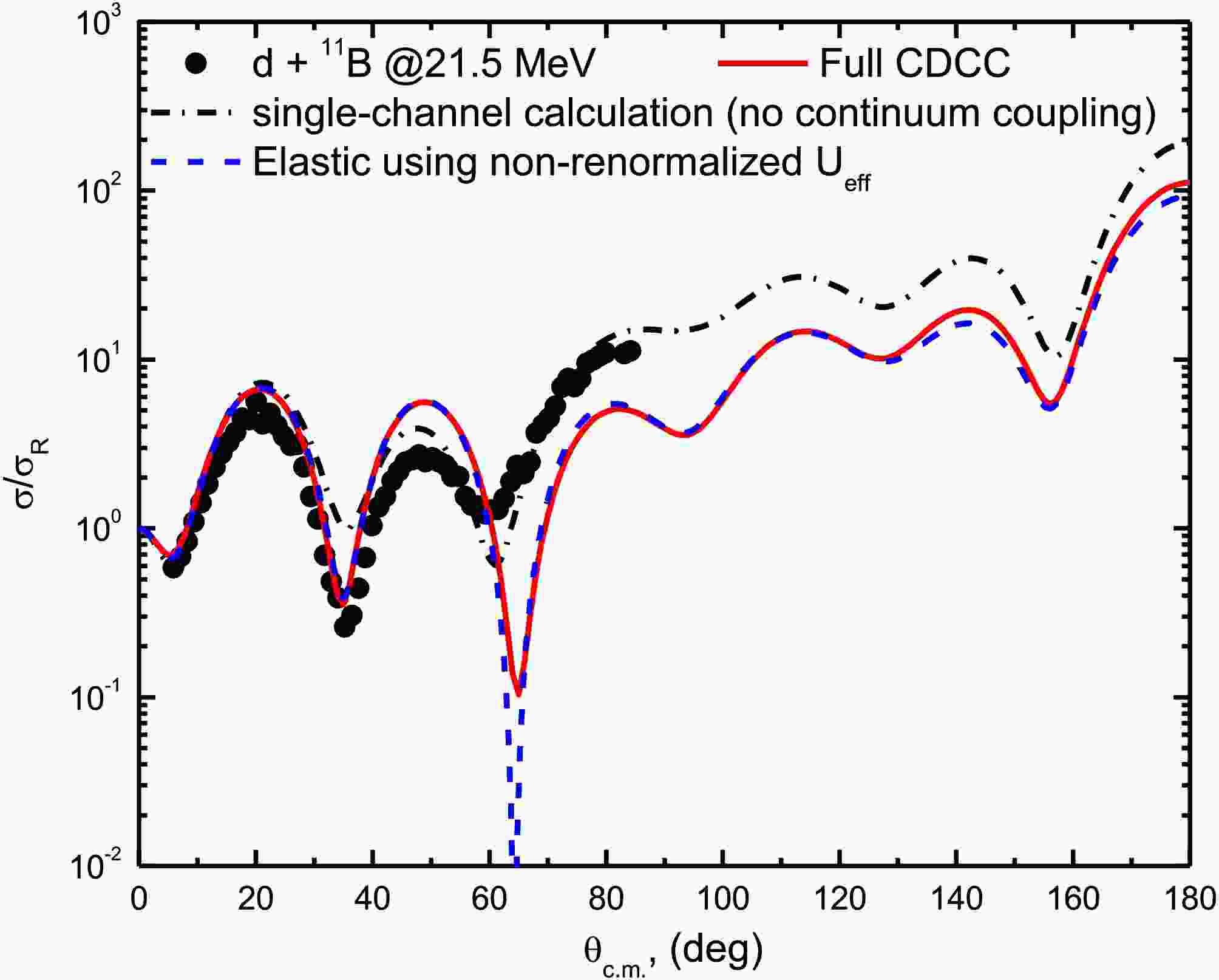
Figure 1 compares the experimental elastic ADs for d + 11B at 21.5 MeV with our CDCC predictions. The solid curve shows the full CDCC result, obtained without any adjustable parameters. Consistent with earlier studies of light-ion scattering, the calculation reproduces the measured data well at forward angles up to roughly 30°. In the intermediate angular region between 30° and 60°, the theoretical predictions overestimate the measured differential cross sections, whereas a clear underestimation appears in the 60°−80° range. To isolate the specific role of breakup couplings, the dashed-dotted curve in Fig. 1 displays the outcome of a single-channel calculation (no continuum coupling) that includes only the deuteron ground state. Comparing this with the full CDCC calculation reveals that breakup couplings induce a substantial reduction in the cross section values at angles beyond 60°. This behavior mirrors observations in other systems, such as d + 58Ni [2] and d + 11Be [32], where single-channel calculations consistently overpredict the elastic scattering data at larger angles.
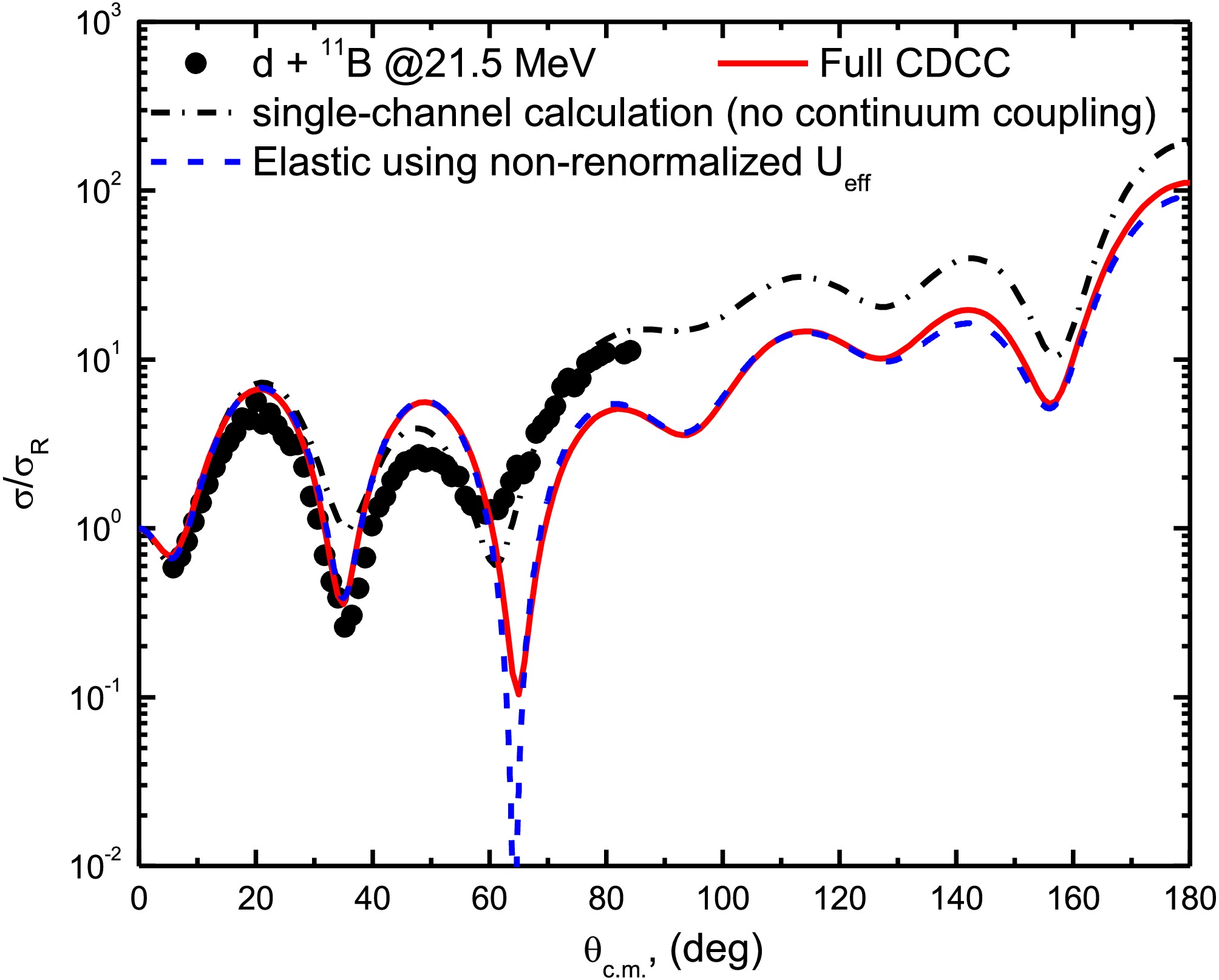
Figure 1. (color online) Experimental d + 11B elastic AD at E = 21.5 MeV (ratio to Rutherford) versus CDCC calculations (full CDCC and single-channel calculation (no continuum coupling)) and calculations within the non-renormalized Ueff potential
Additionally, we analyzed the same elastic data using an effective potential (
$ {U}_{\rm eff} $ ) derived from the microscopic CDCC calculations, as illustrated in Fig. 2. This effective potential combines the cluster-folding potential ($ {U}_{\rm CF} $ ) with the DPP ($ {U}_{\rm DPP} $ ), each containing real and imaginary components that respectively simulate the scattering process and account for flux absorption: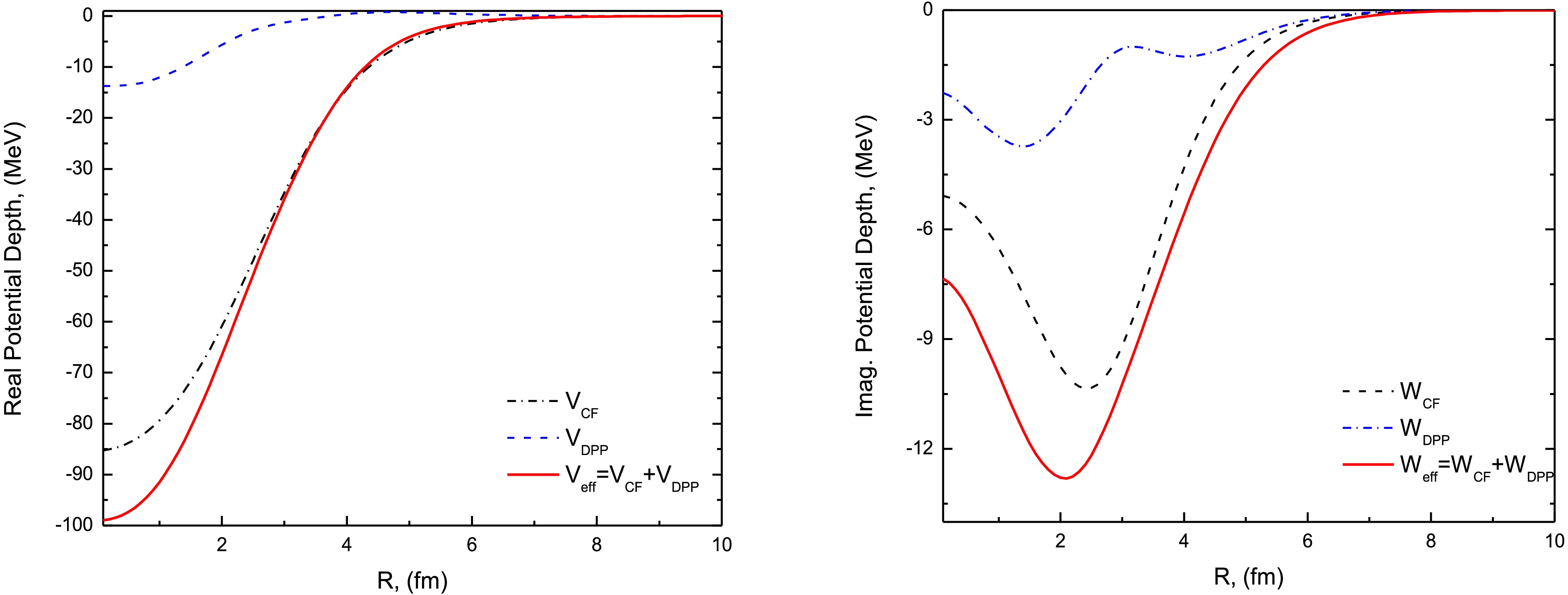
Figure 2. (color online) Generated effective potential (
$ {U}_{\rm eff} $ ) from the microscopic CDCC calculations$ {U}_{\rm eff}(r)={U}_{\rm CF}(r)+{U}_{\rm DPP}(r),\, U=V+W . $
(4) The
$ {U}_{\rm eff} $ is characterized by two normalization parameters, NReff and NIeff, which scale the real and imaginary parts, respectively. In all the calculations presented here, these parameters were fixed at unity, maintaining the parameter-free character of the approach. The elastic scattering ADs obtained with this non-renormalized$ {U}_{\rm eff} $ closely follow the full CDCC result, confirming the consistency between these two representations of the deuteron-target interaction. -
To evaluate quantitatively how the breakup of the deuteron affects the elastic-scattering ADs of the d + 11B system at Elab = 21.5 MeV, we applied the CDCC formalism. In this framework, the continuum located above the deuteron breakup threshold (2.2245 MeV) is truncated and divided into discrete momentum bins. Following the prescription of Ref. [9], we chose a bin width of Δk = 0.125 fm-1 and included bins up to kmax= 0.625 fm-1, which corresponds to a maximum excitation energy of Emax = 16.33 MeV in the n-p continuum. The convergence of the CDCC model space was systematically tested. Varying Δk from 0.1 to 0.15 fm-1 changed the elastic cross section by less than 2% at forward angles and less than 5% at backward angles. Increasing kmax to 0.75 fm-1 altered the results by less than 3%. The partial-wave expansion for the n-p continuum included L = 0 (S-wave) and L = 2 (D-wave) components; L = 1 (P-wave) contributions were explicitly tested and observed to be below 1% of the total breakup cross section at this energy, consistent with the findings of Yahiro et al. [2] for similar deuteron energies. Table 1 summarizes the converged CDCC model-space parameters. One notable advantage of the CDCC method is that it naturally produces the dynamic polarization potential (DPP) originating from couplings to continuum states, thereby giving insight into breakup effects without needing any adjustable parameters.
To construct the deuteron–target interaction, the essential ingredients are the neutron–nucleus and proton–nucleus optical potentials, ideally required at exactly half the incident deuteron energy (10.75 MeV). In practice, exact-energy potentials are not always available. For n + 11B, the potential of Cookson and Locke [28] at 9.72 MeV was used. For p + 11B, we employed the potential of Watson et al. [29] at 12 MeV, which is close to the required half-energy. The parameters of both nucleon potentials are listed in Table 2. These nucleon potentials are folded with the internal wave function of the deuteron using a cluster-folding technique to obtain both the real and imaginary parts of the deuteron–nucleus interaction:
$ \begin{split} & {V}^{CF}(\boldsymbol{R})\\&=\int \left[{V}_{n-{{}^{11}}\text{B}}\left(\boldsymbol{R-}\frac{1}{2}\boldsymbol{r}\right)+{V}_{p{-^{11}}\text{B}}\left(\boldsymbol{R}+\frac{1}{2}\boldsymbol{r}\right)\right]{\left| {\chi }_{n-p}(\boldsymbol{r})\right| }^{2}{\mathrm{d}}\boldsymbol{r} , \end{split} $
(1) $ \begin{split} & {W}^{CF}(\boldsymbol{R})\\ &=\int \left[{W}_{n-{{}^{11}}\mathrm{B}}\left(\boldsymbol{R-}\frac{1}{2}\boldsymbol{r}\right)+{W}_{p{-^{11}}\mathrm{B}}\left(\boldsymbol{R}+\frac{1}{2}\boldsymbol{r}\right)\right]{\left| {\chi }_{n-p}(\boldsymbol{r})\right| }^{2}{\mathrm{d}}\boldsymbol{r} , \end{split} $
(2) where (
$ {V}_{n-{{}^{11}}\text{B}} $ and$ {V}_{p{{-}^{11}}\text{B}} $ ) and ($ {W}_{n-{{}^{11}}\text{B}} $ and$ {W}_{p{{-}^{11}}\text{B}} $ ) are the real and imaginary components of the optical potentials for the n + 11B and p + 11B channels, respectively. The optimal n + 11B and p + 11B potentials employed in our CDCC calculations are listed in Table 2. The quantity$ {\chi }_{n-p}(\boldsymbol{r}) $ represents the deuteron internal wave function describing its cluster structure. The deuteron wave function was calculated using the Gaussian n + p binding potential of Iseri et al. [30]:$ {V}_{n-p}={V}_{0}\exp -{(r/{{r}_{0}})}^{2}. $
(3) Both S- and D-wave components were included, with potential depths V0 = 72.15 MeV for the S-component and V0 = 515.26 MeV for the D-component, and a common range parameter r0 = 1.484 fm, following the parametrization of Lacombe et al. [31]. The SAs for the S- and D-components were taken as 0.9706 and 0.2410, respectively, reproducing the deuteron binding energy and quadrupole moment.
Figure 1 compares the experimental elastic ADs for d + 11B at 21.5 MeV with our CDCC predictions. The solid curve shows the full CDCC result, obtained without any adjustable parameters. Consistent with earlier studies of light-ion scattering, the calculation reproduces the measured data well at forward angles up to roughly 30°. In the intermediate angular region between 30° and 60°, the theoretical predictions overestimate the measured differential cross sections, whereas a clear underestimation appears in the 60°−80° range. To isolate the specific role of breakup couplings, the dashed-dotted curve in Fig. 1 displays the outcome of a single-channel calculation (no continuum coupling) that includes only the deuteron ground state. Comparing this with the full CDCC calculation reveals that breakup couplings induce a substantial reduction in the cross section values at angles beyond 60°. This behavior mirrors observations in other systems, such as d + 58Ni [2] and d + 11Be [32], where single-channel calculations consistently overpredict the elastic scattering data at larger angles.
Figure 1. (color online) Experimental d + 11B elastic AD at E = 21.5 MeV (ratio to Rutherford) versus CDCC calculations (full CDCC and single-channel calculation (no continuum coupling)) and calculations within the non-renormalized Ueff potential
Additionally, we analyzed the same elastic data using an effective potential (
$ {U}_{\rm eff} $ ) derived from the microscopic CDCC calculations, as illustrated in Fig. 2. This effective potential combines the cluster-folding potential ($ {U}_{\rm CF} $ ) with the DPP ($ {U}_{\rm DPP} $ ), each containing real and imaginary components that respectively simulate the scattering process and account for flux absorption:
Figure 2. (color online) Generated effective potential (
$ {U}_{\rm eff} $ ) from the microscopic CDCC calculations$ {U}_{\rm eff}(r)={U}_{\rm CF}(r)+{U}_{\rm DPP}(r),\, U=V+W . $
(4) The
$ {U}_{\rm eff} $ is characterized by two normalization parameters, NReff and NIeff, which scale the real and imaginary parts, respectively. In all the calculations presented here, these parameters were fixed at unity, maintaining the parameter-free character of the approach. The elastic scattering ADs obtained with this non-renormalized$ {U}_{\rm eff} $ closely follow the full CDCC result, confirming the consistency between these two representations of the deuteron-target interaction. -
Beyond the breakup effects that manifest at lower projectile energies, additional reaction mechanisms—particularly nucleon transfer processes—can substantially modify elastic scattering angular distributions. This section examines how various transfer channels couple to the elastic channel and alter the predicted cross sections for the d + 11B system.
-
Beyond the breakup effects that manifest at lower projectile energies, additional reaction mechanisms—particularly nucleon transfer processes—can substantially modify elastic scattering angular distributions. This section examines how various transfer channels couple to the elastic channel and alter the predicted cross sections for the d + 11B system.
-
To investigate how neutron stripping influences the elastic scattering ADs, we analyzed previously measured ADs for the 11B(d, p)12B reaction at Ed = 21.5 MeV [18]. These measurements include transitions to four distinct states in 12B: (1+, 0.0 MeV), (2+, 0.953 MeV), (2–, 1.674 MeV), and (Jπ = 0+, 2.72 MeV). The (1–, 2.62 MeV) and (3–, 3.39 MeV) 12B states were omitted because they are unbound or very weakly bound, requiring a more sophisticated treatment of the continuum in the exit channel, and their spectroscopic factors are small [18]; their inclusion is not expected to affect the coupling effects on elastic scattering significantly. Our CRC calculations were performed in the post form, including full complex remnant terms and non-orthogonality corrections as implemented in FRESCO code, following the same conventions as Ref. [18] to ensure a meaningful comparison of SAs. For the entrance d + 11B channel, we utilized the previously generated
$ {U}_{\rm eff} $ (see Fig. 2) without any renormalizations, maintaining consistency with the breakup analysis. For the exit p + 12B channel, we employed the potential of Liu et al. [33] without modification. This potential was originally constrained by elastic scattering data at nearby energies and has been used successfully in a previous (d, p) study [18]. Therefore, we adopt it without further adjustment, avoiding the potential ambiguities associated with searching on exit channel parameters. The binding potentials for the overlaps followed the same conventions as in Ref. [18]: a Gaussian potential for the n + p (deuteron) system with V0 = 72.15 MeV and r0 = 1.484 fm, and Woods-Saxon potentials for the n + 11B overlaps with r0 = 1.25 fm and a0 = 0.65 fm, with depths adjusted to reproduce the neutron binding energies of the respective 12B states.Figure 3 compares the experimental ADs for the 11B(d, p)12B reaction leading to the four aforementioned 12B states with our CRC calculations. The theoretical curves, shown as solid lines, demonstrate reasonably good agreement with the measured cross sections across the entire angular range. The (2+, 0.953 MeV)12B state was assigned a 3P1/2 configuration in Ref. [18], which is not credible for such a light system. Shell-model calculations by Cohen and Kurath [34] indicate that this state should be a mixture of 1P3/2 and 1P1/2, with a dominant 1P1/2 component. Therefore, we have considered the (d, p) cross section for this state assuming a pure 1P1/2 configuration.
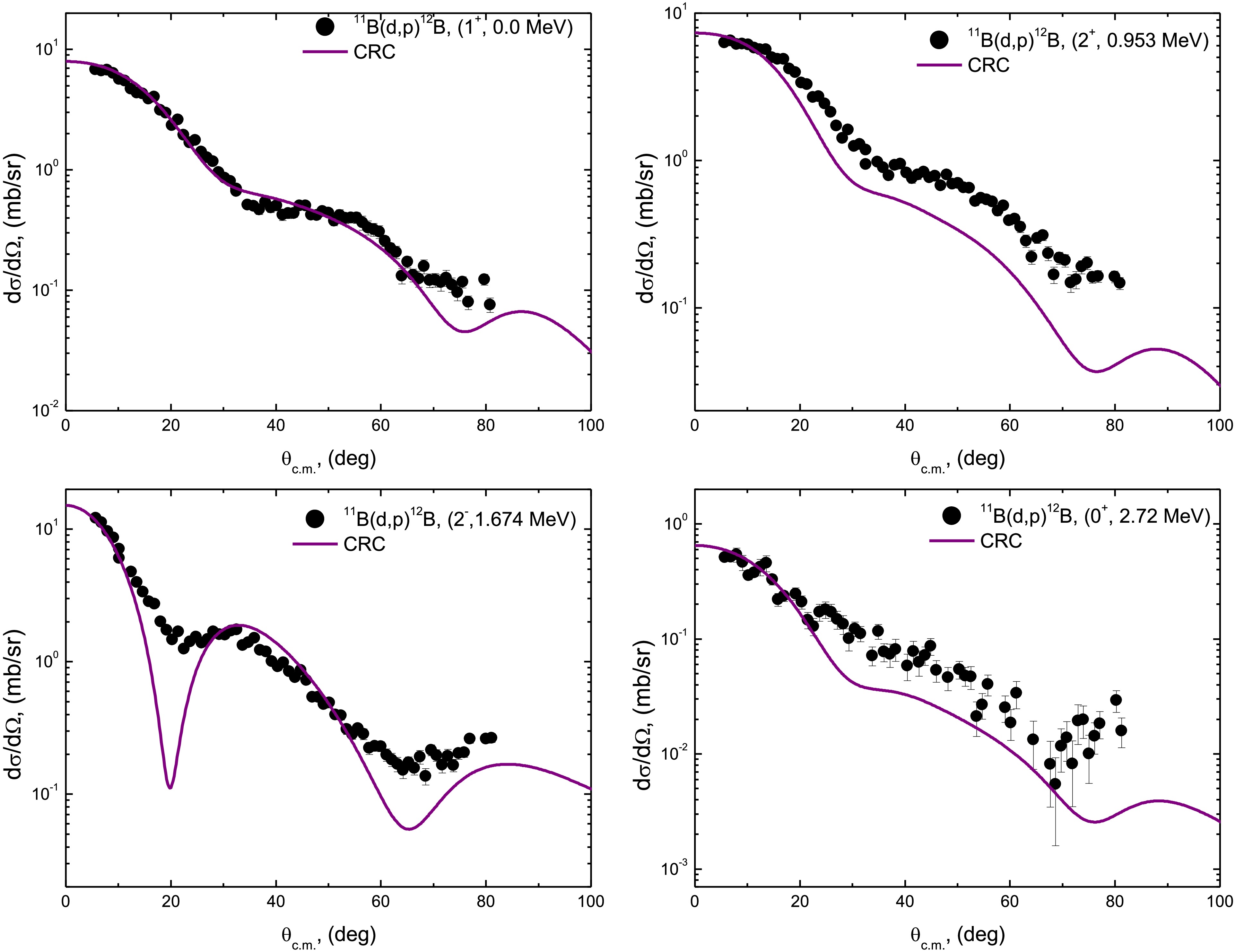
Figure 3. (color online) Measured ADs for the 11B(d, p)12B reaction at Elab = 21.5 MeV populating the (1+, 0.0 MeV), (2+, 0.953 MeV), (2–, 1.674 MeV), and (0+, 2.72 MeV) states of 12B (circles) compared with CRC calculations (curves)
The optimal SAs for the configurations: 12B(1+, 0.0) → 11B + n, 12B*(2+, 0.953) → 11B + n, 12B*(2-, 1.674) → 11B + n , and 12B*(0+, 2.72) → 11B + n were derived by fitting the experimental data across the full angular range while minimizing χ2/N, as illustrated in Fig. 4. The extracted SA values, presented in Table 3, are in good agreement with those previously reported in Ref. [18] where available, with the exception noted above. Regarding the quality of fits, the (2-, 1.674 MeV) state yields χ2/N ≈ 104, with a calculated diffraction minimum near 20° that is absent in the data; therefore, the SA for this state should be regarded as indicative rather than definitive. For the remaining states, χ2/N values are in the range 2.5−10.5, which is acceptable for CRC calculations at this energy. The SA value for the configurations 12B*(2+, 0.953) → 11B + n (SA= 0.549) is in reasonable agreement with the previously reported theoretical value (SA= 0.748) from Ref. [34].
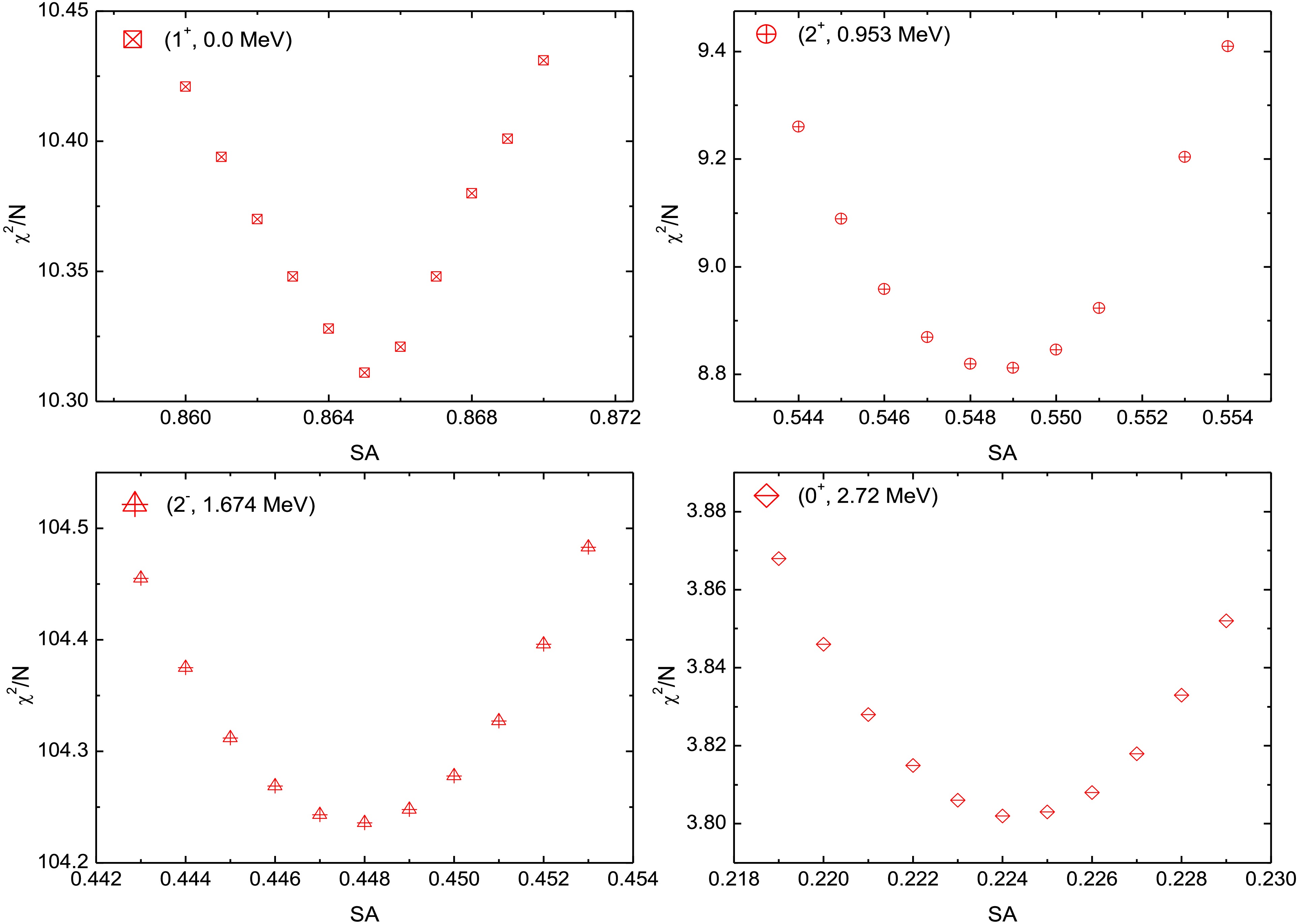
Figure 4. (color online) Dependence of the χ2/N value on the extracted SAs obtained from CRC computations for the 11B(d, p)12B reaction at Elab= 21.5 MeV. The panels correspond to transitions to the (1+, 0.0 MeV), (2+, 0.953 MeV), (2–, 1.674 MeV), and (0+, 2.72 MeV) states in 12B.
-
To investigate how neutron stripping influences the elastic scattering ADs, we analyzed previously measured ADs for the 11B(d, p)12B reaction at Ed = 21.5 MeV [18]. These measurements include transitions to four distinct states in 12B: (1+, 0.0 MeV), (2+, 0.953 MeV), (2–, 1.674 MeV), and (Jπ = 0+, 2.72 MeV). The (1–, 2.62 MeV) and (3–, 3.39 MeV) 12B states were omitted because they are unbound or very weakly bound, requiring a more sophisticated treatment of the continuum in the exit channel, and their spectroscopic factors are small [18]; their inclusion is not expected to affect the coupling effects on elastic scattering significantly. Our CRC calculations were performed in the post form, including full complex remnant terms and non-orthogonality corrections as implemented in FRESCO code, following the same conventions as Ref. [18] to ensure a meaningful comparison of SAs. For the entrance d + 11B channel, we utilized the previously generated
$ {U}_{\rm eff} $ (see Fig. 2) without any renormalizations, maintaining consistency with the breakup analysis. For the exit p + 12B channel, we employed the potential of Liu et al. [33] without modification. This potential was originally constrained by elastic scattering data at nearby energies and has been used successfully in a previous (d, p) study [18]. Therefore, we adopt it without further adjustment, avoiding the potential ambiguities associated with searching on exit channel parameters. The binding potentials for the overlaps followed the same conventions as in Ref. [18]: a Gaussian potential for the n + p (deuteron) system with V0 = 72.15 MeV and r0 = 1.484 fm, and Woods-Saxon potentials for the n + 11B overlaps with r0 = 1.25 fm and a0 = 0.65 fm, with depths adjusted to reproduce the neutron binding energies of the respective 12B states.Figure 3 compares the experimental ADs for the 11B(d, p)12B reaction leading to the four aforementioned 12B states with our CRC calculations. The theoretical curves, shown as solid lines, demonstrate reasonably good agreement with the measured cross sections across the entire angular range. The (2+, 0.953 MeV)12B state was assigned a 3P1/2 configuration in Ref. [18], which is not credible for such a light system. Shell-model calculations by Cohen and Kurath [34] indicate that this state should be a mixture of 1P3/2 and 1P1/2, with a dominant 1P1/2 component. Therefore, we have considered the (d, p) cross section for this state assuming a pure 1P1/2 configuration.
Figure 3. (color online) Measured ADs for the 11B(d, p)12B reaction at Elab = 21.5 MeV populating the (1+, 0.0 MeV), (2+, 0.953 MeV), (2–, 1.674 MeV), and (0+, 2.72 MeV) states of 12B (circles) compared with CRC calculations (curves)
The optimal SAs for the configurations: 12B(1+, 0.0) → 11B + n, 12B*(2+, 0.953) → 11B + n, 12B*(2-, 1.674) → 11B + n , and 12B*(0+, 2.72) → 11B + n were derived by fitting the experimental data across the full angular range while minimizing χ2/N, as illustrated in Fig. 4. The extracted SA values, presented in Table 3, are in good agreement with those previously reported in Ref. [18] where available, with the exception noted above. Regarding the quality of fits, the (2-, 1.674 MeV) state yields χ2/N ≈ 104, with a calculated diffraction minimum near 20° that is absent in the data; therefore, the SA for this state should be regarded as indicative rather than definitive. For the remaining states, χ2/N values are in the range 2.5−10.5, which is acceptable for CRC calculations at this energy. The SA value for the configurations 12B*(2+, 0.953) → 11B + n (SA= 0.549) is in reasonable agreement with the previously reported theoretical value (SA= 0.748) from Ref. [34].
Figure 4. (color online) Dependence of the χ2/N value on the extracted SAs obtained from CRC computations for the 11B(d, p)12B reaction at Elab= 21.5 MeV. The panels correspond to transitions to the (1+, 0.0 MeV), (2+, 0.953 MeV), (2–, 1.674 MeV), and (0+, 2.72 MeV) states in 12B.
Configuration nLj SA (P.W.) Ref.
12B(1+, 0.0) → 11B + n1P1/2 0.374* [18] 1P3/2 0.865 This work 12B*(2+, 0.953) → 11B + n 1P1/2 0.549 This work 12B*(2-, 1.674) → 11B + n 2S1/2 0.448 This work 12B*(0+, 2.72) → 11B + n 1P3/2 0.224 This work 3H → d + n 1S1/2 1.2274* [36] 11B → 10B(3+, 0.0) + n 1P3/2 1.05* [34]
11B → 10B* (1+, 0.718) + n1P3/2 0.27* [34] 1P1/2 0.64 This work 3He → d + p 1S1/2 1.2247* [36] 11B → 10Be + p 1P3/2 0.39 This work Table 3. List of SAs used in the CRC computations for the 11B(d, p)12B, 11B(d, t)10B, and 11B(d, 3He)10Be reactions. The asterisks denote SA values that were fixed according to literature data.
-
We next examined how neutron pickup influences the d + 11B elastic scattering channel by analyzing the 11B(d, t)10B reaction at Ed= 18 MeV [19]. This dataset includes transitions to the following 10B ground state (3+, 0.0 MeV) and the first excited state (1+, 0.718 MeV). The CRC calculations for this reaction require optical potentials for both the entrance (d + 11B) and exit (t + 10B) channels, together with SAs describing the relevant nuclear overlaps. For the entrance channel, we again employed the non-renormalized
$ {U}_{\rm eff} $ derived from our CDCC calculations. The optical potential for the exit t + 10B channel was adopted from the global triton parameterization of Pang et al. [35]. Our CRC calculations for the (d, t) reaction were performed consistently with the (d, p) analysis described in Section III. A, using the prior form of CRC with full complex remnant terms and non-orthogonality corrections as implemented in FRESCO code. The binding potentials for the overlaps followed the same conventions as in Ref. [18]: a Woods-Saxon potential for the n + 10B overlaps with r0 = 1.25 fm and a0 = 0.65 fm, with depths adjusted to reproduce the neutron binding energies of the respective 10B states.To obtain an optimal description of the transfer data, we performed a search using the SFRESCO code. For the 10B ground state (3+, 0.0 MeV), the 1P3/2 component was fixed to the literature value of 1.05 from Cohen and Kurath [34]. For the (1+, 0.718 MeV) state, the 1P3/2 component was fixed to 0.27 from the same source, whereas the 1P1/2 component was varied to fit the data, yielding a value of 0.64, which is in reasonable agreement with the reported value (SA=0.44) from Ref. [34]. The potentials employed for the entrance and exit channels are listed in Table 2. Figure 5 presents a comparison between the experimental ADs for the 11B(d, t)10B reaction at Ed = 18 MeV, populating the (3+, 0.0 MeV) and (1+, 0.718 MeV) states of 10B, and our theoretical CRC predictions.
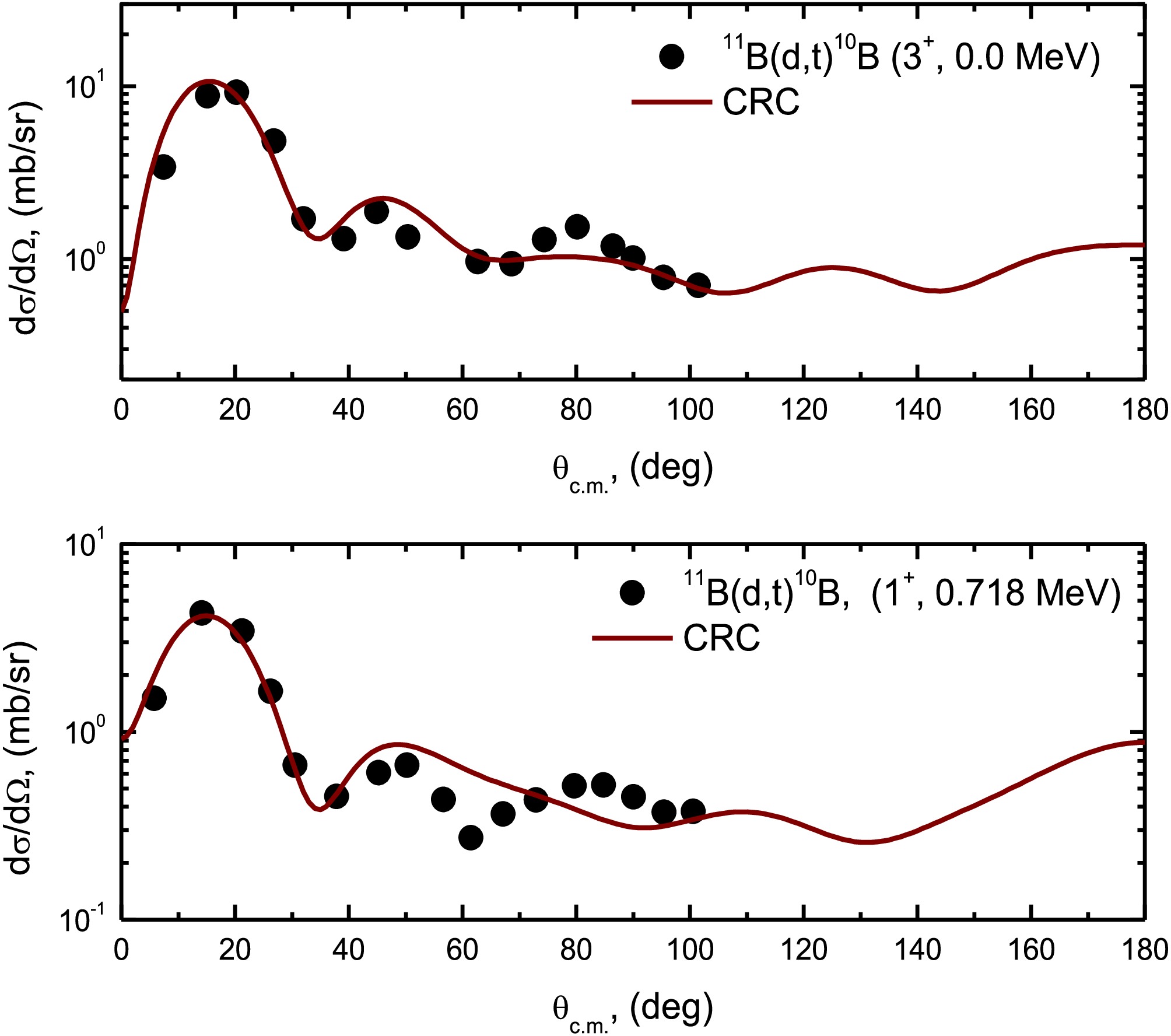
Figure 5. Measured ADs for the 11B(d,t)10B reaction at Elab = 18 MeV, populating the (3+, 0.0 MeV) and (1+, 0.718 MeV) states of 10B (circles), compared with CRC calculations (curves).
-
We next examined how neutron pickup influences the d + 11B elastic scattering channel by analyzing the 11B(d, t)10B reaction at Ed= 18 MeV [19]. This dataset includes transitions to the following 10B ground state (3+, 0.0 MeV) and the first excited state (1+, 0.718 MeV). The CRC calculations for this reaction require optical potentials for both the entrance (d + 11B) and exit (t + 10B) channels, together with SAs describing the relevant nuclear overlaps. For the entrance channel, we again employed the non-renormalized
$ {U}_{\rm eff} $ derived from our CDCC calculations. The optical potential for the exit t + 10B channel was adopted from the global triton parameterization of Pang et al. [35]. Our CRC calculations for the (d, t) reaction were performed consistently with the (d, p) analysis described in Section III. A, using the prior form of CRC with full complex remnant terms and non-orthogonality corrections as implemented in FRESCO code. The binding potentials for the overlaps followed the same conventions as in Ref. [18]: a Woods-Saxon potential for the n + 10B overlaps with r0 = 1.25 fm and a0 = 0.65 fm, with depths adjusted to reproduce the neutron binding energies of the respective 10B states.To obtain an optimal description of the transfer data, we performed a search using the SFRESCO code. For the 10B ground state (3+, 0.0 MeV), the 1P3/2 component was fixed to the literature value of 1.05 from Cohen and Kurath [34]. For the (1+, 0.718 MeV) state, the 1P3/2 component was fixed to 0.27 from the same source, whereas the 1P1/2 component was varied to fit the data, yielding a value of 0.64, which is in reasonable agreement with the reported value (SA=0.44) from Ref. [34]. The potentials employed for the entrance and exit channels are listed in Table 2. Figure 5 presents a comparison between the experimental ADs for the 11B(d, t)10B reaction at Ed = 18 MeV, populating the (3+, 0.0 MeV) and (1+, 0.718 MeV) states of 10B, and our theoretical CRC predictions.
Figure 5. Measured ADs for the 11B(d,t)10B reaction at Elab = 18 MeV, populating the (3+, 0.0 MeV) and (1+, 0.718 MeV) states of 10B (circles), compared with CRC calculations (curves).
-
Finally, we examined the coupling effects arising from the (d, 3He) proton transfer reaction on the d + 11B elastic scattering channel. To this end, we analyzed previously measured ADs for the 11B(d, 3He)10Be reaction at Ed = 22 MeV, which populate the 10Be ground state [20], using the CRC formalism. For the entrance d + 11B channel, we again employed the non-renormalized effective potential derived from our CDCC calculations. The exit channel 3He + 10Be potential was taken in accordance with Ref. [35]. As in the previous transfer calculations, the CRC calculations were performed in the prior form, including full complex remnant terms and non-orthogonality corrections as implemented in FRESCO code. Woods-Saxon type binding potentials, with conventional geometrical values r0 = 1.25 fm and a0 = 0.65 fm, were employed to describe the 3He and 11B wave functions. The CRC results were observed to be in reasonable accordance with the measurements of Ref. [20], as displayed in Fig. 6.
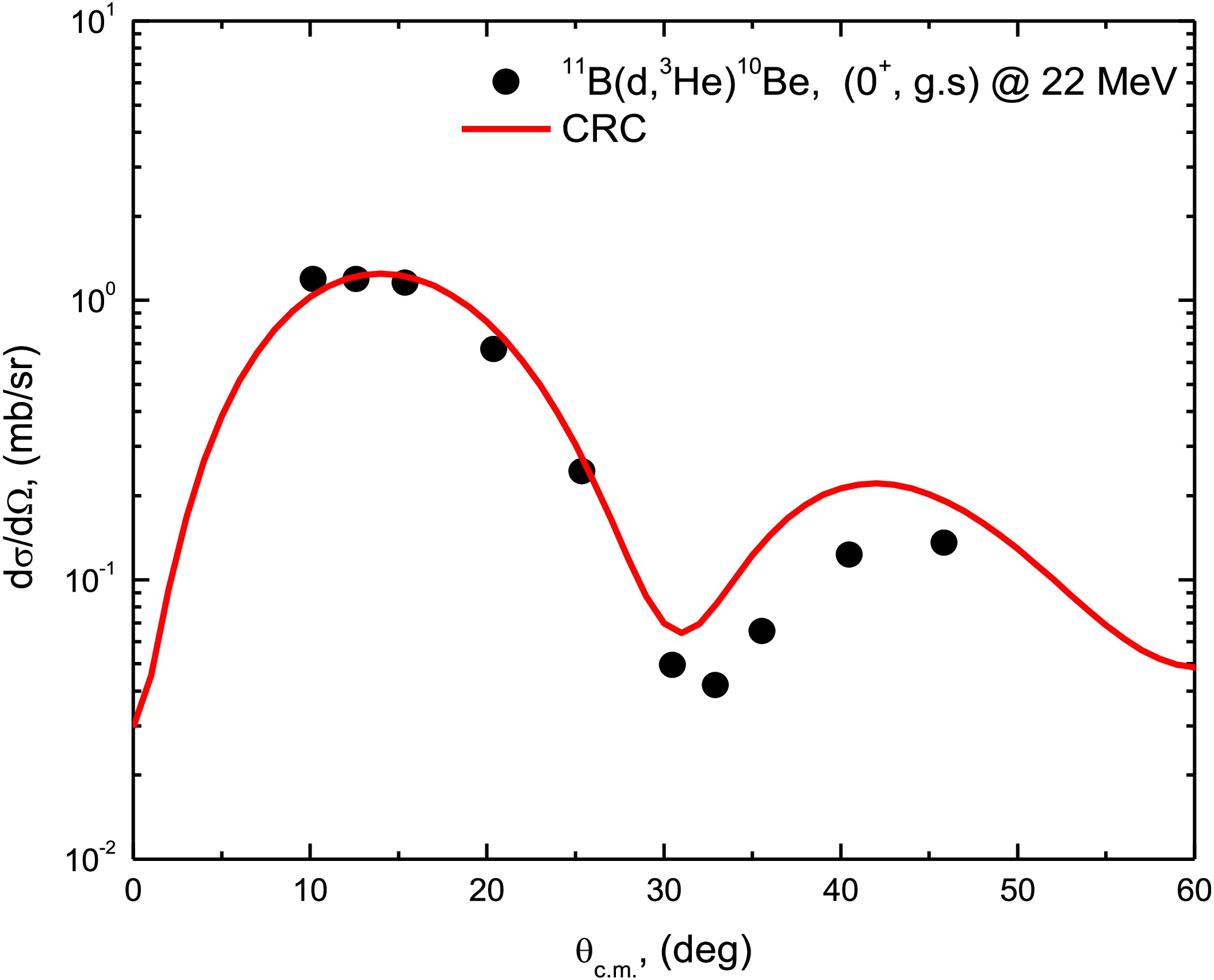
Figure 6. (color online) Measured ADs for the 11B(d, 3He)10Be reaction at Elab = 22 MeV, populating the (0+, 0.0 MeV) 10Be ground state (circles), compared with CRC calculations (curves)
To assess the relative importance of different transfer channels on the d + 11B elastic scattering, we performed four calculations: breakup only, breakup+(d, p), breakup+(d, p)+ (d, t), and breakup+(d, p)+ (d, t)+ (d, 3He). These calculations were performed using the potentials listed in Table II and the overlaps given in Table III. In all cases, the previously generated Ueff from the CDCC computations (without any renormalization) was employed for the d + 11B entrance channel. As illustrated in Fig. 7, the calculated d + 11B ADs are presented as ratio to Rutherford. The dotted curve shows the breakup-only (CDCC) result. Adding the (d, p) coupling alone (dashed curve) has very little influence on the elastic scattering angular distribution, as it remains close to the breakup-only result (dotted curve). In contrast, the further inclusion of the (d, t) coupling (dashed-dotted curve) produces a significant effect over a broad angular range, from approximately 40° to 100° and also at angles greater than ~130°. The solid curve, which additionally includes the (d, 3He) channel, is almost indistinguishable from the dashed-dotted curve, confirming that the proton pickup contribution is negligible. These findings are consistent with those of Amar et al. [14] at 14.5 MeV, where the (d, t) coupling also dominated and the (d, p) coupling had very little influence. Importantly, none of the calculated curves fully resolve the discrepancies in the intermediate angular region, and the full coupling still overshoots the data in some parts. This indicates that, although the (d, t) transfer channel is necessary to describe the elastic scattering, other missing physics (possibly target excitation or more complex reaction paths) remains important.
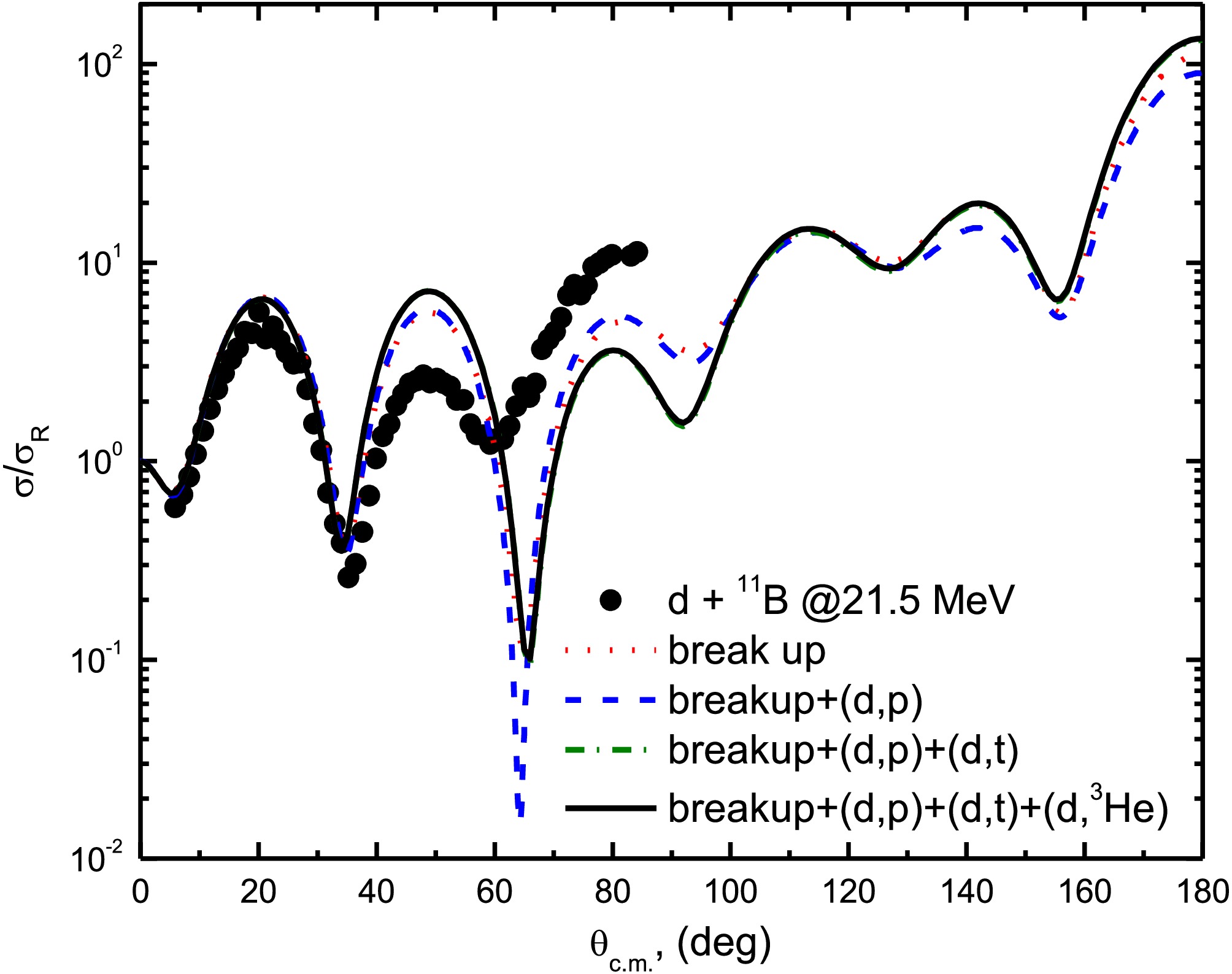
Figure 7. (color online) Measured ADs for d + 11B elastic scattering at Elab = 21.5 MeV (ratio to Rutherford) compared with CDCC and CDCC+CRC calculations. The different curves correspond to progressively including more reaction channels: dotted – breakup only; dashed – breakup plus (d, p); dashed-dotted – breakup plus (d, p) and (d, t); solid – breakup plus (d, p), (d, t), and (d, 3He).
-
Finally, we examined the coupling effects arising from the (d, 3He) proton transfer reaction on the d + 11B elastic scattering channel. To this end, we analyzed previously measured ADs for the 11B(d, 3He)10Be reaction at Ed = 22 MeV, which populate the 10Be ground state [20], using the CRC formalism. For the entrance d + 11B channel, we again employed the non-renormalized effective potential derived from our CDCC calculations. The exit channel 3He + 10Be potential was taken in accordance with Ref. [35]. As in the previous transfer calculations, the CRC calculations were performed in the prior form, including full complex remnant terms and non-orthogonality corrections as implemented in FRESCO code. Woods-Saxon type binding potentials, with conventional geometrical values r0 = 1.25 fm and a0 = 0.65 fm, were employed to describe the 3He and 11B wave functions. The CRC results were observed to be in reasonable accordance with the measurements of Ref. [20], as displayed in Fig. 6.
Figure 6. (color online) Measured ADs for the 11B(d, 3He)10Be reaction at Elab = 22 MeV, populating the (0+, 0.0 MeV) 10Be ground state (circles), compared with CRC calculations (curves)
To assess the relative importance of different transfer channels on the d + 11B elastic scattering, we performed four calculations: breakup only, breakup+(d, p), breakup+(d, p)+ (d, t), and breakup+(d, p)+ (d, t)+ (d, 3He). These calculations were performed using the potentials listed in Table II and the overlaps given in Table III. In all cases, the previously generated Ueff from the CDCC computations (without any renormalization) was employed for the d + 11B entrance channel. As illustrated in Fig. 7, the calculated d + 11B ADs are presented as ratio to Rutherford. The dotted curve shows the breakup-only (CDCC) result. Adding the (d, p) coupling alone (dashed curve) has very little influence on the elastic scattering angular distribution, as it remains close to the breakup-only result (dotted curve). In contrast, the further inclusion of the (d, t) coupling (dashed-dotted curve) produces a significant effect over a broad angular range, from approximately 40° to 100° and also at angles greater than ~130°. The solid curve, which additionally includes the (d, 3He) channel, is almost indistinguishable from the dashed-dotted curve, confirming that the proton pickup contribution is negligible. These findings are consistent with those of Amar et al. [14] at 14.5 MeV, where the (d, t) coupling also dominated and the (d, p) coupling had very little influence. Importantly, none of the calculated curves fully resolve the discrepancies in the intermediate angular region, and the full coupling still overshoots the data in some parts. This indicates that, although the (d, t) transfer channel is necessary to describe the elastic scattering, other missing physics (possibly target excitation or more complex reaction paths) remains important.
Figure 7. (color online) Measured ADs for d + 11B elastic scattering at Elab = 21.5 MeV (ratio to Rutherford) compared with CDCC and CDCC+CRC calculations. The different curves correspond to progressively including more reaction channels: dotted – breakup only; dashed – breakup plus (d, p); dashed-dotted – breakup plus (d, p) and (d, t); solid – breakup plus (d, p), (d, t), and (d, 3He).
-
The d + 11B elastic scattering at Ed = 21.5 MeV has been analyzed using CDCC and combined CDCC + CRC approaches. Breakup effects, treated within the CDCC framework, are crucial for describing forward-angle scattering. However, a satisfactory description of the full angular range remains challenging. The (d, p) neutron stripping channel has very little influence on the elastic scattering at this energy, whereas the (d, t) neutron pickup channel produces a significant effect over a broad angular range, from approximately 40° to 100° and also at angles greater than ~130°. The (d, 3He) proton pickup channel plays a negligible role. These results confirm the findings of Amar et al. [14] at 14.5 MeV: the (d, t) neutron pickup channel dominates the transfer coupling effects on elastic scattering in the d + 11B system, whereas the (d, p) stripping channel has very little influence, even at the higher incident energy of 21.5 MeV.
In a complementary study on the neighboring d + 13C system, Janseitov et al. [17] also observed that deuteron breakup alone is insufficient and that neutron stripping plays a major role. However, in contrast to the present results for d + 11B, they observed that neutron pickup (d, t) had only a minor effect, whereas proton stripping (d, n) was significant—differences attributable to the distinct spectroscopic amplitudes of the two targets.
The present analysis demonstrates that a realistic description of deuteron-induced reactions on light nuclei must account simultaneously for breakup and neutron transfer mechanisms, but also highlights that additional effects (e.g., target excitation or multistep processes) likely contribute to the intermediate-angle region. Spectroscopic amplitudes for the following configurations: 12B(1+,0.0) → 11B + n, 12B*(2+, 0.953) → 11B + n, 12B*(2-, 1.674) → 11B + n, 12B*(0+, 2.72) → 11B + n, and 11B → 10B* (1+, 0.718) + n were extracted and compared with those in literature.
-
The d + 11B elastic scattering at Ed = 21.5 MeV has been analyzed using CDCC and combined CDCC + CRC approaches. Breakup effects, treated within the CDCC framework, are crucial for describing forward-angle scattering. However, a satisfactory description of the full angular range remains challenging. The (d, p) neutron stripping channel has very little influence on the elastic scattering at this energy, whereas the (d, t) neutron pickup channel produces a significant effect over a broad angular range, from approximately 40° to 100° and also at angles greater than ~130°. The (d, 3He) proton pickup channel plays a negligible role. These results confirm the findings of Amar et al. [14] at 14.5 MeV: the (d, t) neutron pickup channel dominates the transfer coupling effects on elastic scattering in the d + 11B system, whereas the (d, p) stripping channel has very little influence, even at the higher incident energy of 21.5 MeV.
In a complementary study on the neighboring d + 13C system, Janseitov et al. [17] also observed that deuteron breakup alone is insufficient and that neutron stripping plays a major role. However, in contrast to the present results for d + 11B, they observed that neutron pickup (d, t) had only a minor effect, whereas proton stripping (d, n) was significant—differences attributable to the distinct spectroscopic amplitudes of the two targets.
The present analysis demonstrates that a realistic description of deuteron-induced reactions on light nuclei must account simultaneously for breakup and neutron transfer mechanisms, but also highlights that additional effects (e.g., target excitation or multistep processes) likely contribute to the intermediate-angle region. Spectroscopic amplitudes for the following configurations: 12B(1+,0.0) → 11B + n, 12B*(2+, 0.953) → 11B + n, 12B*(2-, 1.674) → 11B + n, 12B*(0+, 2.72) → 11B + n, and 11B → 10B* (1+, 0.718) + n were extracted and compared with those in literature.
Coupling and breakup effects of deuteron on d + 11B system
- Received Date: 2026-05-07
- Available Online: 2026-10-15
Abstract: In the present study, we examine the reaction dynamics of the d + 11B system with a special focus on the interplay between deuteron breakup and nucleon transfer mechanisms. Elastic scattering data at Ed = 21.5 MeV are analyzed using the continuum-discretized coupled-channel (CDCC) framework to assess the role of breakup couplings. In addition, coupled-reaction-channel (CRC) calculations are performed for the 11B(d, p)12B neutron stripping reaction at 21.5 MeV, the 11B(d, t)10B neutron pickup reaction at 18 MeV, and the 11B(d, 3He)10Be proton pickup reaction at 22 MeV. The CDCC calculations successfully reproduce the elastic angular distribution at forward angles without introducing renormalization factors, confirming the importance of continuum coupling effects. Nevertheless, deviations observed at larger angles suggest that breakup alone is insufficient. The (d, p) neutron stripping channel has negligible influence on the elastic scattering at this energy, whereas the (d, t) neutron pickup channel significantly modifies the calculated elastic cross sections over a broad angular range. The proton pickup channel produces only a minor effect. The present analysis demonstrates that neutron pickup, rather than stripping, is the primary transfer mechanism affecting d + 11B elastic scattering at this incident energy.



 DownLoad: