


 Abstract
 HTML
 Reference
 Related
 PDF



-
The pp tune reported in Ref. [1] was constructed as a sequential retune of PYTHIA 8.316 [2, 3] around the Monash 2013 baseline for soft-QCD observables in proton–proton collisions. A separate pp validation against ATLAS underlying-event and azimuthal-ordering data at
$ \sqrt{s}=0.9 $ and 7 TeV showed improvements in several measurement groups [4]. A useful test is to determine whether the non-perturbative parameter values obtained from pp collisions also describe$ e^+e^- $ data. In$ e^+e^- $ annihilation, there are no beam remnants and no multiparton interactions; therefore, the comparison is driven directly by fragmentation, flavour production, and baryon formation. The B-factory data near the$ \Upsilon(4S) $ thus provide a direct test of the extent to which a pp-derived non-perturbative tune can be applied to$ e^+e^- $ collisions before a dedicated channel-specific refinement becomes necessary. Previous pp studies show that the performance of PYTHIA depends on the observable, particle species, and kinematic region [5−7]. This motivates a separate test of the pp-derived parameters using$ e^+e^- $ data.The available measurements are now sufficiently broad to make this comparison meaningful. Near
$ \sqrt{s}= 10.52 $ –10.58 GeV, BELLE and BABAR provide identified charged-hadron spectra, baryon production spectra, single- and dihadron distributions, and light- and charm-meson spectra [8−12]. These measurements constrain distinct parts of the string-fragmentation model [13] while remaining sufficiently close in energy that the comparison is not obscured by a large beam-energy lever arm. They therefore offer a compact but stringent basis for an$ e^+e^- $ tune refinement. The starting point of the present$ e^+e^- $ study is the nine-parameter pp tune of Ref. [1], evaluated in a channel in which colour reconnection and multiparton interactions are not used in this setup. In practice, this reduces the effective starting point to a five-parameter hadronization subset. This subset gives competitive scores for several selected B-factory observables, but it does not surpass Monash on the combined$ e^+e^- $ scoring basis. The purpose of the present paper is therefore to document a dedicated$ e^+e^- $ refinement of that baseline and to compare the resulting tune with the two relevant references: Monash 2013$ e^+e^- $ [14] and the older internal PYTHIA$ e^+e^- $ tune implemented by$\mathrm{Tune:ee=4}$ [3]. -
The comparison is based on five Rivet analyses from BELLE and BABAR B-factory measurements. These analyses cover identified charged hadrons at 10.52 and 10.54 GeV, baryon production at 10.52 GeV, the large BELLE single- and dihadron sample at 10.58 GeV, and the recent BELLE meson spectrum analysis at 10.58 GeV. The selected measurements were not used in the pp tune construction of Ref. [1]; thus, the
$ e^+e^- $ study is independent of the original tuning basis by construction.The measurements are sufficiently close in energy to be compared jointly, but they constrain different aspects of the model. BELLE 2013 provides the 10.52 GeV charged-hadron reference measurement; BABAR 2013 provides an independent experimental cross-check at 10.54 GeV; BELLE 2017 constrains the baryon sector; BELLE 2020 dominates the total number of bins and therefore the final bin-weighted score; and BELLE 2025 tests meson production in a sector that proved especially informative during the final refinement. The complete analysis inventory is listed in Table 1.
Analysis $ \sqrt{s} $ /GeVGenerator-frame beam energies Observable family Dataset note $\mathrm{BELLE}\_\mathrm{2013}\_\mathrm{I1216515}$ 10.52 asymmetric (3.50 + 7.91) identified charged hadrons Independent of the pp tuning basis. Used as a 10.52 GeV cross-check, although $\mathrm{BELLE}\_\mathrm{2020}\_\mathrm{I1777678}$ supersedes
part of the single-hadron program.$\mathrm{BELLE}\_\mathrm{2017}\_\mathrm{I1606201}$ 10.52 symmetric (5.26 + 5.26) baryon spectra Independent of the pp tuning basis. $\mathrm{BABAR}\_\mathrm{2013}\_\mathrm{I1238276}$ 10.54 asymmetric (3.50 + 8.00) identified charged hadrons Independent measurement at a nearby energy; included as a cross-check on the charged-hadron sector. $\mathrm{BELLE}\_\mathrm{2020}\_\mathrm{I1777678}$ 10.58 symmetric (5.29 + 5.29) single- and dihadron spectra Highest-statistics and highest-granularity sample in the suite;
it supplies most bins in the common comparison.$\mathrm{BELLE}\_\mathrm{2025}\_\mathrm{I2849895}$ 10.58 symmetric (5.29 + 5.29) meson spectra Recent Rivet routine for light- and charm-meson production. Table 1. Continuum analyses used for the
$ e^+e^- $ refinement and the final comparison. -
All events were generated with PYTHIA 8.316 and analysed with Rivet 4.1.1 [15]. The common
$ e^+e^- $ production configuration uses the direct Rivet interface with$\mathrm{WeakSingleBoson:ffbar2gmZ=on}$ ,$\mathrm{23:onMode=off}$ , and$\mathrm{23:onIfAny=12345}$ . Lepton PDFs are disabled, multiparton interactions are switched off, and hadronization remains fully active. For symmetric beam energies, event generation was performed in the centre-of-mass frame. The Rivet observables compared are defined in that frame and do not require application of the experimental laboratory boost. Independent random seeds were used for all statistically independent event samples. The exact run conditions are summarized in Table 2.Item Setting Generator PYTHIA 8.316 Analysis framework Rivet 4.1.1 Hard process $\mathrm{WeakSingleBoson:ffbar2gmZ=on}$ ,$\mathrm{23:onMode=off}$ , and$\mathrm{23:onIfAny=12345}$ Beam species $ e^{+}e^{-} $ , with point-specific beam energies listed in Table 1Underlying event $\mathrm{PartonLevel:MPI=off}$ Hadronization $\mathrm{HadronLevel:all=on}$ Statistics Statistically independent samples with 1,000,000 generated events per analysis and tune point in the final comparison Tune points Refined tune, Monash 2013 $ e^{+}e^{-} $ , and Skands$ e^{+}e^{-} (\mathrm{Tune:ee=4})$ Analyses $\mathrm{BELLE}\_\mathrm{2013}\_\mathrm{I1216515}$ ,$\mathrm{BELLE}\_\mathrm{2017}\_\mathrm{I1606201}$ ,$\mathrm{BABAR}\_\mathrm{2013}\_\mathrm{I1238276}$ ,$\mathrm{BELLE}\_\mathrm{2020}\_\mathrm{I1777678}$ , and$\mathrm{BELLE}\_\mathrm{2025}\_\mathrm{I2849895}$ Common bin set 20,803 bins common to all final tune comparisons Table 2. Generator settings used for the final
$ e^+e^- $ comparison.The final comparison uses three tune points: the refined tune, Monash 2013
$ e^+e^- $ , and the Skands$ e^+e^- $ reference. Their parameter values are listed in Table 3. The refined tune is defined relative to the Monash$ e^+e^- $ baseline,$\mathrm{Tune:ee=7}$ , and varies only parameters that are active in the leptonic setup. The inactive pp-specific colour-reconnection and multiparton-interaction parameters are therefore not retuned. This approach restricts the comparison to the hadronization sector relevant to the$ e^+e^-\to q\bar q $ final state.Parameter Refined tune Monash 2013 Skands $ e^{+}e^{-} $ $\mathrm{Tune:ee}$ 7 7 4 $\mathrm{StringZ:aLund}$ 0.75 0.680 default $\mathrm{StringZ:bLund}$ 1.0 0.980 default $\mathrm{StringFlav:probStoUD}$ 0.21 0.217 default $\mathrm{StringPT:sigma}$ 0.32 0.335 default $\mathrm{StringFlav:probQQtoQ}$ 0.092 0.081 default $\mathrm{StringFlav:probSQtoQQ}$ 0.77 default default $\mathrm{StringFlav:probQQ1toQQ0}$ 0.042 default default $\mathrm{StringFlav:mesonUDvector}$ 0.58 default default $\mathrm{StringFlav:mesonSvector}$ 0.54 default default $\mathrm{StringFlav:mesonCvector}$ 0.82 default default $\mathrm{StringFlav:etaSup}$ 0.68 default default $\mathrm{StringFlav:etaPrimeSup}$ 0.26 default default $\mathrm{StringFlav:popcornRate}$ 0.32 default default Table 3. Final tune parameters used for the comparison of
$ e^+e^- $ collisions at the BELLE/BABAR energies. Entries marked "default'' denote values that were not explicitly retuned in the corresponding reference configuration. The refined-tune values are reported with the numerical precision supported by the one-parameter profile study. The exact values used for event generation are retained in the input tune card. -
The retuning was performed in a staged sequence rather than as a single high-dimensional scan. This approach follows the standard generator-tuning practice of using controlled parameter variations and validation samples rather than interpreting a single scan point in isolation [16]. The staged procedure also allows the effects of the added parameter groups to be examined separately. Table 4 summarizes the sequence, and Table 5 reports the stagewise equal-analysis performance for the fixed-mask validation comparison based on 200,000 events per analysis point.
Stage Parameters varied Statistics Result pp-derived active subset Five hadronization parameters from Ref. [1]: $\mathrm{aLund}$ ,$\mathrm{bLund}$ ,$\mathrm{probStoUD}$ ,$\mathrm{sigma}$ , and$\mathrm{probQQtoQ}$ .
The pp-specific CR/MPI parameters are not used in the$ e^+e^- $ setup.Initial $ e^{+}e^{-} $ benchmark comparison.Competitive for BELLE 2013 and BELLE 2017, but below Monash in the combined score. First $ e^{+}e^{-} $ extensionAdded $\mathrm{probSQtoQQ}$ ,$\mathrm{probQQ1toQQ0}$ ,$\mathrm{mesonUDvector}$ ,
and$\mathrm{mesonSvector}$ .Scouting runs followed by 200,000 events per analysis for the leading points. Improved the combined score, while BABAR 2013 and BELLE 2025 remained less well described. Final refinement step Added $\mathrm{mesonCvector}$ ,$\mathrm{etaSup}$ ,$\mathrm{etaPrimeSup}$ , and$\mathrm{popcornRate}$ ; 25 Latin-hypercube points were centred
on the leading region.48 parameter vectors with 200,000 events per analysis; final comparison with 1,000,000 events per analysis. The selected tune gives the lowest bin-weighted, equal-analysis, and family-balanced scores among the final compared tunes. Table 4. Sequential construction of the selected
$ e^+e^- $ tune.Configuration Additional active parameters beyond the pp-derived active subset Equal-analysis score $ \Delta S_{{\rm{analysis}}} $ from final refinementpp-derived active subset none 76.246 7.534 First $ e^{+}e^{-} $ extension$\mathrm{probSQtoQQ}$ ,$\mathrm{probQQ1toQQ0}$ ,$\mathrm{mesonUDvector}$ ,$\mathrm{mesonSvector}$ 74.968 6.256 Final refinement step $\mathrm{mesonCvector}$ ,$\mathrm{etaSup}$ ,$\mathrm{etaPrimeSup}$ ,$\mathrm{popcornRate}$ 68.712 0.000 Skands $ e^{+}e^{-} $ PYTHIA $ e^{+}e^{-} $ reference tune71.334 2.623 Monash 2013 $ e^{+}e^{-} $ Monash 2013 reference tune 74.427 5.716 Table 5. Stagewise equal-analysis performance in the fixed-common-bin validation comparison, with 200,000 generated events per analysis point.
The starting point was the nine-parameter pp tune of Ref. [1], evaluated in the
$ e^+e^- $ channel. Because$\mathrm{ColourReconnection:range}$ ,$\mathrm{MultipartonInterac} \mathrm{tions:pT0Ref}$ ,$\mathrm{MultipartonInteractions:ecmPow}$ , and$\mathrm{MultipartonInteractions:expPow}$ are inactive in this setup, the effective baseline reduces to a five-parameter hadronization subset defined by$\mathrm{StringZ:aLund}$ ,$\mathrm{StringZ:bLund}$ ,$\mathrm{StringFlav:probStoUD}$ ,$\mathrm{StringPT:} \mathrm{sigma}$ , and$\mathrm{StringFlav:probQQtoQ}$ . This baseline remained competitive across several B-factory observables, but it still performed slightly worse than Monash in the combined score.The first dedicated extension therefore introduced four flavour-sensitive parameters with direct hadronization interpretations:
$\mathrm{StringFlav:probSQtoQQ}$ ,$\mathrm{String} \mathrm{Flav:probQQ1toQQ0}$ ,$\mathrm{StringFlav:mesonUDvector}$ , and$\mathrm{StringFlav:mesonSvector}$ . This step improved the combined$ e^+e^- $ score relative to both reference tunes, although the remaining differences were concentrated in BABAR 2013 and BELLE 2025.The final refinement was designed to address the remaining BABAR 2013 and BELLE 2025 deficits. A 25-point scan based on Latin-hypercube sampling [17] was centered on the leading point from the previous step. The nine already active parameters were varied within a narrow range, and
$\mathrm{StringFlav:mesonCvector}$ ,$\mathrm{String} \mathrm{Flav:etaSup}$ ,$\mathrm{StringFlav:etaPrimeSup}$ , and$\mathrm{String} \mathrm{Flav:popcornRate}$ , which controls popcorn baryon production in the string picture [18], were added to the scan. In the high-statistics stage, 48 parameter vectors were examined with 200,000 generated events per analysis. The best points were then compared with the reference tunes using 1,000,000 generated events per analysis.For each bin, the contribution to the comparison score is
$ \chi_i^2=\frac{\left(y_i^{{\rm{MC}}}-y_i^{{\rm{data}}}\right)^2}{\sigma_{i,{\rm{data}}}^2+\sigma_{i,{\rm{MC}}}^2}. $
(1) Here, i denotes a bin in the fixed common mask
$ {\cal{M}} $ ,$ y_i^{{\rm{MC}}} $ and$ y_i^{{\rm{data}}} $ are the simulated and reference bin contents, respectively, and$ \sigma_{i,{\rm{MC}}} $ and$ \sigma_{i,{\rm{data}}} $ are the corresponding diagonal uncertainties. The three comparison scores are$ S_{{\rm{bin}}}=\frac{1}{N_{{\rm{bin}}}}\sum\limits_{i\in{\cal{M}}}\chi_i^2,\qquad N_{{\rm{bin}}}=|{\cal{M}}|=20,803, $
(2) $ S_{{\rm{analysis}}}=\frac{1}{5}\sum\limits_{a\in{\cal{A}}}S_a,\qquad S_a=\frac{1}{N_a}\sum\limits_{i\in{\cal{M}}_a}\chi_i^2, $
(3) $ S_{{\rm{family}}}=\frac{1}{8}\sum\limits_{f\in{\cal{F}}}S_f,\qquad S_f=\frac{1}{N_f}\sum\limits_{i\in{\cal{M}}_f}\chi_i^2. $
(4) The set
$ {\cal{A}} $ contains the five analyses listed in Table 1. The eight equally weighted observable families are the BELLE 2013 charged-hadron spectra, the BABAR 2013 charged-hadron spectra, the BELLE 2017 strange-baryon spectra, the BELLE 2017 charmed-baryon spectra, the BELLE 2020 single-hadron spectra, the BELLE 2020 dihadron spectra, the BELLE 2025 light-meson spectra, and the BELLE 2025 charm-meson spectra. The score uses the uncertainty provided for each Rivet/YODA reference bin and the Monte Carlo statistical uncertainty. The input does not separate the experimental statistical and systematic components. For asymmetric (Y) errors, the larger absolute up or down error is used. No normalization correction is fitted, and full covariance matrices are not available. Monte Carlo statistical uncertainties are included in the denominator to account for finite simulated samples [19]. These scores are therefore used to compare tune points and are not interpreted as formal goodness-of-fit probabilities. -
The final three-way comparison is summarized in Table 6 and Table 7. In the one-million-event comparison, the selected refined tune yields a bin-weighted score of 73.42, compared with 76.49 for Skands and 79.22 for Monash. The same tune also gives the lowest equal-analysis and observable-family-balanced scores.
Tune $ \chi^2 $ $ N_{{\rm{bin}}} $ Bin-weighted Equal-analysis Family-balanced Refined tune 1527269.7 20803 73.42 97.65 81.72 Monash 2013 1648042.3 20803 79.22 107.98 89.95 Skands $ e^{+}e^{-} $ 1591323.1 20803 76.49 102.95 84.26 Table 6. Global continuum comparison of the three final
$ e^+e^- $ tune configurations.Analysis Family Refined tune Monash 2013 Skands $ e^{+}e^{-} $ $ N_{{\rm{bin}}} $ Best tune $\mathrm{BELLE}\_\mathrm{2013}\_\mathrm{I1216515}$ identified charged hadrons 245.94 290.45 276.96 156 Refined tune $\mathrm{BELLE}\_\mathrm{2017}\_\mathrm{I1606201}$ baryon spectra 98.09 106.17 106.92 266 Refined tune $\mathrm{BABAR}\_\mathrm{2013}\_\mathrm{I1238276}$ identified charged hadrons 30.90 25.25 24.36 270 Skands $ e^{+}e^{-} $ $\mathrm{BELLE}\_\mathrm{2020}\_\mathrm{I1777678}$ single- and dihadron spectra 73.28 79.11 76.58 19530 Refined tune $\mathrm{BELLE}\_\mathrm{2025}\_\mathrm{I2849895}$ meson spectra 40.04 38.91 29.94 581 Skands $ e^{+}e^{-} $ Table 7. Point-by-point scores for the five BELLE/BABAR analyses used in the final comparison of the three tunes.
The point-level scores exhibit a non-uniform pattern. The refined tune gives the lowest scores for BELLE 2013, BELLE 2017, and BELLE 2020, with scores of
$ 245.94 $ ,$ 98.09 $ , and$ 73.28 $ , respectively. Skands gives the lowest scores for BABAR 2013 and BELLE 2025, with scores of$ 24.36 $ and$ 29.94 $ , compared with$ 30.90 $ and$ 40.04 $ for the refined tune. The refined tune therefore changes the balance among the selected data sets rather than improving every observable family. -
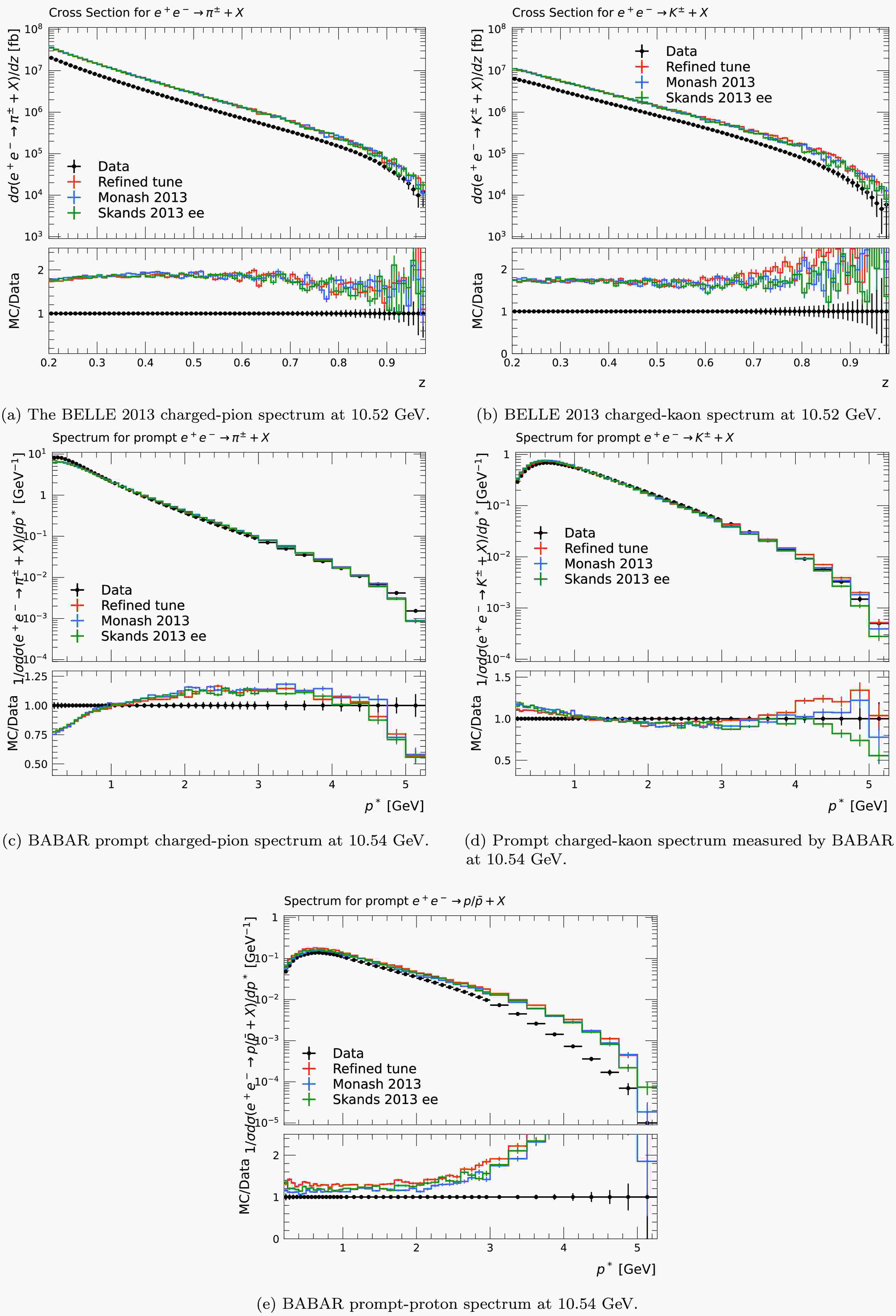
The selected panels illustrate the data sets that drive the comparison. Figure 1 shows the charged-hadron sector: BELLE 2013 favours the refined tune, whereas BABAR 2013 favours Skands. Figure 2 shows representative BELLE 2020 single- and dihadron spectra. This analysis contains most of the common-bin population and therefore dominates the bin-weighted score. Figure 3 shows representative BELLE 2025 meson spectra, for which Skands remains the best of the three configurations. Additional panels are provided in Appendix A (Figs. A1 and A2), the full numerical breakdown is provided in Appendix B (Table B1), and the parameter sensitivity summary is provided in Appendix C (Table C1).
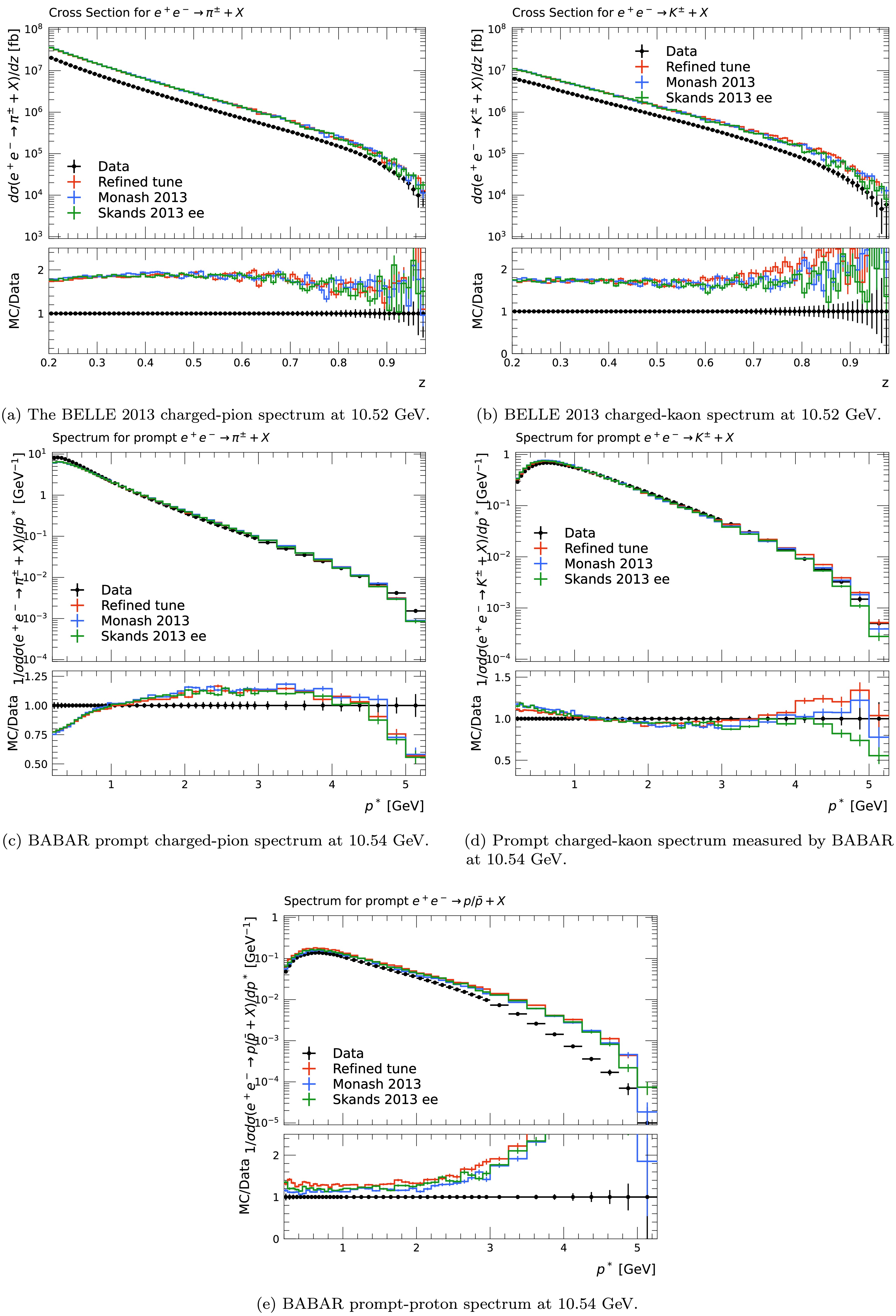
Figure 1. (color online) In the low-energy charged-hadron sector, the selected refined tune remains the best description of the BELLE 2013 charged-hadron spectra, although the nearby BABAR sample is still described more accurately by the Skands reference.
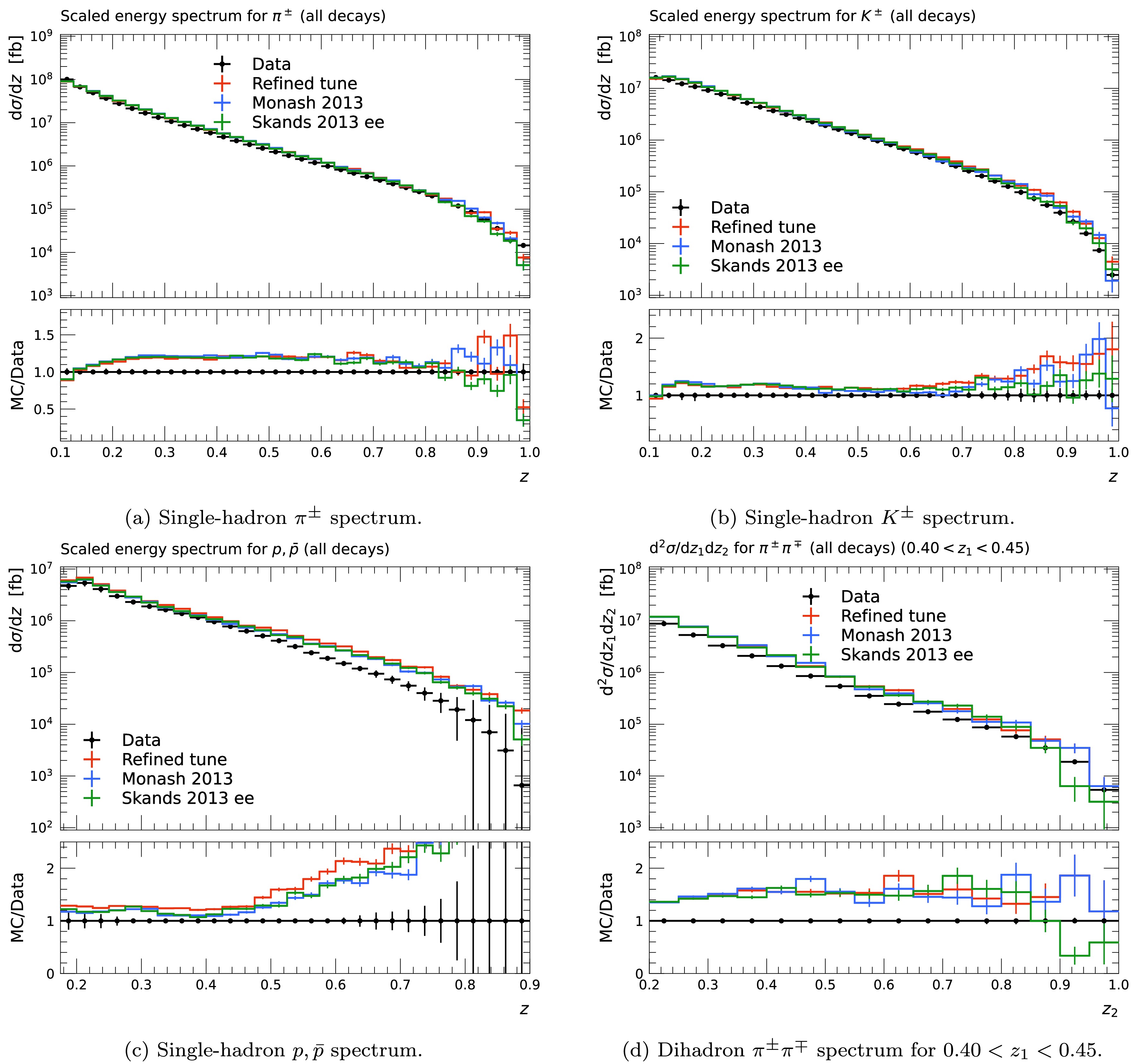
Figure 2. (color online) Selected BELLE 2020 single- and dihadron spectra. The differences among the three tune curves are modest; however, BELLE 2020 provides most of the common bins and therefore largely determines the bin-weighted ranking.
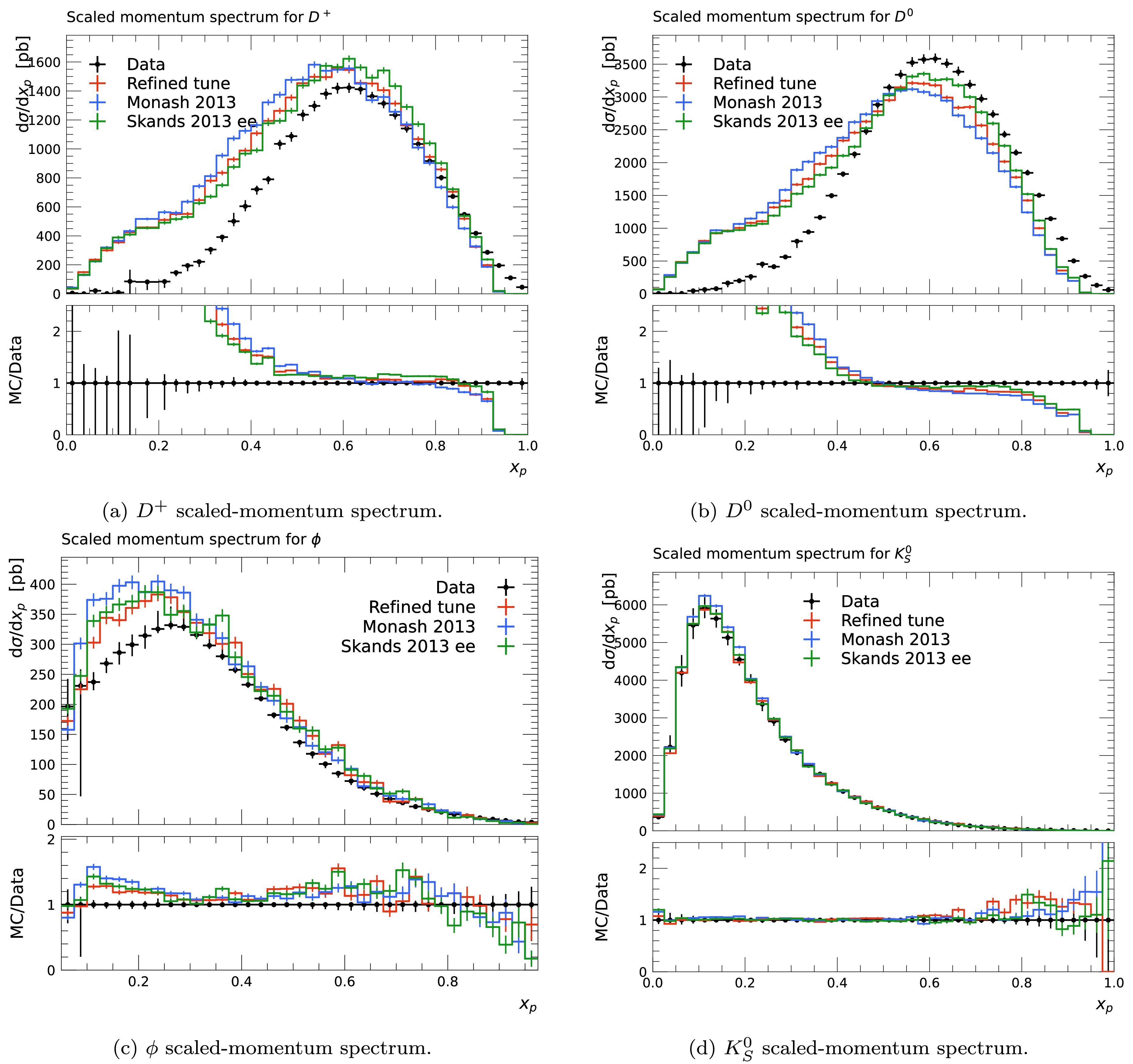
Figure 3. (color online) Selected BELLE 2025 meson spectra. The selected tune agrees more closely with the data than Monash in some channels, although Skands achieves the lowest aggregate BELLE 2025 score.
Analysis Tune $ \chi^2 $ $ N_{{\rm{bin}}} $ Score $\mathrm{BELLE}\_\mathrm{2013}\_\mathrm{I1216515}$ Refined tune 38366.9 156 245.94 Monash 2013 45310.2 156 290.45 Skands $ e^{+}e^{-} $ 43205.8 156 276.96 $\mathrm{BELLE}\_\mathrm{2017}\_\mathrm{I1606201}$ Refined tune 26092.8 266 98.09 Monash 2013 28240.4 266 106.17 Skands $ e^{+}e^{-} $ 28441.0 266 106.92 $\mathrm{BABAR}\_\mathrm{2013}\_\mathrm{I1238276}$ Refined tune 8343.4 270 30.90 Monash 2013 6817.2 270 25.25 Skands $ e^{+}e^{-} $ 6578.5 270 24.36 $\mathrm{BELLE}\_\mathrm{2020}\_\mathrm{I1777678}$ Refined tune 1431205.7 19530 73.28 Monash 2013 1545068.5 19530 79.11 Skands $ e^{+}e^{-} $ 1495701.7 19530 76.58 $\mathrm{BELLE}\_\mathrm{2025}\_\mathrm{I2849895}$ Refined tune 23260.9 581 40.04 Monash 2013 22605.9 581 38.91 Skands $ e^{+}e^{-} $ 17396.2 581 29.94 Global total Refined tune 1527269.7 20803 73.42 Monash 2013 1648042.3 20803 79.22 Skands $ e^{+}e^{-} $ 1591323.1 20803 76.49 Table B1. Complete numerical breakdown of
$ \chi^2 $ , the common-bin count, and the bin-weighted score for the final three-way comparison.Parameter Reported value Tested range $ \max |\Delta S_{{\rm{analysis}}}| $ Reported precision $\mathrm{StringZ:aLund}$ 0.75 0.6261–0.7816 6.00 2 significant digits $\mathrm{StringZ:bLund}$ 1.0 1.0072–1.3864 5.89 2 significant digits $\mathrm{StringFlav:probStoUD}$ 0.21 0.1964–0.2511 5.91 2 significant digits $\mathrm{StringPT:sigma}$ 0.32 0.2796–0.3392 5.84 2 significant digits $\mathrm{StringFlav:probQQtoQ}$ 0.092 0.0790–0.1037 6.62 2 significant digits $\mathrm{StringFlav:probSQtoQQ}$ 0.77 0.7300–0.9875 6.24 2 significant digits $\mathrm{StringFlav:probQQ1toQQ0}$ 0.042 0.0272–0.0523 6.03 2 significant digits $\mathrm{StringFlav:mesonUDvector}$ 0.58 0.4507–0.6466 6.02 2 significant digits $\mathrm{StringFlav:mesonSvector}$ 0.54 0.4805–0.6732 6.02 2 significant digits $\mathrm{StringFlav:mesonCvector}$ 0.82 0.6847–1.1213 6.44 2 significant digits $\mathrm{StringFlav:etaSup}$ 0.68 0.4310–0.8242 6.77 2 significant digits $\mathrm{StringFlav:etaPrimeSup}$ 0.26 0.1161–0.2803 6.20 2 significant digits $\mathrm{StringFlav:popcornRate}$ 0.32 0.2463–0.8896 6.49 2 significant digits Table C1. One-parameter sensitivity study around the selected refined tune. The tested range lists the sampled values for each parameter, while the remaining parameters were fixed at their selected values. The quantity
$ \max |\Delta S_{{\rm{analysis}}}| $ denotes the largest absolute change in the equal-analysis score relative to the central tune within the tested range. All variations yield$ \max|\Delta S_{{\rm{analysis}}}|>0.69 $ , indicating that the score changes are resolved within the profile scan. The listed ranges are the tested scan ranges only, not confidence intervals or correlated tune uncertainties. -
The selected panels illustrate the data sets that drive the comparison. Figure 1 shows the charged-hadron sector: BELLE 2013 favours the refined tune, whereas BABAR 2013 favours Skands. Figure 2 shows representative BELLE 2020 single- and dihadron spectra. This analysis contains most of the common-bin population and therefore dominates the bin-weighted score. Figure 3 shows representative BELLE 2025 meson spectra, for which Skands remains the best of the three configurations. Additional panels are provided in Appendix A (Figs. A1 and A2), the full numerical breakdown is provided in Appendix B (Table B1), and the parameter sensitivity summary is provided in Appendix C (Table C1).
Figure 1. (color online) In the low-energy charged-hadron sector, the selected refined tune remains the best description of the BELLE 2013 charged-hadron spectra, although the nearby BABAR sample is still described more accurately by the Skands reference.
Figure 2. (color online) Selected BELLE 2020 single- and dihadron spectra. The differences among the three tune curves are modest; however, BELLE 2020 provides most of the common bins and therefore largely determines the bin-weighted ranking.
Figure 3. (color online) Selected BELLE 2025 meson spectra. The selected tune agrees more closely with the data than Monash in some channels, although Skands achieves the lowest aggregate BELLE 2025 score.
Analysis Tune $ \chi^2 $ $ N_{{\rm{bin}}} $ Score $\mathrm{BELLE}\_\mathrm{2013}\_\mathrm{I1216515}$ Refined tune 38366.9 156 245.94 Monash 2013 45310.2 156 290.45 Skands $ e^{+}e^{-} $ 43205.8 156 276.96 $\mathrm{BELLE}\_\mathrm{2017}\_\mathrm{I1606201}$ Refined tune 26092.8 266 98.09 Monash 2013 28240.4 266 106.17 Skands $ e^{+}e^{-} $ 28441.0 266 106.92 $\mathrm{BABAR}\_\mathrm{2013}\_\mathrm{I1238276}$ Refined tune 8343.4 270 30.90 Monash 2013 6817.2 270 25.25 Skands $ e^{+}e^{-} $ 6578.5 270 24.36 $\mathrm{BELLE}\_\mathrm{2020}\_\mathrm{I1777678}$ Refined tune 1431205.7 19530 73.28 Monash 2013 1545068.5 19530 79.11 Skands $ e^{+}e^{-} $ 1495701.7 19530 76.58 $\mathrm{BELLE}\_\mathrm{2025}\_\mathrm{I2849895}$ Refined tune 23260.9 581 40.04 Monash 2013 22605.9 581 38.91 Skands $ e^{+}e^{-} $ 17396.2 581 29.94 Global total Refined tune 1527269.7 20803 73.42 Monash 2013 1648042.3 20803 79.22 Skands $ e^{+}e^{-} $ 1591323.1 20803 76.49 Table B1. Complete numerical breakdown of
$ \chi^2 $ , the common-bin count, and the bin-weighted score for the final three-way comparison.Parameter Reported value Tested range $ \max |\Delta S_{{\rm{analysis}}}| $ Reported precision $\mathrm{StringZ:aLund}$ 0.75 0.6261–0.7816 6.00 2 significant digits $\mathrm{StringZ:bLund}$ 1.0 1.0072–1.3864 5.89 2 significant digits $\mathrm{StringFlav:probStoUD}$ 0.21 0.1964–0.2511 5.91 2 significant digits $\mathrm{StringPT:sigma}$ 0.32 0.2796–0.3392 5.84 2 significant digits $\mathrm{StringFlav:probQQtoQ}$ 0.092 0.0790–0.1037 6.62 2 significant digits $\mathrm{StringFlav:probSQtoQQ}$ 0.77 0.7300–0.9875 6.24 2 significant digits $\mathrm{StringFlav:probQQ1toQQ0}$ 0.042 0.0272–0.0523 6.03 2 significant digits $\mathrm{StringFlav:mesonUDvector}$ 0.58 0.4507–0.6466 6.02 2 significant digits $\mathrm{StringFlav:mesonSvector}$ 0.54 0.4805–0.6732 6.02 2 significant digits $\mathrm{StringFlav:mesonCvector}$ 0.82 0.6847–1.1213 6.44 2 significant digits $\mathrm{StringFlav:etaSup}$ 0.68 0.4310–0.8242 6.77 2 significant digits $\mathrm{StringFlav:etaPrimeSup}$ 0.26 0.1161–0.2803 6.20 2 significant digits $\mathrm{StringFlav:popcornRate}$ 0.32 0.2463–0.8896 6.49 2 significant digits Table C1. One-parameter sensitivity study around the selected refined tune. The tested range lists the sampled values for each parameter, while the remaining parameters were fixed at their selected values. The quantity
$ \max |\Delta S_{{\rm{analysis}}}| $ denotes the largest absolute change in the equal-analysis score relative to the central tune within the tested range. All variations yield$ \max|\Delta S_{{\rm{analysis}}}|>0.69 $ , indicating that the score changes are resolved within the profile scan. The listed ranges are the tested scan ranges only, not confidence intervals or correlated tune uncertainties. -
The refined tune improves the combined BELLE/BABAR scores relative to Monash and Skands, but the improvement is not uniform across the five analyses. The improvement is modest but reproducible within the scoring procedure used here. BABAR 2013 and BELLE 2025 still prefer the Skands reference; therefore, the refined tune is not presented as a general replacement for existing
$ e^+e^- $ tunes. The parameter changes also constrain the interpretation. The basic Lund-shape parameters remain close to the Monash values, while the added freedom is mainly in flavour, vector-meson, diquark, isoscalar-meson, charm-vector, and popcorn-baryon controls. The result is therefore consistent with changes primarily in the species-composition and baryon-production balance of the PYTHIA string model, rather than a substantial change in the longitudinal-fragmentation shape. The bin-weighted score is dominated by BELLE 2020, which contributes 19,530 of the 20,803 bins in the common comparison. The bin-weighted ranking is therefore driven mainly by the single- and dihadron block, not by a balanced average across the five analyses. For this reason, the refined tune is best described as a channel-specific improvement on the selected continuum scoring basis, with remaining discrepancies in BABAR 2013 and BELLE 2025.The residual pattern is also species dependent. In BABAR 2013, the refined tune is closest to the data for kaons, while Skands gives lower scores for pions and protons. In BELLE 2025, the largest tension occurs in the light-meson spectra, especially at low and high momentum; Skands remains lower than the refined tune for both light- and charm-meson groups. One-dimensional parameter scans show local responses to the string transverse-momentum width, vector-meson fractions, isoscalar suppression factors, and popcorn-baryon parameter, but the available scan does not support a reliable covariance matrix or confidence interval for the tune parameters. The parameter values in Table 3 are reported to the precision supported by the profile study in Appendix C; the exact values used for event generation are retained in the original tune card.
-
We have presented a staged
$ e^+e^- $ refinement of a pp-derived PYTHIA 8 hadronization tune for$ e^+e^-\to q\bar q $ production near$ \sqrt{s}=10.52 $ –10.58 GeV. Starting from the five-parameter hadronization subset of the referenced pp tune, the refinement introduces additional flavour-sensitive controls in two steps, guided by the residual discrepancies with the BELLE and BABAR data. The final comparison used 1,000,000 generated events per analysis and a fixed common set of 20,803 bins. The selected refined tune yields a bin-weighted score of 73.42, compared with 76.49 for the Skands$ e^+e^- $ reference and 79.22 for Monash 2013$ e^+e^- $ . It also yields the lowest equal-analysis and observable-family-balanced scores among the tunes included in the final comparison. It remains the best-scoring tune for BELLE 2013, BELLE 2017, and BELLE 2020, whereas Skands remains better for BABAR 2013 and BELLE 2025. These results indicate a modest improvement for the selected BELLE/BABAR data set, rather than a general replacement for existing$ e^+e^- $ tunes. The extension of the pp-derived hadronization sector provides a small improvement in the bin-weighted score, driven mainly by BELLE 2020, but does not eliminate the data-set-dependent differences, particularly for BABAR 2013 and BELLE 2025. -
The appendix presents supplementary comparison panels for the BELLE 2017 baryon sector and additional BELLE 2025 meson channels discussed in the main text.
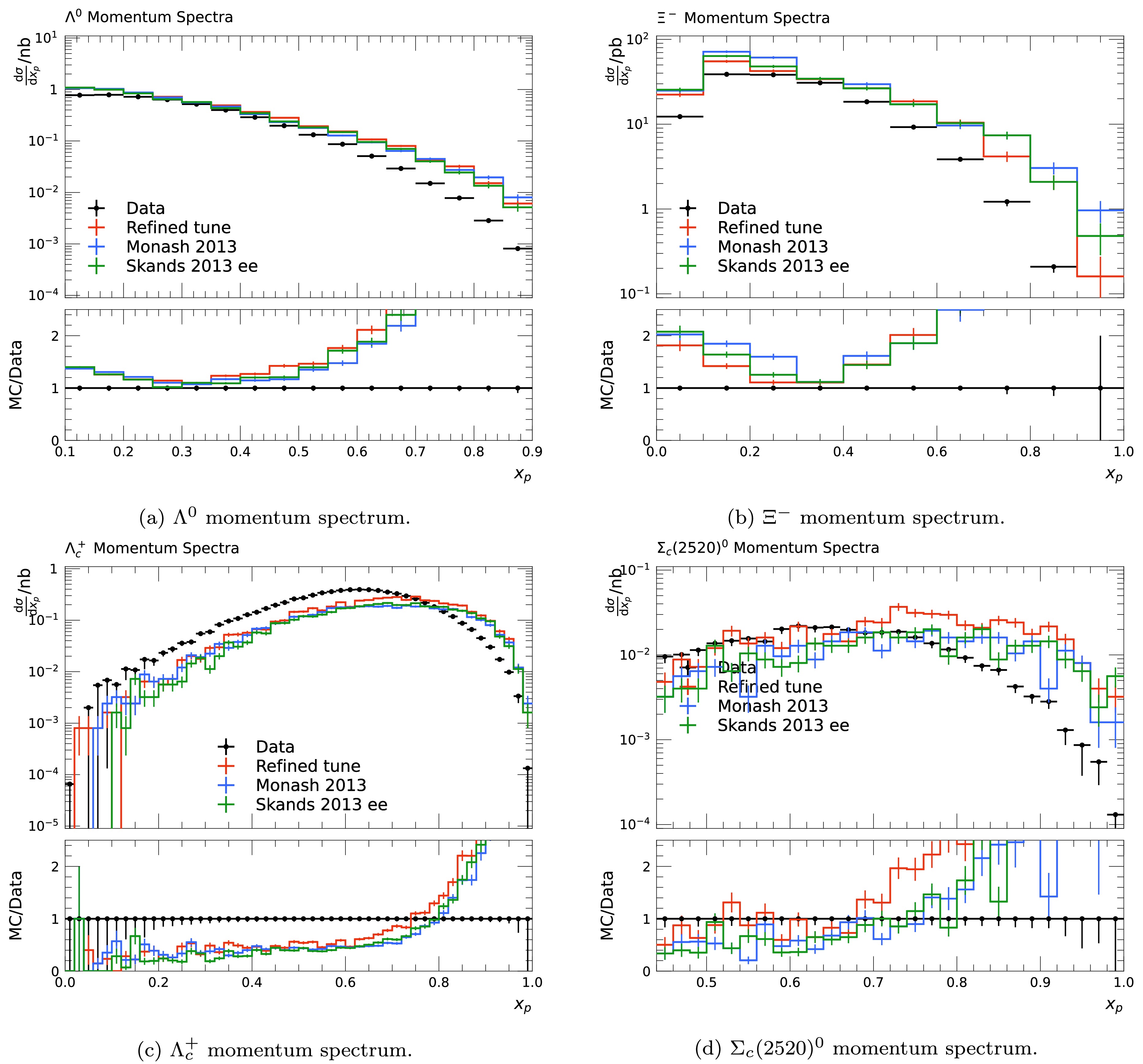
Figure A1. (color online) Selected BELLE 2017 baryon channels. The selected refined tune yields the lowest score for this baryon sample in the final comparison.
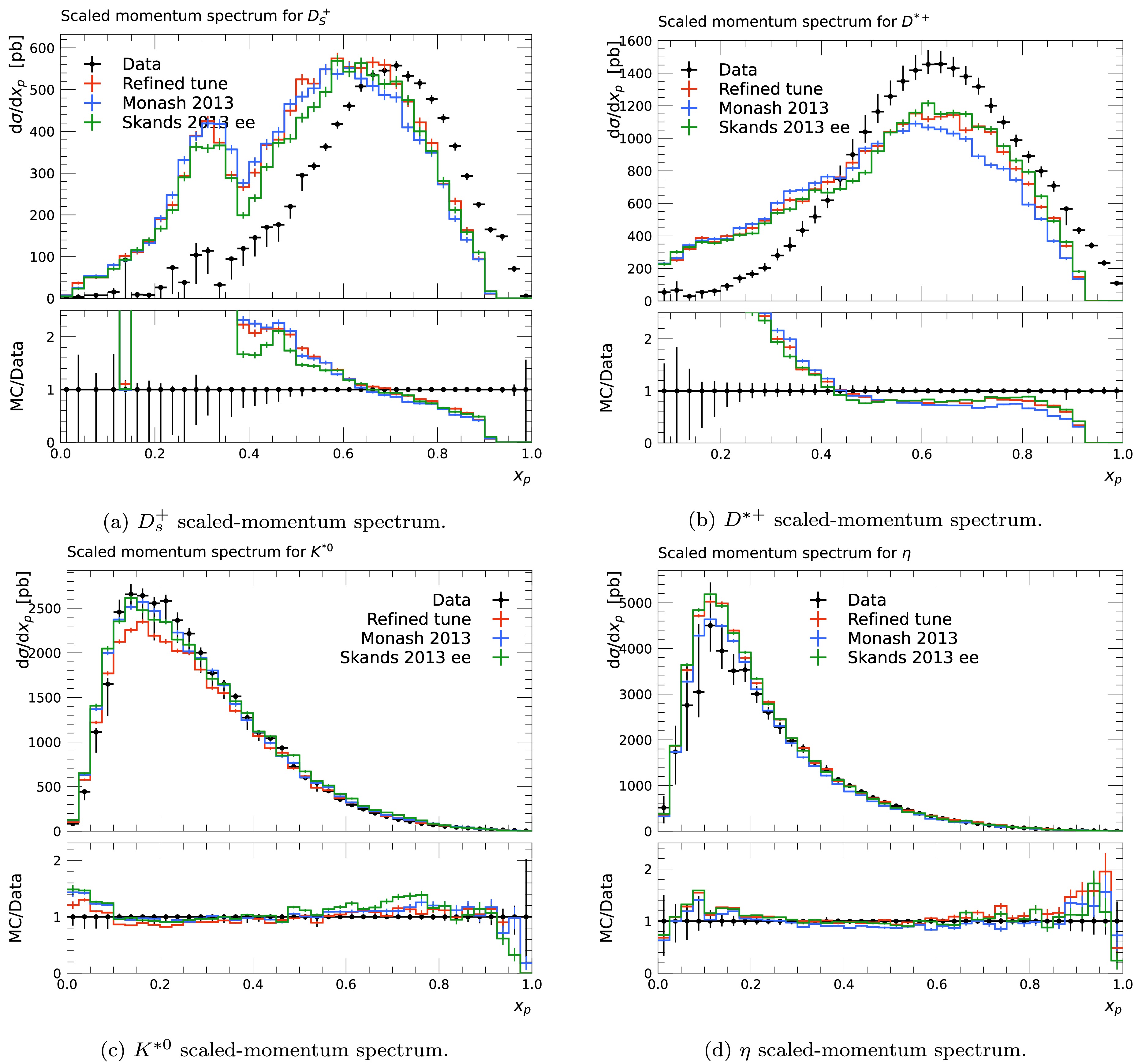
Figure A2. (color online) Selected supplementary BELLE 2025 channels. The reference Skands tune provides the strongest overall description of the BELLE 2025 meson spectra, whereas the selected refined tune remains competitive in several channels.
-
The appendix presents supplementary comparison panels for the BELLE 2017 baryon sector and additional BELLE 2025 meson channels discussed in the main text.
Figure A1. (color online) Selected BELLE 2017 baryon channels. The selected refined tune yields the lowest score for this baryon sample in the final comparison.
Figure A2. (color online) Selected supplementary BELLE 2025 channels. The reference Skands tune provides the strongest overall description of the BELLE 2025 meson spectra, whereas the selected refined tune remains competitive in several channels.
A B-factory continuum retune of PYTHIA 8 hadronization parameters using BELLE and BABAR identified-hadron data
- Received Date: 2026-05-30
- Available Online: 2026-11-15
Abstract: We refine the hadronization sector of a pp PYTHIA 8 tune for $ e^+e^-\to q\bar q $ production using selected BELLE and BABAR measurements near the $ \Upsilon(4S) $ region. The study is performed with PYTHIA 8.316 and Rivet 4.1.1 and is restricted to the parameters used in this $ e^+e^- $ setup. Starting from the five-parameter hadronization subset of the pp tune, we perform a staged extension guided by the remaining discrepancies with the BELLE and BABAR data. The final comparison uses a fixed common set of 20,803 bins and samples of 1,000,000 generated events per analysis and tune point. On this basis, the selected refined tune yields a bin-weighted score of 73.42, compared with 76.49 for the Skands $ e^+e^- $ reference and 79.22 for Monash 2013 $ e^+e^- $. It remains the best-scoring tune for the BELLE charged-hadron, baryon, and single- and dihadron measurements, whereas Skands still performs better for the BABAR charged-hadron sample and the BELLE meson sample. The bin-weighted ordering is driven primarily by the BELLE 2020 sample. The refined tune provides a small but stable improvement for the selected BELLE and BABAR measurements, although clear differences among the individual datasets remain.



 DownLoad: