


 Abstract
 HTML
 Reference
 Related
 PDF




-
The conventional quark model, which categorizes hadrons as mesons (quark-antiquark pairs) or baryons (three-quark states), is inadequate for explaining the existence of exotic hadrons, such as compact multiquark configurations and hadronic molecules. These unconventional states, which lie beyond the standard framework, have become a major focus of modern hadron physics. Over the past three decades, both experimental discoveries and theoretical advances have significantly intensified research efforts in this area. Notably, several hidden-charm pentaquark states have been discovered, including the
$ {P_{c}(4380)} $ ,$ {P_{c}(4440)} $ ,$ {P_{c}(4457)} $ ,$ {P_{c}(4312)} $ ,$ {P_{cs}(4459)} $ , and$ {P_{cs}(4338)} $ [1−4]. Since these states contain at least five quarks (such as$ c\bar c udd $ or$ c\bar c uds $ ), they are strong candidates for classification as hidden-charm pentaquarks. In 2021, the LHCb Collaboration further reported the observation of the first doubly-charm tetraquark,$ T_{cc}^+(3875) $ , in the$ D^0 D^0 \pi^+ $ invariant mass spectrum [5, 6]. The simplest quark model interpretation of this state is a$ cc\bar u\bar d $ configuration with quantum numbers$ {J^P} = 1^+ $ . Following these experimental breakthroughs, a variety of theoretical models have been proposed to explain the structure and properties of these exotic states. These include interpretations as compact multiquark states, hadronic molecules, or even manifestations of kinematical effects [7−22]. Nevertheless, despite significant progress, the internal substructures and precise quantum numbers of these multiquark states continue to pose fundamental challenges in high-energy hadron physics.The discovery of the
$ T_{cc}^+(3875) $ tetraquark state opens a novel avenue for the search for states beyond conventional hadrons. If$ T_{cc}^+(3875) $ is indeed a genuine doubly-charm tetraquark, then by analogy, one may expect the existence of doubly-bottom pentaquark states as well. This reasoning mirrors the approach taken to predict hidden-charm pentaquarks based on the discovery of hidden-charm tetraquarks. In the absence of experimental evidence for doubly-bottom pentaquarks, it is imperative to understand the underlying reasons behind their apparent non-observation. To this end, several theoretical investigations have been conducted to explore the possible existence and properties of doubly-charm/bottom pentaquark states [22−38]. These studies generally suggest that the doubly-bottom pentaquarks lie below the relevant meson–baryon thresholds, making the formation of bound states feasible. Compared to doubly-charm systems, doubly-bottom pentaquarks are anticipated to be heavier. However, due to the complex dynamics of multiquark systems, their actual mass may be reduced, making it difficult to distinguish them from conventional baryons based on mass alone. Therefore, studying other characteristics—particularly their electromagnetic properties—can offer essential insights into their underlying structures.The electromagnetic multipole moments are measurable quantities that can provide crucial insights into the internal quark-gluon structure and dynamics of hadronic states. Specifically, in photo- and electro-production processes, the magnetic dipole moments (MDMs) of hadrons play an essential role in shaping both the total and differential cross sections. As such, determining the MDMs of hadronic states is vital for understanding their internal configuration. Although the electromagnetic properties of hadrons have received less attention compared to their mass spectra, production mechanisms, quantum numbers, or decay channels, recent years have seen growing interest in these observables. This is especially true for exotic states with ambiguous internal compositions, where electromagnetic characteristics can serve as critical probes [39−68]. In this work, we use the QCD light-cone sum rule (LCSR) method to compute the MDMs of the
$ B^{(*)} \Sigma_b^{(*)} $ states, considering them as molecular configurations:$ B \Sigma_b $ ,$ B^* \Sigma_b $ , and$ B \Sigma_b^* $ , with quantum numbers$ {I(J^P)= {1}/{2}({1}/{2}^-)} $ ,$ {I(J^P)= {1}/{2}({3}/{2}^-)} $ , and$ {I(J^P)= {1}/{2}({3}/{2}^-)} $ , respectively. Among the available tools for calculating non-perturbative QCD quantities, LCSR stands out for its efficiency and reliability [69−71]. Within this framework, the correlation function is calculated from two complementary perspectives: the hadronic representation and the QCD (operator product expansion) side. By matching these two sides using the quark-hadron duality principle, one derives sum rules for the MDMs at the hadronic level.The structure of this paper is as follows. Following the introduction, Section II develops the theoretical formalism for MDMs of the
$ B \Sigma_b $ ,$ B^{*} \Sigma_b $ , and$ B \Sigma_b^{*} $ pentaquark states. Section III then provides the numerical analysis and results. Finally, Section IV concludes with a summary of the main findings. -
The QCD light-cone sum rules for the magnetic dipole moments (MDMs) of the spin-
$ {1}/{2}$ and spin-$ {3}/{2}$ doubly-bottom pentaquarks,$ {P_{bb}}$ ($J^P = {1}/{2}^-$ ) and$ {P_{bb}^*}$ ($J^P = {3}/{2}^-$ ), respectively, can be derived from the analysis of correlation functions evaluated in the presence of a weak external electromagnetic field, denoted by γ.$ \Pi(p,q)= {\rm i}\int {\rm d}^4x {\rm e}^{{\rm i}p \cdot x} \langle0|T\left\{ {J}^{ {P_{bb}}}( {x})\bar{{J}}^{ {P_{bb}}}(0)\right\}|0\rangle _\gamma \, , $
(1) $ \Pi_{\mu\nu}(p,q)={\rm i}\int {\rm d}^4x {\rm e}^{{\rm i}p \cdot x} \langle0|T\left\{ {J}_\mu^{ {P_{bb}^*}}( {x})\bar{J}_\nu^{ {P_{bb}^*}}(0)\right\}|0\rangle _\gamma \,, $
(2) where
$ {J^{P_{bb}}}(x)$ and$ {J_\mu^{P^*_{bb}}}(x)$ represent the interpolating currents associated with the respective states. The explicit forms of these currents, which are crucial for our analysis within the QCD light-cone sum rule framework, are provided by the following expressions [36]:$ {J}^{ {\rm{B}} \Sigma_{\rm{b}}}({\rm{x}}) =\dfrac{1}{\sqrt{3}}\mid \bar B^0(x) \Sigma_b^0(x) \rangle \, - \sqrt{\dfrac{2}{3}}\mid B^-(x) \Sigma_b^+(x) \rangle , $
(3) $ {J}_{\mu}^{ {\rm{B}} \Sigma_{\rm{b}}^*}({\rm{x}})=\dfrac{1}{\sqrt{3}}\mid \bar B^0(x) \Sigma_b^{*0}(x) \rangle \, - \sqrt{\dfrac{2}{3}}\mid B^-(x) \Sigma_b^{*+}(x) \rangle , $
(4) $ {J}_{\mu}^{ {\rm{B}}^* \Sigma_{\rm{b}}}({\rm{x}}) =\dfrac{1}{\sqrt{3}}\mid \bar B^{*0}(x) \Sigma_b^0(x) \rangle \, - \sqrt{\dfrac{2}{3}}\mid B^{*-}(x) \Sigma_b^+(x) \rangle, $
(5) where
$ B^-(x)= \bar u^d(x) {\rm i} \gamma_5 b^d(x), $
(6) $ \bar B^0(x)= - \bar d^d(x) {\rm i} \gamma_5 b^d(x), $
(7) $ B^{*-}(x)= \bar u^d(x) \gamma_\mu b^d(x), $
(8) $ \bar B^{*0}(x)= - \bar d^d(x) \gamma_\mu b^d(x), $
(9) $ \Sigma_b^0(x)= \varepsilon^{abc} u^{a^T}(x)C \gamma_\mu d^b(x) \gamma^\mu \gamma_5 b^c(x) $
(10) $ \Sigma_b^+(x)= \varepsilon^{abc} u^{a^T}(x)C \gamma_\mu u^b(x) \gamma^\mu \gamma_5 b^c(x) $
(11) $ \Sigma_b^{*0}(x)= \varepsilon^{abc} u^{a^T}(x)C \gamma_\mu d^b(x) b^c(x) $
(12) $ \Sigma_b^{*+}(x)= \varepsilon^{abc} u^{a^T}(x)C \gamma_\mu u^b(x) b^c(x). $
(13) Combining the spin of the open-bottom meson with that of the singly-bottom baryon, the S-wave
$ B^{(*)}\Sigma_b^{(*)} $ systems accommodate, with negative parity throughout, the spin assignments$ B\Sigma_b \to J^P= {1}/{2}^- $ ,$ B\Sigma_b^{*}\to {3}/{2}^- $ ,$ B^{*}\Sigma_b \to {1}/{2}^-\oplus {3}/{2}^- $ , and$ B^{*}\Sigma_b^{*}\to {1}/{2}^-\oplus {3}/{2}^-\oplus {5}/{2}^- $ . In this work, we analyze the$ B\Sigma_b\,( {1}/{2}^-) $ ,$ B\Sigma_b^{*}\,( {3}/{2}^-) $ , and$ B^{*}\Sigma_b\,( {3}/{2}^-) $ states, while the spin-$ {1}/{2} $ partner of$ B^{*}\Sigma_b $ and the entire$ B^{*}\Sigma_b^{*} $ multiplet are excluded. This restriction is due to technical considerations detailed below and does not reflect any physical preference among the states.Within the light-cone sum rule framework, the mass and residue of the state under study are external, two-point inputs for the magnetic dipole moment [cf. Eq. (52)]. For the spin-
$ {1}/{2} $ member of$ B^{*}\Sigma_b $ and the members of the$ B^{*}\Sigma_b^{*} $ family, these spectroscopic parameters have not been determined in the study whose mass and residue predictions we adopt [36]. In the absence of these inputs, the corresponding sum rules cannot be evaluated. Once such masses and residues become available, the electromagnetic multipole moments of these states can be obtained following the procedure presented here.For the highest-spin member,
$ B^{*}\Sigma_b^{*} $ with$ J^P= {5}/{2}^- $ , a further difficulty arises specific to the electromagnetic analysis, which has no counterpart in the mass calculation. To the best of our knowledge, a consistent electromagnetic vertex and multipole decomposition for a spin-$ {5}/{2} $ interpolating current has not been established. Moreover, a spin-$ {5}/{2} $ current couples not only to the spin-$ {5}/{2} $ ground state but also to lower-lying spin-$ {1}/{2} $ and spin-$ {3}/{2} $ states. Identifying the appropriate independent Lorentz structures at the photon vertex and systematically removing these lower-spin admixtures—a step far more demanding than in the mass sum rule—constitutes a separate and nontrivial challenge that would compromise the reliability of the extracted moments. This obstacle is independent of the availability of spectroscopic parameters, so the spin-$ {5}/{2} $ case remains beyond the scope of the present study.Finally, we emphasize that these omissions do not affect the central observation that the magnetic dipole moments are strongly sensitive to the internal spin structure of the states. The three configurations analyzed here already couple the constituent spins in distinct ways and yield markedly different magnetic moments—including a change of sign between the
$ B\Sigma_b^{*} $ and$ B^{*}\Sigma_b $ states—which in itself establishes the pronounced dependence of the moment on the spin-flavor arrangement. The inclusion of the omitted states, once feasible, would provide additional data points and can only enrich this pattern rather than modify the qualitative conclusion.Following the QCD light-cone sum rule approach, the correlation function is initially represented in terms of the hadron’s physical parameters. To achieve this, a complete set of hadronic states sharing the same quantum numbers as the interpolating currents
$ {J^{P_{bb}}}(x)$ and$ {J_\mu^{P^*_{bb}}}(x)$ is inserted into the correlation function. Using the dispersion relation, the correlation functions can then be expressed as:$ \Pi^{\rm Had}(p,q)=\dfrac{\langle0\mid {J}^{ {P_{bb}}}({{x}}) \mid { {P_{bb}}}({{p}}, {{s}}) \rangle}{[p^{2}-m_{ {P_{bb}}}^{2}]} \langle { {P_{bb}}}(p, s)\mid { {P_{bb}}}(p+q, s)\rangle_\gamma \dfrac{\langle { {P_{bb}}}(p+q, s)\mid \bar{J}^{ {P_{bb}}}(0) \mid 0\rangle}{[(p+q)^{2}-m_{ {P_{bb}}}^{2}]}+ \cdots , $
(14) $ \Pi^{\rm Had}_{\mu\nu}(p,q)=\dfrac{\langle0\mid {J}_{\mu}^{ {P_{bb}^*}}({{x}})\mid { {P_{bb}^*}}({{p}},{{s}})\rangle}{[p^{2}-m_{{ {P_{bb}^*}}}^{2}]} \langle { {P_{bb}^*}}(p,s)\mid { {P_{bb}^*}}(p+q,s)\rangle_\gamma \dfrac{\langle { {P_{bb}^*}}(p+q,s)\mid \bar{J}_{\nu}^{ {P_{bb}^*}}(0)\mid 0\rangle}{[(p+q)^{2}-m_{{ {P_{bb}^*}}}^{2}]}+ \cdots . $
(15) For the continuation of the calculations, the matrix elements introduced in Eqs. (14) and (15) are necessary. These elements can be expressed in terms of hadronic parameters as follows [72−74]:
$ \langle 0\mid {J^{P}_{bb}}(x)\mid {P_{bb}}(p,s)\rangle = {\lambda _{P_{bb}}}{\gamma _5}{\mkern 1mu} \nu (p,s),$
(16) $ \langle {{{P}}_{{{bb}}}}(p + q,s)\mid {{{\bar J}}^{{{{P}}_{{{bb}}}}}}({{0}})\mid {{0}}\rangle = {\lambda _{{{{P}}_{{{bb}}}}}}{\mkern 1mu} \bar \nu (p + q,s){\mkern 1mu} {\gamma _5}, $
(17) $ \langle 0\mid {{J}}_\mu ^{{{P}}_{{{bb}}}^{{*}}}({{x}})\mid {P}_{{{bb}}}^{{*}}({{p,s}})\rangle = {\lambda _{{{P}}_{{{bb}}}^{{*}}}}{u_\mu }(p,s), $
(18) $ \langle {{P}}_{{{bb}}}^{{*}}(p + q,s)\mid {{\bar J}}_\nu ^{{{P}}_{{{bb}}}^{{*}}}({{0}})\mid {{0}}\rangle = {\lambda _{{{P}}_{{{bb}}}^{{*}}}}{\bar u_\nu }(p + q,s), $
(19) $ {\langle {{{P}}_{{{bb}}}}(p,s)\mid {{{P}}_{{{bb}}}}(p + q,s)\rangle _\gamma } = {\varepsilon ^\mu }{\mkern 1mu} \bar \nu (p,s)\bigg[[{f_1}({q^2}) + {f_2}({q^2})]{\gamma _\mu } + {f_2}({q^2})\dfrac{{{{(2p + q)}_\mu }}}{{2{m_{{{{P}}_{{{bb}}}}}}}}\bigg]{\mkern 1mu} \nu (p + q,s), $
(20) $ \begin{aligned}[b] \langle { {P_{bb}^*}}(p,s)\mid { {P_{bb}^*}}(p+q,s)\rangle_\gamma = \;&-\bar u_{\alpha}(p,s)\bigg[F_{1}(q^2)g^{\alpha \beta }{\not \varepsilon} - \dfrac{1}{2m_{{ {P_{bb}^*}}}} \Big[F_{2}(q^2)g^{\alpha \beta} {\not \varepsilon}\, {\not\, q} +F_{4}(q^2)\dfrac{q^{\alpha}q^{\beta}{\not \varepsilon}\, {\not\, q}}{(2m_{{ {P_{bb}^*}}})^2}\Big] \\ &+ F_{3}(q^2)\dfrac{1}{(2m_{{ {P_{bb}^*}}})^2}q^{\alpha}q^{\beta}{\not \varepsilon} \bigg] u_{\beta}(p+q,s), \end{aligned} $
(21) where
$\nu(p+q,s)$ and$u_{\alpha}(p,s)$ denote the spinors associated with the$ {P_{bb}}$ and$ {P_{bb}^*}$ states, respectively. The quantities$\lambda_{ {P_{bb}}}$ and$\lambda_{ {P_{bb}^*}}$ represent the corresponding pole residues. Furthermore,$f_i(q^2)$ and$F_i(q^2)$ denote the form factors governing the respective transition amplitudes.Using the relations above, the hadronic representation of the correlation functions related to the magnetic dipole moments (MDMs) can be expressed as follows:
$ \Pi^{\rm Had}(p,q)= \lambda^2_{ {P_{bb}}} \dfrac{ \varepsilon^\mu \gamma_5 \big({\not p}+m_{ {P_{bb}}} \big)}{[p^{2}-m_{{ {P_{bb}}}}^{2}] [(p+q)^{2}-m_{{ {P_{bb}}}}^{2}]} \bigg[\big[f_1(q^2)+f_2(q^2)\big] \gamma_\mu +f_2(q^2)\, \dfrac{(2p+q)_\mu}{2 m_{ {P_{bb}}}}\bigg] \big({\not p}+{\not\, q}+m_{ {P_{bb}}}\big) \gamma_5, $
(22) $ \begin{aligned}[b] \Pi^{\rm Had}_{\mu\nu}(p,q)=\;&- \lambda_{P_{bb}^*}^{2}\dfrac{ \big({\not p}+m_{P_{bb}^*}\big)}{[(p+q)^{2}-m_{P_{bb}^*}^{2}][p^{2}-m_{P_{bb}^*}^{2}]} \bigg[g_{\mu\alpha} -\dfrac{1}{3}\gamma_{\mu}\gamma_{\alpha}-\dfrac{2\,p_{\mu}p_{\alpha}} {3\,m^{2}_{P_{bb}^*}}+\dfrac{p_{\mu}\gamma_{\alpha}-p_{\alpha}\gamma_{\mu}}{3\,m_{P_{bb}^*}}\bigg] \\ & \times \bigg\{F_{1}(q^2)g^{\alpha\beta}{\not \varepsilon} - \dfrac{1}{2m_{P_{bb}^*}} \Big[F_{2}(q^2)g^{\alpha\beta}{\not \varepsilon}{\not\, q} + \dfrac{F_{4}(q^2)}{(2m_{P_{bb}^*})^2}q^{\alpha}q^{\beta}{\not \varepsilon}{\not\, q}\Big]+\dfrac{F_{3}(q^2)}{(2m_{P_{bb}^*})^2} q^{\alpha}q^{\beta}{\not \varepsilon}\bigg\} \\ &\times ({\not p}+{\not\, q}+m_{P_{bb}^*}) \bigg[g_{\beta\nu}-\dfrac{1}{3}\gamma_{\beta}\gamma_{\nu}-\dfrac{2\,(p+q)_{\beta}(p+q)_{\nu}} {3\,m^{2}_{P_{bb}^*}}+\dfrac{(p+q)_{\beta}\gamma_{\nu}-(p+q)_{\nu}\gamma_{\beta}}{3\,m_{P_{bb}^*}}\bigg]. \end{aligned} $
(23) The expressions in Eqs. (22) and (23) are derived by inserting complete sets of hadronic states and summing over spins. For the spin-
$ 1/2 $ case, the Dirac spinor summation formula is applied, whereas for the spin-$ 3/2 $ case, the Rarita–Schwinger spinor summation is utilized. The pertinent summation formulas are as follows:$ \sum\limits_{s} v(p,s) \bar{v}(p,s) = {\not p} + m_{ {P_{bb}}}, $
(24) $ \sum\limits_{s} v(p+q,s) \bar{v}(p+q,s) = {\not p} + {\not\, q} + m_{ {P_{bb}}}, $
(25) $ \sum\limits_s u_{\mu}(p,s)\bar{u}_{\alpha}(p,s) = -({\not p}+m_{P_{bb}^*})\bigg[g_{\mu\alpha}-\dfrac{1}{3}\gamma_{\mu}\gamma_{\alpha}-\dfrac{2\,p_{\mu}p_{\alpha}}{3\,m^{2}_{P_{bb}^*}}+\dfrac{p_{\mu}\gamma_{\alpha}-p_{\alpha}\gamma_{\mu}}{3\,m_{P_{bb}^*}}\bigg], $
(26) $ \sum\limits_s u_{\beta}(p+q,s)\bar{u}_{\nu}(p+q,s) = -({\not p}+{\not\, q}+m_{P_{bb}^*})\bigg[g_{\beta\nu}-\dfrac{1}{3}\gamma_{\beta}\gamma_{\nu}-\dfrac{2\,(p+q)_{\beta}(p+q)_{\nu}}{3\,m^{2}_{P_{bb}^*}}+\dfrac{(p+q)_{\beta}\gamma_{\nu}-(p+q)_{\nu}\gamma_{\beta}}{3\,m_{P_{bb}^*}}\bigg]. $
(27) Substituting the polarization sums (24)–(27) into Eqs. (22) and (23), and applying the on-shell condition
$ p^{2}=m^{2}_{ {P_{bb}^{(*)}}} $ in the spinor numerators, generates the expanded forms of the correlation functions. The spin-$ 1/2 $ case yields a concise expression with a limited number of Lorentz structures:$ \begin{aligned}[b] \Pi^{\rm Had}(p,q)= & \dfrac{\lambda^2_{ {P_{bb}}}}{[p^{2}-m_{{ {P_{bb}}}}^{2}][(p+q)^{2}-m_{{ {P_{bb}}}}^{2}]} \bigg[ (f_1 (q^2) + f_2(q^2)) \Big(-2\,m_{ {P_{bb}}}^2\,{\not \varepsilon} + 2\,(\varepsilon\cdot p)\,{\not p} - m_{ {P_{bb}}}\,{\not \varepsilon}\,{\not p}- m_{ {P_{bb}}}\,{\not \varepsilon}\,{\not\, q} \\ & + m_{ {P_{bb}}}\,{\not p}\,{\not \varepsilon} + {\not p}\,{\not \varepsilon}\,{\not\, q}\Big) +f_2(q^2)\,\dfrac{(\varepsilon\cdot p)\,\big(m_{ {P_{bb}}}\,{\not\, q} - {\not p}\,{\not\, q}\big)}{m_{ {P_{bb}}}} \bigg]. \end{aligned}$
(28) The spin-
$ 3/2 $ case, in contrast, generates several hundred Lorentz structures organized by the four form factors$ F_i(q^2) $ . These structures are systematically produced by the contraction of the two Rarita–Schwinger projectors with the photon-vertex matrix element in Eq. (23). Representative samples of these structures, grouped according to the form factor to which they are proportional, are as follows:$\begin{aligned}[b] \Pi^{\rm Had}_{\mu\nu}(p,q) =\;& -\dfrac{\lambda^2_{ {P_{bb}^*}}}{[(p+q)^2 - m^2_{ {P_{bb}^*}}][p^2 - m^2_{ {P_{bb}^*}}]}\\& \times \Bigg\{ F_1(q^2)\bigg[ \dfrac{4(\varepsilon \cdot p)\, p_\mu p_\nu}{3m_{ {P_{bb}^*}}} - \dfrac{4(\varepsilon \cdot q)\, p_\mu p_\nu}{3m_{ {P_{bb}^*}}} + \dfrac{4(\varepsilon \cdot p)\, p_\mu q_\nu}{3m_{ {P_{bb}^*}}} - \dfrac{4(\varepsilon \cdot q)\, p_\mu q_\nu}{3m_{ {P_{bb}^*}}} - \dfrac{2\, p_\mu p_\nu\, q^2\,{\not \varepsilon}}{3m_{ {P_{bb}^*}}^2} + \cdots \bigg] \\ & + F_2(q^2)\bigg[ - \dfrac{2\,\varepsilon_\nu\, p_\mu\, q^2}{3\, m_{ {P_{bb}^*}}} - \dfrac{5\, p_\mu p_\nu\, q^2\,{\not \varepsilon}}{3\, m_{ {P_{bb}^*}}^2} + \dfrac{2(p \cdot q)\, p_\mu p_\nu\, q^2\,{\not \varepsilon}}{3\, m_{ {P_{bb}^*}}^4} - \dfrac{p_\nu\, q^2 q_\mu\,{\not \varepsilon}}{m_{ {P_{bb}^*}}^2} - \dfrac{2\, p_\mu\, q^2 q_\nu\,{\not \varepsilon}}{3\, m_{ {P_{bb}^*}}^2} + \cdots \bigg] \\ & + F_3(q^2)\bigg[ - \dfrac{(\varepsilon \cdot q)\, p_\mu p_\nu\, q^2}{6\, m_{ {P_{bb}^*}}^3} - \dfrac{(\varepsilon \cdot q)\, p_\mu\, q^2 q_\nu}{6\, m_{ {P_{bb}^*}}^3} + \dfrac{p_\mu p_\nu\, q^2}{6\, m_{ {P_{bb}^*}}^2}\,{\not \varepsilon} - \dfrac{p_\mu p_\nu\, (q^2)^2}{6\, m_{ {P_{bb}^*}}^4}\,{\not \varepsilon} - \dfrac{p_\nu\, q^2 q_\mu}{4\, m_{ {P_{bb}^*}}^2}\,{\not \varepsilon} + \cdots \bigg] \\ &+ F_4(q^2)\bigg[ - \dfrac{(p \cdot q)\, p_\mu p_\nu\, q^2}{6\, m_{ {P_{bb}^*}}^4}\,{\not \varepsilon} + \dfrac{(p \cdot q)^2\, p_\mu p_\nu\, q^2}{6\, m_{ {P_{bb}^*}}^6}\,{\not \varepsilon} - \dfrac{p_\mu p_\nu\, (q^2)^2}{24\, m_{ {P_{bb}^*}}^4}\,{\not \varepsilon} + \dfrac{(p \cdot q)\, p_\mu p_\nu\, (q^2)^2}{6\, m_{ {P_{bb}^*}}^6}\,{\not \varepsilon} + \cdots \bigg]\Bigg\}, \end{aligned}$
(29) where the ellipses
$ (\cdots) $ indicate additional Lorentz structures of the same form, systematically generated by the Dirac algebra and processed similarly. The complete, unabbreviated expression for$ \Pi^{\rm Had}_{\mu\nu}(p,q) $ , organized term by term according to the form-factor sector$ F_i(q^2) $ , is provided in Appendix C.1.In principle, Eqs. (28) and (29) offer the hadronic representation of the correlation functions. However, before proceeding with the numerical analysis, two technical aspects require attention. First, not all Lorentz structures appearing in the spin-
$ 3/2 $ correlation function are linearly independent. Second, the interpolating current$ J_\mu $ for the spin-$ 3/2 $ states also couples to spin-$ 1/2 $ pentaquark states, and these unwanted contributions must be eliminated. The coupling of$ J_\mu $ to spin-$ 1/2 $ states can be parameterized through$ \langle 0 | J_{\mu}(0) | B(p, s = 1/2) \rangle = (A p_{\mu} + B \gamma_{\mu}) u(p, s = 1/2), $
(30) where A and B are constants. As evident from Eq. (30), spin-
$ 1/2 $ contamination appears in structures proportional to$ p_\mu $ and$ \gamma_\mu $ . To eliminate these contaminations and isolate the independent Lorentz structures in the spin-$ 3/2 $ case, we adopt the gamma-matrix ordering$ \gamma_\mu {\not p} \, {\not \varepsilon} \, {\not\, q} \gamma_\nu $ , following [75, 76]. Within this ordering, terms beginning with$ \gamma_\mu $ , ending with$ \gamma_\nu $ , or proportional to$ p_\mu $ or$ p_\nu $ are discarded as spin-$ 1/2 $ contamination. For the spin-$ 1/2 $ case, no such contamination is present, and the ordering$ {\not p}\, {\not \varepsilon} \,{\not\, q} $ is adopted to isolate the MDM contribution.Reduction of the spin-
$ 1/2 $ correlation function. After applying these procedures to Eq. (28), the spin-$ 1/2 $ hadronic representation reduces to$\begin{aligned}[b] \Pi^{\rm Had}(p,q)=& \dfrac{\lambda^2_{ {P_{bb}}}}{[p^{2}-m_{{ {P_{bb}}}}^{2}][(p+q)^{2}-m_{{ {P_{bb}}}}^{2}]} \bigg[ \Big(f_1 (q^2) \\ & + f_2(q^2) \Big)\Big(-2\,m_{ {P_{bb}}}^2\,{\not \varepsilon} + 2\,(\varepsilon\cdot p)\,{\not p} - m_{ {P_{bb}}}\,{\not \varepsilon}\,{\not p}\\&- m_{ {P_{bb}}}\,{\not \varepsilon}\,{\not\, q} + m_{ {P_{bb}}}\,{\not p}\,{\not \varepsilon} + {\not p}\,{\not \varepsilon}\,{\not\, q}\Big) + \cdots \bigg]. \end{aligned}$
(31) As an illustrative example of this reduction procedure, consider the coefficient of
$ \gamma_\mu $ in the bracket of Eq. (28), multiplied by$ \varepsilon^\mu $ . The relevant Dirac structure is$ \gamma_5\,({\not p}+m_{ {P_{bb}}})\,{\not \varepsilon}\,({\not p}+{\not\, q}+m_{ {P_{bb}}})\,\gamma_5 $ . Using$ \{\gamma_5,\gamma_\mu\}=0 $ together with$ \gamma_5^2=1 $ , this expression reduces to$ ({\not p}-m_{ {P_{bb}}})\,{\not \varepsilon}\times ({\not p}+{\not\, q}-m_{ {P_{bb}}}) $ . Expanding the product and applying the identity$ {\not p}\,{\not \varepsilon} = 2(\varepsilon\cdot p)-{\not \varepsilon}\,{\not p} $ , one obtains the four independent Lorentz structures appearing in Eq. (31):$ 2(\varepsilon\cdot p){\not p} $ ,$ -m_{ {P_{bb}}}\,{\not \varepsilon}\,{\not p} $ ,$ -m_{ {P_{bb}}}\,{\not \varepsilon}\,{\not\, q} $ , and$ {\not p}\,{\not \varepsilon}\,{\not\, q} $ . The remaining$ f_2(q^2)\,(\varepsilon\cdot p)\,(m_{ {P_{bb}}}\,{\not\, q} - {\not p}\,{\not\, q})/m_{ {P_{bb}}} $ contribution in Eq. (28) is processed analogously and reduces to the same set of independent structures, generating the overall combination$ f_1(q^2)+f_2(q^2) $ as the coefficient of$ {\not p}\,{\not \varepsilon}\,{\not\, q} $ .Reduction of the spin-
$ 3/2 $ correlation function. For the spin-$ 3/2 $ case, the reduction is organized into four successive stages, each documented in detail in Appendix C: (i) substitution of the polarization sum (27) into Eq. (23) and imposition of the on-shell condition$ p^{2}=m^{2}_{P^{*}_{bb}} $ , yielding the unreduced expression in Appendix C.1; (ii) imposition of the real-photon kinematic conditions$ q^{2}=0 $ and$ \varepsilon \cdot q=0 $ , yielding the gauge-fixed expression in Appendix C.6; (iii) application of the gamma-matrix ordering$ \gamma_\mu {\not p} {\not \varepsilon} {\not\, q} \gamma_\nu $ and removal of the spin-$ 1/2 $ contamination, yielding the expression in Appendix C.7; and (iv) projection of the resulting expression onto the four linearly independent Lorentz structures$ g_{\mu\nu}\,{\not p}\,{\not \varepsilon}\,{\not\, q} $ ,$ g_{\mu\nu}\,{\not \varepsilon}\,{\not\, q} $ ,$ q_\mu q_\nu\,{\not \varepsilon}\,{\not\, q} $ , and$ (\varepsilon \cdot p)\,q_\mu q_\nu\,{\not p}\,{\not\, q} $ , documented in Appendix C.8. To ensure this procedure is transparent and reproducible, we detail below the contribution of the$ F_1(q^2)\,g^{\alpha\beta}\,{\not \varepsilon} $ component of the vertex in Eq. (23), restricted to the leading$ g_{\mu\alpha}\,g_{\beta\nu} $ contractions of the two Rarita–Schwinger projectors; the remaining projector contractions and form-factor sectors are processed identically, with the complete term-by-term algebra collected in Appendix C.The contribution under consideration reads
$\begin{aligned}[b] \Pi^{\rm Had,\, {lead}}_{\mu\nu}\Big|_{F_1} =\;& -\,\dfrac{\lambda^{2}_{P^{*}_{bb}}\,F_1(q^2)\,g_{\mu\nu}} {[(p+q)^2-m^2_{P^{*}_{bb}}]\,[p^2-m^2_{P^{*}_{bb}}]}\,\\ & \times \big({\not p}+m_{P^{*}_{bb}}\big)\,{\not \varepsilon}\, \big({\not p}+{\not\, q}+m_{P^{*}_{bb}}\big), \end{aligned}$
(32) where the factor
$ g_{\mu\nu} $ results from the contraction$ g_{\mu\alpha}\,g^{\alpha\beta}\,g_{\beta\nu}=g_{\mu\nu} $ , and the on-shell condition$ p^{2}=m^{2}_{P^{*}_{bb}} $ is applied in the spinor numerators. By expanding the Dirac chain in Eq. (32) and employing the anticommutation identity$ {\not p}\,{\not \varepsilon} = 2(\varepsilon \cdot p) - {\not \varepsilon}\,{\not p} $ , along with$ {\not p}^{2}=p^{2}=m^{2}_{P^{*}_{bb}} $ :$\begin{aligned}[b]& \big({\not p}+m_{P^{*}_{bb}}\big)\,{\not \varepsilon}\,\big({\not p}+{\not\, q}+m_{P^{*}_{bb}}\big)\\ =\;& \big[\,2(\varepsilon \cdot p)-{\not \varepsilon}\,{\not p} + m_{P^{*}_{bb}}\,{\not \varepsilon}\,\big]\big({\not p}+{\not\, q}+m_{P^{*}_{bb}}\big) \\ =\;& 2(\varepsilon \cdot p)\,{\not p} + 2(\varepsilon \cdot p)\,{\not\, q} + 2m_{P^{*}_{bb}}(\varepsilon \cdot p) \\& -\,{\not \varepsilon}\,{\not p}\,{\not p} - {\not \varepsilon}\,{\not p}\,{\not\, q} - m_{P^{*}_{bb}}\,{\not \varepsilon}\,{\not p} \\& +\,m_{P^{*}_{bb}}\,{\not \varepsilon}\,{\not p} + m_{P^{*}_{bb}}\,{\not \varepsilon}\,{\not\, q} + m^{2}_{P^{*}_{bb}}\,{\not \varepsilon}. \end{aligned}$
(33) Applying
$ {\not \varepsilon}\,{\not p}\,{\not p} = m^{2}_{P^{*}_{bb}}\,{\not \varepsilon} $ eliminates the$ +m^{2}_{P^{*}_{bb}}\,{\not \varepsilon} $ term. Similarly, the pair$ -m_{P^{*}_{bb}}\,{\not \varepsilon}\,{\not p} + m_{P^{*}_{bb}}\,{\not \varepsilon}\,{\not p} $ cancels out completely. By applying$ {\not \varepsilon}\,{\not p}\,{\not\, q} = 2(\varepsilon \cdot p)\,{\not\, q} - {\not p}\,{\not \varepsilon}\,{\not\, q} $ to the remaining$ -{\not \varepsilon}\,{\not p}\,{\not\, q} $ term, Eq. (33) simplifies to$ \begin{aligned}[b] & \big({\not p}+m_{P^{*}_{bb}}\big)\,{\not \varepsilon}\,\big({\not p}+{\not\, q}+m_{P^{*}_{bb}}\big) \\=\;& 2(\varepsilon \cdot p)\,{\not p} + 2m_{P^{*}_{bb}}(\varepsilon \cdot p) \\ &+ {\not p}\,{\not \varepsilon}\,{\not\, q} + m_{P^{*}_{bb}}\,{\not \varepsilon}\,{\not\, q}. \end{aligned}$
(34) Inserting Eq. (34) back into Eq. (32) yields four
$ F_1(q^2) $ -proportional Lorentz structures in Eq. (36):$\begin{aligned}[b] \Pi^{\rm Had,\, {lead}}_{\mu\nu}\Big|_{F_1} = & -\,\dfrac{\lambda^{2}_{P^{*}_{bb}}\,F_1(q^2)}{[(p+q)^2-m^2_{P^{*}_{bb}}][p^2-m^2_{P^{*}_{bb}}]} \\ & \times \Big[\,2(\varepsilon \cdot p)\,g_{\mu\nu}\,{\not p} + 2m_{P^{*}_{bb}}(\varepsilon \cdot p)\,g_{\mu\nu} \\ & +\,g_{\mu\nu}\,{\not p}\,{\not \varepsilon}\,{\not\, q} + m_{P^{*}_{bb}}\,g_{\mu\nu}\,{\not \varepsilon}\,{\not\, q}\Big], \end{aligned}$
(35) each of which can be identified with the corresponding
$ g_{\mu\nu} $ -dependent contributions to the$ F_1(q^2) $ bracket of Eq. (36). The remaining components of the two Rarita–Schwinger projectors—namely,$ -\dfrac{1}{3}\gamma_\mu\gamma_\alpha $ ,$ -\dfrac{2 p_\mu p_\alpha}{3 m^{2}_{P^{*}_{bb}}} $ , and$ \dfrac{p_\mu\gamma_\alpha-p_\alpha\gamma_\mu}{3 m_{P^{*}_{bb}}} $ on the left, with their analogues on the right—contribute additional Lorentz structures of the types$ \gamma_\mu(\ldots)\gamma_\nu $ ,$ p_\mu p_\nu $ ,$ p_\mu q_\nu $ ,$ q_\mu p_\nu $ ,$ q_\mu q_\nu $ , and$ \varepsilon_\mu q_\nu $ . After applying the gamma-matrix ordering$ \gamma_\mu\, {\not p}\, {\not \varepsilon}\, {\not\, q} \gamma_\nu $ and discarding all terms beginning with$ \gamma_\mu $ , ending with$ \gamma_\nu $ , or proportional to$ p_\mu $ or$ p_\nu $ as spin-$ 1/2 $ contamination, the remaining structures combine with those of Eq. (35) to reproduce the full$ F_1(q^2) $ sector of Eq. (36). The$ F_2(q^2) $ ,$ F_3(q^2) $ , and$ F_4(q^2) $ sectors are processed similarly, with the additional vertex factor$ q^{\alpha}q^{\beta}/(2m_{P^{*}_{bb}})^{2} $ accompanying$ F_3(q^2) $ and$ F_4(q^2) $ , generating the compact$ q_\mu q_\nu $ -tensor families that appear in Eq. (36). The complete intermediate algebra for all four form-factor sectors—in both unreduced (Appendix C.1) and gauge-fixed reduced (Appendix C.6) forms—as well as the explicit projection onto the independent Lorentz structures (Appendix C.7), is compiled in Appendix C.By systematically applying these manipulations to every Lorentz structure generated in stage (i), across all four form-factor sectors, and on the sixteen cross-products of the two Rarita–Schwinger projectors, the spin-
$ 3/2 $ hadronic correlation function is reduced to the form$\begin{aligned}[b] \Pi^{\rm Had}_{\mu\nu}(p,q)= \;& -\dfrac{\lambda_{_{{ {P_{bb}^*}}}}^{2}}{[(p+q)^{2}-m_{_{{ {P_{bb}^*}}}}^{2}][p^{2}-m_{_{{ {P_{bb}^*}}}}^{2}]} \times \Bigg\{ F_{1}(q^2) \bigg[ \dfrac{4\,(\varepsilon \cdot p)\, q_\mu q_\nu}{m_{P_{bb}^*}} -\,2\,m_{P_{bb}^*}\,\varepsilon_\mu\, q_\nu - 2\,m_{P_{bb}^*}\,(\varepsilon \cdot p)\, g_{\mu\nu} - m_{P_{bb}^*}^{2}\, g_{\mu\nu}\,{\not \varepsilon} \\ &+ \dfrac{4\,(\varepsilon \cdot p)\, q_\mu q_\nu {\not p}}{m_{P_{bb}^*}^{2}} - 2\,(\varepsilon \cdot p)\, g_{\mu\nu}\,{\not p} + 2\,\varepsilon_\mu\, q_\nu\,{\not\, q} + \dfrac{2\, q_\mu q_\nu {\not \varepsilon}\,{\not\, q}}{m_{P_{bb}^*}} - m_{P_{bb}^*}\, g_{\mu\nu}\,{\not \varepsilon}\,{\not\, q} - \dfrac{2\, q_\mu q_\nu {\not p}\,{\not \varepsilon}}{m_{P_{bb}^*}} + \dfrac{2\,\varepsilon_\mu\, q_\nu {\not p}\,{\not\, q}}{m_{P_{bb}^*}} + \dfrac{2\, q_\mu q_\nu {\not p}\,{\not \varepsilon}\,{\not\, q}}{m_{P_{bb}^*}^{2}} \\ &- g_{\mu\nu}\,{\not p}\,{\not \varepsilon}\,{\not\, q} \bigg ] +F_{2}(q^2) \bigg[ q_\mu q_\nu\,{\not \varepsilon} -\,\dfrac{2\,(\varepsilon \cdot p)\, q_\mu q_\nu}{m_{P_{bb}^*}} - \dfrac{2\,(\varepsilon \cdot p)\, q_\mu q_\nu}{m_{P_{bb}^*}^{2}}\,{\not p} - \varepsilon_\mu\, q_\nu\,{\not\, q} + \dfrac{2\,(\varepsilon \cdot p)\, q_\mu q_\nu {\not\, q}}{m_{P_{bb}^*}^{2}} - (\varepsilon \cdot p)\, g_{\mu\nu}\,{\not\, q} - \dfrac{q_\mu q_\nu {\not \varepsilon}\,{\not\, q}}{m_{P_{bb}^*}} \\ &+ m_{P_{bb}^*}\, g_{\mu\nu}\,{\not \varepsilon}\,{\not\, q} + \dfrac{2\, q_\mu q_\nu {\not p}\,{\not \varepsilon}}{m_{P_{bb}^*}} - \dfrac{2\,\varepsilon_\mu\, q_\nu \,{\not p}\,{\not\, q}}{m_{P_{bb}^*}} + \dfrac{2\,(\varepsilon \cdot p)\, q_\mu q_\nu \,{\not p}\,{\not\, q}}{m_{P_{bb}^*}^{3}} - \dfrac{(\varepsilon \cdot p)\, g_{\mu\nu} \,{\not p}\,{\not\, q}}{m_{P_{bb}^*}} - \dfrac{2\, q_\mu q_\nu\,{\not p}\,{\not \varepsilon}\,{\not\, q}}{m_{P_{bb}^*}^{2}} + g_{\mu\nu}\,{\not p}\,{\not \varepsilon}\,{\not\, q} \bigg] \\ & + F_{3}(q^2) \bigg[ -\,\dfrac{(\varepsilon \cdot p)\, q_\mu q_\nu}{2\, m_{P_{bb}^*}} - \dfrac{q_\mu q_\nu {\not \varepsilon}}{4} - \dfrac{(\varepsilon \cdot p)\, q_\mu q_\nu {\not p} }{2\, m_{P_{bb}^*}^{2}} - \dfrac{(\varepsilon \cdot p)\, q_\mu q_\nu {\not\, q}}{2\, m_{P_{bb}^*}^{2}}\ - \dfrac{q_\mu q_\nu {\not \varepsilon}\,{\not\, q}}{2\, m_{P_{bb}^*}} - \dfrac{(\varepsilon \cdot p)\, q_\mu q_\nu {\not p}\,{\not\, q}}{2\, m_{P_{bb}^*}^{3}} - \dfrac{q_\mu q_\nu {\not p}\,{\not \varepsilon}\,{\not\, q}}{4\, m_{P_{bb}^*}^{2}} \bigg] \\ & + F_{4}(q^2) \bigg[ \dfrac{q_\mu q_\nu \,{\not \varepsilon}\,{\not\, q} }{8\, m_{P_{bb}^*}} -\,\dfrac{(\varepsilon \cdot p)\, q_\mu q_\nu \,{\not\, q}}{4\, m_{P_{bb}^*}^{2}} - \dfrac{(\varepsilon \cdot p)\, q_\mu q_\nu \,{\not p}\,{\not\, q} }{4\, m_{P_{bb}^*}^{3}} + \dfrac{q_\mu q_\nu \,{\not p}\,{\not \varepsilon}\,{\not\, q} }{4\, m_{P_{bb}^*}^{2}} \bigg] \Bigg\}. \end{aligned}$
(36) The compact structure of the
$ F_3(q^2) $ and$ F_4(q^2) $ sectors in Eq. (36), compared to the$ F_1(q^2) $ and$ F_2(q^2) $ sectors, reflects the high density of$ (\varepsilon \cdot q) $ and$ q^2 $ factors associated with the vertex kinematics$ q^{\alpha}q^{\beta}/(2m_{P^{*}_{bb}})^{2} $ in Eq. (21). These factors vanish under the real-photon conditions$ q^2=0 $ and$ \varepsilon \cdot q=0 $ . A detailed term-by-term comparison of the unreduced and reduced expressions, illustrating this collapse, is presented in Appendix C 6.After isolating the relevant independent Lorentz structures and eliminating all extraneous elements, the final expressions for the correlation functions are given by:
$ \Pi^{\rm Had}(p,q)=\dfrac{\lambda^2_{ {P_{bb}}}}{[(p+q)^2-m^2_{ {P_{bb}}}][p^2-m^2_{ {P_{bb}}}]} \bigg[\Big(f_1(q^2)+f_2(q^2)\Big){\not p}\,{\not \varepsilon}\,{\not\, q} + \cdots \bigg], $
(37) $ \begin{aligned}[b] \Pi^{\rm Had}_{\mu\nu}(p,q)= & \dfrac{\lambda_{_{{ {P_{bb}^*}}}}^{2}}{[(p+q)^{2}-m_{_{{ {P_{bb}^*}}}}^{2}][p^{2}-m_{_{{ {P_{bb}^*}}}}^{2}]} \bigg[ F_{1}(q^2) \, g_{\mu\nu}\,{\not p}\,{\not \varepsilon}\,{\not\, q} -F_{2}(q^2) \, m_{{ {P_{bb}^*}}}g_{\mu\nu}{\not \varepsilon}\,{\not\, q} + \dfrac{F_{3}(q^2)}{2m_{{ {P_{bb}^*}}}}q_{\mu}q_{\nu}\,{\not \varepsilon}\,{\not\, q} \\ & + \dfrac{F_{4}(q^2)}{4m_{{ {P_{bb}^*}}}^3}(\varepsilon.p)q_{\mu}q_{\nu}\,{\not p}\,{\not\, q} + \cdots \bigg]. \end{aligned} $
(38) The choice of Lorentz structures in Eq. (38) is determined by the linear independence of the form factors
$ F_1(q^2), \ldots, F_4(q^2) $ in Eq. (36). A direct examination of Eq. (36) reveals that$ F_3(q^2) $ and$ F_4(q^2) $ contribute solely to structures proportional to$ q_\mu q_\nu $ , specifically$ q_\mu q_\nu\,{\not \varepsilon}\,{\not\, q} $ and$ (\varepsilon \cdot p)\,q_\mu q_\nu\,{\not p}\,{\not\, q} $ , which are kinematically orthogonal to the$ g_{\mu\nu} $ -class structures$ g_{\mu\nu}\,{\not p}\,{\not \varepsilon}\,{\not\, q} $ and$ g_{\mu\nu}\,{\not \varepsilon}\,{\not\, q} $ that convey the$ F_1(q^2) $ and$ F_2(q^2) $ information. This orthogonality, detailed in Appendix C.7, ensures that the magnetic dipole form factor$ G_M(0) = F_1(0) + F_2(0) $ can be accurately extracted from the selected structures, without interference from the higher-multipole form factors$ F_3(q^2) $ and$ F_4(q^2) $ . In the derivation leading to Eqs. (41) and (42), the Lorentz structures$ {\not p}\,{\not \varepsilon}\,{\not\, q} $ ,$ g_{\mu\nu}\,{\not p}\,{\not \varepsilon}\,{\not\, q} $ , and$ g_{\mu\nu}\,{\not \varepsilon}\,{\not\, q} $ are thus chosen to isolate$ \big(f_1(0) + f_2(0)\big) $ ,$ F_1(0) $ , and$ F_2(0) $ , respectively. Among the independent structures bearing$ F_1(q^2) $ and$ F_2(q^2) $ , the preference for these specific ones arises from their higher mass dimension, which enhances pole-dominance behavior and operator-product-expansion convergence, thereby improving the reliability of the extracted magnetic dipole moments (MDMs). Several alternative independent Lorentz structures were evaluated, and the resulting predictions differed by less than 5%, confirming the robustness of the current analysis.To evaluate the magnetic form factors
$ F_M(q^2) $ and$ G_M(q^2) $ , corresponding respectively to the$ P_{bb} $ and$ P_{bb}^* $ pentaquarks, it is crucial to express them in terms of the previously introduced form factors$ f_i(q^2) $ and$ F_i(q^2) $ . The explicit relations are presented below [72−74]:$ F_M(q^2) = f_1(q^2) + f_2(q^2), $
(39) $ \begin{aligned}[b] G_{M}(q^2) =\;& \left[ F_1(q^2) + F_2(q^2)\right] ( 1+ \dfrac{4}{5} \eta ) \\ & -\dfrac{2}{5} \left[ F_3(q^2) + F_4(q^2)\right] \eta \left( 1 + \eta \right), \end{aligned} $
(40) where
$ \eta = -\dfrac{q^2}{4m^2_{{ {P_{bb}^*}}}} $ . The expressions derived earlier facilitate the calculation of the electromagnetic form factors for the doubly-bottom states. Given that our focus is on a real photon with$ q^2 = 0 $ , it is essential to utilize the specific form factor expressions pertinent to the magnetic dipole moment (MDM). These are detailed in the following equations:$ \mu_{ {P_{bb}}} = \dfrac{ e}{2\, m_{ {P_{bb}}}} \,F_M( 0), $
(41) $ \mu_{{ {P_{bb}^*}}}=\dfrac{e}{2m_{{ {P_{bb}^*}}}}G_{M}(0), $
(42) with
$ F_{M}(0) = f_1(0) + f_2(0) $ and$ G_{M}(0) = F_1(0) + F_2(0) $ .For the two spin-
$ {3}/{2} $ pentaquarks,$ B\Sigma_b^{*} $ and$ B^{*}\Sigma_b $ , we also evaluate the electric quadrupole and magnetic octupole moments. These are given by$ {\cal{Q}}_{ {P_{bb}^*}} = \dfrac{e}{(2m_{ {P_{bb}^*}})^{2}}\,G_{E2}(0) $ and$ {\cal{O}}_{ {P_{bb}^*}} = \dfrac{e}{(2m_{ {P_{bb}^*}})^{3}}\,G_{M3}(0) $ , where$ G_{E2}(0) = F_1(0) - \dfrac{1}{2}F_3(0) $ and$ G_{M3}(0) = F_1(0) + F_2(0) - \dfrac{1}{2}\left[F_3(0) + F_4(0)\right] $ . The additional form factors$ F_3 $ and$ F_4 $ , which contribute to these higher multipoles, are extracted from the same correlation function using the Lorentz structures detailed in Appendix C. The corresponding sum rules are derived through the same operator-product-expansion and Borel-transformation procedure employed earlier for the magnetic dipole moment. The comprehensive analytic formulation of the electric-quadrupole and magnetic-octupole sum rules for multiquark states within this QCD light-cone sum rule framework, including explicit higher-multipole projections, is thoroughly detailed in Refs. [66, 77]. We refer the reader to these references for the complete formalism.Within the QCD framework, the quark fields are initially contracted using Wick’s theorem, followed by the application of the operator product expansion (OPE). This process results in a correlation function expressed in terms of light and heavy quark propagators and the photon’s distribution amplitudes. The results of these operations can be summarized as follows:
$\begin{aligned}[b] \Pi^{ {\rm QCD} - B{\Sigma _{b}}}(p,q)=\; & \dfrac{\rm i}{3}\varepsilon^{abc} \varepsilon^{a^{\prime}b^{\prime}c^{\prime}}\, \int {\rm d}^4x \, {\rm e}^{{\rm i}p\cdot x} \langle 0\mid \Big\{ {\rm Tr}\Big[\gamma_{\alpha} S_d^{bb^\prime}(x) \gamma_{\beta} \widetilde S_{u}^{aa^\prime}(x)\Big] {\rm Tr}\Big[\gamma_5 S_{b}^{dd^\prime}(x) \gamma_5 S_{d}^{d^\prime d}(-x) \Big] \\ & +2 {\rm Tr}\Big[\gamma_{\alpha} S_u^{bb^\prime}(x) \gamma_{\beta} \widetilde S_{u}^{aa^\prime}(x)\Big] {\rm Tr}\Big[\gamma_5 S_{b}^{dd^\prime}(x) \gamma_5 S_{u}^{d^\prime d}(-x) \Big] \\ &+ 2 {\rm Tr}\Big[\gamma_{\alpha} S_u^{ba^\prime}(x) \gamma_{\beta} \widetilde S_{u}^{ab^\prime}(x)\Big] {\rm Tr}\Big[\gamma_5 S_{b}^{dd^\prime}(x) \gamma_5 S_{u}^{d^\prime d}(-x) \Big] \Big\} \Big(\gamma^{\alpha}\gamma_5 S_{b}^{cc^\prime}(x) \gamma_5 \gamma^{\beta}\Big) \mid 0 \rangle _\gamma \,, \end{aligned}$
(43) $\begin{aligned}[b] \Pi_{\mu\nu}^{{\rm QCD}-B\Sigma_{b}^{*}}(p,q)=\;& \dfrac{\rm i}{3}\varepsilon^{abc} \varepsilon^{a^{\prime}b^{\prime}c^{\prime}}\, \int {\rm d}^4x \, {\rm e}^{{\rm i}p\cdot x} \langle 0\mid \Big\{ {\rm Tr}\Big[\gamma_{\mu} S_d^{bb^\prime}(x) \gamma_{\nu} \widetilde S_{u}^{aa^\prime}(x)\Big] {\rm Tr}\Big[\gamma_5 S_{b}^{dd^\prime}(x)\gamma_5 S_{d}^{d^\prime d}(-x) \Big] \\ & +2 {\rm Tr}\Big[\gamma_{\mu} S_u^{bb^\prime}(x) \gamma_{\nu} \widetilde S_{u}^{aa^\prime}(x)\Big] {\rm Tr}\Big[\gamma_5 S_{b}^{dd^\prime}(x)\gamma_5 S_{u}^{d^\prime d}(-x) \Big] \\ & + 2 {\rm Tr}\Big[\gamma_{\mu} S_u^{ba^\prime}(x) \gamma_{\nu} \widetilde S_{u}^{ab^\prime}(x)\Big] {\rm Tr}\Big[\gamma_5 S_{b}^{dd^\prime}(x)\gamma_5 S_{u}^{d^\prime d}(-x) \Big] \Big\}S_{b}^{cc^\prime}(x) \mid 0 \rangle _\gamma \,, \end{aligned}$
(44) $\begin{aligned}[b] \Pi_{\mu\nu}^{{\rm{QCD - }}{{{B}}^{\rm{*}}}{\Sigma _{{b}}}}(p,q) =\; & \dfrac{\rm i}{3}\varepsilon^{abc} \varepsilon^{a^{\prime}b^{\prime}c^{\prime}}\, \int {\rm d}^4x \, {\rm e}^{{\rm i}p\cdot x} \langle 0\mid \Big\{ {\rm Tr}\Big[\gamma_{\mu} S_d^{bb^\prime}(x) \gamma_{\nu} \widetilde S_{u}^{aa^\prime}(x)\Big] {\rm Tr}\Big[\gamma_{\alpha} S_{b}^{dd^\prime}(x) \gamma_{\beta} S_{d}^{d^\prime d}(-x)\Big] \\ & +2 {\rm Tr}\Big[\gamma_{\mu} S_u^{bb^\prime}(x) \gamma_{\nu}\widetilde S_{u}^{aa^\prime}(x)\Big] {\rm Tr}\Big[\gamma_{\alpha} S_{b}^{dd^\prime}(x) \gamma_{\beta} S_{u}^{d^\prime d}(-x)\Big] \\ & +2 {\rm Tr}\Big[\gamma_{\mu} S_u^{ba^\prime}(x) \gamma_{\nu} \widetilde S_{u}^{ab^\prime}(x)\Big] {\rm Tr}\Big[\gamma_{\alpha} S_{b}^{dd^\prime}(x) \gamma_{\beta} S_{u}^{d^\prime d}(-x)\Big] \Big\} \Big(\gamma^{\alpha}\gamma_5 S_{b}^{cc^\prime}(x) \gamma_5 \gamma^{\beta}\Big) \mid 0 \rangle _\gamma \,, \end{aligned}$
(45) where
$ \widetilde{S}_{b(q)}^{ij}(x)=CS_{b(q)}^{ij {T}}(x)C $ . The propagators for the light and bottom quarks, denoted by$ S_q(x) $ and$ S_b(x) $ , respectively, are expressed as follows [78, 79]:$ \begin{aligned}[b] S_{q}(x)= & S_q^{\rm free}(x) - \dfrac{\langle \bar qq \rangle }{12} \Big(1-{\rm i}\dfrac{m_{q} {\not x}}{4} \Big)- \dfrac{ \langle \bar qq \rangle } {192}m_0^2 x^2 \\ & \times \Big(1-{\rm i}\dfrac{m_{q} {\not x}}{6} \Big) -\dfrac {{\rm i} g_s }{16 \pi^2 x^2} \int_0^1 {\rm d}u \, G^{\mu \nu} (ux) \\ & \times \bigg[\bar u {\not x} \sigma_{\mu \nu} + u \sigma_{\mu \nu} {\not x} \bigg], \end{aligned} $
(46) $ \begin{aligned}[b] S_{b}(x)=\;&S_b^{\rm free}(x) -{\rm i}\dfrac{m_{b}\,g_{s} }{16\pi ^{2}} \int_0^1 {\rm d}v \,G^{\mu \nu}(vx)\\ &\times \bigg[ (\sigma _{\mu \nu }{{\not x}} +{{\not x}}\sigma _{\mu \nu }) \dfrac{K_{1}\big( m_{b}\sqrt{-x^{2}}\big) }{\sqrt{-x^{2}}} \\ & +2\sigma_{\mu \nu }K_{0}\big( m_{b}\sqrt{-x^{2}}\big)\bigg], \end{aligned} $
(47) with
$ S_q^{\rm free}(x)=\dfrac{1}{2 \pi x^2}\Big({\rm i} \dfrac{{\not x}}{x^2}- \dfrac{m_q}{2}\Big), $
(48) $ S_b^{\rm free}(x)=\dfrac{m_{b}^{2}}{4 \pi^{2}} \bigg[ \dfrac{K_{1}\big(m_{b}\sqrt{-x^{2}}\big) }{\sqrt{-x^{2}}} + {\rm i} \dfrac{{{\not x}}\; K_{2}\big( m_{b}\sqrt{-x^{2}}\big)} {(\sqrt{-x^{2}})^{2}}\bigg], $
(49) where
$ G^{\mu\nu} $ is the gluon field-strength tensor, and$ K_n $ are the modified Bessel functions of the second kind.Within the QCD framework, the correlation function receives two primary types of contributions. The first type corresponds to perturbative effects, where the photon is emitted at short distances. The second type arises from nonperturbative effects, which involve photon emission at long distances. To extract the short-distance contributions, the following relation is employed:
$ S^{\rm free}(x) \rightarrow \int {\rm d}^4z\, S^{\rm free} (x-z)\, {\not A}(z)\, S^{\rm free} (z)\,, $
(50) and the four propagators that remain in Eqs. (43)−(45) are treated as free. To effectively incorporate nonperturbative (long-distance) effects, the light-cone operator product expansion is typically employed. This expansion is expressed in terms of photon distribution amplitudes, which encapsulate the relevant hadronic matrix elements in the presence of an external electromagnetic field. The corresponding transformation is executed as follows:
$ S_{\alpha\beta}^{ab}(x) \rightarrow -\dfrac{1}{4} \Big[\bar{q}^a(x) \Gamma_i q^b(0)\Big]\Big(\Gamma_i\Big)_{\alpha\beta}, $
(51) and the four propagators remaining in Eqs. (43)−(45) are considered full propagators. Here,
$ \Gamma_i = \{{1}, \gamma_5, \gamma_\mu, {\rm i}\gamma_5 \gamma_\mu, \sigma_{\mu\nu}/2\} $ . Applying the steps outlined in Eq. (51) introduces matrix elements such as$ \langle \gamma(q) | \bar{q}(x) \Gamma_i G_{\alpha\beta} q(0) | 0 \rangle $ and$ \langle \gamma(q) | \bar{q}(x) \Gamma_i q(0) | 0 \rangle $ , which are defined in terms of photon distribution amplitudes (DAs) and encapsulate essential nonperturbative contributions [80]. The QCD side of the correlation functions is constructed using Eqs. (43)–(51) and subsequently transformed into momentum space via Fourier transformation. Following these systematic procedures, one arrives at the final QCD representation of the MDMs. Given the technical nature of these aspects and the fact that they follow standard procedures, we omit a more detailed exposition here. Readers seeking a more comprehensive discussion are referred to [62], where the relevant methods are presented in detail.The QCD light-cone sum rules for MDMs are derived by equating the correlation functions computed at both the hadronic and quark-gluon levels, in accordance with the principle of quark-hadron duality. To enhance the contribution of the ground state while suppressing those of higher resonances and the continuum, we employ Borel transformation and continuum subtraction techniques. These standard procedures improve the reliability of the extracted physical observables. The resulting expression for the MDMs is given by:
$ \mu_{P} = \dfrac{{\rm e}^{m_{P}^2/ {M}^2}}{\tilde \lambda_{P}}\, {\cal{R}}_i( {M}^2, {s}_0), $
(52) where
$ \tilde{\lambda}_{P} = m_{P}\,\lambda_{P}^2 $ , and$ P \in \{B\Sigma_b,\, B\Sigma_b^*,\, B^*\Sigma_b\} $ denotes the doubly-bottom pentaquark state under consideration. Here,$ i = 1, 2, 3 $ refers to the corresponding sum-rule function$ {\cal{R}}_i( {M}^2, {s}_0) $ . The functions$ {\cal{R}}_i( {M}^2, {s}_0) $ encapsulate the contributions from various quark and gluon configurations to the sum rules. These functions are essential for determining the MDMs, and their explicit expressions are provided in Appendix A. -
In this section, we present a numerical evaluation of the expressions derived for the MDMs of the doubly-bottom pentaquark states. This analysis requires specific input parameters, which are listed in Table 1. Furthermore, as indicated by the sum rules provided in Eqs. (A1)–(A7), the photon DAs are essential to the calculations. The explicit forms of these DAs are provided in B.
Inputs Values $ m_b $ $ 4.78 \pm 0.06 $ GeV [81]$ m_{ B \Sigma_b} $ $ 11.07^{+0.08}_{-0.08} $ GeV [36]$ m_{ B \Sigma_b^*} $ $ 11.09^{+0.08}_{-0.08} $ GeV [36]$ m_{ B^* \Sigma_b} $ $ 11.12^{+0.08}_{-0.08} $ GeV [36]$ m_0^{2} $ $ 0.8 \pm 0.1 $ GeV2 [82]$ f_{3\gamma} $ $ -0.0039 $ GeV2 [80]χ $ 2.85 \pm 0.5 $ GeV−2 [83]$ \langle \bar qq\rangle $ $ (-0.255 \pm 0.008)^3 $ GeV3 [82]$ \langle g_s^2G^2\rangle $ $ 0.80 \pm 0.04 $ GeV4 [84]$ \lambda_{ B \Sigma_b} $ $ (19.89^{+2.65}_{-2.57})\times 10^{-3} $ GeV6 [36]$ \lambda_{ B \Sigma_b^*} $ $ (12.10^{+1.56}_{-1.51})\times 10^{-3} $ GeV6 [36]$ \lambda_{ B^* \Sigma_b} $ $ (22.63^{+2.92}_{-2.84})\times 10^{-3} $ GeV6 [36]Table 1. Input parameters in this work.
In addition to the previously discussed parameters, two additional inputs are crucial in the QCD sum rule analysis: the Borel mass parameter
$ {M^2} $ and the continuum threshold$ {s_0} $ . The numerical evaluation is conducted within the bounds defined by the standard criteria of the QCD sum rule approach, ensuring the stability and reliability of the results. The continuum threshold$ {s_0} $ is not an arbitrary quantity; it characterizes the scale at which the excited states and the continuum begin to contribute significantly to the correlation function. Several methodologies have been proposed for its estimation. One technique involves varying the parameter within a reasonable range while monitoring the emergence of a$ {M^2} $ window in which the predictions become independent of$ {M^2} $ [85]. An alternative technique treats$ {s_0} $ as a function of$ {M^2} $ and determines the functional form of this relationship by requiring that the mass result be insensitive to$ {M^2} $ [86]. Another approach allows the continuum threshold to be evaluated independently [87, 88]. Each of these perspectives has its own advantages and drawbacks regarding the reliability of the analysis. Nevertheless, the most widely adopted prescription is to constrain$ {s_0} $ to the range$ (m_H + 0.4)^2 \; {\rm GeV}^2 \le s_0 \le ( m_H + 0.8)^2 {\rm GeV}^2 $ , guided by the mass gap between the ground state (1S) and the first radial excitation (2S) of the state under study. In the absence of experimental data on the excited states of doubly-bottom pentaquarks, a comparable estimate can be obtained by examining analogous multiquark systems for which such mass gaps have been discussed. If one adopts the tetraquark assignments, the$ X(3915) $ and$ X(4500) $ may be identified as the 1S and 2S states with$ {J^{PC}}=0^{++} $ [89, 90]; the$ Z_c(3900) $ and$ Z_c(4430) $ as the 1S and 2S states with$ {J^{PC}}=1^{+-} $ [91−94]; the$ Z_c(4020) $ and$ Z_c(4600) $ as the 1S and 2S states with$ {J^{PC}}=1^{+-} $ [95, 96]; and the$ X(4140) $ and$ X(4685) $ as the 1S and 2S states with$ {J^{PC}}=1^{++} $ [97]. Across these assignments, the 1S–2S mass splittings are estimated to lie in the range of approximately$ 0.5 $ to$ 0.6\; {\rm GeV} $ . It is therefore reasonable to expect a comparable splitting for the doubly-bottom pentaquark states. Accordingly, we set the continuum threshold for the states considered here to$ (m_{P_{bb}} + 0.5)^2 \;{\rm GeV^2} \le s_0 \le (m_{P_{bb}} + 0.8)^2 \;{\rm GeV^2}$ .The working region for the Borel parameter
$ {M^2} $ is determined by ensuring two fundamental conditions: pole dominance (PC) and the convergence of the operator product expansion (CVG). These constraints are imposed through the following relations:$ {\rm PC} =\dfrac{{\cal{R}}_i ( {M^2}, {s_0})}{{\cal{R}}_i ( {M^2},\infty)} \gt 35{\text{%}}, $
(53) $ {\rm CVG} =\dfrac{{\cal{R}}_i^{ {DimN}} ( {M^2}, {s_0})}{{\cal{R}}_i ( {M^2}, {s_0})} \lt 5{\text{%}}, $
(54) where
$ {\cal{R}}_i^{ {DimN}} ( {M^2}, {s_0}) $ is the highest-dimensional term in the OPE of$ {\cal{R}}_i ( {M^2}, {s_0}) $ . The results of the corresponding CVG analysis are presented in Table 2, and the outcomes of the PC analysis are also provided in the same table. As observed from the table, the contribution of the highest-dimensional term in the CVG analysis is relatively small, indicating that it is adequately controlled.States $ {s_0} $ /GeV2$ {M^2} $ /GeV2PC (%) CVG (%) $ \mu\, (\mu_N) $ $ B \Sigma_b $ $ 134.0 - 140.0 $ $ 5.0 - 7.0 $ $ 76.65 - 40.71 $ $<1.0 $ $ 2.40^{+0.56}_{-0.47} $ $ B \Sigma_b^* $ $ 134.0 - 140.0 $ $ 5.0 - 7.0 $ $ 75.67 - 40.18 $ $<1.0 $ $ - 2.84^{+0.78}_{-0.59} $ $ B^* \Sigma_b $ $ 135.0 - 141.0 $ $ 5.5 - 8.0 $ $ 77.16 - 39.16 $ $<1.0 $ $ 5.17^{+1.08}_{-0.94} $ Table 2. Working regions of
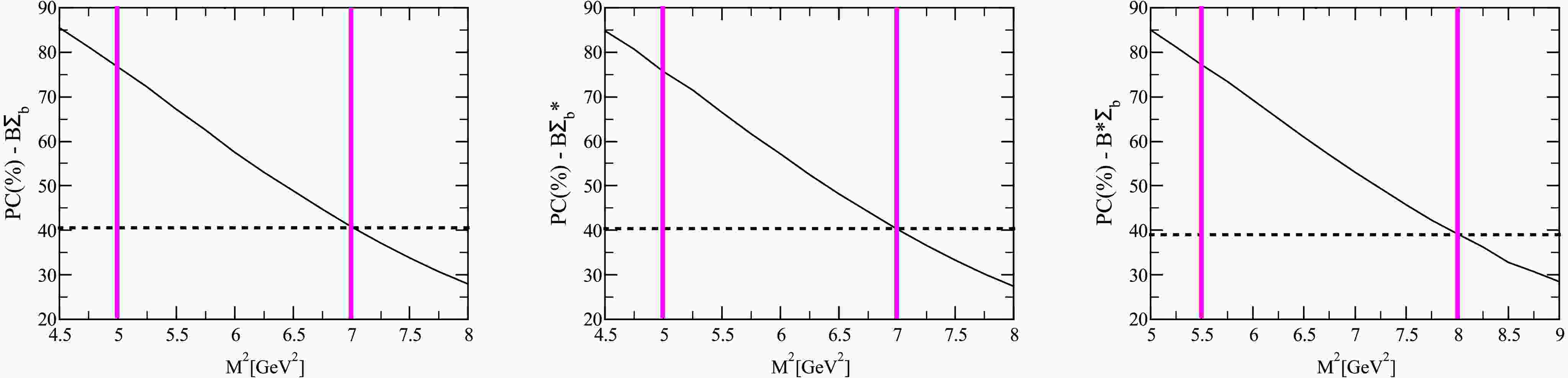
$ {s_0} $ and$ {M^2} $ , along with the PC and CVG for the MDMs of the doubly-bottom pentaquarks, are presented.To illustrate the results of the PC analysis, Figure 1 shows that, within the adopted Borel window, the PC contribution remains significantly above the continuum, thereby confirming ground-state dominance. The PC curves in Fig. 1 are obtained by averaging over the continuum threshold
$ {s_0} $ within the interval specified in Table 2. Specifically, the PC is computed for a dense set of$ {s_0} $ values spanning this interval, and the resulting values are averaged. The spread of the PC over the interval is only a few percent, so the averaged curve is representative of the entire$ {s_0} $ range, and the resulting Borel window is essentially unaffected by the choice of$ {s_0} $ . This confirms that the ground-state dominance displayed in the figure is insensitive to$ {s_0} $ within its established interval.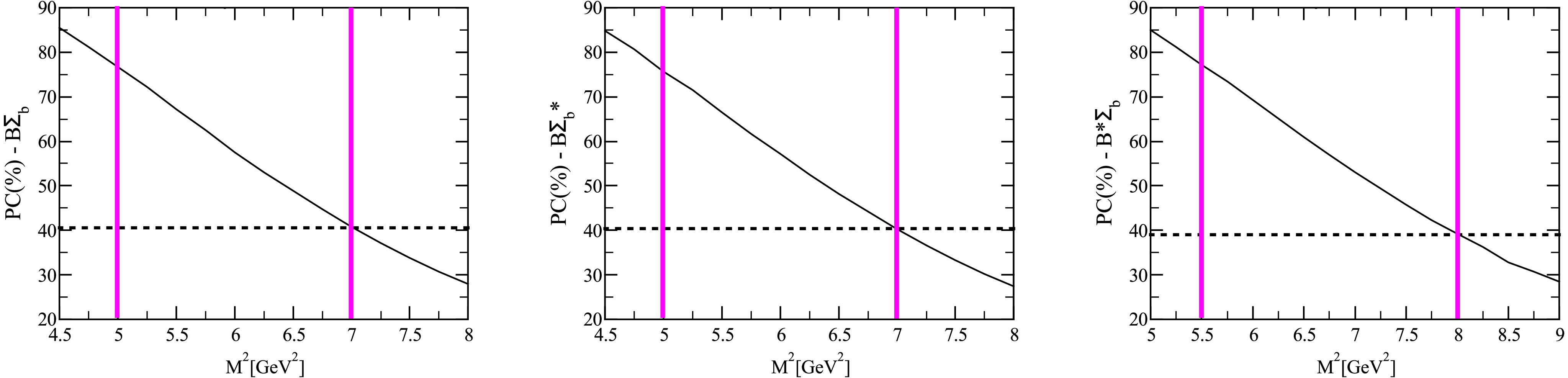
Figure 1. (color online) PC analysis of the MDM for doubly bottom pentaquarks is presented as a function of
$ {M^2} $ . The area enclosed by the vertical lines indicates the selected Borel window, and the horizontal line denotes the minimum value of the PC in this analysis. The PC results are derived by averaging over the continuum threshold$ {s_0} $ within the range specified in Table 2.For completeness, Fig. 2 displays the dependence of the MDMs of the doubly bottom pentaquark states on the Borel mass parameter
$ {M^2} $ and the continuum threshold$ {s_0} $ . As evident from the figure, the magnetic moment remains largely insensitive to variations in$ {M^2} $ within the chosen window, thereby confirming the stability and reliability of the theoretical predictions. Although the magnetic moment exhibits a more pronounced sensitivity to the continuum threshold$ {s_0} $ , the resulting variations remain well within the estimated theoretical uncertainties of the employed sum-rule approach. This indicates that, despite the inherent dependence on the choice of$ {s_0} $ , the predictions are stable and reliable. Moreover, the observed behavior reflects the expected physical consistency of the method: variations in$ {s_0} $ primarily affect the continuum contribution, while the ground-state dominance, as ensured by the pole contribution analysis, remains intact. Consequently, the extracted magnetic moments can be regarded as robust estimates, and their dependence on$ {s_0} $ does not compromise the overall validity of the theoretical predictions.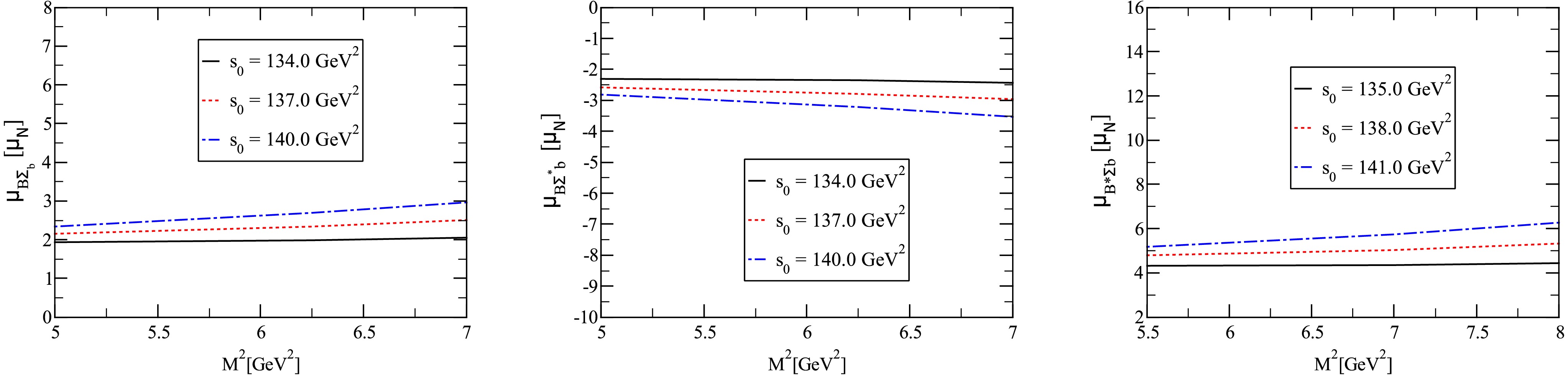
Figure 2. (color online) The mass distribution models (MDMs) of doubly-bottom pentaquarks are analyzed in relation to
$ {M^2} $ .Following the numerical analysis, the predicted values of the MDMs for the doubly-bottom pentaquark states with quantum numbers
$ {J^P} = {1}/{2}^- $ and$ {3}/{2}^- $ are presented in Table 2. The uncertainties in these results primarily arise from variations in the continuum threshold parameter$ {s_0} $ and the Borel mass parameter$ {M^2} $ , as well as from uncertainties associated with other input parameters, including those used in the DAs. The contributions to the total uncertainty are approximately distributed as follows: 15% from the mass of the pentaquarks, 24% from their residues, 30% from the threshold parameter$ {s_0} $ , 7% from the Borel mass$ {M^2} $ , 9% from the photon DAs, and the remaining 15% from other parameters.Based on these results, we summarize our findings as follows:
● For the
$ B \Sigma_b $ state, the dominant contribution to the magnetic moment arises from the perturbative component, which constitutes approximately 92% of the total value. In the$ B \Sigma_b^* $ configuration, this fraction is about 84%, whereas for the$ B^* \Sigma_b $ state, the perturbative contribution decreases to nearly 76%. These results demonstrate that the perturbative component plays a leading role in all configurations, although its relative significance varies depending on the spin structure of the state.● The significant variation in the MDMs among the
$ B \Sigma_b $ ,$ B \Sigma_b^* $ , and$ B^* \Sigma_b $ configurations underscores the crucial role of the internal spin structure and the dynamics of the constituent quarks. The observed differences, particularly in the sign and magnitude of the magnetic moments, reflect the sensitivity of these observables to the spin alignment between light and heavy quarks. Specifically, the negative value obtained for the$ B \Sigma_b^* $ state indicates destructive interference between spin components, whereas the enhanced magnetic moment in the$ B^* \Sigma_b $ configuration suggests constructive spin alignment. These findings provide valuable insights into the electromagnetic structure and internal dynamics of doubly-bottom pentaquark systems.● The results presented in Table 3 elucidate the distinct roles of light and heavy quarks in determining the magnetic moments of the
$ P_{bb} $ pentaquark states. For the$ B \Sigma_b $ configuration, the predominant contribution arises from the up quark, resulting in a substantial positive magnetic moment of$ \mu_{u} = 2.54 \mu_N $ , while the down quark provides a minor negative correction ($ \mu_{d} = -0.14 \mu_N $ ). The total magnetic moment,$ \mu_{ {\rm total}} = 2.40 \mu_N $ , primarily reflects the influence of light quark dynamics, as the contribution from the heavy b-quark is negligible or effectively canceled in this state.States $ \mu_{u} $ $ \mu_{d} $ $ \mu_{b} $ $ \mu_{tot} $ $ B \Sigma_b $ $ 2.54 $ $ -0.14 $ $ - $ $ 2.40 $ $ B \Sigma_b^* $ $ -0.275 $ $ 0.015 $ $ -2.58 $ $ -2.84 $ $ B^* \Sigma_b $ $ 2.76 $ $ -0.35 $ $ 2.76 $ $ 5.17 $ Table 3. The contribution of light and heavy quarks to the magnetic dipole moments (MDMs) of the
$ P_{bb} $ states is presented in units of$ \mu_N $ . These results have been derived using the central values of the numerical input parameters.In contrast, the
$ B \Sigma_b^* $ state exhibits a dominant negative contribution from the heavy b-quark ($ \mu_{b} = -2.58 \mu_N $ ), which, combined with a relatively minor net effect from the light quarks, results in a strongly negative total magnetic moment ($ \mu_{ {\rm total}} = -2.84 \mu_N $ ). This indicates that the spin alignment and internal structure in this state allow the heavy quark’s magnetic moment to play a significant role.Finally, in the
$ B^* \Sigma_b $ configuration, both light and heavy quarks contribute substantially and constructively. The up quark and b-quark yield$ \mu_u = 2.76 \mu_N $ and$ \mu_b = 2.76 \mu_N $ , respectively, while the down quark slightly suppresses the total with$ \mu_d = -0.35 \mu_N $ . The resulting total magnetic moment,$ \mu_{ {\rm total}} = 5.17 \mu_N $ , is significantly enhanced, highlighting the cooperative effect between quark constituents in this configuration.These observations underscore the sensitivity of the magnetic moments to the internal spin-flavor configuration of the pentaquark states and demonstrate that both the composition and the spin alignment of the constituent quarks profoundly impact the electromagnetic properties of such exotic hadrons.
● The magnetic dipole moments (MDMs) predicted in this work for the
$ B\Sigma_b $ ,$ B\Sigma_b^{*} $ , and$ B^{*}\Sigma_b $ configurations are compared with the results of [37], where compact doubly-bottom pentaquark states were studied using QCD light-cone sum rules. In that analysis, the spin-$ {1}/{2} $ compact pentaquark states were found to have negative magnetic moments, whereas positive values were obtained for the spin-$ {3}/{2} $ states.Our result for the
$ B\Sigma_b $ molecular configuration yields a positive magnetic moment of approximately$ 2.40\,\mu_N $ , which differs significantly in both sign and magnitude from the compact spin-$ {1}/{2} $ predictions. This behavior indicates a strong sensitivity of the MDM to the underlying configuration of the state. In the spin-$ {3}/{2} $ sector, the$ B^{*}\Sigma_b $ molecular state exhibits a magnetic moment of approximately$ 5.17\,\mu_N $ , showing a close numerical similarity to the compact pentaquark result, while the$ B\Sigma_b^{*} $ configuration results in an opposite-sign value.These observations suggest that, although certain spin-
$ {3}/{2} $ molecular configurations may reproduce the magnitude of the compact pentaquark magnetic moments, the overall pattern of signs and magnitudes is strongly model-dependent. It must be emphasized, however, that the sign of the magnetic moment alone cannot serve as an unambiguous discriminator between the molecular and compact pictures. Among the states considered here, the two spin-$ {3}/{2} $ molecular configurations exhibit opposite signs, indicating that the sign is configuration-dependent within the molecular scenario itself.Furthermore, the spin-
$ {1}/{2} $ molecular partners associated with the$ B^{*}\Sigma_b $ and$ B^{*}\Sigma_b^{*} $ systems could not be included in the present analysis for the reasons discussed above, and their magnetic moments—whose signs cannot be anticipated—might also be negative. Consequently, the observation of a negative spin-$ {1}/{2} $ magnetic moment would not, by itself, establish a compact internal structure. Rather than relying on a single sign rule, we therefore consider the characteristic pattern of the magnetic dipole and higher multipole moments across the accessible spectrum, together with the masses and decay widths, as providing complementary information for distinguishing molecular from compact assignments in future experimental studies.● The sensitivity of the MDMs to spin alignment suggests that future experimental measurements could offer crucial insights into the internal structure of these pentaquark states. MDMs significantly influence the electromagnetic transitions of pentaquark states, determining the rates and probabilities of photon emission between different spin-parity configurations. These moments directly affect the amplitudes of electromagnetic decay channels, thereby impacting the partial decay widths and lifetimes. Consequently, precise theoretical predictions of magnetic moments are essential for interpreting future experimental data on radiative decays. Furthermore, when considered alongside masses and decay widths, variations in the magnetic moments can provide complementary information for distinguishing compact multiquark structures from hadronic molecular configurations, thereby aiding in the clarification of the internal quark dynamics of exotic states.
● In addition to the MDMs, we have evaluated the electric quadrupole and magnetic octupole moments of the spin-
$ {3}/{2} $ molecular configurations$ B\Sigma_b^{*} $ and$ B^{*}\Sigma_b $ . These evaluations provide further insight into the spatial deformation and higher-order spin–magnetic correlations of these states, following the definitions and the sum-rule procedure outlined in Sec. II. For the$ B\Sigma_b^{*} $ configuration, the electric quadrupole moment is determined to be$ {\cal{Q}}_{B\Sigma_b^{*}} = (0.75 \pm 0.12)\times 10^{-1}\, {fm}^2 $ , indicating a small but non-negligible deviation from spherical symmetry. The positive sign of the quadrupole moment suggests a prolate-type charge deformation, consistent with a molecular model in which the spin alignment of the constituents induces an elongated charge distribution along the quantization axis.The corresponding magnetic octupole moment,
$ {\cal{O}}_{B\Sigma_b^{*}} = (0.62 \pm 0.10)\times 10^{-3}\, {fm}^3 $ , is relatively suppressed, reflecting the weak contribution of higher-order magnetic multipoles in this configuration. This behavior indicates that, although the state exhibits mild spatial deformation, the spin–magnetic correlations beyond the dipole level remain limited, as expected for a loosely bound molecular system dominated by a single heavy-quark spin orientation.In contrast, the
$ B^{*}\Sigma_b $ molecular configuration exhibits a markedly different multipole structure. The electric quadrupole moment is obtained as$ {\cal{Q}}_{B^{*}\Sigma_b} = -0.60 \pm 0.10 \;\rm {fm}^2 $ , with the negative sign indicating an oblate-type deformation of the charge distribution. The considerably larger magnitude of this quadrupole moment compared to the$ B\Sigma_b^{*} $ case suggests more pronounced spatial anisotropy, arising from the interplay between the spin-$ 1 $ $ B^{*} $ meson and the spin-$ {1}/{2} $ $ \Sigma_b $ baryon. Furthermore, the magnetic octupole moment of the$ B^{*}\Sigma_b $ state is found to be$ {\cal{O}}_{B^{*}\Sigma_b} = (0.12 \pm 0.02)\times 10^{-1}\; {\rm fm}^3 $ , which is significantly enhanced relative to that of the$ B\Sigma_b^{*} $ configuration. This enhancement indicates the presence of stronger higher-order spin–magnetic correlations, driven by the constructive coupling between the light- and heavy-quark sectors in the$ B^{*}\Sigma_b $ molecular system. Such a pattern is consistent with the simultaneously large MDM obtained for this state, indicating a coherent multipole hierarchy extending beyond the dipole level.Overall, the distinct behaviors of the electric quadrupole and magnetic octupole moments for the
$ B\Sigma_b^{*} $ and$ B^{*}\Sigma_b $ configurations highlight the sensitivity of higher electromagnetic multipoles to the internal spin arrangement and spatial structure of doubly-bottom pentaquark molecules. These results reinforce the role of electromagnetic multipole moments as powerful probes of hadronic structure and suggest that measurements of quadrupole and octupole observables, in addition to MDMs, could provide valuable discrimination between different molecular configurations and their compact counterparts. -
In this section, we present a numerical evaluation of the expressions derived for the MDMs of the doubly-bottom pentaquark states. This analysis requires specific input parameters, which are listed in Table 1. Furthermore, as indicated by the sum rules provided in Eqs. (A1)–(A7), the photon DAs are essential to the calculations. The explicit forms of these DAs are provided in B.
Inputs Values $ m_b $ $ 4.78 \pm 0.06 $ GeV [81]$ m_{ B \Sigma_b} $ $ 11.07^{+0.08}_{-0.08} $ GeV [36]$ m_{ B \Sigma_b^*} $ $ 11.09^{+0.08}_{-0.08} $ GeV [36]$ m_{ B^* \Sigma_b} $ $ 11.12^{+0.08}_{-0.08} $ GeV [36]$ m_0^{2} $ $ 0.8 \pm 0.1 $ GeV2 [82]$ f_{3\gamma} $ $ -0.0039 $ GeV2 [80]χ $ 2.85 \pm 0.5 $ GeV−2 [83]$ \langle \bar qq\rangle $ $ (-0.255 \pm 0.008)^3 $ GeV3 [82]$ \langle g_s^2G^2\rangle $ $ 0.80 \pm 0.04 $ GeV4 [84]$ \lambda_{ B \Sigma_b} $ $ (19.89^{+2.65}_{-2.57})\times 10^{-3} $ GeV6 [36]$ \lambda_{ B \Sigma_b^*} $ $ (12.10^{+1.56}_{-1.51})\times 10^{-3} $ GeV6 [36]$ \lambda_{ B^* \Sigma_b} $ $ (22.63^{+2.92}_{-2.84})\times 10^{-3} $ GeV6 [36]Table 1. Input parameters in this work.
In addition to the previously discussed parameters, two additional inputs are crucial in the QCD sum rule analysis: the Borel mass parameter
$ {M^2} $ and the continuum threshold$ {s_0} $ . The numerical evaluation is conducted within the bounds defined by the standard criteria of the QCD sum rule approach, ensuring the stability and reliability of the results. The continuum threshold$ {s_0} $ is not an arbitrary quantity; it characterizes the scale at which the excited states and the continuum begin to contribute significantly to the correlation function. Several methodologies have been proposed for its estimation. One technique involves varying the parameter within a reasonable range while monitoring the emergence of a$ {M^2} $ window in which the predictions become independent of$ {M^2} $ [85]. An alternative technique treats$ {s_0} $ as a function of$ {M^2} $ and determines the functional form of this relationship by requiring that the mass result be insensitive to$ {M^2} $ [86]. Another approach allows the continuum threshold to be evaluated independently [87, 88]. Each of these perspectives has its own advantages and drawbacks regarding the reliability of the analysis. Nevertheless, the most widely adopted prescription is to constrain$ {s_0} $ to the range$ (m_H + 0.4)^2 \; {\rm GeV}^2 \le s_0 \le ( m_H + 0.8)^2 {\rm GeV}^2 $ , guided by the mass gap between the ground state (1S) and the first radial excitation (2S) of the state under study. In the absence of experimental data on the excited states of doubly-bottom pentaquarks, a comparable estimate can be obtained by examining analogous multiquark systems for which such mass gaps have been discussed. If one adopts the tetraquark assignments, the$ X(3915) $ and$ X(4500) $ may be identified as the 1S and 2S states with$ {J^{PC}}=0^{++} $ [89, 90]; the$ Z_c(3900) $ and$ Z_c(4430) $ as the 1S and 2S states with$ {J^{PC}}=1^{+-} $ [91−94]; the$ Z_c(4020) $ and$ Z_c(4600) $ as the 1S and 2S states with$ {J^{PC}}=1^{+-} $ [95, 96]; and the$ X(4140) $ and$ X(4685) $ as the 1S and 2S states with$ {J^{PC}}=1^{++} $ [97]. Across these assignments, the 1S–2S mass splittings are estimated to lie in the range of approximately$ 0.5 $ to$ 0.6\; {\rm GeV} $ . It is therefore reasonable to expect a comparable splitting for the doubly-bottom pentaquark states. Accordingly, we set the continuum threshold for the states considered here to$ (m_{P_{bb}} + 0.5)^2 \;{\rm GeV^2} \le s_0 \le (m_{P_{bb}} + 0.8)^2 \;{\rm GeV^2}$ .The working region for the Borel parameter
$ {M^2} $ is determined by ensuring two fundamental conditions: pole dominance (PC) and the convergence of the operator product expansion (CVG). These constraints are imposed through the following relations:$ {\rm PC} =\dfrac{{\cal{R}}_i ( {M^2}, {s_0})}{{\cal{R}}_i ( {M^2},\infty)} \gt 35{\text{%}}, $
(53) $ {\rm CVG} =\dfrac{{\cal{R}}_i^{ {DimN}} ( {M^2}, {s_0})}{{\cal{R}}_i ( {M^2}, {s_0})} \lt 5{\text{%}}, $
(54) where
$ {\cal{R}}_i^{ {DimN}} ( {M^2}, {s_0}) $ is the highest-dimensional term in the OPE of$ {\cal{R}}_i ( {M^2}, {s_0}) $ . The results of the corresponding CVG analysis are presented in Table 2, and the outcomes of the PC analysis are also provided in the same table. As observed from the table, the contribution of the highest-dimensional term in the CVG analysis is relatively small, indicating that it is adequately controlled.States $ {s_0} $ /GeV2$ {M^2} $ /GeV2PC (%) CVG (%) $ \mu\, (\mu_N) $ $ B \Sigma_b $ $ 134.0 - 140.0 $ $ 5.0 - 7.0 $ $ 76.65 - 40.71 $ $<1.0 $ $ 2.40^{+0.56}_{-0.47} $ $ B \Sigma_b^* $ $ 134.0 - 140.0 $ $ 5.0 - 7.0 $ $ 75.67 - 40.18 $ $<1.0 $ $ - 2.84^{+0.78}_{-0.59} $ $ B^* \Sigma_b $ $ 135.0 - 141.0 $ $ 5.5 - 8.0 $ $ 77.16 - 39.16 $ $<1.0 $ $ 5.17^{+1.08}_{-0.94} $ Table 2. Working regions of
$ {s_0} $ and$ {M^2} $ , along with the PC and CVG for the MDMs of the doubly-bottom pentaquarks, are presented.To illustrate the results of the PC analysis, Figure 1 shows that, within the adopted Borel window, the PC contribution remains significantly above the continuum, thereby confirming ground-state dominance. The PC curves in Fig. 1 are obtained by averaging over the continuum threshold
$ {s_0} $ within the interval specified in Table 2. Specifically, the PC is computed for a dense set of$ {s_0} $ values spanning this interval, and the resulting values are averaged. The spread of the PC over the interval is only a few percent, so the averaged curve is representative of the entire$ {s_0} $ range, and the resulting Borel window is essentially unaffected by the choice of$ {s_0} $ . This confirms that the ground-state dominance displayed in the figure is insensitive to$ {s_0} $ within its established interval.
Figure 1. (color online) PC analysis of the MDM for doubly bottom pentaquarks is presented as a function of
$ {M^2} $ . The area enclosed by the vertical lines indicates the selected Borel window, and the horizontal line denotes the minimum value of the PC in this analysis. The PC results are derived by averaging over the continuum threshold$ {s_0} $ within the range specified in Table 2.For completeness, Fig. 2 displays the dependence of the MDMs of the doubly bottom pentaquark states on the Borel mass parameter
$ {M^2} $ and the continuum threshold$ {s_0} $ . As evident from the figure, the magnetic moment remains largely insensitive to variations in$ {M^2} $ within the chosen window, thereby confirming the stability and reliability of the theoretical predictions. Although the magnetic moment exhibits a more pronounced sensitivity to the continuum threshold$ {s_0} $ , the resulting variations remain well within the estimated theoretical uncertainties of the employed sum-rule approach. This indicates that, despite the inherent dependence on the choice of$ {s_0} $ , the predictions are stable and reliable. Moreover, the observed behavior reflects the expected physical consistency of the method: variations in$ {s_0} $ primarily affect the continuum contribution, while the ground-state dominance, as ensured by the pole contribution analysis, remains intact. Consequently, the extracted magnetic moments can be regarded as robust estimates, and their dependence on$ {s_0} $ does not compromise the overall validity of the theoretical predictions.
Figure 2. (color online) The mass distribution models (MDMs) of doubly-bottom pentaquarks are analyzed in relation to
$ {M^2} $ .Following the numerical analysis, the predicted values of the MDMs for the doubly-bottom pentaquark states with quantum numbers
$ {J^P} = {1}/{2}^- $ and$ {3}/{2}^- $ are presented in Table 2. The uncertainties in these results primarily arise from variations in the continuum threshold parameter$ {s_0} $ and the Borel mass parameter$ {M^2} $ , as well as from uncertainties associated with other input parameters, including those used in the DAs. The contributions to the total uncertainty are approximately distributed as follows: 15% from the mass of the pentaquarks, 24% from their residues, 30% from the threshold parameter$ {s_0} $ , 7% from the Borel mass$ {M^2} $ , 9% from the photon DAs, and the remaining 15% from other parameters.Based on these results, we summarize our findings as follows:
● For the
$ B \Sigma_b $ state, the dominant contribution to the magnetic moment arises from the perturbative component, which constitutes approximately 92% of the total value. In the$ B \Sigma_b^* $ configuration, this fraction is about 84%, whereas for the$ B^* \Sigma_b $ state, the perturbative contribution decreases to nearly 76%. These results demonstrate that the perturbative component plays a leading role in all configurations, although its relative significance varies depending on the spin structure of the state.● The significant variation in the MDMs among the
$ B \Sigma_b $ ,$ B \Sigma_b^* $ , and$ B^* \Sigma_b $ configurations underscores the crucial role of the internal spin structure and the dynamics of the constituent quarks. The observed differences, particularly in the sign and magnitude of the magnetic moments, reflect the sensitivity of these observables to the spin alignment between light and heavy quarks. Specifically, the negative value obtained for the$ B \Sigma_b^* $ state indicates destructive interference between spin components, whereas the enhanced magnetic moment in the$ B^* \Sigma_b $ configuration suggests constructive spin alignment. These findings provide valuable insights into the electromagnetic structure and internal dynamics of doubly-bottom pentaquark systems.● The results presented in Table 3 elucidate the distinct roles of light and heavy quarks in determining the magnetic moments of the
$ P_{bb} $ pentaquark states. For the$ B \Sigma_b $ configuration, the predominant contribution arises from the up quark, resulting in a substantial positive magnetic moment of$ \mu_{u} = 2.54 \mu_N $ , while the down quark provides a minor negative correction ($ \mu_{d} = -0.14 \mu_N $ ). The total magnetic moment,$ \mu_{ {\rm total}} = 2.40 \mu_N $ , primarily reflects the influence of light quark dynamics, as the contribution from the heavy b-quark is negligible or effectively canceled in this state.States $ \mu_{u} $ $ \mu_{d} $ $ \mu_{b} $ $ \mu_{tot} $ $ B \Sigma_b $ $ 2.54 $ $ -0.14 $ $ - $ $ 2.40 $ $ B \Sigma_b^* $ $ -0.275 $ $ 0.015 $ $ -2.58 $ $ -2.84 $ $ B^* \Sigma_b $ $ 2.76 $ $ -0.35 $ $ 2.76 $ $ 5.17 $ Table 3. The contribution of light and heavy quarks to the magnetic dipole moments (MDMs) of the
$ P_{bb} $ states is presented in units of$ \mu_N $ . These results have been derived using the central values of the numerical input parameters.In contrast, the
$ B \Sigma_b^* $ state exhibits a dominant negative contribution from the heavy b-quark ($ \mu_{b} = -2.58 \mu_N $ ), which, combined with a relatively minor net effect from the light quarks, results in a strongly negative total magnetic moment ($ \mu_{ {\rm total}} = -2.84 \mu_N $ ). This indicates that the spin alignment and internal structure in this state allow the heavy quark’s magnetic moment to play a significant role.Finally, in the
$ B^* \Sigma_b $ configuration, both light and heavy quarks contribute substantially and constructively. The up quark and b-quark yield$ \mu_u = 2.76 \mu_N $ and$ \mu_b = 2.76 \mu_N $ , respectively, while the down quark slightly suppresses the total with$ \mu_d = -0.35 \mu_N $ . The resulting total magnetic moment,$ \mu_{ {\rm total}} = 5.17 \mu_N $ , is significantly enhanced, highlighting the cooperative effect between quark constituents in this configuration.These observations underscore the sensitivity of the magnetic moments to the internal spin-flavor configuration of the pentaquark states and demonstrate that both the composition and the spin alignment of the constituent quarks profoundly impact the electromagnetic properties of such exotic hadrons.
● The magnetic dipole moments (MDMs) predicted in this work for the
$ B\Sigma_b $ ,$ B\Sigma_b^{*} $ , and$ B^{*}\Sigma_b $ configurations are compared with the results of [37], where compact doubly-bottom pentaquark states were studied using QCD light-cone sum rules. In that analysis, the spin-$ {1}/{2} $ compact pentaquark states were found to have negative magnetic moments, whereas positive values were obtained for the spin-$ {3}/{2} $ states.Our result for the
$ B\Sigma_b $ molecular configuration yields a positive magnetic moment of approximately$ 2.40\,\mu_N $ , which differs significantly in both sign and magnitude from the compact spin-$ {1}/{2} $ predictions. This behavior indicates a strong sensitivity of the MDM to the underlying configuration of the state. In the spin-$ {3}/{2} $ sector, the$ B^{*}\Sigma_b $ molecular state exhibits a magnetic moment of approximately$ 5.17\,\mu_N $ , showing a close numerical similarity to the compact pentaquark result, while the$ B\Sigma_b^{*} $ configuration results in an opposite-sign value.These observations suggest that, although certain spin-
$ {3}/{2} $ molecular configurations may reproduce the magnitude of the compact pentaquark magnetic moments, the overall pattern of signs and magnitudes is strongly model-dependent. It must be emphasized, however, that the sign of the magnetic moment alone cannot serve as an unambiguous discriminator between the molecular and compact pictures. Among the states considered here, the two spin-$ {3}/{2} $ molecular configurations exhibit opposite signs, indicating that the sign is configuration-dependent within the molecular scenario itself.Furthermore, the spin-
$ {1}/{2} $ molecular partners associated with the$ B^{*}\Sigma_b $ and$ B^{*}\Sigma_b^{*} $ systems could not be included in the present analysis for the reasons discussed above, and their magnetic moments—whose signs cannot be anticipated—might also be negative. Consequently, the observation of a negative spin-$ {1}/{2} $ magnetic moment would not, by itself, establish a compact internal structure. Rather than relying on a single sign rule, we therefore consider the characteristic pattern of the magnetic dipole and higher multipole moments across the accessible spectrum, together with the masses and decay widths, as providing complementary information for distinguishing molecular from compact assignments in future experimental studies.● The sensitivity of the MDMs to spin alignment suggests that future experimental measurements could offer crucial insights into the internal structure of these pentaquark states. MDMs significantly influence the electromagnetic transitions of pentaquark states, determining the rates and probabilities of photon emission between different spin-parity configurations. These moments directly affect the amplitudes of electromagnetic decay channels, thereby impacting the partial decay widths and lifetimes. Consequently, precise theoretical predictions of magnetic moments are essential for interpreting future experimental data on radiative decays. Furthermore, when considered alongside masses and decay widths, variations in the magnetic moments can provide complementary information for distinguishing compact multiquark structures from hadronic molecular configurations, thereby aiding in the clarification of the internal quark dynamics of exotic states.
● In addition to the MDMs, we have evaluated the electric quadrupole and magnetic octupole moments of the spin-
$ {3}/{2} $ molecular configurations$ B\Sigma_b^{*} $ and$ B^{*}\Sigma_b $ . These evaluations provide further insight into the spatial deformation and higher-order spin–magnetic correlations of these states, following the definitions and the sum-rule procedure outlined in Sec. II. For the$ B\Sigma_b^{*} $ configuration, the electric quadrupole moment is determined to be$ {\cal{Q}}_{B\Sigma_b^{*}} = (0.75 \pm 0.12)\times 10^{-1}\, {fm}^2 $ , indicating a small but non-negligible deviation from spherical symmetry. The positive sign of the quadrupole moment suggests a prolate-type charge deformation, consistent with a molecular model in which the spin alignment of the constituents induces an elongated charge distribution along the quantization axis.The corresponding magnetic octupole moment,
$ {\cal{O}}_{B\Sigma_b^{*}} = (0.62 \pm 0.10)\times 10^{-3}\, {fm}^3 $ , is relatively suppressed, reflecting the weak contribution of higher-order magnetic multipoles in this configuration. This behavior indicates that, although the state exhibits mild spatial deformation, the spin–magnetic correlations beyond the dipole level remain limited, as expected for a loosely bound molecular system dominated by a single heavy-quark spin orientation.In contrast, the
$ B^{*}\Sigma_b $ molecular configuration exhibits a markedly different multipole structure. The electric quadrupole moment is obtained as$ {\cal{Q}}_{B^{*}\Sigma_b} = -0.60 \pm 0.10 \;\rm {fm}^2 $ , with the negative sign indicating an oblate-type deformation of the charge distribution. The considerably larger magnitude of this quadrupole moment compared to the$ B\Sigma_b^{*} $ case suggests more pronounced spatial anisotropy, arising from the interplay between the spin-$ 1 $ $ B^{*} $ meson and the spin-$ {1}/{2} $ $ \Sigma_b $ baryon. Furthermore, the magnetic octupole moment of the$ B^{*}\Sigma_b $ state is found to be$ {\cal{O}}_{B^{*}\Sigma_b} = (0.12 \pm 0.02)\times 10^{-1}\; {\rm fm}^3 $ , which is significantly enhanced relative to that of the$ B\Sigma_b^{*} $ configuration. This enhancement indicates the presence of stronger higher-order spin–magnetic correlations, driven by the constructive coupling between the light- and heavy-quark sectors in the$ B^{*}\Sigma_b $ molecular system. Such a pattern is consistent with the simultaneously large MDM obtained for this state, indicating a coherent multipole hierarchy extending beyond the dipole level.Overall, the distinct behaviors of the electric quadrupole and magnetic octupole moments for the
$ B\Sigma_b^{*} $ and$ B^{*}\Sigma_b $ configurations highlight the sensitivity of higher electromagnetic multipoles to the internal spin arrangement and spatial structure of doubly-bottom pentaquark molecules. These results reinforce the role of electromagnetic multipole moments as powerful probes of hadronic structure and suggest that measurements of quadrupole and octupole observables, in addition to MDMs, could provide valuable discrimination between different molecular configurations and their compact counterparts. -
In this study, we investigated the magnetic dipole moments (MDMs) of doubly-bottom pentaquark states with spin-parities
$ J^P= {1}/{2}^- $ and$ {3}/{2}^- $ , treating them as hadronic molecules in the$ B\Sigma_b $ ,$ B\Sigma_b^{*} $ , and$ B^{*}\Sigma_b $ configurations. The analysis was conducted within the framework of QCD light-cone sum rules employing photon distribution amplitudes. Our results demonstrate that the MDMs are highly sensitive to the internal spin structure and quark dynamics of the states. In the$ B\Sigma_b $ configuration, the magnetic moment is dominated by the light-quark contributions, whereas in the$ B\Sigma_b^{*} $ case, the heavy bottom-quark sector plays a leading role. For the$ B^{*}\Sigma_b $ molecular state, both light and heavy sectors contribute constructively, resulting in a significantly enhanced magnetic moment. Although perturbative contributions are dominant in all configurations, their relative weight decreases from approximately 92% to 76% as the spin structure becomes more complex. Moreover, the predicted electric quadrupole and magnetic octupole moments of the spin-$ {3}/{2} $ $ B\Sigma_b^{*} $ and$ B^{*}\Sigma_b $ configurations reveal distinct deformation patterns and higher-order spin–magnetic correlations, further emphasizing the sensitivity of electromagnetic multipole observables to the internal structure of doubly-bottom pentaquark molecules.A comparison with compact pentaquark predictions from [37] reveals differences in the magnetic dipole moments that can be traced back to the distinct internal structures of molecular and compact configurations. This suggests that magnetic dipole moments, particularly when combined with the masses, decay widths, and higher electromagnetic multipole moments, can provide complementary information for distinguishing between these two models. We caution, however, that the sign of the moment alone is not a decisive criterion, since the spin-
$ {1}/{2} $ molecular partners not treated here could also yield negative moments. These findings may have important experimental implications for radiative decay channels and electromagnetic transitions, offering valuable insight into the structure of exotic hadrons and providing guidance for future searches at LHCb and Belle II. -
This section presents the analytical outcomes of the MDM analysis of doubly-bottom pentaquark states.
The study focuses on the magnetic dipole moments (MDMs) of these exotic hadrons, which are crucial for understanding their internal structure and interactions. The MDMs provide insights into the distribution of charge and magnetization within the pentaquarks, thereby offering a deeper comprehension of their quantum characteristics.
The analysis employs a theoretical framework based on quantum chromodynamics (QCD), which is the fundamental theory describing the strong interaction. By utilizing this framework, we calculate the MDMs of the doubly-bottom pentaquark states with high precision. The results are compared with existing theoretical predictions and experimental data, where available, to validate the accuracy of our approach.
Our findings indicate that the MDMs of these pentaquark states exhibit unique patterns that distinguish them from other hadronic systems. These patterns are attributed to the presence of two bottom quarks, which significantly influence the magnetic properties of the states. The implications of these results are discussed in the context of current theoretical models and their potential impact on future experimental investigations.
In conclusion, the analysis of the MDMs of doubly-bottom pentaquark states enhances our understanding of their structure and dynamics. This work contributes to the broader field of hadron physics by providing valuable data that can guide future research and experimental efforts.
-
$\begin{aligned}[b] {\cal{R}}_1 ( {M^2}, {s_0}) =\;& \dfrac{1}{2 ^{26}\times 3^2 \times 5^3\times 7^2 \pi^7} \Big[ 3 (e_d + 9 e_u) \big(149 I[0, 5] + 427 I[1, 4]\big) \Big] -\dfrac {m_b\langle g_s^2 G^2\rangle \langle \bar q q \rangle f_ {3\gamma } } {2^{20} \times 3^3 \pi^3} (e_d + 9 e_u) I_5[\psi^a] I[0, 0]\\& -\dfrac { \langle \bar q q \rangle^2 } {2^{18} \times 3^2 \times 5^2 \pi^3} \Big[ (e_d + 9 e_u)\Big ( 15 I[0, 2] h_\gamma[u_ 0] + 2 \chi I[0, 3] \varphi_\gamma[u_ 0]\Big)\Big]\\& + \dfrac {\langle g_s^2 G^2\rangle f_ {3 \gamma} } {2^{27}\times 3^5 \times 5 \pi^5} (e_d + 9 e_u)\Big [ 63 I_ 1[{\cal{V}}] + 80 (-9 I_5[\psi^a] + 4 \psi^a[u_ 0])\Big] I[ 0, 2]\\& + \dfrac { m_b \langle \bar q q \rangle f_ {3 \gamma} } {2^{19}\times 3^4 \times 5 \pi^3} (e_d + 9 e_u)\Big[ 9 \big(I_ 1[{\cal{V}}] - 4 I_5[\psi^a]\big) I[0, 2] + 22 I[0, 2] \psi^a[u_ 0] \Big]\\ & + \dfrac { f_ {3\gamma } } {2 ^{24}\times 3^2 \times 5^2 \times 7^2 \pi^5} (e_d + 9 e_u)\Big [ \big(5 I_ 1[{\cal{V}}] + 10 I_5[\psi^a] + 7 \psi^a[u_ 0]\big) I[0, 4]\Big]. \end{aligned}\tag{A1}$
(A1) -
$ {\cal{R}}_2 ({{{M}}^{{2}}},{{{s}}_{{0}}}) = F_1^{B\Sigma _b^*}({{{M}}^{{2}}},{{{s}}_{{0}}}) - \dfrac{1}{{{{{m}}_{{{B}}\Sigma _{{b}}^{{*}}}}}}{{F}}_{{2}}^{{{B}}\Sigma _{{b}}^{{*}}}({{{M}}^{{2}}},{{{s}}_{{0}}}),\tag{A2} $
(A2) with
$\begin{aligned}[b] F_1^{B\Sigma_b^{*}}( {M^2}, {s_0})= \;& \dfrac{19 e_b }{2^{28} \times 3 \times 5^2 \times 7^2 \pi^7 } I[0, 5] - \dfrac{ m_b \langle g_s^2 G^2\rangle \langle \bar q q \rangle f_{3\gamma}}{2^{21} \times 3^6 \times 5 \pi^3} (e_d + 9 e_u) \psi^a[u_0]I[0, 0] \\ & + \dfrac{ \langle \bar q q \rangle^2}{2^{21} \times 3^2 \pi^3} (e_d + 9 e_u) I_3[{\cal{S}}] I[0, 2] +\dfrac{ \langle g_s^2 G^2\rangle f_{3\gamma}}{2^{28}\times 3^4 \times 5 \pi^5} (e_d + 9 e_u)(26 I_1[{\cal{V}}] + \psi^a[u_0]) I[0, 2] \\ &+\dfrac{ m_b \langle \bar q q \rangle f_{3\gamma} }{2^{20}\times 3 ^2\times 5 \pi^3} (e_d + 9 e_u) I_1[{\cal{V}}] (m_0^2 I[0, 1] - I[0, 2]) -\dfrac{ f_{3\gamma} }{2^{26}\times 3 ^2\times 5 \pi^5} (e_d + 9 e_u) I_1[{\cal{V}}] I[0, 4], \end{aligned}\tag{A3}$
(A3) $\begin{aligned}[b] F_2^{B\Sigma_b^*}( {M^2}, {s_0})=\; & -\dfrac{223 e_b m_b }{2^{28} \times 3 \times 5^2 \times 7^2 \pi^7 } I[0, 5] + \dfrac{m_b \langle g_s^2 G^2\rangle \langle \bar q q \rangle^2}{2^{24} \times 3^4 \pi^3} (e_d + 9 e_u) I_1[{\cal{S}}] I[0, 0] \\ & + \dfrac{ m_b^2\langle g_s^2 G^2\rangle \langle \bar q q \rangle f_{3\gamma}}{2^{21} \times 3^5 \pi^3} (e_d + 9 e_u) (3 I_5[\psi^a] + 2 \psi^a[u_0])I[0, 0] - \dfrac{ m_b \langle \bar q q \rangle^2}{2^{19} \times 3 \times 5 \pi^3} (e_d + 9 e_u) I_3[{\cal{S}}] I[0, 2] \\ & +\dfrac{m_b \langle g_s^2 G^2\rangle f_{3\gamma}}{2^{30}\times 3^3 \times 5 \times \pi^5} (e_d + 9 e_u)(85 I_1[{\cal{V}}] + 64 I_5[\psi^a]) I[0, 2] \\ & -\dfrac{ m_b^2 \langle \bar q q \rangle f_{3\gamma} }{2^{21}\times 3^2 \pi^3} (e_d + 9 e_u) I_1[{\cal{V}}] (m_0^2 I[0, 1] - I[0, 2]) +\dfrac{ m_b f_{3\gamma} }{2^{24}\times 3 \times 5^2 \pi^5} (e_d + 9 e_u) I_1[{\cal{V}}] I[0, 4]. \end{aligned}\tag{A4}$
(A4) -
$ {\cal{R}}_3 ({{{M}}^{{2}}},{{{s}}_{{0}}}) = F_1^{{B^*}{\Sigma _b}}({{{M}}^{{2}}},{{{s}}_{{0}}}) - \dfrac{1}{{{{{m}}_{{{{B}}^{{*}}}{\Sigma _{{b}}}}}}}{{F}}_{{2}}^{{{{B}}^{{*}}}{\Sigma _{{b}}}}({{{M}}^{{2}}},{{{s}}_{{0}}}), \tag{A5}$
(A5) with
$\begin{aligned}[b] F_1^{B^*\Sigma_b}( {M^2}, {s_0})= & \dfrac{1 }{2^{27}\times 3 \times 5 ^2 \times 7^2 \pi^7 } (95 e_b - 78 (e_d + 4 e_u)) I[0, 5] +\dfrac{ m_b \langle g_s^2 G^2\rangle \langle \bar q q \rangle }{2^{26} \times 3^6 \times 5 \pi^5}\Big[ -248 (e_d + 4 e_u) {\mathbb A}[_ 0] I[0, 1] \\ &+ 3348 (e_d + 4 e_u) I_ 4[{\cal{S}}] I[0, 1] - 4428 e_d I_ 4[ {\tilde{\cal{S}}}] I[0, 1] + 263 \chi e_d I[0, 2] \varphi_\gamma[u_ 0] + 1052 \chi e_u I[0, 2] \varphi_\gamma[u_ 0] \\ &+ 704 (e_d + 9 e_u) f_ {3\gamma} \pi^2 I[0, 0] \psi^a[u_ 0] \Big] +\dfrac{ \langle g_s^2 G^2\rangle f_ {3\gamma}}{2^{28}\times 3 ^4\times 5 \times 7 \pi^5} \Big[ 336 (e_d + 9 e_u) I_ 1[{\cal{V}}] - (e_d + 4 e_u) (28 I_ 2[{\cal{V}}]\\ & + 71 \psi^a[u_ 0]) \Big] I[0,2] + \dfrac{ m_b \langle \bar q q \rangle }{2^{24}\times 3 ^2\times 5 ^3 \times 7 \pi^5}\Big[ -5600 (e_d + 9 e_u) f_ {3\gamma} \pi^2 I_ 1[{\cal{V}}] (m_ 0^2 I[0, 1] - I[0, 2]) \\ &+ 420 ((e_d + 4 e_u) ({\mathbb A}[u_ 0] - 8 I_ 4[{\cal{S}}]) + 8 e_d I_ 4[ {\tilde{\cal{S}}}]) I[0, 3] - 149 \chi (e_d + 4 e_u) I[0, 4] \varphi_\gamma[u_ 0] \Big] \\ &+\dfrac{ f_ {3\gamma}}{2^{26}\times 3 ^3\times 5 ^3 \times 7 \pi^5} (e_d + 4 e_u) (1400 I_2[{\cal{V}}] + 2223 \psi^a[u_0])I[0, 4], \end{aligned}\tag{A6}$
(A6) $\begin{aligned}[b] F_2^{B^*\Sigma_b}( {M^2}, {s_0})= \; &\dfrac{m_b }{2^{27}\times 3^4 \times 5 ^3 \times 7^2 \pi^7 } \Big[ -54 (e_d + 4 e_u) (88 I[0, 5] + 427 I[1, 4]) + 5 e_b (839 I[0, 5] + 19390 I[1, 4])\Big] \\ & + \dfrac{m_b \langle g_s^2 G^2\rangle \langle \bar q q \rangle^2}{2^{24} \times 3^4 \pi^3} (e_d + 9 e_u) I_1[{\cal{S}}] I[0, 0] + \dfrac{ m_b^2\langle g_s^2 G^2\rangle \langle \bar q q \rangle }{2^{21} \times 3^5 \pi^3} \Big[ \Big (124 (e_d + 4 e_u) {\mathbb A}[_ 0] \\ & - 45 \big ((e_d + 4 e_u) I_ 2[{\cal{S}}] - e_d I_ 2[ {\tilde{\cal{S}}}] - 8 (e_d + 4 e_u) I_ 4[{\cal{S}}] + 24 e_d I_ 4[ {\tilde{\cal{S}}}] \end{aligned}$
$\begin{aligned}[b] \quad\quad\quad\quad\quad \quad &+ 32 (e_d + 4 e_u) I_ 6[h_ {\gamma}]\big)\Big) I[0, 1] - 172 \chi (e_d + 4 e_u) I[0, 2] \varphi_\gamma[u_ 0] \Big]\\ & + \dfrac{ m_b \langle \bar q q \rangle^2}{2^{18} \times 3 \times 5 \pi^3} (e_d + 9 e_u) \Big[ (m_0^2 I[0, 1] - I[0, 2])I_1[{\cal{S}}] + I_3[{\cal{S}}] I[0, 2]\Big] \\ & +\dfrac{m_b \langle g_s^2 G^2\rangle f_{3\gamma}}{2^{29}\times 3^4 \times 5 \times \pi^5} \Big[ 5 (e_d + 9 e_u) I_1[{\cal{V}}] + 164 (e_d + 4 e_u) I_2[{\cal{V}}] - 32 \big (5 (7 e_d + 34 e_u) I_5[\psi^a] \\ & + 4 (e_d + 4 e_u) \psi^a[u_0]\big)\Big] I[0,2] +\dfrac{ m_b^2 \langle \bar q q \rangle }{2^{23}\times 3 ^5\times 5 ^2 \pi^5} \Big[ -9 \Big (19 (e_d + 4 e_u) {\mathbb A}[u_ 0]\\ & + 8 \big (-15 (e_d + 4 e_u) I_ 4[{\cal{S}}] + 15 e_d I_ 4[ {\tilde{\cal{S}}}] + 46 (e_d + 4 e_u) \\ & \times I_ 6[h_ {\gamma}]\big)\Big) I[0, 3] + 56 \chi (e_d + 4 e_u) I[0, 4] \varphi_\gamma[u_ 0] \Big] -\dfrac{ m_b f_{3\gamma} }{2^{24}\times 3^3 \times 5^2 \pi^5} \Big[ 12 (e_d + 9 e_u) I_ 1[{\cal{V}}] \\ &+ (e_d + 4 e_u) (8 I_ 2[{\cal{V}}] + 60 I_ 5[\psi^a] + 3 \psi^a[u_ 0])\Big] I[0, 4], \end{aligned}\tag{A7}$
(A7) The symbols appearing in Eqs. (A1)−(A7) are defined as follows:
$ e_u $ ,$ e_d $ , and$ e_b $ denote the electric charges of the up, down, and bottom quarks, respectively, in units of the elementary charge e;$ \langle \bar{q} q \rangle $ represents the light-quark condensate;$ \langle g_s^2 G^2 \rangle $ is the gluon condensate;$ f_{3\gamma} $ corresponds to a non-perturbative constant measuring the chirality-flipping soft part of a photon's structure; χ is the magnetic susceptibility of the quark condensate; and$ m_0^2 $ is defined through the mixed quark-gluon condensate as$ \langle \bar{q} g_s \sigma_{\mu\nu} G^{\mu\nu} q \rangle = m_0^2 \langle \bar{q} q \rangle $ . The explicit forms of the functions$ I[n,m] $ ,$ I_i[F] $ , and the various photon distribution amplitudes ($ \psi^a $ ,$ \psi^v $ ,$ h_\gamma $ ,$ \varphi_\gamma $ ,$ {\mathbb{A}} $ ,$ {\cal{S}} $ ,$ \tilde{{\cal{S}}} $ ,$ {\cal{A}} $ ,$ {\cal{V}} $ ,$ {\cal{T}}_1 $ ,$ {\cal{T}}_2 $ ,$ {\cal{T}}_3 $ ,$ {\cal{T}}_4 $ ), along with the integration measures and conventions, are provided in Appendix B. The functions$ I_i[{\cal{F}}] $ and$ I[n,m] $ are defined as follows:$\begin{aligned}[b] I[n,m]=\;& \int_{{\cal{M}}}^{\rm{s_0}} {\rm d}s \, s^n (s-{\cal{M}})^m\,{\rm e}^{-s/ {M^2}}, \\ I_1[{\cal{F}}]=\;&\int D_{\alpha_i} \int_0^1 {\rm d}v {\cal{F}}(\alpha_{\bar q},\alpha_q,\alpha_g) \delta'(\alpha_ q +\bar v \alpha_g-u_0), \\ I_2[{\cal{F}}]=\;&\int D_{\alpha_i} \int_0^1 {\rm d}v {\cal{F}}(\alpha_{\bar q},\alpha_q,\alpha_g) \delta'(\alpha_{\bar q}+ v \alpha_g-u_0), \\ I_3[{\cal{F}}]=\;&\int D_{\alpha_i} \int_0^1 {\rm d}v {\cal{F}}(\alpha_{\bar q},\alpha_q,\alpha_g) \delta(\alpha_ q +\bar v \alpha_g-u_0), \\ I_4[{\cal{F}}]=\;&\int D_{\alpha_i} \int_0^1 {\rm d}v {\cal{F}}(\alpha_{\bar q},\alpha_q,\alpha_g) \delta(\alpha_{\bar q}+ v \alpha_g-u_0), \\ I_5[{\cal{F}}]=\;&\int_0^1 {\rm d}u {\cal{F}}(u)\delta'(u-u_0), \\ I_6[{\cal{F}}]=\;&\int_0^1 {\rm d}u {\cal{F}}(u), \end{aligned} \tag{A8}$
(A8) with
$ {\cal{M}} = 4\,m_b^2 $ and$ {\cal{F}} $ representing the relevant photon DAs.The Borel transformations are performed using the standard formulas provided below. At the hadronic level, the transformation applied to the double-pole structure results in:
$ {\cal{B}}\left\{ \dfrac{1}{\big[ (p^2-m_i^2)((p+q)^2-m_f^2) \big]} \right\} \rightarrow {\rm e}^{-m_i^2/ M_1^2 - m_f^2/ M_2^2}.\tag{A9} $
(A9) At the quark-gluon level, for the generic denominator structure that appears in the QCD side, one employs:
$ {\cal{B}}\left\{ \dfrac{1}{\big( m^2 - \bar u p^2 - u (p+q)^2 \big)^{\alpha}} \right\} \rightarrow ( M^2)^{(2-\alpha)} \, \delta(u-u_0) \, {\rm e}^{-m^2/ M^2}, \tag{A10}$
(A10) where the auxiliary Borel parameters are defined as:
$ M^2 = \dfrac{ M_1^2 M_2^2}{ M_1^2 + M_2^2} $ and$ u_0 = \dfrac{ M_1^2}{ M_1^2 + M_2^2}. $ In these expressions,
$ M_1^2 $ and$ M_2^2 $ represent the Borel parameters associated with the initial and final pentaquark channels, respectively. Since the initial and final states are identical in this analysis, it is logical to adopt the symmetric choice$ M_1^2 = M_2^2 = 2 M^2 $ , resulting in$ u_0 = 1/2 $ . This selection ensures a balanced treatment of both sides of the correlation function and adequately suppresses contributions from higher resonances and the continuum. -
In this appendix, we present the explicit forms of the non-perturbative matrix elements that appear in the QCD aspect of the light-cone sum rule calculations. These matrix elements, which involve photon distribution amplitudes (DAs), are defined as
$ \langle \gamma(q) | \bar{q}(x) \Gamma_i q(0) | 0 \rangle $ and$ \langle \gamma(q) | \bar{q}(x) \Gamma_i G_{\mu\nu} q(0) | 0 \rangle $ , where$ \Gamma_i $ denotes the relevant Dirac matrix structures. Following the conventions established in [80], these matrix elements can be expressed as:$ \langle \gamma(q) \vert \bar q(x) \gamma_\mu q(0) \vert 0 \rangle = e_q f_{3 \gamma} \left(\varepsilon_\mu - q_\mu \dfrac{\varepsilon x}{q x} \right) \int_0^1 {\rm d} u {\rm e}^{{\rm i} \bar u q x} \psi^v(u), \tag{B1}$
(B1) $ \langle \gamma(q) \vert \bar q(x) \gamma_\mu \gamma_5 q(0) \vert 0 \rangle = - \dfrac{1}{4} e_q f_{3 \gamma} \epsilon_{\mu \nu \alpha \beta } \varepsilon^\nu q^\alpha x^\beta \int_0^1 {\rm d} u {\rm e}^{{\rm i} \bar u q x} \psi^a(u), \tag{B2}$
(B2) $\begin{aligned}[b] \langle \gamma(q) \vert \bar q(x) \sigma_{\mu \nu} q(0) \vert 0 \rangle =\; & -{\rm i} e_q \langle \bar q q \rangle (\varepsilon_\mu q_\nu - \varepsilon_\nu q_\mu) \int_0^1 {\rm d} u {\rm e}^{{\rm i} \bar u qx} \left(\chi \varphi_\gamma(u) + \dfrac{x^2}{16} {\mathbb{A}} (u) \right) \\ & -\dfrac{\rm i}{2(qx)} e_q \langle \bar q q \rangle \left[x_\nu \left(\varepsilon_\mu - q_\mu \dfrac{\varepsilon x}{qx}\right) - x_\mu \left(\varepsilon_\nu - q_\nu \dfrac{\varepsilon x}{q x}\right) \right] \int_0^1 {\rm d} u {\rm e}^{{\rm i} \bar u q x} h_\gamma(u), \end{aligned}\tag{B3}$
(B3) $ \langle \gamma(q) | \bar q(x) g_s G_{\mu \nu} (v x) q(0) \vert 0 \rangle = -{\rm i} e_q \langle \bar q q \rangle \left(\varepsilon_\mu q_\nu - \varepsilon_\nu q_\mu \right) \int{\cal D}\alpha_i {\rm e}^{{\rm i} (\alpha_{\bar q} + v \alpha_g) q x} {\cal S}(\alpha_i), \tag{B4}$
(B4) $ \langle \gamma(q) | \bar q(x) g_s \tilde G_{\mu \nu}(v x) {\rm i} \gamma_5 q(0) \vert 0 \rangle = -{\rm i} e_q \langle \bar q q \rangle \left(\varepsilon_\mu q_\nu - \varepsilon_\nu q_\mu \right) \int{\cal D}\alpha_i {\rm e}^{{\rm i} (\alpha_{\bar q} + v \alpha_g) q x} \tilde{\cal S}(\alpha_i), \tag{B5}$
(B5) $ \langle \gamma(q) \vert \bar q(x) g_s \tilde G_{\mu \nu}(v x) \gamma_\alpha \gamma_5 q(0) \vert 0 \rangle = e_q f_{3 \gamma} q_\alpha (\varepsilon_\mu q_\nu - \varepsilon_\nu q_\mu) \int{\cal D}\alpha_i {\rm e}^{{\rm i} (\alpha_{\bar q} + v \alpha_g) q x} {\cal A}(\alpha_i),\tag{B6} $
(B6) $ \langle \gamma(q) \vert \bar q(x) g_s G_{\mu \nu}(v x) {\rm i} \gamma_\alpha q(0) \vert 0 \rangle = e_q f_{3 \gamma} q_\alpha (\varepsilon_\mu q_\nu - \varepsilon_\nu q_\mu) \int{\cal D}\alpha_i {\rm e}^{{\rm i} (\alpha_{\bar q} + v \alpha_g) q x} {\cal V}(\alpha_i),\tag{B7} $
(B7) $\begin{aligned}[b] \langle \gamma(q) \vert \bar q(x) \sigma_{\alpha \beta} g_s G_{\mu \nu}(v x) q(0) \vert 0 \rangle =\; & e_q \langle \bar q q \rangle \left\{ \left[\left(\varepsilon_\mu - q_\mu \dfrac{\varepsilon x}{q x}\right)\left(g_{\alpha \nu} - \dfrac{1}{qx} (q_\alpha x_\nu + q_\nu x_\alpha)\right) \right. \right. q_\beta \\ & - \left(\varepsilon_\mu - q_\mu \dfrac{\varepsilon x}{q x}\right)\left(g_{\beta \nu} - \dfrac{1}{qx} (q_\beta x_\nu + q_\nu x_\beta)\right) q_\alpha - \left(\varepsilon_\nu - q_\nu \dfrac{\varepsilon x}{q x}\right)\left(g_{\alpha \mu} - \dfrac{1}{qx} (q_\alpha x_\mu + q_\mu x_\alpha)\right) q_\beta \\ &+ \left. \left(\varepsilon_\nu - q_\nu \dfrac{\varepsilon x}{q x}\right)\left( g_{\beta \mu} - \dfrac{1}{qx} (q_\beta x_\mu + q_\mu x_\beta)\right) q_\alpha \right] \int{\cal D}\alpha_i {\rm e}^{{\rm i} (\alpha_{\bar q} + v \alpha_g) qx} {\cal T}_1(\alpha_i) \\ &+ \left[\left(\varepsilon_\alpha - q_\alpha \dfrac{\varepsilon x}{qx}\right) \left(g_{\mu \beta} - \dfrac{1}{qx}(q_\mu x_\beta + q_\beta x_\mu)\right) \right. q_\nu - \left(\varepsilon_\alpha - q_\alpha \dfrac{\varepsilon x}{qx}\right) \left(g_{\nu \beta} - \dfrac{1}{qx}(q_\nu x_\beta + q_\beta x_\nu)\right) q_\mu \\ & - \left(\varepsilon_\beta - q_\beta \dfrac{\varepsilon x}{qx}\right) \left(g_{\mu \alpha} - \dfrac{1}{qx}(q_\mu x_\alpha + q_\alpha x_\mu)\right) q_\nu \\ &+ \left. \left(\varepsilon_\beta - q_\beta \dfrac{\varepsilon x}{qx}\right) \left(g_{\nu \alpha} - \dfrac{1}{qx}(q_\nu x_\alpha + q_\alpha x_\nu) \right) q_\mu \right] \int{\cal D} \alpha_i {\rm e}^{{\rm i} (\alpha_{\bar q} + v \alpha_g) qx} {\cal T}_2(\alpha_i) \\ &+\dfrac{1}{qx} (q_\mu x_\nu - q_\nu x_\mu) (\varepsilon_\alpha q_\beta - \varepsilon_\beta q_\alpha) \int{\cal D} \alpha_i {\rm e}^{{\rm i} (\alpha_{\bar q} + v \alpha_g) qx} {\cal T}_3(\alpha_i) \\ &+ \left. \dfrac{1}{qx} (q_\alpha x_\beta - q_\beta x_\alpha) (\varepsilon_\mu q_\nu - \varepsilon_\nu q_\mu) \int{\cal D} \alpha_i {\rm e}^{{\rm i} (\alpha_{\bar q} + v \alpha_g) qx} {\cal T}_4(\alpha_i) \right\}. \end{aligned}\tag{B8}$
(B8) In these expressions, the functions
$ \varphi_\gamma(u) $ ,$ \psi^v(u) $ ,$ \psi^a(u) $ ,$ {\cal A}(\alpha_i) $ ,$ {\cal V}(\alpha_i) $ ,$ h_\gamma(u) $ ,$ {\mathbb{A}}(u) $ ,$ {\cal S}(\alpha_i) $ ,$ \tilde{\cal S}(\alpha_i) $ ,$ {\cal T}_1(\alpha_i) $ ,$ {\cal T}_2(\alpha_i) $ ,$ {\cal T}_3(\alpha_i) $ , and$ {\cal T}_4(\alpha_i) $ represent the photon distribution amplitudes (DAs) of different twists. Specifically,$ \varphi_\gamma(u) $ corresponds to the leading twist-2 DA, while$ \psi^v(u) $ ,$ \psi^a(u) $ ,$ {\cal A}(\alpha_i) $ , and$ {\cal V}(\alpha_i) $ are associated with twist-3 contributions. The remaining functions, namely$ h_\gamma(u) $ ,$ {\mathbb{A}}(u) $ ,$ {\cal S}(\alpha_i) $ ,$ \tilde{\cal S}(\alpha_i) $ ,$ {\cal T}_1(\alpha_i) $ ,$ {\cal T}_2(\alpha_i) $ ,$ {\cal T}_3(\alpha_i) $ , and$ {\cal T}_4(\alpha_i) $ , encode the twist-4 effects.The integration measure
$ {\cal D} \alpha_i $ appearing in the multi-variable distributions is defined as:$ \int {\cal D} \alpha_i = \int_0^1 {\rm d} \alpha_{\bar q} \int_0^1 {\rm d} \alpha_q \int_0^1 {\rm d} \alpha_g \,\delta(1-\alpha_{\bar q}-\alpha_q-\alpha_g). \tag{B9}$
(B9) The explicit functional forms of the photon DAs utilized in our analysis are presented below:
$\begin{aligned}[b] & \varphi_\gamma(u) = 6 u \bar u \left( 1 + \varphi_2(\mu) C_2^{\dfrac{3}{2}}(u - \bar u) \right), \\& \psi^v(u) = 3 \left(3 (2 u - 1)^2 -1 \right)+\dfrac{3}{64} \left(15 w^V_\gamma - 5 w^A_\gamma\right) \left(3 - 30 (2 u - 1)^2 + 35 (2 u -1)^4 \right), \\& \psi^a(u) = \left(1- (2 u -1)^2\right)\left(5 (2 u -1)^2 -1\right) \dfrac{5}{2} \left(1 + \dfrac{9}{16} w^V_\gamma - \dfrac{3}{16} w^A_\gamma \right), \\& h_\gamma(u) = - 10 \left(1 + 2 \kappa^+\right) C_2^{\frac{1}{2}}(u - \bar u), \\& \;\; {\mathbb{A}}(u) = 40 u^2 \bar u^2 \left(3 \kappa - \kappa^+ +1\right) + 8 (\zeta_2^+ - 3 \zeta_2) \left[u \bar u (2 + 13 u \bar u) + 2 u^3 (10 -15 u + 6 u^2) \ln(u)\right. \\& \quad\left. + 2 \bar u^3 (10 - 15 \bar u + 6 \bar u^2) \ln(\bar u) \right], \\& {\cal A}(\alpha_i) = 360 \alpha_q \alpha_{\bar q} \alpha_g^2 \left(1 + w^A_\gamma \dfrac{1}{2} (7 \alpha_g - 3)\right), \\& {\cal V}(\alpha_i) = 540 w^V_\gamma (\alpha_q - \alpha_{\bar q}) \alpha_q \alpha_{\bar q} \alpha_g^2, \\& {\cal T}_1(\alpha_i) = -120 (3 \zeta_2 + \zeta_2^+)(\alpha_{\bar q} - \alpha_q) \alpha_{\bar q} \alpha_q \alpha_g, \\& {\cal T}_2(\alpha_i) = 30 \alpha_g^2 (\alpha_{\bar q} - \alpha_q) \left((\kappa - \kappa^+) + (\zeta_1 - \zeta_1^+)(1 - 2\alpha_g) + \zeta_2 (3 - 4 \alpha_g)\right), \\& {\cal T}_3(\alpha_i) = - 120 (3 \zeta_2 - \zeta_2^+)(\alpha_{\bar q} -\alpha_q) \alpha_{\bar q} \alpha_q \alpha_g, \\& {\cal T}_4(\alpha_i) = 30 \alpha_g^2 (\alpha_{\bar q} - \alpha_q) \left((\kappa + \kappa^+) + (\zeta_1 + \zeta_1^+)(1 - 2\alpha_g) + \zeta_2 (3 - 4 \alpha_g)\right), \\& {\cal S}(\alpha_i) = 30\alpha_g^2\left[(\kappa + \kappa^+)(1-\alpha_g)+(\zeta_1 + \zeta_1^+)(1 - \alpha_g)(1 - 2\alpha_g)+\zeta_2\left(3 (\alpha_{\bar q} - \alpha_q)^2-\alpha_g(1 - \alpha_g)\right)\right], \\& \tilde {\cal S}(\alpha_i) =-30\alpha_g^2\left[(\kappa -\kappa^+)(1-\alpha_g)+(\zeta_1 - \zeta_1^+)(1 - \alpha_g)(1 - 2\alpha_g)+\zeta_2 \left(3 (\alpha_{\bar q} -\alpha_q)^2-\alpha_g(1 - \alpha_g)\right)\right]. \end{aligned}\tag{B10}$
(B10) The numerical values of the parameters used in these DAs are as follows:
$\varphi_2(1\; {\rm GeV}) = 0$ ,$ w^V_\gamma = 3.8 \pm 1.8 $ ,$ w^A_\gamma = -2.1 \pm 1.0 $ ,$ \kappa = 0.2 $ ,$ \kappa^+ = 0 $ ,$ \zeta_1 = 0.4 $ , and$ \zeta_2 = 0.3 $ . These values adhere to the conventions established in [80]. -
This appendix explicitly documents each intermediate expression that links the hadronic representation of the correlation function in Eq. (23) to the projected form in Eq. (36). The derivation unfolds in four stages, each detailed in a dedicated subsection:
$ ({\rm{i}}) $ Application of the polarization sums from Eqs. (24)–(27) and the on-shell substitution$ p^{2}=m_{ {P_{bb}^{*}}}^{2} $ , without further simplification (Sec. C 1). The result is a Lorentz decomposition in which each term generated by the Dirac algebra is explicitly presented.$ ({\rm{ii}}) $ Imposition of the real-photon kinematic conditions$ q^{2}=0 $ and$ \varepsilon \cdot q=0 $ on the unreduced expressions from Sec. C.1 (Sec. C.6). The outcome is the gauge-fixed expression, which still includes Lorentz structures arising from the spin-$ 1/2 $ contamination of the interpolating current$ {J}_{\mu}^{ {P_{bb}^{*}}}(x) $ .$ ({\rm{iii}}) $ Application of the gamma-matrix ordering$ \gamma_{\mu}\,{\not p}\,{\not \varepsilon}\,{\not\, q}\,\gamma_{\nu} $ to the gauge-fixed expressions from Sec. C.6 and elimination of all Lorentz structures that begin with$ \gamma_{\mu} $ , end with$ \gamma_{\nu} $ , or are proportional to$ p_{\mu} $ or$ p_{\nu} $ , which are identified as spin-$ 1/2 $ contamination (Sec. C.7). The result contains only those Lorentz structures that contribute to the magnetic dipole moment.$ ({\rm{iv}}) $ Projection of the resulting expressions onto the linearly independent Lorentz structures$ g_{\mu\nu}\,{\not p}\,{\not \varepsilon}\,{\not\, q} $ ,$ g_{\mu\nu}\,{\not \varepsilon}\,{\not\, q} $ ,$ q_{\mu}q_{\nu}\,{\not \varepsilon}\,{\not\, q} $ , and$ (\varepsilon \cdot p)\,q_{\mu}q_{\nu}\,{\not p}\,{\not\, q} $ (Sec. C.8), yielding the coefficients of the form factors$ F_{1}(q^{2}) $ ,$ F_{2}(q^{2}) $ ,$ F_{3}(q^{2}) $ , and$ F_{4}(q^{2}) $ that appear in Eq. (36).The expressions in stages (i), (ii), and (iii) are organized according to the form factor to which they are proportional, allowing each
$ F_{i}(q^{2}) $ contribution to be independently traced throughout the derivation. All quantities are expressed in terms of$ m_{ {P_{bb}^{*}}} $ , with the on-shell substitution$ p^{2}=m_{ {P_{bb}^{*}}}^{2} $ consistently applied. -
The hadronic correlation function
$\Pi^{ {\rm Had}}_{\mu\nu}(p,q)$ in Eq. (23) incorporates the Rarita-Schwinger projectors$ P_{\mu\alpha}(p) $ and$ P_{\beta\nu}(p+q) $ on either side of the photon-vertex insertion. By substituting the explicit form of these projectors [Eq. (27)], expanding the products, and applying the on-shell condition$ p^{2}=m_{ {P_{bb}^{*}}}^{2} $ , the correlation function decomposes into four sectors, each proportional to a distinct form factor$ F_{i}(q^{2}) $ :$ \begin{aligned}[b] \Pi^{ {\rm Had}}_{\mu\nu}(p,q)= \; & - \dfrac{\lambda^{2}_{ {P_{bb}^{*}}}} {[(p+q)^{2}-m^{2}_{ {P_{bb}^{*}}}]\, [p^{2}-m^{2}_{ {P_{bb}^{*}}}]}\; \\ & \times \sum\limits_{i=1}^{4} F_{i}(q^{2})\,{\cal{T}}^{(i)}_{\mu\nu}(p,q, \varepsilon), \end{aligned}\tag{C1}$
(C1) where
$ {\cal{T}}^{(i)}_{\mu\nu} $ denotes the tensor structure multiplying$ F_{i}(q^{2}) $ . The following four subsections present these tensor structures individually, in their fully unreduced form. At this stage, no gamma-matrix reordering, projection, or kinematic constraints, other than$ p^{2}=m_{ {P_{bb}^{*}}}^{2} $ , have been applied. The terms are organized according to the Dirac chain they contain (e.g., no chain, single slash, double slash) to facilitate the identification of structures that persist through subsequent ordering and gauge-fixing steps. -
$\begin{aligned}[b] {F}_1(q^2) \propto\, & \Bigg\{ \dfrac{8m_{ {P_{bb}^*}}}{3}\,\varepsilon_\nu\, p_\mu + \dfrac{4(\varepsilon \cdot p)\, p_\mu p_\nu}{3m_{ {P_{bb}^*}}} - \dfrac{4(\varepsilon \cdot q)\, p_\mu p_\nu}{3m_{ {P_{bb}^*}}} + \dfrac{4(\varepsilon \cdot p)\, p_\mu q_\nu}{3m_{ {P_{bb}^*}}} - \dfrac{4(\varepsilon \cdot q)\, p_\mu q_\nu}{3m_{ {P_{bb}^*}}} - \dfrac{2\, p_\mu p_\nu\, q^2\,{\not \varepsilon}}{3m_{ {P_{bb}^*}}^2} - \dfrac{2\, p_\mu\, q^2\, q_\nu\,{\not \varepsilon}}{3m_{ {P_{bb}^*}}^2} \\&- \dfrac{4}{3}\,\varepsilon_\nu\, p_\mu\,{\not p} + \dfrac{4(\varepsilon \cdot p)\, p_\mu p_\nu\,{\not p}}{3m_{ {P_{bb}^*}}^2} - \dfrac{4(\varepsilon \cdot q)\, p_\mu p_\nu\,{\not p}}{3m_{ {P_{bb}^*}}^2} - \dfrac{8(\varepsilon \cdot p)\,(p \cdot q)\, p_\mu p_\nu\,{\not p}}{3m_{ {P_{bb}^*}}^4} + \dfrac{4(\varepsilon \cdot p)\, p_\nu q_\mu\,{\not p}}{m_{ {P_{bb}^*}}^2} - \dfrac{4(\varepsilon \cdot q)\, p_\mu q_\nu\,{\not p}}{3m_{ {P_{bb}^*}}^2} \\&- \dfrac{8(\varepsilon \cdot p)\,(p \cdot q)\, p_\mu q_\nu\,{\not p}}{3m_{ {P_{bb}^*}}^4} + \dfrac{4(\varepsilon \cdot p)\, q_\mu q_\nu\,{\not p}}{m_{ {P_{bb}^*}}^2} - 6(\varepsilon \cdot p)\, g_{\mu\nu}\,{\not p} + \dfrac{4(\varepsilon \cdot q)\, p_\mu p_\nu\,{\not\, q}}{3m_{ {P_{bb}^*}}^2} + \dfrac{4(\varepsilon \cdot q)\, p_\mu q_\nu\,{\not\, q}}{3m_{ {P_{bb}^*}}^2} + 2(\varepsilon \cdot p)\, p_\nu\,\gamma_\mu \\&+ \dfrac{4(\varepsilon \cdot q)\, p_\nu}{3}\,\gamma_\mu + 2(\varepsilon \cdot p)\, q_\nu\,\gamma_\mu + \dfrac{4(\varepsilon \cdot q)\, q_\nu}{3}\,\gamma_\mu + 2(\varepsilon \cdot p)\, p_\mu\,\gamma_\nu + \dfrac{4\, p_\mu p_\nu}{3m_{ {P_{bb}^*}}}\,{\not \varepsilon}\,{\not p} - \dfrac{4(p \cdot q)\, p_\mu p_\nu}{3m_{ {P_{bb}^*}}^3}\,{\not \varepsilon}\,{\not p} \\& + \dfrac{2\, p_\nu q_\mu}{m_{ {P_{bb}^*}}}\,{\not \varepsilon}\,{\not p} + \dfrac{2\, p_\mu q_\nu}{3m_{ {P_{bb}^*}}}\,{\not \varepsilon}\,{\not p} - \dfrac{4(p \cdot q)\, p_\mu q_\nu}{3m_{ {P_{bb}^*}}^3}\,{\not \varepsilon}\,{\not p} + \dfrac{2\, q_\mu q_\nu}{m_{ {P_{bb}^*}}}\,{\not \varepsilon}\,{\not p} - 3m_{ {P_{bb}^*}}\, g_{\mu\nu}\,{\not \varepsilon}\,{\not p} + \dfrac{4\, p_\mu p_\nu}{m_{ {P_{bb}^*}}}\,{\not \varepsilon}\,{\not\, q} - \dfrac{4(p \cdot q)\, p_\mu p_\nu}{3m_{ {P_{bb}^*}}^3}\,{\not \varepsilon}\,{\not\, q} \\ & + \dfrac{2\, p_\nu q_\mu}{m_{ {P_{bb}^*}}}\,{\not \varepsilon}\,{\not\, q} + \dfrac{2\, p_\mu q_\nu}{m_{ {P_{bb}^*}}}\,{\not \varepsilon}\,{\not\, q} - \dfrac{4(p \cdot q)\, p_\mu q_\nu}{3m_{ {P_{bb}^*}}^3}\,{\not \varepsilon}\,{\not\, q} + \dfrac{2\, q_\mu q_\nu}{m_{ {P_{bb}^*}}}\,{\not \varepsilon}\,{\not\, q} - 3m_{ {P_{bb}^*}}\, g_{\mu\nu}\,{\not \varepsilon}\,{\not\, q} - \dfrac{2m_{ {P_{bb}^*}}\, p_\mu}{3}\,{\not \varepsilon}\,\gamma_\nu - \dfrac{p_\mu\, q^2}{3m_{ {P_{bb}^*}}}\,{\not \varepsilon}\,\gamma_\nu \\ & + \dfrac{4\, p_\mu p_\nu}{3m_{ {P_{bb}^*}}}\,{\not p}\,{\not \varepsilon} - \dfrac{2\, p_\mu p_\nu\, q^2}{3m_{ {P_{bb}^*}}^3}\,{\not p}\,{\not \varepsilon} + \dfrac{2\, p_\nu q_\mu}{m_{ {P_{bb}^*}}}\,{\not p}\,{\not \varepsilon} + \dfrac{2\, p_\mu q_\nu}{3m_{ {P_{bb}^*}}}\,{\not p}\,{\not \varepsilon} - \dfrac{2\, p_\mu\, q^2 q_\nu}{3m_{ {P_{bb}^*}}^3}\,{\not p}\,{\not \varepsilon} + \dfrac{2\, q_\mu q_\nu}{m_{ {P_{bb}^*}}}\,{\not p}\,{\not \varepsilon} - 3m_{ {P_{bb}^*}}\, g_{\mu\nu}\,{\not p}\,{\not \varepsilon} \\ & - \dfrac{4m_{ {P_{bb}^*}}}{3}\,\varepsilon_\nu\,{\not p}\,\gamma_\mu - \dfrac{2(\varepsilon \cdot p)\, p_\nu}{3m_{ {P_{bb}^*}}}\,{\not p}\,\gamma_\mu + \dfrac{4(\varepsilon \cdot q)\, p_\nu}{3m_{ {P_{bb}^*}}}\,{\not p}\,\gamma_\mu - \dfrac{4(\varepsilon \cdot p)\,(p \cdot q)\, p_\nu}{3m_{ {P_{bb}^*}}^3}\,{\not p}\,\gamma_\mu - \dfrac{4(\varepsilon \cdot p)\, q_\nu}{3m_{ {P_{bb}^*}}}\,{\not p}\,\gamma_\mu \\ & + \dfrac{4(\varepsilon \cdot q)\, q_\nu}{3m_{ {P_{bb}^*}}}\,{\not p}\,\gamma_\mu - \dfrac{4(\varepsilon \cdot p)\,(p \cdot q)\, q_\nu}{3m_{ {P_{bb}^*}}^3}\,{\not p}\,\gamma_\mu - \dfrac{2(\varepsilon \cdot p)\, p_\mu}{3m_{ {P_{bb}^*}}}\,{\not p}\,\gamma_\nu - \dfrac{4(\varepsilon \cdot p)\,(p \cdot q)\, p_\mu}{3m_{ {P_{bb}^*}}^3}\,{\not p}\,\gamma_\nu \\ & + \dfrac{2(\varepsilon \cdot p)\, q_\mu}{m_{ {P_{bb}^*}}}\,{\not p}\,\gamma_\nu + \dfrac{4\, p_\mu p_\nu}{3m_{ {P_{bb}^*}}}\,{\not\, q}\,{\not \varepsilon} + \dfrac{4\, p_\mu q_\nu}{3m_{ {P_{bb}^*}}}\,{\not\, q}\,{\not \varepsilon} + \dfrac{2(\varepsilon \cdot q)\, p_\mu}{3m_{ {P_{bb}^*}}}\,{\not\, q}\,\gamma_\nu + 2m_{ {P_{bb}^*}}\, p_\nu\,\gamma_\mu\,{\not \varepsilon}\\& - \dfrac{4(p \cdot q)\, p_\nu}{3m_{ {P_{bb}^*}}}\,\gamma_\mu\,{\not \varepsilon} + \dfrac{2\, p_\nu\, q^2}{3m_{ {P_{bb}^*}}}\,\gamma_\mu\,{\not \varepsilon} - \dfrac{4(p \cdot q)\, q_\nu}{3m_{ {P_{bb}^*}}}\,\gamma_\mu\,{\not \varepsilon} + \dfrac{2\, q^2 q_\nu}{3m_{ {P_{bb}^*}}}\,\gamma_\mu\,{\not \varepsilon} - \dfrac{4(\varepsilon \cdot p)\, p_\nu}{3m_{ {P_{bb}^*}}}\,\gamma_\mu\,{\not p} - \dfrac{4(\varepsilon \cdot p)\, q_\nu}{3m_{ {P_{bb}^*}}}\,\gamma_\mu\,{\not p} \\& - \dfrac{4(\varepsilon \cdot q)\, p_\nu}{3m_{ {P_{bb}^*}}}\,\gamma_\mu\,{\not\, q} - \dfrac{4(\varepsilon \cdot q)\, q_\nu}{3m_{ {P_{bb}^*}}}\,\gamma_\mu\,{\not\, q} - 2m_{ {P_{bb}^*}}\, p_\mu\,\gamma_\nu\,{\not \varepsilon} - p_\nu\,{\not \varepsilon}\,{\not p}\,\gamma_\mu - q_\nu\,{\not \varepsilon}\,{\not p}\,\gamma_\mu + \dfrac{p_\mu}{3}\,{\not \varepsilon}\,{\not p}\,\gamma_\nu \end{aligned}$
$\begin{aligned}[b]& - \dfrac{2(p \cdot q)\, p_\mu}{3m_{ {P_{bb}^*}}^2}\,{\not \varepsilon}\,{\not p}\,\gamma_\nu + q_\mu\,{\not \varepsilon}\,{\not p}\,\gamma_\nu + \dfrac{2\, p_\mu p_\nu}{3m_{ {P_{bb}^*}}^2}\,{\not \varepsilon}\,{\not\, q}\,{\not p} + \dfrac{2\, p_\mu q_\nu}{3m_{ {P_{bb}^*}}^2}\,{\not \varepsilon}\,{\not\, q}\,{\not p} - p_\nu\,{\not \varepsilon}\,{\not\, q}\,\gamma_\mu - q_\nu\,{\not \varepsilon}\,{\not\, q}\,\gamma_\mu \\ & + \dfrac{4\, p_\mu}{3}\,{\not \varepsilon}\,{\not\, q}\,\gamma_\nu - \dfrac{2(p \cdot q)\, p_\mu}{3m_{ {P_{bb}^*}}^2}\,{\not \varepsilon}\,{\not\, q}\,\gamma_\nu + q_\mu\,{\not \varepsilon}\,{\not\, q}\,\gamma_\nu + \dfrac{4\, p_\mu p_\nu}{3m_{ {P_{bb}^*}}^2}\,{\not p}\,{\not \varepsilon}\,{\not\, q} - \dfrac{4(p \cdot q)\, p_\mu p_\nu}{3m_{ {P_{bb}^*}}^4}\,{\not p}\,{\not \varepsilon}\,{\not\, q} + \dfrac{2\, p_\nu q_\mu}{m_{ {P_{bb}^*}}^2}\,{\not p}\,{\not \varepsilon}\,{\not\, q} \\& + \dfrac{2\, p_\mu q_\nu}{3m_{ {P_{bb}^*}}^2}\,{\not p}\,{\not \varepsilon}\,{\not\, q} - \dfrac{4(p \cdot q)\, p_\mu q_\nu}{3m_{ {P_{bb}^*}}^4}\,{\not p}\,{\not \varepsilon}\,{\not\, q} + \dfrac{2\, q_\mu q_\nu}{m_{ {P_{bb}^*}}^2}\,{\not p}\,{\not \varepsilon}\,{\not\, q} - 3\, g_{\mu\nu}\,{\not p}\,{\not \varepsilon}\,{\not\, q} - p_\nu\,{\not p}\,{\not \varepsilon}\,\gamma_\mu - q_\nu\,{\not p}\,{\not \varepsilon}\,\gamma_\mu \\ & + p_\mu\,{\not p}\,{\not \varepsilon}\,\gamma_\nu + \dfrac{2(p \cdot q)\, p_\mu}{3m_{ {P_{bb}^*}}^2}\,{\not p}\,{\not \varepsilon}\,\gamma_\nu - \dfrac{p_\mu\, q^2}{3m_{ {P_{bb}^*}}^2}\,{\not p}\,{\not \varepsilon}\,\gamma_\nu + q_\mu\,{\not p}\,{\not \varepsilon}\,\gamma_\nu - \dfrac{2\, p_\mu p_\nu}{3m_{ {P_{bb}^*}}^2}\,{\not p}\,{\not\, q}\,{\not \varepsilon} - \dfrac{2\, p_\mu q_\nu}{3m_{ {P_{bb}^*}}^2}\,{\not p}\,{\not\, q}\,{\not \varepsilon} \\ & - \dfrac{2(\varepsilon \cdot p)\, p_\mu}{3m_{ {P_{bb}^*}}^2}\,{\not p}\,{\not\, q}\,\gamma_\nu + \dfrac{2(\varepsilon \cdot q)\, p_\mu}{3m_{ {P_{bb}^*}}^2}\,{\not p}\,{\not\, q}\,\gamma_\nu - \dfrac{p_\nu}{3}\,\gamma_\mu\,{\not p}\,{\not \varepsilon} + \dfrac{4(p \cdot q)\, p_\nu}{3m_{ {P_{bb}^*}}^2}\,\gamma_\mu\,{\not p}\,{\not \varepsilon} + \dfrac{2\, p_\nu\, q^2}{3m_{ {P_{bb}^*}}^2}\,\gamma_\mu\,{\not p}\,{\not \varepsilon} \\ & + \dfrac{4(p \cdot q)\, q_\nu}{3m_{ {P_{bb}^*}}^2}\,\gamma_\mu\,{\not p}\,{\not \varepsilon} + \dfrac{2\, q^2 q_\nu}{3m_{ {P_{bb}^*}}^2}\,\gamma_\mu\,{\not p}\,{\not \varepsilon} - \dfrac{2(\varepsilon \cdot p)\, p_\nu}{m_{ {P_{bb}^*}}^2}\,\gamma_\mu\,{\not p}\,{\not\, q} - \dfrac{4(\varepsilon \cdot q)\, p_\nu}{3m_{ {P_{bb}^*}}^2}\,\gamma_\mu\,{\not p}\,{\not\, q} - \dfrac{2(\varepsilon \cdot p)\, q_\nu}{m_{ {P_{bb}^*}}^2}\,\gamma_\mu\,{\not p}\,{\not\, q} \\ & - \dfrac{4(\varepsilon \cdot q)\, q_\nu}{3m_{ {P_{bb}^*}}^2}\,\gamma_\mu\,{\not p}\,{\not\, q} + 2(\varepsilon \cdot p)\,\gamma_\mu\,{\not p}\,\gamma_\nu - \dfrac{2(\varepsilon \cdot p)\,(p \cdot q)}{3m_{ {P_{bb}^*}}^2}\,\gamma_\mu\,{\not p}\,\gamma_\nu + p_\mu\,\gamma_\nu\,{\not p}\,{\not \varepsilon} + 2(\varepsilon \cdot p)\,\gamma_\mu\,\gamma_\nu\,{\not p} \\ & + \dfrac{2\, p_\mu p_\nu}{3m_{ {P_{bb}^*}}^2}\,{\not\, q}\,{\not \varepsilon}\,{\not p} + \dfrac{2\, p_\mu q_\nu}{3m_{ {P_{bb}^*}}^2}\,{\not\, q}\,{\not \varepsilon}\,{\not p} + \dfrac{2\, p_\mu}{3}\,{\not\, q}\,{\not \varepsilon}\,\gamma_\nu + \dfrac{p_\nu}{3}\,\gamma_\mu\,{\not \varepsilon}\,{\not p} - \dfrac{2(p \cdot q)\, p_\nu}{3m_{ {P_{bb}^*}}^2}\,\gamma_\mu\,{\not \varepsilon}\,{\not p} - \dfrac{2(p \cdot q)\, q_\nu}{3m_{ {P_{bb}^*}}^2}\,\gamma_\mu\,{\not \varepsilon}\,{\not p} \\& + \dfrac{2\, p_\nu}{3}\,\gamma_\mu\,{\not \varepsilon}\,{\not\, q} - \dfrac{2(p \cdot q)\, p_\nu}{3m_{ {P_{bb}^*}}^2}\,\gamma_\mu\,{\not \varepsilon}\,{\not\, q} - \dfrac{q_\nu}{3}\,\gamma_\mu\,{\not \varepsilon}\,{\not\, q} - \dfrac{2(p \cdot q)\, q_\nu}{3m_{ {P_{bb}^*}}^2}\,\gamma_\mu\,{\not \varepsilon}\,{\not\, q} - \dfrac{2(p \cdot q)}{3}\,\gamma_\mu\,{\not \varepsilon}\,\gamma_\nu + \dfrac{q^2}{3}\,\gamma_\mu\,{\not \varepsilon}\,\gamma_\nu \\ & - \dfrac{2(\varepsilon \cdot p)}{3}\,\gamma_\mu\,{\not p}\,\gamma_\nu - \dfrac{2(\varepsilon \cdot q)}{3}\,\gamma_\mu\,{\not\, q}\,\gamma_\nu - p_\mu\,\gamma_\nu\,{\not \varepsilon}\,{\not p} - p_\mu\,\gamma_\nu\,{\not \varepsilon}\,{\not\, q} - \dfrac{2\, p_\mu}{3}\,\gamma_\nu\,{\not p}\,{\not \varepsilon} - \dfrac{2\, p_\mu}{3}\,\gamma_\nu\,{\not\, q}\,{\not \varepsilon} \\ & + m_{ {P_{bb}^*}}\,{\not \varepsilon}\,{\not p}\,\gamma_\nu\,\gamma_\mu - \dfrac{2\, p_\mu}{3m_{ {P_{bb}^*}}}\,{\not \varepsilon}\,{\not\, q}\,\gamma_\nu\,{\not p} + m_{ {P_{bb}^*}}\,{\not \varepsilon}\,{\not\, q}\,\gamma_\nu\,\gamma_\mu - \dfrac{p_\nu}{m_{ {P_{bb}^*}}}\,{\not p}\,{\not \varepsilon}\,{\not\, q}\,\gamma_\mu - \dfrac{q_\nu}{m_{ {P_{bb}^*}}}\,{\not p}\,{\not \varepsilon}\,{\not\, q}\,\gamma_\mu + \dfrac{2\, p_\mu}{3m_{ {P_{bb}^*}}}\,{\not p}\,{\not \varepsilon}\,{\not\, q}\,\gamma_\nu \\ & - \dfrac{2(p \cdot q)\, p_\mu}{3m_{ {P_{bb}^*}}^3}\,{\not p}\,{\not \varepsilon}\,{\not\, q}\,\gamma_\nu + \dfrac{q_\mu}{m_{ {P_{bb}^*}}}\,{\not p}\,{\not \varepsilon}\,{\not\, q}\,\gamma_\nu + m\,{\not p}\,{\not \varepsilon}\,\gamma_\nu\,\gamma_\mu - \dfrac{p_\mu}{3m_{ {P_{bb}^*}}}\,{\not p}\,{\not\, q}\,{\not \varepsilon}\,\gamma_\nu - \dfrac{p_\nu}{3m_{ {P_{bb}^*}}}\,{\not p}\,\gamma_\mu\,{\not \varepsilon}\,{\not\, q} - \dfrac{2(p \cdot q)\, p_\nu}{3m_{ {P_{bb}^*}}^3}\,{\not p}\,\gamma_\mu\,{\not \varepsilon}\,{\not\, q} \\ & - \dfrac{2\, q_\nu}{3m_{ {P_{bb}^*}}}\,{\not p}\,\gamma_\mu\,{\not \varepsilon}\,{\not\, q} - \dfrac{2(p \cdot q)\, q_\nu}{3m_{ {P_{bb}^*}}^3}\,{\not p}\,\gamma_\mu\,{\not \varepsilon}\,{\not\, q} + \dfrac{m_{ {P_{bb}^*}}}{3}\,{\not p}\,\gamma_\mu\,{\not \varepsilon}\,\gamma_\nu + \dfrac{(p \cdot q)}{m_{ {P_{bb}^*}}}\,{\not p}\,\gamma_\mu\,{\not \varepsilon}\,\gamma_\nu + \dfrac{q^2}{3m_{ {P_{bb}^*}}}\,{\not p}\,\gamma_\mu\,{\not \varepsilon}\,\gamma_\nu \\ & - \dfrac{2\, p_\nu}{3m_{ {P_{bb}^*}}}\,{\not p}\,\gamma_\mu\,{\not\, q}\,{\not \varepsilon} - \dfrac{2\, q_\nu}{3m_{ {P_{bb}^*}}}\,{\not p}\,\gamma_\mu\,{\not\, q}\,{\not \varepsilon} - \dfrac{4(\varepsilon \cdot p)}{3m_{ {P_{bb}^*}}}\,{\not p}\,\gamma_\mu\,{\not\, q}\,\gamma_\nu - \dfrac{2(\varepsilon \cdot q)}{3m_{ {P_{bb}^*}}}\,{\not p}\,\gamma_\mu\,{\not\, q}\,\gamma_\nu +m_{ {P_{bb}^*}}\,{\not p}\,\gamma_\mu\,\gamma_\nu\,{\not \varepsilon} \\& - \dfrac{p_\mu}{m_{ {P_{bb}^*}}}\,{\not p}\,\gamma_\nu\,{\not \varepsilon}\,{\not\, q} - \dfrac{2\, p_\mu}{3m_{ {P_{bb}^*}}}\,{\not p}\,\gamma_\nu\,{\not\, q}\,{\not \varepsilon} + \dfrac{p_\mu}{3m_{ {P_{bb}^*}}}\,{\not\, q}\,{\not \varepsilon}\,{\not p}\,\gamma_\nu - \dfrac{m_{ {P_{bb}^*}}}{3}\,\gamma_\mu\,{\not \varepsilon}\,{\not p}\,\gamma_\nu - \dfrac{(p \cdot q)}{3m_{ {P_{bb}^*}}}\,\gamma_\mu\,{\not \varepsilon}\,{\not p}\,\gamma_\nu \\ & + \dfrac{p_\nu}{3m_{ {P_{bb}^*}}}\,\gamma_\mu\,{\not \varepsilon}\,{\not\, q}\,{\not p} + \dfrac{q_\nu}{3m_{ {P_{bb}^*}}}\,\gamma_\mu\,{\not \varepsilon}\,{\not\, q}\,{\not p} - \dfrac{m_{ {P_{bb}^*}}}{3}\,\gamma_\mu\,{\not \varepsilon}\,{\not\, q}\,\gamma_\nu - \dfrac{(p \cdot q)}{3m_{ {P_{bb}^*}}}\,\gamma_\mu\,{\not \varepsilon}\,{\not\, q}\,\gamma_\nu - \dfrac{2m_{ {P_{bb}^*}}}{3}\,\gamma_\mu\,{\not \varepsilon}\,\gamma_\nu\,{\not p} \\ & - \dfrac{2\, p_\nu}{3m_{ {P_{bb}^*}}}\,\gamma_\mu\,{\not p}\,{\not \varepsilon}\,{\not\, q} - \dfrac{2\, q_\nu}{3m_{ {P_{bb}^*}}}\,\gamma_\mu\,{\not p}\,{\not \varepsilon}\,{\not\, q} - \dfrac{2\, p_\nu}{3m_{ {P_{bb}^*}}}\,\gamma_\mu\,{\not\, q}\,{\not \varepsilon}\,{\not p} - \dfrac{2\, q_\nu}{3m_{ {P_{bb}^*}}}\,\gamma_\mu\,{\not\, q}\,{\not \varepsilon}\,{\not p} + m_{ {P_{bb}^*}}\,\gamma_\mu\,\gamma_\nu\,{\not \varepsilon}\,{\not p} + m_{ {P_{bb}^*}}\,\gamma_\mu\,\gamma_\nu\,{\not \varepsilon}\,{\not\, q} \\ & + \dfrac{2m_{ {P_{bb}^*}}}{3}\,\gamma_\mu\,\gamma_\nu\,{\not p}\,{\not \varepsilon} + \dfrac{2m_{ {P_{bb}^*}}}{3}\,\gamma_\mu\,\gamma_\nu\,{\not\, q}\,{\not \varepsilon} + {\not p}\,{\not \varepsilon}\,{\not\, q}\,\gamma_\nu\,\gamma_\mu - \dfrac{1}{3}\,{\not p}\,\gamma_\mu\,{\not \varepsilon}\,{\not\, q}\,\gamma_\nu - \dfrac{(p \cdot q)}{3m_{ {P_{bb}^*}}^2}\,{\not p}\,\gamma_\mu\,{\not \varepsilon}\,{\not\, q}\,\gamma_\nu - \dfrac{1}{3}\,{\not p}\,\gamma_\mu\,{\not\, q}\,{\not \varepsilon}\,\gamma_\nu \\ & + {\not p}\,\gamma_\mu\,\gamma_\nu\,{\not \varepsilon}\,{\not\, q} + \dfrac{2}{3}\,{\not p}\,\gamma_\mu\,\gamma_\nu\,{\not\, q}\,{\not \varepsilon} - \dfrac{1}{3}\,\gamma_\mu\,{\not \varepsilon}\,{\not\, q}\,\gamma_\nu\,{\not p} - \dfrac{1}{3}\,\gamma_\mu\,{\not p}\,{\not \varepsilon}\,{\not\, q}\,\gamma_\nu - \dfrac{1}{3}\,\gamma_\mu\,{\not\, q}\,{\not \varepsilon}\,{\not p}\,\gamma_\nu \Bigg\}. \end{aligned}\tag{C2}$
(C2) -
$\begin{aligned}[b] {F}_2 \propto\,& \Bigg\{ - \dfrac{2\,\varepsilon_\nu\, p_\mu\, q^2}{3\, m_{ {P_{bb}^*}}} - \dfrac{5\, p_\mu p_\nu\, q^2\,{\not \varepsilon}}{3\, m_{ {P_{bb}^*}}^2} + \dfrac{2(p \cdot q)\, p_\mu p_\nu\, q^2\,{\not \varepsilon}}{3\, m_{ {P_{bb}^*}}^4} - \dfrac{p_\nu\, q^2 q_\mu\,{\not \varepsilon}}{m_{ {P_{bb}^*}}^2} - \dfrac{2\, p_\mu\, q^2 q_\nu\,{\not \varepsilon}}{3\, m_{ {P_{bb}^*}}^2} \end{aligned}$
$ \begin{aligned}[b] & + \dfrac{2(p \cdot q)\, p_\mu\, q^2 q_\nu\,{\not \varepsilon}}{3\, m_{ {P_{bb}^*}}^4} - \dfrac{q^2 q_\mu q_\nu\,{\not \varepsilon}}{m_{ {P_{bb}^*}}^2} + \dfrac{3\, q^2 g_{\mu\nu}\,{\not \varepsilon}}{2} - \dfrac{4(p \cdot q)\,\varepsilon_\nu\, p_\mu\,{\not p}}{3\, m_{ {P_{bb}^*}}^2} + \dfrac{2(\varepsilon \cdot q)\, p_\mu p_\nu\,{\not p}}{m_{ {P_{bb}^*}}^2} - \dfrac{2\,\varepsilon_\nu\, p_\mu\, q^2\,{\not p}}{3\, m_{ {P_{bb}^*}}^2} \\ &+ \dfrac{4(\varepsilon \cdot p)\, p_\mu q_\nu\,{\not p}}{3\, m_{ {P_{bb}^*}}^2} + \dfrac{2(\varepsilon \cdot q)\, p_\mu q_\nu\,{\not p}}{m_{ {P_{bb}^*}}^2} - \dfrac{4(\varepsilon \cdot q)\, p_\nu}{3}\,\gamma_\mu + \dfrac{2\,\varepsilon_\nu\, q^2}{3}\,\gamma_\mu - \dfrac{4(\varepsilon \cdot q)\, q_\nu}{3}\,\gamma_\mu - \dfrac{14\, p_\mu p_\nu}{3\, m_{ {P_{bb}^*}}}\,{\not \varepsilon}\,{\not\, q} \\ &+ \dfrac{4(p \cdot q)\, p_\mu p_\nu}{3\, m_{ {P_{bb}^*}}^3}\,{\not \varepsilon}\,{\not\, q} - \dfrac{2\, p_\nu q_\mu}{m_{ {P_{bb}^*}}}\,{\not \varepsilon}\,{\not\, q} - \dfrac{8\, p_\mu q_\nu}{3\, m_{ {P_{bb}^*}}}\,{\not \varepsilon}\,{\not\, q} + \dfrac{4(p \cdot q)\, p_\mu q_\nu}{3\, m_{ {P_{bb}^*}}^3}\,{\not \varepsilon}\,{\not\, q} - \dfrac{2\, q_\mu q_\nu}{m_{ {P_{bb}^*}}}\,{\not \varepsilon}\,{\not\, q} + 3\, m_{ {P_{bb}^*}}\, g_{\mu\nu}\,{\not \varepsilon}\,{\not\, q} \\ &+ \dfrac{p_\nu\, q^2}{2\, m_{ {P_{bb}^*}}}\,{\not \varepsilon}\,\gamma_\mu + \dfrac{q^2 q_\nu}{2\, m_{ {P_{bb}^*}}}\,{\not \varepsilon}\,\gamma_\mu + \dfrac{(p \cdot q)\, p_\mu}{3\, m_{ {P_{bb}^*}}}\,{\not \varepsilon}\,\gamma_\nu + \dfrac{(p \cdot q)\, p_\mu\, q^2}{3\, m_{ {P_{bb}^*}}^3}\,{\not \varepsilon}\,\gamma_\nu - \dfrac{q^2 q_\mu}{2\, m_{ {P_{bb}^*}}}\,{\not \varepsilon}\,\gamma_\nu \\ &- \dfrac{4(p \cdot q)\, p_\mu p_\nu}{3\, m_{ {P_{bb}^*}}^3}\,{\not p}\,{\not \varepsilon} + \dfrac{4(p \cdot q)^2\, p_\mu p_\nu}{3\, m_{ {P_{bb}^*}}^5}\,{\not p}\,{\not \varepsilon} + \dfrac{2\, p_\mu p_\nu\, q^2}{3\, m_{ {P_{bb}^*}}^3}\,{\not p}\,{\not \varepsilon} + \dfrac{2(p \cdot q)\, p_\mu p_\nu\, q^2}{3\, m_{ {P_{bb}^*}}^5}\,{\not p}\,{\not \varepsilon} - \dfrac{2(p \cdot q)\, p_\nu q_\mu}{m_{ {P_{bb}^*}}^3}\,{\not p}\,{\not \varepsilon} \quad \quad \\& - \dfrac{p_\nu\, q^2 q_\mu}{m_{ {P_{bb}^*}}^3}\,{\not p}\,{\not \varepsilon} - \dfrac{2(p \cdot q)\, p_\mu q_\nu}{3\, m_{ {P_{bb}^*}}^3}\,{\not p}\,{\not \varepsilon} + \dfrac{4(p \cdot q)^2\, p_\mu q_\nu}{3\, m_{ {P_{bb}^*}}^5}\,{\not p}\,{\not \varepsilon} + \dfrac{p_\mu\, q^2 q_\nu}{m_{ {P_{bb}^*}}^3}\,{\not p}\,{\not \varepsilon} + \dfrac{2(p \cdot q)\, p_\mu\, q^2 q_\nu}{3\, m_{ {P_{bb}^*}}^5}\,{\not p}\,{\not \varepsilon} \\ & - \dfrac{2(p \cdot q)\, q_\mu q_\nu}{m_{ {P_{bb}^*}}^3}\,{\not p}\,{\not \varepsilon} - \dfrac{q^2 q_\mu q_\nu}{m_{ {P_{bb}^*}}^3}\,{\not p}\,{\not \varepsilon} + \dfrac{3(p \cdot q)\, g_{\mu\nu}}{m_{ {P_{bb}^*}}}\,{\not p}\,{\not \varepsilon} + \dfrac{3\, q^2 g_{\mu\nu}}{2\, m_{ {P_{bb}^*}}}\,{\not p}\,{\not \varepsilon} + \dfrac{4(\varepsilon \cdot p)\, p_\mu p_\nu}{3\, m_{ {P_{bb}^*}}^3}\,{\not p}\,{\not\, q} \\ & - \dfrac{2(\varepsilon \cdot q)\, p_\mu p_\nu}{m_{ {P_{bb}^*}}^3}\,{\not p}\,{\not\, q} - \dfrac{4(\varepsilon \cdot p)\,(p \cdot q)\, p_\mu p_\nu}{3\, m_{ {P_{bb}^*}}^5}\,{\not p}\,{\not\, q} + \dfrac{2(\varepsilon \cdot p)\, p_\nu q_\mu}{m_{ {P_{bb}^*}}^3}\,{\not p}\,{\not\, q} + \dfrac{2(\varepsilon \cdot p)\, p_\mu q_\nu}{3\, m_{ {P_{bb}^*}}^3}\,{\not p}\,{\not\, q} \\ & - \dfrac{2(\varepsilon \cdot q)\, p_\mu q_\nu}{m_{ {P_{bb}^*}}^3}\,{\not p}\,{\not\, q} - \dfrac{4(\varepsilon \cdot p)\,(p \cdot q)\, p_\mu q_\nu}{3\, m_{ {P_{bb}^*}}^5}\,{\not p}\,{\not\, q} + \dfrac{2(\varepsilon \cdot p)\, q_\mu q_\nu}{m_{ {P_{bb}^*}}^3}\,{\not p}\,{\not\, q} - \dfrac{3(\varepsilon \cdot p)\, g_{\mu\nu}}{m_{ {P_{bb}^*}}}\,{\not p}\,{\not\, q} \\ & + \dfrac{4(p \cdot q)\,\varepsilon_\nu}{3\, m_{ {P_{bb}^*}}}\,{\not p}\,\gamma_\mu - \dfrac{2(\varepsilon \cdot q)\, p_\nu}{3\, m_{ {P_{bb}^*}}}\,{\not p}\,\gamma_\mu + \dfrac{2\,\varepsilon_\nu\, q^2}{3\, m_{ {P_{bb}^*}}}\,{\not p}\,\gamma_\mu - \dfrac{(\varepsilon \cdot p)\, p_\nu\, q^2}{m_{ {P_{bb}^*}}^3}\,{\not p}\,\gamma_\mu - \dfrac{4(\varepsilon \cdot p)\, q_\nu}{3\, m_{ {P_{bb}^*}}}\,{\not p}\,\gamma_\mu \\ & - \dfrac{2(\varepsilon \cdot q)\, q_\nu}{3\, m_{ {P_{bb}^*}}}\,{\not p}\,\gamma_\mu - \dfrac{(\varepsilon \cdot p)\, q^2 q_\nu}{m_{ {P_{bb}^*}}^3}\,{\not p}\,\gamma_\mu - \dfrac{(\varepsilon \cdot p)\, p_\mu\, q^2}{3\, m_{ {P_{bb}^*}}^3}\,{\not p}\,\gamma_\nu - \dfrac{p_\mu p_\nu\, q^2}{3\, m_{ {P_{bb}^*}}^3}\,{\not\, q}\,{\not \varepsilon} - \dfrac{p_\mu\, q^2 q_\nu}{3\, m_{ {P_{bb}^*}}^3}\,{\not\, q}\,{\not \varepsilon} \\ & - \dfrac{2(\varepsilon \cdot q)\, p_\mu p_\nu}{3\, m_{ {P_{bb}^*}}^3}\,{\not\, q}\,{\not p} - \dfrac{2(\varepsilon \cdot q)\, p_\mu q_\nu}{3\, m_{ {P_{bb}^*}}^3}\,{\not\, q}\,{\not p} - \dfrac{(\varepsilon \cdot p)\, p_\mu}{3\, m_{ {P_{bb}^*}}}\,{\not\, q}\,\gamma_\nu - \dfrac{(p \cdot q)\, p_\nu}{m_{ {P_{bb}^*}}}\,\gamma_\mu\,{\not \varepsilon} - \dfrac{p_\nu\, q^2}{m_{ {P_{bb}^*}}}\,\gamma_\mu\,{\not \varepsilon} \quad\quad \\ & + \dfrac{(p \cdot q)\, p_\nu\, q^2}{3\, m_{ {P_{bb}^*}}^3}\,\gamma_\mu\,{\not \varepsilon} - \dfrac{(p \cdot q)\, q_\nu}{m_{ {P_{bb}^*}}}\,\gamma_\mu\,{\not \varepsilon} - \dfrac{q^2 q_\nu}{2\, m_{ {P_{bb}^*}}}\,\gamma_\mu\,{\not \varepsilon} + \dfrac{(p \cdot q)\, q^2 q_\nu}{3\, m_{ {P_{bb}^*}}^3}\,\gamma_\mu\,{\not \varepsilon} + \dfrac{(\varepsilon \cdot p)\, p_\nu}{m_{ {P_{bb}^*}}}\,\gamma_\mu\,{\not\, q} \\ & + \dfrac{4(\varepsilon \cdot q)\, p_\nu}{3\, m_{ {P_{bb}^*}}}\,\gamma_\mu\,{\not\, q} + \dfrac{(\varepsilon \cdot p)\, q_\nu}{m_{ {P_{bb}^*}}}\,\gamma_\mu\,{\not\, q} + \dfrac{4(\varepsilon \cdot q)\, q_\nu}{3\, m_{ {P_{bb}^*}}}\,\gamma_\mu\,{\not\, q} + \dfrac{p_\mu\, q^2}{2\, m_{ {P_{bb}^*}}}\,\gamma_\nu\,{\not \varepsilon} + \dfrac{p_\mu\, q^2}{6\, m_{ {P_{bb}^*}}^2}\,{\not \varepsilon}\,{\not p}\,\gamma_\nu \\ & - \dfrac{4\, p_\mu p_\nu}{3\, m_{ {P_{bb}^*}}^2}\,{\not \varepsilon}\,{\not\, q}\,{\not p} + \dfrac{2(p \cdot q)\, p_\mu p_\nu}{3\, m_{ {P_{bb}^*}}^4}\,{\not \varepsilon}\,{\not\, q}\,{\not p} - \dfrac{p_\nu q_\mu}{m_{ {P_{bb}^*}}^2}\,{\not \varepsilon}\,{\not\, q}\,{\not p} - \dfrac{p_\mu q_\nu}{m_{ {P_{bb}^*}}^2}\,{\not \varepsilon}\,{\not\, q}\,{\not p} + \dfrac{2(p \cdot q)\, p_\mu q_\nu}{3\, m_{ {P_{bb}^*}}^4}\,{\not \varepsilon}\,{\not\, q}\,{\not p} \\ & - \dfrac{q_\mu q_\nu}{m_{ {P_{bb}^*}}^2}\,{\not \varepsilon}\,{\not\, q}\,{\not p} + \dfrac{3\, g_{\mu\nu}}{2}\,{\not \varepsilon}\,{\not\, q}\,{\not p} + p_\nu\,{\not \varepsilon}\,{\not\, q}\,\gamma_\mu + q_\nu\,{\not \varepsilon}\,{\not\, q}\,\gamma_\mu - \dfrac{5\, p_\mu}{3}\,{\not \varepsilon}\,{\not\, q}\,\gamma_\nu + \dfrac{2(p \cdot q)\, p_\mu}{3\, m_{ {P_{bb}^*}}^2}\,{\not \varepsilon}\,{\not\, q}\,\gamma_\nu \\ & - q_\mu\,{\not \varepsilon}\,{\not\, q}\,\gamma_\nu + \dfrac{p_\mu\, q^2}{3\, m_{ {P_{bb}^*}}^2}\,{\not \varepsilon}\,\gamma_\nu\,{\not p} - \dfrac{q^2}{2}\,{\not \varepsilon}\,\gamma_\nu\,\gamma_\mu - \dfrac{p_\mu p_\nu}{m_{ {P_{bb}^*}}^2}\,{\not p}\,{\not \varepsilon}\,{\not\, q} + \dfrac{2(p \cdot q)\, p_\mu p_\nu}{3\, m_{ {P_{bb}^*}}^4}\,{\not p}\,{\not \varepsilon}\,{\not\, q} - \dfrac{p_\nu q_\mu}{m_{ {P_{bb}^*}}^2}\,{\not p}\,{\not \varepsilon}\,{\not\, q} \\ & - \dfrac{2\, p_\mu q_\nu}{3\, m_{ {P_{bb}^*}}^2}\,{\not p}\,{\not \varepsilon}\,{\not\, q} + \dfrac{2(p \cdot q)\, p_\mu q_\nu}{3\, m_{ {P_{bb}^*}}^4}\,{\not p}\,{\not \varepsilon}\,{\not\, q} - \dfrac{q_\mu q_\nu}{m_{ {P_{bb}^*}}^2}\,{\not p}\,{\not \varepsilon}\,{\not\, q} + \dfrac{3\, g_{\mu\nu}}{2}\,{\not p}\,{\not \varepsilon}\,{\not\, q} + \dfrac{(p \cdot q)\, p_\nu}{m_{ {P_{bb}^*}}^2}\,{\not p}\,{\not \varepsilon}\,\gamma_\mu \\ & + \dfrac{p_\nu\, q^2}{2\, m_{ {P_{bb}^*}}^2}\,{\not p}\,{\not \varepsilon}\,\gamma_\mu + \dfrac{(p \cdot q)\, q_\nu}{m_{ {P_{bb}^*}}^2}\,{\not p}\,{\not \varepsilon}\,\gamma_\mu + \dfrac{q^2 q_\nu}{2\, m_{ {P_{bb}^*}}^2}\,{\not p}\,{\not \varepsilon}\,\gamma_\mu + \dfrac{2(p \cdot q)^2\, p_\mu}{3\, m_{ {P_{bb}^*}}^4}\,{\not p}\,{\not \varepsilon}\,\gamma_\nu + \dfrac{5\, p_\mu\, q^2}{6\, m_{ {P_{bb}^*}}^2}\,{\not p}\,{\not \varepsilon}\,\gamma_\nu \\ & + \dfrac{(p \cdot q)\, p_\mu\, q^2}{3\, m_{ {P_{bb}^*}}^4}\,{\not p}\,{\not \varepsilon}\,\gamma_\nu - \dfrac{(p \cdot q)\, q_\mu}{m_{ {P_{bb}^*}}^2}\,{\not p}\,{\not \varepsilon}\,\gamma_\nu - \dfrac{q^2 q_\mu}{2\, m_{ {P_{bb}^*}}^2}\,{\not p}\,{\not \varepsilon}\,\gamma_\nu - \dfrac{p_\mu p_\nu}{3\, m_{ {P_{bb}^*}}^2}\,{\not p}\,{\not\, q}\,{\not \varepsilon} - \dfrac{2(p \cdot q)\, p_\mu p_\nu}{3\, m_{ {P_{bb}^*}}^4}\,{\not p}\,{\not\, q}\,{\not \varepsilon} \\ & - \dfrac{p_\mu p_\nu\, q^2}{3\, m_{ {P_{bb}^*}}^4}\,{\not p}\,{\not\, q}\,{\not \varepsilon} - \dfrac{p_\mu q_\nu}{3\, m_{ {P_{bb}^*}}^2}\,{\not p}\,{\not\, q}\,{\not \varepsilon} - \dfrac{2(p \cdot q)\, p_\mu q_\nu}{3\, m_{ {P_{bb}^*}}^4}\,{\not p}\,{\not\, q}\,{\not \varepsilon} - \dfrac{p_\mu\, q^2 q_\nu}{3\, m_{ {P_{bb}^*}}^4}\,{\not p}\,{\not\, q}\,{\not \varepsilon} - \dfrac{(\varepsilon \cdot p)\, p_\nu}{m_{ {P_{bb}^*}}^2}\,{\not p}\,{\not\, q}\,\gamma_\mu \\ \end{aligned}$
$\begin{aligned}[b] & - \dfrac{(\varepsilon \cdot p)\, q_\nu}{m_{ {P_{bb}^*}}^2}\,{\not p}\,{\not\, q}\,\gamma_\mu - \dfrac{(\varepsilon \cdot q)\, p_\mu}{m_{ {P_{bb}^*}}^2}\,{\not p}\,{\not\, q}\,\gamma_\nu - \dfrac{2(\varepsilon \cdot p)\,(p \cdot q)\, p_\mu}{3\, m_{ {P_{bb}^*}}^4}\,{\not p}\,{\not\, q}\,\gamma_\nu + \dfrac{(\varepsilon \cdot p)\, q_\mu}{m_{ {P_{bb}^*}}^2}\,{\not p}\,{\not\, q}\,\gamma_\nu \\ & + \dfrac{2(p \cdot q)^2\, p_\nu}{3\, m_{ {P_{bb}^*}}^4}\,{\not p}\,\gamma_\mu\,{\not \varepsilon} + \dfrac{p_\nu\, q^2}{6\, m_{ {P_{bb}^*}}^2}\,{\not p}\,\gamma_\mu\,{\not \varepsilon} + \dfrac{(p \cdot q)\, p_\nu\, q^2}{3\, m_{ {P_{bb}^*}}^4}\,{\not p}\,\gamma_\mu\,{\not \varepsilon} + \dfrac{(p \cdot q)\, q_\nu}{3\, m_{ {P_{bb}^*}}^2}\,{\not p}\,\gamma_\mu\,{\not \varepsilon} + \dfrac{2(p \cdot q)^2\, q_\nu}{3\, m_{ {P_{bb}^*}}^4}\,{\not p}\,\gamma_\mu\,{\not \varepsilon} \\ & + \dfrac{q^2 q_\nu}{3\, m_{ {P_{bb}^*}}^2}\,{\not p}\,\gamma_\mu\,{\not \varepsilon} + \dfrac{(p \cdot q)\, q^2 q_\nu}{3\, m_{ {P_{bb}^*}}^4}\,{\not p}\,\gamma_\mu\,{\not \varepsilon} + \dfrac{2(\varepsilon \cdot q)\, p_\nu}{3\, m_{ {P_{bb}^*}}^2}\,{\not p}\,\gamma_\mu\,{\not\, q} - \dfrac{2(\varepsilon \cdot p)\,(p \cdot q)\, p_\nu}{3\, m_{ {P_{bb}^*}}^4}\,{\not p}\,\gamma_\mu\,{\not\, q} \\ & - \dfrac{(\varepsilon \cdot p)\, q_\nu}{3\, m_{ {P_{bb}^*}}^2}\,{\not p}\,\gamma_\mu\,{\not\, q} + \dfrac{2(\varepsilon \cdot q)\, q_\nu}{3\, m_{ {P_{bb}^*}}^2}\,{\not p}\,\gamma_\mu\,{\not\, q} - \dfrac{2(\varepsilon \cdot p)\,(p \cdot q)\, q_\nu}{3\, m_{ {P_{bb}^*}}^4}\,{\not p}\,\gamma_\mu\,{\not\, q} - \dfrac{2(\varepsilon \cdot p)\, q^2}{3\, m_{ {P_{bb}^*}}^2}\,{\not p}\,\gamma_\mu\,\gamma_\nu \end{aligned}$
$ \begin{aligned}[b] & + \dfrac{(p \cdot q)\, p_\mu}{m_{ {P_{bb}^*}}^2}\,{\not p}\,\gamma_\nu\,{\not \varepsilon} + \dfrac{p_\mu\, q^2}{2\, m_{ {P_{bb}^*}}^2}\,{\not p}\,\gamma_\nu\,{\not \varepsilon} - \dfrac{(\varepsilon \cdot p)\, p_\mu}{m_{ {P_{bb}^*}}^2}\,{\not p}\,\gamma_\nu\,{\not\, q} - \dfrac{p_\mu\, q^2}{6\, m_{ {P_{bb}^*}}^2}\,{\not\, q}\,{\not \varepsilon}\,\gamma_\nu \\ & - \dfrac{(\varepsilon \cdot q)\, p_\mu}{3\, m_{ {P_{bb}^*}}^2}\,{\not\, q}\,{\not p}\,\gamma_\nu - \dfrac{p_\nu\, q^2}{2\, m_{ {P_{bb}^*}}^2}\,\gamma_\mu\,{\not \varepsilon}\,{\not p} - \dfrac{q^2 q_\nu}{2\, m_{ {P_{bb}^*}}^2}\,\gamma_\mu\,{\not \varepsilon}\,{\not p} + \dfrac{p_\nu}{3}\,\gamma_\mu\,{\not \varepsilon}\,{\not\, q} + \dfrac{q_\nu}{3}\,\gamma_\mu\,{\not \varepsilon}\,{\not\, q} \\ & - \dfrac{2(p \cdot q)}{3}\,\gamma_\mu\,{\not \varepsilon}\,\gamma_\nu - \dfrac{q^2}{2}\,\gamma_\mu\,{\not \varepsilon}\,\gamma_\nu + \dfrac{(p \cdot q)\, q^2}{6\, m_{ {P_{bb}^*}}^2}\,\gamma_\mu\,{\not \varepsilon}\,\gamma_\nu + \dfrac{2(p \cdot q)\, p_\nu}{3\, m_{ {P_{bb}^*}}^2}\,\gamma_\mu\,{\not p}\,{\not \varepsilon} + \dfrac{p_\nu\, q^2}{3\, m_{ {P_{bb}^*}}^2}\,\gamma_\mu\,{\not p}\,{\not \varepsilon} \\ & + \dfrac{2(p \cdot q)\, q_\nu}{3\, m_{ {P_{bb}^*}}^2}\,\gamma_\mu\,{\not p}\,{\not \varepsilon} + \dfrac{q^2 q_\nu}{3\, m_{ {P_{bb}^*}}^2}\,\gamma_\mu\,{\not p}\,{\not \varepsilon} - \dfrac{2(\varepsilon \cdot p)\, p_\nu}{3\, m_{ {P_{bb}^*}}^2}\,\gamma_\mu\,{\not p}\,{\not\, q} - \dfrac{2(\varepsilon \cdot p)\, q_\nu}{3\, m_{ {P_{bb}^*}}^2}\,\gamma_\mu\,{\not p}\,{\not\, q} \\ & + \dfrac{p_\nu\, q^2}{3\, m_{ {P_{bb}^*}}^2}\,\gamma_\mu\,{\not\, q}\,{\not \varepsilon} + \dfrac{q^2 q_\nu}{3\, m_{ {P_{bb}^*}}^2}\,\gamma_\mu\,{\not\, q}\,{\not \varepsilon} + \dfrac{2(\varepsilon \cdot q)\, p_\nu}{3\, m_{ {P_{bb}^*}}^2}\,\gamma_\mu\,{\not\, q}\,{\not p} + \dfrac{2(\varepsilon \cdot q)\, q_\nu}{3\, m_{ {P_{bb}^*}}^2}\,\gamma_\mu\,{\not\, q}\,{\not p} + \dfrac{2(\varepsilon \cdot p)}{3}\,\gamma_\mu\,{\not\, q}\,\gamma_\nu \\ & + \dfrac{2(\varepsilon \cdot q)}{3}\,\gamma_\mu\,{\not\, q}\,\gamma_\nu - \dfrac{q^2}{2}\,\gamma_\mu\,\gamma_\nu\,{\not \varepsilon} + \dfrac{p_\mu\, q^2}{2\, m_{ {P_{bb}^*}}}\,\gamma_\nu\,{\not \varepsilon} + \dfrac{p_\nu}{2\, m_{ {P_{bb}^*}}}\,{\not \varepsilon}\,{\not\, q}\,{\not p}\,\gamma_\mu + \dfrac{q_\nu}{2\, m_{ {P_{bb}^*}}}\,{\not \varepsilon}\,{\not\, q}\,{\not p}\,\gamma_\mu \\ & - \dfrac{p_\mu}{6\, m_{ {P_{bb}^*}}}\,{\not \varepsilon}\,{\not\, q}\,{\not p}\,\gamma_\nu + \dfrac{(p \cdot q)\, p_\mu}{3\, m_{ {P_{bb}^*}}^3}\,{\not \varepsilon}\,{\not\, q}\,{\not p}\,\gamma_\nu - \dfrac{q_\mu}{2\, m_{ {P_{bb}^*}}}\,{\not \varepsilon}\,{\not\, q}\,{\not p}\,\gamma_\nu + \dfrac{2\, p_\mu}{3\, m_{ {P_{bb}^*}}}\,{\not \varepsilon}\,{\not\, q}\,\gamma_\nu\,{\not p} - m_{ {P_{bb}^*}}\,{\not \varepsilon}\,{\not\, q}\,\gamma_\nu\,\gamma_\mu \\ & + \dfrac{p_\nu}{2\, m_{ {P_{bb}^*}}}\,{\not p}\,{\not \varepsilon}\,{\not\, q}\,\gamma_\mu + \dfrac{q_\nu}{2\, m_{ {P_{bb}^*}}}\,{\not p}\,{\not \varepsilon}\,{\not\, q}\,\gamma_\mu - \dfrac{5\, p_\mu}{6\, m_{ {P_{bb}^*}}}\,{\not p}\,{\not \varepsilon}\,{\not\, q}\,\gamma_\nu + \dfrac{(p \cdot q)\, p_\mu}{3\, m_{ {P_{bb}^*}}^3}\,{\not p}\,{\not \varepsilon}\,{\not\, q}\,\gamma_\nu - \dfrac{q_\mu}{2\, m_{ {P_{bb}^*}}}\,{\not p}\,{\not \varepsilon}\,{\not\, q}\,\gamma_\nu \\ & - \dfrac{(p \cdot q)}{m_{ {P_{bb}^*}}}\,{\not p}\,{\not \varepsilon}\,\gamma_\nu\,\gamma_\mu - \dfrac{q^2}{2\, m_{ {P_{bb}^*}}}\,{\not p}\,{\not \varepsilon}\,\gamma_\nu\,\gamma_\mu - \dfrac{p_\mu}{3\, m_{ {P_{bb}^*}}}\,{\not p}\,{\not\, q}\,{\not \varepsilon}\,\gamma_\nu - \dfrac{(p \cdot q)\, p_\mu}{3\, m_{ {P_{bb}^*}}^3}\,{\not p}\,{\not\, q}\,{\not \varepsilon}\,\gamma_\nu - \dfrac{p_\mu\, q^2}{6\, m_{ {P_{bb}^*}}^3}\,{\not p}\,{\not\, q}\,{\not \varepsilon}\,\gamma_\nu \end{aligned}$
$ \begin{aligned}[b] & + \dfrac{(\varepsilon \cdot p)}{m_{ {P_{bb}^*}}}\,{\not p}\,{\not\, q}\,\gamma_\nu\,\gamma_\mu + \dfrac{p_\nu}{2\, m_{ {P_{bb}^*}}}\,{\not p}\,\gamma_\mu\,{\not \varepsilon}\,{\not\, q} + \dfrac{(p \cdot q)\, p_\nu}{m_{ {P_{bb}^*}}^3}\,{\not p}\,\gamma_\mu\,{\not \varepsilon}\,{\not\, q} + \dfrac{q_\nu}{m_{ {P_{bb}^*}}}\,{\not p}\,\gamma_\mu\,{\not \varepsilon}\,{\not\, q} + \dfrac{(p \cdot q)\, q_\nu}{m_{ {P_{bb}^*}}^3}\,{\not p}\,\gamma_\mu\,{\not \varepsilon}\,{\not\, q} \\ & - \dfrac{2(p \cdot q)}{3\, m_{ {P_{bb}^*}}}\,{\not p}\,\gamma_\mu\,{\not \varepsilon}\,\gamma_\nu + \dfrac{(p \cdot q)^2}{3\, m_{ {P_{bb}^*}}^3}\,{\not p}\,\gamma_\mu\,{\not \varepsilon}\,\gamma_\nu + \dfrac{(p \cdot q)\, q^2}{6\, m_{ {P_{bb}^*}}^3}\,{\not p}\,\gamma_\mu\,{\not \varepsilon}\,\gamma_\nu + \dfrac{2(p \cdot q)\, p_\nu}{3\, m_{ {P_{bb}^*}}^3}\,{\not p}\,\gamma_\mu\,{\not\, q}\,{\not \varepsilon} \\ & + \dfrac{p_\nu\, q^2}{3\, m_{ {P_{bb}^*}}^3}\,{\not p}\,\gamma_\mu\,{\not\, q}\,{\not \varepsilon} + \dfrac{2(p \cdot q)\, q_\nu}{3\, m_{ {P_{bb}^*}}^3}\,{\not p}\,\gamma_\mu\,{\not\, q}\,{\not \varepsilon} + \dfrac{q^2 q_\nu}{3\, m_{ {P_{bb}^*}}^3}\,{\not p}\,\gamma_\mu\,{\not\, q}\,{\not \varepsilon} + \dfrac{2(\varepsilon \cdot p)}{3\, m_{ {P_{bb}^*}}}\,{\not p}\,\gamma_\mu\,{\not\, q}\,\gamma_\nu \\ & + \dfrac{(\varepsilon \cdot q)}{3\, m_{ {P_{bb}^*}}}\,{\not p}\,\gamma_\mu\,{\not\, q}\,\gamma_\nu - \dfrac{(\varepsilon \cdot p)\,(p \cdot q)}{3\, m_{ {P_{bb}^*}}^3}\,{\not p}\,\gamma_\mu\,{\not\, q}\,\gamma_\nu - \dfrac{(p \cdot q)}{m_{ {P_{bb}^*}}}\,{\not p}\,\gamma_\mu\,\gamma_\nu\,{\not \varepsilon} - \dfrac{q^2}{2\, m_{ {P_{bb}^*}}}\,{\not p}\,\gamma_\mu\,\gamma_\nu\,{\not \varepsilon} \\ & + \dfrac{(\varepsilon \cdot p)}{m_{ {P_{bb}^*}}}\,{\not p}\,\gamma_\mu\,\gamma_\nu\,{\not\, q} + \dfrac{3\, p_\mu}{2\, m_{ {P_{bb}^*}}}\,{\not p}\,\gamma_\nu\,{\not \varepsilon}\,{\not\, q} + \dfrac{p_\mu}{m_{ {P_{bb}^*}}}\,{\not p}\,\gamma_\nu\,{\not\, q}\,{\not \varepsilon} - \dfrac{q^2}{6\, m_{ {P_{bb}^*}}}\,\gamma_\mu\,{\not \varepsilon}\,{\not p}\,\gamma_\nu + \dfrac{p_\nu}{6\, m_{ {P_{bb}^*}}}\,\gamma_\mu\,{\not \varepsilon}\,{\not\, q}\,{\not p} \\ & + \dfrac{(p \cdot q)\, p_\nu}{3\, m_{ {P_{bb}^*}}^3}\,\gamma_\mu\,{\not \varepsilon}\,{\not\, q}\,{\not p} + \dfrac{q_\nu}{3\, m_{ {P_{bb}^*}}}\,\gamma_\mu\,{\not \varepsilon}\,{\not\, q}\,{\not p} + \dfrac{(p \cdot q)\, q_\nu}{3\, m_{ {P_{bb}^*}}^3}\,\gamma_\mu\,{\not \varepsilon}\,{\not\, q}\,{\not p} + \dfrac{m_{ {P_{bb}^*}}}{3}\,\gamma_\mu\,{\not \varepsilon}\,{\not\, q}\,\gamma_\nu + \dfrac{q^2}{6\, m_{ {P_{bb}^*}}}\,\gamma_\mu\,{\not \varepsilon}\,\gamma_\nu\,{\not p} \\ & + \dfrac{2\, p_\nu}{3\, m_{ {P_{bb}^*}}}\,\gamma_\mu\,{\not p}\,{\not \varepsilon}\,{\not\, q} + \dfrac{2\, q_\nu}{3\, m_{ {P_{bb}^*}}}\,\gamma_\mu\,{\not p}\,{\not \varepsilon}\,{\not\, q} + \dfrac{(p \cdot q)}{3\, m_{ {P_{bb}^*}}}\,\gamma_\mu\,{\not p}\,{\not \varepsilon}\,\gamma_\nu + \dfrac{q^2}{6\, m_{ {P_{bb}^*}}}\,\gamma_\mu\,{\not p}\,{\not \varepsilon}\,\gamma_\nu + \dfrac{p_\nu}{3\, m_{ {P_{bb}^*}}}\,\gamma_\mu\,{\not p}\,{\not\, q}\,{\not \varepsilon} \\\end{aligned}$
$\begin{aligned}[b] & + \dfrac{q_\nu}{3\, m_{ {P_{bb}^*}}}\,\gamma_\mu\,{\not p}\,{\not\, q}\,{\not \varepsilon} - \dfrac{(\varepsilon \cdot p)}{3\, m_{ {P_{bb}^*}}}\,\gamma_\mu\,{\not p}\,{\not\, q}\,\gamma_\nu + \dfrac{q^2}{6\, m_{ {P_{bb}^*}}}\,\gamma_\mu\,{\not\, q}\,{\not \varepsilon}\,\gamma_\nu + \dfrac{(\varepsilon \cdot q)}{3\, m_{ {P_{bb}^*}}}\,\gamma_\mu\,{\not\, q}\,{\not p}\,\gamma_\nu \\ & - m_{ {P_{bb}^*}}\,\gamma_\mu\,\gamma_\nu\,{\not \varepsilon}\,{\not\, q} - \dfrac{2\, m_{ {P_{bb}^*}}}{3}\,\gamma_\mu\,\gamma_\nu\,{\not\, q}\,{\not \varepsilon} + \dfrac{p_\mu}{6\, m_{ {P_{bb}^*}}}\,\gamma_\nu\,{\not \varepsilon}\,{\not\, q}\,{\not p} - \dfrac{1}{2}\,{\not \varepsilon}\,{\not\, q}\,{\not p}\,\gamma_\nu\,\gamma_\mu - \dfrac{1}{2}\,{\not p}\,{\not \varepsilon}\,{\not\, q}\,\gamma_\nu\,\gamma_\mu \\ & + \dfrac{1}{2}\,{\not p}\,\gamma_\mu\,{\not \varepsilon}\,{\not\, q}\,\gamma_\nu + \dfrac{(p \cdot q)}{2\, m_{ {P_{bb}^*}}^2}\,{\not p}\,\gamma_\mu\,{\not \varepsilon}\,{\not\, q}\,\gamma_\nu + \dfrac{(p \cdot q)}{3\, m_{ {P_{bb}^*}}^2}\,{\not p}\,\gamma_\mu\,{\not\, q}\,{\not \varepsilon}\,\gamma_\nu + \dfrac{q^2}{6\, m_{ {P_{bb}^*}}^2}\,{\not p}\,\gamma_\mu\,{\not\, q}\,{\not \varepsilon}\,\gamma_\nu \\ & - \dfrac{1}{2}\,{\not p}\,\gamma_\mu\,\gamma_\nu\,{\not \varepsilon}\,{\not\, q} - \dfrac{1}{3}\,{\not p}\,\gamma_\mu\,\gamma_\nu\,{\not\, q}\,{\not \varepsilon} + \dfrac{1}{6}\,\gamma_\mu\,{\not \varepsilon}\,{\not\, q}\,{\not p}\,\gamma_\nu + \dfrac{(p \cdot q)}{6\, m_{ {P_{bb}^*}}^2}\,\gamma_\mu\,{\not \varepsilon}\,{\not\, q}\,{\not p}\,\gamma_\nu + \dfrac{1}{3}\,\gamma_\mu\,{\not p}\,{\not \varepsilon}\,{\not\, q}\,\gamma_\nu + \dfrac{1}{3}\,\gamma_\mu\,{\not p}\,{\not\, q}\,{\not \varepsilon}\,\gamma_\nu - \dfrac{1}{6}\,\gamma_\mu\,\gamma_\nu\,{\not \varepsilon}\,{\not\, q}\,{\not p} \Bigg\}. \end{aligned}\tag{C3}$
(C3) -
$\begin{aligned}[b] {F}_3 \propto \, &\Bigg\{ - \dfrac{(\varepsilon \cdot q)\, p_\mu p_\nu\, q^2}{6\, m_{ {P_{bb}^*}}^3} - \dfrac{(\varepsilon \cdot q)\, p_\mu\, q^2 q_\nu}{6\, m_{ {P_{bb}^*}}^3} + \dfrac{p_\mu p_\nu\, q^2}{6\, m_{ {P_{bb}^*}}^2}\,{\not \varepsilon} - \dfrac{p_\mu p_\nu\, (q^2)^2}{6\, m_{ {P_{bb}^*}}^4}\,{\not \varepsilon} - \dfrac{p_\nu\, q^2 q_\mu}{4\, m_{ {P_{bb}^*}}^2}\,{\not \varepsilon} \\ & + \dfrac{5\, p_\mu\, q^2 q_\nu}{12\, m_{ {P_{bb}^*}}^2}\,{\not \varepsilon} - \dfrac{p_\mu\, (q^2)^2 q_\nu}{6\, m_{ {P_{bb}^*}}^4}\,{\not \varepsilon} - \dfrac{q^2 q_\mu q_\nu}{4\, m_{ {P_{bb}^*}}^2}\,{\not \varepsilon} - \dfrac{2(\varepsilon \cdot p)(p \cdot q)^2\, p_\mu p_\nu}{3\, m_{ {P_{bb}^*}}^6}\,{\not p} - \dfrac{(\varepsilon \cdot p)\, p_\mu p_\nu\, q^2}{6\, m_{ {P_{bb}^*}}^4}\,{\not p} \\ & - \dfrac{(\varepsilon \cdot q)\, p_\mu p_\nu\, q^2}{6\, m_{ {P_{bb}^*}}^4}\,{\not p} - \dfrac{2(\varepsilon \cdot p)(p \cdot q)\, p_\mu p_\nu\, q^2}{3\, m_{ {P_{bb}^*}}^6}\,{\not p} + \dfrac{(\varepsilon \cdot p)(p \cdot q)\, p_\nu q_\mu}{m_{ {P_{bb}^*}}^4}\,{\not p} + \dfrac{(\varepsilon \cdot p)\, p_\nu\, q^2 q_\mu}{m_{ {P_{bb}^*}}^4}\,{\not p} \\ & + \dfrac{(\varepsilon \cdot p)(p \cdot q)\, p_\mu q_\nu}{m_{ {P_{bb}^*}}^4}\,{\not p} - \dfrac{2(\varepsilon \cdot p)(p \cdot q)^2\, p_\mu q_\nu}{3\, m_{ {P_{bb}^*}}^6}\,{\not p} - \dfrac{(\varepsilon \cdot p)\, p_\mu\, q^2 q_\nu}{6\, m_{ {P_{bb}^*}}^4}\,{\not p} - \dfrac{(\varepsilon \cdot q)\, p_\mu\, q^2 q_\nu}{6\, m_{ {P_{bb}^*}}^4}\,{\not p} \\ & - \dfrac{2(\varepsilon \cdot p)(p \cdot q)\, p_\mu\, q^2 q_\nu}{3\, m_{ {P_{bb}^*}}^6}\,{\not p} - \dfrac{3(\varepsilon \cdot p)\, q_\mu q_\nu}{2\, m_{ {P_{bb}^*}}^2}\,{\not p} + \dfrac{(\varepsilon \cdot p)(p \cdot q)\, q_\mu q_\nu}{m_{ {P_{bb}^*}}^4}\,{\not p} + \dfrac{(\varepsilon \cdot p)\, q^2 q_\mu q_\nu}{m_{ {P_{bb}^*}}^4}\,{\not p} \\ & - \dfrac{(\varepsilon \cdot q)\, p_\mu p_\nu}{3\, m_{ {P_{bb}^*}}^2}\,{\not\, q} + \dfrac{(\varepsilon \cdot q)(p \cdot q)\, p_\mu p_\nu}{3\, m_{ {P_{bb}^*}}^4}\,{\not\, q} + \dfrac{(\varepsilon \cdot q)\, p_\mu p_\nu\, q^2}{3\, m_{ {P_{bb}^*}}^4}\,{\not\, q} - \dfrac{(\varepsilon \cdot q)\, p_\mu q_\nu}{2\, m_{ {P_{bb}^*}}^2}\,{\not\, q} + \dfrac{(\varepsilon \cdot q)(p \cdot q)\, p_\mu q_\nu}{3\, m_{ {P_{bb}^*}}^4}\,{\not\, q} \end{aligned}$
$ \begin{aligned}[b]\quad\quad & + \dfrac{(\varepsilon \cdot q)\, p_\mu\, q^2 q_\nu}{3\, m_{ {P_{bb}^*}}^4}\,{\not\, q} + \dfrac{(\varepsilon \cdot q)\, p_\nu\, q^2}{6\, m_{ {P_{bb}^*}}^2}\,\gamma_\mu + \dfrac{(\varepsilon \cdot q)\, q^2 q_\nu}{6\, m_{ {P_{bb}^*}}^2}\,\gamma_\mu - \dfrac{(\varepsilon \cdot q)\, p_\mu\, q^2}{6\, m_{ {P_{bb}^*}}^2}\,\gamma_\nu - \dfrac{(p \cdot q)^2\, p_\mu p_\nu}{3\, m_{ {P_{bb}^*}}^5}\,{\not \varepsilon}\,{\not p} \\ & - \dfrac{p_\mu p_\nu\, q^2}{12\, m_{ {P_{bb}^*}}^3}\,{\not \varepsilon}\,{\not p} - \dfrac{(p \cdot q)\, p_\mu p_\nu\, q^2}{3\, m_{ {P_{bb}^*}}^5}\,{\not \varepsilon}\,{\not p} + \dfrac{(p \cdot q)\, p_\nu q_\mu}{2\, m_{ {P_{bb}^*}}^3}\,{\not \varepsilon}\,{\not p} + \dfrac{p_\nu\, q^2 q_\mu}{2\, m_{ {P_{bb}^*}}^3}\,{\not \varepsilon}\,{\not p} + \dfrac{(p \cdot q)\, p_\mu q_\nu}{2\, m_{ {P_{bb}^*}}^3}\,{\not \varepsilon}\,{\not p} \\ & - \dfrac{(p \cdot q)^2\, p_\mu q_\nu}{3\, m_{ {P_{bb}^*}}^5}\,{\not \varepsilon}\,{\not p} - \dfrac{p_\mu\, q^2 q_\nu}{12\, m_{ {P_{bb}^*}}^3}\,{\not \varepsilon}\,{\not p} - \dfrac{(p \cdot q)\, p_\mu\, q^2 q_\nu}{3\, m_{ {P_{bb}^*}}^5}\,{\not \varepsilon}\,{\not p} - \dfrac{3\, q_\mu q_\nu}{4\, m_{ {P_{bb}^*}}}\,{\not \varepsilon}\,{\not p} + \dfrac{(p \cdot q)\, q_\mu q_\nu}{2\, m_{ {P_{bb}^*}}^3}\,{\not \varepsilon}\,{\not p} \\ & + \dfrac{q^2 q_\mu q_\nu}{2\, m_{ {P_{bb}^*}}^3}\,{\not \varepsilon}\,{\not p} - \dfrac{(p \cdot q)^2\, p_\mu p_\nu}{3\, m_{ {P_{bb}^*}}^5}\,{\not \varepsilon}\,{\not\, q} + \dfrac{p_\mu p_\nu\, q^2}{12\, m_{ {P_{bb}^*}}^3}\,{\not \varepsilon}\,{\not\, q} - \dfrac{(p \cdot q)\, p_\mu p_\nu\, q^2}{3\, m_{ {P_{bb}^*}}^5}\,{\not \varepsilon}\,{\not\, q} + \dfrac{(p \cdot q)\, p_\nu q_\mu}{2\, m_{ {P_{bb}^*}}^3}\,{\not \varepsilon}\,{\not\, q} \\ & + \dfrac{p_\nu\, q^2 q_\mu}{2\, m_{ {P_{bb}^*}}^3}\,{\not \varepsilon}\,{\not\, q} + \dfrac{(p \cdot q)\, p_\mu q_\nu}{6\, m_{ {P_{bb}^*}}^3}\,{\not \varepsilon}\,{\not\, q} - \dfrac{(p \cdot q)^2\, p_\mu q_\nu}{3\, m_{ {P_{bb}^*}}^5}\,{\not \varepsilon}\,{\not\, q} + \dfrac{p_\mu\, q^2 q_\nu}{12\, m_{ {P_{bb}^*}}^3}\,{\not \varepsilon}\,{\not\, q} - \dfrac{(p \cdot q)\, p_\mu\, q^2 q_\nu}{3\, m_{ {P_{bb}^*}}^5}\,{\not \varepsilon}\,{\not\, q} \\ & - \dfrac{q_\mu q_\nu}{4\, m_{ {P_{bb}^*}}}\,{\not \varepsilon}\,{\not\, q} + \dfrac{(p \cdot q)\, q_\mu q_\nu}{2\, m_{ {P_{bb}^*}}^3}\,{\not \varepsilon}\,{\not\, q} + \dfrac{q^2 q_\mu q_\nu}{2\, m_{ {P_{bb}^*}}^3}\,{\not \varepsilon}\,{\not\, q} + \dfrac{p_\mu\, q^2}{6\, m_{ {P_{bb}^*}}}\,{\not \varepsilon}\,\gamma_\nu + \dfrac{(p \cdot q)\, p_\mu\, q^2}{12\, m_{ {P_{bb}^*}}^3}\,{\not \varepsilon}\,\gamma_\nu - \dfrac{p_\mu\, (q^2)^2}{12\, m_{ {P_{bb}^*}}^3}\,{\not \varepsilon}\,\gamma_\nu \\ & - \dfrac{q^2 q_\mu}{4\, m_{ {P_{bb}^*}}}\,{\not \varepsilon}\,\gamma_\nu - \dfrac{(p \cdot q)^2\, p_\mu p_\nu}{3\, m_{ {P_{bb}^*}}^5}\,{\not p}\,{\not \varepsilon} - \dfrac{p_\mu p_\nu\, q^2}{12\, m_{ {P_{bb}^*}}^3}\,{\not p}\,{\not \varepsilon} - \dfrac{(p \cdot q)\, p_\mu p_\nu\, q^2}{3\, m_{ {P_{bb}^*}}^5}\,{\not p}\,{\not \varepsilon} - \dfrac{p_\mu p_\nu\, (q^2)^2}{6\, m_{ {P_{bb}^*}}^5}\,{\not p}\,{\not \varepsilon}\\& + \dfrac{(p \cdot q)\, p_\nu q_\mu}{2\, m_{ {P_{bb}^*}}^3}\,{\not p}\,{\not \varepsilon} + \dfrac{p_\nu\, q^2 q_\mu}{4\, m_{ {P_{bb}^*}}^3}\,{\not p}\,{\not \varepsilon} + \dfrac{(p \cdot q)\, p_\mu q_\nu}{2\, m_{ {P_{bb}^*}}^3}\,{\not p}\,{\not \varepsilon} - \dfrac{(p \cdot q)^2\, p_\mu q_\nu}{3\, m_{ {P_{bb}^*}}^5}\,{\not p}\,{\not \varepsilon} + \dfrac{p_\mu\, q^2 q_\nu}{6\, m_{ {P_{bb}^*}}^3}\,{\not p}\,{\not \varepsilon} \end{aligned}$
$\begin{aligned}[b] & - \dfrac{(p \cdot q)\, p_\mu\, q^2 q_\nu}{3\, m_{ {P_{bb}^*}}^5}\,{\not p}\,{\not \varepsilon} - \dfrac{p_\mu\, (q^2)^2 q_\nu}{6\, m_{ {P_{bb}^*}}^5}\,{\not p}\,{\not \varepsilon} - \dfrac{3\, q_\mu q_\nu}{4\, m_{ {P_{bb}^*}}}\,{\not p}\,{\not \varepsilon} + \dfrac{(p \cdot q)\, q_\mu q_\nu}{2\, m_{ {P_{bb}^*}}^3}\,{\not p}\,{\not \varepsilon} + \dfrac{q^2 q_\mu q_\nu}{4\, m_{ {P_{bb}^*}}^3}\,{\not p}\,{\not \varepsilon} \\ & + \dfrac{(\varepsilon \cdot q)\, p_\mu p_\nu}{6\, m_{ {P_{bb}^*}}^3}\,{\not p}\,{\not\, q} + \dfrac{2(\varepsilon \cdot p)(p \cdot q)\, p_\mu p_\nu}{3\, m_{ {P_{bb}^*}}^5}\,{\not p}\,{\not\, q} + \dfrac{(\varepsilon \cdot q)(p \cdot q)\, p_\mu p_\nu}{3\, m_{ {P_{bb}^*}}^5}\,{\not p}\,{\not\, q} + \dfrac{(\varepsilon \cdot p)\, p_\mu p_\nu\, q^2}{3\, m_{ {P_{bb}^*}}^5}\,{\not p}\,{\not\, q} \\ & + \dfrac{(\varepsilon \cdot q)\, p_\mu p_\nu\, q^2}{3\, m_{ {P_{bb}^*}}^5}\,{\not p}\,{\not\, q} - \dfrac{(\varepsilon \cdot p)\, p_\nu q_\mu}{2\, m_{ {P_{bb}^*}}^3}\,{\not p}\,{\not\, q} - \dfrac{(\varepsilon \cdot p)\, p_\mu q_\nu}{6\, m_{ {P_{bb}^*}}^3}\,{\not p}\,{\not\, q} + \dfrac{2(\varepsilon \cdot p)(p \cdot q)\, p_\mu q_\nu}{3\, m_{ {P_{bb}^*}}^5}\,{\not p}\,{\not\, q} \\ & + \dfrac{(\varepsilon \cdot q)(p \cdot q)\, p_\mu q_\nu}{3\, m_{ {P_{bb}^*}}^5}\,{\not p}\,{\not\, q} + \dfrac{(\varepsilon \cdot p)\, p_\mu\, q^2 q_\nu}{3\, m_{ {P_{bb}^*}}^5}\,{\not p}\,{\not\, q} + \dfrac{(\varepsilon \cdot q)\, p_\mu\, q^2 q_\nu}{3\, m_{ {P_{bb}^*}}^5}\,{\not p}\,{\not\, q} - \dfrac{(\varepsilon \cdot p)\, q_\mu q_\nu}{2\, m_{ {P_{bb}^*}}^3}\,{\not p}\,{\not\, q} \end{aligned}$
$ \begin{aligned}[b] & - \dfrac{(\varepsilon \cdot p)(p \cdot q)^2\, p_\nu}{3\, m_{ {P_{bb}^*}}^5}\,{\not p}\,\gamma_\mu + \dfrac{(\varepsilon \cdot p)\, p_\nu\, q^2}{6\, m_{ {P_{bb}^*}}^3}\,{\not p}\,\gamma_\mu + \dfrac{(\varepsilon \cdot q)\, p_\nu\, q^2}{6\, m_{ {P_{bb}^*}}^3}\,{\not p}\,\gamma_\mu - \dfrac{(\varepsilon \cdot p)(p \cdot q)\, p_\nu\, q^2}{3\, m_{ {P_{bb}^*}}^5}\,{\not p}\,\gamma_\mu \\ & + \dfrac{(\varepsilon \cdot p)(p \cdot q)\, q_\nu}{2\, m_{ {P_{bb}^*}}^3}\,{\not p}\,\gamma_\mu - \dfrac{(\varepsilon \cdot p)(p \cdot q)^2\, q_\nu}{3\, m_{ {P_{bb}^*}}^5}\,{\not p}\,\gamma_\mu + \dfrac{(\varepsilon \cdot p)\, q^2 q_\nu}{6\, m_{ {P_{bb}^*}}^3}\,{\not p}\,\gamma_\mu + \dfrac{(\varepsilon \cdot q)\, q^2 q_\nu}{6\, m_{ {P_{bb}^*}}^3}\,{\not p}\,\gamma_\mu \\ & - \dfrac{(\varepsilon \cdot p)(p \cdot q)\, q^2 q_\nu}{3\, m_{ {P_{bb}^*}}^5}\,{\not p}\,\gamma_\mu - \dfrac{(\varepsilon \cdot p)(p \cdot q)^2\, p_\mu}{3\, m_{ {P_{bb}^*}}^5}\,{\not p}\,\gamma_\nu - \dfrac{(\varepsilon \cdot p)\, p_\mu\, q^2}{6\, m_{ {P_{bb}^*}}^3}\,{\not p}\,\gamma_\nu - \dfrac{(\varepsilon \cdot q)\, p_\mu\, q^2}{6\, m_{ {P_{bb}^*}}^3}\,{\not p}\,\gamma_\nu \\ & - \dfrac{(\varepsilon \cdot p)(p \cdot q)\, p_\mu\, q^2}{3\, m_{ {P_{bb}^*}}^5}\,{\not p}\,\gamma_\nu + \dfrac{(\varepsilon \cdot p)(p \cdot q)\, q_\mu}{2\, m_{ {P_{bb}^*}}^3}\,{\not p}\,\gamma_\nu + \dfrac{(\varepsilon \cdot p)\, q^2 q_\mu}{2\, m_{ {P_{bb}^*}}^3}\,{\not p}\,\gamma_\nu + \dfrac{(p \cdot q)\, p_\mu p_\nu}{6\, m_{ {P_{bb}^*}}^3}\,{\not\, q}\,{\not \varepsilon} \\ & + \dfrac{p_\mu p_\nu\, q^2}{3\, m_{ {P_{bb}^*}}^3}\,{\not\, q}\,{\not \varepsilon} - \dfrac{p_\mu q_\nu}{6\, m_{ {P_{bb}^*}}}\,{\not\, q}\,{\not \varepsilon} + \dfrac{(p \cdot q)\, p_\mu q_\nu}{6\, m_{ {P_{bb}^*}}^3}\,{\not\, q}\,{\not \varepsilon} + \dfrac{p_\mu\, q^2 q_\nu}{3\, m_{ {P_{bb}^*}}^3}\,{\not\, q}\,{\not \varepsilon} + \dfrac{(\varepsilon \cdot q)\, p_\mu p_\nu}{6\, m_{ {P_{bb}^*}}^3}\,{\not\, q}\,{\not p} \\ & + \dfrac{(\varepsilon \cdot q)\, p_\mu q_\nu}{6\, m_{ {P_{bb}^*}}^3}\,{\not\, q}\,{\not p} - \dfrac{(\varepsilon \cdot q)\, p_\mu}{3\, m_{ {P_{bb}^*}}}\,{\not\, q}\,\gamma_\nu + \dfrac{(\varepsilon \cdot q)(p \cdot q)\, p_\mu}{6\, m_{ {P_{bb}^*}}^3}\,{\not\, q}\,\gamma_\nu + \dfrac{(\varepsilon \cdot q)\, p_\mu\, q^2}{6\, m_{ {P_{bb}^*}}^3}\,{\not\, q}\,\gamma_\nu \end{aligned}$
$ \begin{aligned}[b] & - \dfrac{(p \cdot q)^2\, p_\nu}{3\, m_{ {P_{bb}^*}}^3}\,\gamma_\mu\,{\not \varepsilon} - \dfrac{(p \cdot q)\, p_\nu\, q^2}{12\, m_{ {P_{bb}^*}}^3}\,\gamma_\mu\,{\not \varepsilon} + \dfrac{p_\nu\, (q^2)^2}{6\, m_{ {P_{bb}^*}}^3}\,\gamma_\mu\,{\not \varepsilon} + \dfrac{(p \cdot q)\, q_\nu}{2\, m_{ {P_{bb}^*}}}\,\gamma_\mu\,{\not \varepsilon} - \dfrac{(p \cdot q)^2\, q_\nu}{3\, m_{ {P_{bb}^*}}^3}\,\gamma_\mu\,{\not \varepsilon} \\ & - \dfrac{q^2 q_\nu}{4\, m_{ {P_{bb}^*}}}\,\gamma_\mu\,{\not \varepsilon} - \dfrac{(p \cdot q)\, q^2 q_\nu}{12\, m_{ {P_{bb}^*}}^3}\,\gamma_\mu\,{\not \varepsilon} + \dfrac{(q^2)^2 q_\nu}{6\, m_{ {P_{bb}^*}}^3}\,\gamma_\mu\,{\not \varepsilon} - \dfrac{(\varepsilon \cdot q)(p \cdot q)\, p_\nu}{3\, m_{ {P_{bb}^*}}^3}\,\gamma_\mu\,{\not\, q} - \dfrac{(\varepsilon \cdot q)\, p_\nu\, q^2}{3\, m_{ {P_{bb}^*}}^3}\,\gamma_\mu\,{\not\, q} \\ & + \dfrac{(\varepsilon \cdot q)\, q_\nu}{6\, m_{ {P_{bb}^*}}}\,\gamma_\mu\,{\not\, q} - \dfrac{(\varepsilon \cdot q)(p \cdot q)\, q_\nu}{3\, m_{ {P_{bb}^*}}^3}\,\gamma_\mu\,{\not\, q} - \dfrac{(\varepsilon \cdot q)\, q^2 q_\nu}{3\, m_{ {P_{bb}^*}}^3}\,\gamma_\mu\,{\not\, q} + \dfrac{(\varepsilon \cdot q)\, q^2}{6\, m_{ {P_{bb}^*}}}\,\gamma_\mu\,\gamma_\nu \\ & + \dfrac{(p \cdot q)\, p_\mu p_\nu}{6\, m_{ {P_{bb}^*}}^4}\,{\not \varepsilon}\,{\not p}\,{\not\, q} - \dfrac{p_\nu q_\mu}{4\, m_{ {P_{bb}^*}}^2}\,{\not \varepsilon}\,{\not p}\,{\not\, q} + \dfrac{(p \cdot q)\, p_\mu q_\nu}{6\, m_{ {P_{bb}^*}}^4}\,{\not \varepsilon}\,{\not p}\,{\not\, q} - \dfrac{q_\mu q_\nu}{4\, m_{ {P_{bb}^*}}^2}\,{\not \varepsilon}\,{\not p}\,{\not\, q} \\ & - \dfrac{(p \cdot q)^2\, p_\mu}{6\, m_{ {P_{bb}^*}}^4}\,{\not \varepsilon}\,{\not p}\,\gamma_\nu - \dfrac{p_\mu\, q^2}{12\, m_{ {P_{bb}^*}}^2}\,{\not \varepsilon}\,{\not p}\,\gamma_\nu - \dfrac{(p \cdot q)\, p_\mu\, q^2}{6\, m_{ {P_{bb}^*}}^4}\,{\not \varepsilon}\,{\not p}\,\gamma_\nu + \dfrac{(p \cdot q)\, q_\mu}{4\, m_{ {P_{bb}^*}}^2}\,{\not \varepsilon}\,{\not p}\,\gamma_\nu + \dfrac{q^2 q_\mu}{4\, m_{ {P_{bb}^*}}^2}\,{\not \varepsilon}\,{\not p}\,\gamma_\nu \\ & - \dfrac{(p \cdot q)^2\, p_\mu}{6\, m_{ {P_{bb}^*}}^4}\,{\not \varepsilon}\,{\not\, q}\,\gamma_\nu - \dfrac{(p \cdot q)\, p_\mu\, q^2}{6\, m_{ {P_{bb}^*}}^4}\,{\not \varepsilon}\,{\not\, q}\,\gamma_\nu + \dfrac{(p \cdot q)\, q_\mu}{4\, m_{ {P_{bb}^*}}^2}\,{\not \varepsilon}\,{\not\, q}\,\gamma_\nu + \dfrac{q^2 q_\mu}{4\, m_{ {P_{bb}^*}}^2}\,{\not \varepsilon}\,{\not\, q}\,\gamma_\nu - \dfrac{p_\mu\, q^2}{12\, m_{ {P_{bb}^*}}^2}\,{\not \varepsilon}\,\gamma_\nu\,{\not\, q} \\ & + \dfrac{(p \cdot q)\, p_\mu p_\nu}{6\, m_{ {P_{bb}^*}}^4}\,{\not p}\,{\not \varepsilon}\,{\not\, q} - \dfrac{(p \cdot q)^2\, p_\mu p_\nu}{3\, m_{ {P_{bb}^*}}^6}\,{\not p}\,{\not \varepsilon}\,{\not\, q} + \dfrac{p_\mu p_\nu\, q^2}{12\, m_{ {P_{bb}^*}}^4}\,{\not p}\,{\not \varepsilon}\,{\not\, q} - \dfrac{(p \cdot q)\, p_\mu p_\nu\, q^2}{3\, m_{ {P_{bb}^*}}^6}\,{\not p}\,{\not \varepsilon}\,{\not\, q} \\ & - \dfrac{p_\nu q_\mu}{4\, m_{ {P_{bb}^*}}^2}\,{\not p}\,{\not \varepsilon}\,{\not\, q} + \dfrac{(p \cdot q)\, p_\nu q_\mu}{2\, m_{ {P_{bb}^*}}^4}\,{\not p}\,{\not \varepsilon}\,{\not\, q} + \dfrac{p_\nu\, q^2 q_\mu}{2\, m_{ {P_{bb}^*}}^4}\,{\not p}\,{\not \varepsilon}\,{\not\, q} + \dfrac{(p \cdot q)\, p_\mu q_\nu}{3\, m_{ {P_{bb}^*}}^4}\,{\not p}\,{\not \varepsilon}\,{\not\, q} \\ & - \dfrac{(p \cdot q)^2\, p_\mu q_\nu}{3\, m_{ {P_{bb}^*}}^6}\,{\not p}\,{\not \varepsilon}\,{\not\, q} + \dfrac{p_\mu\, q^2 q_\nu}{12\, m_{ {P_{bb}^*}}^4}\,{\not p}\,{\not \varepsilon}\,{\not\, q} - \dfrac{(p \cdot q)\, p_\mu\, q^2 q_\nu}{3\, m_{ {P_{bb}^*}}^6}\,{\not p}\,{\not \varepsilon}\,{\not\, q} - \dfrac{q_\mu q_\nu}{2\, m_{ {P_{bb}^*}}^2}\,{\not p}\,{\not \varepsilon}\,{\not\, q} + \dfrac{(p \cdot q)\, q_\mu q_\nu}{2\, m_{ {P_{bb}^*}}^4}\,{\not p}\,{\not \varepsilon}\,{\not\, q} \\ & + \dfrac{q^2 q_\mu q_\nu}{2\, m_{ {P_{bb}^*}}^4}\,{\not p}\,{\not \varepsilon}\,{\not\, q} - \dfrac{(p \cdot q)^2\, p_\mu}{6\, m_{ {P_{bb}^*}}^4}\,{\not p}\,{\not \varepsilon}\,\gamma_\nu - \dfrac{p_\mu\, q^2}{12\, m_{ {P_{bb}^*}}^2}\,{\not p}\,{\not \varepsilon}\,\gamma_\nu - \dfrac{(p \cdot q)\, p_\mu\, q^2}{12\, m_{ {P_{bb}^*}}^4}\,{\not p}\,{\not \varepsilon}\,\gamma_\nu \end{aligned}$
$\begin{aligned}[b] &- \dfrac{p_\mu\, (q^2)^2}{12\, m_{ {P_{bb}^*}}^4}\,{\not p}\,{\not \varepsilon}\,\gamma_\nu + \dfrac{(p \cdot q)\, q_\mu}{4\, m_{ {P_{bb}^*}}^2}\,{\not p}\,{\not \varepsilon}\,\gamma_\nu - \dfrac{(p \cdot q)\, p_\mu p_\nu}{6\, m_{ {P_{bb}^*}}^4}\,{\not p}\,{\not\, q}\,{\not \varepsilon} - \dfrac{p_\mu p_\nu\, q^2}{6\, m_{ {P_{bb}^*}}^4}\,{\not p}\,{\not\, q}\,{\not \varepsilon} + \dfrac{p_\mu q_\nu}{12\, m_{ {P_{bb}^*}}^2}\,{\not p}\,{\not\, q}\,{\not \varepsilon} \\ &- \dfrac{(p \cdot q)\, p_\mu q_\nu}{6\, m_{ {P_{bb}^*}}^4}\,{\not p}\,{\not\, q}\,{\not \varepsilon} - \dfrac{p_\mu\, q^2 q_\nu}{6\, m_{ {P_{bb}^*}}^4}\,{\not p}\,{\not\, q}\,{\not \varepsilon} + \dfrac{(\varepsilon \cdot q)\, p_\mu}{6\, m_{ {P_{bb}^*}}^2}\,{\not p}\,{\not\, q}\,\gamma_\nu + \dfrac{(\varepsilon \cdot p)(p \cdot q)\, p_\mu}{6\, m_{ {P_{bb}^*}}^4}\,{\not p}\,{\not\, q}\,\gamma_\nu \\ &+ \dfrac{(\varepsilon \cdot q)(p \cdot q)\, p_\mu}{6\, m_{ {P_{bb}^*}}^4}\,{\not p}\,{\not\, q}\,\gamma_\nu + \dfrac{(\varepsilon \cdot p)\, p_\mu\, q^2}{6\, m_{ {P_{bb}^*}}^4}\,{\not p}\,{\not\, q}\,\gamma_\nu + \dfrac{(\varepsilon \cdot q)\, p_\mu\, q^2}{6\, m_{ {P_{bb}^*}}^4}\,{\not p}\,{\not\, q}\,\gamma_\nu + \dfrac{(p \cdot q)^2\, p_\nu}{6\, m_{ {P_{bb}^*}}^4}\,{\not p}\,\gamma_\mu\,{\not \varepsilon} \\ &- \dfrac{p_\nu\, q^2}{12\, m_{ {P_{bb}^*}}^2}\,{\not p}\,\gamma_\mu\,{\not \varepsilon} + \dfrac{5(p \cdot q)\, p_\nu\, q^2}{12\, m_{ {P_{bb}^*}}^4}\,{\not p}\,\gamma_\mu\,{\not \varepsilon} + \dfrac{p_\nu\, (q^2)^2}{6\, m_{ {P_{bb}^*}}^4}\,{\not p}\,\gamma_\mu\,{\not \varepsilon} - \dfrac{(p \cdot q)\, q_\nu}{4\, m_{ {P_{bb}^*}}^2}\,{\not p}\,\gamma_\mu\,{\not \varepsilon} \\ &+ \dfrac{(p \cdot q)^2\, q_\nu}{6\, m_{ {P_{bb}^*}}^4}\,{\not p}\,\gamma_\mu\,{\not \varepsilon} - \dfrac{q^2 q_\nu}{3\, m_{ {P_{bb}^*}}^2}\,{\not p}\,\gamma_\mu\,{\not \varepsilon} + \dfrac{5(p \cdot q)\, q^2 q_\nu}{12\, m_{ {P_{bb}^*}}^4}\,{\not p}\,\gamma_\mu\,{\not \varepsilon} + \dfrac{(q^2)^2 q_\nu}{6\, m_{ {P_{bb}^*}}^4}\,{\not p}\,\gamma_\mu\,{\not \varepsilon} \end{aligned}$
$ \begin{aligned}[b] &+ \dfrac{(\varepsilon \cdot q)\, p_\nu}{6\, m_{ {P_{bb}^*}}^2}\,{\not p}\,\gamma_\mu\,{\not\, q} - \dfrac{(\varepsilon \cdot p)(p \cdot q)\, p_\nu}{6\, m_{ {P_{bb}^*}}^4}\,{\not p}\,\gamma_\mu\,{\not\, q} - \dfrac{(\varepsilon \cdot q)(p \cdot q)\, p_\nu}{3\, m_{ {P_{bb}^*}}^4}\,{\not p}\,\gamma_\mu\,{\not\, q} - \dfrac{(\varepsilon \cdot p)\, p_\nu\, q^2}{3\, m_{ {P_{bb}^*}}^4}\,{\not p}\,\gamma_\mu\,{\not\, q} \\ &- \dfrac{(\varepsilon \cdot q)\, p_\nu\, q^2}{3\, m_{ {P_{bb}^*}}^4}\,{\not p}\,\gamma_\mu\,{\not\, q} + \dfrac{(\varepsilon \cdot p)\, q_\nu}{6\, m_{ {P_{bb}^*}}^2}\,{\not p}\,\gamma_\mu\,{\not\, q} + \dfrac{(\varepsilon \cdot q)\, q_\nu}{3\, m_{ {P_{bb}^*}}^2}\,{\not p}\,\gamma_\mu\,{\not\, q} - \dfrac{(\varepsilon \cdot p)(p \cdot q)\, q_\nu}{6\, m_{ {P_{bb}^*}}^4}\,{\not p}\,\gamma_\mu\,{\not\, q} \\ &- \dfrac{(\varepsilon \cdot q)(p \cdot q)\, q_\nu}{3\, m_{ {P_{bb}^*}}^4}\,{\not p}\,\gamma_\mu\,{\not\, q} - \dfrac{(\varepsilon \cdot p)\, q^2 q_\nu}{3\, m_{ {P_{bb}^*}}^4}\,{\not p}\,\gamma_\mu\,{\not\, q} - \dfrac{(\varepsilon \cdot q)\, q^2 q_\nu}{3\, m_{ {P_{bb}^*}}^4}\,{\not p}\,\gamma_\mu\,{\not\, q} - \dfrac{(\varepsilon \cdot p)(p \cdot q)^2}{6\, m_{ {P_{bb}^*}}^4}\,{\not p}\,\gamma_\mu\,\gamma_\nu \\ &+ \dfrac{(\varepsilon \cdot p)\, q^2}{6\, m_{ {P_{bb}^*}}^2}\,{\not p}\,\gamma_\mu\,\gamma_\nu + \dfrac{(\varepsilon \cdot q)\, q^2}{6\, m_{ {P_{bb}^*}}^2}\,{\not p}\,\gamma_\mu\,\gamma_\nu - \dfrac{(\varepsilon \cdot p)(p \cdot q)\, q^2}{6\, m_{ {P_{bb}^*}}^4}\,{\not p}\,\gamma_\mu\,\gamma_\nu - \dfrac{(\varepsilon \cdot p)(p \cdot q)\, p_\mu}{3\, m_{ {P_{bb}^*}}^4}\,{\not p}\,\gamma_\nu\,{\not\, q} \\ &+ \dfrac{(\varepsilon \cdot p)\, q_\mu}{2\, m_{ {P_{bb}^*}}^2}\,{\not p}\,\gamma_\nu\,{\not\, q} + \dfrac{(p \cdot q)\, p_\mu p_\nu}{6\, m_{ {P_{bb}^*}}^4}\,{\not\, q}\,{\not \varepsilon}\,{\not p} + \dfrac{p_\mu p_\nu\, q^2}{6\, m_{ {P_{bb}^*}}^4}\,{\not\, q}\,{\not \varepsilon}\,{\not p} - \dfrac{p_\mu q_\nu}{12\, m_{ {P_{bb}^*}}^2}\,{\not\, q}\,{\not \varepsilon}\,{\not p} \end{aligned}$
$ \begin{aligned}[b] &+ \dfrac{(p \cdot q)\, p_\mu q_\nu}{6\, m_{ {P_{bb}^*}}^4}\,{\not\, q}\,{\not \varepsilon}\,{\not p} + \dfrac{p_\mu\, q^2 q_\nu}{6\, m_{ {P_{bb}^*}}^4}\,{\not\, q}\,{\not \varepsilon}\,{\not p} + \dfrac{p_\mu\, q^2}{6\, m_{ {P_{bb}^*}}^2}\,{\not\, q}\,{\not \varepsilon}\,\gamma_\nu + \dfrac{(\varepsilon \cdot q)\, p_\mu}{6\, m_{ {P_{bb}^*}}^2}\,{\not\, q}\,{\not p}\,\gamma_\nu \\ &- \dfrac{(p \cdot q)^2\, p_\nu}{6\, m_{ {P_{bb}^*}}^4}\,\gamma_\mu\,{\not \varepsilon}\,{\not p} + \dfrac{p_\nu\, q^2}{12\, m_{ {P_{bb}^*}}^2}\,\gamma_\mu\,{\not \varepsilon}\,{\not p} - \dfrac{(p \cdot q)\, p_\nu\, q^2}{6\, m_{ {P_{bb}^*}}^4}\,\gamma_\mu\,{\not \varepsilon}\,{\not p} + \dfrac{(p \cdot q)\, q_\nu}{4\, m_{ {P_{bb}^*}}^2}\,\gamma_\mu\,{\not \varepsilon}\,{\not p} \\ &- \dfrac{(p \cdot q)^2\, q_\nu}{6\, m_{ {P_{bb}^*}}^4}\,\gamma_\mu\,{\not \varepsilon}\,{\not p} + \dfrac{q^2 q_\nu}{12\, m_{ {P_{bb}^*}}^2}\,\gamma_\mu\,{\not \varepsilon}\,{\not p} - \dfrac{(p \cdot q)\, q^2 q_\nu}{6\, m_{ {P_{bb}^*}}^4}\,\gamma_\mu\,{\not \varepsilon}\,{\not p} + \dfrac{(p \cdot q)\, p_\nu}{6\, m_{ {P_{bb}^*}}^2}\,\gamma_\mu\,{\not \varepsilon}\,{\not\, q} - \dfrac{(p \cdot q)^2\, p_\nu}{6\, m_{ {P_{bb}^*}}^4}\,\gamma_\mu\,{\not \varepsilon}\,{\not\, q} \\ &- \dfrac{p_\nu\, q^2}{12\, m_{ {P_{bb}^*}}^2}\,\gamma_\mu\,{\not \varepsilon}\,{\not\, q} - \dfrac{(p \cdot q)\, p_\nu\, q^2}{6\, m_{ {P_{bb}^*}}^4}\,\gamma_\mu\,{\not \varepsilon}\,{\not\, q} + \dfrac{(p \cdot q)\, q_\nu}{4\, m_{ {P_{bb}^*}}^2}\,\gamma_\mu\,{\not \varepsilon}\,{\not\, q} - \dfrac{(p \cdot q)^2\, q_\nu}{6\, m_{ {P_{bb}^*}}^4}\,\gamma_\mu\,{\not \varepsilon}\,{\not\, q} \\ &- \dfrac{q^2 q_\nu}{12\, m_{ {P_{bb}^*}}^2}\,\gamma_\mu\,{\not \varepsilon}\,{\not\, q} - \dfrac{(p \cdot q)\, q^2 q_\nu}{6\, m_{ {P_{bb}^*}}^4}\,\gamma_\mu\,{\not \varepsilon}\,{\not\, q} - \dfrac{(p \cdot q)^2}{6\, m_{ {P_{bb}^*}}^2}\,\gamma_\mu\,{\not \varepsilon}\,\gamma_\nu + \dfrac{(q^2)^2}{12\, m_{ {P_{bb}^*}}^2}\,\gamma_\mu\,{\not \varepsilon}\,\gamma_\nu \\ &+ \dfrac{(p \cdot q)\, p_\nu}{6\, m_{ {P_{bb}^*}}^2}\,\gamma_\mu\,{\not\, q}\,{\not \varepsilon} + \dfrac{(p \cdot q)\, q_\nu}{6\, m_{ {P_{bb}^*}}^2}\,\gamma_\mu\,{\not\, q}\,{\not \varepsilon} - \dfrac{(\varepsilon \cdot q)\, p_\nu}{6\, m_{ {P_{bb}^*}}^2}\,\gamma_\mu\,{\not\, q}\,{\not p} - \dfrac{(\varepsilon \cdot q)\, q_\nu}{6\, m_{ {P_{bb}^*}}^2}\,\gamma_\mu\,{\not\, q}\,{\not p} \\ &- \dfrac{(\varepsilon \cdot q)(p \cdot q)}{6\, m_{ {P_{bb}^*}}^2}\,\gamma_\mu\,{\not\, q}\,\gamma_\nu - \dfrac{(\varepsilon \cdot q)\, q^2}{6\, m_{ {P_{bb}^*}}^2}\,\gamma_\mu\,{\not\, q}\,\gamma_\nu - \dfrac{(p \cdot q)\, p_\mu}{6\, m_{ {P_{bb}^*}}^3}\,{\not \varepsilon}\,{\not p}\,\gamma_\nu\,{\not\, q} + \dfrac{q_\mu}{4\, m_{ {P_{bb}^*}}}\,{\not \varepsilon}\,{\not p}\,\gamma_\nu\,{\not\, q} \\ &- \dfrac{(p \cdot q)^2\, p_\mu}{6\, m_{ {P_{bb}^*}}^5}\,{\not p}\,{\not \varepsilon}\,{\not\, q}\,\gamma_\nu - \dfrac{(p \cdot q)\, p_\mu\, q^2}{6\, m_{ {P_{bb}^*}}^5}\,{\not p}\,{\not \varepsilon}\,{\not\, q}\,\gamma_\nu + \dfrac{(p \cdot q)\, q_\mu}{4\, m_{ {P_{bb}^*}}^3}\,{\not p}\,{\not \varepsilon}\,{\not\, q}\,\gamma_\nu + \dfrac{q^2 q_\mu}{4\, m_{ {P_{bb}^*}}^3}\,{\not p}\,{\not \varepsilon}\,{\not\, q}\,\gamma_\nu \\ &- \dfrac{(p \cdot q)\, p_\mu}{6\, m_{ {P_{bb}^*}}^3}\,{\not p}\,{\not \varepsilon}\,\gamma_\nu\,{\not\, q} - \dfrac{p_\mu\, q^2}{12\, m_{ {P_{bb}^*}}^3}\,{\not p}\,{\not \varepsilon}\,\gamma_\nu\,{\not\, q} + \dfrac{q_\mu}{4\, m_{ {P_{bb}^*}}}\,{\not p}\,{\not \varepsilon}\,\gamma_\nu\,{\not\, q} - \dfrac{(p \cdot q)\, p_\mu}{12\, m_{ {P_{bb}^*}}^3}\,{\not p}\,{\not\, q}\,{\not \varepsilon}\,\gamma_\nu \\ &- \dfrac{p_\mu\, q^2}{12\, m_{ {P_{bb}^*}}^3}\,{\not p}\,{\not\, q}\,{\not \varepsilon}\,\gamma_\nu - \dfrac{(p \cdot q)\, p_\nu}{12\, m_{ {P_{bb}^*}}^3}\,{\not p}\,\gamma_\mu\,{\not \varepsilon}\,{\not\, q} - \dfrac{(p \cdot q)^2\, p_\nu}{6\, m_{ {P_{bb}^*}}^5}\,{\not p}\,\gamma_\mu\,{\not \varepsilon}\,{\not\, q} - \dfrac{p_\nu\, q^2}{12\, m_{ {P_{bb}^*}}^3}\,{\not p}\,\gamma_\mu\,{\not \varepsilon}\,{\not\, q} \end{aligned}$
$ \begin{aligned}[b]&- \dfrac{(p \cdot q)\, p_\nu\, q^2}{6\, m_{ {P_{bb}^*}}^5}\,{\not p}\,\gamma_\mu\,{\not \varepsilon}\,{\not\, q} - \dfrac{(p \cdot q)^2\, q_\nu}{6\, m_{ {P_{bb}^*}}^5}\,{\not p}\,\gamma_\mu\,{\not \varepsilon}\,{\not\, q} - \dfrac{q^2 q_\nu}{12\, m_{ {P_{bb}^*}}^3}\,{\not p}\,\gamma_\mu\,{\not \varepsilon}\,{\not\, q} - \dfrac{(p \cdot q)\, q^2 q_\nu}{6\, m_{ {P_{bb}^*}}^5}\,{\not p}\,\gamma_\mu\,{\not \varepsilon}\,{\not\, q} \end{aligned}$
$\begin{aligned}[b] &+ \dfrac{(p \cdot q)^2}{12\, m_{ {P_{bb}^*}}^3}\,{\not p}\,\gamma_\mu\,{\not \varepsilon}\,\gamma_\nu - \dfrac{q^2}{12\, m_{ {P_{bb}^*}}}\,{\not p}\,\gamma_\mu\,{\not \varepsilon}\,\gamma_\nu + \dfrac{(p \cdot q)\, q^2}{4\, m_{ {P_{bb}^*}}^3}\,{\not p}\,\gamma_\mu\,{\not \varepsilon}\,\gamma_\nu + \dfrac{(q^2)^2}{12\, m_{ {P_{bb}^*}}^3}\,{\not p}\,\gamma_\mu\,{\not \varepsilon}\,\gamma_\nu \\ &- \dfrac{(p \cdot q)\, p_\nu}{6\, m_{ {P_{bb}^*}}^3}\,{\not p}\,\gamma_\mu\,{\not\, q}\,{\not \varepsilon} - \dfrac{p_\nu\, q^2}{6\, m_{ {P_{bb}^*}}^3}\,{\not p}\,\gamma_\mu\,{\not\, q}\,{\not \varepsilon} + \dfrac{q_\nu}{12\, m_{ {P_{bb}^*}}}\,{\not p}\,\gamma_\mu\,{\not\, q}\,{\not \varepsilon} - \dfrac{(p \cdot q)\, q_\nu}{6\, m_{ {P_{bb}^*}}^3}\,{\not p}\,\gamma_\mu\,{\not\, q}\,{\not \varepsilon} \\ &- \dfrac{q^2 q_\nu}{6\, m_{ {P_{bb}^*}}^3}\,{\not p}\,\gamma_\mu\,{\not\, q}\,{\not \varepsilon} + \dfrac{(\varepsilon \cdot q)}{6\, m_{ {P_{bb}^*}}}\,{\not p}\,\gamma_\mu\,{\not\, q}\,\gamma_\nu - \dfrac{(\varepsilon \cdot p)(p \cdot q)}{6\, m_{ {P_{bb}^*}}^3}\,{\not p}\,\gamma_\mu\,{\not\, q}\,\gamma_\nu - \dfrac{(\varepsilon \cdot q)(p \cdot q)}{6\, m_{ {P_{bb}^*}}^3}\,{\not p}\,\gamma_\mu\,{\not\, q}\,\gamma_\nu \end{aligned}$
$ \begin{aligned}[b] & - \dfrac{(\varepsilon \cdot p)\, q^2}{6\, m_{ {P_{bb}^*}}^3}\,{\not p}\,\gamma_\mu\,{\not\, q}\,\gamma_\nu - \dfrac{(\varepsilon \cdot q)\, q^2}{6\, m_{ {P_{bb}^*}}^3}\,{\not p}\,\gamma_\mu\,{\not\, q}\,\gamma_\nu - \dfrac{(\varepsilon \cdot p)(p \cdot q)}{6\, m_{ {P_{bb}^*}}^3}\,{\not p}\,\gamma_\mu\,\gamma_\nu\,{\not\, q} + \dfrac{(p \cdot q)\, p_\mu}{12\, m_{ {P_{bb}^*}}^3}\,{\not\, q}\,{\not \varepsilon}\,{\not p}\,\gamma_\nu \\ & + \dfrac{p_\mu\, q^2}{12\, m_{ {P_{bb}^*}}^3}\,{\not\, q}\,{\not \varepsilon}\,{\not p}\,\gamma_\nu + \dfrac{(p \cdot q)\, p_\nu}{12\, m_{ {P_{bb}^*}}^3}\,\gamma_\mu\,{\not \varepsilon}\,{\not p}\,{\not\, q} + \dfrac{(p \cdot q)\, q_\nu}{12\, m_{ {P_{bb}^*}}^3}\,\gamma_\mu\,{\not \varepsilon}\,{\not p}\,{\not\, q} - \dfrac{(p \cdot q)^2}{12\, m_{ {P_{bb}^*}}^3}\,\gamma_\mu\,{\not \varepsilon}\,{\not p}\,\gamma_\nu \\ & + \dfrac{q^2}{12\, m_{ {P_{bb}^*}}}\,\gamma_\mu\,{\not \varepsilon}\,{\not p}\,\gamma_\nu - \dfrac{(p \cdot q)\, q^2}{12\, m_{ {P_{bb}^*}}^3}\,\gamma_\mu\,{\not \varepsilon}\,{\not p}\,\gamma_\nu - \dfrac{(p \cdot q)^2}{12\, m_{ {P_{bb}^*}}^3}\,\gamma_\mu\,{\not \varepsilon}\,{\not\, q}\,\gamma_\nu - \dfrac{(p \cdot q)\, q^2}{12\, m_{ {P_{bb}^*}}^3}\,\gamma_\mu\,{\not \varepsilon}\,{\not\, q}\,\gamma_\nu \\ & - \dfrac{(p \cdot q)}{6\, m_{ {P_{bb}^*}}}\,\gamma_\mu\,{\not \varepsilon}\,\gamma_\nu\,{\not\, q} + \dfrac{q^2}{12\, m_{ {P_{bb}^*}}}\,\gamma_\mu\,{\not \varepsilon}\,\gamma_\nu\,{\not\, q} - \dfrac{(p \cdot q)\, p_\nu}{6\, m_{ {P_{bb}^*}}^3}\,\gamma_\mu\,{\not\, q}\,{\not \varepsilon}\,{\not p} - \dfrac{p_\nu\, q^2}{6\, m_{ {P_{bb}^*}}^3}\,\gamma_\mu\,{\not\, q}\,{\not \varepsilon}\,{\not p} \\ & + \dfrac{q_\nu}{12\, m_{ {P_{bb}^*}}}\,\gamma_\mu\,{\not\, q}\,{\not \varepsilon}\,{\not p} - \dfrac{(p \cdot q)\, q_\nu}{6\, m_{ {P_{bb}^*}}^3}\,\gamma_\mu\,{\not\, q}\,{\not \varepsilon}\,{\not p} - \dfrac{q^2 q_\nu}{6\, m_{ {P_{bb}^*}}^3}\,\gamma_\mu\,{\not\, q}\,{\not \varepsilon}\,{\not p} + \dfrac{(p \cdot q)}{6\, m_{ {P_{bb}^*}}}\,\gamma_\mu\,{\not\, q}\,{\not \varepsilon}\,\gamma_\nu - \dfrac{(\varepsilon \cdot q)}{6\, m_{ {P_{bb}^*}}}\,\gamma_\mu\,{\not\, q}\,{\not p}\,\gamma_\nu \\ & - \dfrac{(p \cdot q)}{12\, m_{ {P_{bb}^*}}^2}\,{\not p}\,\gamma_\mu\,{\not \varepsilon}\,{\not\, q}\,\gamma_\nu - \dfrac{q^2}{12\, m_{ {P_{bb}^*}}^2}\,{\not p}\,\gamma_\mu\,{\not \varepsilon}\,{\not\, q}\,\gamma_\nu + \dfrac{(p \cdot q)}{12\, m_{ {P_{bb}^*}}^2}\,{\not p}\,\gamma_\mu\,{\not \varepsilon}\,\gamma_\nu\,{\not\, q} + \dfrac{q^2}{12\, m_{ {P_{bb}^*}}^2}\,{\not p}\,\gamma_\mu\,{\not \varepsilon}\,\gamma_\nu\,{\not\, q} \\ & - \dfrac{(p \cdot q)}{12\, m_{ {P_{bb}^*}}^2}\,{\not p}\,\gamma_\mu\,{\not\, q}\,{\not \varepsilon}\,\gamma_\nu - \dfrac{q^2}{12\, m_{ {P_{bb}^*}}^2}\,{\not p}\,\gamma_\mu\,{\not\, q}\,{\not \varepsilon}\,\gamma_\nu - \dfrac{(p \cdot q)}{12\, m_{ {P_{bb}^*}}^2}\,\gamma_\mu\,{\not \varepsilon}\,{\not p}\,\gamma_\nu\,{\not\, q} - \dfrac{(p \cdot q)}{12\, m_{ {P_{bb}^*}}^2}\,\gamma_\mu\,{\not\, q}\,{\not \varepsilon}\,{\not p}\,\gamma_\nu - \dfrac{q^2}{12\, m_{ {P_{bb}^*}}^2}\,\gamma_\mu\,{\not\, q}\,{\not \varepsilon}\,{\not p}\,\gamma_\nu \Bigg\}. \end{aligned}\tag{C4}$
(C4) -
$\begin{aligned}[b] F_4(q^2) \propto \, & \Bigg\{ - \dfrac{(p \cdot q)\, p_\mu p_\nu\, q^2}{6\, m_{ {P_{bb}^*}}^4}\,{\not \varepsilon} + \dfrac{(p \cdot q)^2\, p_\mu p_\nu\, q^2}{6\, m_{ {P_{bb}^*}}^6}\,{\not \varepsilon} - \dfrac{p_\mu p_\nu\, (q^2)^2}{24\, m_{ {P_{bb}^*}}^4}\,{\not \varepsilon} + \dfrac{(p \cdot q)\, p_\mu p_\nu\, (q^2)^2}{6\, m_{ {P_{bb}^*}}^6}\,{\not \varepsilon} \\ & + \dfrac{p_\nu\, q^2 q_\mu}{4\, m_{ {P_{bb}^*}}^2}\,{\not \varepsilon} - \dfrac{(p \cdot q)\, p_\nu\, q^2 q_\mu}{4\, m_{ {P_{bb}^*}}^4}\,{\not \varepsilon} - \dfrac{p_\nu\, (q^2)^2 q_\mu}{4\, m_{ {P_{bb}^*}}^4}\,{\not \varepsilon} - \dfrac{5(p \cdot q)\, p_\mu\, q^2 q_\nu}{12\, m_{ {P_{bb}^*}}^4}\,{\not \varepsilon} + \dfrac{(p \cdot q)^2\, p_\mu\, q^2 q_\nu}{6\, m_{ {P_{bb}^*}}^6}\,{\not \varepsilon} \\ & - \dfrac{p_\mu\, (q^2)^2 q_\nu}{24\, m_{ {P_{bb}^*}}^4}\,{\not \varepsilon} + \dfrac{(p \cdot q)\, p_\mu\, (q^2)^2 q_\nu}{6\, m_{ {P_{bb}^*}}^6}\,{\not \varepsilon} + \dfrac{5\, q^2 q_\mu q_\nu}{8\, m_{ {P_{bb}^*}}^2}\,{\not \varepsilon} - \dfrac{(p \cdot q)\, q^2 q_\mu q_\nu}{4\, m_{ {P_{bb}^*}}^4}\,{\not \varepsilon} - \dfrac{(q^2)^2 q_\mu q_\nu}{4\, m_{ {P_{bb}^*}}^4}\,{\not \varepsilon} \\ & + \dfrac{(\varepsilon \cdot q)\, p_\mu p_\nu\, q^2}{6\, m_{ {P_{bb}^*}}^4}\,{\not p} + \dfrac{(\varepsilon \cdot p)(p \cdot q)\, p_\mu p_\nu\, q^2}{3\, m_{ {P_{bb}^*}}^6}\,{\not p} + \dfrac{(\varepsilon \cdot p)\, p_\mu p_\nu\, (q^2)^2}{6\, m_{ {P_{bb}^*}}^6}\,{\not p} - \dfrac{(\varepsilon \cdot p)\, p_\nu\, q^2 q_\mu}{4\, m_{ {P_{bb}^*}}^4}\,{\not p} \\ & - \dfrac{(\varepsilon \cdot p)\, p_\mu\, q^2 q_\nu}{4\, m_{ {P_{bb}^*}}^4}\,{\not p} + \dfrac{(\varepsilon \cdot q)\, p_\mu\, q^2 q_\nu}{6\, m_{ {P_{bb}^*}}^4}\,{\not p} + \dfrac{(\varepsilon \cdot p)(p \cdot q)\, p_\mu\, q^2 q_\nu}{3\, m_{ {P_{bb}^*}}^6}\,{\not p} + \dfrac{(\varepsilon \cdot p)\, p_\mu\, (q^2)^2 q_\nu}{6\, m_{ {P_{bb}^*}}^6}\,{\not p} \\ & - \dfrac{(\varepsilon \cdot p)\, q^2 q_\mu q_\nu}{4\, m_{ {P_{bb}^*}}^4}\,{\not p} + \dfrac{(\varepsilon \cdot q)(p \cdot q)\, p_\mu p_\nu}{6\, m_{ {P_{bb}^*}}^4}\,{\not\, q} + \dfrac{(\varepsilon \cdot q)\, p_\mu p_\nu\, q^2}{12\, m_{ {P_{bb}^*}}^4}\,{\not\, q} + \dfrac{(\varepsilon \cdot q)(p \cdot q)\, p_\mu q_\nu}{6\, m_{ {P_{bb}^*}}^4}\,{\not\, q} \\& + \dfrac{(\varepsilon \cdot q)\, p_\mu\, q^2 q_\nu}{12\, m_{ {P_{bb}^*}}^4}\,{\not\, q} - \dfrac{(\varepsilon \cdot q)\, p_\nu\, q^2}{6\, m_{ {P_{bb}^*}}^2}\,\gamma_\mu - \dfrac{(\varepsilon \cdot q)\, q^2 q_\nu}{6\, m_{ {P_{bb}^*}}^2}\,\gamma_\mu + \dfrac{(p \cdot q)\, p_\mu p_\nu\, q^2}{6\, m_{ {P_{bb}^*}}^5}\,{\not \varepsilon}\,{\not p} \end{aligned}$
$\begin{aligned}[b] & + \dfrac{p_\mu p_\nu\, (q^2)^2}{12\, m_{ {P_{bb}^*}}^5}\,{\not \varepsilon}\,{\not p} - \dfrac{p_\nu\, q^2 q_\mu}{8\, m_{ {P_{bb}^*}}^3}\,{\not \varepsilon}\,{\not p} - \dfrac{p_\mu\, q^2 q_\nu}{8\, m_{ {P_{bb}^*}}^3}\,{\not \varepsilon}\,{\not p} + \dfrac{(p \cdot q)\, p_\mu\, q^2 q_\nu}{6\, m_{ {P_{bb}^*}}^5}\,{\not \varepsilon}\,{\not p} + \dfrac{p_\mu\, (q^2)^2 q_\nu}{12\, m_{ {P_{bb}^*}}^5}\,{\not \varepsilon}\,{\not p} \\ & - \dfrac{q^2 q_\mu q_\nu}{8\, m_{ {P_{bb}^*}}^3}\,{\not \varepsilon}\,{\not p} + \dfrac{(p \cdot q)^2\, p_\mu p_\nu}{6\, m_{ {P_{bb}^*}}^5}\,{\not \varepsilon}\,{\not\, q} + \dfrac{(p \cdot q)\, p_\mu p_\nu\, q^2}{4\, m_{ {P_{bb}^*}}^5}\,{\not \varepsilon}\,{\not\, q} - \dfrac{(p \cdot q)\, p_\nu q_\mu}{4\, m_{ {P_{bb}^*}}^3}\,{\not \varepsilon}\,{\not\, q} - \dfrac{3\, p_\nu\, q^2 q_\mu}{8\, m_{ {P_{bb}^*}}^3}\,{\not \varepsilon}\,{\not\, q} \\ & - \dfrac{(p \cdot q)\, p_\mu q_\nu}{6\, m_{ {P_{bb}^*}}^3}\,{\not \varepsilon}\,{\not\, q} + \dfrac{(p \cdot q)^2\, p_\mu q_\nu}{6\, m_{ {P_{bb}^*}}^5}\,{\not \varepsilon}\,{\not\, q} + \dfrac{(p \cdot q)\, p_\mu\, q^2 q_\nu}{4\, m_{ {P_{bb}^*}}^5}\,{\not \varepsilon}\,{\not\, q} + \dfrac{q_\mu q_\nu}{4\, m_{ {P_{bb}^*}}}\,{\not \varepsilon}\,{\not\, q} - \dfrac{(p \cdot q)\, q_\mu q_\nu}{4\, m_{ {P_{bb}^*}}^3}\,{\not \varepsilon}\,{\not\, q} \end{aligned}$
$\begin{aligned}[b] & - \dfrac{3\, q^2 q_\mu q_\nu}{8\, m_{ {P_{bb}^*}}^3}\,{\not \varepsilon}\,{\not\, q} - \dfrac{(p \cdot q)\, p_\mu\, q^2}{6\, m_{ {P_{bb}^*}}^3}\,{\not \varepsilon}\,\gamma_\nu + \dfrac{(p \cdot q)^2\, p_\mu\, q^2}{12\, m_{ {P_{bb}^*}}^5}\,{\not \varepsilon}\,\gamma_\nu - \dfrac{p_\mu\, (q^2)^2}{24\, m_{ {P_{bb}^*}}^3}\,{\not \varepsilon}\,\gamma_\nu + \dfrac{(p \cdot q)\, p_\mu\, (q^2)^2}{12\, m_{ {P_{bb}^*}}^5}\,{\not \varepsilon}\,\gamma_\nu \\ & + \dfrac{q^2 q_\mu}{4\, m_{ {P_{bb}^*}}}\,{\not \varepsilon}\,\gamma_\nu - \dfrac{(p \cdot q)\, q^2 q_\mu}{8\, m_{ {P_{bb}^*}}^3}\,{\not \varepsilon}\,\gamma_\nu - \dfrac{(q^2)^2 q_\mu}{8\, m_{ {P_{bb}^*}}^3}\,{\not \varepsilon}\,\gamma_\nu + \dfrac{(p \cdot q)^3\, p_\mu p_\nu}{3\, m_{ {P_{bb}^*}}^7}\,{\not p}\,{\not \varepsilon} \\ & + \dfrac{(p \cdot q)\, p_\mu p_\nu\, q^2}{12\, m_{ {P_{bb}^*}}^5}\,{\not p}\,{\not \varepsilon} + \dfrac{(p \cdot q)^2\, p_\mu p_\nu\, q^2}{2\, m_{ {P_{bb}^*}}^7}\,{\not p}\,{\not \varepsilon} + \dfrac{5\, p_\mu p_\nu\, (q^2)^2}{24\, m_{ {P_{bb}^*}}^5}\,{\not p}\,{\not \varepsilon} + \dfrac{(p \cdot q)\, p_\mu p_\nu\, (q^2)^2}{6\, m_{ {P_{bb}^*}}^7}\,{\not p}\,{\not \varepsilon} \\ & - \dfrac{(p \cdot q)^2\, p_\nu q_\mu}{2\, m_{ {P_{bb}^*}}^5}\,{\not p}\,{\not \varepsilon} + \dfrac{p_\nu\, q^2 q_\mu}{8\, m_{ {P_{bb}^*}}^3}\,{\not p}\,{\not \varepsilon} - \dfrac{3(p \cdot q)\, p_\nu\, q^2 q_\mu}{4\, m_{ {P_{bb}^*}}^5}\,{\not p}\,{\not \varepsilon} - \dfrac{p_\nu\, (q^2)^2 q_\mu}{4\, m_{ {P_{bb}^*}}^5}\,{\not p}\,{\not \varepsilon} - \dfrac{(p \cdot q)^2\, p_\mu q_\nu}{2\, m_{ {P_{bb}^*}}^5}\,{\not p}\,{\not \varepsilon} \\ & + \dfrac{(p \cdot q)^3\, p_\mu q_\nu}{3\, m_{ {P_{bb}^*}}^7}\,{\not p}\,{\not \varepsilon} - \dfrac{3\, p_\mu\, q^2 q_\nu}{8\, m_{ {P_{bb}^*}}^3}\,{\not p}\,{\not \varepsilon} - \dfrac{(p \cdot q)\, p_\mu\, q^2 q_\nu}{6\, m_{ {P_{bb}^*}}^5}\,{\not p}\,{\not \varepsilon} + \dfrac{(p \cdot q)^2\, p_\mu\, q^2 q_\nu}{2\, m_{ {P_{bb}^*}}^7}\,{\not p}\,{\not \varepsilon} + \dfrac{5\, p_\mu\, (q^2)^2 q_\nu}{24\, m_{ {P_{bb}^*}}^5}\,{\not p}\,{\not \varepsilon} \\ & + \dfrac{(p \cdot q)\, p_\mu\, (q^2)^2 q_\nu}{6\, m_{ {P_{bb}^*}}^7}\,{\not p}\,{\not \varepsilon} + \dfrac{3(p \cdot q)\, q_\mu q_\nu}{4\, m_{ {P_{bb}^*}}^3}\,{\not p}\,{\not \varepsilon} - \dfrac{(p \cdot q)^2\, q_\mu q_\nu}{2\, m_{ {P_{bb}^*}}^5}\,{\not p}\,{\not \varepsilon} + \dfrac{q^2 q_\mu q_\nu}{2\, m_{ {P_{bb}^*}}^3}\,{\not p}\,{\not \varepsilon} - \dfrac{3(p \cdot q)\, q^2 q_\mu q_\nu}{4\, m_{ {P_{bb}^*}}^5}\,{\not p}\,{\not \varepsilon} \end{aligned}$
$\begin{aligned}[b] & - \dfrac{(q^2)^2 q_\mu q_\nu}{4\, m_{ {P_{bb}^*}}^5}\,{\not p}\,{\not \varepsilon} - \dfrac{(\varepsilon \cdot q)(p \cdot q)\, p_\mu p_\nu}{3\, m_{ {P_{bb}^*}}^5}\,{\not p}\,{\not\, q} - \dfrac{(\varepsilon \cdot p)(p \cdot q)^2\, p_\mu p_\nu}{3\, m_{ {P_{bb}^*}}^7}\,{\not p}\,{\not\, q} - \dfrac{(\varepsilon \cdot p)\, p_\mu p_\nu\, q^2}{12\, m_{ {P_{bb}^*}}^5}\,{\not p}\,{\not\, q} \\ & - \dfrac{5(\varepsilon \cdot q)\, p_\mu p_\nu\, q^2}{12\, m_{ {P_{bb}^*}}^5}\,{\not p}\,{\not\, q} - \dfrac{(\varepsilon \cdot p)(p \cdot q)\, p_\mu p_\nu\, q^2}{3\, m_{ {P_{bb}^*}}^7}\,{\not p}\,{\not\, q} + \dfrac{(\varepsilon \cdot p)(p \cdot q)\, p_\nu q_\mu}{2\, m_{ {P_{bb}^*}}^5}\,{\not p}\,{\not\, q} + \dfrac{(\varepsilon \cdot p)\, p_\nu\, q^2 q_\mu}{2\, m_{ {P_{bb}^*}}^5}\,{\not p}\,{\not\, q} \\ & + \dfrac{(\varepsilon \cdot q)\, p_\mu q_\nu}{4\, m_{ {P_{bb}^*}}^3}\,{\not p}\,{\not\, q} + \dfrac{(\varepsilon \cdot p)(p \cdot q)\, p_\mu q_\nu}{6\, m_{ {P_{bb}^*}}^5}\,{\not p}\,{\not\, q} - \dfrac{(\varepsilon \cdot q)(p \cdot q)\, p_\mu q_\nu}{3\, m_{ {P_{bb}^*}}^5}\,{\not p}\,{\not\, q} - \dfrac{(\varepsilon \cdot p)(p \cdot q)^2\, p_\mu q_\nu}{3\, m_{ {P_{bb}^*}}^7}\,{\not p}\,{\not\, q} \\ & - \dfrac{(\varepsilon \cdot p)\, p_\mu\, q^2 q_\nu}{12\, m_{ {P_{bb}^*}}^5}\,{\not p}\,{\not\, q} - \dfrac{5(\varepsilon \cdot q)\, p_\mu\, q^2 q_\nu}{12\, m_{ {P_{bb}^*}}^5}\,{\not p}\,{\not\, q} - \dfrac{(\varepsilon \cdot p)(p \cdot q)\, p_\mu\, q^2 q_\nu}{3\, m_{ {P_{bb}^*}}^7}\,{\not p}\,{\not\, q} - \dfrac{(\varepsilon \cdot p)\, q_\mu q_\nu}{4\, m_{ {P_{bb}^*}}^3}\,{\not p}\,{\not\, q} \\ & + \dfrac{(\varepsilon \cdot p)(p \cdot q)\, q_\mu q_\nu}{2\, m_{ {P_{bb}^*}}^5}\,{\not p}\,{\not\, q} + \dfrac{(\varepsilon \cdot p)\, q^2 q_\mu q_\nu}{2\, m_{ {P_{bb}^*}}^5}\,{\not p}\,{\not\, q} - \dfrac{(\varepsilon \cdot q)\, p_\nu\, q^2}{12\, m_{ {P_{bb}^*}}^3}\,{\not p}\,\gamma_\mu - \dfrac{(\varepsilon \cdot p)(p \cdot q)\, p_\nu\, q^2}{12\, m_{ {P_{bb}^*}}^5}\,{\not p}\,\gamma_\mu \end{aligned}$
$\begin{aligned}[b] & - \dfrac{(\varepsilon \cdot p)\, p_\nu\, (q^2)^2}{6\, m_{ {P_{bb}^*}}^5}\,{\not p}\,\gamma_\mu + \dfrac{(\varepsilon \cdot p)\, q^2 q_\nu}{4\, m_{ {P_{bb}^*}}^3}\,{\not p}\,\gamma_\mu - \dfrac{(\varepsilon \cdot q)\, q^2 q_\nu}{12\, m_{ {P_{bb}^*}}^3}\,{\not p}\,\gamma_\mu - \dfrac{(\varepsilon \cdot p)(p \cdot q)\, q^2 q_\nu}{12\, m_{ {P_{bb}^*}}^5}\,{\not p}\,\gamma_\mu \\ & - \dfrac{(\varepsilon \cdot p)\, (q^2)^2 q_\nu}{6\, m_{ {P_{bb}^*}}^5}\,{\not p}\,\gamma_\mu + \dfrac{(\varepsilon \cdot q)\, p_\mu\, q^2}{6\, m_{ {P_{bb}^*}}^3}\,{\not p}\,\gamma_\nu + \dfrac{(\varepsilon \cdot p)(p \cdot q)\, p_\mu\, q^2}{4\, m_{ {P_{bb}^*}}^5}\,{\not p}\,\gamma_\nu + \dfrac{(\varepsilon \cdot p)\, p_\mu\, (q^2)^2}{12\, m_{ {P_{bb}^*}}^5}\,{\not p}\,\gamma_\nu \\ & - \dfrac{(\varepsilon \cdot p)\, q^2 q_\mu}{4\, m_{ {P_{bb}^*}}^3}\,{\not p}\,\gamma_\nu - \dfrac{(p \cdot q)\, p_\mu p_\nu\, q^2}{12\, m_{ {P_{bb}^*}}^5}\,{\not\, q}\,{\not \varepsilon} - \dfrac{p_\mu p_\nu\, (q^2)^2}{12\, m_{ {P_{bb}^*}}^5}\,{\not\, q}\,{\not \varepsilon} + \dfrac{p_\mu\, q^2 q_\nu}{24\, m_{ {P_{bb}^*}}^3}\,{\not\, q}\,{\not \varepsilon} \\ & - \dfrac{(p \cdot q)\, p_\mu\, q^2 q_\nu}{12\, m_{ {P_{bb}^*}}^5}\,{\not\, q}\,{\not \varepsilon} - \dfrac{p_\mu\, (q^2)^2 q_\nu}{12\, m_{ {P_{bb}^*}}^5}\,{\not\, q}\,{\not \varepsilon} - \dfrac{(\varepsilon \cdot q)(p \cdot q)\, p_\mu p_\nu}{6\, m_{ {P_{bb}^*}}^5}\,{\not\, q}\,{\not p} - \dfrac{(\varepsilon \cdot q)\, p_\mu p_\nu\, q^2}{6\, m_{ {P_{bb}^*}}^5}\,{\not\, q}\,{\not p} \\ & + \dfrac{(\varepsilon \cdot q)\, p_\mu q_\nu}{12\, m_{ {P_{bb}^*}}^3}\,{\not\, q}\,{\not p} - \dfrac{(\varepsilon \cdot q)(p \cdot q)\, p_\mu q_\nu}{6\, m_{ {P_{bb}^*}}^5}\,{\not\, q}\,{\not p} - \dfrac{(\varepsilon \cdot q)\, p_\mu\, q^2 q_\nu}{6\, m_{ {P_{bb}^*}}^5}\,{\not\, q}\,{\not p} + \dfrac{(\varepsilon \cdot q)(p \cdot q)\, p_\mu}{6\, m_{ {P_{bb}^*}}^3}\,{\not\, q}\,\gamma_\nu \end{aligned}$
$\begin{aligned}[b] & + \dfrac{(\varepsilon \cdot q)\, p_\mu\, q^2}{12\, m_{ {P_{bb}^*}}^3}\,{\not\, q}\,\gamma_\nu - \dfrac{(p \cdot q)\, p_\nu\, q^2}{6\, m_{ {P_{bb}^*}}^3}\,\gamma_\mu\,{\not \varepsilon} + \dfrac{(p \cdot q)^2\, p_\nu\, q^2}{12\, m_{ {P_{bb}^*}}^5}\,\gamma_\mu\,{\not \varepsilon} - \dfrac{p_\nu\, (q^2)^2}{8\, m_{ {P_{bb}^*}}^3}\,\gamma_\mu\,{\not \varepsilon} \\ & + \dfrac{(p \cdot q)\, p_\nu\, (q^2)^2}{12\, m_{ {P_{bb}^*}}^5}\,\gamma_\mu\,{\not \varepsilon} + \dfrac{q^2 q_\nu}{4\, m_{ {P_{bb}^*}}}\,\gamma_\mu\,{\not \varepsilon} - \dfrac{7(p \cdot q)\, q^2 q_\nu}{24\, m_{ {P_{bb}^*}}^3}\,\gamma_\mu\,{\not \varepsilon} + \dfrac{(p \cdot q)^2\, q^2 q_\nu}{12\, m_{ {P_{bb}^*}}^5}\,\gamma_\mu\,{\not \varepsilon} \\ & - \dfrac{(q^2)^2 q_\nu}{8\, m_{ {P_{bb}^*}}^3}\,\gamma_\mu\,{\not \varepsilon} + \dfrac{(p \cdot q)\, (q^2)^2 q_\nu}{12\, m_{ {P_{bb}^*}}^5}\,\gamma_\mu\,{\not \varepsilon} + \dfrac{(\varepsilon \cdot q)\, p_\nu\, q^2}{12\, m_{ {P_{bb}^*}}^3}\,\gamma_\mu\,{\not p} + \dfrac{(\varepsilon \cdot q)\, q^2 q_\nu}{12\, m_{ {P_{bb}^*}}^3}\,\gamma_\mu\,{\not p} \\ & + \dfrac{(\varepsilon \cdot q)(p \cdot q)\, p_\nu}{6\, m_{ {P_{bb}^*}}^3}\,\gamma_\mu\,{\not\, q} + \dfrac{(\varepsilon \cdot q)\, p_\nu\, q^2}{4\, m_{ {P_{bb}^*}}^3}\,\gamma_\mu\,{\not\, q} - \dfrac{(\varepsilon \cdot q)\, q_\nu}{6\, m_{ {P_{bb}^*}}}\,\gamma_\mu\,{\not\, q} + \dfrac{(\varepsilon \cdot q)(p \cdot q)\, q_\nu}{6\, m_{ {P_{bb}^*}}^3}\,\gamma_\mu\,{\not\, q} + \dfrac{(\varepsilon \cdot q)\, q^2 q_\nu}{4\, m_{ {P_{bb}^*}}^3}\,\gamma_\mu\,{\not\, q} \\ & - \dfrac{(\varepsilon \cdot q)\, q^2}{6\, m_{ {P_{bb}^*}}}\,\gamma_\mu\,\gamma_\nu - \dfrac{p_\mu p_\nu\, q^2}{24\, m_{ {P_{bb}^*}}^4}\,{\not \varepsilon}\,{\not p}\,{\not\, q} - \dfrac{p_\mu\, q^2 q_\nu}{24\, m_{ {P_{bb}^*}}^4}\,{\not \varepsilon}\,{\not p}\,{\not\, q} + \dfrac{(p \cdot q)\, p_\mu\, q^2}{8\, m_{ {P_{bb}^*}}^4}\,{\not \varepsilon}\,{\not p}\,\gamma_\nu \\ & + \dfrac{p_\mu\, (q^2)^2}{24\, m_{ {P_{bb}^*}}^4}\,{\not \varepsilon}\,{\not p}\,\gamma_\nu - \dfrac{q^2 q_\mu}{8\, m_{ {P_{bb}^*}}^2}\,{\not \varepsilon}\,{\not p}\,\gamma_\nu + \dfrac{(p \cdot q)^2\, p_\mu p_\nu}{6\, m_{ {P_{bb}^*}}^6}\,{\not \varepsilon}\,{\not\, q}\,{\not p} + \dfrac{(p \cdot q)\, p_\mu p_\nu\, q^2}{6\, m_{ {P_{bb}^*}}^6}\,{\not \varepsilon}\,{\not\, q}\,{\not p} \end{aligned}$
$\begin{aligned}[b] & - \dfrac{(p \cdot q)\, p_\nu q_\mu}{4\, m_{ {P_{bb}^*}}^4}\,{\not \varepsilon}\,{\not\, q}\,{\not p} - \dfrac{p_\nu\, q^2 q_\mu}{4\, m_{ {P_{bb}^*}}^4}\,{\not \varepsilon}\,{\not\, q}\,{\not p} - \dfrac{(p \cdot q)\, p_\mu q_\nu}{12\, m_{ {P_{bb}^*}}^4}\,{\not \varepsilon}\,{\not\, q}\,{\not p} + \dfrac{(p \cdot q)^2\, p_\mu q_\nu}{6\, m_{ {P_{bb}^*}}^6}\,{\not \varepsilon}\,{\not\, q}\,{\not p} \\ & + \dfrac{(p \cdot q)\, p_\mu\, q^2 q_\nu}{6\, m_{ {P_{bb}^*}}^6}\,{\not \varepsilon}\,{\not\, q}\,{\not p} + \dfrac{q_\mu q_\nu}{8\, m_{ {P_{bb}^*}}^2}\,{\not \varepsilon}\,{\not\, q}\,{\not p} - \dfrac{(p \cdot q)\, q_\mu q_\nu}{4\, m_{ {P_{bb}^*}}^4}\,{\not \varepsilon}\,{\not\, q}\,{\not p} - \dfrac{q^2 q_\mu q_\nu}{4\, m_{ {P_{bb}^*}}^4}\,{\not \varepsilon}\,{\not\, q}\,{\not p} \\ & + \dfrac{(p \cdot q)\, p_\mu\, q^2}{6\, m_{ {P_{bb}^*}}^4}\,{\not \varepsilon}\,{\not\, q}\,\gamma_\nu - \dfrac{q^2 q_\mu}{4\, m_{ {P_{bb}^*}}^2}\,{\not \varepsilon}\,{\not\, q}\,\gamma_\nu + \dfrac{(p \cdot q)\, p_\mu\, q^2}{12\, m_{ {P_{bb}^*}}^4}\,{\not \varepsilon}\,\gamma_\nu\,{\not\, q} - \dfrac{q^2 q_\mu}{8\, m_{ {P_{bb}^*}}^2}\,{\not \varepsilon}\,\gamma_\nu\,{\not\, q} \\ & - \dfrac{p_\mu p_\nu\, q^2}{8\, m_{ {P_{bb}^*}}^4}\,{\not p}\,{\not \varepsilon}\,{\not\, q} + \dfrac{(p \cdot q)\, p_\mu p_\nu\, q^2}{12\, m_{ {P_{bb}^*}}^6}\,{\not p}\,{\not \varepsilon}\,{\not\, q} - \dfrac{p_\nu\, q^2 q_\mu}{8\, m_{ {P_{bb}^*}}^4}\,{\not p}\,{\not \varepsilon}\,{\not\, q} - \dfrac{(p \cdot q)\, p_\mu q_\nu}{12\, m_{ {P_{bb}^*}}^4}\,{\not p}\,{\not \varepsilon}\,{\not\, q} \\ & - \dfrac{p_\mu\, q^2 q_\nu}{8\, m_{ {P_{bb}^*}}^4}\,{\not p}\,{\not \varepsilon}\,{\not\, q} + \dfrac{(p \cdot q)\, p_\mu\, q^2 q_\nu}{12\, m_{ {P_{bb}^*}}^6}\,{\not p}\,{\not \varepsilon}\,{\not\, q} + \dfrac{q_\mu q_\nu}{8\, m_{ {P_{bb}^*}}^2}\,{\not p}\,{\not \varepsilon}\,{\not\, q} - \dfrac{q^2 q_\mu q_\nu}{8\, m_{ {P_{bb}^*}}^4}\,{\not p}\,{\not \varepsilon}\,{\not\, q} \\ & + \dfrac{(p \cdot q)^3\, p_\mu}{6\, m_{ {P_{bb}^*}}^6}\,{\not p}\,{\not \varepsilon}\,\gamma_\nu - \dfrac{(p \cdot q)\, p_\mu\, q^2}{24\, m_{ {P_{bb}^*}}^4}\,{\not p}\,{\not \varepsilon}\,\gamma_\nu + \dfrac{(p \cdot q)^2\, p_\mu\, q^2}{4\, m_{ {P_{bb}^*}}^6}\,{\not p}\,{\not \varepsilon}\,\gamma_\nu + \dfrac{p_\mu\, (q^2)^2}{12\, m_{ {P_{bb}^*}}^4}\,{\not p}\,{\not \varepsilon}\,\gamma_\nu \end{aligned}$
$\begin{aligned}[b] & + \dfrac{(p \cdot q)\, p_\mu\, (q^2)^2}{12\, m_{ {P_{bb}^*}}^6}\,{\not p}\,{\not \varepsilon}\,\gamma_\nu - \dfrac{(p \cdot q)^2\, q_\mu}{4\, m_{ {P_{bb}^*}}^4}\,{\not p}\,{\not \varepsilon}\,\gamma_\nu + \dfrac{q^2 q_\mu}{8\, m_{ {P_{bb}^*}}^2}\,{\not p}\,{\not \varepsilon}\,\gamma_\nu - \dfrac{3(p \cdot q)\, q^2 q_\mu}{8\, m_{ {P_{bb}^*}}^4}\,{\not p}\,{\not \varepsilon}\,\gamma_\nu \\ & - \dfrac{(q^2)^2 q_\mu}{8\, m_{ {P_{bb}^*}}^4}\,{\not p}\,{\not \varepsilon}\,\gamma_\nu - \dfrac{(p \cdot q)^2\, p_\mu p_\nu}{6\, m_{ {P_{bb}^*}}^6}\,{\not p}\,{\not\, q}\,{\not \varepsilon} - \dfrac{(p \cdot q)\, p_\mu p_\nu\, q^2}{4\, m_{ {P_{bb}^*}}^6}\,{\not p}\,{\not\, q}\,{\not \varepsilon} - \dfrac{p_\mu p_\nu\, (q^2)^2}{12\, m_{ {P_{bb}^*}}^6}\,{\not p}\,{\not\, q}\,{\not \varepsilon} \\ & + \dfrac{(p \cdot q)\, p_\mu q_\nu}{12\, m_{ {P_{bb}^*}}^4}\,{\not p}\,{\not\, q}\,{\not \varepsilon} - \dfrac{(p \cdot q)^2\, p_\mu q_\nu}{6\, m_{ {P_{bb}^*}}^6}\,{\not p}\,{\not\, q}\,{\not \varepsilon} + \dfrac{p_\mu\, q^2 q_\nu}{24\, m_{ {P_{bb}^*}}^4}\,{\not p}\,{\not\, q}\,{\not \varepsilon} - \dfrac{(p \cdot q)\, p_\mu\, q^2 q_\nu}{4\, m_{ {P_{bb}^*}}^6}\,{\not p}\,{\not\, q}\,{\not \varepsilon} \\ & - \dfrac{p_\mu\, (q^2)^2 q_\nu}{12\, m_{ {P_{bb}^*}}^6}\,{\not p}\,{\not\, q}\,{\not \varepsilon} - \dfrac{(\varepsilon \cdot q)(p \cdot q)\, p_\mu}{12\, m_{ {P_{bb}^*}}^4}\,{\not p}\,{\not\, q}\,\gamma_\nu - \dfrac{(\varepsilon \cdot p)(p \cdot q)^2\, p_\mu}{6\, m_{ {P_{bb}^*}}^6}\,{\not p}\,{\not\, q}\,\gamma_\nu - \dfrac{(\varepsilon \cdot q)\, p_\mu\, q^2}{6\, m_{ {P_{bb}^*}}^4}\,{\not p}\,{\not\, q}\,\gamma_\nu \\ & - \dfrac{(\varepsilon \cdot p)(p \cdot q)\, p_\mu\, q^2}{6\, m_{ {P_{bb}^*}}^6}\,{\not p}\,{\not\, q}\,\gamma_\nu + \dfrac{(\varepsilon \cdot p)(p \cdot q)\, q_\mu}{4\, m_{ {P_{bb}^*}}^4}\,{\not p}\,{\not\, q}\,\gamma_\nu + \dfrac{(\varepsilon \cdot p)\, q^2 q_\mu}{4\, m_{ {P_{bb}^*}}^4}\,{\not p}\,{\not\, q}\,\gamma_\nu \\& + \dfrac{(p \cdot q)^3\, p_\nu}{6\, m_{ {P_{bb}^*}}^6}\,{\not p}\,\gamma_\mu\,{\not \varepsilon} - \dfrac{(p \cdot q)\, p_\nu\, q^2}{8\, m_{ {P_{bb}^*}}^4}\,{\not p}\,\gamma_\mu\,{\not \varepsilon} + \dfrac{(p \cdot q)^2\, p_\nu\, q^2}{4\, m_{ {P_{bb}^*}}^6}\,{\not p}\,\gamma_\mu\,{\not \varepsilon} - \dfrac{p_\nu\, (q^2)^2}{24\, m_{ {P_{bb}^*}}^4}\,{\not p}\,\gamma_\mu\,{\not \varepsilon} \\ & + \dfrac{(p \cdot q)\, p_\nu\, (q^2)^2}{12\, m_{ {P_{bb}^*}}^6}\,{\not p}\,\gamma_\mu\,{\not \varepsilon} - \dfrac{(p \cdot q)^2\, q_\nu}{4\, m_{ {P_{bb}^*}}^4}\,{\not p}\,\gamma_\mu\,{\not \varepsilon} + \dfrac{(p \cdot q)^3\, q_\nu}{6\, m_{ {P_{bb}^*}}^6}\,{\not p}\,\gamma_\mu\,{\not \varepsilon} + \dfrac{q^2 q_\nu}{8\, m_{ {P_{bb}^*}}^2}\,{\not p}\,\gamma_\mu\,{\not \varepsilon} - \dfrac{(p \cdot q)\, q^2 q_\nu}{4\, m_{ {P_{bb}^*}}^4}\,{\not p}\,\gamma_\mu\,{\not \varepsilon} \\ & + \dfrac{(p \cdot q)^2\, q^2 q_\nu}{4\, m_{ {P_{bb}^*}}^6}\,{\not p}\,\gamma_\mu\,{\not \varepsilon} - \dfrac{(q^2)^2 q_\nu}{24\, m_{ {P_{bb}^*}}^4}\,{\not p}\,\gamma_\mu\,{\not \varepsilon} + \dfrac{(p \cdot q)\, (q^2)^2 q_\nu}{12\, m_{ {P_{bb}^*}}^6}\,{\not p}\,\gamma_\mu\,{\not \varepsilon} - \dfrac{(\varepsilon \cdot p)(p \cdot q)^2\, p_\nu}{6\, m_{ {P_{bb}^*}}^6}\,{\not p}\,\gamma_\mu\,{\not\, q} \end{aligned}$
$\begin{aligned}[b] & + \dfrac{(\varepsilon \cdot p)\, p_\nu\, q^2}{12\, m_{ {P_{bb}^*}}^4}\,{\not p}\,\gamma_\mu\,{\not\, q} + \dfrac{(\varepsilon \cdot q)\, p_\nu\, q^2}{12\, m_{ {P_{bb}^*}}^4}\,{\not p}\,\gamma_\mu\,{\not\, q} - \dfrac{(\varepsilon \cdot p)(p \cdot q)\, p_\nu\, q^2}{6\, m_{ {P_{bb}^*}}^6}\,{\not p}\,\gamma_\mu\,{\not\, q} - \dfrac{(\varepsilon \cdot q)\, q_\nu}{12\, m_{ {P_{bb}^*}}^2}\,{\not p}\,\gamma_\mu\,{\not\, q} \end{aligned}$
$\begin{aligned}[b] & + \dfrac{(\varepsilon \cdot p)(p \cdot q)\, q_\nu}{12\, m_{ {P_{bb}^*}}^4}\,{\not p}\,\gamma_\mu\,{\not\, q} - \dfrac{(\varepsilon \cdot p)(p \cdot q)^2\, q_\nu}{6\, m_{ {P_{bb}^*}}^6}\,{\not p}\,\gamma_\mu\,{\not\, q} + \dfrac{(\varepsilon \cdot p)\, q^2 q_\nu}{12\, m_{ {P_{bb}^*}}^4}\,{\not p}\,\gamma_\mu\,{\not\, q} + \dfrac{(\varepsilon \cdot q)\, q^2 q_\nu}{12\, m_{ {P_{bb}^*}}^4}\,{\not p}\,\gamma_\mu\,{\not\, q} \\ & - \dfrac{(\varepsilon \cdot p)(p \cdot q)\, q^2 q_\nu}{6\, m_{ {P_{bb}^*}}^6}\,{\not p}\,\gamma_\mu\,{\not\, q} - \dfrac{(\varepsilon \cdot q)\, q^2}{12\, m_{ {P_{bb}^*}}^2}\,{\not p}\,\gamma_\mu\,\gamma_\nu - \dfrac{(\varepsilon \cdot p)\, (q^2)^2}{12\, m_{ {P_{bb}^*}}^4}\,{\not p}\,\gamma_\mu\,\gamma_\nu + \dfrac{(\varepsilon \cdot p)\, p_\mu\, q^2}{12\, m_{ {P_{bb}^*}}^4}\,{\not p}\,\gamma_\nu\,{\not\, q} \\ & - \dfrac{(p \cdot q)\, p_\mu\, q^2}{24\, m_{ {P_{bb}^*}}^4}\,{\not\, q}\,{\not \varepsilon}\,\gamma_\nu - \dfrac{p_\mu\, (q^2)^2}{24\, m_{ {P_{bb}^*}}^4}\,{\not\, q}\,{\not \varepsilon}\,\gamma_\nu - \dfrac{(\varepsilon \cdot q)(p \cdot q)\, p_\mu}{12\, m_{ {P_{bb}^*}}^4}\,{\not\, q}\,{\not p}\,\gamma_\nu - \dfrac{(\varepsilon \cdot q)\, p_\mu\, q^2}{12\, m_{ {P_{bb}^*}}^4}\,{\not\, q}\,{\not p}\,\gamma_\nu \\ & - \dfrac{(p \cdot q)\, p_\nu\, q^2}{24\, m_{ {P_{bb}^*}}^4}\,\gamma_\mu\,{\not \varepsilon}\,{\not p} - \dfrac{p_\nu\, (q^2)^2}{12\, m_{ {P_{bb}^*}}^4}\,\gamma_\mu\,{\not \varepsilon}\,{\not p} + \dfrac{q^2 q_\nu}{8\, m_{ {P_{bb}^*}}^2}\,\gamma_\mu\,{\not \varepsilon}\,{\not p} - \dfrac{(p \cdot q)\, q^2 q_\nu}{24\, m_{ {P_{bb}^*}}^4}\,\gamma_\mu\,{\not \varepsilon}\,{\not p} \end{aligned}$
$\begin{aligned}[b] & - \dfrac{(q^2)^2 q_\nu}{12\, m_{ {P_{bb}^*}}^4}\,\gamma_\mu\,{\not \varepsilon}\,{\not p} - \dfrac{(p \cdot q)^2\, p_\nu}{12\, m_{ {P_{bb}^*}}^4}\,\gamma_\mu\,{\not \varepsilon}\,{\not\, q} + \dfrac{p_\nu\, q^2}{12\, m_{ {P_{bb}^*}}^2}\,\gamma_\mu\,{\not \varepsilon}\,{\not\, q} - \dfrac{(p \cdot q)\, p_\nu\, q^2}{24\, m_{ {P_{bb}^*}}^4}\,\gamma_\mu\,{\not \varepsilon}\,{\not\, q} \\ & - \dfrac{(p \cdot q)^2\, q_\nu}{12\, m_{ {P_{bb}^*}}^4}\,\gamma_\mu\,{\not \varepsilon}\,{\not\, q} + \dfrac{q^2 q_\nu}{12\, m_{ {P_{bb}^*}}^2}\,\gamma_\mu\,{\not \varepsilon}\,{\not\, q} - \dfrac{(p \cdot q)\, q^2 q_\nu}{24\, m_{ {P_{bb}^*}}^4}\,\gamma_\mu\,{\not \varepsilon}\,{\not\, q} - \dfrac{(p \cdot q)\, q^2}{12\, m_{ {P_{bb}^*}}^2}\,\gamma_\mu\,{\not \varepsilon}\,\gamma_\nu \\ & + \dfrac{(p \cdot q)^2\, q^2}{24\, m_{ {P_{bb}^*}}^4}\,\gamma_\mu\,{\not \varepsilon}\,\gamma_\nu - \dfrac{(q^2)^2}{24\, m_{ {P_{bb}^*}}^2}\,\gamma_\mu\,{\not \varepsilon}\,\gamma_\nu + \dfrac{(p \cdot q)\, (q^2)^2}{24\, m_{ {P_{bb}^*}}^4}\,\gamma_\mu\,{\not \varepsilon}\,\gamma_\nu + \dfrac{(\varepsilon \cdot q)\, q^2}{12\, m_{ {P_{bb}^*}}^2}\,\gamma_\mu\,{\not p}\,\gamma_\nu \\ & + \dfrac{(p \cdot q)\, p_\nu\, q^2}{12\, m_{ {P_{bb}^*}}^4}\,\gamma_\mu\,{\not\, q}\,{\not \varepsilon} + \dfrac{p_\nu\, (q^2)^2}{12\, m_{ {P_{bb}^*}}^4}\,\gamma_\mu\,{\not\, q}\,{\not \varepsilon} - \dfrac{q^2 q_\nu}{24\, m_{ {P_{bb}^*}}^2}\,\gamma_\mu\,{\not\, q}\,{\not \varepsilon} + \dfrac{(p \cdot q)\, q^2 q_\nu}{12\, m_{ {P_{bb}^*}}^4}\,\gamma_\mu\,{\not\, q}\,{\not \varepsilon} \end{aligned}$
$\begin{aligned}[b] & + \dfrac{(q^2)^2 q_\nu}{12\, m_{ {P_{bb}^*}}^4}\,\gamma_\mu\,{\not\, q}\,{\not \varepsilon} + \dfrac{(\varepsilon \cdot q)(p \cdot q)\, p_\nu}{6\, m_{ {P_{bb}^*}}^4}\,\gamma_\mu\,{\not\, q}\,{\not p} + \dfrac{(\varepsilon \cdot q)\, p_\nu\, q^2}{6\, m_{ {P_{bb}^*}}^4}\,\gamma_\mu\,{\not\, q}\,{\not p} - \dfrac{(\varepsilon \cdot q)\, q_\nu}{12\, m_{ {P_{bb}^*}}^2}\,\gamma_\mu\,{\not\, q}\,{\not p} \\ & + \dfrac{(\varepsilon \cdot q)(p \cdot q)\, q_\nu}{6\, m_{ {P_{bb}^*}}^4}\,\gamma_\mu\,{\not\, q}\,{\not p} + \dfrac{(\varepsilon \cdot q)\, q^2 q_\nu}{6\, m_{ {P_{bb}^*}}^4}\,\gamma_\mu\,{\not\, q}\,{\not p} + \dfrac{(\varepsilon \cdot q)\, q^2}{12\, m_{ {P_{bb}^*}}^2}\,\gamma_\mu\,{\not\, q}\,\gamma_\nu + \dfrac{p_\mu\, q^2}{24\, m_{ {P_{bb}^*}}^3}\,{\not \varepsilon}\,{\not p}\,\gamma_\nu\,{\not\, q} \\ & + \dfrac{(p \cdot q)^2\, p_\mu}{12\, m_{ {P_{bb}^*}}^5}\,{\not \varepsilon}\,{\not\, q}\,{\not p}\,\gamma_\nu + \dfrac{(p \cdot q)\, p_\mu\, q^2}{12\, m_{ {P_{bb}^*}}^5}\,{\not \varepsilon}\,{\not\, q}\,{\not p}\,\gamma_\nu - \dfrac{(p \cdot q)\, q_\mu}{8\, m_{ {P_{bb}^*}}^3}\,{\not \varepsilon}\,{\not\, q}\,{\not p}\,\gamma_\nu - \dfrac{q^2 q_\mu}{8\, m_{ {P_{bb}^*}}^3}\,{\not \varepsilon}\,{\not\, q}\,{\not p}\,\gamma_\nu \\ & + \dfrac{(p \cdot q)^2\, p_\mu}{12\, m_{ {P_{bb}^*}}^5}\,{\not p}\,{\not \varepsilon}\,{\not\, q}\,\gamma_\nu + \dfrac{(p \cdot q)\, p_\mu\, q^2}{12\, m_{ {P_{bb}^*}}^5}\,{\not p}\,{\not \varepsilon}\,{\not\, q}\,\gamma_\nu - \dfrac{(p \cdot q)\, q_\mu}{8\, m_{ {P_{bb}^*}}^3}\,{\not p}\,{\not \varepsilon}\,{\not\, q}\,\gamma_\nu - \dfrac{q^2 q_\mu}{8\, m_{ {P_{bb}^*}}^3}\,{\not p}\,{\not \varepsilon}\,{\not\, q}\,\gamma_\nu \\ & + \dfrac{(p \cdot q)^2\, p_\mu}{6\, m_{ {P_{bb}^*}}^5}\,{\not p}\,{\not \varepsilon}\,\gamma_\nu\,{\not\, q} + \dfrac{p_\mu\, q^2}{8\, m_{ {P_{bb}^*}}^3}\,{\not p}\,{\not \varepsilon}\,\gamma_\nu\,{\not\, q} + \dfrac{(p \cdot q)\, p_\mu\, q^2}{12\, m_{ {P_{bb}^*}}^5}\,{\not p}\,{\not \varepsilon}\,\gamma_\nu\,{\not\, q} - \dfrac{(p \cdot q)\, q_\mu}{4\, m_{ {P_{bb}^*}}^3}\,{\not p}\,{\not \varepsilon}\,\gamma_\nu\,{\not\, q} \end{aligned}$
$\begin{aligned}[b] & - \dfrac{q^2 q_\mu}{8\, m_{ {P_{bb}^*}}^3}\,{\not p}\,{\not \varepsilon}\,\gamma_\nu\,{\not\, q} - \dfrac{(p \cdot q)^2\, p_\mu}{12\, m_{ {P_{bb}^*}}^5}\,{\not p}\,{\not\, q}\,{\not \varepsilon}\,\gamma_\nu - \dfrac{(p \cdot q)\, p_\mu\, q^2}{8\, m_{ {P_{bb}^*}}^5}\,{\not p}\,{\not\, q}\,{\not \varepsilon}\,\gamma_\nu - \dfrac{p_\mu\, (q^2)^2}{24\, m_{ {P_{bb}^*}}^5}\,{\not p}\,{\not\, q}\,{\not \varepsilon}\,\gamma_\nu \\ & + \dfrac{(p \cdot q)^2\, p_\nu}{6\, m_{ {P_{bb}^*}}^5}\,{\not p}\,\gamma_\mu\,{\not \varepsilon}\,{\not\, q} + \dfrac{p_\nu\, q^2}{24\, m_{ {P_{bb}^*}}^3}\,{\not p}\,\gamma_\mu\,{\not \varepsilon}\,{\not\, q} + \dfrac{5(p \cdot q)\, p_\nu\, q^2}{24\, m_{ {P_{bb}^*}}^5}\,{\not p}\,\gamma_\mu\,{\not \varepsilon}\,{\not\, q} - \dfrac{(p \cdot q)\, q_\nu}{8\, m_{ {P_{bb}^*}}^3}\,{\not p}\,\gamma_\mu\,{\not \varepsilon}\,{\not\, q} \\ & + \dfrac{(p \cdot q)^2\, q_\nu}{6\, m_{ {P_{bb}^*}}^5}\,{\not p}\,\gamma_\mu\,{\not \varepsilon}\,{\not\, q} + \dfrac{q^2 q_\nu}{24\, m_{ {P_{bb}^*}}^3}\,{\not p}\,\gamma_\mu\,{\not \varepsilon}\,{\not\, q} + \dfrac{5(p \cdot q)\, q^2 q_\nu}{24\, m_{ {P_{bb}^*}}^5}\,{\not p}\,\gamma_\mu\,{\not \varepsilon}\,{\not\, q} + \dfrac{(p \cdot q)^3}{12\, m_{ {P_{bb}^*}}^5}\,{\not p}\,\gamma_\mu\,{\not \varepsilon}\,\gamma_\nu \\ & - \dfrac{(p \cdot q)\, q^2}{12\, m_{ {P_{bb}^*}}^3}\,{\not p}\,\gamma_\mu\,{\not \varepsilon}\,\gamma_\nu + \dfrac{(p \cdot q)^2\, q^2}{8\, m_{ {P_{bb}^*}}^5}\,{\not p}\,\gamma_\mu\,{\not \varepsilon}\,\gamma_\nu + \dfrac{(p \cdot q)\, (q^2)^2}{24\, m_{ {P_{bb}^*}}^5}\,{\not p}\,\gamma_\mu\,{\not \varepsilon}\,\gamma_\nu + \dfrac{(p \cdot q)^2\, p_\nu}{6\, m_{ {P_{bb}^*}}^5}\,{\not p}\,\gamma_\mu\,{\not\, q}\,{\not \varepsilon} \\ & + \dfrac{(p \cdot q)\, p_\nu\, q^2}{4\, m_{ {P_{bb}^*}}^5}\,{\not p}\,\gamma_\mu\,{\not\, q}\,{\not \varepsilon} + \dfrac{p_\nu\, (q^2)^2}{12\, m_{ {P_{bb}^*}}^5}\,{\not p}\,\gamma_\mu\,{\not\, q}\,{\not \varepsilon} - \dfrac{(p \cdot q)\, q_\nu}{12\, m_{ {P_{bb}^*}}^3}\,{\not p}\,\gamma_\mu\,{\not\, q}\,{\not \varepsilon} + \dfrac{(p \cdot q)^2\, q_\nu}{6\, m_{ {P_{bb}^*}}^5}\,{\not p}\,\gamma_\mu\,{\not\, q}\,{\not \varepsilon} \\ & - \dfrac{q^2 q_\nu}{24\, m_{ {P_{bb}^*}}^3}\,{\not p}\,\gamma_\mu\,{\not\, q}\,{\not \varepsilon} + \dfrac{(p \cdot q)\, q^2 q_\nu}{4\, m_{ {P_{bb}^*}}^5}\,{\not p}\,\gamma_\mu\,{\not\, q}\,{\not \varepsilon} + \dfrac{(q^2)^2 q_\nu}{12\, m_{ {P_{bb}^*}}^5}\,{\not p}\,\gamma_\mu\,{\not\, q}\,{\not \varepsilon} - \dfrac{(\varepsilon \cdot q)(p \cdot q)}{12\, m_{ {P_{bb}^*}}^3}\,{\not p}\,\gamma_\mu\,{\not\, q}\,\gamma_\nu \\\end{aligned}$
$\begin{aligned}[b] & - \dfrac{(\varepsilon \cdot p)(p \cdot q)^2}{12\, m_{ {P_{bb}^*}}^5}\,{\not p}\,\gamma_\mu\,{\not\, q}\,\gamma_\nu - \dfrac{(\varepsilon \cdot p)(p \cdot q)\, q^2}{12\, m_{ {P_{bb}^*}}^5}\,{\not p}\,\gamma_\mu\,{\not\, q}\,\gamma_\nu - \dfrac{(\varepsilon \cdot p)\, q^2}{12\, m_{ {P_{bb}^*}}^3}\,{\not p}\,\gamma_\mu\,\gamma_\nu\,{\not\, q} + \dfrac{p_\nu\, q^2}{24\, m_{ {P_{bb}^*}}^3}\,\gamma_\mu\,{\not \varepsilon}\,{\not p}\,{\not\, q} \\ & + \dfrac{q^2 q_\nu}{24\, m_{ {P_{bb}^*}}^3}\,\gamma_\mu\,{\not \varepsilon}\,{\not p}\,{\not\, q} - \dfrac{(q^2)^2}{24\, m_{ {P_{bb}^*}}^3}\,\gamma_\mu\,{\not \varepsilon}\,{\not p}\,\gamma_\nu + \dfrac{(p \cdot q)^2\, p_\nu}{12\, m_{ {P_{bb}^*}}^5}\,\gamma_\mu\,{\not \varepsilon}\,{\not\, q}\,{\not p} + \dfrac{(p \cdot q)\, p_\nu\, q^2}{12\, m_{ {P_{bb}^*}}^5}\,\gamma_\mu\,{\not \varepsilon}\,{\not\, q}\,{\not p} \\ & - \dfrac{(p \cdot q)\, q_\nu}{24\, m_{ {P_{bb}^*}}^3}\,\gamma_\mu\,{\not \varepsilon}\,{\not\, q}\,{\not p} + \dfrac{(p \cdot q)^2\, q_\nu}{12\, m_{ {P_{bb}^*}}^5}\,\gamma_\mu\,{\not \varepsilon}\,{\not\, q}\,{\not p} + \dfrac{(p \cdot q)\, q^2 q_\nu}{12\, m_{ {P_{bb}^*}}^5}\,\gamma_\mu\,{\not \varepsilon}\,{\not\, q}\,{\not p} - \dfrac{(p \cdot q)^2}{12\, m_{ {P_{bb}^*}}^3}\,\gamma_\mu\,{\not \varepsilon}\,{\not\, q}\,\gamma_\nu \end{aligned}$
$\begin{aligned}[b] & - \dfrac{q^2}{12\, m_{ {P_{bb}^*}}}\,\gamma_\mu\,{\not \varepsilon}\,{\not\, q}\,\gamma_\nu + \dfrac{(p \cdot q)\, q^2}{24\, m_{ {P_{bb}^*}}^3}\,\gamma_\mu\,{\not \varepsilon}\,{\not\, q}\,\gamma_\nu + \dfrac{(p \cdot q)\, q^2}{24\, m_{ {P_{bb}^*}}^3}\,\gamma_\mu\,{\not\, q}\,{\not \varepsilon}\,\gamma_\nu + \dfrac{(q^2)^2}{24\, m_{ {P_{bb}^*}}^3}\,\gamma_\mu\,{\not\, q}\,{\not \varepsilon}\,\gamma_\nu \\ & + \dfrac{(\varepsilon \cdot q)(p \cdot q)}{12\, m_{ {P_{bb}^*}}^3}\,\gamma_\mu\,{\not\, q}\,{\not p}\,\gamma_\nu + \dfrac{(\varepsilon \cdot q)\, q^2}{12\, m_{ {P_{bb}^*}}^3}\,\gamma_\mu\,{\not\, q}\,{\not p}\,\gamma_\nu + \dfrac{(p \cdot q)^2}{8\, m_{ {P_{bb}^*}}^4}\,{\not p}\,\gamma_\mu\,{\not \varepsilon}\,{\not\, q}\,\gamma_\nu + \dfrac{(p \cdot q)\, q^2}{8\, m_{ {P_{bb}^*}}^4}\,{\not p}\,\gamma_\mu\,{\not \varepsilon}\,{\not\, q}\,\gamma_\nu \\ & + \dfrac{(p \cdot q)^2}{12\, m_{ {P_{bb}^*}}^4}\,{\not p}\,\gamma_\mu\,{\not \varepsilon}\,\gamma_\nu\,{\not\, q} - \dfrac{q^2}{24\, m_{ {P_{bb}^*}}^2}\,{\not p}\,\gamma_\mu\,{\not \varepsilon}\,\gamma_\nu\,{\not\, q} + \dfrac{(p \cdot q)\, q^2}{24\, m_{ {P_{bb}^*}}^4}\,{\not p}\,\gamma_\mu\,{\not \varepsilon}\,\gamma_\nu\,{\not\, q} + \dfrac{(p \cdot q)^2}{12\, m_{ {P_{bb}^*}}^4}\,{\not p}\,\gamma_\mu\,{\not\, q}\,{\not \varepsilon}\,\gamma_\nu \\ & + \dfrac{(p \cdot q)\, q^2}{8\, m_{ {P_{bb}^*}}^4}\,{\not p}\,\gamma_\mu\,{\not\, q}\,{\not \varepsilon}\,\gamma_\nu + \dfrac{(q^2)^2}{24\, m_{ {P_{bb}^*}}^4}\,{\not p}\,\gamma_\mu\,{\not\, q}\,{\not \varepsilon}\,\gamma_\nu - \dfrac{q^2}{24\, m_{ {P_{bb}^*}}^2}\,\gamma_\mu\,{\not \varepsilon}\,{\not p}\,\gamma_\nu\,{\not\, q} + \dfrac{(p \cdot q)^2}{24\, m_{ {P_{bb}^*}}^4}\,\gamma_\mu\,{\not \varepsilon}\,{\not\, q}\,{\not p}\,\gamma_\nu \\ & + \dfrac{(p \cdot q)\, q^2}{24\, m_{ {P_{bb}^*}}^4}\,\gamma_\mu\,{\not \varepsilon}\,{\not\, q}\,{\not p}\,\gamma_\nu \Bigg\}. \end{aligned}\tag{C5}$
(C5) -
In this stage, the kinematic conditions of real photons are meticulously analyzed to ensure accurate data interpretation. The experimental setup is designed to optimize the detection of photon interactions, thereby enhancing the precision of the measurements. The parameters are carefully calibrated to align with theoretical predictions, facilitating a robust comparison between experimental results and theoretical models. This alignment is crucial for validating the underlying physical theories and for identifying any potential discrepancies that may warrant further investigation. By maintaining stringent control over the experimental conditions, the study aims to minimize systematic errors and improve the reliability of the findings. Consequently, the results obtained from this analysis are expected to contribute significantly to the advancement of knowledge in the field of photon interactions.
$ q^{2}=0, \qquad \varepsilon \cdot q=0 \tag{C6}$
(C6) are imposed on the unreduced expressions of Sec. C.1. All Lorentz structures proportional to either
$ q^{2} $ or$ (\varepsilon \cdot q) $ are thereby eliminated. The gamma-matrix ordering$ \gamma_{\mu}\,{\not p}\,{\not \varepsilon}\,{\not\, q}\,\gamma_{\nu} $ has not yet been applied at this stage, so the resulting gauge-fixed expressions still contain Lorentz structures with$ \gamma_{\mu} $ at the leftmost position,$ \gamma_{\nu} $ at the rightmost position, or terms proportional to$ p_{\mu} $ or$ p_{\nu} $ . These structures originate from the spin-$ 1/2 $ contamination of the interpolating current$ {J}_{\mu}^{ {P_{bb}^{*}}}(x) $ , as parametrized in Eq. (30), and will be removed in Sec. C.7.The effect of the present stage is most pronounced in the
$ F_{3}(q^{2}) $ and$ F_{4}(q^{2}) $ sectors, whose unreduced structures exhibit a high density of$ q^{2} $ and$ (\varepsilon \cdot q) $ factors inherited from the vertex kinematics$ q^{\alpha}q^{\beta}/(2m_{ {P_{bb}^{*}}})^{2} $ of Eq. (21). The gauge-fixed expressions, organized by form factor, are as follows. -
$\begin{aligned}[b] {F}_1 \propto\,& \Bigg\{ \dfrac{8(\varepsilon \cdot p)\, p_\mu p_\nu}{3\, m_{ {P_{bb}^*}}} - \dfrac{16(\varepsilon \cdot p)(p \cdot q)\, p_\mu p_\nu}{3\, m_{ {P_{bb}^*}}^3} + \dfrac{4(\varepsilon \cdot p)\, p_\nu q_\mu}{m_{ {P_{bb}^*}}} - \dfrac{16(\varepsilon \cdot p)(p \cdot q)\, p_\mu q_\nu}{3\, m_{ {P_{bb}^*}}^3} \\ & + \dfrac{4(\varepsilon \cdot p)\, q_\mu q_\nu}{m_{ {P_{bb}^*}}} - 2\, m_{ {P_{bb}^*}}\,(\varepsilon \cdot p)\, g_{\mu\nu} + \dfrac{8(p \cdot q)\, p_\mu p_\nu}{3\, m_{ {P_{bb}^*}}^2}\,{\not \varepsilon} - 2\, p_\nu q_\mu\,{\not \varepsilon} - \dfrac{2\, p_\mu q_\nu}{3}\,{\not \varepsilon} + \dfrac{8(p \cdot q)\, p_\mu q_\nu}{3\, m_{ {P_{bb}^*}}^2}\,{\not \varepsilon} \end{aligned}$
$\begin{aligned}[b] & - 2\, q_\mu q_\nu\,{\not \varepsilon} + \dfrac{4(\varepsilon \cdot p)\, p_\mu p_\nu}{3\, m_{ {P_{bb}^*}}^2}\,{\not p} - \dfrac{8(\varepsilon \cdot p)(p \cdot q)\, p_\mu p_\nu}{3\, m_{ {P_{bb}^*}}^4}\,{\not p} + \dfrac{4(\varepsilon \cdot p)\, p_\nu q_\mu}{m_{ {P_{bb}^*}}^2}\,{\not p} - \dfrac{8(\varepsilon \cdot p)(p \cdot q)\, p_\mu q_\nu}{3\, m_{ {P_{bb}^*}}^4}\,{\not p} \\ & + \dfrac{4(\varepsilon \cdot p)\, q_\mu q_\nu}{m_{ {P_{bb}^*}}^2}\,{\not p} - 2(\varepsilon \cdot p)\, g_{\mu\nu}\,{\not p} + \dfrac{2\,\varepsilon_\nu\, p_\mu}{3}\,{\not\, q} + 2\,\varepsilon_\mu\, p_\nu\,{\not\, q} - \dfrac{4(\varepsilon \cdot p)\, p_\mu p_\nu}{m_{ {P_{bb}^*}}^2}\,{\not\, q} + 2\,\varepsilon_\mu\, q_\nu\,{\not\, q} \\ & - \dfrac{4(\varepsilon \cdot p)\, p_\mu q_\nu}{m_{ {P_{bb}^*}}^2}\,{\not\, q} + \dfrac{2(\varepsilon \cdot p)\, p_\nu}{3}\,\gamma_\mu - \dfrac{4(\varepsilon \cdot p)(p \cdot q)\, p_\nu}{3\, m_{ {P_{bb}^*}}^2}\,\gamma_\mu - \dfrac{4(\varepsilon \cdot p)(p \cdot q)\, q_\nu}{3\, m_{ {P_{bb}^*}}^2}\,\gamma_\mu + \dfrac{2(\varepsilon \cdot p)\, p_\mu}{3}\,\gamma_\nu \\ & - \dfrac{8(\varepsilon \cdot p)(p \cdot q)\, p_\mu}{3\, m_{ {P_{bb}^*}}^2}\,\gamma_\nu + 2(\varepsilon \cdot p)\, q_\mu\,\gamma_\nu - \dfrac{8(p \cdot q)\, p_\mu p_\nu}{3\, m_{ {P_{bb}^*}}^3}\,{\not \varepsilon}\,{\not\, q} + \dfrac{2\, p_\nu q_\mu}{m_{ {P_{bb}^*}}}\,{\not \varepsilon}\,{\not\, q} - \dfrac{4\, p_\mu q_\nu}{3\, m_{ {P_{bb}^*}}}\,{\not \varepsilon}\,{\not\, q} \\ & - \dfrac{8(p \cdot q)\, p_\mu q_\nu}{3\, m_{ {P_{bb}^*}}^3}\,{\not \varepsilon}\,{\not\, q} + \dfrac{2\, q_\mu q_\nu}{m_{ {P_{bb}^*}}}\,{\not \varepsilon}\,{\not\, q} - m_{ {P_{bb}^*}}\, g_{\mu\nu}\,{\not \varepsilon}\,{\not\, q} + \dfrac{8(p \cdot q)\, p_\mu}{3\, m_{ {P_{bb}^*}}}\,{\not \varepsilon}\,\gamma_\nu - 2\, m_{ {P_{bb}^*}}\, q_\mu\,{\not \varepsilon}\,\gamma_\nu \\ & + \dfrac{4(p \cdot q)\, p_\mu p_\nu}{3\, m_{ {P_{bb}^*}}^3}\,{\not p}\,{\not \varepsilon} - \dfrac{2\, p_\nu q_\mu}{m_{ {P_{bb}^*}}}\,{\not p}\,{\not \varepsilon} + \dfrac{2\, p_\mu q_\nu}{3\, m_{ {P_{bb}^*}}}\,{\not p}\,{\not \varepsilon} + \dfrac{4(p \cdot q)\, p_\mu q_\nu}{3\, m_{ {P_{bb}^*}}^3}\,{\not p}\,{\not \varepsilon} - \dfrac{2\, q_\mu q_\nu}{m_{ {P_{bb}^*}}}\,{\not p}\,{\not \varepsilon} \\ & - \dfrac{2\,\varepsilon_\nu\, p_\mu}{3\, m_{ {P_{bb}^*}}}\,{\not p}\,{\not\, q} + \dfrac{2\,\varepsilon_\mu\, p_\nu}{m_{ {P_{bb}^*}}}\,{\not p}\,{\not\, q} + \dfrac{2\,\varepsilon_\mu\, q_\nu}{m_{ {P_{bb}^*}}}\,{\not p}\,{\not\, q} - \dfrac{2(\varepsilon \cdot p)\, p_\mu}{3\, m_{ {P_{bb}^*}}}\,{\not p}\,\gamma_\nu - \dfrac{4(\varepsilon \cdot p)(p \cdot q)\, p_\mu}{3\, m_{ {P_{bb}^*}}^3}\,{\not p}\,\gamma_\nu \\ & + \dfrac{2(\varepsilon \cdot p)\, q_\mu}{m_{ {P_{bb}^*}}}\,{\not p}\,\gamma_\nu + 2\, m_{ {P_{bb}^*}}\,\varepsilon_\mu\,{\not\, q}\,\gamma_\nu - \dfrac{10(\varepsilon \cdot p)\, p_\mu}{3\, m_{ {P_{bb}^*}}}\,{\not\, q}\,\gamma_\nu + \dfrac{2(p \cdot q)\, p_\nu}{3\, m_{ {P_{bb}^*}}}\,\gamma_\mu\,{\not \varepsilon} - \dfrac{2\, m_{ {P_{bb}^*}}\, q_\nu}{3}\,\gamma_\mu\,{\not \varepsilon} \\ & + \dfrac{2(p \cdot q)\, q_\nu}{3\, m_{ {P_{bb}^*}}}\,\gamma_\mu\,{\not \varepsilon} - \dfrac{2(\varepsilon \cdot p)\, p_\nu}{3\, m_{ {P_{bb}^*}}}\,\gamma_\mu\,{\not p} + \dfrac{4(\varepsilon \cdot p)(p \cdot q)\, p_\nu}{3\, m_{ {P_{bb}^*}}^3}\,\gamma_\mu\,{\not p} + \dfrac{4(\varepsilon \cdot p)(p \cdot q)\, q_\nu}{3\, m_{ {P_{bb}^*}}^3}\,\gamma_\mu\,{\not p} \\ & + \dfrac{2\, m_{ {P_{bb}^*}}\,\varepsilon_\nu}{3}\,\gamma_\mu\,{\not\, q} - \dfrac{2(\varepsilon \cdot p)\, p_\nu}{m_{ {P_{bb}^*}}}\,\gamma_\mu\,{\not\, q} - \dfrac{2(\varepsilon \cdot p)\, q_\nu}{m_{ {P_{bb}^*}}}\,\gamma_\mu\,{\not\, q} + \dfrac{2\, m_{ {P_{bb}^*}}\,(\varepsilon \cdot p)}{3}\,\gamma_\mu\,\gamma_\nu - \dfrac{2(\varepsilon \cdot p)(p \cdot q)}{3\, m_{ {P_{bb}^*}}}\,\gamma_\mu\,\gamma_\nu \\ & - p_\mu\,{\not \varepsilon}\,{\not\, q}\,\gamma_\nu - \dfrac{4(p \cdot q)\, p_\mu}{3\, m_{ {P_{bb}^*}}^2}\,{\not \varepsilon}\,{\not\, q}\,\gamma_\nu + q_\mu\,{\not \varepsilon}\,{\not\, q}\,\gamma_\nu + \dfrac{2\, p_\mu p_\nu}{m_{ {P_{bb}^*}}^2}\,{\not p}\,{\not \varepsilon}\,{\not\, q} - \dfrac{4(p \cdot q)\, p_\mu p_\nu}{3\, m_{ {P_{bb}^*}}^4}\,{\not p}\,{\not \varepsilon}\,{\not\, q} \\ & + \dfrac{2\, p_\nu q_\mu}{m_{ {P_{bb}^*}}^2}\,{\not p}\,{\not \varepsilon}\,{\not\, q} + \dfrac{4\, p_\mu q_\nu}{3\, m_{ {P_{bb}^*}}^2}\,{\not p}\,{\not \varepsilon}\,{\not\, q} - \dfrac{4(p \cdot q)\, p_\mu q_\nu}{3\, m_{ {P_{bb}^*}}^4}\,{\not p}\,{\not \varepsilon}\,{\not\, q} + \dfrac{2\, q_\mu q_\nu}{m_{ {P_{bb}^*}}^2}\,{\not p}\,{\not \varepsilon}\,{\not\, q} - g_{\mu\nu}\,{\not p}\,{\not \varepsilon}\,{\not\, q} \\ & + \dfrac{4(p \cdot q)\, p_\mu}{3\, m_{ {P_{bb}^*}}^2}\,{\not p}\,{\not \varepsilon}\,\gamma_\nu - 2\, q_\mu\,{\not p}\,{\not \varepsilon}\,\gamma_\nu + 2\,\varepsilon_\mu\,{\not p}\,{\not\, q}\,\gamma_\nu - \dfrac{2(\varepsilon \cdot p)\, p_\mu}{3\, m_{ {P_{bb}^*}}^2}\,{\not p}\,{\not\, q}\,\gamma_\nu - p_\nu\,\gamma_\mu\,{\not \varepsilon}\,{\not\, q} \end{aligned}$
$\begin{aligned}[b] & - \dfrac{2(p \cdot q)\, p_\nu}{3\, m_{ {P_{bb}^*}}^2}\,\gamma_\mu\,{\not \varepsilon}\,{\not\, q} - \dfrac{4\, q_\nu}{3}\,\gamma_\mu\,{\not \varepsilon}\,{\not\, q} - \dfrac{2(p \cdot q)\, q_\nu}{3\, m_{ {P_{bb}^*}}^2}\,\gamma_\mu\,{\not \varepsilon}\,{\not\, q} + \dfrac{2(p \cdot q)}{3}\,\gamma_\mu\,{\not \varepsilon}\,\gamma_\nu - \dfrac{2(p \cdot q)\, p_\nu}{3\, m_{ {P_{bb}^*}}^2}\,\gamma_\mu\,{\not p}\,{\not \varepsilon} \\ & + \dfrac{2\, q_\nu}{3}\,\gamma_\mu\,{\not p}\,{\not \varepsilon} - \dfrac{2(p \cdot q)\, q_\nu}{3\, m_{ {P_{bb}^*}}^2}\,\gamma_\mu\,{\not p}\,{\not \varepsilon} - \dfrac{2\,\varepsilon_\nu}{3}\,\gamma_\mu\,{\not p}\,{\not\, q} + \dfrac{2(\varepsilon \cdot p)\, p_\nu}{m_{ {P_{bb}^*}}^2}\,\gamma_\mu\,{\not p}\,{\not\, q} + \dfrac{2(\varepsilon \cdot p)\, q_\nu}{m_{ {P_{bb}^*}}^2}\,\gamma_\mu\,{\not p}\,{\not\, q} \\ & - \dfrac{2(\varepsilon \cdot p)}{3}\,\gamma_\mu\,{\not p}\,\gamma_\nu + \dfrac{2(\varepsilon \cdot p)(p \cdot q)}{3\, m_{ {P_{bb}^*}}^2}\,\gamma_\mu\,{\not p}\,\gamma_\nu - \dfrac{4(\varepsilon \cdot p)}{3}\,\gamma_\mu\,{\not\, q}\,\gamma_\nu + \dfrac{p_\mu}{m_{ {P_{bb}^*}}}\,{\not p}\,{\not \varepsilon}\,{\not\, q}\,\gamma_\nu - \dfrac{2(p \cdot q)\, p_\mu}{3\, m_{ {P_{bb}^*}}^3}\,{\not p}\,{\not \varepsilon}\,{\not\, q}\,\gamma_\nu \\ & + \dfrac{q_\mu}{m_{ {P_{bb}^*}}}\,{\not p}\,{\not \varepsilon}\,{\not\, q}\,\gamma_\nu - m_{ {P_{bb}^*}}\,\gamma_\mu\,{\not \varepsilon}\,{\not\, q}\,\gamma_\nu - \dfrac{(p \cdot q)}{3\, m_{ {P_{bb}^*}}}\,\gamma_\mu\,{\not \varepsilon}\,{\not\, q}\,\gamma_\nu + \dfrac{p_\nu}{m_{ {P_{bb}^*}}}\,\gamma_\mu\,{\not p}\,{\not \varepsilon}\,{\not\, q} + \dfrac{2(p \cdot q)\, p_\nu}{3\, m_{ {P_{bb}^*}}^3}\,\gamma_\mu\,{\not p}\,{\not \varepsilon}\,{\not\, q} \\ & + \dfrac{4\, q_\nu}{3\, m_{ {P_{bb}^*}}}\,\gamma_\mu\,{\not p}\,{\not \varepsilon}\,{\not\, q} + \dfrac{2(p \cdot q)\, q_\nu}{3\, m_{ {P_{bb}^*}}^3}\,\gamma_\mu\,{\not p}\,{\not \varepsilon}\,{\not\, q} - \dfrac{2(p \cdot q)}{3\, m_{ {P_{bb}^*}}}\,\gamma_\mu\,{\not p}\,{\not \varepsilon}\,\gamma_\nu + \dfrac{4(\varepsilon \cdot p)}{3\, m_{ {P_{bb}^*}}}\,\gamma_\mu\,{\not p}\,{\not\, q}\,\gamma_\nu \\ & + \gamma_\mu\,{\not p}\,{\not \varepsilon}\,{\not\, q}\,\gamma_\nu + \dfrac{(p \cdot q)}{3\, m_{ {P_{bb}^*}}^2}\,\gamma_\mu\,{\not p}\,{\not \varepsilon}\,{\not\, q}\,\gamma_\nu \Bigg\}. \end{aligned}\tag{C7}$
(C7) -
$\begin{aligned}[b] {F}_2 \propto\,& \Bigg\{ - \dfrac{2\,\varepsilon_\nu\,(p \cdot q)\, p_\mu}{3\, m_{ {P_{bb}^*}}} + \dfrac{2\,\varepsilon_\mu\,(p \cdot q)\, p_\nu}{m_{ {P_{bb}^*}}} - \dfrac{2(\varepsilon \cdot p)\, p_\nu q_\mu}{m_{ {P_{bb}^*}}} + \dfrac{2\,\varepsilon_\mu\,(p \cdot q)\, q_\nu}{m_{ {P_{bb}^*}}} + \dfrac{2(\varepsilon \cdot p)\, p_\mu q_\nu}{3\, m_{ {P_{bb}^*}}} - \dfrac{2(\varepsilon \cdot p)\, q_\mu q_\nu}{m_{ {P_{bb}^*}}} \end{aligned}$
$\begin{aligned}[b] & - \dfrac{14(p \cdot q)\, p_\mu p_\nu}{3\, m_{ {P_{bb}^*}}^2}\,{\not \varepsilon} + \dfrac{8(p \cdot q)^2\, p_\mu p_\nu}{3\, m_{ {P_{bb}^*}}^4}\,{\not \varepsilon} + 2\, p_\nu q_\mu\,{\not \varepsilon} - \dfrac{2(p \cdot q)\, p_\nu q_\mu}{m_{ {P_{bb}^*}}^2}\,{\not \varepsilon} + \dfrac{2\, p_\mu q_\nu}{3}\,{\not \varepsilon} - \dfrac{10(p \cdot q)\, p_\mu q_\nu}{3\, m_{ {P_{bb}^*}}^2}\,{\not \varepsilon} \\ & + \dfrac{8(p \cdot q)^2\, p_\mu q_\nu}{3\, m_{ {P_{bb}^*}}^4}\,{\not \varepsilon} + 2\, q_\mu q_\nu\,{\not \varepsilon} - \dfrac{2(p \cdot q)\, q_\mu q_\nu}{m_{ {P_{bb}^*}}^2}\,{\not \varepsilon} + (p \cdot q)\, g_{\mu\nu}\,{\not \varepsilon} + \dfrac{2\,\varepsilon_\nu\,(p \cdot q)\, p_\mu}{3\, m_{ {P_{bb}^*}}^2}\,{\not p} + \dfrac{2\,\varepsilon_\mu\,(p \cdot q)\, p_\nu}{m_{ {P_{bb}^*}}^2}\,{\not p} \\ & - \dfrac{2(\varepsilon \cdot p)\, p_\nu q_\mu}{m_{ {P_{bb}^*}}^2}\,{\not p} + \dfrac{2\,\varepsilon_\mu\,(p \cdot q)\, q_\nu}{m_{ {P_{bb}^*}}^2}\,{\not p} - \dfrac{2(\varepsilon \cdot p)\, p_\mu q_\nu}{3\, m_{ {P_{bb}^*}}^2}\,{\not p} - \dfrac{2(\varepsilon \cdot p)\, q_\mu q_\nu}{m_{ {P_{bb}^*}}^2}\,{\not p} - \dfrac{2\,\varepsilon_\nu\, p_\mu}{3}\,{\not\, q} - 2\,\varepsilon_\mu\, p_\nu\,{\not\, q} \\ & + \dfrac{14(\varepsilon \cdot p)\, p_\mu p_\nu}{3\, m_{ {P_{bb}^*}}^2}\,{\not\, q} - \dfrac{8(\varepsilon \cdot p)(p \cdot q)\, p_\mu p_\nu}{3\, m_{ {P_{bb}^*}}^4}\,{\not\, q} + \dfrac{2(\varepsilon \cdot p)\, p_\nu q_\mu}{m_{ {P_{bb}^*}}^2}\,{\not\, q} - 2\,\varepsilon_\mu\, q_\nu\,{\not\, q} + \dfrac{10(\varepsilon \cdot p)\, p_\mu q_\nu}{3\, m_{ {P_{bb}^*}}^2}\,{\not\, q}\\& - \dfrac{8(\varepsilon \cdot p)(p \cdot q)\, p_\mu q_\nu}{3\, m_{ {P_{bb}^*}}^4}\,{\not\, q} + \dfrac{2(\varepsilon \cdot p)\, q_\mu q_\nu}{m_{ {P_{bb}^*}}^2}\,{\not\, q} - (\varepsilon \cdot p)\, g_{\mu\nu}\,{\not\, q} - \dfrac{2\,\varepsilon_\nu\,(p \cdot q)}{3}\,\gamma_\mu + \dfrac{2(\varepsilon \cdot p)\, q_\nu}{3}\,\gamma_\mu + 2\,\varepsilon_\mu\,(p \cdot q)\,\gamma_\nu \\ & - 2(\varepsilon \cdot p)\, q_\mu\,\gamma_\nu + \dfrac{2(p \cdot q)\, p_\mu p_\nu}{m_{ {P_{bb}^*}}^3}\,{\not \varepsilon}\,{\not\, q} - \dfrac{2\, p_\nu q_\mu}{m_{ {P_{bb}^*}}}\,{\not \varepsilon}\,{\not\, q} + \dfrac{4\, p_\mu q_\nu}{3\, m_{ {P_{bb}^*}}}\,{\not \varepsilon}\,{\not\, q} + \dfrac{2(p \cdot q)\, p_\mu q_\nu}{m_{ {P_{bb}^*}}^3}\,{\not \varepsilon}\,{\not\, q} \\ & - \dfrac{2\, q_\mu q_\nu}{m_{ {P_{bb}^*}}}\,{\not \varepsilon}\,{\not\, q} + m_{ {P_{bb}^*}}\, g_{\mu\nu}\,{\not \varepsilon}\,{\not\, q} - \dfrac{3(p \cdot q)\, p_\mu}{m_{ {P_{bb}^*}}}\,{\not \varepsilon}\,\gamma_\nu + \dfrac{4(p \cdot q)^2\, p_\mu}{3\, m_{ {P_{bb}^*}}^3}\,{\not \varepsilon}\,\gamma_\nu + 2\, m_{ {P_{bb}^*}}\, q_\mu\,{\not \varepsilon}\,\gamma_\nu - \dfrac{(p \cdot q)\, q_\mu}{m_{ {P_{bb}^*}}}\,{\not \varepsilon}\,\gamma_\nu \\ & - \dfrac{4(p \cdot q)\, p_\mu p_\nu}{3\, m_{ {P_{bb}^*}}^3}\,{\not p}\,{\not \varepsilon} + \dfrac{4(p \cdot q)^2\, p_\mu p_\nu}{3\, m_{ {P_{bb}^*}}^5}\,{\not p}\,{\not \varepsilon} + \dfrac{2\, p_\nu q_\mu}{m_{ {P_{bb}^*}}}\,{\not p}\,{\not \varepsilon} - \dfrac{2(p \cdot q)\, p_\nu q_\mu}{m_{ {P_{bb}^*}}^3}\,{\not p}\,{\not \varepsilon} - \dfrac{2\, p_\mu q_\nu}{3\, m_{ {P_{bb}^*}}}\,{\not p}\,{\not \varepsilon} \\ & - \dfrac{2(p \cdot q)\, p_\mu q_\nu}{3\, m_{ {P_{bb}^*}}^3}\,{\not p}\,{\not \varepsilon} + \dfrac{4(p \cdot q)^2\, p_\mu q_\nu}{3\, m_{ {P_{bb}^*}}^5}\,{\not p}\,{\not \varepsilon} + \dfrac{2\, q_\mu q_\nu}{m_{ {P_{bb}^*}}}\,{\not p}\,{\not \varepsilon} - \dfrac{2(p \cdot q)\, q_\mu q_\nu}{m_{ {P_{bb}^*}}^3}\,{\not p}\,{\not \varepsilon} + \dfrac{(p \cdot q)\, g_{\mu\nu}}{m_{ {P_{bb}^*}}}\,{\not p}\,{\not \varepsilon} \\ & + \dfrac{2\,\varepsilon_\nu\, p_\mu}{3\, m_{ {P_{bb}^*}}}\,{\not p}\,{\not\, q} - \dfrac{2\,\varepsilon_\mu\, p_\nu}{m_{ {P_{bb}^*}}}\,{\not p}\,{\not\, q} + \dfrac{4(\varepsilon \cdot p)\, p_\mu p_\nu}{3\, m_{ {P_{bb}^*}}^3}\,{\not p}\,{\not\, q} - \dfrac{4(\varepsilon \cdot p)(p \cdot q)\, p_\mu p_\nu}{3\, m_{ {P_{bb}^*}}^5}\,{\not p}\,{\not\, q} + \dfrac{2(\varepsilon \cdot p)\, p_\nu q_\mu}{m_{ {P_{bb}^*}}^3}\,{\not p}\,{\not\, q} \end{aligned}$
$\begin{aligned}[b] & - \dfrac{2\,\varepsilon_\mu\, q_\nu}{m_{ {P_{bb}^*}}}\,{\not p}\,{\not\, q} + \dfrac{2(\varepsilon \cdot p)\, p_\mu q_\nu}{3\, m_{ {P_{bb}^*}}^3}\,{\not p}\,{\not\, q} - \dfrac{4(\varepsilon \cdot p)(p \cdot q)\, p_\mu q_\nu}{3\, m_{ {P_{bb}^*}}^5}\,{\not p}\,{\not\, q} + \dfrac{2(\varepsilon \cdot p)\, q_\mu q_\nu}{m_{ {P_{bb}^*}}^3}\,{\not p}\,{\not\, q} - \dfrac{(\varepsilon \cdot p)\, g_{\mu\nu}}{m_{ {P_{bb}^*}}}\,{\not p}\,{\not\, q} \\ & + \dfrac{2\,\varepsilon_\mu\,(p \cdot q)}{m_{ {P_{bb}^*}}}\,{\not p}\,\gamma_\nu - \dfrac{2(\varepsilon \cdot p)\, q_\mu}{m_{ {P_{bb}^*}}}\,{\not p}\,\gamma_\nu - 2\, m_{ {P_{bb}^*}}\,\varepsilon_\mu\,{\not\, q}\,\gamma_\nu + \dfrac{3(\varepsilon \cdot p)\, p_\mu}{m_{ {P_{bb}^*}}}\,{\not\, q}\,\gamma_\nu - \dfrac{4(\varepsilon \cdot p)(p \cdot q)\, p_\mu}{3\, m_{ {P_{bb}^*}}^3}\,{\not\, q}\,\gamma_\nu \\ & + \dfrac{(\varepsilon \cdot p)\, q_\mu}{m_{ {P_{bb}^*}}}\,{\not\, q}\,\gamma_\nu - \dfrac{5(p \cdot q)\, p_\nu}{3\, m_{ {P_{bb}^*}}}\,\gamma_\mu\,{\not \varepsilon} + \dfrac{2(p \cdot q)^2\, p_\nu}{3\, m_{ {P_{bb}^*}}^3}\,\gamma_\mu\,{\not \varepsilon} + \dfrac{2\, m_{ {P_{bb}^*}}\, q_\nu}{3}\,\gamma_\mu\,{\not \varepsilon} - \dfrac{4(p \cdot q)\, q_\nu}{3\, m_{ {P_{bb}^*}}}\,\gamma_\mu\,{\not \varepsilon} + \dfrac{2(p \cdot q)^2\, q_\nu}{3\, m_{ {P_{bb}^*}}^3}\,\gamma_\mu\,{\not \varepsilon} \\ & + \dfrac{2\,\varepsilon_\nu\,(p \cdot q)}{3\, m_{ {P_{bb}^*}}}\,\gamma_\mu\,{\not p} - \dfrac{2(\varepsilon \cdot p)\, q_\nu}{3\, m_{ {P_{bb}^*}}}\,\gamma_\mu\,{\not p} - \dfrac{2\, m_{ {P_{bb}^*}}\,\varepsilon_\nu}{3}\,\gamma_\mu\,{\not\, q} + \dfrac{5(\varepsilon \cdot p)\, p_\nu}{3\, m_{ {P_{bb}^*}}}\,\gamma_\mu\,{\not\, q} - \dfrac{2(\varepsilon \cdot p)(p \cdot q)\, p_\nu}{3\, m_{ {P_{bb}^*}}^3}\,\gamma_\mu\,{\not\, q} \\ & + \dfrac{4(\varepsilon \cdot p)\, q_\nu}{3\, m_{ {P_{bb}^*}}}\,\gamma_\mu\,{\not\, q} - \dfrac{2(\varepsilon \cdot p)(p \cdot q)\, q_\nu}{3\, m_{ {P_{bb}^*}}^3}\,\gamma_\mu\,{\not\, q} + p_\mu\,{\not \varepsilon}\,{\not\, q}\,\gamma_\nu + \dfrac{(p \cdot q)\, p_\mu}{m_{ {P_{bb}^*}}^2}\,{\not \varepsilon}\,{\not\, q}\,\gamma_\nu - q_\mu\,{\not \varepsilon}\,{\not\, q}\,\gamma_\nu \\ & - \dfrac{2\, p_\mu p_\nu}{m_{ {P_{bb}^*}}^2}\,{\not p}\,{\not \varepsilon}\,{\not\, q} + \dfrac{2(p \cdot q)\, p_\mu p_\nu}{m_{ {P_{bb}^*}}^4}\,{\not p}\,{\not \varepsilon}\,{\not\, q} - \dfrac{2\, p_\nu q_\mu}{m_{ {P_{bb}^*}}^2}\,{\not p}\,{\not \varepsilon}\,{\not\, q} - \dfrac{4\, p_\mu q_\nu}{3\, m_{ {P_{bb}^*}}^2}\,{\not p}\,{\not \varepsilon}\,{\not\, q} \end{aligned}$
$\begin{aligned}[b] & + \dfrac{2(p \cdot q)\, p_\mu q_\nu}{m_{ {P_{bb}^*}}^4}\,{\not p}\,{\not \varepsilon}\,{\not\, q} - \dfrac{2\, q_\mu q_\nu}{m_{ {P_{bb}^*}}^2}\,{\not p}\,{\not \varepsilon}\,{\not\, q} + g_{\mu\nu}\,{\not p}\,{\not \varepsilon}\,{\not\, q} - \dfrac{(p \cdot q)\, p_\mu}{m_{ {P_{bb}^*}}^2}\,{\not p}\,{\not \varepsilon}\,\gamma_\nu + \dfrac{2(p \cdot q)^2\, p_\mu}{3\, m_{ {P_{bb}^*}}^4}\,{\not p}\,{\not \varepsilon}\,\gamma_\nu \\ & + 2\, q_\mu\,{\not p}\,{\not \varepsilon}\,\gamma_\nu - \dfrac{(p \cdot q)\, q_\mu}{m_{ {P_{bb}^*}}^2}\,{\not p}\,{\not \varepsilon}\,\gamma_\nu - 2\,\varepsilon_\mu\,{\not p}\,{\not\, q}\,\gamma_\nu + \dfrac{(\varepsilon \cdot p)\, p_\mu}{m_{ {P_{bb}^*}}^2}\,{\not p}\,{\not\, q}\,\gamma_\nu - \dfrac{2(\varepsilon \cdot p)(p \cdot q)\, p_\mu}{3\, m_{ {P_{bb}^*}}^4}\,{\not p}\,{\not\, q}\,\gamma_\nu \\ & + \dfrac{(\varepsilon \cdot p)\, q_\mu}{m_{ {P_{bb}^*}}^2}\,{\not p}\,{\not\, q}\,\gamma_\nu + p_\nu\,\gamma_\mu\,{\not \varepsilon}\,{\not\, q} + \dfrac{4\, q_\nu}{3}\,\gamma_\mu\,{\not \varepsilon}\,{\not\, q} - (p \cdot q)\,\gamma_\mu\,{\not \varepsilon}\,\gamma_\nu + \dfrac{(p \cdot q)^2}{3\, m_{ {P_{bb}^*}}^2}\,\gamma_\mu\,{\not \varepsilon}\,\gamma_\nu + \dfrac{5(p \cdot q)\, p_\nu}{3\, m_{ {P_{bb}^*}}^2}\,\gamma_\mu\,{\not p}\,{\not \varepsilon} \\ & - \dfrac{2(p \cdot q)^2\, p_\nu}{3\, m_{ {P_{bb}^*}}^4}\,\gamma_\mu\,{\not p}\,{\not \varepsilon} - \dfrac{2\, q_\nu}{3}\,\gamma_\mu\,{\not p}\,{\not \varepsilon} + \dfrac{4(p \cdot q)\, q_\nu}{3\, m_{ {P_{bb}^*}}^2}\,\gamma_\mu\,{\not p}\,{\not \varepsilon} - \dfrac{2(p \cdot q)^2\, q_\nu}{3\, m_{ {P_{bb}^*}}^4}\,\gamma_\mu\,{\not p}\,{\not \varepsilon} + \dfrac{2\,\varepsilon_\nu}{3}\,\gamma_\mu\,{\not p}\,{\not\, q} \\ & - \dfrac{5(\varepsilon \cdot p)\, p_\nu}{3\, m_{ {P_{bb}^*}}^2}\,\gamma_\mu\,{\not p}\,{\not\, q} + \dfrac{2(\varepsilon \cdot p)(p \cdot q)\, p_\nu}{3\, m_{ {P_{bb}^*}}^4}\,\gamma_\mu\,{\not p}\,{\not\, q} - \dfrac{4(\varepsilon \cdot p)\, q_\nu}{3\, m_{ {P_{bb}^*}}^2}\,\gamma_\mu\,{\not p}\,{\not\, q} + \dfrac{2(\varepsilon \cdot p)(p \cdot q)\, q_\nu}{3\, m_{ {P_{bb}^*}}^4}\,\gamma_\mu\,{\not p}\,{\not\, q} \end{aligned}$
$\begin{aligned}[b] & + (\varepsilon \cdot p)\,\gamma_\mu\,{\not\, q}\,\gamma_\nu - \dfrac{(\varepsilon \cdot p)(p \cdot q)}{3\, m_{ {P_{bb}^*}}^2}\,\gamma_\mu\,{\not\, q}\,\gamma_\nu - \dfrac{p_\mu}{m_{ {P_{bb}^*}}}\,{\not p}\,{\not \varepsilon}\,{\not\, q}\,\gamma_\nu + \dfrac{(p \cdot q)\, p_\mu}{m_{ {P_{bb}^*}}^3}\,{\not p}\,{\not \varepsilon}\,{\not\, q}\,\gamma_\nu - \dfrac{q_\mu}{m_{ {P_{bb}^*}}}\,{\not p}\,{\not \varepsilon}\,{\not\, q}\,\gamma_\nu \\ & + m_{ {P_{bb}^*}}\,\gamma_\mu\,{\not \varepsilon}\,{\not\, q}\,\gamma_\nu - \dfrac{p_\nu}{m_{ {P_{bb}^*}}}\,\gamma_\mu\,{\not p}\,{\not \varepsilon}\,{\not\, q} + \dfrac{(p \cdot q)\, p_\nu}{m_{ {P_{bb}^*}}^3}\,\gamma_\mu\,{\not p}\,{\not \varepsilon}\,{\not\, q} - \dfrac{4\, q_\nu}{3\, m_{ {P_{bb}^*}}}\,\gamma_\mu\,{\not p}\,{\not \varepsilon}\,{\not\, q} + \dfrac{(p \cdot q)}{m_{ {P_{bb}^*}}}\,\gamma_\mu\,{\not p}\,{\not \varepsilon}\,\gamma_\nu \\ & - \dfrac{(p \cdot q)^2}{3\, m_{ {P_{bb}^*}}^3}\,\gamma_\mu\,{\not p}\,{\not \varepsilon}\,\gamma_\nu - \dfrac{(\varepsilon \cdot p)}{m_{ {P_{bb}^*}}}\,\gamma_\mu\,{\not p}\,{\not\, q}\,\gamma_\nu + \dfrac{(\varepsilon \cdot p)(p \cdot q)}{3\, m_{ {P_{bb}^*}}^3}\,\gamma_\mu\,{\not p}\,{\not\, q}\,\gamma_\nu - \gamma_\mu\,{\not p}\,{\not \varepsilon}\,{\not\, q}\,\gamma_\nu \Bigg\}. \end{aligned}\tag{C8}$
(C8) -
In this section, we examine the gauge-fixed tensor structure that is proportional to
$ F_{3}(q^{2}) $ , before addressing the removal of spin-1/2 contamination. The analysis focuses on the implications of gauge fixing on the tensor structure and its subsequent influence on the physical interpretation of$ F_{3}(q^{2}) $ . This approach allows for a clearer understanding of the underlying physics, as well as the potential artifacts introduced by spin-1/2 contamination. By isolating the gauge-fixed contributions, we aim to provide a more accurate representation of the tensor structure's role in the theoretical framework:$\begin{aligned}[b] \label{F3_appendix1} {F}_3 \propto\,& \Bigg\{ - \dfrac{4(\varepsilon \cdot p)(p \cdot q)^2\, p_\mu p_\nu}{3\, m_{ {P_{bb}^*}}^5} + \dfrac{(\varepsilon \cdot p)(p \cdot q)\, p_\nu q_\mu}{m_{ {P_{bb}^*}}^3} + \dfrac{2(\varepsilon \cdot p)(p \cdot q)\, p_\mu q_\nu}{3\, m_{ {P_{bb}^*}}^3} - \dfrac{4(\varepsilon \cdot p)(p \cdot q)^2\, p_\mu q_\nu}{3\, m_{ {P_{bb}^*}}^5} \\ & - \dfrac{(\varepsilon \cdot p)\, q_\mu q_\nu}{2\, m_{ {P_{bb}^*}}} + \dfrac{(\varepsilon \cdot p)(p \cdot q)\, q_\mu q_\nu}{m_{ {P_{bb}^*}}^3} - \dfrac{2(\varepsilon \cdot p)(p \cdot q)^2\, p_\mu p_\nu}{3\, m_{ {P_{bb}^*}}^6}\,{\not p} + \dfrac{(\varepsilon \cdot p)(p \cdot q)\, p_\nu q_\mu}{m_{ {P_{bb}^*}}^4}\,{\not p} \\ & + \dfrac{(\varepsilon \cdot p)(p \cdot q)\, p_\mu q_\nu}{3\, m_{ {P_{bb}^*}}^4}\,{\not p} - \dfrac{2(\varepsilon \cdot p)(p \cdot q)^2\, p_\mu q_\nu}{3\, m_{ {P_{bb}^*}}^6}\,{\not p} - \dfrac{(\varepsilon \cdot p)\, q_\mu q_\nu}{2\, m_{ {P_{bb}^*}}^2}\,{\not p} + \dfrac{(\varepsilon \cdot p)(p \cdot q)\, q_\mu q_\nu}{m_{ {P_{bb}^*}}^4}\,{\not p} \\ & + \dfrac{(\varepsilon \cdot p)(p \cdot q)\, p_\mu p_\nu}{3\, m_{ {P_{bb}^*}}^4}\,{\not\, q} - \dfrac{(\varepsilon \cdot p)\, p_\nu q_\mu}{2\, m_{ {P_{bb}^*}}^2}\,{\not\, q} + \dfrac{(\varepsilon \cdot p)\, p_\mu q_\nu}{6\, m_{ {P_{bb}^*}}^2}\,{\not\, q} + \dfrac{(\varepsilon \cdot p)(p \cdot q)\, p_\mu q_\nu}{3\, m_{ {P_{bb}^*}}^4}\,{\not\, q} - \dfrac{(\varepsilon \cdot p)\, q_\mu q_\nu}{2\, m_{ {P_{bb}^*}}^2}\,{\not\, q} \end{aligned}$
$\begin{aligned}[b] & - \dfrac{(\varepsilon \cdot p)(p \cdot q)^2\, p_\nu}{3\, m_{ {P_{bb}^*}}^4}\,\gamma_\mu + \dfrac{(\varepsilon \cdot p)(p \cdot q)\, q_\nu}{6\, m_{ {P_{bb}^*}}^2}\,\gamma_\mu - \dfrac{(\varepsilon \cdot p)(p \cdot q)^2\, q_\nu}{3\, m_{ {P_{bb}^*}}^4}\,\gamma_\mu - \dfrac{2(\varepsilon \cdot p)(p \cdot q)^2\, p_\mu}{3\, m_{ {P_{bb}^*}}^4}\,\gamma_\nu + \dfrac{(\varepsilon \cdot p)(p \cdot q)\, q_\mu}{2\, m_{ {P_{bb}^*}}^2}\,\gamma_\nu \\ & - \dfrac{2(p \cdot q)^2\, p_\mu p_\nu}{3\, m_{ {P_{bb}^*}}^5}\,{\not \varepsilon}\,{\not\, q} + \dfrac{(p \cdot q)\, p_\nu q_\mu}{2\, m_{ {P_{bb}^*}}^3}\,{\not \varepsilon}\,{\not\, q} + \dfrac{(p \cdot q)\, p_\mu q_\nu}{3\, m_{ {P_{bb}^*}}^3}\,{\not \varepsilon}\,{\not\, q} - \dfrac{2(p \cdot q)^2\, p_\mu q_\nu}{3\, m_{ {P_{bb}^*}}^5}\,{\not \varepsilon}\,{\not\, q} \\ & - \dfrac{q_\mu q_\nu}{4\, m_{ {P_{bb}^*}}}\,{\not \varepsilon}\,{\not\, q} + \dfrac{(p \cdot q)\, q_\mu q_\nu}{2\, m_{ {P_{bb}^*}}^3}\,{\not \varepsilon}\,{\not\, q} + \dfrac{5(p \cdot q)\, p_\mu}{12\, m_{ {P_{bb}^*}}^3}\,{\not \varepsilon}\,\gamma_\nu - \dfrac{q_\mu}{4\, m_{ {P_{bb}^*}}}\,{\not \varepsilon}\,\gamma_\nu + \dfrac{2(\varepsilon \cdot p)(p \cdot q)\, p_\mu p_\nu}{3\, m_{ {P_{bb}^*}}^5}\,{\not p}\,{\not\, q} \\ & - \dfrac{(\varepsilon \cdot p)\, p_\nu q_\mu}{2\, m_{ {P_{bb}^*}}^3}\,{\not p}\,{\not\, q} - \dfrac{(\varepsilon \cdot p)\, p_\mu q_\nu}{6\, m_{ {P_{bb}^*}}^3}\,{\not p}\,{\not\, q} + \dfrac{2(\varepsilon \cdot p)(p \cdot q)\, p_\mu q_\nu}{3\, m_{ {P_{bb}^*}}^5}\,{\not p}\,{\not\, q} - \dfrac{(\varepsilon \cdot p)\, q_\mu q_\nu}{2\, m_{ {P_{bb}^*}}^3}\,{\not p}\,{\not\, q} \\ & - \dfrac{(\varepsilon \cdot p)(p \cdot q)^2\, p_\nu}{3\, m_{ {P_{bb}^*}}^5}\,{\not p}\,\gamma_\mu + \dfrac{(\varepsilon \cdot p)(p \cdot q)\, q_\nu}{2\, m_{ {P_{bb}^*}}^3}\,{\not p}\,\gamma_\mu - \dfrac{(\varepsilon \cdot p)(p \cdot q)^2\, q_\nu}{3\, m_{ {P_{bb}^*}}^5}\,{\not p}\,\gamma_\mu - \dfrac{(\varepsilon \cdot p)(p \cdot q)^2\, p_\mu}{3\, m_{ {P_{bb}^*}}^5}\,{\not p}\,\gamma_\nu \end{aligned}$
$\begin{aligned}[b] & + \dfrac{(\varepsilon \cdot p)(p \cdot q)\, q_\mu}{2\, m_{ {P_{bb}^*}}^3}\,{\not p}\,\gamma_\nu + \dfrac{(\varepsilon \cdot p)(p \cdot q)\, p_\mu}{2\, m_{ {P_{bb}^*}}^3}\,{\not\, q}\,\gamma_\nu - \dfrac{(\varepsilon \cdot p)\, q_\mu}{2\, m_{ {P_{bb}^*}}}\,{\not\, q}\,\gamma_\nu - \dfrac{(p \cdot q)^2\, p_\nu}{3\, m_{ {P_{bb}^*}}^3}\,\gamma_\mu\,{\not \varepsilon} - \dfrac{(p \cdot q)^2\, q_\nu}{3\, m_{ {P_{bb}^*}}^3}\,\gamma_\mu\,{\not \varepsilon} \\ & + \dfrac{(\varepsilon \cdot p)(p \cdot q)^2\, p_\nu}{3\, m_{ {P_{bb}^*}}^5}\,\gamma_\mu\,{\not p} + \dfrac{(\varepsilon \cdot p)(p \cdot q)\, q_\nu}{6\, m_{ {P_{bb}^*}}^3}\,\gamma_\mu\,{\not p} + \dfrac{(\varepsilon \cdot p)(p \cdot q)^2\, q_\nu}{3\, m_{ {P_{bb}^*}}^5}\,\gamma_\mu\,{\not p} - \dfrac{(\varepsilon \cdot p)(p \cdot q)\, p_\nu}{6\, m_{ {P_{bb}^*}}^3}\,\gamma_\mu\,{\not\, q} \\ & - \dfrac{(\varepsilon \cdot p)(p \cdot q)\, q_\nu}{6\, m_{ {P_{bb}^*}}^3}\,\gamma_\mu\,{\not\, q} - \dfrac{(\varepsilon \cdot p)(p \cdot q)^2}{6\, m_{ {P_{bb}^*}}^3}\,\gamma_\mu\,\gamma_\nu - \dfrac{(p \cdot q)^2\, p_\mu}{3\, m_{ {P_{bb}^*}}^4}\,{\not \varepsilon}\,{\not\, q}\,\gamma_\nu + \dfrac{(p \cdot q)\, q_\mu}{4\, m_{ {P_{bb}^*}}^2}\,{\not \varepsilon}\,{\not\, q}\,\gamma_\nu \\ & - \dfrac{(p \cdot q)^2\, p_\mu p_\nu}{3\, m_{ {P_{bb}^*}}^6}\,{\not p}\,{\not \varepsilon}\,{\not\, q} + \dfrac{(p \cdot q)\, p_\nu q_\mu}{2\, m_{ {P_{bb}^*}}^4}\,{\not p}\,{\not \varepsilon}\,{\not\, q} + \dfrac{(p \cdot q)\, p_\mu q_\nu}{6\, m_{ {P_{bb}^*}}^4}\,{\not p}\,{\not \varepsilon}\,{\not\, q} - \dfrac{(p \cdot q)^2\, p_\mu q_\nu}{3\, m_{ {P_{bb}^*}}^6}\,{\not p}\,{\not \varepsilon}\,{\not\, q} \end{aligned}$
$\begin{aligned}[b] & - \dfrac{q_\mu q_\nu}{4\, m_{ {P_{bb}^*}}^2}\,{\not p}\,{\not \varepsilon}\,{\not\, q} + \dfrac{(p \cdot q)\, q_\mu q_\nu}{2\, m_{ {P_{bb}^*}}^4}\,{\not p}\,{\not \varepsilon}\,{\not\, q} + \dfrac{(\varepsilon \cdot p)(p \cdot q)\, p_\mu}{2\, m_{ {P_{bb}^*}}^4}\,{\not p}\,{\not\, q}\,\gamma_\nu - \dfrac{(\varepsilon \cdot p)\, q_\mu}{2\, m_{ {P_{bb}^*}}^2}\,{\not p}\,{\not\, q}\,\gamma_\nu \\ & - \dfrac{(p \cdot q)^2\, p_\nu}{6\, m_{ {P_{bb}^*}}^4}\,\gamma_\mu\,{\not \varepsilon}\,{\not\, q} + \dfrac{(p \cdot q)\, q_\nu}{12\, m_{ {P_{bb}^*}}^2}\,\gamma_\mu\,{\not \varepsilon}\,{\not\, q} - \dfrac{(p \cdot q)^2\, q_\nu}{6\, m_{ {P_{bb}^*}}^4}\,\gamma_\mu\,{\not \varepsilon}\,{\not\, q} + \dfrac{(p \cdot q)^2}{6\, m_{ {P_{bb}^*}}^2}\,\gamma_\mu\,{\not \varepsilon}\,\gamma_\nu \\ & + \dfrac{(\varepsilon \cdot p)(p \cdot q)\, p_\nu}{6\, m_{ {P_{bb}^*}}^4}\,\gamma_\mu\,{\not p}\,{\not\, q} + \dfrac{(\varepsilon \cdot p)(p \cdot q)\, q_\nu}{6\, m_{ {P_{bb}^*}}^4}\,\gamma_\mu\,{\not p}\,{\not\, q} + \dfrac{(\varepsilon \cdot p)(p \cdot q)^2}{6\, m_{ {P_{bb}^*}}^4}\,\gamma_\mu\,{\not p}\,\gamma_\nu - \dfrac{(p \cdot q)^2\, p_\mu}{6\, m_{ {P_{bb}^*}}^5}\,{\not p}\,{\not \varepsilon}\,{\not\, q}\,\gamma_\nu \\ & + \dfrac{(p \cdot q)\, q_\mu}{4\, m_{ {P_{bb}^*}}^3}\,{\not p}\,{\not \varepsilon}\,{\not\, q}\,\gamma_\nu + \dfrac{(p \cdot q)^2}{12\, m_{ {P_{bb}^*}}^4}\,{\not p}\,{\not \varepsilon}\,{\not\, q}\,\gamma_\nu + \dfrac{(p \cdot q)^2\, p_\nu}{6\, m_{ {P_{bb}^*}}^5}\,\gamma_\mu\,{\not p}\,{\not \varepsilon}\,{\not\, q} + \dfrac{(p \cdot q)^2\, q_\nu}{6\, m_{ {P_{bb}^*}}^5}\,\gamma_\mu\,{\not p}\,{\not \varepsilon}\,{\not\, q} \\ & - \dfrac{(p \cdot q)^2}{12\, m_{ {P_{bb}^*}}^3}\,\gamma_\mu\,{\not p}\,{\not \varepsilon}\,\gamma_\nu + \dfrac{(p \cdot q)^2}{12\, m_{ {P_{bb}^*}}^4}\,\gamma_\mu\,{\not p}\,{\not \varepsilon}\,{\not\, q}\,\gamma_\nu \Bigg\}. \end{aligned}\tag{C9}$
(C9) -
In this section, we examine the gauge-fixed tensor structure that is proportional to
$ F_{4}(q^{2}) $ , before addressing the removal of spin-1/2 contamination. The analysis focuses on the implications of gauge fixing on the tensor structure and its subsequent influence on the physical interpretation of the results. By isolating the contributions proportional to$ F_{4}(q^{2}) $ , we aim to clarify the role of gauge fixing in the context of spin-1/2 contamination. This approach allows for a more precise understanding of the underlying physics and facilitates the identification of any potential artifacts introduced by the gauge-fixing process:$\begin{aligned}[b] {F}_4 \propto\,& \Bigg\{ \dfrac{(\varepsilon \cdot q)(p \cdot q)^2\, p_\mu p_\nu}{3\, m_{ {P_{bb}^*}}^5} - \dfrac{(\varepsilon \cdot p)\, p_\nu q_\mu\, q^2}{4\, m_{ {P_{bb}^*}}^3} - \dfrac{(\varepsilon \cdot q)(p \cdot q)\, p_\mu q_\nu}{6\, m_{ {P_{bb}^*}}^3} + \dfrac{(\varepsilon \cdot q)(p \cdot q)^2\, p_\mu q_\nu}{3\, m_{ {P_{bb}^*}}^5} \\ & - \dfrac{(\varepsilon \cdot p)\, q_\mu q_\nu\, q^2}{4\, m_{ {P_{bb}^*}}^3} + \dfrac{2(p \cdot q)^3\, p_\mu p_\nu}{3\, m_{ {P_{bb}^*}}^6}\,{\not \varepsilon} - \dfrac{(p \cdot q)^2\, p_\nu q_\mu}{2\, m_{ {P_{bb}^*}}^4}\,{\not \varepsilon} - \dfrac{(p \cdot q)^2\, p_\mu q_\nu}{3\, m_{ {P_{bb}^*}}^4}\,{\not \varepsilon} + \dfrac{2(p \cdot q)^3\, p_\mu q_\nu}{3\, m_{ {P_{bb}^*}}^6}\,{\not \varepsilon} \\ & + \dfrac{(p \cdot q)\, q_\mu q_\nu}{4\, m_{ {P_{bb}^*}}^2}\,{\not \varepsilon} - \dfrac{(p \cdot q)^2\, q_\mu q_\nu}{2\, m_{ {P_{bb}^*}}^4}\,{\not \varepsilon} - \dfrac{(\varepsilon \cdot q)(p \cdot q)^2\, p_\mu p_\nu}{3\, m_{ {P_{bb}^*}}^6}\,{\not p} - \dfrac{(\varepsilon \cdot p)\, p_\nu q_\mu\, q^2}{4\, m_{ {P_{bb}^*}}^4}\,{\not p} \\ & + \dfrac{(\varepsilon \cdot q)(p \cdot q)\, p_\mu q_\nu}{6\, m_{ {P_{bb}^*}}^4}\,{\not p} - \dfrac{(\varepsilon \cdot q)(p \cdot q)^2\, p_\mu q_\nu}{3\, m_{ {P_{bb}^*}}^6}\,{\not p} - \dfrac{(\varepsilon \cdot p)\, q_\mu q_\nu\, q^2}{4\, m_{ {P_{bb}^*}}^4}\,{\not p} + \dfrac{(\varepsilon \cdot q)(p \cdot q)\, p_\mu p_\nu}{6\, m_{ {P_{bb}^*}}^4}\,{\not\, q} \end{aligned}$
$\begin{aligned}[b] & \qquad- \dfrac{2(\varepsilon \cdot p)(p \cdot q)^2\, p_\mu p_\nu}{3\, m_{ {P_{bb}^*}}^6}\,{\not\, q} + \dfrac{(\varepsilon \cdot p)(p \cdot q)\, p_\nu q_\mu}{2\, m_{ {P_{bb}^*}}^4}\,{\not\, q} - \dfrac{(\varepsilon \cdot q)\, p_\mu q_\nu}{6\, m_{ {P_{bb}^*}}^2}\,{\not\, q} + \dfrac{(\varepsilon \cdot p)(p \cdot q)\, p_\mu q_\nu}{3\, m_{ {P_{bb}^*}}^4}\,{\not\, q} \\ & \qquad+ \dfrac{(\varepsilon \cdot q)(p \cdot q)\, p_\mu q_\nu}{6\, m_{ {P_{bb}^*}}^4}\,{\not\, q} - \dfrac{2(\varepsilon \cdot p)(p \cdot q)^2\, p_\mu q_\nu}{3\, m_{ {P_{bb}^*}}^6}\,{\not\, q} - \dfrac{(\varepsilon \cdot p)\, q_\mu q_\nu}{4\, m_{ {P_{bb}^*}}^2}\,{\not\, q} + \dfrac{(\varepsilon \cdot p)(p \cdot q)\, q_\mu q_\nu}{2\, m_{ {P_{bb}^*}}^4}\,{\not\, q} \\ & \qquad+ \dfrac{(\varepsilon \cdot q)(p \cdot q)^2\, p_\nu}{3\, m_{ {P_{bb}^*}}^4}\,\gamma_\mu - \dfrac{(\varepsilon \cdot q)(p \cdot q)\, q_\nu}{6\, m_{ {P_{bb}^*}}^2}\,\gamma_\mu + \dfrac{(\varepsilon \cdot q)(p \cdot q)^2\, q_\nu}{3\, m_{ {P_{bb}^*}}^4}\,\gamma_\mu + \dfrac{(\varepsilon \cdot q)(p \cdot q)^2\, p_\mu}{6\, m_{ {P_{bb}^*}}^4}\,\gamma_\nu \\ & \qquad+ \dfrac{(p \cdot q)^2\, p_\mu p_\nu}{6\, m_{ {P_{bb}^*}}^5}\,{\not \varepsilon}\,{\not\, q} - \dfrac{(p \cdot q)\, p_\nu q_\mu}{4\, m_{ {P_{bb}^*}}^3}\,{\not \varepsilon}\,{\not\, q} - \dfrac{(p \cdot q)\, p_\mu q_\nu}{4\, m_{ {P_{bb}^*}}^3}\,{\not \varepsilon}\,{\not\, q} + \dfrac{(p \cdot q)^2\, p_\mu q_\nu}{6\, m_{ {P_{bb}^*}}^5}\,{\not \varepsilon}\,{\not\, q} \\ & \qquad+ \dfrac{q_\mu q_\nu}{4\, m_{ {P_{bb}^*}}}\,{\not \varepsilon}\,{\not\, q} - \dfrac{(p \cdot q)\, q_\mu q_\nu}{4\, m_{ {P_{bb}^*}}^3}\,{\not \varepsilon}\,{\not\, q} + \dfrac{(p \cdot q)^3\, p_\mu}{3\, m_{ {P_{bb}^*}}^5}\,{\not \varepsilon}\,\gamma_\nu - \dfrac{(p \cdot q)^2\, q_\mu}{4\, m_{ {P_{bb}^*}}^3}\,{\not \varepsilon}\,\gamma_\nu \\ & \qquad+ \dfrac{(p \cdot q)^3\, p_\mu p_\nu}{3\, m_{ {P_{bb}^*}}^7}\,{\not p}\,{\not \varepsilon} - \dfrac{(p \cdot q)^2\, p_\nu q_\mu}{2\, m_{ {P_{bb}^*}}^5}\,{\not p}\,{\not \varepsilon} - \dfrac{(p \cdot q)^2\, p_\mu q_\nu}{6\, m_{ {P_{bb}^*}}^5}\,{\not p}\,{\not \varepsilon} + \dfrac{(p \cdot q)^3\, p_\mu q_\nu}{3\, m_{ {P_{bb}^*}}^7}\,{\not p}\,{\not \varepsilon} \\ & \qquad+ \dfrac{(p \cdot q)\, q_\mu q_\nu}{4\, m_{ {P_{bb}^*}}^3}\,{\not p}\,{\not \varepsilon} - \dfrac{(p \cdot q)^2\, q_\mu q_\nu}{2\, m_{ {P_{bb}^*}}^5}\,{\not p}\,{\not \varepsilon} - \dfrac{(\varepsilon \cdot q)(p \cdot q)\, p_\mu p_\nu}{6\, m_{ {P_{bb}^*}}^5}\,{\not p}\,{\not\, q} - \dfrac{(\varepsilon \cdot p)(p \cdot q)^2\, p_\mu p_\nu}{3\, m_{ {P_{bb}^*}}^7}\,{\not p}\,{\not\, q} \\\end{aligned}$
$\begin{aligned}[b] & + \dfrac{(\varepsilon \cdot p)(p \cdot q)\, p_\nu q_\mu}{2\, m_{ {P_{bb}^*}}^5}\,{\not p}\,{\not\, q} + \dfrac{(\varepsilon \cdot q)\, p_\mu q_\nu}{6\, m_{ {P_{bb}^*}}^3}\,{\not p}\,{\not\, q} + \dfrac{(\varepsilon \cdot p)(p \cdot q)\, p_\mu q_\nu}{6\, m_{ {P_{bb}^*}}^5}\,{\not p}\,{\not\, q} - \dfrac{(\varepsilon \cdot q)(p \cdot q)\, p_\mu q_\nu}{6\, m_{ {P_{bb}^*}}^5}\,{\not p}\,{\not\, q} \\ & - \dfrac{(\varepsilon \cdot p)(p \cdot q)^2\, p_\mu q_\nu}{3\, m_{ {P_{bb}^*}}^7}\,{\not p}\,{\not\, q} - \dfrac{(\varepsilon \cdot p)\, q_\mu q_\nu}{4\, m_{ {P_{bb}^*}}^3}\,{\not p}\,{\not\, q} + \dfrac{(\varepsilon \cdot p)(p \cdot q)\, q_\mu q_\nu}{2\, m_{ {P_{bb}^*}}^5}\,{\not p}\,{\not\, q} - \dfrac{(\varepsilon \cdot q)(p \cdot q)^2\, p_\mu}{6\, m_{ {P_{bb}^*}}^5}\,{\not p}\,\gamma_\nu \\ & - \dfrac{(\varepsilon \cdot p)\, q_\mu\, q^2}{4\, m_{ {P_{bb}^*}}^3}\,{\not p}\,\gamma_\nu + \dfrac{(p \cdot q)^3\, p_\nu}{6\, m_{ {P_{bb}^*}}^5}\,\gamma_\mu\,{\not \varepsilon} - \dfrac{(p \cdot q)^2\, q_\nu}{12\, m_{ {P_{bb}^*}}^3}\,\gamma_\mu\,{\not \varepsilon} + \dfrac{(p \cdot q)^3\, q_\nu}{6\, m_{ {P_{bb}^*}}^5}\,\gamma_\mu\,{\not \varepsilon} + \dfrac{(\varepsilon \cdot q)(p \cdot q)^2\, p_\nu}{6\, m_{ {P_{bb}^*}}^5}\,\gamma_\mu\,{\not\, q} \end{aligned}$
$\begin{aligned}[b] & - \dfrac{(\varepsilon \cdot q)\, q_\nu}{6\, m_{ {P_{bb}^*}}}\,\gamma_\mu\,{\not\, q} + \dfrac{(\varepsilon \cdot q)(p \cdot q)\, q_\nu}{6\, m_{ {P_{bb}^*}}^3}\,\gamma_\mu\,{\not\, q} + \dfrac{(\varepsilon \cdot q)(p \cdot q)^2\, q_\nu}{6\, m_{ {P_{bb}^*}}^5}\,\gamma_\mu\,{\not\, q} + \dfrac{(\varepsilon \cdot q)(p \cdot q)^2}{6\, m_{ {P_{bb}^*}}^3}\,\gamma_\mu\,\gamma_\nu \\ & - \dfrac{(p \cdot q)^2\, p_\mu}{12\, m_{ {P_{bb}^*}}^4}\,{\not \varepsilon}\,{\not\, q}\,\gamma_\nu + \dfrac{(p \cdot q)^2\, p_\mu p_\nu}{3\, m_{ {P_{bb}^*}}^6}\,{\not p}\,{\not \varepsilon}\,{\not\, q} - \dfrac{(p \cdot q)\, p_\nu q_\mu}{4\, m_{ {P_{bb}^*}}^4}\,{\not p}\,{\not \varepsilon}\,{\not\, q} - \dfrac{(p \cdot q)\, p_\mu q_\nu}{4\, m_{ {P_{bb}^*}}^4}\,{\not p}\,{\not \varepsilon}\,{\not\, q} \\ & + \dfrac{(p \cdot q)^2\, p_\mu q_\nu}{3\, m_{ {P_{bb}^*}}^6}\,{\not p}\,{\not \varepsilon}\,{\not\, q} + \dfrac{q_\mu q_\nu}{4\, m_{ {P_{bb}^*}}^2}\,{\not p}\,{\not \varepsilon}\,{\not\, q} - \dfrac{(p \cdot q)\, q_\mu q_\nu}{4\, m_{ {P_{bb}^*}}^4}\,{\not p}\,{\not \varepsilon}\,{\not\, q} + \dfrac{(p \cdot q)^3\, p_\mu}{6\, m_{ {P_{bb}^*}}^6}\,{\not p}\,{\not \varepsilon}\,\gamma_\nu \\ & - \dfrac{(p \cdot q)^2\, q_\mu}{4\, m_{ {P_{bb}^*}}^4}\,{\not p}\,{\not \varepsilon}\,\gamma_\nu - \dfrac{(\varepsilon \cdot p)(p \cdot q)^2\, p_\mu}{6\, m_{ {P_{bb}^*}}^6}\,{\not p}\,{\not\, q}\,\gamma_\nu + \dfrac{(\varepsilon \cdot p)(p \cdot q)\, q_\mu}{4\, m_{ {P_{bb}^*}}^4}\,{\not p}\,{\not\, q}\,\gamma_\nu \\ & + \dfrac{(p \cdot q)^3\, p_\nu}{6\, m_{ {P_{bb}^*}}^6}\,\gamma_\mu\,{\not \varepsilon}\,{\not\, q} - \dfrac{(p \cdot q)\, q_\nu}{4\, m_{ {P_{bb}^*}}^2}\,\gamma_\mu\,{\not \varepsilon}\,{\not\, q} + \dfrac{(p \cdot q)^2\, q_\nu}{6\, m_{ {P_{bb}^*}}^4}\,\gamma_\mu\,{\not \varepsilon}\,{\not\, q} + \dfrac{(p \cdot q)^3}{12\, m_{ {P_{bb}^*}}^4}\,\gamma_\mu\,{\not \varepsilon}\,\gamma_\nu \\ & - \dfrac{(\varepsilon \cdot p)(p \cdot q)^2\, p_\nu}{6\, m_{ {P_{bb}^*}}^6}\,\gamma_\mu\,{\not p}\,{\not\, q} - \dfrac{(\varepsilon \cdot p)(p \cdot q)^2\, q_\nu}{6\, m_{ {P_{bb}^*}}^6}\,\gamma_\mu\,{\not p}\,{\not\, q} - \dfrac{(\varepsilon \cdot p)(p \cdot q)^2}{12\, m_{ {P_{bb}^*}}^4}\,\gamma_\mu\,{\not p}\,\gamma_\nu \Bigg\}. \end{aligned}\tag{C10}$
(C10) -
In this stage, we focus on the application of gamma-matrix ordering to eliminate spin-
$ 1/2 $ contamination. The gamma matrices are fundamental in the formulation of relativistic quantum mechanics and play a crucial role in the Dirac equation. Proper ordering of these matrices is essential to ensure the accuracy of our calculations.First, we systematically apply the gamma-matrix ordering to the relevant expressions. This process involves arranging the matrices in a specific sequence that adheres to the established conventions in quantum field theory. By doing so, we maintain consistency with the theoretical framework and facilitate the subsequent steps in our analysis.
Next, we address the issue of spin-
$ 1/2 $ contamination. This contamination arises from the mixing of spin states, which can lead to inaccuracies in the interpretation of our results. To mitigate this, we implement a series of transformations that isolate the desired spin states, effectively removing any unwanted contributions from spin-$ 1/2 $ components.The successful application of these techniques is critical for the integrity of our findings. By ensuring the correct ordering of gamma matrices and eliminating spin-
$ 1/2 $ contamination, we enhance the precision of our theoretical predictions and align them with experimental observations.The interpolating current
$ {J}_{\mu}^{ {P_{bb}^{*}}}(x) $ couples not only to the spin-$ 3/2 $ ground state but also to spin-$ 1/2 $ states with the same quantum numbers, as parameterized in Eq. (30). Following the methodology outlined in Refs. [75, 76], the spin-$ 1/2 $ contamination is removed from the gauge-fixed expressions in Sec. C.6 as follows. All Dirac chains are reordered into the canonical form$ \gamma_{\mu}\,{\not p}\,{\not \varepsilon}\,{\not\, q}\,\gamma_{\nu} $ using the anticommutation identity$ \{\gamma_{\alpha},\gamma_{\beta}\}=2 g_{\alpha\beta} $ . After this reordering, any term in which$ \gamma_{\mu} $ is not at the leftmost position,$ \gamma_{\nu} $ is not at the rightmost position, or which is proportional to$ p_{\mu} $ or$ p_{\nu} $ , is discarded as spin-$ 1/2 $ contamination.Additionally, we utilize the on-shell condition for the outgoing pentaquark state,
$ (p+q)^{2}=m_{P_{bb}^{*}}^{2} $ . This, combined with the on-shell condition$ p^{2}=m_{P_{bb}^{*}}^{2} $ already established in Sec. C.1 and the real-photon condition$ q^{2}=0 $ imposed in Sec. C.6, implies the kinematic constraint$ (p \cdot q)\,=\,\dfrac{(p+q)^{2}-p^{2}-q^{2}}{2}\,=\,0. \tag{C11}$
(C11) All Lorentz structures proportional to
$ (p \cdot q) $ in the gauge-fixed expressions of Sec. C.6 consequently vanish and are eliminated at this stage.The resulting expressions from these operations, organized by form factor, are presented below. They contain only Lorentz structures of two kinematically orthogonal classes: those proportional to
$ g_{\mu\nu} $ , which convey information on$ F_{1}(q^{2}) $ and$ F_{2}(q^{2}) $ , and those proportional to$ q_{\mu}q_{\nu} $ , which convey information on$ F_{3}(q^{2}) $ and$ F_{4}(q^{2}) $ . These expressions serve as the input for the projection in Sec. C.8. -
$\begin{aligned}[b] F_{1}(q^{2}) \propto & \Bigg[ -\,2\,m_{P_{bb}^*}\,\varepsilon_\mu\, q_\nu + \dfrac{4\,(\varepsilon \cdot p)\, q_\mu q_\nu}{m_{P_{bb}^*}} - 2\,m_{P_{bb}^*}\,(\varepsilon \cdot p)\, g_{\mu\nu} - m_{P_{bb}^*}^{2}\, g_{\mu\nu}\,{\not \varepsilon} + \dfrac{4\,(\varepsilon \cdot p)\, q_\mu q_\nu}{m_{P_{bb}^*}^{2}}\,{\not p} - 2\,(\varepsilon \cdot p)\, g_{\mu\nu}\,{\not p} + 2\,\varepsilon_\mu\, q_\nu\,{\not\, q} \\ & \quad + \dfrac{2\, q_\mu q_\nu}{m_{P_{bb}^*}}\,{\not \varepsilon}\,{\not\, q} - m_{P_{bb}^*}\, g_{\mu\nu}\,{\not \varepsilon}\,{\not\, q} - \dfrac{2\, q_\mu q_\nu}{m_{P_{bb}^*}}\,{\not p}\,{\not \varepsilon} + \dfrac{2\,\varepsilon_\mu\, q_\nu}{m_{P_{bb}^*}}\,{\not p}\,{\not\, q} + \dfrac{2\, q_\mu q_\nu}{m_{P_{bb}^*}^{2}}\,{\not p}\,{\not \varepsilon}\,{\not\, q} - g_{\mu\nu}\,{\not p}\,{\not \varepsilon}\,{\not\, q} \Bigg]. \end{aligned}\tag{C12}$
(C12) -
In this section, we examine the tensor structure that arises when the spin-
$ 1/2 $ component is eliminated, specifically focusing on its proportionality to$ F_{2}(q^{2}) $ . The analysis begins by considering the relevant equations that describe the interaction dynamics. These equations are derived from the fundamental principles governing the system and are essential for understanding the underlying physics.To achieve a comprehensive understanding, we first outline the theoretical framework. This framework provides the basis for the subsequent derivation of the tensor structure. By systematically applying the appropriate mathematical transformations, we isolate the terms that contribute to the spin-
$ 1/2 $ elimination. This process involves careful manipulation of the equations to ensure that all relevant factors are accounted for.Once the spin-
$ 1/2 $ component is effectively removed, the resulting tensor structure is analyzed in detail. The proportionality to$ F_{2}(q^{2}) $ is a key feature of this structure, and it is crucial to understand how this relationship influences the overall behavior of the system. We explore the implications of this proportionality, considering both theoretical predictions and potential experimental observations.In conclusion, the elimination of the spin-
$ 1/2 $ component leads to a distinct tensor structure that is directly proportional to$ F_{2}(q^{2}) $ . This finding has significant implications for the study of the system, providing insights into both its theoretical and practical aspects. Further research is needed to explore the full range of consequences arising from this proportionality, particularly in relation to experimental validation and potential applications:$\begin{aligned}[b] F_{2}(q^{2}) \propto\; & \Bigg[-\,\dfrac{2\,(\varepsilon \cdot p)\, q_\mu q_\nu}{m_{P_{bb}^*}} + q_\mu q_\nu\,{\not \varepsilon} - \dfrac{2\,(\varepsilon \cdot p)\, q_\mu q_\nu}{m_{P_{bb}^*}^{2}}\,{\not p} - \varepsilon_\mu\, q_\nu\,{\not\, q} + \dfrac{2\,(\varepsilon \cdot p)\, q_\mu q_\nu}{m_{P_{bb}^*}^{2}}\,{\not\, q} - (\varepsilon \cdot p)\, g_{\mu\nu}\,{\not\, q} - \dfrac{q_\mu q_\nu}{m_{P_{bb}^*}}\,{\not \varepsilon}\,{\not\, q} \\ & + m_{P_{bb}^*}\, g_{\mu\nu}\,{\not \varepsilon}\,{\not\, q} + \dfrac{2\, q_\mu q_\nu}{m_{P_{bb}^*}}\,{\not p}\,{\not \varepsilon} - \dfrac{2\,\varepsilon_\mu\, q_\nu}{m_{P_{bb}^*}}\,{\not p}\,{\not\, q} + \dfrac{2\,(\varepsilon \cdot p)\, q_\mu q_\nu}{m_{P_{bb}^*}^{3}}\,{\not p}\,{\not\, q} - \dfrac{(\varepsilon \cdot p)\, g_{\mu\nu}}{m_{P_{bb}^*}}\,{\not p}\,{\not\, q} - \dfrac{2\, q_\mu q_\nu}{m_{P_{bb}^*}^{2}}\,{\not p}\,{\not \varepsilon}\,{\not\, q} + g_{\mu\nu}\,{\not p}\,{\not \varepsilon}\,{\not\, q} \Bigg]. \end{aligned}\tag{C13}$
(C13) -
In this section, we examine the tensor structure that arises when the spin-
$ 1/2 $ component is eliminated, specifically focusing on its proportionality to$ F_{3}(q^{2}) $ . The analysis begins by considering the relevant terms in the Lagrangian, which contribute to the tensor structure. These terms are carefully selected to ensure that the spin-$ 1/2 $ component does not contribute to the final expression.To achieve this, we employ a systematic approach that involves decomposing the tensor into its constituent parts. This decomposition allows us to isolate the contributions that are directly proportional to
$ F_{3}(q^{2}) $ . By doing so, we can clearly identify the terms that are independent of the spin-$ 1/2 $ component.The resulting tensor structure is then analyzed to determine its physical implications. This analysis reveals that the elimination of the spin-
$ 1/2 $ component leads to a simplification of the tensor, making it more tractable for further theoretical investigations. Additionally, the proportionality to$ F_{3}(q^{2}) $ provides insights into the underlying symmetries of the system.In conclusion, the elimination of the spin-
$ 1/2 $ component from the tensor structure not only simplifies the mathematical formulation but also enhances our understanding of the physical processes involved. This approach offers a clearer perspective on the role of$ F_{3}(q^{2}) $ in the context of the studied interactions:$ F_{3}(q^{2}) \propto \Bigg[-\,\dfrac{(\varepsilon \cdot p)\, q_\mu q_\nu}{2\, m_{P_{bb}^*}} - \dfrac{q_\mu q_\nu}{4}\,{\not \varepsilon} - \dfrac{(\varepsilon \cdot p)\, q_\mu q_\nu}{2\, m_{P_{bb}^*}^{2}}\,{\not p} - \dfrac{(\varepsilon \cdot p)\, q_\mu q_\nu}{2\, m_{P_{bb}^*}^{2}}\,{\not\, q} - \dfrac{q_\mu q_\nu}{2\, m_{P_{bb}^*}}\,{\not \varepsilon}\,{\not\, q} - \dfrac{(\varepsilon \cdot p)\, q_\mu q_\nu}{2\, m_{P_{bb}^*}^{3}}\,{\not p}\,{\not\, q} - \dfrac{q_\mu q_\nu}{4\, m_{P_{bb}^*}^{2}}\,{\not p}\,{\not \varepsilon}\,{\not\, q} \Bigg]. \tag{C14}$
(C14) -
In this section, we examine the tensor structure that arises when the spin-
$ 1/2 $ component is eliminated, specifically focusing on its proportionality to$ F_{4}(q^{2}) $ . The analysis begins by considering the relevant equations that describe the interaction dynamics. These equations are crucial for understanding the underlying physical processes.To achieve a comprehensive understanding, we first outline the theoretical framework. This involves a detailed examination of the spinor algebra and the associated transformation properties. By systematically applying these principles, we can isolate the terms that contribute to the tensor structure of interest.
Next, we derive the expressions that explicitly show the dependence on
$ F_{4}(q^{2}) $ . This derivation is essential for identifying the specific contributions of the spin-$ 1/2 $ component. Through careful algebraic manipulation, we ensure that the resulting expressions are both accurate and concise.Finally, we discuss the implications of these findings in the context of the broader theoretical model. The elimination of the spin-
$ 1/2 $ component simplifies the tensor structure, allowing for a more straightforward interpretation of the results. This simplification is particularly beneficial for subsequent computational analyses and experimental validations.In conclusion, the spin-
$ 1/2 $ -eliminated tensor structure, proportional to$ F_{4}(q^{2}) $ , provides valuable insights into the interaction dynamics. The methodological approach outlined here serves as a robust foundation for further investigations in this area:$ \begin{aligned}[b] F_{4}(q^{2}) \propto & \Bigg[ -\,\dfrac{(\varepsilon \cdot p)\, q_\mu q_\nu}{4\, m_{P_{bb}^*}^{2}}\,{\not\, q} + \dfrac{q_\mu q_\nu}{8\, m_{P_{bb}^*}}\,{\not \varepsilon}\,{\not\, q} \\ & - \dfrac{(\varepsilon \cdot p)\, q_\mu q_\nu}{4\, m_{P_{bb}^*}^{3}}\,{\not p}\,{\not\, q} + \dfrac{q_\mu q_\nu}{4\, m_{P_{bb}^*}^{2}}\,{\not p}\,{\not \varepsilon}\,{\not\, q} \Bigg]. \end{aligned} \tag{C15}$
(C15) -
In this stage, we focus on projecting the amplitude onto the independent Lorentz structures. This process is crucial for simplifying the analysis of the scattering amplitude. The amplitude can be expressed as a linear combination of Lorentz structures, each multiplied by a corresponding form factor. To achieve this, we first identify the complete set of independent Lorentz structures relevant to the process under consideration.
The projection is performed by contracting the amplitude with specific tensors that isolate each Lorentz structure. These tensors are carefully chosen to ensure orthogonality with respect to the other structures. By applying these projection tensors, we can extract the coefficients of the form factors associated with each Lorentz structure.
Once the projection is complete, the amplitude is represented in terms of these form factors. This representation facilitates further analysis, such as the evaluation of physical observables or the comparison with experimental data. It is important to note that the choice of Lorentz structures and projection tensors depends on the symmetries and conservation laws applicable to the process.
In summary, the projection onto independent Lorentz structures is a vital step in the analysis of scattering amplitudes. It allows for a systematic decomposition of the amplitude, enabling a clearer understanding of the underlying physics.
The expressions in Sec. C 7, when combined with the propagator denominator of Eq. (C1), contain only Lorentz structures that fall into two kinematically orthogonal classes. Structures proportional to
$ g_{\mu\nu} $ convey information about$ F_{1}(q^{2}) $ and$ F_{2}(q^{2}) $ , while structures proportional to$ q_{\mu}q_{\nu} $ convey information about$ F_{3}(q^{2}) $ and$ F_{4}(q^{2}) $ . Within each class, the form factors are isolated by projecting onto specific Lorentz structures, which are distinguished by their Dirac chain content:●
$ F_{1}(q^{2}) $ is derived from the coefficient of$ g_{\mu\nu}\,{\not p}\,{\not \varepsilon}\,{\not\, q} $ ;●
$ F_{2}(q^{2}) $ is derived from the coefficient of$ g_{\mu\nu}\,{\not \varepsilon}\,{\not\, q} $ .●
$ F_{3}(q^{2}) $ is derived from the coefficient of$ q_{\mu}q_{\nu}\,{\not \varepsilon}\,{\not\, q} $ .●
$ F_{4}(q^{2}) $ is derived from the coefficient of$ (\varepsilon \cdot p)\,q_{\mu}q_{\nu}\,{\not p}\,{\not\, q} $ .The selection of these specific structures, among the various linearly independent options available, is driven by their higher mass dimension, which enhances pole-dominance behavior and improves operator-product-expansion convergence. Alternative projections were evaluated and produced predictions consistent with those presented here, within a 5% margin, as previously mentioned in Sec. II. The outcome of this projection aligns with the concise expression in Eq. (36), which serves as the basis for extracting the magnetic dipole moment at the real-photon point
$ q^{2}=0 $ . -
In this stage, we focus on projecting the amplitude onto the independent Lorentz structures. This process is crucial for simplifying the analysis of the scattering amplitude. The amplitude can be expressed as a linear combination of Lorentz structures, each multiplied by a corresponding form factor. To achieve this, we first identify the complete set of independent Lorentz structures relevant to the process under consideration.
The projection is performed by contracting the amplitude with specific tensors that isolate each Lorentz structure. These tensors are carefully chosen to ensure orthogonality with respect to the other structures. By applying these projection tensors, we can extract the coefficients of the form factors associated with each Lorentz structure.
Once the projection is complete, the amplitude is represented in terms of these form factors. This representation facilitates further analysis, such as the evaluation of physical observables or the comparison with experimental data. It is important to note that the choice of Lorentz structures and projection tensors depends on the symmetries and conservation laws applicable to the process.
In summary, the projection onto independent Lorentz structures is a vital step in the analysis of scattering amplitudes. It allows for a systematic decomposition of the amplitude, enabling a clearer understanding of the underlying physics.
The expressions in Sec. C 7, when combined with the propagator denominator of Eq. (C1), contain only Lorentz structures that fall into two kinematically orthogonal classes. Structures proportional to
$ g_{\mu\nu} $ convey information about$ F_{1}(q^{2}) $ and$ F_{2}(q^{2}) $ , while structures proportional to$ q_{\mu}q_{\nu} $ convey information about$ F_{3}(q^{2}) $ and$ F_{4}(q^{2}) $ . Within each class, the form factors are isolated by projecting onto specific Lorentz structures, which are distinguished by their Dirac chain content:●
$ F_{1}(q^{2}) $ is derived from the coefficient of$ g_{\mu\nu}\,{\not p}\,{\not \varepsilon}\,{\not\, q} $ ;●
$ F_{2}(q^{2}) $ is derived from the coefficient of$ g_{\mu\nu}\,{\not \varepsilon}\,{\not\, q} $ .●
$ F_{3}(q^{2}) $ is derived from the coefficient of$ q_{\mu}q_{\nu}\,{\not \varepsilon}\,{\not\, q} $ .●
$ F_{4}(q^{2}) $ is derived from the coefficient of$ (\varepsilon \cdot p)\,q_{\mu}q_{\nu}\,{\not p}\,{\not\, q} $ .The selection of these specific structures, among the various linearly independent options available, is driven by their higher mass dimension, which enhances pole-dominance behavior and improves operator-product-expansion convergence. Alternative projections were evaluated and produced predictions consistent with those presented here, within a 5% margin, as previously mentioned in Sec. II. The outcome of this projection aligns with the concise expression in Eq. (36), which serves as the basis for extracting the magnetic dipole moment at the real-photon point
$ q^{2}=0 $ .
Magnetic dipole moments as probes of doubly-bottom molecular pentaquarks
- Received Date: 2026-07-06
- Available Online: 2026-11-15
Abstract: We investigate the magnetic dipole moments of doubly-bottom pentaquark states with spin-parities $J^P= {1}/{2}^-$ and $ {3}/{2}^-$, interpreted as hadronic molecules in the $B\Sigma_b$, $B\Sigma_b^{*}$, and $B^{*}\Sigma_b$ configurations. The analysis is conducted within the framework of QCD light-cone sum rules employing photon distribution amplitudes. Our results demonstrate a strong sensitivity of the magnetic dipole moments to the internal spin structure and quark composition of the states. Specifically, the light-quark sector provides the dominant contribution in the $B\Sigma_b$ configuration, whereas the magnetic moment of $B\Sigma_b^{*}$ is largely governed by the heavy bottom quark. For the $B^{*}\Sigma_b$ molecular state, both light and heavy sectors contribute constructively, leading to a significantly enhanced magnetic dipole moment. These findings indicate that magnetic dipole moments serve as a sensitive probe of the internal structure of molecular-type doubly-bottom pentaquarks and provide testable predictions for future experimental studies.


 DownLoad: