


 Abstract
 HTML
 Reference
 Related
 PDF




-
Signature is a quantum number used to classify high-spin rotational spectra and is associated with the symmetry of the nuclear wave function under a rotation of
$ 180^{\circ} $ about an axis perpendicular to the symmetry axis [1]. For a deformed, rotating nucleus, signature distinguishes two energetically similar sequences of states that differ in angular momentum by one unit ($ \Delta I=1 $ ) [2]. These sequences, known as signature-partner bands, are labeled by signature quantum numbers$ \alpha=\pm 1/2 $ for odd-mass nuclei and arise from the intrinsic symmetry of the single-particle orbitals under rotation. The energy difference between these partner bands, termed signature splitting, is sensitive to shell structure, deformation, and rotational frequency, making it a useful probe of nuclear shape and quasiparticle configurations [3].The origin of signature splitting is fundamentally linked to the admixture of
$ K=1/2 $ components in the quasiparticle wave functions. Thus, signature splitting serves as a sensitive indicator of two-quasiparticle bands and provides insight into the deformation-driving effects of the orbitals involved in their coupling [4–6]. Large signature splitting is generally observed for low-K orbitals within a high-j shell, whereas mid- to high-K orbitals exhibit smaller splitting owing to reduced$ K=1/2 $ admixture [7, 8]. The splitting is sensitive to nuclear triaxiality, as different quasiparticles can induce different γ deformation values depending on the position of the chemical potential [9].Signature inversion, a reversal of the usual signature splitting pattern at low spin, has been observed in odd-odd nuclei where both odd nucleons occupy high-j orbitals, such as the
$ \pi h_{11/2} \otimes \nu h_{11/2} $ configuration near$ A \approx 130 $ and the$ \pi h_{11/2} \otimes \nu i_{13/2} $ configuration near$ A \approx 160 $ [5, 6]. Theoretical interpretations of signature inversion invoke beyond-mean-field effects, including dynamic deformations associated with vibrations [10], wobbling motion [11], proton-neutron residual interactions [12], and quadrupole pairing correlations [6]. This pronounced phenomenon is a valuable indicator of triaxiality in rotating γ-soft nuclei [13].The odd-A barium isotopes 117–127Ba lie between the neutron shell closures at
$ N=50 $ and$ N=82 $ . This mass region is of particular interest because it exhibits large quadrupole deformations ($ \beta_2 $ ), with the neutron Fermi surface near the middle of the$ \nu h_{11/2} $ shell and the proton Fermi surface in the lower part of the intruder subshell. Consequently, proton and neutron excitations compete and drive the nuclear shape toward prolate and oblate configurations, respectively [14].The odd-N nuclei are particularly useful for studying proton alignment because the odd neutron blocks one member of the lowest neutron-pair alignment. Previous calculations have demonstrated that the relative proton and neutron alignment frequencies are sensitive to nuclear shape [15, 16]. At low frequency, the shape of these γ-soft nuclei is strongly influenced by the valence quasineutron; at higher frequency, the deformation-driving effects of the aligned quasiparticles must also be included [17]. Observables such as signature splitting therefore provide a sensitive probe of the deformation and configuration of odd-A nuclei [3, 13, 18, 19]. However, a small signature splitting may also reflect tilted-axis rotation, which is beyond the present principal-axis framework [20].
This sensitivity is pronounced in the low-lying negative-parity bands of 117–127Ba. The one-quasiparticle bands below the first crossing and the three-quasiparticle bands above it need not have the same equilibrium deformation. The present work focuses on bands based on a neutron
$ h_{11/2} $ quasiparticle and follows the effects of proton and neutron$ h_{11/2} $ pair alignments as the rotational frequency increases. Previous investigations reported substantial signature splitting in neutron$ h_{11/2} $ bands with$ K^{\pi}=5/2^{-} $ or$ 7/2^{-} $ for nuclei with$ N=61-71 $ . These bands have been interpreted using, among other approaches, the interacting boson model [21, 22] and the projected shell model [23]. The present work adds a configuration-dependent, isotope-wide TRS analysis. In particular, it (i) compares the measured and calculated alignments for both signatures, (ii) tracks the$ \beta_2 $ and γ dependence of the lowest quasiparticle Routhians on both sides of the first crossing, and (iii) separates the proton-aligned and neutron-aligned interpretations of the high-spin bands in the heavier isotopes. This provides a unified test of how shape evolution and quasiparticle alignment control signature splitting across the 117–127Ba chain.This paper is organized as follows. Section 2 elaborates on the fundamental principles and computational procedures of the present pairing- and deformation-self-consistent Woods-Saxon-Strutinsky calculations. Section 3 systematically presents the numerical results on signature splitting and inversion in 117–127Ba isotopes, together with an in-depth analysis and comparative discussion. Section 4 concludes by summarizing the main findings and key innovations of this study and outlines feasible directions and prospects for future work.
-
The total-Routhian-surface (TRS) calculations used in this work are based on a pairing- and deformation-self-consistent cranked mean-field approach [6, 24]. The total nuclear energy consists of a macroscopic component and a microscopic correction. The macroscopic energy is derived from the shape-dependent liquid-drop model (LDM), with parameters adopted from Myers and Swiatecki [25]. The microscopic correction, which reflects the nonuniform distribution of single-particle levels in the nucleus, primarily includes shell and pairing corrections. These are computed using the Strutinsky smoothing method [26] and the Lipkin-Nogami (LN) method [27, 28], respectively.
In the cranking approximation, the nucleus rotates about the fixed x axis at rotational frequency ω. Pairing correlations, which depend on both frequency and deformation, are treated within the cranked Hartree-Fock-Bogoliubov approximation. The equations are solved at each point on a deformation grid in
$ (\beta_2,\gamma,\beta_4) $ , and the pairing field is determined self-consistently at each frequency and deformation.Approximate particle-number projection is included through the Lipkin-Nogami method. The resulting cranked Lipkin-Nogami equations define the quasiparticle Routhians [2, 24]. The auxiliary Routhian
$ \hat{{\cal{H}}} $ is$ \hat{{\cal{H}}} = \hat{H}^{\omega}-\lambda_{1}\hat{N} - \lambda_{2}\hat{N}^2, $
(1) where
$ \hat{N} $ denotes the nucleon-number operator and$ \hat{H}^{\omega} $ denotes the cranking Hamiltonian, which comprises the single-particle Hamiltonian$ \hat{H}_{{\rm{sp}}} $ , the pairing Hamiltonian$ \hat{H}_{{\rm{pair}}} $ , and the cranking term,$ \hat{H}^\omega =\hat{H}_{{\rm{sp}}} + \hat{H}_{{\rm{pair}}} -\omega\hat{J}_{x} =\sum_{k}e_{k}a^{\dagger}_{k}a_{k} - G\sum_{k,l>0}a^{\dagger}_{k}a^{\dagger}_{\bar{k}} a_{\bar{l}}a_{l} -\omega\hat{J}_{x}, $
(2) where
$ e_{k} $ denotes the single-particle energy, G is the pairing strength, and$ |\bar{k}\rangle=\hat{T}|k\rangle $ , where$ \hat{T} $ is the time-reversal operator. The operator$ \hat{J}_{x} $ is the x component of the total angular momentum, and$ a^{\dagger} $ and a denote particle creation and annihilation operators, respectively. The monopole pairing strengths were determined separately for protons and neutrons using the average-gap prescription of Møller and Nix [29]. For each particle species$ \tau=p,n $ , the pairing strength is calculated as$ G_\tau = \frac{2}{\widetilde{\rho}_{\tau}} \left[ \ln\left( \frac{\sqrt{y_{2,\tau}^{2}+\bar{\Delta}_{\tau}^{2}}+y_{2,\tau}} {\sqrt{y_{1,\tau}^{2}+\bar{\Delta}_{\tau}^{2}}+y_{1,\tau}} \right)\right]^{-1}, $
(3) in which
$ y_{1,\tau} = \frac{-N_{\tau}/2+n_{1,\tau}-1} {\widetilde{\rho}_{\tau}}, y_{2,\tau} = \frac{-N_{\tau}/2+n_{2,\tau}} {\widetilde{\rho}_{\tau}},$
(4) where
$ \widetilde{\rho}_{\tau} $ is the smoothed single-particle level density at the Fermi surface, and$ n_{1,\tau} $ and$ n_{2,\tau} $ define the pairing window. The empirical average pairing gap is used in [29]$ \bar{\Delta}_{\tau} = 3.3\,N_{\tau}^{-1/3}f_{\tau}\ {{\rm{MeV}}}. $
(5) In the Lipkin-Nogami method, the expectation value of
$ \hat{{\cal{H}}} $ is varied, with$ \lambda_{1} $ and$ \lambda_{2} $ treated as Lagrange multipliers:$ \delta\langle \Phi | \hat{{\cal{H}}} | \Phi \rangle =0, $
(6) where
$ |\Phi\rangle $ takes the standard BCS form$ |\Phi\rangle = \prod\limits_{k} (u_{k} + v_{k} a^{\dagger}_{k} a^{\dagger}_{\bar{k}}) | 0 \rangle , $
(7) with the normalisation condition
$ u^{2}_{k}+ v^{2}_{k} = 1, $
(8) where
$ |0\rangle $ denotes the particle vacuum, and$ v_k^2 $ and$ u_k^2 $ are the occupation and vacancy probabilities, respectively. Thus, the self-consistent monopole pairing gap is$ \Delta_{\tau} \; =\; G_{\tau}\sum\limits_k u_{k\tau}v_{k\tau}. $
(9) The Lagrange multipliers
$ \lambda_1 $ and$ \lambda_2 $ , as well as the rotational frequency, are determined by constraining the particle number and the angular momentum along the rotational axis:$ \langle \Phi | \hat{N} |\Phi\rangle =n, \quad n=Z\; \text {or } N, $
(10) and
$ \langle \Phi | \hat{J}_{x} |\Phi \rangle =I_x. $
(11) Here,
$ \lambda_1 $ constrains the mean particle number, whereas$ \lambda_2 $ is obtained from the auxiliary equation for particle-number fluctuations,$ \lambda_{2} = \frac{G}{4} \frac{{\displaystyle \sum}_{k>0}(u^3_{k}v_{k}){\displaystyle \sum}_{k>0}(u_{k}v^3_{k}) - {\displaystyle \sum}_{k>0}(u_{k}v_{k})^4} {{\displaystyle \sum}_{k>0}(u^2_{k}v^2_{k})^2 - {\displaystyle \sum}_{k>0}(u_{k}v_{k})^4}. $
(12) The microscopic Lipkin–Nogami gap corresponding to the experimental odd–even mass difference is defined as
$ \Delta_{{{\rm{LN}}},\tau} \; =\; \Delta_{\tau}+\lambda_{2,\tau}, \qquad \tau=p,n. $
(13) The single-particle energies used in the shell correction are calculated using the deformed Woods-Saxon (WS) potential and its universal parametrization [30]. The WS Hamiltonian is diagonalized in an oscillator basis including shells up to
$ N_{{\rm{osc}}}=12 $ for protons and$ N_{{\rm{osc}}}=14 $ for neutrons.The nuclear surface is parameterized by a spherical-harmonic expansion [31]. In the Lund convention [32], the Cartesian quadrupole coordinates are
$ X=\beta_2\cos(\gamma+30^{\circ}) \quad{{\rm{and}}}\quad Y=\beta_2\sin(\gamma+30^{\circ}). $
(14) The γ parameter ranges from
$ -120^{\circ} $ to$ 60^{\circ} $ . This range can be divided into three sectors,$ -120^{\circ}<\gamma<-60^{\circ} $ ,$ -60^{\circ}<\gamma<0^{\circ} $ , and$ 0^{\circ}<\gamma<60^{\circ} $ , which correspond to the same triaxial shapes at zero frequency but to rotation about the long, medium, and short axes, respectively, at nonzero cranking frequency. The four limiting values of γ at$ -120^\circ $ ,$ -60^\circ $ ,$ 0^\circ $ , and$ 60^\circ $ correspond to axially symmetric shapes exhibiting different rotational behaviors. In particular,$ \gamma = -120^\circ $ and$ 0^\circ $ correspond to prolate shapes, whereas$ \gamma = \pm 60^\circ $ correspond to oblate shapes, each with a distinct orientation of the nuclear symmetry axis relative to the rotation axis. At$ \gamma = -120^\circ $ and$ 60^\circ $ , the nucleus undergoes non-collective rotation about its symmetry axis, whereas at$ \gamma = -60^\circ $ and$ 0^\circ $ , the rotation is collective and occurs about an axis perpendicular to the symmetry axis.In reflection-symmetric nuclei, both signature (r) and intrinsic parity (π) are good quantum numbers. The signature quantum number r is the eigenvalue of the operator
$ \hat{\cal{R}}_x=\exp(-\mathrm{i}\pi\hat{J}_x) $ . It is conventionally written as [1, 2]$ r=\mathrm{e}^{-\mathrm{i}\pi\alpha}. $
(15) For a state of spin I, this gives
$ r=\mathrm{e}^{-\mathrm{i}\pi I}, $
(16) where I denotes the total nuclear spin. Thus, for an even number of nucleons
$ r=+1 (\alpha = 0), \quad\quad I=0,2,4,\cdots $
(17) $ r=-1 (\alpha = 1), \quad\quad I=1,3,5,\cdots $
(18) For an odd number of nucleons
$ r=-{\rm i} (\alpha = + \frac{1}{2}), \quad\quad I=\frac{1}{2},\frac{5}{2},\frac{9}{2}, \cdots $
(19) $ r=+{\rm i} (\alpha = - \frac{1}{2}), \quad \quad I=\frac{3}{2},\frac{7}{2},\frac{11}{2}, \cdots $
(20) Consequently, signature symmetry divides a rotational sequence into two families of levels that differ by
$ 2\hbar $ in spin. The two families share the same intrinsic configuration but have different eigenvalues r. The signature exponent α, defined by$ I\equiv\alpha\pmod{2} $ , labels these families. For an odd particle in an orbital with angular momentum j, the favored signature is$ \alpha_{f} = \frac{1}{2} (-1)^{j- \tfrac{1}{2}}, $
(21) and the unfavored signature is
$ \alpha_{u} = \frac{1}{2} (-1)^{j+ \tfrac{1}{2}}, $
(22) where j represents the total angular momentum of the odd particle [33].
-
The odd-even staggering exhibited by these bands reflects the signature dependence of the Coriolis interaction. We quantify it using
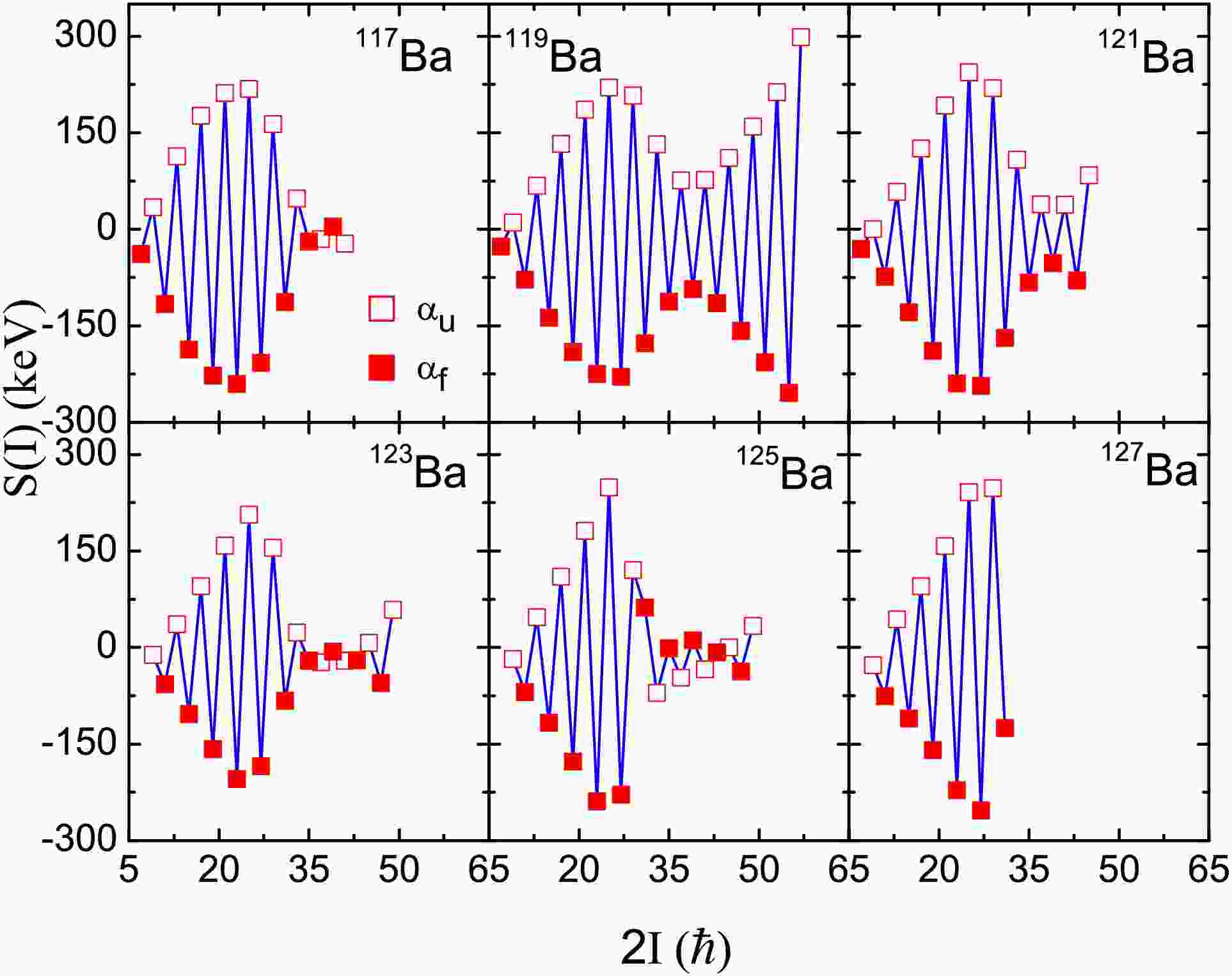
$ S(I)=E(I)-[E(I+1)+E(I-1)]/2. $
(23) Figure 1 shows
$ S(I) $ for 117–127Ba. For the$ h_{11/2} $ shell, Eqs. (16) and (17) yield the favored sequence$ I= 7/2,11/2,\cdots $ and the unfavored sequence$ I=5/2,9/2,\cdots $ . The alternating values of$ S(I) $ reflect the energy difference between these two negative-parity signature partners. The signature splitting gradually increases up to$ 2I\approx22 $ and then decreases significantly; anomalous splitting (signature inversion) is observed at high spin in 117Ba, 123Ba, and 125Ba. Similar behavior has been observed in the$ A\approx110 $ , 130, and 190 mass regions [4, 10, 18, 19, 40, 41], including in recent studies [42−46]. Several interpretations of signature splitting and inversion have therefore been proposed.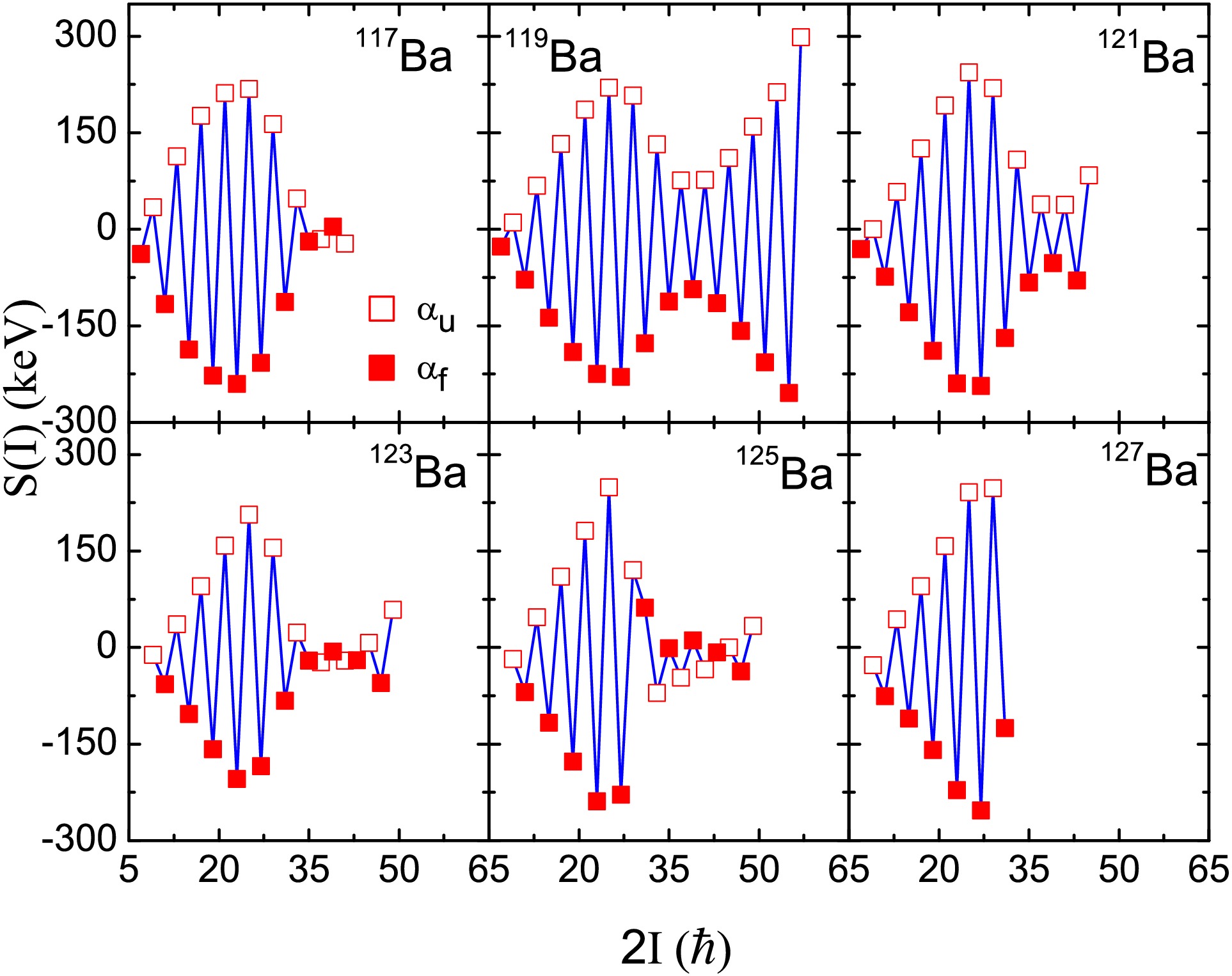
Figure 1. (color online) Energy-staggering parameter
$ S(I) $ as a function of$ 2I $ for 117–127Ba. Filled and open symbols denote the favored$ \alpha_f=-1/2 $ and unfavored$ \alpha_u=+1/2 $ components, respectively, of the$ \nu h_{11/2} $ bands. Experimental level energies are taken from 117Ba [34], 119Ba [35], 121Ba [36], 123Ba [37], 125Ba [38], 127Ba [39], respectively.The proton and neutron single-particle energies as functions of
$ \beta_2 $ are illustrated in Fig. 2. Near$ \beta_2=0.20 $ , the relevant proton states arise from the low-K$ [530]1/2 $ component of the$ h_{11/2} $ shell. For$ N=61-71 $ , the neutron Fermi level traverses the components with$ K=1/2 $ to$ 7/2 $ . The negative-parity bands considered below are based on an odd neutron occupying an orbital derived from the$ \nu h_{11/2} $ shell. For an axially symmetric shape, the Coriolis interaction mixes intrinsic components with different K. Closely spaced components of a unique-parity shell mix more strongly, and the contribution of low-K components can therefore enhance signature splitting as the rotational frequency increases [6]. In a γ-soft nucleus, the splitting is also sensitive to changes between configurations associated with prolate, triaxial, and oblate minima [18]. Signature splitting in a three-quasineutron rotational band was recently analyzed in Ref. [47].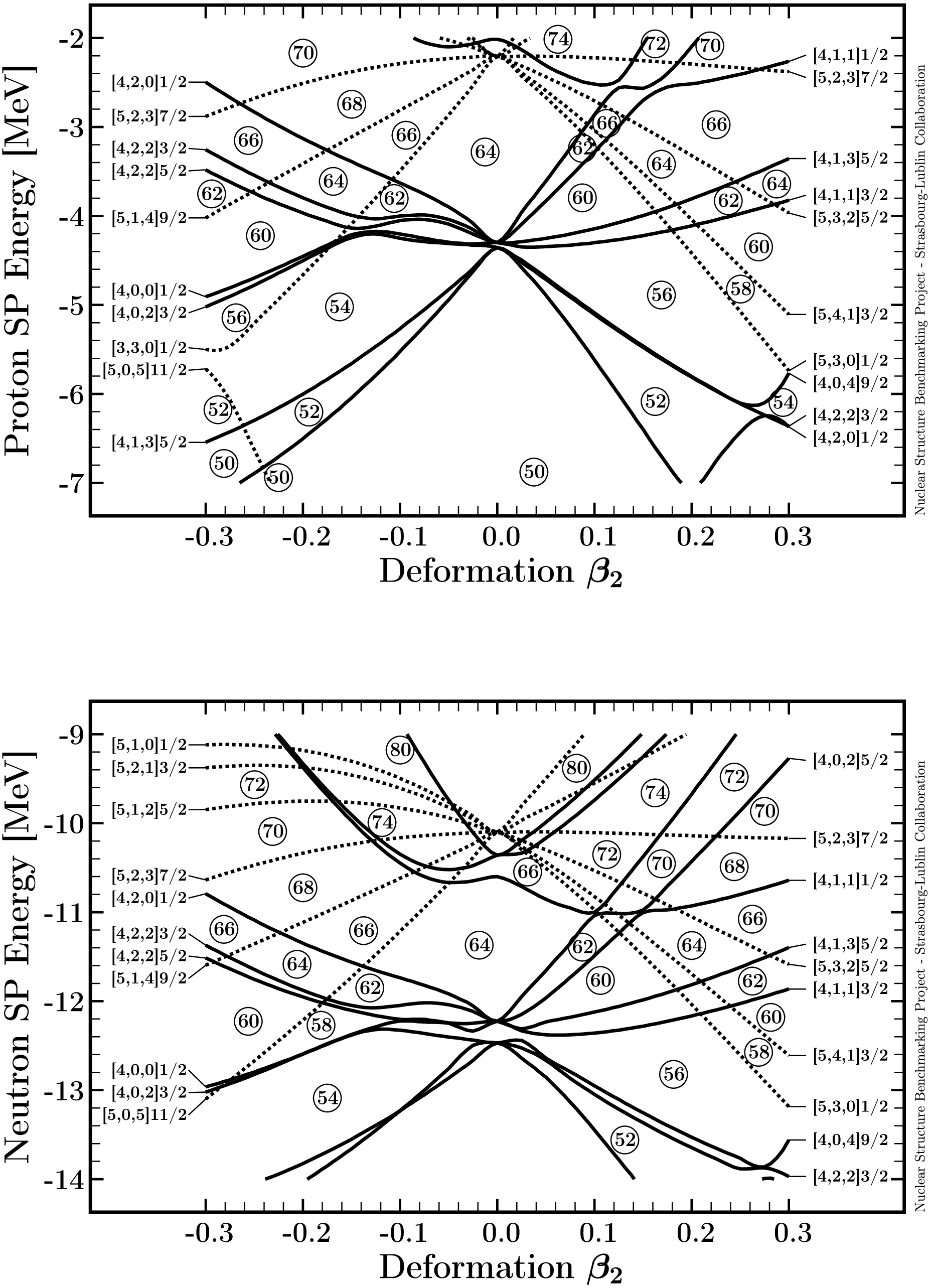
Figure 2. Proton and neutron single-particle energies as functions of
$ \beta_2 $ for 130Ba, calculated with the universal Woods-Saxon Hamiltonian.Figure 3 compares the experimental alignments (solid symbols) with the calculated values (open symbols). The experimental rotational frequency is estimated from
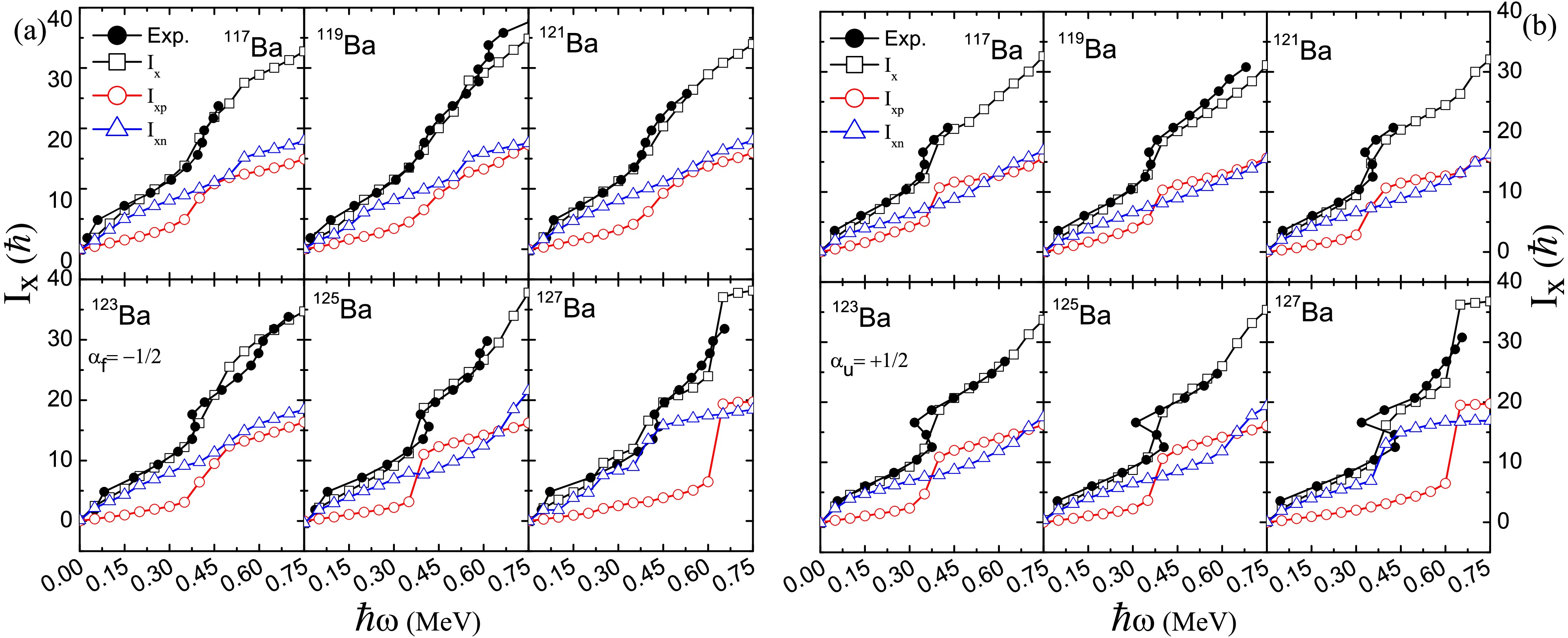
Figure 3. (color online) Experimental and calculated alignments
$ I_x $ as functions of$ \hbar\omega $ for (a)$ \alpha_f=-1/2 $ and (b)$ \alpha_u=+1/2 $ . The calculated total alignment and its proton and neutron contributions are shown separately.$ \hbar\omega=\frac{E(I+1)-E(I-1)}{I_x(I+1)-I_x(I-1)}, $
(24) where
$ I_x=\sqrt{I(I+1)-K^2} $ approximates the angular-momentum component along the rotational x axis; K is the projection on the intrinsic symmetry axis. Panels (a) and (b) show the favored and unfavored signatures, respectively. At low frequency, the neutron contribution includes the angular momentum of the blocked odd quasineutron. Because this odd neutron blocks the alignment of the lowest neutron pair, the first pronounced gain in both signatures of 117–125Ba is assigned to the alignment of an$ h_{11/2} $ proton pair near$ \hbar\omega\approx0.35 $ MeV. In 127Ba, the corresponding calculated proton alignment occurs only near$ 0.60 $ MeV, and neutron-pair alignment becomes competitive. This result differs from calculations restricted to prolate shapes [23] and from the systematic proton assignment proposed for other proton-rich nuclei near$ A\approx130 $ [48].Equilibrium deformations in soft nuclei can depend appreciably on the model parameters [15]. To examine this dependence across the alignment region, Fig. 4 shows deformation-dependent Routhians at
$ \hbar\omega=0.25 $ , 0.45, and 0.65 MeV. The first frequency lies below the main crossing in the lighter isotopes, whereas the other two sample the post-crossing regime. At$ \hbar\omega=0.25 $ MeV, the minima are generally prolate, with$ \beta_2\approx0.25 $ , as in the neighboring even-even isotopes 118–128Ba [15]. With increasing frequency, the$ \beta_2 $ minima in the lighter isotopes remain in the prolate sector, and 117Ba retains a particularly pronounced minimum up to$ \hbar\omega=0.65 $ MeV. Toward 125,127Ba, however, the$ \beta_2 $ surfaces become shallower and develop competing minima, indicating increased shape softness after the alignment region.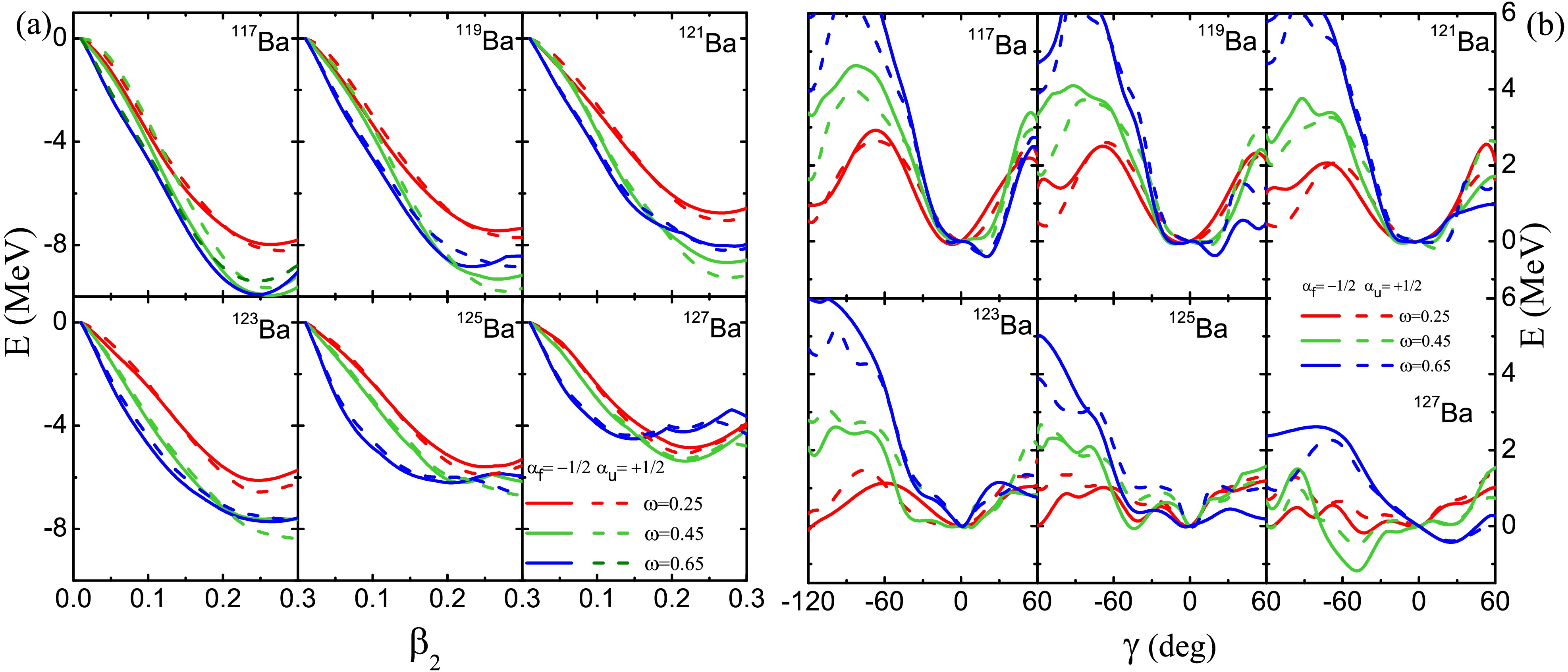
Figure 4. (color online) Deformation-dependent Routhians for 117–127Ba as functions of (a)
$ \beta_2 $ and (b) γ at$ \hbar\omega=0.25 $ (red), 0.45 (green), and 0.65 MeV (blue). (a) Routhians as functions of$ \beta_2 $ , minimized with respect to γ and$ \beta_4 $ at each point. (b) Routhians as functions of γ, minimized with respect to$ \beta_2 $ and$ \beta_4 $ at each point. Solid and dashed curves denote$ \alpha_f=-1/2 $ and$ \alpha_u=+1/2 $ , respectively.The evolution in the γ degree of freedom is more pronounced. The lighter isotopes retain minima near the collectively rotating prolate region, whereas the heavier isotopes develop low-lying prolate, triaxial, and oblate alternatives. In particular, an oblate minimum near
$ \gamma=-60^{\circ} $ becomes competitive in 127Ba at$ \hbar\omega=0.45 $ MeV, and the relative ordering of the shallow minima changes again at$ \hbar\omega=0.65 $ MeV. The two signature partners show similar overall$ \beta_2 $ evolution but differ in their γ softness and in the ordering of the competing minima. These changes occur in the frequency region where proton and neutron alignments compete and therefore indicate configuration- and signature-dependent shape competition rather than a universal shape transition [16, 38, 39].Quasiparticle alignments connect the calculated shape evolution to the observed backbending. As the frequency increases, Routhians belonging to different quasiparticle configurations cross one another. Diabatic trajectories that preserve their wave-function character through these crossings can be associated with the connected experimental rotational bands [2, 49, 50].
Figure 5 shows representative quasiparticle Routhians. Following Ref. [49], lowercase letters label proton orbitals and uppercase letters label neutron orbitals; the negative-parity orbitals are denoted
$ e,f,\cdots $ and$ E,F,\cdots $ , and the positive-parity orbitals are denoted$ a,b,\cdots $ and$ A,B,\cdots $ , respectively. The two-quasiparticle$ h_{11/2} $ alignments are labeled$ ef $ for protons and$ EF $ for neutrons. In Fig. 5, the$ \pi(h_{11/2})^2 $ and$ \nu(h_{11/2})^2 $ crossings both occur near$ \hbar\omega=0.35 $ MeV. In an odd-N band based on the lowest quasineutron, however, the$ EF $ neutron alignment is blocked. Accordingly, the first calculated gain in Fig. 3 is assigned primarily to the$ \pi(h_{11/2})^2 $ crossing.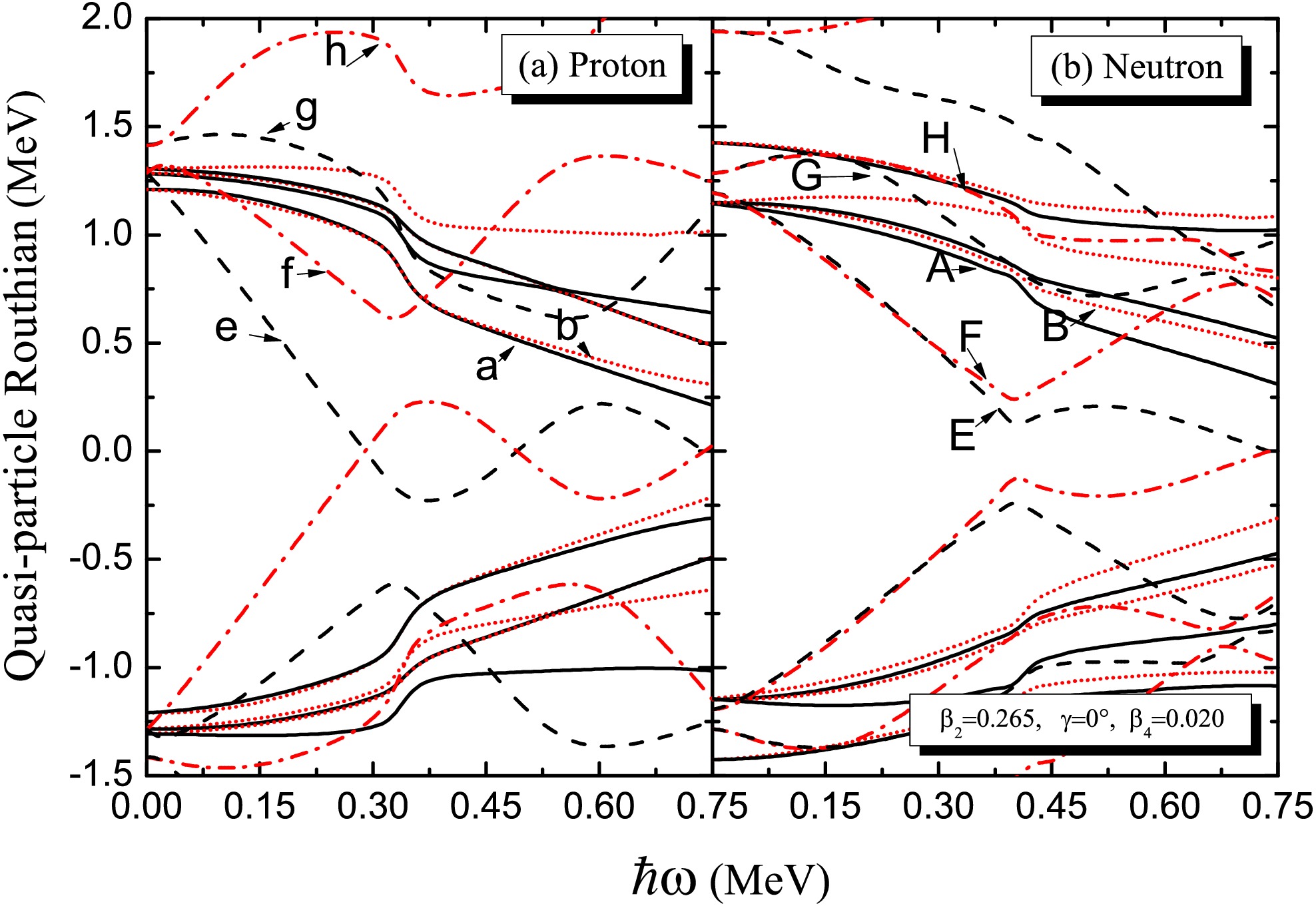
Figure 5. (color online) Calculated quasiparticle Routhians as functions of
$ \hbar\omega $ for (a) quasiproton and (b) quasineutron orbitals in 121Ba at$ \beta_2=0.265 $ ,$ \gamma=0^{\circ} $ , and$ \beta_4=0.020 $ . The parity and signature (π, α) of the Routhians are represented as follows: ($ +, +1/2 $ ) solid lines, ($ +,-1/2 $ ) dotted lines, ($ -,+1/2 $ ) dash-dotted lines, and ($ -,-1/2 $ ) dashed lines.The remainder of the analysis focuses on the lowest E and F quasineutron Routhians associated with the observed
$ \nu h_{11/2} $ bands. Figure 6 compares the isotopes at the common representative deformation$ \beta_2=0.265 $ ,$ \gamma=0^{\circ} $ , and$ \beta_4=0.020 $ . The vertical marker at$ \hbar\omega=0.250 $ MeV lies below the proton crossing.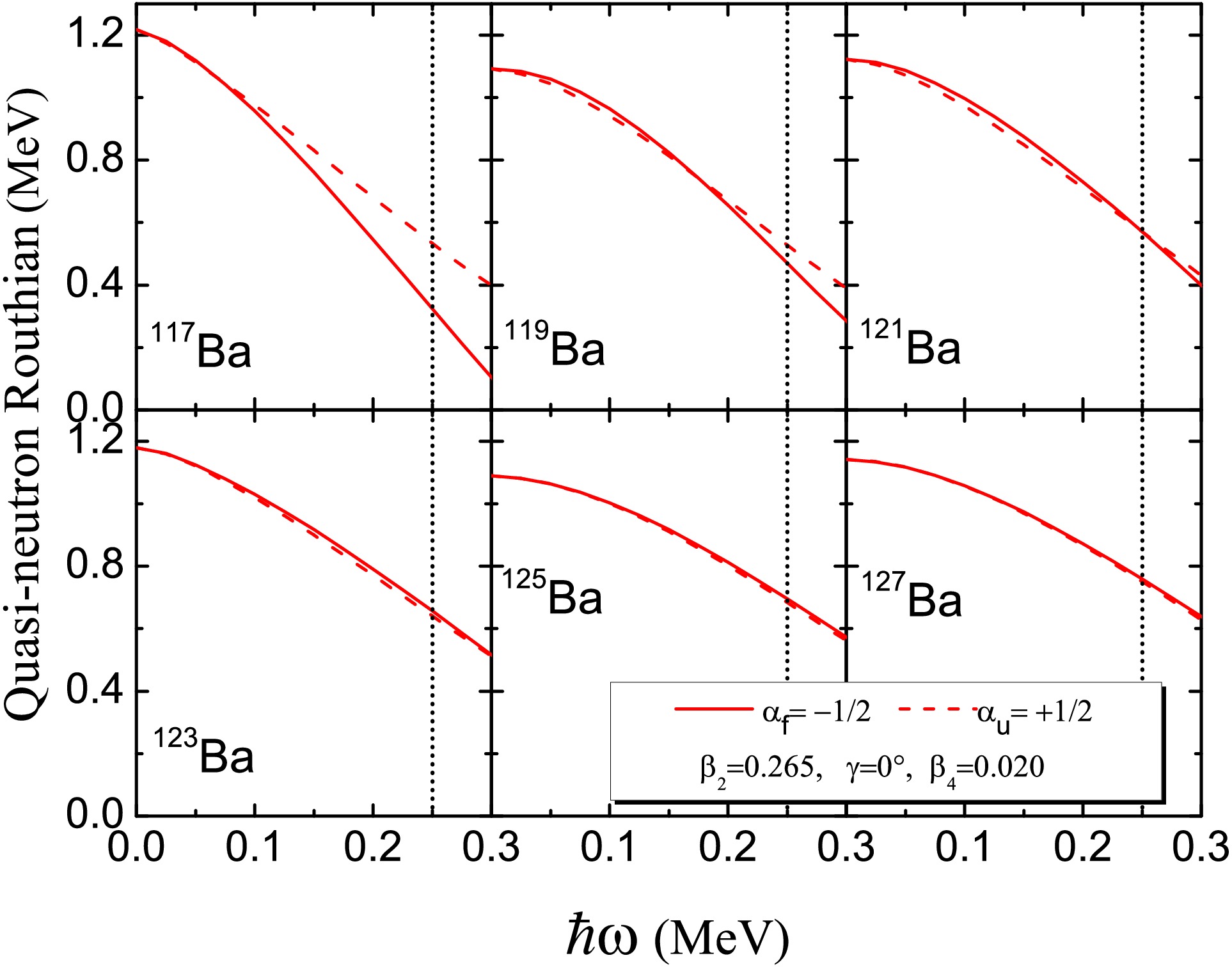
Figure 6. (color online) Lowest
$ h_{11/2} $ quasineutron Routhians E and F as functions of$ \hbar\omega $ for 117–127Ba at$ \beta_2=0.265 $ ,$ \gamma=0^{\circ} $ , and$ \beta_4=0.020 $ . Solid and dashed curves denote$ \alpha_f=-1/2 $ (E) and$ \alpha_u=+1/2 $ (F), respectively. The vertical dotted lines mark$ \hbar\omega=0.250 $ MeV.At zero rotational frequency, the two signature partners are degenerate. As
$ \hbar\omega $ increases, the E and F trajectories separate most visibly in the lighter isotopes, particularly in 117Ba, whereas they remain close or cross in the heavier isotopes. At the reference frequency$ \hbar\omega=0.250 $ MeV, the magnitude of the calculated E–F splitting decreases overall from$ N=61 $ to$ N=71 $ . This trend reflects the migration of the neutron Fermi level from low-K toward higher-K components of the$ h_{11/2} $ shell. Because all six panels use the same axial deformation, Fig. 6 isolates the neutron-number dependence of the underlying single-particle structure. The additional sensitivity to the equilibrium deformation is examined next.Since signature splitting is sensitive to deformation [3, 13, 18, 19], a change across the crossing may indicate different equilibrium shapes for the one- and three-quasiparticle configurations. Figure 7 separates the
$ \beta_2 $ and γ dependences at$ \hbar\omega=0.250 $ MeV. In Fig. 7(a), the splitting is small at large prolate deformation but increases rapidly as$ \beta_2 $ decreases. At small$ \beta_2 $ , it also tends to decrease with increasing neutron number. This trend is consistent with stronger Coriolis mixing when the relevant$ h_{11/2} $ components are closely spaced [3]. At the equilibrium$ \beta_2 $ values indicated in the insets, the calculated splitting is small throughout the isotope chain. Thus, within this calculation, variations in$ \beta_2 $ near the equilibrium values are not the principal source of the observed isotope-dependent staggering.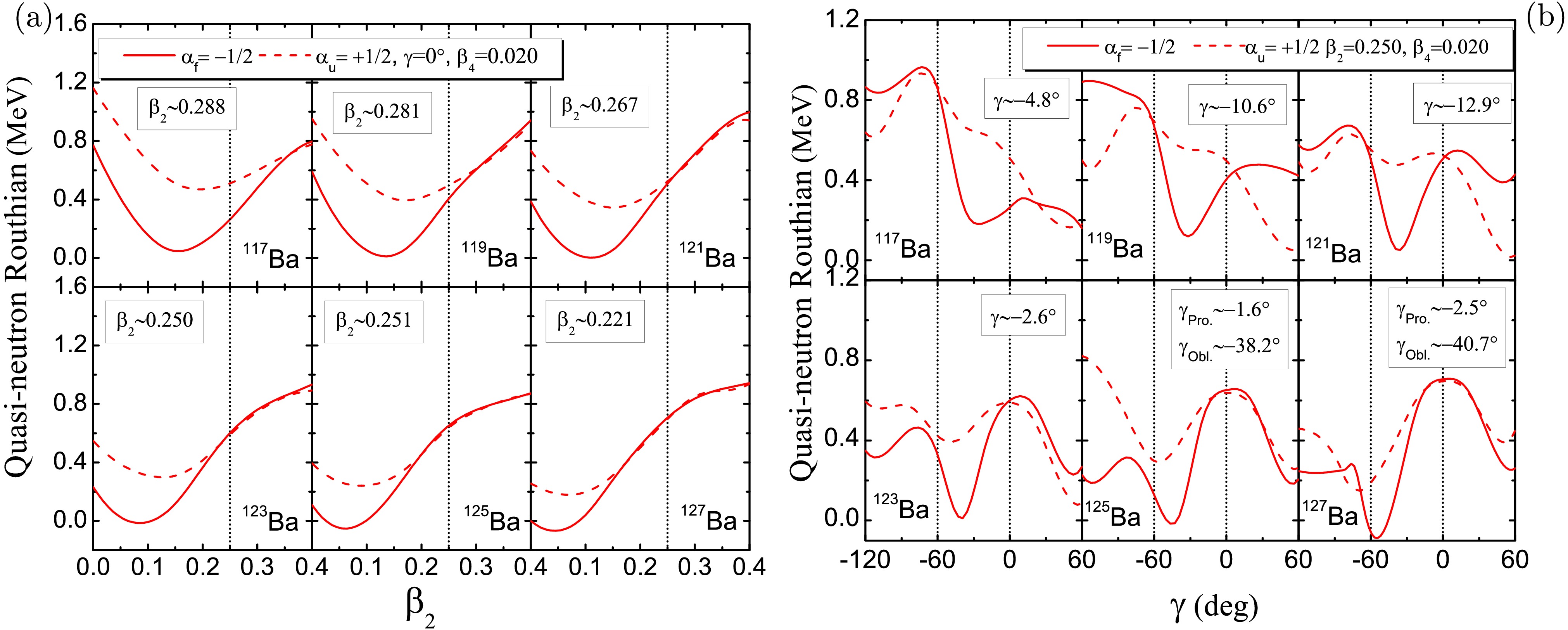
Figure 7. (color online) Lowest
$ h_{11/2} $ quasineutron Routhians E and F in 117–127Ba at$ \hbar\omega=0.250 $ MeV as functions of (a)$ \beta_2 $ , with$ \gamma=0^{\circ} $ and$ \beta_4=0.020 $ , and (b) γ, with$ \beta_2=0.250 $ and$ \beta_4=0.020 $ . Insets give the corresponding TRS equilibrium deformations. Solid and dashed curves denote$ \alpha_f=-1/2 $ (E) and$ \alpha_u=+1/2 $ (F), respectively.We therefore use
$ \beta_2=0.250 $ as a common reference value to isolate the γ dependence in Fig. 7(b). At fixed$ \hbar\omega $ and$ \beta_2 $ , Fig. 7(b) shows that the two signatures have different γ-driving tendencies. With increasing neutron number, the minimum of the favored E Routhian moves from negative γ toward the collective oblate limit at$ \gamma=-60^{\circ} $ , whereas the unfavored F Routhian evolves from positive-γ triaxiality toward an oblate minimum.This evolution reflects the combined action of Coriolis and nonaxial quadrupole couplings. The former,
$ \langle j,\Omega=\pm1/2|j_1|j,\Omega=\mp1/2\rangle $ , mixes the signature partners through their$ \Omega=1/2 $ components and dominates near prolate shapes when the Fermi level lies among low-K orbitals. As the shape becomes triaxial, the latter,$ \langle j,\Omega=\pm1/2|Y_{22}+Y_{2-2}|j,\Omega=\mp3/2\rangle $ , mixes the$ \Omega=1/2 $ and$ 3/2 $ components and can alter the signature ordering [33]. Since both couplings enter coherently in the diagonalization, they cannot be assigned unique additive contributions.Whether the ordering reverses therefore depends on the position of the neutron Fermi level. In 117Ba, its low-K position allows the Coriolis contribution to preserve the same favored signature from the near-prolate to the collective-oblate region. In 123–127Ba, the higher-K character makes the splitting small without a clear reversal. Only in 119,121Ba is the Fermi level intermediate, so the increasing nonaxial mixing can overcome the near-prolate ordering and interchange the E and F Routhians. This interpretation is consistent with the low-K to high-K migration discussed for Fig. 6. Because
$ \beta_4 $ varies only weakly, the sensitivity calculations use the common value$ \beta_4=0.020 $ .Because the proton Fermi surface lies in the lower part of the intruder shell, near the low-K components of
$ h_{11/2} $ , the lowest quasiproton Routhians are expected to exhibit stronger signature splitting. Figure 8 shows its dependence on$ \hbar\omega $ ,$ \beta_2 $ , and γ. In particular, the slopes in panel (c) indicate that the quasiproton favors positive γ. The calculated e–f separation reaches approximately 0.8 MeV, much larger than the E–F separation at the same representative deformation. A strong signature dependence of low-K quasiproton Routhians has also been found in neighboring odd-odd nuclei [4, 18, 19, 41, 51, 52]. After proton-pair alignment, the positive-γ tendency of the proton orbitals competes with the negative-γ tendency of the odd neutron. This partial cancellation shifts the equilibrium shape closer to$ \gamma=0^{\circ} $ and provides a qualitative mechanism for the reduced experimental splitting in Fig. 1.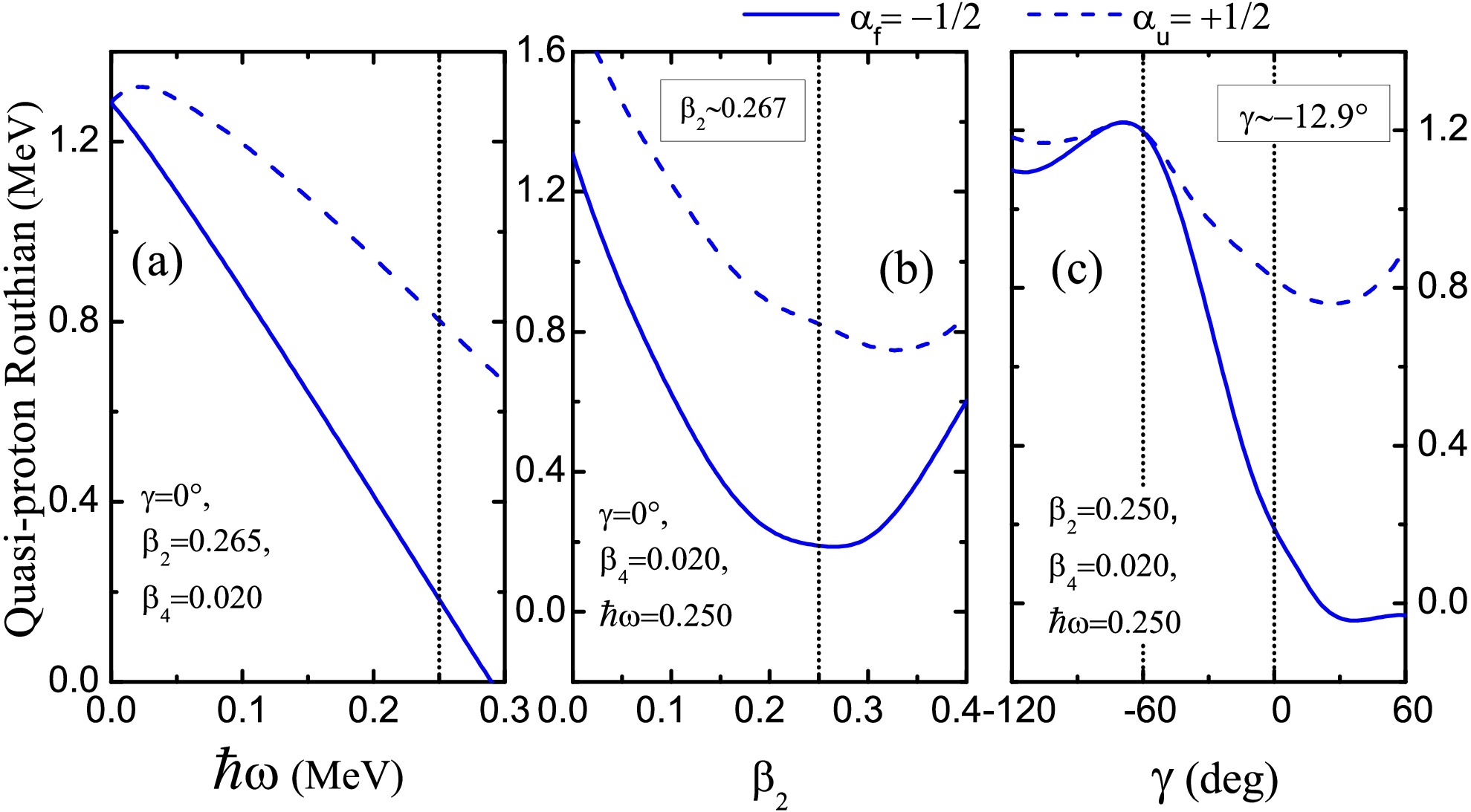
Figure 8. (color online) Lowest
$ h_{11/2} $ quasiproton Routhians e and f in 121Ba as functions of (a)$ \hbar\omega $ , (b)$ \beta_2 $ , and (c) γ. The fixed deformation parameters are the same as those used in Figs. 6 and 7. Solid and dashed blue curves denote$ \alpha_f=-1/2 $ (e) and$ \alpha_u=+1/2 $ (f), respectively.Figure 9 tests this interpretation above the first crossing. At the equilibrium
$ \beta_2 $ values shown in Fig. 9(a), the post-crossing splitting remains small in 117–121Ba and is nearly zero in 123–127Ba. Panel (b) shows the corresponding γ dependence. In 117Ba, the splitting passes through zero near$ \gamma\approx+10^{\circ} $ , as does the calculated splitting in 123Ba. For 119,121Ba, the finite separation at the equilibrium minima is consistent with an increase above the crossing. The heavier isotopes again display competing minima with different signature dependence.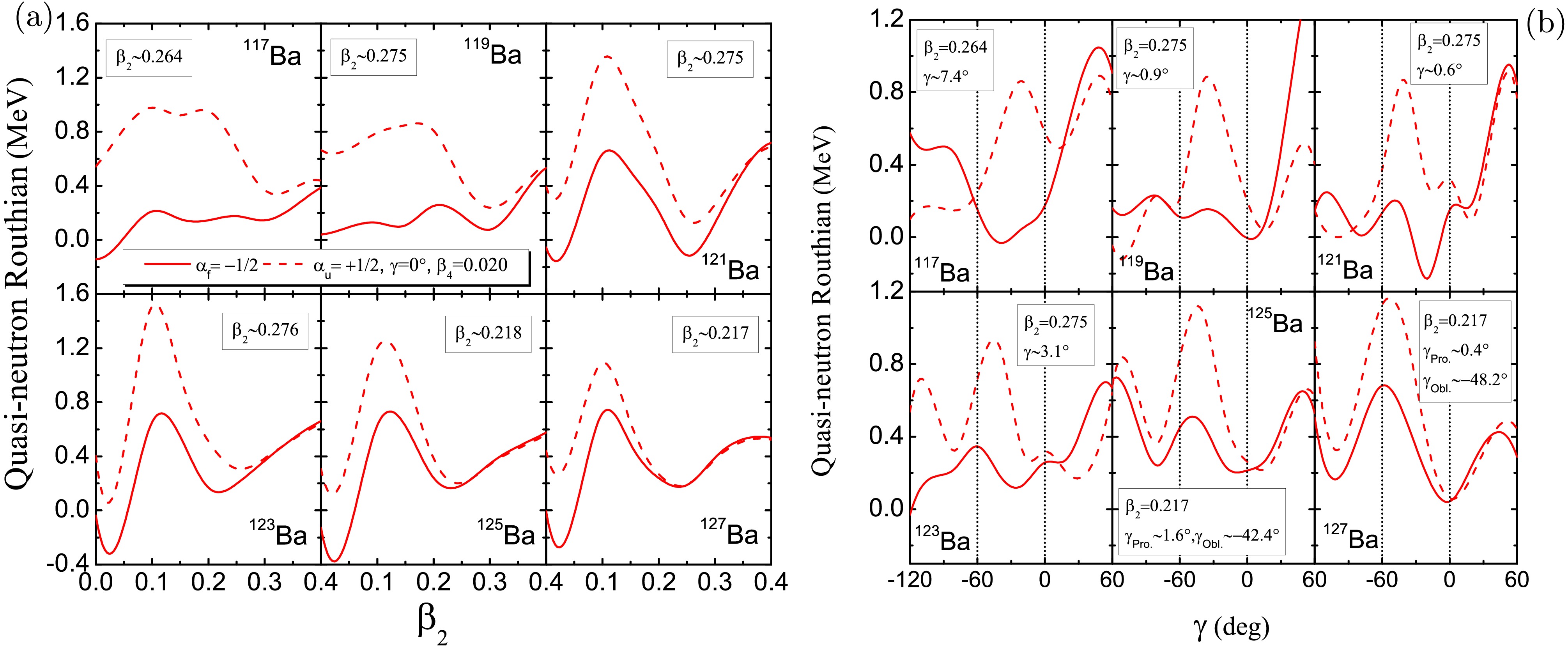
Figure 9. (color online) Same as Fig. 7, but at
$ \hbar\omega=0.45 $ MeV, above the first crossing in the lighter isotopes. Insets show the TRS equilibrium deformations. Solid and dashed curves denote$ \alpha_f=-1/2 $ (E) and$ \alpha_u=+1/2 $ (F), respectively.The changes in ordering occur in each of the three Lund sectors,
$ -120^{\circ}<\gamma<-60^{\circ} $ ,$ -60^{\circ}<\gamma<0^{\circ} $ , and$ 0^{\circ}<\gamma<60^{\circ} $ , which correspond to rotation about the long, medium, and short principal axes, respectively [16]. A similar dependence was found for odd-odd nuclei near$ A\approx130 $ [53]. Quadrupole pairing can also modify signature splitting in odd-odd systems [6]; its role in the present odd-A nuclei is not included and remains a source of model uncertainty.In neighboring even-even Ba nuclei, two positive-parity bands have been observed in addition to the ground-state band. These bands have nearly the same energy and are attributed to the alignment of two
$ h_{11/2} $ protons in one case and two$ h_{11/2} $ neutrons in the other. This behavior arises from shape changes induced by the aligned quasiparticles. Specifically, the alignment of two high-K$ h_{11/2} $ neutrons tends to drive the nucleus toward an oblate shape, while adding one neutron in a$ \nu h_{11/2} $ orbital outside the even-even core can stabilize a triaxial deformation, as discussed in Refs. [14−16, 48].The results for 125,127Ba are consistent with the behavior calculated for the neighboring even-even nucleus 126Ba: in both cases, prolate and triaxial or oblate minima coexist [15, 16]. In an odd-A nucleus, blocking makes the crossing pattern configuration- and signature-dependent. Because the two heavier isotopes exhibit similar shape competition, Fig. 10 uses 125Ba as a representative example.
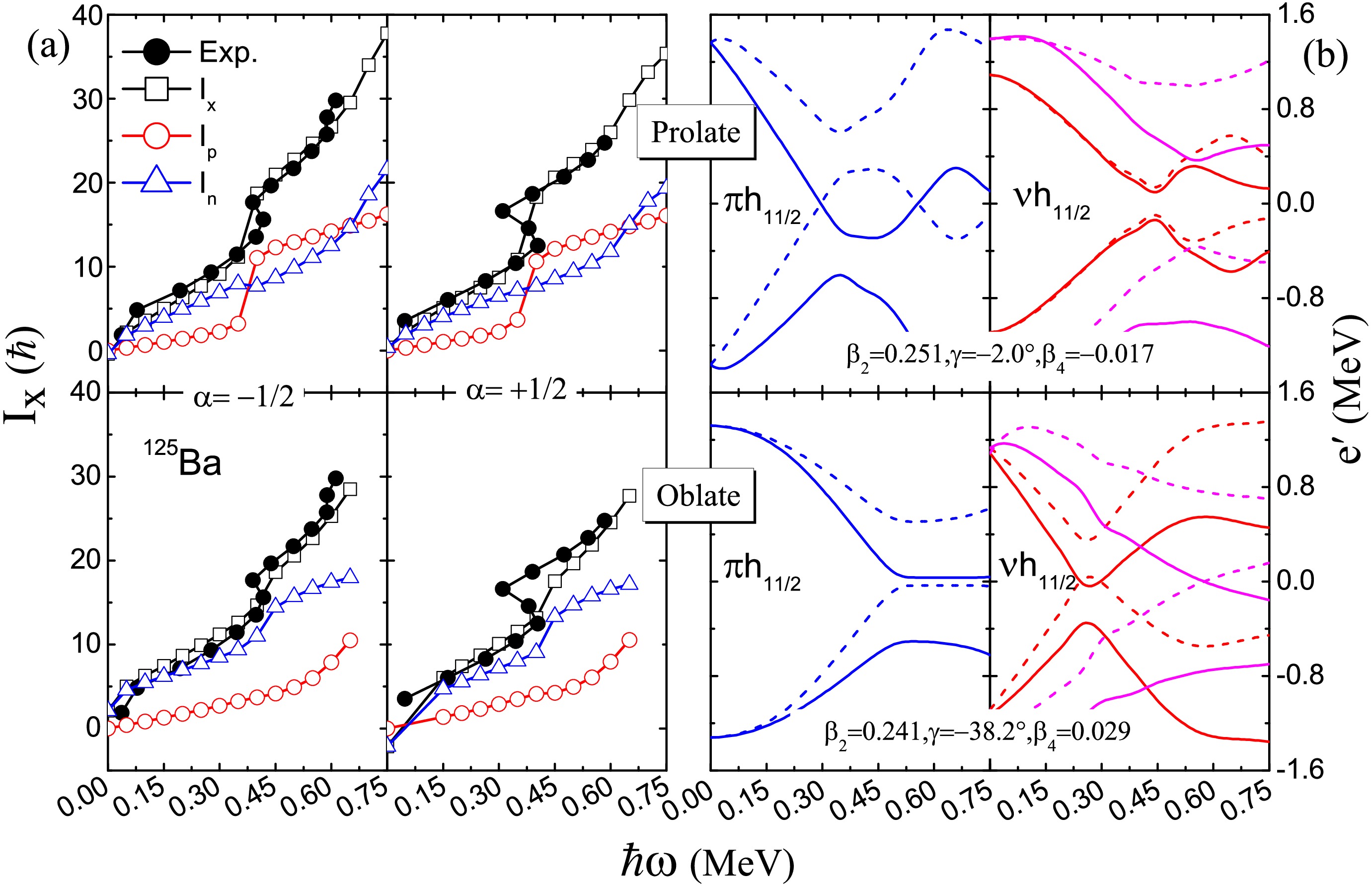
Figure 10. (color online) Results for 125Ba. (a) Experimental total alignments (solid black circles) and calculated total alignments
$ I_x $ (open symbols), together with the proton ($ I_p $ ) and neutron ($ I_n $ ) contributions for both signatures. (b) Calculated quasiparticle Routhians: proton$ ef $ (blue), neutron$ EF $ (red), and neutron$ GH $ (magenta). The upper panels use the prolate configuration$ (\beta_2,\gamma,\beta_4)=(0.251,-2.0^{\circ},0.020) $ ; the lower panels use the triaxial-oblate configuration$ (0.241,-38.2^{\circ},0.021) $ .Figure 10(a) compares the measured alignment with calculations for the two competing shapes. The calculated backbending is dominated by proton alignment in the prolate minimum and by neutron alignment in the triaxial-oblate minimum for both signatures. Figure 10(b) identifies the crossings. Because the
$ EF $ neutron alignment is blocked, the first crossing must involve either the first unblocked neutron pair ($ FG $ or$ EH $ , depending on signature) or the proton pair$ ef $ . The E band can therefore be crossed by$ Eef $ or$ EFG $ , and the F band by$ Fef $ or$ FEH $ .In the figure, the lowest quasiproton
$ ef $ bands of$ \pi h_{11/2} $ are shown in blue, the lowest quasineutron$ EF $ bands are in red, and the first negative signature partner bands$ GH $ are in magenta. Solid curves represent the favored signature$ \alpha_f=-1/2 $ , while dashed curves indicate the unfavored signature$ \alpha_u=+1/2 $ . For the prolate deformation, the proton$ ef $ crossing occurs near$ \hbar\omega\approx0.35 $ MeV, whereas the neutron$ FG $ crossing lies above 0.55 MeV. The resulting three-quasiparticle configurations are$ Eef $ for the favored signature and$ Fef $ for the unfavored signature. For the triaxial-oblate deformation, the proton crossing moves to about 0.50 MeV, while the neutron$ FG/EH $ crossings occur near 0.37 MeV and produce$ EFG $ and$ FEH $ , respectively. Thus the G and H quasineutron orbitals control both the first alignment and much of the post-crossing signature dependence in this minimum. In the prolate minimum, the post-crossing bands are dominated by$ Eef $ and$ Fef $ ; once the proton pair is aligned, their relative behavior reflects the E and F quasineutron Routhians. In the triaxial-oblate minimum, the splitting instead follows the G and H Routhians.Figure 11 therefore compares the
$ EF $ and$ GH $ quasineutron Routhians as functions of γ at$ \hbar\omega=0.45 $ MeV for 125Ba and 127Ba. The insets show the experimental staggering for the bands assigned to the competing shapes. The G and H quasineutron Routhians become energetically competitive above the first alignment. The$ EF $ splitting remains small, whereas the$ GH $ splitting is pronounced in both nuclei. The$ GH $ minima move toward the collective-oblate limit ($ \gamma=-60^{\circ} $ ), while the$ EF $ minima remain near prolate. The calculation therefore associates neutron-pair alignment with a transition toward a collectively rotating oblate shape, consistent with the alignment trend in Fig. 3(b). At prolate deformation, by contrast, the$ EF $ splitting is small or inverted. The relevant experimental partners are bands (7) and (8) in 125Ba [38] and bands (5) and (6) in 127Ba [39], particularly near$ I=29/2 $ and$ 31/2 $ . In the prolate bands of 125,127Ba, the renewed increase in splitting at high spin accompanies the second upbending. For 125Ba, the calculated$ FG/EH $ neutron crossing gives the five-quasiparticle configurations$ EefFG $ ($ \alpha=-1/2 $ ) and$ FefEH $ ($ \alpha=+1/2 $ ) [3]. For 127Ba, the corresponding assignments are$ EFGef $ and$ FEHef $ [39]. No comparable reduction or inversion is established for the bands assigned to the triaxial-oblate minimum: band (4) in 125Ba [38] and band (15) in 127Ba [39]. The large calculated G–H separation offers a possible, but not unique, explanation for why a high-spin signature partner has not been identified experimentally.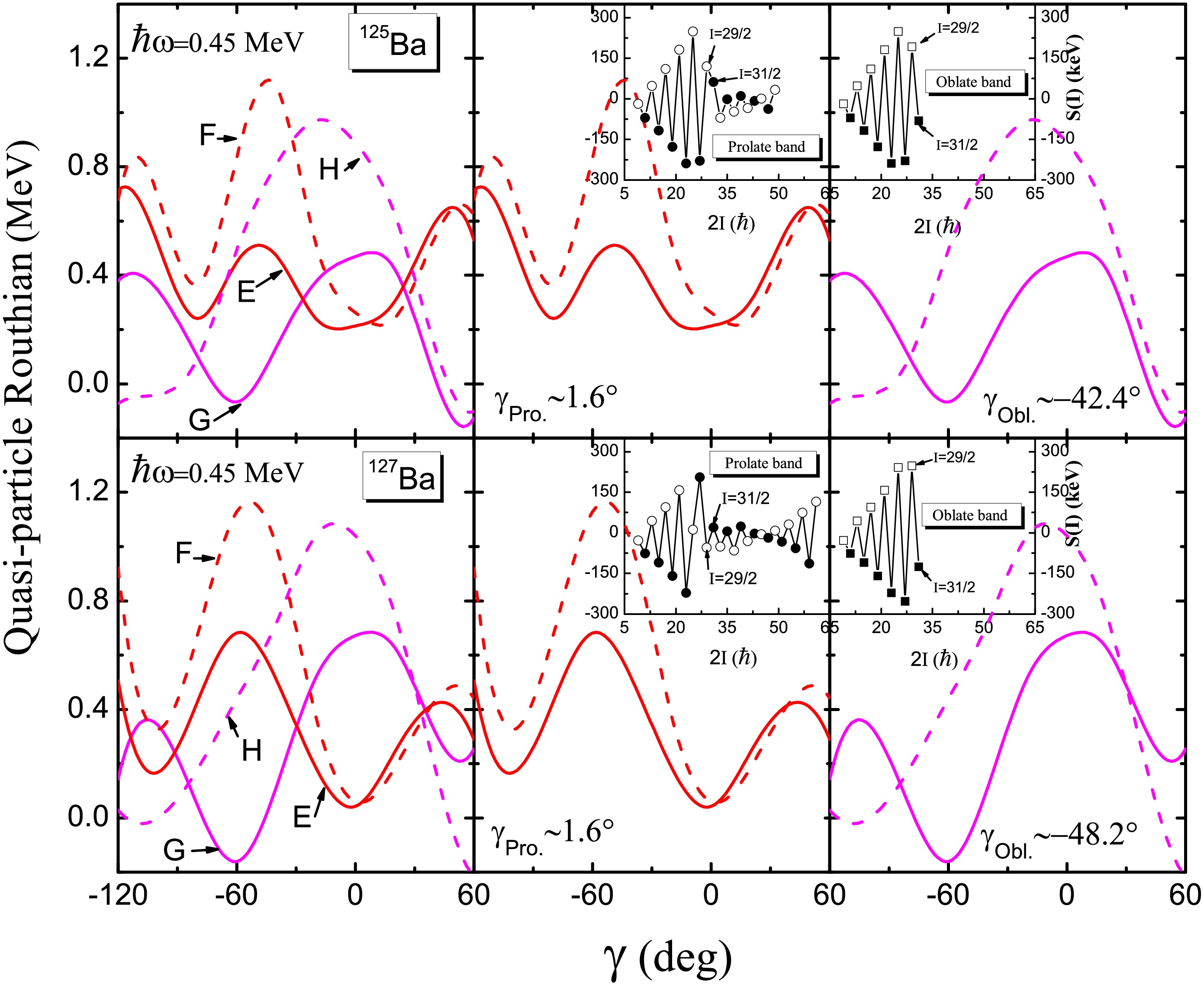
Figure 11. (color online) Quasineutron
$ EF $ and$ GH $ Routhians as functions of γ for 125Ba and 127Ba at$ \hbar\omega=0.45 $ MeV, with$ \beta_2=0.217 $ and$ \beta_4=0.020 $ . Insets show the experimental energy-staggering parameter$ S(I) $ for the bands assigned to the prolate and triaxial-oblate minima.The calculations thus suggest two high-spin structures in nuclei with shape coexistence: a pair of prolate signature partners and a triaxial-oblate band for which only one signature may be observed. Similar spectra occur in neighboring odd-A nuclei [48]. Figure 12 extends the comparison to Ba, Ce, and Nd isotopes, separating bands assigned to proton and neutron alignments. This separation leads to a different systematics of the staggering from analyses that combine the bands without regard to the aligned configuration [23, 48, 54].
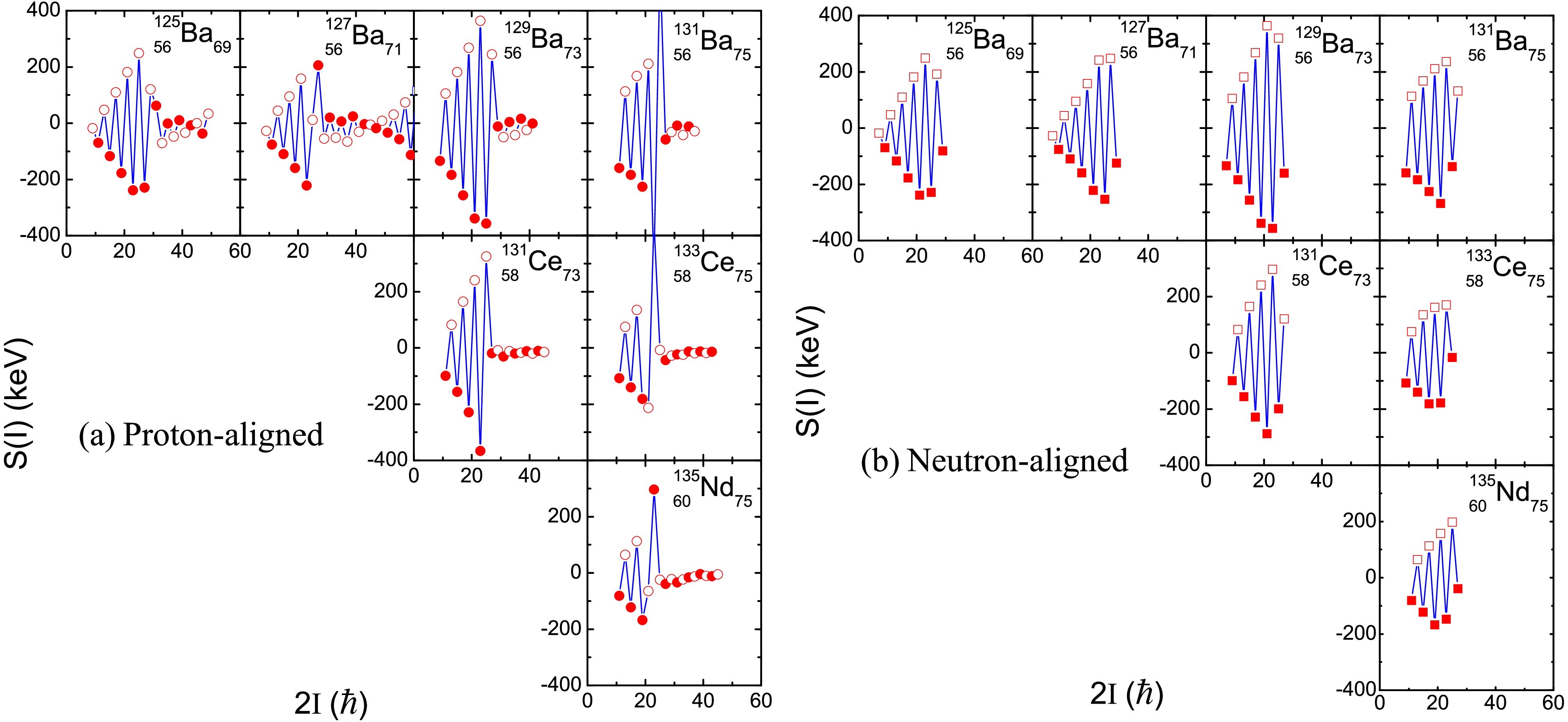
Figure 12. (color online) Experimental
$ S(I) $ values for$ h_{11/2} $ bands in odd-A Ba ($ Z=56 $ ), Ce ($ Z=58 $ ), and Nd ($ Z=60 $ ) isotopes. Filled and open symbols denote the favored$ \alpha_f=-1/2 $ and unfavored$ \alpha_u=+1/2 $ signatures, respectively. The adopted bandheads have$ K=7/2 $ for$ N=67\text{--}71 $ and$ K=9/2 $ for$ N=73\text{--}75 $ . Circles in (a) denote proton-aligned bands; squares in (b) denote neutron-aligned bands. Experimental data are taken from 129Ba [54], 131Ba [55], 131Ce [56], 133Ce [57], and 135Nd [58].As shown in Figure 12, for
$ N=67-75 $ , the available systematics favor triaxial or oblate ground-state shapes [48], and neutron alignment can compete in the yrast sequence. The combined data support the same qualitative pattern as the TRS results: the prolate configuration tends to appear as a pair of bands with reduced or inverted splitting, whereas the triaxial-oblate configuration often appears as a single high-spin band. These systematics support the interpretation that proton and neutron alignments influence both shape coexistence and the observed signature splitting. They do not, by themselves, uniquely determine the shape; the assignment relies on the combined alignment and Routhian analysis above. -
The odd-even staggering exhibited by these bands reflects the signature dependence of the Coriolis interaction. We quantify it using
$ S(I)=E(I)-[E(I+1)+E(I-1)]/2. $
(23) Figure 1 shows
$ S(I) $ for 117–127Ba. For the$ h_{11/2} $ shell, Eqs. (16) and (17) yield the favored sequence$ I= 7/2,11/2,\cdots $ and the unfavored sequence$ I=5/2,9/2,\cdots $ . The alternating values of$ S(I) $ reflect the energy difference between these two negative-parity signature partners. The signature splitting gradually increases up to$ 2I\approx22 $ and then decreases significantly; anomalous splitting (signature inversion) is observed at high spin in 117Ba, 123Ba, and 125Ba. Similar behavior has been observed in the$ A\approx110 $ , 130, and 190 mass regions [4, 10, 18, 19, 40, 41], including in recent studies [42−46]. Several interpretations of signature splitting and inversion have therefore been proposed.
Figure 1. (color online) Energy-staggering parameter
$ S(I) $ as a function of$ 2I $ for 117–127Ba. Filled and open symbols denote the favored$ \alpha_f=-1/2 $ and unfavored$ \alpha_u=+1/2 $ components, respectively, of the$ \nu h_{11/2} $ bands. Experimental level energies are taken from 117Ba [34], 119Ba [35], 121Ba [36], 123Ba [37], 125Ba [38], 127Ba [39], respectively.The proton and neutron single-particle energies as functions of
$ \beta_2 $ are illustrated in Fig. 2. Near$ \beta_2=0.20 $ , the relevant proton states arise from the low-K$ [530]1/2 $ component of the$ h_{11/2} $ shell. For$ N=61-71 $ , the neutron Fermi level traverses the components with$ K=1/2 $ to$ 7/2 $ . The negative-parity bands considered below are based on an odd neutron occupying an orbital derived from the$ \nu h_{11/2} $ shell. For an axially symmetric shape, the Coriolis interaction mixes intrinsic components with different K. Closely spaced components of a unique-parity shell mix more strongly, and the contribution of low-K components can therefore enhance signature splitting as the rotational frequency increases [6]. In a γ-soft nucleus, the splitting is also sensitive to changes between configurations associated with prolate, triaxial, and oblate minima [18]. Signature splitting in a three-quasineutron rotational band was recently analyzed in Ref. [47].
Figure 2. Proton and neutron single-particle energies as functions of
$ \beta_2 $ for 130Ba, calculated with the universal Woods-Saxon Hamiltonian.Figure 3 compares the experimental alignments (solid symbols) with the calculated values (open symbols). The experimental rotational frequency is estimated from
Figure 3. (color online) Experimental and calculated alignments
$ I_x $ as functions of$ \hbar\omega $ for (a)$ \alpha_f=-1/2 $ and (b)$ \alpha_u=+1/2 $ . The calculated total alignment and its proton and neutron contributions are shown separately.$ \hbar\omega=\frac{E(I+1)-E(I-1)}{I_x(I+1)-I_x(I-1)}, $
(24) where
$ I_x=\sqrt{I(I+1)-K^2} $ approximates the angular-momentum component along the rotational x axis; K is the projection on the intrinsic symmetry axis. Panels (a) and (b) show the favored and unfavored signatures, respectively. At low frequency, the neutron contribution includes the angular momentum of the blocked odd quasineutron. Because this odd neutron blocks the alignment of the lowest neutron pair, the first pronounced gain in both signatures of 117–125Ba is assigned to the alignment of an$ h_{11/2} $ proton pair near$ \hbar\omega\approx0.35 $ MeV. In 127Ba, the corresponding calculated proton alignment occurs only near$ 0.60 $ MeV, and neutron-pair alignment becomes competitive. This result differs from calculations restricted to prolate shapes [23] and from the systematic proton assignment proposed for other proton-rich nuclei near$ A\approx130 $ [48].Equilibrium deformations in soft nuclei can depend appreciably on the model parameters [15]. To examine this dependence across the alignment region, Fig. 4 shows deformation-dependent Routhians at
$ \hbar\omega=0.25 $ , 0.45, and 0.65 MeV. The first frequency lies below the main crossing in the lighter isotopes, whereas the other two sample the post-crossing regime. At$ \hbar\omega=0.25 $ MeV, the minima are generally prolate, with$ \beta_2\approx0.25 $ , as in the neighboring even-even isotopes 118–128Ba [15]. With increasing frequency, the$ \beta_2 $ minima in the lighter isotopes remain in the prolate sector, and 117Ba retains a particularly pronounced minimum up to$ \hbar\omega=0.65 $ MeV. Toward 125,127Ba, however, the$ \beta_2 $ surfaces become shallower and develop competing minima, indicating increased shape softness after the alignment region.
Figure 4. (color online) Deformation-dependent Routhians for 117–127Ba as functions of (a)
$ \beta_2 $ and (b) γ at$ \hbar\omega=0.25 $ (red), 0.45 (green), and 0.65 MeV (blue). (a) Routhians as functions of$ \beta_2 $ , minimized with respect to γ and$ \beta_4 $ at each point. (b) Routhians as functions of γ, minimized with respect to$ \beta_2 $ and$ \beta_4 $ at each point. Solid and dashed curves denote$ \alpha_f=-1/2 $ and$ \alpha_u=+1/2 $ , respectively.The evolution in the γ degree of freedom is more pronounced. The lighter isotopes retain minima near the collectively rotating prolate region, whereas the heavier isotopes develop low-lying prolate, triaxial, and oblate alternatives. In particular, an oblate minimum near
$ \gamma=-60^{\circ} $ becomes competitive in 127Ba at$ \hbar\omega=0.45 $ MeV, and the relative ordering of the shallow minima changes again at$ \hbar\omega=0.65 $ MeV. The two signature partners show similar overall$ \beta_2 $ evolution but differ in their γ softness and in the ordering of the competing minima. These changes occur in the frequency region where proton and neutron alignments compete and therefore indicate configuration- and signature-dependent shape competition rather than a universal shape transition [16, 38, 39].Quasiparticle alignments connect the calculated shape evolution to the observed backbending. As the frequency increases, Routhians belonging to different quasiparticle configurations cross one another. Diabatic trajectories that preserve their wave-function character through these crossings can be associated with the connected experimental rotational bands [2, 49, 50].
Figure 5 shows representative quasiparticle Routhians. Following Ref. [49], lowercase letters label proton orbitals and uppercase letters label neutron orbitals; the negative-parity orbitals are denoted
$ e,f,\cdots $ and$ E,F,\cdots $ , and the positive-parity orbitals are denoted$ a,b,\cdots $ and$ A,B,\cdots $ , respectively. The two-quasiparticle$ h_{11/2} $ alignments are labeled$ ef $ for protons and$ EF $ for neutrons. In Fig. 5, the$ \pi(h_{11/2})^2 $ and$ \nu(h_{11/2})^2 $ crossings both occur near$ \hbar\omega=0.35 $ MeV. In an odd-N band based on the lowest quasineutron, however, the$ EF $ neutron alignment is blocked. Accordingly, the first calculated gain in Fig. 3 is assigned primarily to the$ \pi(h_{11/2})^2 $ crossing.
Figure 5. (color online) Calculated quasiparticle Routhians as functions of
$ \hbar\omega $ for (a) quasiproton and (b) quasineutron orbitals in 121Ba at$ \beta_2=0.265 $ ,$ \gamma=0^{\circ} $ , and$ \beta_4=0.020 $ . The parity and signature (π, α) of the Routhians are represented as follows: ($ +, +1/2 $ ) solid lines, ($ +,-1/2 $ ) dotted lines, ($ -,+1/2 $ ) dash-dotted lines, and ($ -,-1/2 $ ) dashed lines.The remainder of the analysis focuses on the lowest E and F quasineutron Routhians associated with the observed
$ \nu h_{11/2} $ bands. Figure 6 compares the isotopes at the common representative deformation$ \beta_2=0.265 $ ,$ \gamma=0^{\circ} $ , and$ \beta_4=0.020 $ . The vertical marker at$ \hbar\omega=0.250 $ MeV lies below the proton crossing.
Figure 6. (color online) Lowest
$ h_{11/2} $ quasineutron Routhians E and F as functions of$ \hbar\omega $ for 117–127Ba at$ \beta_2=0.265 $ ,$ \gamma=0^{\circ} $ , and$ \beta_4=0.020 $ . Solid and dashed curves denote$ \alpha_f=-1/2 $ (E) and$ \alpha_u=+1/2 $ (F), respectively. The vertical dotted lines mark$ \hbar\omega=0.250 $ MeV.At zero rotational frequency, the two signature partners are degenerate. As
$ \hbar\omega $ increases, the E and F trajectories separate most visibly in the lighter isotopes, particularly in 117Ba, whereas they remain close or cross in the heavier isotopes. At the reference frequency$ \hbar\omega=0.250 $ MeV, the magnitude of the calculated E–F splitting decreases overall from$ N=61 $ to$ N=71 $ . This trend reflects the migration of the neutron Fermi level from low-K toward higher-K components of the$ h_{11/2} $ shell. Because all six panels use the same axial deformation, Fig. 6 isolates the neutron-number dependence of the underlying single-particle structure. The additional sensitivity to the equilibrium deformation is examined next.Since signature splitting is sensitive to deformation [3, 13, 18, 19], a change across the crossing may indicate different equilibrium shapes for the one- and three-quasiparticle configurations. Figure 7 separates the
$ \beta_2 $ and γ dependences at$ \hbar\omega=0.250 $ MeV. In Fig. 7(a), the splitting is small at large prolate deformation but increases rapidly as$ \beta_2 $ decreases. At small$ \beta_2 $ , it also tends to decrease with increasing neutron number. This trend is consistent with stronger Coriolis mixing when the relevant$ h_{11/2} $ components are closely spaced [3]. At the equilibrium$ \beta_2 $ values indicated in the insets, the calculated splitting is small throughout the isotope chain. Thus, within this calculation, variations in$ \beta_2 $ near the equilibrium values are not the principal source of the observed isotope-dependent staggering.
Figure 7. (color online) Lowest
$ h_{11/2} $ quasineutron Routhians E and F in 117–127Ba at$ \hbar\omega=0.250 $ MeV as functions of (a)$ \beta_2 $ , with$ \gamma=0^{\circ} $ and$ \beta_4=0.020 $ , and (b) γ, with$ \beta_2=0.250 $ and$ \beta_4=0.020 $ . Insets give the corresponding TRS equilibrium deformations. Solid and dashed curves denote$ \alpha_f=-1/2 $ (E) and$ \alpha_u=+1/2 $ (F), respectively.We therefore use
$ \beta_2=0.250 $ as a common reference value to isolate the γ dependence in Fig. 7(b). At fixed$ \hbar\omega $ and$ \beta_2 $ , Fig. 7(b) shows that the two signatures have different γ-driving tendencies. With increasing neutron number, the minimum of the favored E Routhian moves from negative γ toward the collective oblate limit at$ \gamma=-60^{\circ} $ , whereas the unfavored F Routhian evolves from positive-γ triaxiality toward an oblate minimum.This evolution reflects the combined action of Coriolis and nonaxial quadrupole couplings. The former,
$ \langle j,\Omega=\pm1/2|j_1|j,\Omega=\mp1/2\rangle $ , mixes the signature partners through their$ \Omega=1/2 $ components and dominates near prolate shapes when the Fermi level lies among low-K orbitals. As the shape becomes triaxial, the latter,$ \langle j,\Omega=\pm1/2|Y_{22}+Y_{2-2}|j,\Omega=\mp3/2\rangle $ , mixes the$ \Omega=1/2 $ and$ 3/2 $ components and can alter the signature ordering [33]. Since both couplings enter coherently in the diagonalization, they cannot be assigned unique additive contributions.Whether the ordering reverses therefore depends on the position of the neutron Fermi level. In 117Ba, its low-K position allows the Coriolis contribution to preserve the same favored signature from the near-prolate to the collective-oblate region. In 123–127Ba, the higher-K character makes the splitting small without a clear reversal. Only in 119,121Ba is the Fermi level intermediate, so the increasing nonaxial mixing can overcome the near-prolate ordering and interchange the E and F Routhians. This interpretation is consistent with the low-K to high-K migration discussed for Fig. 6. Because
$ \beta_4 $ varies only weakly, the sensitivity calculations use the common value$ \beta_4=0.020 $ .Because the proton Fermi surface lies in the lower part of the intruder shell, near the low-K components of
$ h_{11/2} $ , the lowest quasiproton Routhians are expected to exhibit stronger signature splitting. Figure 8 shows its dependence on$ \hbar\omega $ ,$ \beta_2 $ , and γ. In particular, the slopes in panel (c) indicate that the quasiproton favors positive γ. The calculated e–f separation reaches approximately 0.8 MeV, much larger than the E–F separation at the same representative deformation. A strong signature dependence of low-K quasiproton Routhians has also been found in neighboring odd-odd nuclei [4, 18, 19, 41, 51, 52]. After proton-pair alignment, the positive-γ tendency of the proton orbitals competes with the negative-γ tendency of the odd neutron. This partial cancellation shifts the equilibrium shape closer to$ \gamma=0^{\circ} $ and provides a qualitative mechanism for the reduced experimental splitting in Fig. 1.
Figure 8. (color online) Lowest
$ h_{11/2} $ quasiproton Routhians e and f in 121Ba as functions of (a)$ \hbar\omega $ , (b)$ \beta_2 $ , and (c) γ. The fixed deformation parameters are the same as those used in Figs. 6 and 7. Solid and dashed blue curves denote$ \alpha_f=-1/2 $ (e) and$ \alpha_u=+1/2 $ (f), respectively.Figure 9 tests this interpretation above the first crossing. At the equilibrium
$ \beta_2 $ values shown in Fig. 9(a), the post-crossing splitting remains small in 117–121Ba and is nearly zero in 123–127Ba. Panel (b) shows the corresponding γ dependence. In 117Ba, the splitting passes through zero near$ \gamma\approx+10^{\circ} $ , as does the calculated splitting in 123Ba. For 119,121Ba, the finite separation at the equilibrium minima is consistent with an increase above the crossing. The heavier isotopes again display competing minima with different signature dependence.
Figure 9. (color online) Same as Fig. 7, but at
$ \hbar\omega=0.45 $ MeV, above the first crossing in the lighter isotopes. Insets show the TRS equilibrium deformations. Solid and dashed curves denote$ \alpha_f=-1/2 $ (E) and$ \alpha_u=+1/2 $ (F), respectively.The changes in ordering occur in each of the three Lund sectors,
$ -120^{\circ}<\gamma<-60^{\circ} $ ,$ -60^{\circ}<\gamma<0^{\circ} $ , and$ 0^{\circ}<\gamma<60^{\circ} $ , which correspond to rotation about the long, medium, and short principal axes, respectively [16]. A similar dependence was found for odd-odd nuclei near$ A\approx130 $ [53]. Quadrupole pairing can also modify signature splitting in odd-odd systems [6]; its role in the present odd-A nuclei is not included and remains a source of model uncertainty.In neighboring even-even Ba nuclei, two positive-parity bands have been observed in addition to the ground-state band. These bands have nearly the same energy and are attributed to the alignment of two
$ h_{11/2} $ protons in one case and two$ h_{11/2} $ neutrons in the other. This behavior arises from shape changes induced by the aligned quasiparticles. Specifically, the alignment of two high-K$ h_{11/2} $ neutrons tends to drive the nucleus toward an oblate shape, while adding one neutron in a$ \nu h_{11/2} $ orbital outside the even-even core can stabilize a triaxial deformation, as discussed in Refs. [14−16, 48].The results for 125,127Ba are consistent with the behavior calculated for the neighboring even-even nucleus 126Ba: in both cases, prolate and triaxial or oblate minima coexist [15, 16]. In an odd-A nucleus, blocking makes the crossing pattern configuration- and signature-dependent. Because the two heavier isotopes exhibit similar shape competition, Fig. 10 uses 125Ba as a representative example.
Figure 10. (color online) Results for 125Ba. (a) Experimental total alignments (solid black circles) and calculated total alignments
$ I_x $ (open symbols), together with the proton ($ I_p $ ) and neutron ($ I_n $ ) contributions for both signatures. (b) Calculated quasiparticle Routhians: proton$ ef $ (blue), neutron$ EF $ (red), and neutron$ GH $ (magenta). The upper panels use the prolate configuration$ (\beta_2,\gamma,\beta_4)=(0.251,-2.0^{\circ},0.020) $ ; the lower panels use the triaxial-oblate configuration$ (0.241,-38.2^{\circ},0.021) $ .Figure 10(a) compares the measured alignment with calculations for the two competing shapes. The calculated backbending is dominated by proton alignment in the prolate minimum and by neutron alignment in the triaxial-oblate minimum for both signatures. Figure 10(b) identifies the crossings. Because the
$ EF $ neutron alignment is blocked, the first crossing must involve either the first unblocked neutron pair ($ FG $ or$ EH $ , depending on signature) or the proton pair$ ef $ . The E band can therefore be crossed by$ Eef $ or$ EFG $ , and the F band by$ Fef $ or$ FEH $ .In the figure, the lowest quasiproton
$ ef $ bands of$ \pi h_{11/2} $ are shown in blue, the lowest quasineutron$ EF $ bands are in red, and the first negative signature partner bands$ GH $ are in magenta. Solid curves represent the favored signature$ \alpha_f=-1/2 $ , while dashed curves indicate the unfavored signature$ \alpha_u=+1/2 $ . For the prolate deformation, the proton$ ef $ crossing occurs near$ \hbar\omega\approx0.35 $ MeV, whereas the neutron$ FG $ crossing lies above 0.55 MeV. The resulting three-quasiparticle configurations are$ Eef $ for the favored signature and$ Fef $ for the unfavored signature. For the triaxial-oblate deformation, the proton crossing moves to about 0.50 MeV, while the neutron$ FG/EH $ crossings occur near 0.37 MeV and produce$ EFG $ and$ FEH $ , respectively. Thus the G and H quasineutron orbitals control both the first alignment and much of the post-crossing signature dependence in this minimum. In the prolate minimum, the post-crossing bands are dominated by$ Eef $ and$ Fef $ ; once the proton pair is aligned, their relative behavior reflects the E and F quasineutron Routhians. In the triaxial-oblate minimum, the splitting instead follows the G and H Routhians.Figure 11 therefore compares the
$ EF $ and$ GH $ quasineutron Routhians as functions of γ at$ \hbar\omega=0.45 $ MeV for 125Ba and 127Ba. The insets show the experimental staggering for the bands assigned to the competing shapes. The G and H quasineutron Routhians become energetically competitive above the first alignment. The$ EF $ splitting remains small, whereas the$ GH $ splitting is pronounced in both nuclei. The$ GH $ minima move toward the collective-oblate limit ($ \gamma=-60^{\circ} $ ), while the$ EF $ minima remain near prolate. The calculation therefore associates neutron-pair alignment with a transition toward a collectively rotating oblate shape, consistent with the alignment trend in Fig. 3(b). At prolate deformation, by contrast, the$ EF $ splitting is small or inverted. The relevant experimental partners are bands (7) and (8) in 125Ba [38] and bands (5) and (6) in 127Ba [39], particularly near$ I=29/2 $ and$ 31/2 $ . In the prolate bands of 125,127Ba, the renewed increase in splitting at high spin accompanies the second upbending. For 125Ba, the calculated$ FG/EH $ neutron crossing gives the five-quasiparticle configurations$ EefFG $ ($ \alpha=-1/2 $ ) and$ FefEH $ ($ \alpha=+1/2 $ ) [3]. For 127Ba, the corresponding assignments are$ EFGef $ and$ FEHef $ [39]. No comparable reduction or inversion is established for the bands assigned to the triaxial-oblate minimum: band (4) in 125Ba [38] and band (15) in 127Ba [39]. The large calculated G–H separation offers a possible, but not unique, explanation for why a high-spin signature partner has not been identified experimentally.
Figure 11. (color online) Quasineutron
$ EF $ and$ GH $ Routhians as functions of γ for 125Ba and 127Ba at$ \hbar\omega=0.45 $ MeV, with$ \beta_2=0.217 $ and$ \beta_4=0.020 $ . Insets show the experimental energy-staggering parameter$ S(I) $ for the bands assigned to the prolate and triaxial-oblate minima.The calculations thus suggest two high-spin structures in nuclei with shape coexistence: a pair of prolate signature partners and a triaxial-oblate band for which only one signature may be observed. Similar spectra occur in neighboring odd-A nuclei [48]. Figure 12 extends the comparison to Ba, Ce, and Nd isotopes, separating bands assigned to proton and neutron alignments. This separation leads to a different systematics of the staggering from analyses that combine the bands without regard to the aligned configuration [23, 48, 54].
Figure 12. (color online) Experimental
$ S(I) $ values for$ h_{11/2} $ bands in odd-A Ba ($ Z=56 $ ), Ce ($ Z=58 $ ), and Nd ($ Z=60 $ ) isotopes. Filled and open symbols denote the favored$ \alpha_f=-1/2 $ and unfavored$ \alpha_u=+1/2 $ signatures, respectively. The adopted bandheads have$ K=7/2 $ for$ N=67\text{--}71 $ and$ K=9/2 $ for$ N=73\text{--}75 $ . Circles in (a) denote proton-aligned bands; squares in (b) denote neutron-aligned bands. Experimental data are taken from 129Ba [54], 131Ba [55], 131Ce [56], 133Ce [57], and 135Nd [58].As shown in Figure 12, for
$ N=67-75 $ , the available systematics favor triaxial or oblate ground-state shapes [48], and neutron alignment can compete in the yrast sequence. The combined data support the same qualitative pattern as the TRS results: the prolate configuration tends to appear as a pair of bands with reduced or inverted splitting, whereas the triaxial-oblate configuration often appears as a single high-spin band. These systematics support the interpretation that proton and neutron alignments influence both shape coexistence and the observed signature splitting. They do not, by themselves, uniquely determine the shape; the assignment relies on the combined alignment and Routhian analysis above. -
We have analyzed signature splitting in the
$ \nu h_{11/2} $ bands of the odd-N isotopes 117–127Ba. The experimental staggering parameter$ S(I) $ generally increases toward$ 2I\approx22 $ and then decreases; in several isotopes the ordering of the signatures reverses at higher spin.Pairing- and deformation-self-consistent Woods-Saxon-Strutinsky calculations were used to connect this behavior to quasiparticle alignment and shape evolution in
$ (\beta_2,\gamma,\beta_4) $ space. The first calculated alignment in 117–123Ba is dominated by an$ h_{11/2} $ proton pair. In 125,127Ba, proton and neutron alignmentscompete because the alignment frequencies depend strongly on the prolate and triaxial-oblate minima.Sensitivity studies of the lowest quasineutron Routhians show that changes of
$ \beta_2 $ near the equilibrium values produce only a small splitting, whereas the ordering and separation of the signatures vary strongly with γ. The reduction or inversion after proton alignment can therefore be understood qualitatively as a competition between the negative-γ tendency of the strongly coupled odd neutron and the positive-γ tendency of the aligned proton pair.For the heavier isotopes, the first unblocked neutron crossing (
$ FG/EH $ ) is favored in the triaxial-oblate minimum and produces a large G–H separation. This offers a possible explanation for the absence of an observed high-spin partner, while the smaller or inverted splitting of the prolate bands is consistent with$ \pi(h_{11/2})^2 $ alignment. The assignments remain model dependent, but the combined isotope, alignment, and deformation systematics provide a coherent interpretation of the observed splitting. -
We have analyzed signature splitting in the
$ \nu h_{11/2} $ bands of the odd-N isotopes 117–127Ba. The experimental staggering parameter$ S(I) $ generally increases toward$ 2I\approx22 $ and then decreases; in several isotopes the ordering of the signatures reverses at higher spin.Pairing- and deformation-self-consistent Woods-Saxon-Strutinsky calculations were used to connect this behavior to quasiparticle alignment and shape evolution in
$ (\beta_2,\gamma,\beta_4) $ space. The first calculated alignment in 117–123Ba is dominated by an$ h_{11/2} $ proton pair. In 125,127Ba, proton and neutron alignmentscompete because the alignment frequencies depend strongly on the prolate and triaxial-oblate minima.Sensitivity studies of the lowest quasineutron Routhians show that changes of
$ \beta_2 $ near the equilibrium values produce only a small splitting, whereas the ordering and separation of the signatures vary strongly with γ. The reduction or inversion after proton alignment can therefore be understood qualitatively as a competition between the negative-γ tendency of the strongly coupled odd neutron and the positive-γ tendency of the aligned proton pair.For the heavier isotopes, the first unblocked neutron crossing (
$ FG/EH $ ) is favored in the triaxial-oblate minimum and produces a large G–H separation. This offers a possible explanation for the absence of an observed high-spin partner, while the smaller or inverted splitting of the prolate bands is consistent with$ \pi(h_{11/2})^2 $ alignment. The assignments remain model dependent, but the combined isotope, alignment, and deformation systematics provide a coherent interpretation of the observed splitting.
Signature splitting and inversion in neutron-deficient 117–127Ba isotopes: a systematic total-Routhian-surface study
- Received Date: 2026-07-15
- Available Online: 2026-11-15
Abstract: Signature splitting in the $ \nu h_{11/2} $ rotational bands of the odd-N neutron-deficient isotopes 117–127Ba is investigated systematically. Band crossings and shape evolution are studied using pairing- and deformation-self-consistent Woods-Saxon-Strutinsky calculations within the total-Routhian-surface (TRS) method in the $ (\beta_2,\gamma,\beta_4) $ deformation space. Calculated alignments and deformation-dependent Routhians indicate that proton-pair alignment is favored in 117–123Ba, whereas proton and neutron alignments compete in 125,127Ba. The signature splitting of the lowest $ h_{11/2} $ quasineutron Routhians is examined as a function of $ \beta_2 $ and γ, both below and above the first band crossing. The observed reduction and occasional inversion of the splitting are interpreted qualitatively in terms of competing γ-driving tendencies of the strongly coupled odd neutron and the aligned proton pair. For the heavier isotopes, the calculations associate large splitting with an aligned, oblate $ \nu h_{11/2} $ configuration; this association may help explain why only one member of a partner pair has been identified experimentally at high spin.



 DownLoad: