


 Abstract
 HTML
HTML Reference
 Related
 PDF
PDF




-
The Z boson has long served as a cornerstone of precision tests of the electroweak sector of the Standard Model (SM). At both the LEP and the LHC, measurements of Z-boson production and decay have reached a precision that enables indirect probes of physics beyond the SM [1−3]. In particular, rare and multi-body Z-boson decays probe kinematic regimes and operator structures not fully constrained by inclusive observables.
The Standard Model Effective Field Theory (SMEFT) offers a model-independent framework to parameterize the effects of heavy new physics through higher-dimensional operators constructed from SM fields [4−6]. In recent years, SMEFT interpretations of Z-boson observables have attracted considerable attention. Purely leptonic decay modes, such as
$ Z \to 4\ell $ , provide stringent constraints on electroweak and four-lepton operators. Complementary information arises from SMEFT analyses of inclusive Z production and Z+jets, which probe quark electroweak couplings and dipole interactions [7, 8].Despite this progress, Z-boson decays into mixed leptonic–hadronic final states remain relatively unexplored in the SMEFT context. Such channels are sensitive to a distinct set of operators, in particular four-fermion contact interactions involving both leptons and quarks, as well as flavor-dependent modifications of Z–fermion couplings [9]. Among these, the
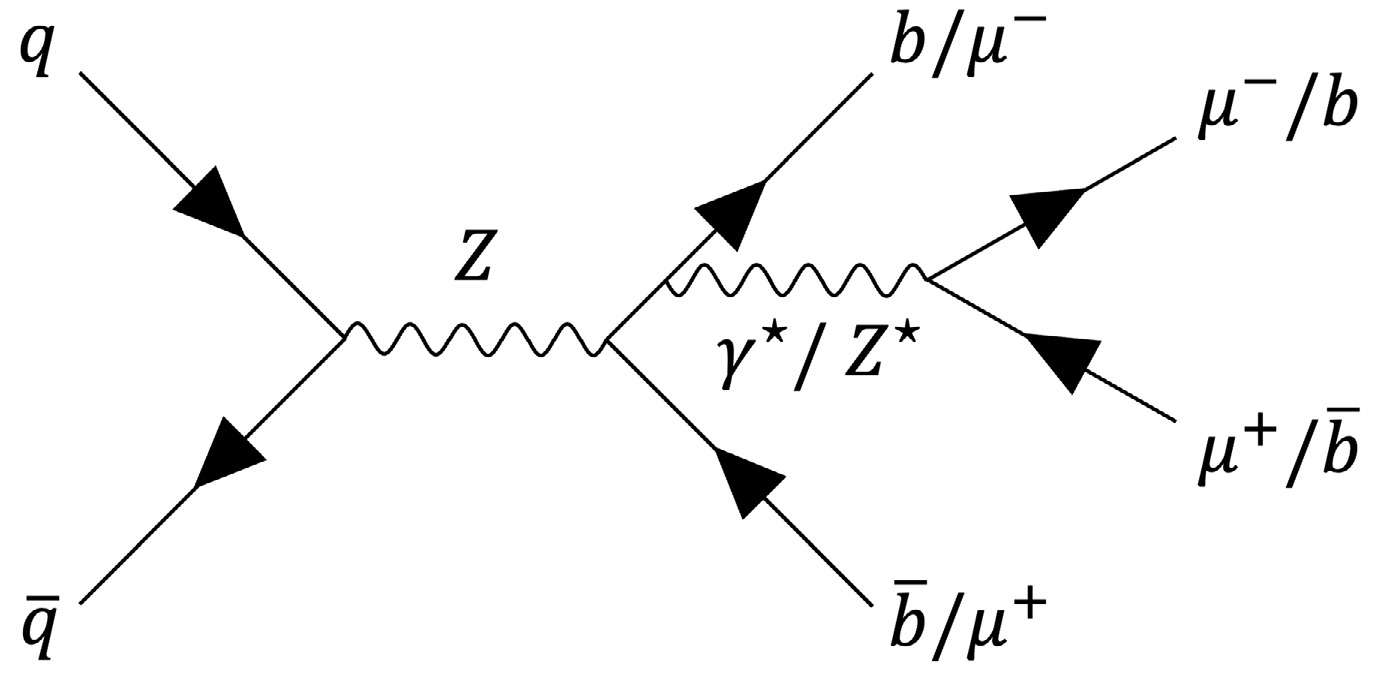
$ \mu^+\mu^-b\bar b $ final state in the Z-pole region is of special interest. The presence of bottom quarks enhances sensitivity to operators coupling to the third quark generation, while the dimuon final state enables precise reconstruction of the leptonic kinematics. At the same time, such an analysis poses experimental challenges due to significant QCD backgrounds and the reliance on heavy-flavor tagging [10, 11].The diagram shown in Fig. 1 illustrates the characteristic topology of the
$ Z \to \mu\mu bb $ decay in the Standard Model, where the four-body final state arises predominantly from the final-state radiation of an off-shell electroweak gauge boson. Compared to two-body Z decays, this topology probes a richer kinematic structure and provides access to contact interactions that are absent at leading order in simpler final states. In the SMEFT framework, this process is particularly sensitive to four-fermion operators involving muons and bottom quarks, which generate direct$ \mu\mu b b $ interactions at tree level. Such contributions interfere with the SM amplitudes mediated by off-shell$ Z^\ast/\gamma^\ast $ exchange, leading to characteristic deviations in both the total rate and differential distributions. As a result, the$ Z \to \mu\mu bb $ channel provides a complementary, process-specific probe of lepton–quark operator structures that are only weakly constrained by inclusive Z observables or purely leptonic decay modes.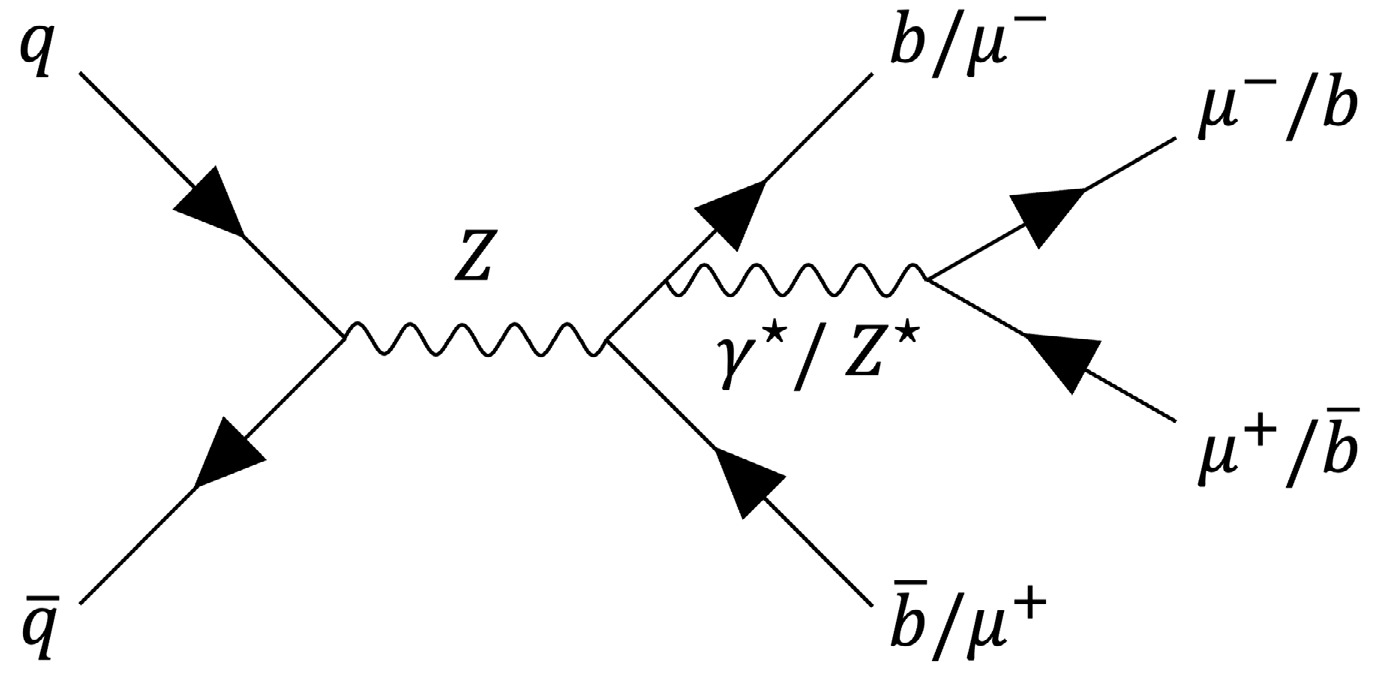
Figure 1. A representative Feynman diagram contributing to the
$ \mu^+\mu^-b\bar b $ final state near the Z pole in the Standard Model, where the four-body final state may arise from final-state radiation of an off-shell$ Z^\ast $ or$ \gamma^\ast $ .The analysis is based on leading-order Monte Carlo simulations combined with parton showering and a fast detector simulation. Constraints on the selected Wilson coefficients are obtained using an Asimov likelihood-ratio method by varying one operator at a time. Within this setup, the study provides channel-specific constraints on flavor-resolved SMEFT effects in the
${\mu^+\mu^-b\bar b}$ final state. The results also provide a useful starting point for future refinements including higher-order corrections, systematic uncertainties, electroweak interference effects, and multi-operator SMEFT interpretations. -
In the absence of direct evidence for new resonances, the effects of physics beyond the Standard Model (SM) can be systematically described using an effective field theory approach [4−6]. These low-energy effects can be encoded in higher-dimensional operators constructed from SM fields and respecting the SM gauge symmetries.
Within the SMEFT framework, the Lagrangian is organized as an expansion in inverse powers of the new physics scale Λ,
$ \mathcal{L}_{\mathrm{SMEFT}} = \mathcal{L}_{\mathrm{SM}} + \sum\limits_i \frac{C_i}{\Lambda^2} \mathcal{O}_i + \mathcal{O}\left(\frac{1}{\Lambda^4}\right), $
(1) where
$ \mathcal{O}_i $ are dimension-six operators and$ C_i $ the corresponding WCs [8,9]. In this work, we focus on the effects of dimension-six operators. Our baseline numerical results include both the interference between the SM and dimension-six amplitudes and the quadratic contribution from dimension-six amplitudes. The latter is formally of order$ 1/\Lambda^4 $ and should therefore be interpreted with the usual SMEFT truncation caveat.For a generic event yield, the SMEFT dependence can be written as
$ N(\vec C) = N_{\mathrm{SM}} + \sum\limits_i \frac{C_i}{\Lambda^2} N_i^{\mathrm{int}} + \sum\limits_{i,j} \frac{C_i C_j}{\Lambda^4} N_{ij}^{\mathrm{quad}}, $
(2) where
$ N_i^{\mathrm{int}} $ denotes the interference between the SM amplitude and the amplitude induced by a single dimension-six operator, while$ N_{ij}^{\mathrm{quad}} $ denotes the quadratic contribution from the product of two dimension-six amplitudes. In the numerical analysis below, one operator is varied at a time, so that Eq. (2) reduces to a quadratic dependence on a single Wilson coefficient. The resulting limits are therefore individual expected constraints and should not be interpreted as fully marginalized SMEFT constraints.The selected
${\mu^+\mu^-b\bar b}$ final state near the${Z}$ pole receives contributions from several classes of dimension-six operators. First, four-fermion operators involving leptons and bottom quarks generate direct contact interactions that contribute to the four-body final state at tree level [7]. Schematically, such operators can be written as$ (\bar{\ell} \Gamma \ell)(\bar{q} \Gamma q) $ and induce amplitudes that interfere with the SM contributions mediated by off-shell electroweak bosons.Second, operators that modify the couplings of the Z boson to fermions yield indirect contributions to the decay process. After electroweak symmetry breaking, these operators generate shifts in the effective Z–lepton and Z–quark couplings, which affect both the production and decay of the Z boson [12, 13]. These effects propagate into the
$ Z \to \mu\mu bb $ final state through the modified electroweak vertices. Throughout the event generation and reweighting procedure, the total Z-boson width is held fixed at its SM value. Operators such as$ C_{H\ell}^{(1,3)} $ and$ C_{Hq}^{(1,3)} $ can, in general, modify the total and partial Z widths. The expected constraints reported in this work should therefore be interpreted under the fixed-width assumption. Including SMEFT-induced width variations would require a global treatment of electroweak precision observables and is left for future work.In the numerical analysis, we select a set of six dimension-six operators that contribute to this decay channel and study their impact individually. These operators are listed in Table 1, together with their explicit field content in the Warsaw basis [5] and the relevant flavor indices.
Operator Definition Type $ \mathcal{O}_{H\ell}^{(1),22} $ $ (H^\dagger i\overleftrightarrow{D}_\mu H) (\bar{\ell}_2\gamma^\mu\ell_2) $ Z–lepton $ \mathcal{O}_{H\ell}^{(3),22} $ $ (H^\dagger i\overleftrightarrow{D}^I_\mu H) (\bar{\ell}_2\gamma^\mu\tau^I\ell_2) $ Z–lepton $ \mathcal{O}_{Hq}^{(1),33} $ $ (H^\dagger i\overleftrightarrow{D}_\mu H) (\bar{q}_3\gamma^\mu q_3) $ Z–quark $ \mathcal{O}_{Hq}^{(3),33} $ $ (H^\dagger i\overleftrightarrow{D}^I_\mu H) (\bar{q}_3\gamma^\mu\tau^I q_3) $ Z–quark $ \mathcal{O}_{\ell q}^{(1),2233} $ $ (\bar{\ell}_2\gamma^\mu\ell_2)(\bar{q}_3\gamma_\mu q_3) $ Four-fermion $ \mathcal{O}_{\ell q}^{(3),2233} $ $ (\bar{\ell}_2\gamma^\mu\tau^I\ell_2) (\bar{q}_3\gamma_\mu\tau^I q_3) $ Four-fermion Table 1. The dimension-six operators selected in this analysis are defined in the Warsaw basis [5]. Here,
$ \ell_2 $ denotes the second-generation$S U(2)_L$ lepton doublet,$ q_3 $ the third-generation quark doublet, H the Higgs doublet, and$ \tau^I $ the Pauli matrices.The operators are implemented using the
$\mathrm{SMEFTsim}$ _$\mathrm{general} $ _$\mathrm{MwScheme} $ _$\mathrm{UFO} $ model [14], which is compatible with$\mathrm{MadGraph5}$ _${\mathrm{aMC@NLO}} $ [15] and enables leading-order event generation and reweighting within a consistent electroweak input scheme.In the baseline numerical results, both interference and quadratic dimension-six terms are retained in the event yield. This choice follows the structure of the squared matrix element used in the reweighting procedure and is particularly relevant for operators with suppressed interference. The caveat concerning EFT truncation, discussed above, is taken into account when interpreting the quoted constraints.
The SMEFT expansion requires that the typical energy scale of the process remain below the cutoff scale Λ [8, 16]. In the selected
${Z}$ -pole region, the analysis is dominated by moderate kinematic scales determined by the reconstructed invariant mass and object transverse momenta, which supports the use of the SMEFT description in the considered phase space. A simultaneous fit of multiple operators is beyond the scope of this exploratory study. Because correlations among operators can weaken individual constraints and may create approximate flat directions, the bounds reported below are individual, one-operator-at-a-time expected constraints. A global fit incorporating correlations with other electroweak and flavor observables would be required for a complete SMEFT interpretation. -
All processes are generated at leading order using
$\mathrm{MadGraph5}$ _$\mathrm{aMC@NLO} $ , followed by parton showering and hadronization with$\mathrm{Pythia8}$ [17]. Detector-level effects are simulated using$\mathrm{Delphes}$ [18] with a CMS-like detector configuration. Unless otherwise stated, proton–proton collisions at a center-of-mass energy of$ \sqrt{s} = 13\; \mathrm{TeV} $ are assumed throughout this analysis. All numerical results presented below should be interpreted as leading-order constraints given the simulation setup described here. Higher-order QCD and electroweak corrections, as well as scale and PDF uncertainties, are not included in the baseline simulation. For several of the processes considered here, next-to-leading-order predictions can be obtained with public Monte Carlo tools and may modify both the normalization and the shapes of kinematic distributions. Their inclusion is deferred to future precision studies.The primary final state considered in this work is
$ pp\to\mu^+\mu^-b\bar b $ in the vicinity of the Z pole. For brevity, we refer to this topology as the$ Z\to\mu\mu b\bar b $ channel. At the amplitude level, however, the same final state may receive contributions from off-shell electroweak bosons and photon-mediated diagrams. The present analysis should therefore be understood as a fiducial sensitivity study of the$ \mu^+\mu^-b\bar b $ final state around the Z resonance, rather than a fully gauge-invariant separation of individual diagram classes.Signal events are generated at parton level using
$\mathrm{MadGraph5}$ _$\mathrm{aMC@NLO} $ . Basic generator-level cuts are applied to ensure numerical stability and to reflect the kinematic acceptance of the detector:$ p_T^\ell>10\; \mathrm{GeV} $ ,$ |\eta^\ell|<2.5 $ for charged leptons, and$ p_T^q>10\; \mathrm{GeV} $ ,$ |\eta^q|<2.5 $ for quarks. The resulting leading-order cross section for the selected signal topology, prior to detector-level selection, is$ \sigma = 0.750\; \mathrm{fb} $ .All generated parton-level events are passed to
$\mathrm{Pythia8}$ for parton showering and hadronization. For the$ Z+\text{jets} $ background, matrix-element calculations with up to two additional jets are merged with the parton shower using the MLM matching scheme [19, 20]. This procedure avoids double counting between matrix-element and parton-shower emissions and provides a more reliable description of multi-jet final states.Detector effects are simulated with
$\mathrm{Delphes}$ , using a CMS-like detector configuration. Jets are identified as b-jets using the built-in b-tagging algorithm, and a fixed working point corresponding to a discriminator threshold of$ \text{BTag} \gt 0.5 $ is applied. This working point yields an average b-tagging efficiency of approximately$ 70\% $ for true b-jets, with mis-tag rates of about$ 10\% $ for charm jets and$ 1\% $ for light-flavor jets, consistent with typical CMS performance [21]. Requiring two b-tagged jets significantly suppresses backgrounds from light-flavor and charm jet production, in particular from$ Z+\text{jets} $ events.The reconstructed kinematic distributions shown in Fig. 2 serve as an important validation of the signal modeling after detector effects are taken into account. In Fig. 2(a), the invariant mass distribution of the
${b\bar b}$ system is considerably broader than that of the dimuon system, as expected from jet energy resolution effects and QCD radiation. Nevertheless, the combined four-body invariant mass$ m_{\mu\mu bb} $ displays a clear enhancement around$ m_Z $ , indicating that the signal topology can be reliably reconstructed at detector level despite the presence of hadronic final states.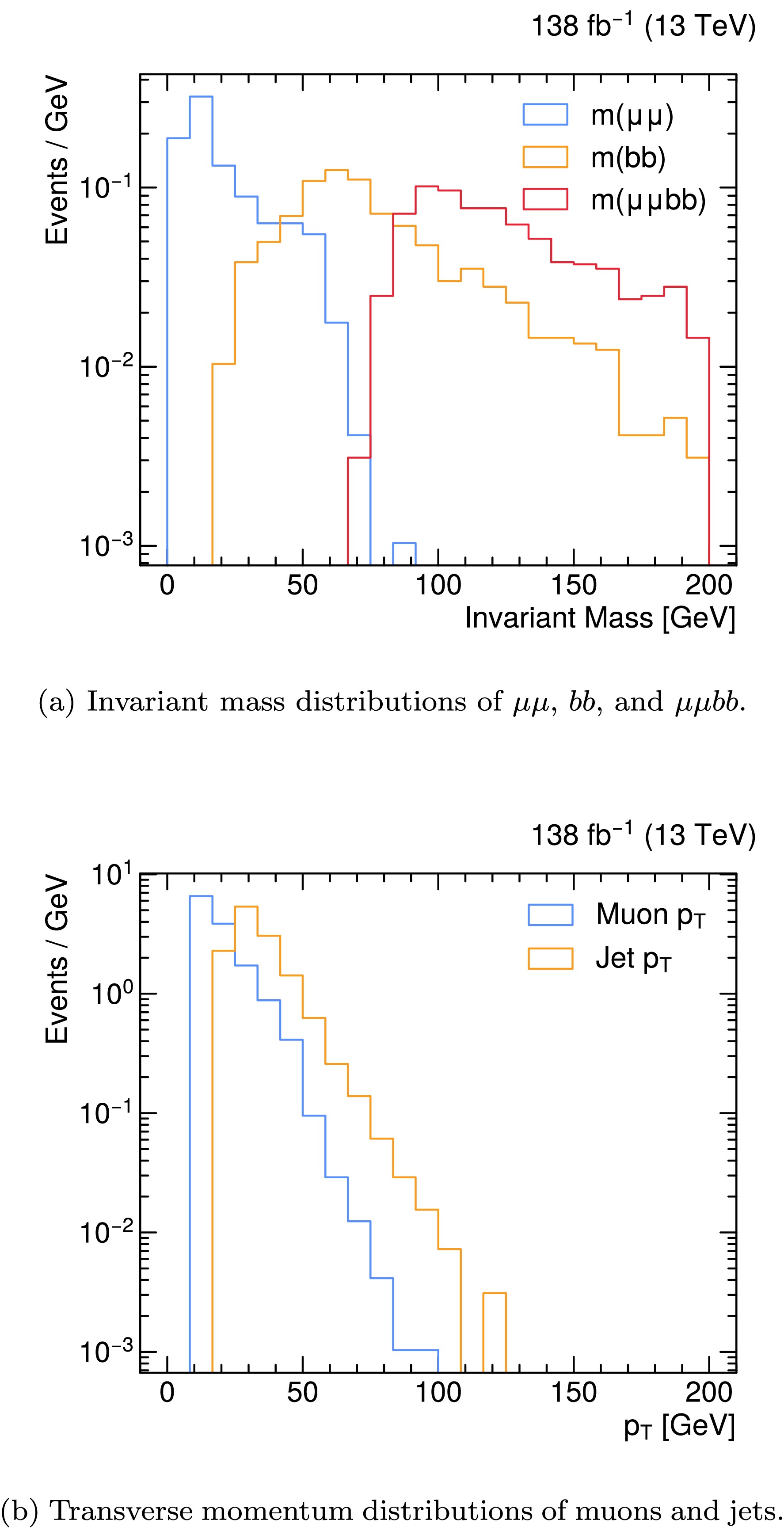
Figure 2. (color online) Detector-level kinematic distributions for the selected
${\mu^+\mu^-b\bar b}$ final-state topology, obtained from the$\mathrm{Delphes}$ simulation.Figure 2(b) shows the transverse momentum spectra of the reconstructed muons and jets. The muon
$ p_T $ distribution peaks around 20–40 GeV, consistent with the two-body decay kinematics of a Z boson with moderate boost, where each muon carries approximately$ m_Z/2 $ in the Z rest frame; this is a physical effect of the Z-decay topology visible after full$\mathrm{Delphes}$ simulation. The jet$ p_T $ spectrum, which receives contributions from both the signal b-jets and the dominant$ Z+\text{jets} $ background, features a longer high-$ p_T $ tail driven by QCD radiation and the harder jet kinematics in background events. The typical energy scales involved remain well below the assumed SMEFT cutoff, supporting the consistency of the SMEFT interpretation within the selected phase space.The dominant background arises from top-quark pair production
$ pp \to t\bar{t} $ , with both top quarks decaying semileptonically,$ t \to b \mu^+ \nu_\mu $ and$ \bar{t} \to \bar{b} \mu^- \bar{\nu}_\mu $ [15, 17]. Due to its large production cross section, this process remains a significant background even after event selection.Additional backgrounds include diboson production, such as
$ pp \to ZZ $ , with$ Z \to \mu^+\mu^- $ and$ Z \to b\bar{b} $ , as well as associated production of a Z boson with a Higgs boson:$ pp \to ZH $ ,$ Z \to \mu^+ \mu^- $ ,$ H \to b\bar{b} $ . Although their cross sections are smaller than that of$ t\bar{t} $ production, these processes closely resemble the signal topology and are therefore included explicitly [15, 18].Drell–Yan production of a Z boson in association with jets,
$ pp \to Z + \text{jets} $ , constitutes another important background due to its very large cross section. Events with light-flavor jets can enter the signal region through jet misidentification, while events with heavy-flavor jets provide an irreducible background. To model this background accurately, samples with up to two additional jets at matrix-element level are generated and merged with the parton shower using the MLM matching scheme [19, 20].Subleading backgrounds from electroweak processes involving photons are also considered, including
$ Z\gamma^* $ ,$ \gamma^*\gamma^* $ , and mixed$ \gamma^* Z $ production, where the virtual photon decays into a fermion pair. We note that electroweak amplitudes leading to the same$ \mu^+\mu^-b\bar b $ final state can in principle interfere. In the present exploratory analysis, the samples are organized according to their dominant physical topology in order to estimate their relative impact after selection. A fully gauge-invariant treatment of the irreducible electroweak$ \mu^+\mu^-b\bar b $ contribution, including all interferences among$ Z^\ast $ - and$ \gamma^\ast $ -mediated diagrams, is beyond the scope of this work. The topology-based separation employed here is justified within the narrow-width approximation (NWA) for the on-shell Z boson [22], under which the production and decay amplitudes factorize into gauge-invariant subprocesses, with corrections of order$ \Gamma_Z/m_Z \sim 3\% $ . The separation of contributions into distinct topological samples is further motivated by the hierarchy of production cross sections and the kinematic features of the selected phase space. In the Z-pole signal region ($ 80 \lt m_{\mu\mu bb} \lt 115 $ GeV), the dominant contribution arises from diagrams with a near-resonant Z propagator, which is strongly enhanced relative to off-shell photon-mediated diagrams by the Breit–Wigner factor. The interference between$ Z^\ast $ - and$ \gamma^\ast $ -mediated amplitudes is further suppressed in this narrow invariant-mass window by the large mass gap between the Z resonance and the photon pole, as well as by the MET and b-tagging requirements that preferentially select the signal topology. While a fully gauge-invariant treatment of the irreducible electroweak$ \mu^+\mu^-b\bar b $ contribution remains beyond the scope of this exploratory study, the topology-based separation is expected to provide a reliable estimate of the dominant contributions within the selected phase space, and the numerical results are interpreted accordingly as channel-specific constraints.A summary of all signal and background processes and their corresponding leading-order cross sections is given in Table 2.
Process Cross section/pb $ pp \to \mu^+\mu^- b\bar{b} $ , Z-pole topology$ 7.50 \times 10^{-4} $ $ pp \to t\bar{t} $ ,$ t \to b \mu^+ \nu_\mu, \bar{t} \to \bar{b} \mu^- \bar{\nu}_\mu $ $ 4.38 $ $ pp \to ZZ $ ,$ Z \to \mu^+ \mu^- $ ,$ Z \to b\bar{b} $ $ 5.54 \times 10^{-2} $ $ pp \to Z + \text{jets} $ $ (0,1,2) $ $ 9.33 \times 10^{2} $ $ pp \to ZH $ ,$ Z \to \mu^+ \mu^- $ ,$ H \to b\bar{b} $ $ 1.03 \times 10^{-2} $ $ pp \to Z\gamma^* $ ,$ Z\to\mu^+\mu^- $ ,$ \gamma^* \to b\bar{b} $ $ 5.54 \times 10^{-3} $ $ pp \to \gamma^*\gamma^* $ ,$ \gamma^* \to \mu^+ \mu^-,\ \gamma^* \to b\bar{b} $ $ 6.70 \times 10^{-5} $ Table 2. The leading-order cross sections for the signal and background processes considered in this analysis are obtained at generator level before the full detector-level event selection and are intended to summarize the relative normalization of the simulated samples. The
$ pp\to Z\gamma^* $ entry corresponds to the topology with$ Z\to\mu^+\mu^- $ and$ \gamma^*\to b\bar{b} $ ; the charge-conjugate topology with$ Z\to b\bar{b} $ and$ \gamma^*\to\mu^+\mu^- $ is found to be negligible after the full event selection and is not listed separately. -
Events are reconstructed using detector-level objects from
$\mathrm{Delphes}$ . Muon candidates are selected within the pseudorapidity range$|\eta| \lt 2.5$ , corresponding to the coverage of the central tracking systems and muon chambers in LHC experiments [23, 24]. Jets are clustered with the anti-$k_T$ algorithm using a radius parameter$R = 0.4$ [25].Bottom-quark jets are identified via the b-tagging information provided by
$\mathrm{Delphes}$ [18, 21]. A jet is considered a b-jet if its b-tag discriminator exceeds 0.5, corresponding to a typical medium working point used in CMS analyses.To emulate the trigger requirements of LHC experiments, events must satisfy at least one of the muon-based trigger conditions listed in Table 3. These triggers are based on standard CMS single- and double-muon triggers used in Run
$\text{II}$ analyses [26]. The single-muon trigger ensures high efficiency for events containing a high-$p_T$ muon, while the di-muon trigger retains sensitivity to events in which both muons have moderate transverse momenta. Only isolated muons are considered in the trigger selection to suppress backgrounds from heavy-flavor decays and hadronic activity.Trigger requirement Threshold/GeV Single-muon trigger $ p_T(\mu)> 25 $ Double-muon trigger (leading) $ p_T(\mu_1)> 18 $ Double-muon trigger (subleading) $ p_T(\mu_2)> 7 $ Table 3. The analysis uses muon trigger requirements that consider only isolated muons.
Events passing the trigger requirements are subjected to a set of preselection criteria designed to suppress reducible backgrounds while maintaining high signal efficiency. The preselection cuts are summarized in Table 4.
Selection Requirement Number of muons $ \geq 2 $ Muon $ p_T $ (subleading)$> 10\; \mathrm{GeV} $ Muon isolation $ \Delta R(\mu,\text{jet})> 0.4 $ Missing transverse energy $ \mathrm{MET}< 30\; \mathrm{GeV} $ Number of jets $ \geq 2 $ Jet $ p_T $ $> 25\; \mathrm{GeV} $ b-tagging $ \geq 2 $ b-jets$ \Delta R(b,b) $ $> 0.4 $ $ \Delta R(\mu,\mu) $ $> 0.4 $ $ \Delta R(\mu,b) $ $> 0.4 $ Table 4. Summary of event selection criteria applied in the analysis.
At least two muon candidates are required per event. The subleading muon is required to satisfy
$ p_T \gt 10\; \mathrm{GeV} $ to ensure reliable reconstruction and high identification efficiency. Muon isolation is imposed by requiring a minimum separation$ \Delta R(\mu, \text{jet}) \gt 0.4 $ between each selected muon and any reconstructed jet [25]. This reduces backgrounds from semileptonic heavy-flavor decays.To suppress backgrounds containing genuine missing transverse energy, such as top-quark pair production, events are required to have
$ \mathrm{MET} \lt 30\; \mathrm{GeV} $ . This exploits the absence of prompt neutrinos in the selected$ {\mu^+\mu^-b\bar b} $ signal topology.Events are required to contain at least two reconstructed jets with
$ p_T \gt 25\; \mathrm{GeV} $ , at least two of which must be identified as b-jets. This reflects the expected presence of a$ b\bar{b} $ pair in the signal final state and significantly suppresses backgrounds from Z+light-jet production.Angular separation requirements are imposed to ensure well-resolved final-state objects. In particular, the separation between the two selected b-jets must satisfy
$ \Delta R(b,b) \gt 0.4 $ , and the separation between the two leading muons must satisfy$ \Delta R(\mu,\mu) \gt 0.4 $ . Additionally, all muon–b-jet pairs must satisfy$ \Delta R(\mu,b) \gt 0.4 $ [25]. These requirements reduce contamination from collinear final-state radiation and overlapping reconstruction effects.The selection criteria are designed to preserve the characteristic kinematics of the
$ Z \to \mu\mu bb $ decay while suppressing backgrounds with genuine missing transverse energy or misidentified heavy-flavor jets. For events passing all selection requirements, the invariant mass of the$ \mu\mu bb $ system is reconstructed using the four-momenta of the two leading isolated muons and the two selected b-jets. The reconstructed invariant mass$ m_{\mu\mu bb} $ serves as the primary observable for signal extraction and the subsequent SMEFT analysis [7].The signal region is defined as
$ 80\; \mathrm{GeV} \lt m_{\mu\mu bb} \lt 115\; \mathrm{GeV} $ , centered around the Z boson mass. This window retains a large fraction of the selected signal topology while reducing non-resonant backgrounds. It provides a simple and experimentally motivated signal region for the subsequent extraction of SMEFT constraints.Figure 3(b) focuses on the signal region defined by
$ 80 \lt m_{\mu\mu bb} \lt 115 $ GeV. In this window, the relative contribution of the selected signal topology is enhanced, while the$ t\bar t $ background is reduced by the missing transverse energy requirement. The remaining electroweak and associated-production backgrounds, including$ Z \gamma^* $ and$ ZH $ production, exhibit similar kinematic features but are subleading in rate after the applied selection. The invariant mass$ m_{\mu\mu bb} $ is therefore used as the main observable for the signal region in the subsequent reweighting and statistics-only constraint extraction.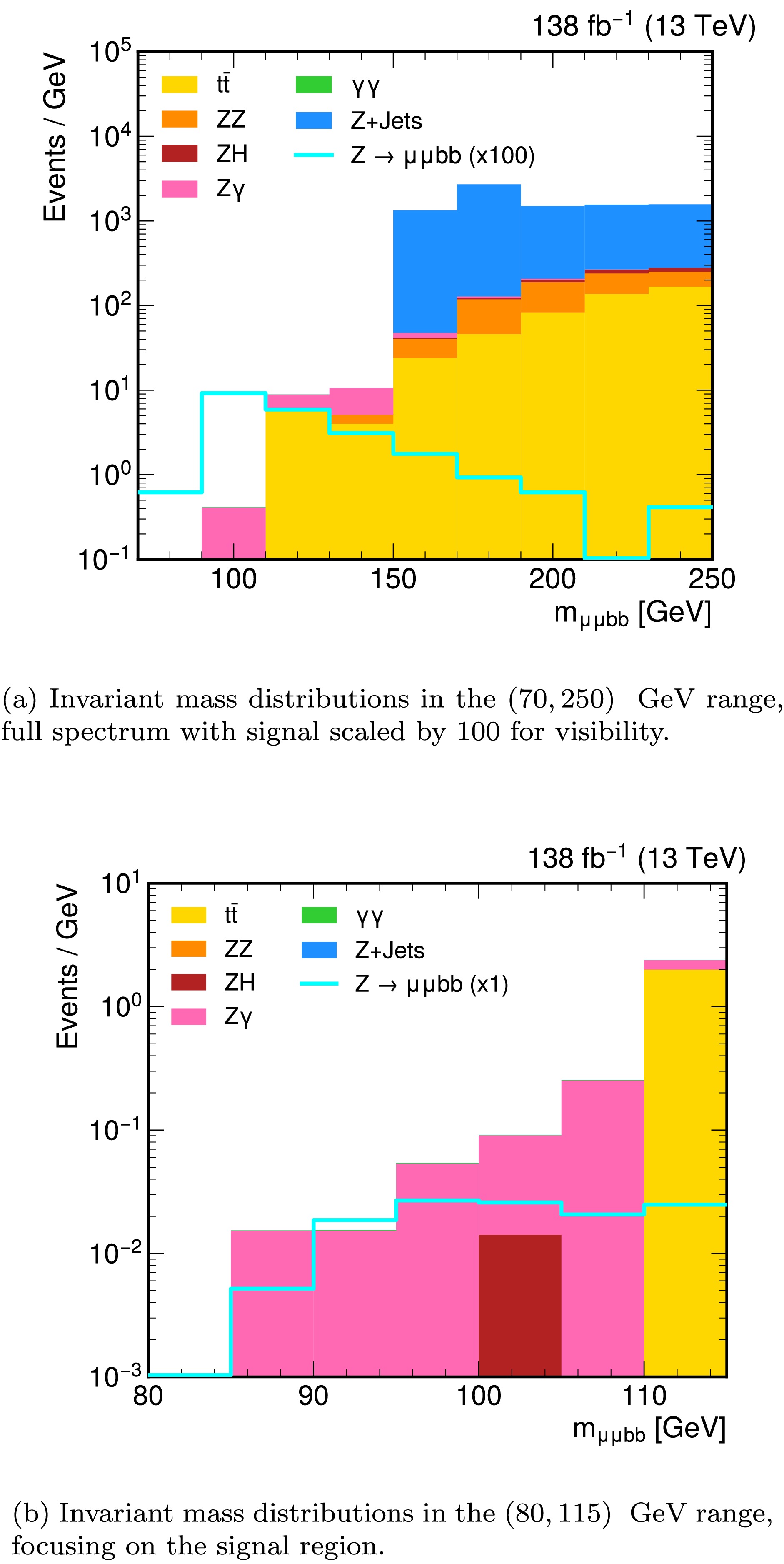
Figure 3. (color online) Detector-level invariant mass distributions for the
$ \mu\mu bb $ system from various processes, obtained from a$\mathrm{Delphes}$ simulation. The first panel shows the full mass spectrum, with the signal scaled for better visibility, while the second panel focuses on the signal region.Figure 3 compares the reconstructed invariant mass distributions of the
$ \mu\mu bb $ system for the signal and the dominant background processes after the full event selection. In Fig. 3(a), the distribution is shown over a wide mass range from 70 to 250 GeV, with the signal contribution scaled by a factor of 100 for visibility. Over this range, the spectrum is dominated by the Z+jets and$ t\bar{t} $ backgrounds, reflecting their large production cross sections.Two sources of interference involving the
$ Z\gamma^* $ background are relevant: its interference with the SM signal amplitude, and its interference with the dimension-six SMEFT amplitude. For the first source, the SM signal arises from a single Z resonance producing a narrow peak in$ m_{\mu\mu bb} $ with width$ \Gamma_Z \approx 2.5 $ GeV, whereas the$ Z\gamma^* $ process involves an off-shell photon and yields a broad, non-resonant$ m_{\mu\mu bb} $ spectrum. The amplitude overlap in the signal region is therefore suppressed by a factor of order$ \Gamma_Z/m_Z \sim 3\% $ , rendering this interference negligible relative to the signal yield. For the second source, the dimension-six amplitude$ \mathcal{M}_\text{EFT} $ inherits the same Z resonance structure as the SM signal, because the SMEFT operators modify the effective vertex but leave the single on-shell Z propagator in the signal topology unchanged. Consequently, the$ Z\gamma^* \times \mathcal{M}_\text{EFT} $ interference is suppressed by the same kinematic factor$ \Gamma_Z/m_Z $ . For operators whose constraints are dominated by the quadratic SMEFT term$ |\mathcal{M}_\text{EFT}|^2 $ , this interference is further suppressed relative to the dominant contribution by an additional factor of$ \sqrt{\sigma_\text{SM}/\sigma_\text{quad}} $ . It is therefore negligible in the extraction of SMEFT bounds. -
The impact of dimension-six operators on the selected
$ \mu^+\mu^-b\bar b $ final-state topology is evaluated within the SMEFT framework using an event-reweighting technique [27, 28]. In this approach, the dependence of the selected event yield on each WC is obtained by reweighting Monte Carlo events. The total event weight includes the SM contribution as well as linear and quadratic corrections from dimension-six operators, allowing an efficient exploration of the WC parameter space without regenerating independent samples for every parameter point.SMEFT effects are incorporated using the
$\mathrm{SMEFTsim}$ _$\mathrm{general} $ _$\mathrm{MwScheme }$ _$\mathrm{UFO} $ model from the SMEFTsim 3.0 framework [14], which provides a gauge-invariant implementation of the relevant dimension-six operators in the$ M_W $ input scheme. The$ M_W $ scheme is adopted to consistently account for electroweak input-parameter shifts induced by dimension-six operators. For each generated event, a set of precomputed weights corresponding to different values of the Wilson coefficient parameter$ \theta \equiv C_i/\Lambda^2 $ (in units of$ \mathrm{TeV}^{-2} $ ) is stored at the generator level. After parton showering, hadronization, detector simulation, and event selection, these weights are used to parametrize the SMEFT dependence of the selected yield. After the full event selection is applied, the expected number of signal events is expressed as a quadratic function of θ,$ N(\theta) = c + b\,\theta + a\,\theta^2 , $
(3) where c denotes the Standard Model (SM) expectation, b corresponds to the interference between the SM and dimension-six amplitudes, and a encodes the pure quadratic SMEFT contribution [7]. In principle, the reweighting information allows the SM contribution, the SM–dimension-six interference term, and the quadratic dimension-six contribution to be extracted separately. In the present analysis, the coefficients a, b, and c are determined by fitting the reweighted event yields at several benchmark values of θ. This procedure provides a simple numerical implementation of the same quadratic dependence and serves as a consistency check of the reweighting behavior after event selection. The fitted parametrization is used only in the parameter region relevant for the quoted confidence intervals.
Constraints on the WCs are derived using a likelihood-based statistical approach [29]. An Asimov dataset is constructed by assuming the observed number of events to be equal to the SM prediction,
$ N_{\mathrm{obs}} = N_{\mathrm{SM}} \equiv c $ . The Poisson likelihood function is then given by$ \mathcal{L}(\theta) = \frac{[N(\theta)]^{N_{\mathrm{obs}}} \, {\rm e}^{-N(\theta)}}{N_{\mathrm{obs}}!}. $
(4) The test statistic is defined as the likelihood ratio.
$ q(\theta) = -2 \ln \frac{\mathcal{L}(\theta)}{\mathcal{L}(0)} = 2 \left[ N(\theta)\ln\frac{N(\theta)}{N_{\mathrm{SM}}} + N_{\mathrm{SM}} - N(\theta) \right], $
(5) The test statistic
$ q(\theta) $ is compared with a$ \chi^2 $ distribution with one degree of freedom, under the large-sample approximation of Wilks' theorem [30]. The 95% confidence level (C.L.) interval on θ is obtained by requiring$ q(\theta) = 3.84 $ . No nuisance parameters are included in the baseline likelihood, so the resulting intervals correspond to statistics-only expected constraints within the baseline likelihood setup.This procedure is applied independently to each dimension-six operator, with all other WCs set to zero, yielding channel-specific constraints on potential SMEFT effects in the
${\mu^+\mu^-b\bar b}$ final state. A flavor-specific setup is adopted, in which the WCs are defined for individual fermion generations. In particular, operators involving second-generation leptons ($ \ell_2 $ ) and third-generation quarks ($ q_3 $ ) are considered explicitly. This approach provides channel-specific constraints on flavor-resolved SMEFT effects in the${\mu^+\mu^-b\bar b}$ final state, beyond the flavor-universal assumptions commonly employed in global SMEFT fits.Figure 4 shows the dependence of the expected event yield in the signal region on the WCs of the six dimension-six operators considered in this analysis. For each operator, the ratio of the SMEFT prediction to the SM expectation is fit with a quadratic function, reflecting the structure of the squared matrix element, which includes both interference and pure SMEFT contributions.
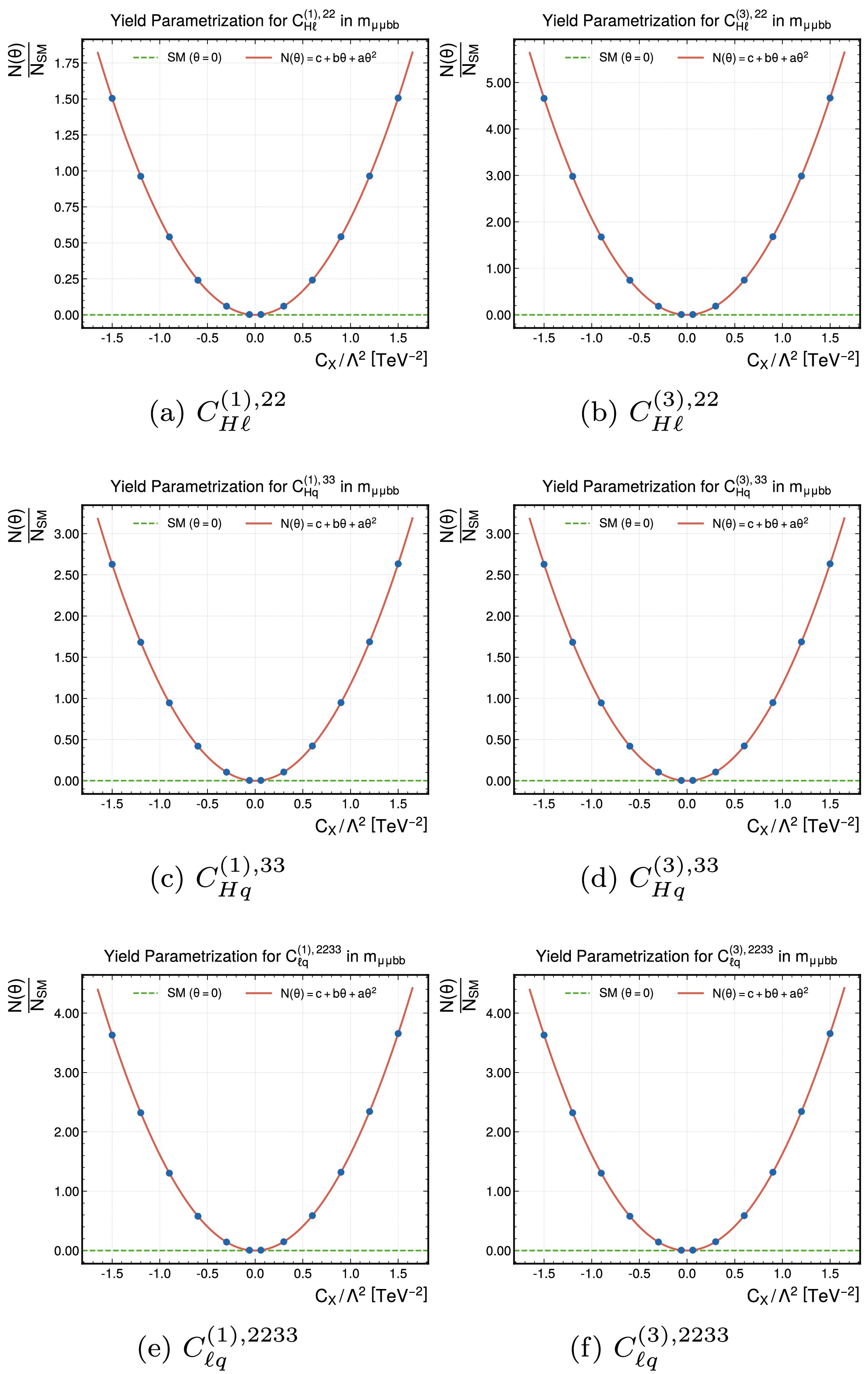
Figure 4. (color online) The dependence of the selected signal-region yield on individual Wilson coefficients is shown for the parameter range relevant to the expected 95% C.L. intervals. The curves are obtained from the quadratic parameterization
$ N(\theta)= $ $ c+b\theta+a\theta^2 $ using SMEFT-reweighted samples. Only one coefficient is varied at a time, while all other coefficients are set to zero. The results include both interference and quadratic dimension-six contributions.The observed quadratic behavior is consistent with the expected structure of the squared matrix element when a single Wilson coefficient is varied at a time. This behavior also illustrates the relative importance of linear and quadratic terms for different operator classes. Operators modifying the Z–fermion couplings exhibit significant interference with the SM amplitude, leading to asymmetric constraints around the SM point. In contrast, certain four-fermion operators show a more symmetric dependence, indicating a dominant contribution from the quadratic term. This highlights the particular sensitivity of this channel to four-fermion operators involving bottom quarks.
The resulting expected 95% C.L. intervals on the WCs obtained from this procedure are summarized in Table 5. These intervals are statistics-only, one-operator-at-a-time expected constraints obtained at leading order.
C 138 fb $ ^{-1} $ 3000 fb $ ^{-1} $ $ C_{\ell q}^{(1),2233} $ $ [-0.023,\;0.014] $ $ [-0.005,\;0.003] $ $ C_{\ell q}^{(3),2233} $ $ [-0.023,\;0.014] $ $ [-0.005,\;0.003] $ $ C_{H q}^{(1),33} $ $ [-0.029,\;0.026] $ $ [-0.006,\;0.006] $ $ C_{H q}^{(3),33} $ $ [-0.030,\;0.026] $ $ [-0.006,\;0.006] $ $ C_{H \ell}^{(1),22} $ $ [-0.025,\;0.009] $ $ [-0.005,\;0.002] $ $ C_{H \ell}^{(3),22} $ $ [-0.028,\;0.025] $ $ [-0.006,\;0.005] $ Table 5. 95% C.L. allowed regions for
$ C/ \Lambda^2 $ [TeV$ ^{-2} $ ] are shown. These results are obtained at leading order within the fixed-width approximation, accounting for both interference and quadratic dimension-six contributions.A direct numerical comparison with existing global SMEFT fits should be interpreted with caution. Global analyses typically combine electroweak precision data, Higgs measurements, diboson production, top-quark observables, and differential LHC measurements. They may also adopt different flavor assumptions, operator subsets, input schemes, and SMEFT truncation prescriptions. In particular, bounds may differ significantly depending on whether they are obtained one operator at a time or after marginalization over a larger parameter space, and on whether quadratic dimension-six terms are retained.
For this reason, the results in Table 5 should be viewed as channel-specific expected constraints rather than direct replacements for global SMEFT constraints. Their main value is to illustrate that the
$ \mu^+\mu^-b\bar b $ final state has potential sensitivity to flavor-resolved operators involving second-generation leptons and third-generation quarks, especially four-fermion structures that are not always explicitly resolved in flavor-universal fits. The HL-LHC luminosity scenario illustrates the statistical improvement expected with larger datasets, while a full high-luminosity interpretation would also require a dedicated treatment of systematic uncertainties. -
The likelihood used in the baseline results includes only the Poisson statistical uncertainty of the expected event yield. Experimental systematic uncertainties, such as those in luminosity, muon reconstruction efficiency, b-tagging efficiency, jet energy scale, and background normalization, are not included. The resulting intervals therefore represent statistics-only expected constraints in the baseline setup.
A complete treatment of systematic uncertainties would require nuisance parameters constrained by auxiliary measurements. Schematically, for each bin or signal region one may write
$ N_k(\vec C,\vec\eta) = N_{k,\mathrm{sig}}(\vec C)(1+\eta_s) + \sum\limits_b N_{k,b}(1+\eta_b), $
(6) with Gaussian constraints on the nuisance parameters,
$ \mathcal{L}(\vec C,\vec\eta) = \prod\limits_k \mathrm{Pois} \left( n_k \mid N_k(\vec C,\vec\eta) \right) \prod\limits_j \exp \left( -\frac{\eta_j^2}{2\sigma_j^2} \right). $
(7) Including such effects would generally weaken the projected bounds, especially in the HL-LHC luminosity scenario where statistical uncertainties are smaller. Since the present work is intended as a first extraction of constraints, the incorporation of experimental systematic uncertainties is left for future work.
In addition, in the baseline reweighting procedure, dimension-six effects are included only for the selected signal topology, while the background samples are kept at their SM predictions. Operators that modify Z–fermion couplings may also affect electroweak backgrounds such as
$ ZZ $ or Z+heavy-flavor production. A full SMEFT interpretation should consistently include these effects, together with the irreducible interferences among electroweak amplitudes. -
In this work, we investigate the
${\mu^+\mu^-b\bar b}$ final state in the reconstructed${Z}$ -pole region as a probe of selected SMEFT operators. The analysis focuses on flavor-resolved interactions involving second-generation leptons and third-generation quarks, including both four-fermion operators and operators that modify effective${Z}$ –fermion couplings.Signal and relevant background processes were simulated at leading order using
$\mathrm{MadGraph5}$ _$\mathrm{aMC@NLO} $ , followed by parton showering and hadronization with$\mathrm{Pythia8}$ , and fast detector simulation with$\mathrm{Delphes}$ . The event selection includes muon trigger requirements, lepton isolation,${b}$ -jet identification, missing-energy suppression, and angular separation cuts. The reconstructed invariant mass of the${\mu^+\mu^-b\bar b}$ system is used to define a signal region around the${Z}$ pole and to extract constraints on potential SMEFT effects.The dependence of the selected event yield on individual Wilson coefficients was obtained using the SMEFT reweighting procedure. For each operator, the yield was parametrized as a quadratic function of the Wilson coefficient, including both the SM–dimension-six interference and the quadratic dimension-six contribution. Using an Asimov likelihood-ratio method, we derived expected 95% C.L. constraints on the selected operators at integrated luminosities of
${138 \;\mathrm{fb}^{-1}}$ and${3000 \;\mathrm{fb}^{-1}}$ .The results show that the
${\mu^+\mu^-b\bar b}$ final state can provide valuable channel-specific constraints on flavor-resolved SMEFT interactions, especially on operators involving muons and bottom quarks. These constraints are complementary to those obtained from inclusive electroweak measurements, purely leptonic${Z}$ decays, and global SMEFT analyses. The projected HL-LHC luminosity further improves the reach, illustrating the potential value of including mixed leptonic–hadronic${Z}$ -pole final states in future SMEFT studies.The present analysis provides a baseline phenomenological study of this channel. Several refinements could be incorporated in future work, including higher-order QCD and electroweak corrections, scale and PDF uncertainties, experimental systematic uncertainties, correlations among multiple Wilson coefficients, SMEFT-induced modifications of the total
${Z}$ width, and a more complete treatment of electroweak interference effects in the irreducible${\mu^+\mu^-b\bar b}$ final state. These extensions would allow the constraints from this channel to be embedded more directly into global SMEFT fits and precision electroweak interpretations.
Constraints on SMEFT operators from Z → μμbb decay
- Received Date: 2026-05-13
- Available Online: 2026-09-15
Abstract: The Standard Model Effective Field Theory (SMEFT) provides a systematic framework to parameterize indirect effects of heavy new physics in precision measurements. In this work, we study the ${\mu^+\mu^-b\bar b}$ final state in the reconstructed ${Z}$-pole region and derive constraints on selected dimension-six SMEFT operators involving second-generation leptons and third-generation quarks. Signal and background processes are simulated at leading order using standard Monte Carlo tools, followed by parton shower and fast detector simulation with simplified ${b}$-tagging effects. We focus on four-fermion operators involving leptons and bottom quarks, as well as operators modifying effective ${Z}$–fermion couplings. The dependence of the selected event yield on individual Wilson coefficients is obtained using SMEFT reweighting and parameterized to include both interference and quadratic dimension-six contributions. Expected constraints are derived using an Asimov likelihood-ratio method for integrated luminosities of ${138\; \mathrm{fb}^{-1}}$ and ${3000 \;\mathrm{fb}^{-1}}$. At $ 138\; \mathrm{fb}^{-1} $, the expected 95% C.L. intervals on the six Wilson coefficients considered span the range from $ [-0.030,\,0.026] $ to $ [-0.023,\,0.014]\; \mathrm{TeV}^{-2} $. These intervals shrink by approximately a factor of five at the HL-LHC luminosity of $ 3000\; \mathrm{fb}^{-1} $. The results provide channel-specific constraints on flavor-resolved SMEFT interactions in mixed leptonic–hadronic ${Z}$-pole final states and offer a useful reference for future analyses that include higher-order and systematic effects.



 DownLoad: