


 Abstract
 HTML
HTML Reference
 Related
 PDF
PDF


-
Shell effects play a central role in shaping our understanding of nuclear structure. Studies of shell effects provide key tests of proton and neutron shell gaps, clarify single-particle configurations, and improve the reliability of effective nuclear interactions. One region of particular interest for such studies, both experimentally and theoretically, is around the proton subshell at Z = 64 [1] and the neutron closed shell at N = 82 [1, 2].
In the vicinity of
$ ^{146}_{\phantom{1}64} $ Gd82, the proton orbitals$ g_{7/2} $ and$ d_{5/2} $ constitute the$ Z=64 $ subshell closure [3] and lie below the higher$ 0h_{11/2} $ ,$ 2s_{1/2} $ , and$ 1d_{3/2} $ orbitals [4]. Of particular importance is the high-j orbital$ 0h_{11/2} $ , which plays an important role in the yrast states of these nuclei. Indeed, the$ \pi h_{11/2}^n $ configurations have been found to dominate high-spin levels up to the fully aligned states at$ 10^+ $ ,$ 27/2^- $ ,$ 16^+ $ , and$ 35/2^- $ in 148Dy, 149Ho, 150Er, and 151Tm [5−8] with n = 2, 3, 4, and 5, respectively.As the available angular momentum in the proton valence space becomes exhausted at higher spin and excitation energy, particle-hole (p-h) excitations across the Z = 64 proton subshell and/or the N = 82 neutron shell closure will set in and compete. Since the neutron shell gap (~4 MeV) is significantly larger than the proton subshell gap (~2 MeV) [1, 2], neutron cross-shell excitations are expected to occur at higher excitation energies than proton excitations. Indeed, such competing excitations have been identified in the N = 82 isotones
$ ^{133}_{\phantom{1}51} $ Sb [10],$ ^{134}_{\phantom{1}52} $ Te,$ ^{135}_{\phantom{1}53} $ I [11],$ ^{136}_{\phantom{1}54} $ Xe,$ ^{137}_{\phantom{1}55} $ Cs, and$ ^{138}_{\phantom{1}56} $ Ba [12], and tentatively assigned in$ ^{139}_{\phantom{1}57} $ La [12] and$ ^{141}_{\phantom{1}59} $ Pr [13].In this work, we present new results on high-spin states of the semimagic nucleus
$ ^{151}_{\phantom{1}69} $ Tm82, produced via the 96Ru(58Ni, 3p) fusion-evaporation reaction. Its high-spin states were investigated using a selective recoil-isomer tagging (RIT) method [14] in combination with the prompt γ-γ coincidence technique. The experimental details are described in Sec. II, and the experimental results are presented in Sec. III. In Sec. IV, the level structures are discussed on the basis of experimental systematics in N = 82 isotones and compared with the CISM calculations. A summary is given in Sec. V. -
Shell effects play a central role in shaping our understanding of nuclear structure. Studies of shell effects provide key tests of proton and neutron shell gaps, clarify single-particle configurations, and improve the reliability of effective nuclear interactions. One region of particular interest for such studies, both experimentally and theoretically, is around the proton subshell at Z = 64 [1] and the neutron closed shell at N = 82 [1, 2].
In the vicinity of
$ ^{146}_{\phantom{1}64} $ Gd82, the proton orbitals$ g_{7/2} $ and$ d_{5/2} $ constitute the$ Z=64 $ subshell closure [3] and lie below the higher$ 0h_{11/2} $ ,$ 2s_{1/2} $ , and$ 1d_{3/2} $ orbitals [4]. Of particular importance is the high-j orbital$ 0h_{11/2} $ , which plays an important role in the yrast states of these nuclei. Indeed, the$ \pi h_{11/2}^n $ configurations have been found to dominate high-spin levels up to the fully aligned states at$ 10^+ $ ,$ 27/2^- $ ,$ 16^+ $ , and$ 35/2^- $ in 148Dy, 149Ho, 150Er, and 151Tm [5−8] with n = 2, 3, 4, and 5, respectively.As the available angular momentum in the proton valence space becomes exhausted at higher spin and excitation energy, particle-hole (p-h) excitations across the Z = 64 proton subshell and/or the N = 82 neutron shell closure will set in and compete. Since the neutron shell gap (~4 MeV) is significantly larger than the proton subshell gap (~2 MeV) [1, 2], neutron cross-shell excitations are expected to occur at higher excitation energies than proton excitations. Indeed, such competing excitations have been identified in the N = 82 isotones
$ ^{133}_{\phantom{1}51} $ Sb [10],$ ^{134}_{\phantom{1}52} $ Te,$ ^{135}_{\phantom{1}53} $ I [11],$ ^{136}_{\phantom{1}54} $ Xe,$ ^{137}_{\phantom{1}55} $ Cs, and$ ^{138}_{\phantom{1}56} $ Ba [12], and tentatively assigned in$ ^{139}_{\phantom{1}57} $ La [12] and$ ^{141}_{\phantom{1}59} $ Pr [13].In this work, we present new results on high-spin states of the semimagic nucleus
$ ^{151}_{\phantom{1}69} $ Tm82, produced via the 96Ru(58Ni, 3p) fusion-evaporation reaction. Its high-spin states were investigated using a selective recoil-isomer tagging (RIT) method [14] in combination with the prompt γ-γ coincidence technique. The experimental details are described in Sec. II, and the experimental results are presented in Sec. III. In Sec. IV, the level structures are discussed on the basis of experimental systematics in N = 82 isotones and compared with the CISM calculations. A summary is given in Sec. V. -
Shell effects play a central role in shaping our understanding of nuclear structure. Studies of shell effects provide key tests of proton and neutron shell gaps, clarify single-particle configurations, and improve the reliability of effective nuclear interactions. One region of particular interest for such studies, both experimentally and theoretically, is around the proton subshell at Z = 64 [1] and the neutron closed shell at N = 82 [1, 2].
In the vicinity of
$ ^{146}_{\phantom{1}64} $ Gd82, the proton orbitals$ g_{7/2} $ and$ d_{5/2} $ constitute the$ Z=64 $ subshell closure [3] and lie below the higher$ 0h_{11/2} $ ,$ 2s_{1/2} $ , and$ 1d_{3/2} $ orbitals [4]. Of particular importance is the high-j orbital$ 0h_{11/2} $ , which plays an important role in the yrast states of these nuclei. Indeed, the$ \pi h_{11/2}^n $ configurations have been found to dominate high-spin levels up to the fully aligned states at$ 10^+ $ ,$ 27/2^- $ ,$ 16^+ $ , and$ 35/2^- $ in 148Dy, 149Ho, 150Er, and 151Tm [5−8] with n = 2, 3, 4, and 5, respectively.As the available angular momentum in the proton valence space becomes exhausted at higher spin and excitation energy, particle-hole (p-h) excitations across the Z = 64 proton subshell and/or the N = 82 neutron shell closure will set in and compete. Since the neutron shell gap (~4 MeV) is significantly larger than the proton subshell gap (~2 MeV) [1, 2], neutron cross-shell excitations are expected to occur at higher excitation energies than proton excitations. Indeed, such competing excitations have been identified in the N = 82 isotones
$ ^{133}_{\phantom{1}51} $ Sb [10],$ ^{134}_{\phantom{1}52} $ Te,$ ^{135}_{\phantom{1}53} $ I [11],$ ^{136}_{\phantom{1}54} $ Xe,$ ^{137}_{\phantom{1}55} $ Cs, and$ ^{138}_{\phantom{1}56} $ Ba [12], and tentatively assigned in$ ^{139}_{\phantom{1}57} $ La [12] and$ ^{141}_{\phantom{1}59} $ Pr [13].In this work, we present new results on high-spin states of the semimagic nucleus
$ ^{151}_{\phantom{1}69} $ Tm82, produced via the 96Ru(58Ni, 3p) fusion-evaporation reaction. Its high-spin states were investigated using a selective recoil-isomer tagging (RIT) method [14] in combination with the prompt γ-γ coincidence technique. The experimental details are described in Sec. II, and the experimental results are presented in Sec. III. In Sec. IV, the level structures are discussed on the basis of experimental systematics in N = 82 isotones and compared with the CISM calculations. A summary is given in Sec. V. -
Shell effects play a central role in shaping our understanding of nuclear structure. Studies of shell effects provide key tests of proton and neutron shell gaps, clarify single-particle configurations, and improve the reliability of effective nuclear interactions. One region of particular interest for such studies, both experimentally and theoretically, is around the proton subshell at Z = 64 [1] and the neutron closed shell at N = 82 [1, 2].
In the vicinity of
$ ^{146}_{\phantom{1}64} $ Gd82, the proton orbitals$ g_{7/2} $ and$ d_{5/2} $ constitute the$ Z=64 $ subshell closure [3] and lie below the higher$ 0h_{11/2} $ ,$ 2s_{1/2} $ , and$ 1d_{3/2} $ orbitals [4]. Of particular importance is the high-j orbital$ 0h_{11/2} $ , which plays an important role in the yrast states of these nuclei. Indeed, the$ \pi h_{11/2}^n $ configurations have been found to dominate high-spin levels up to the fully aligned states at$ 10^+ $ ,$ 27/2^- $ ,$ 16^+ $ , and$ 35/2^- $ in 148Dy, 149Ho, 150Er, and 151Tm [5−8] with n = 2, 3, 4, and 5, respectively.As the available angular momentum in the proton valence space becomes exhausted at higher spin and excitation energy, particle-hole (p-h) excitations across the Z = 64 proton subshell and/or the N = 82 neutron shell closure will set in and compete. Since the neutron shell gap (~4 MeV) is significantly larger than the proton subshell gap (~2 MeV) [1, 2], neutron cross-shell excitations are expected to occur at higher excitation energies than proton excitations. Indeed, such competing excitations have been identified in the N = 82 isotones
$ ^{133}_{\phantom{1}51} $ Sb [10],$ ^{134}_{\phantom{1}52} $ Te,$ ^{135}_{\phantom{1}53} $ I [11],$ ^{136}_{\phantom{1}54} $ Xe,$ ^{137}_{\phantom{1}55} $ Cs, and$ ^{138}_{\phantom{1}56} $ Ba [12], and tentatively assigned in$ ^{139}_{\phantom{1}57} $ La [12] and$ ^{141}_{\phantom{1}59} $ Pr [13].In this work, we present new results on high-spin states of the semimagic nucleus
$ ^{151}_{\phantom{1}69} $ Tm82, produced via the 96Ru(58Ni, 3p) fusion-evaporation reaction. Its high-spin states were investigated using a selective recoil-isomer tagging (RIT) method [14] in combination with the prompt γ-γ coincidence technique. The experimental details are described in Sec. II, and the experimental results are presented in Sec. III. In Sec. IV, the level structures are discussed on the basis of experimental systematics in N = 82 isotones and compared with the CISM calculations. A summary is given in Sec. V. -
Shell effects play a central role in shaping our understanding of nuclear structure. Studies of shell effects provide key tests of proton and neutron shell gaps, clarify single-particle configurations, and improve the reliability of effective nuclear interactions. One region of particular interest for such studies, both experimentally and theoretically, is around the proton subshell at Z = 64 [1] and the neutron closed shell at N = 82 [1, 2].
In the vicinity of
$ ^{146}_{\phantom{1}64} $ Gd82, the proton orbitals$ g_{7/2} $ and$ d_{5/2} $ constitute the$ Z=64 $ subshell closure [3] and lie below the higher$ 0h_{11/2} $ ,$ 2s_{1/2} $ , and$ 1d_{3/2} $ orbitals [4]. Of particular importance is the high-j orbital$ 0h_{11/2} $ , which plays an important role in the yrast states of these nuclei. Indeed, the$ \pi h_{11/2}^n $ configurations have been found to dominate high-spin levels up to the fully aligned states at$ 10^+ $ ,$ 27/2^- $ ,$ 16^+ $ , and$ 35/2^- $ in 148Dy, 149Ho, 150Er, and 151Tm [5−8] with n = 2, 3, 4, and 5, respectively.As the available angular momentum in the proton valence space becomes exhausted at higher spin and excitation energy, particle-hole (p-h) excitations across the Z = 64 proton subshell and/or the N = 82 neutron shell closure will set in and compete. Since the neutron shell gap (~4 MeV) is significantly larger than the proton subshell gap (~2 MeV) [1, 2], neutron cross-shell excitations are expected to occur at higher excitation energies than proton excitations. Indeed, such competing excitations have been identified in the N = 82 isotones
$ ^{133}_{\phantom{1}51} $ Sb [10],$ ^{134}_{\phantom{1}52} $ Te,$ ^{135}_{\phantom{1}53} $ I [11],$ ^{136}_{\phantom{1}54} $ Xe,$ ^{137}_{\phantom{1}55} $ Cs, and$ ^{138}_{\phantom{1}56} $ Ba [12], and tentatively assigned in$ ^{139}_{\phantom{1}57} $ La [12] and$ ^{141}_{\phantom{1}59} $ Pr [13].In this work, we present new results on high-spin states of the semimagic nucleus
$ ^{151}_{\phantom{1}69} $ Tm82, produced via the 96Ru(58Ni, 3p) fusion-evaporation reaction. Its high-spin states were investigated using a selective recoil-isomer tagging (RIT) method [14] in combination with the prompt γ-γ coincidence technique. The experimental details are described in Sec. II, and the experimental results are presented in Sec. III. In Sec. IV, the level structures are discussed on the basis of experimental systematics in N = 82 isotones and compared with the CISM calculations. A summary is given in Sec. V. -
Shell effects play a central role in shaping our understanding of nuclear structure. Studies of shell effects provide key tests of proton and neutron shell gaps, clarify single-particle configurations, and improve the reliability of effective nuclear interactions. One region of particular interest for such studies, both experimentally and theoretically, is around the proton subshell at Z = 64 [1] and the neutron closed shell at N = 82 [1, 2].
In the vicinity of
$ ^{146}_{\phantom{1}64} $ Gd82, the proton orbitals$ g_{7/2} $ and$ d_{5/2} $ constitute the$ Z=64 $ subshell closure [3] and lie below the higher$ 0h_{11/2} $ ,$ 2s_{1/2} $ , and$ 1d_{3/2} $ orbitals [4]. Of particular importance is the high-j orbital$ 0h_{11/2} $ , which plays an important role in the yrast states of these nuclei. Indeed, the$ \pi h_{11/2}^n $ configurations have been found to dominate high-spin levels up to the fully aligned states at$ 10^+ $ ,$ 27/2^- $ ,$ 16^+ $ , and$ 35/2^- $ in 148Dy, 149Ho, 150Er, and 151Tm [5−8] with n = 2, 3, 4, and 5, respectively.As the available angular momentum in the proton valence space becomes exhausted at higher spin and excitation energy, particle-hole (p-h) excitations across the Z = 64 proton subshell and/or the N = 82 neutron shell closure will set in and compete. Since the neutron shell gap (~4 MeV) is significantly larger than the proton subshell gap (~2 MeV) [1, 2], neutron cross-shell excitations are expected to occur at higher excitation energies than proton excitations. Indeed, such competing excitations have been identified in the N = 82 isotones
$ ^{133}_{\phantom{1}51} $ Sb [10],$ ^{134}_{\phantom{1}52} $ Te,$ ^{135}_{\phantom{1}53} $ I [11],$ ^{136}_{\phantom{1}54} $ Xe,$ ^{137}_{\phantom{1}55} $ Cs, and$ ^{138}_{\phantom{1}56} $ Ba [12], and tentatively assigned in$ ^{139}_{\phantom{1}57} $ La [12] and$ ^{141}_{\phantom{1}59} $ Pr [13].In this work, we present new results on high-spin states of the semimagic nucleus
$ ^{151}_{\phantom{1}69} $ Tm82, produced via the 96Ru(58Ni, 3p) fusion-evaporation reaction. Its high-spin states were investigated using a selective recoil-isomer tagging (RIT) method [14] in combination with the prompt γ-γ coincidence technique. The experimental details are described in Sec. II, and the experimental results are presented in Sec. III. In Sec. IV, the level structures are discussed on the basis of experimental systematics in N = 82 isotones and compared with the CISM calculations. A summary is given in Sec. V. -
Shell effects play a central role in shaping our understanding of nuclear structure. Studies of shell effects provide key tests of proton and neutron shell gaps, clarify single-particle configurations, and improve the reliability of effective nuclear interactions. One region of particular interest for such studies, both experimentally and theoretically, is around the proton subshell at Z = 64 [1] and the neutron closed shell at N = 82 [1, 2].
In the vicinity of
$ ^{146}_{\phantom{1}64} $ Gd82, the proton orbitals$ g_{7/2} $ and$ d_{5/2} $ constitute the$ Z=64 $ subshell closure [3] and lie below the higher$ 0h_{11/2} $ ,$ 2s_{1/2} $ , and$ 1d_{3/2} $ orbitals [4]. Of particular importance is the high-j orbital$ 0h_{11/2} $ , which plays an important role in the yrast states of these nuclei. Indeed, the$ \pi h_{11/2}^n $ configurations have been found to dominate high-spin levels up to the fully aligned states at$ 10^+ $ ,$ 27/2^- $ ,$ 16^+ $ , and$ 35/2^- $ in 148Dy, 149Ho, 150Er, and 151Tm [5−8] with n = 2, 3, 4, and 5, respectively.As the available angular momentum in the proton valence space becomes exhausted at higher spin and excitation energy, particle-hole (p-h) excitations across the Z = 64 proton subshell and/or the N = 82 neutron shell closure will set in and compete. Since the neutron shell gap (~4 MeV) is significantly larger than the proton subshell gap (~2 MeV) [1, 2], neutron cross-shell excitations are expected to occur at higher excitation energies than proton excitations. Indeed, such competing excitations have been identified in the N = 82 isotones
$ ^{133}_{\phantom{1}51} $ Sb [10],$ ^{134}_{\phantom{1}52} $ Te,$ ^{135}_{\phantom{1}53} $ I [11],$ ^{136}_{\phantom{1}54} $ Xe,$ ^{137}_{\phantom{1}55} $ Cs, and$ ^{138}_{\phantom{1}56} $ Ba [12], and tentatively assigned in$ ^{139}_{\phantom{1}57} $ La [12] and$ ^{141}_{\phantom{1}59} $ Pr [13].In this work, we present new results on high-spin states of the semimagic nucleus
$ ^{151}_{\phantom{1}69} $ Tm82, produced via the 96Ru(58Ni, 3p) fusion-evaporation reaction. Its high-spin states were investigated using a selective recoil-isomer tagging (RIT) method [14] in combination with the prompt γ-γ coincidence technique. The experimental details are described in Sec. II, and the experimental results are presented in Sec. III. In Sec. IV, the level structures are discussed on the basis of experimental systematics in N = 82 isotones and compared with the CISM calculations. A summary is given in Sec. V. -
Shell effects play a central role in shaping our understanding of nuclear structure. Studies of shell effects provide key tests of proton and neutron shell gaps, clarify single-particle configurations, and improve the reliability of effective nuclear interactions. One region of particular interest for such studies, both experimentally and theoretically, is around the proton subshell at Z = 64 [1] and the neutron closed shell at N = 82 [1, 2].
In the vicinity of
$ ^{146}_{\phantom{1}64} $ Gd82, the proton orbitals$ g_{7/2} $ and$ d_{5/2} $ constitute the$ Z=64 $ subshell closure [3] and lie below the higher$ 0h_{11/2} $ ,$ 2s_{1/2} $ , and$ 1d_{3/2} $ orbitals [4]. Of particular importance is the high-j orbital$ 0h_{11/2} $ , which plays an important role in the yrast states of these nuclei. Indeed, the$ \pi h_{11/2}^n $ configurations have been found to dominate high-spin levels up to the fully aligned states at$ 10^+ $ ,$ 27/2^- $ ,$ 16^+ $ , and$ 35/2^- $ in 148Dy, 149Ho, 150Er, and 151Tm [5−8] with n = 2, 3, 4, and 5, respectively.As the available angular momentum in the proton valence space becomes exhausted at higher spin and excitation energy, particle-hole (p-h) excitations across the Z = 64 proton subshell and/or the N = 82 neutron shell closure will set in and compete. Since the neutron shell gap (~4 MeV) is significantly larger than the proton subshell gap (~2 MeV) [1, 2], neutron cross-shell excitations are expected to occur at higher excitation energies than proton excitations. Indeed, such competing excitations have been identified in the N = 82 isotones
$ ^{133}_{\phantom{1}51} $ Sb [10],$ ^{134}_{\phantom{1}52} $ Te,$ ^{135}_{\phantom{1}53} $ I [11],$ ^{136}_{\phantom{1}54} $ Xe,$ ^{137}_{\phantom{1}55} $ Cs, and$ ^{138}_{\phantom{1}56} $ Ba [12], and tentatively assigned in$ ^{139}_{\phantom{1}57} $ La [12] and$ ^{141}_{\phantom{1}59} $ Pr [13].In this work, we present new results on high-spin states of the semimagic nucleus
$ ^{151}_{\phantom{1}69} $ Tm82, produced via the 96Ru(58Ni, 3p) fusion-evaporation reaction. Its high-spin states were investigated using a selective recoil-isomer tagging (RIT) method [14] in combination with the prompt γ-γ coincidence technique. The experimental details are described in Sec. II, and the experimental results are presented in Sec. III. In Sec. IV, the level structures are discussed on the basis of experimental systematics in N = 82 isotones and compared with the CISM calculations. A summary is given in Sec. V. -
Shell effects play a central role in shaping our understanding of nuclear structure. Studies of shell effects provide key tests of proton and neutron shell gaps, clarify single-particle configurations, and improve the reliability of effective nuclear interactions. One region of particular interest for such studies, both experimentally and theoretically, is around the proton subshell at Z = 64 [1] and the neutron closed shell at N = 82 [1, 2].
In the vicinity of
$ ^{146}_{\phantom{1}64} $ Gd82, the proton orbitals$ g_{7/2} $ and$ d_{5/2} $ constitute the$ Z=64 $ subshell closure [3] and lie below the higher$ 0h_{11/2} $ ,$ 2s_{1/2} $ , and$ 1d_{3/2} $ orbitals [4]. Of particular importance is the high-j orbital$ 0h_{11/2} $ , which plays an important role in the yrast states of these nuclei. Indeed, the$ \pi h_{11/2}^n $ configurations have been found to dominate high-spin levels up to the fully aligned states at$ 10^+ $ ,$ 27/2^- $ ,$ 16^+ $ , and$ 35/2^- $ in 148Dy, 149Ho, 150Er, and 151Tm [5−8] with n = 2, 3, 4, and 5, respectively.As the available angular momentum in the proton valence space becomes exhausted at higher spin and excitation energy, particle-hole (p-h) excitations across the Z = 64 proton subshell and/or the N = 82 neutron shell closure will set in and compete. Since the neutron shell gap (~4 MeV) is significantly larger than the proton subshell gap (~2 MeV) [1, 2], neutron cross-shell excitations are expected to occur at higher excitation energies than proton excitations. Indeed, such competing excitations have been identified in the N = 82 isotones
$ ^{133}_{\phantom{1}51} $ Sb [10],$ ^{134}_{\phantom{1}52} $ Te,$ ^{135}_{\phantom{1}53} $ I [11],$ ^{136}_{\phantom{1}54} $ Xe,$ ^{137}_{\phantom{1}55} $ Cs, and$ ^{138}_{\phantom{1}56} $ Ba [12], and tentatively assigned in$ ^{139}_{\phantom{1}57} $ La [12] and$ ^{141}_{\phantom{1}59} $ Pr [13].In this work, we present new results on high-spin states of the semimagic nucleus
$ ^{151}_{\phantom{1}69} $ Tm82, produced via the 96Ru(58Ni, 3p) fusion-evaporation reaction. Its high-spin states were investigated using a selective recoil-isomer tagging (RIT) method [14] in combination with the prompt γ-γ coincidence technique. The experimental details are described in Sec. II, and the experimental results are presented in Sec. III. In Sec. IV, the level structures are discussed on the basis of experimental systematics in N = 82 isotones and compared with the CISM calculations. A summary is given in Sec. V. -
Shell effects play a central role in shaping our understanding of nuclear structure. Studies of shell effects provide key tests of proton and neutron shell gaps, clarify single-particle configurations, and improve the reliability of effective nuclear interactions. One region of particular interest for such studies, both experimentally and theoretically, is around the proton subshell at Z = 64 [1] and the neutron closed shell at N = 82 [1, 2].
In the vicinity of
$ ^{146}_{\phantom{1}64} $ Gd82, the proton orbitals$ g_{7/2} $ and$ d_{5/2} $ constitute the$ Z=64 $ subshell closure [3] and lie below the higher$ 0h_{11/2} $ ,$ 2s_{1/2} $ , and$ 1d_{3/2} $ orbitals [4]. Of particular importance is the high-j orbital$ 0h_{11/2} $ , which plays an important role in the yrast states of these nuclei. Indeed, the$ \pi h_{11/2}^n $ configurations have been found to dominate high-spin levels up to the fully aligned states at$ 10^+ $ ,$ 27/2^- $ ,$ 16^+ $ , and$ 35/2^- $ in 148Dy, 149Ho, 150Er, and 151Tm [5−8] with n = 2, 3, 4, and 5, respectively.As the available angular momentum in the proton valence space becomes exhausted at higher spin and excitation energy, particle-hole (p-h) excitations across the Z = 64 proton subshell and/or the N = 82 neutron shell closure will set in and compete. Since the neutron shell gap (~4 MeV) is significantly larger than the proton subshell gap (~2 MeV) [1, 2], neutron cross-shell excitations are expected to occur at higher excitation energies than proton excitations. Indeed, such competing excitations have been identified in the N = 82 isotones
$ ^{133}_{\phantom{1}51} $ Sb [10],$ ^{134}_{\phantom{1}52} $ Te,$ ^{135}_{\phantom{1}53} $ I [11],$ ^{136}_{\phantom{1}54} $ Xe,$ ^{137}_{\phantom{1}55} $ Cs, and$ ^{138}_{\phantom{1}56} $ Ba [12], and tentatively assigned in$ ^{139}_{\phantom{1}57} $ La [12] and$ ^{141}_{\phantom{1}59} $ Pr [13].In this work, we present new results on high-spin states of the semimagic nucleus
$ ^{151}_{\phantom{1}69} $ Tm82, produced via the 96Ru(58Ni, 3p) fusion-evaporation reaction. Its high-spin states were investigated using a selective recoil-isomer tagging (RIT) method [14] in combination with the prompt γ-γ coincidence technique. The experimental details are described in Sec. II, and the experimental results are presented in Sec. III. In Sec. IV, the level structures are discussed on the basis of experimental systematics in N = 82 isotones and compared with the CISM calculations. A summary is given in Sec. V. -
Shell effects play a central role in shaping our understanding of nuclear structure. Studies of shell effects provide key tests of proton and neutron shell gaps, clarify single-particle configurations, and improve the reliability of effective nuclear interactions. One region of particular interest for such studies, both experimentally and theoretically, is around the proton subshell at Z = 64 [1] and the neutron closed shell at N = 82 [1, 2].
In the vicinity of
$ ^{146}_{\phantom{1}64} $ Gd82, the proton orbitals$ g_{7/2} $ and$ d_{5/2} $ constitute the$ Z=64 $ subshell closure [3] and lie below the higher$ 0h_{11/2} $ ,$ 2s_{1/2} $ , and$ 1d_{3/2} $ orbitals [4]. Of particular importance is the high-j orbital$ 0h_{11/2} $ , which plays an important role in the yrast states of these nuclei. Indeed, the$ \pi h_{11/2}^n $ configurations have been found to dominate high-spin levels up to the fully aligned states at$ 10^+ $ ,$ 27/2^- $ ,$ 16^+ $ , and$ 35/2^- $ in 148Dy, 149Ho, 150Er, and 151Tm [5−8] with n = 2, 3, 4, and 5, respectively.As the available angular momentum in the proton valence space becomes exhausted at higher spin and excitation energy, particle-hole (p-h) excitations across the Z = 64 proton subshell and/or the N = 82 neutron shell closure will set in and compete. Since the neutron shell gap (~4 MeV) is significantly larger than the proton subshell gap (~2 MeV) [1, 2], neutron cross-shell excitations are expected to occur at higher excitation energies than proton excitations. Indeed, such competing excitations have been identified in the N = 82 isotones
$ ^{133}_{\phantom{1}51} $ Sb [10],$ ^{134}_{\phantom{1}52} $ Te,$ ^{135}_{\phantom{1}53} $ I [11],$ ^{136}_{\phantom{1}54} $ Xe,$ ^{137}_{\phantom{1}55} $ Cs, and$ ^{138}_{\phantom{1}56} $ Ba [12], and tentatively assigned in$ ^{139}_{\phantom{1}57} $ La [12] and$ ^{141}_{\phantom{1}59} $ Pr [13].In this work, we present new results on high-spin states of the semimagic nucleus
$ ^{151}_{\phantom{1}69} $ Tm82, produced via the 96Ru(58Ni, 3p) fusion-evaporation reaction. Its high-spin states were investigated using a selective recoil-isomer tagging (RIT) method [14] in combination with the prompt γ-γ coincidence technique. The experimental details are described in Sec. II, and the experimental results are presented in Sec. III. In Sec. IV, the level structures are discussed on the basis of experimental systematics in N = 82 isotones and compared with the CISM calculations. A summary is given in Sec. V. -
The experiment was carried out using the gas-filled recoil separator RITU at the University of Jyväskylä. High-spin states of 151Tm were populated in the 96Ru(58Ni, 3p) reaction. The 58Ni beam was provided by the K130 cyclotron and used to bombard a self-supporting, 500 μg/cm2 96Ru target with an isotopic enrichment of ~95% at energies of 266 MeV and 274 MeV. The beam was delivered with an average current of 3 particle nA for 110 h.
Prompt γ rays produced in the fusion-evaporation reactions were detected by the JUROGAM array [15], which consists of 43 Compton-suppressed single-crystal Ge detectors surrounding the target chamber. The detectors were positioned at angles of
$ 72.05^\circ $ ,$ 85.84^\circ $ ,$ 94.16^\circ $ ,$ 107.94^\circ $ ,$ 133.57^\circ $ , and$ 157.6^\circ $ with respect to the beam direction. Energy and efficiency calibrations in the 0–2000 keV range were performed using 152Eu and 133Ba standard sources. Typical full-width-at-half-maximum (FWHM) energy resolutions for the 1408-keV line were about 3.0−3.4 keV. The in-beam data were then sorted into coincidence γ-γ matrices and a γ-γ-γ cube, and analyzed using RADWARE [16] and CERN ROOT [17]. In total, about 3 × 10⁸ γ-γ-γ coincidence events were obtained.After a time of flight of approximately 0.5 μs through the RITU separator, the evaporation residues (ERs) and their subsequent decays were detected by the GREAT spectrometer at the focal plane [18]. The ERs passed through a gas-filled multiwire proportional chamber (MWPC) and were then implanted into two 300-μm-thick, 40 mm × 60 mm double-sided silicon strip detectors (DSSSDs). A planar Ge detector was mounted behind the DSSSDs, which were surrounded by three Ge clover detectors. These detectors recorded recoil implantations, subsequent proton, α-, and β-decays, conversion electrons, X-rays, and γ rays.
-
The experiment was carried out using the gas-filled recoil separator RITU at the University of Jyväskylä. High-spin states of 151Tm were populated in the 96Ru(58Ni, 3p) reaction. The 58Ni beam was provided by the K130 cyclotron and used to bombard a self-supporting, 500 μg/cm2 96Ru target with an isotopic enrichment of ~95% at energies of 266 MeV and 274 MeV. The beam was delivered with an average current of 3 particle nA for 110 h.
Prompt γ rays produced in the fusion-evaporation reactions were detected by the JUROGAM array [15], which consists of 43 Compton-suppressed single-crystal Ge detectors surrounding the target chamber. The detectors were positioned at angles of
$ 72.05^\circ $ ,$ 85.84^\circ $ ,$ 94.16^\circ $ ,$ 107.94^\circ $ ,$ 133.57^\circ $ , and$ 157.6^\circ $ with respect to the beam direction. Energy and efficiency calibrations in the 0–2000 keV range were performed using 152Eu and 133Ba standard sources. Typical full-width-at-half-maximum (FWHM) energy resolutions for the 1408-keV line were about 3.0−3.4 keV. The in-beam data were then sorted into coincidence γ-γ matrices and a γ-γ-γ cube, and analyzed using RADWARE [16] and CERN ROOT [17]. In total, about 3 × 10⁸ γ-γ-γ coincidence events were obtained.After a time of flight of approximately 0.5 μs through the RITU separator, the evaporation residues (ERs) and their subsequent decays were detected by the GREAT spectrometer at the focal plane [18]. The ERs passed through a gas-filled multiwire proportional chamber (MWPC) and were then implanted into two 300-μm-thick, 40 mm × 60 mm double-sided silicon strip detectors (DSSSDs). A planar Ge detector was mounted behind the DSSSDs, which were surrounded by three Ge clover detectors. These detectors recorded recoil implantations, subsequent proton, α-, and β-decays, conversion electrons, X-rays, and γ rays.
-
The experiment was carried out using the gas-filled recoil separator RITU at the University of Jyväskylä. High-spin states of 151Tm were populated in the 96Ru(58Ni, 3p) reaction. The 58Ni beam was provided by the K130 cyclotron and used to bombard a self-supporting, 500 μg/cm2 96Ru target with an isotopic enrichment of ~95% at energies of 266 MeV and 274 MeV. The beam was delivered with an average current of 3 particle nA for 110 h.
Prompt γ rays produced in the fusion-evaporation reactions were detected by the JUROGAM array [15], which consists of 43 Compton-suppressed single-crystal Ge detectors surrounding the target chamber. The detectors were positioned at angles of
$ 72.05^\circ $ ,$ 85.84^\circ $ ,$ 94.16^\circ $ ,$ 107.94^\circ $ ,$ 133.57^\circ $ , and$ 157.6^\circ $ with respect to the beam direction. Energy and efficiency calibrations in the 0–2000 keV range were performed using 152Eu and 133Ba standard sources. Typical full-width-at-half-maximum (FWHM) energy resolutions for the 1408-keV line were about 3.0−3.4 keV. The in-beam data were then sorted into coincidence γ-γ matrices and a γ-γ-γ cube, and analyzed using RADWARE [16] and CERN ROOT [17]. In total, about 3 × 10⁸ γ-γ-γ coincidence events were obtained.After a time of flight of approximately 0.5 μs through the RITU separator, the evaporation residues (ERs) and their subsequent decays were detected by the GREAT spectrometer at the focal plane [18]. The ERs passed through a gas-filled multiwire proportional chamber (MWPC) and were then implanted into two 300-μm-thick, 40 mm × 60 mm double-sided silicon strip detectors (DSSSDs). A planar Ge detector was mounted behind the DSSSDs, which were surrounded by three Ge clover detectors. These detectors recorded recoil implantations, subsequent proton, α-, and β-decays, conversion electrons, X-rays, and γ rays.
-
The experiment was carried out using the gas-filled recoil separator RITU at the University of Jyväskylä. High-spin states of 151Tm were populated in the 96Ru(58Ni, 3p) reaction. The 58Ni beam was provided by the K130 cyclotron and used to bombard a self-supporting, 500 μg/cm2 96Ru target with an isotopic enrichment of ~95% at energies of 266 MeV and 274 MeV. The beam was delivered with an average current of 3 particle nA for 110 h.
Prompt γ rays produced in the fusion-evaporation reactions were detected by the JUROGAM array [15], which consists of 43 Compton-suppressed single-crystal Ge detectors surrounding the target chamber. The detectors were positioned at angles of
$ 72.05^\circ $ ,$ 85.84^\circ $ ,$ 94.16^\circ $ ,$ 107.94^\circ $ ,$ 133.57^\circ $ , and$ 157.6^\circ $ with respect to the beam direction. Energy and efficiency calibrations in the 0–2000 keV range were performed using 152Eu and 133Ba standard sources. Typical full-width-at-half-maximum (FWHM) energy resolutions for the 1408-keV line were about 3.0−3.4 keV. The in-beam data were then sorted into coincidence γ-γ matrices and a γ-γ-γ cube, and analyzed using RADWARE [16] and CERN ROOT [17]. In total, about 3 × 10⁸ γ-γ-γ coincidence events were obtained.After a time of flight of approximately 0.5 μs through the RITU separator, the evaporation residues (ERs) and their subsequent decays were detected by the GREAT spectrometer at the focal plane [18]. The ERs passed through a gas-filled multiwire proportional chamber (MWPC) and were then implanted into two 300-μm-thick, 40 mm × 60 mm double-sided silicon strip detectors (DSSSDs). A planar Ge detector was mounted behind the DSSSDs, which were surrounded by three Ge clover detectors. These detectors recorded recoil implantations, subsequent proton, α-, and β-decays, conversion electrons, X-rays, and γ rays.
-
The experiment was carried out using the gas-filled recoil separator RITU at the University of Jyväskylä. High-spin states of 151Tm were populated in the 96Ru(58Ni, 3p) reaction. The 58Ni beam was provided by the K130 cyclotron and used to bombard a self-supporting, 500 μg/cm2 96Ru target with an isotopic enrichment of ~95% at energies of 266 MeV and 274 MeV. The beam was delivered with an average current of 3 particle nA for 110 h.
Prompt γ rays produced in the fusion-evaporation reactions were detected by the JUROGAM array [15], which consists of 43 Compton-suppressed single-crystal Ge detectors surrounding the target chamber. The detectors were positioned at angles of
$ 72.05^\circ $ ,$ 85.84^\circ $ ,$ 94.16^\circ $ ,$ 107.94^\circ $ ,$ 133.57^\circ $ , and$ 157.6^\circ $ with respect to the beam direction. Energy and efficiency calibrations in the 0–2000 keV range were performed using 152Eu and 133Ba standard sources. Typical full-width-at-half-maximum (FWHM) energy resolutions for the 1408-keV line were about 3.0−3.4 keV. The in-beam data were then sorted into coincidence γ-γ matrices and a γ-γ-γ cube, and analyzed using RADWARE [16] and CERN ROOT [17]. In total, about 3 × 10⁸ γ-γ-γ coincidence events were obtained.After a time of flight of approximately 0.5 μs through the RITU separator, the evaporation residues (ERs) and their subsequent decays were detected by the GREAT spectrometer at the focal plane [18]. The ERs passed through a gas-filled multiwire proportional chamber (MWPC) and were then implanted into two 300-μm-thick, 40 mm × 60 mm double-sided silicon strip detectors (DSSSDs). A planar Ge detector was mounted behind the DSSSDs, which were surrounded by three Ge clover detectors. These detectors recorded recoil implantations, subsequent proton, α-, and β-decays, conversion electrons, X-rays, and γ rays.
-
The experiment was carried out using the gas-filled recoil separator RITU at the University of Jyväskylä. High-spin states of 151Tm were populated in the 96Ru(58Ni, 3p) reaction. The 58Ni beam was provided by the K130 cyclotron and used to bombard a self-supporting, 500 μg/cm2 96Ru target with an isotopic enrichment of ~95% at energies of 266 MeV and 274 MeV. The beam was delivered with an average current of 3 particle nA for 110 h.
Prompt γ rays produced in the fusion-evaporation reactions were detected by the JUROGAM array [15], which consists of 43 Compton-suppressed single-crystal Ge detectors surrounding the target chamber. The detectors were positioned at angles of
$ 72.05^\circ $ ,$ 85.84^\circ $ ,$ 94.16^\circ $ ,$ 107.94^\circ $ ,$ 133.57^\circ $ , and$ 157.6^\circ $ with respect to the beam direction. Energy and efficiency calibrations in the 0–2000 keV range were performed using 152Eu and 133Ba standard sources. Typical full-width-at-half-maximum (FWHM) energy resolutions for the 1408-keV line were about 3.0−3.4 keV. The in-beam data were then sorted into coincidence γ-γ matrices and a γ-γ-γ cube, and analyzed using RADWARE [16] and CERN ROOT [17]. In total, about 3 × 10⁸ γ-γ-γ coincidence events were obtained.After a time of flight of approximately 0.5 μs through the RITU separator, the evaporation residues (ERs) and their subsequent decays were detected by the GREAT spectrometer at the focal plane [18]. The ERs passed through a gas-filled multiwire proportional chamber (MWPC) and were then implanted into two 300-μm-thick, 40 mm × 60 mm double-sided silicon strip detectors (DSSSDs). A planar Ge detector was mounted behind the DSSSDs, which were surrounded by three Ge clover detectors. These detectors recorded recoil implantations, subsequent proton, α-, and β-decays, conversion electrons, X-rays, and γ rays.
-
The experiment was carried out using the gas-filled recoil separator RITU at the University of Jyväskylä. High-spin states of 151Tm were populated in the 96Ru(58Ni, 3p) reaction. The 58Ni beam was provided by the K130 cyclotron and used to bombard a self-supporting, 500 μg/cm2 96Ru target with an isotopic enrichment of ~95% at energies of 266 MeV and 274 MeV. The beam was delivered with an average current of 3 particle nA for 110 h.
Prompt γ rays produced in the fusion-evaporation reactions were detected by the JUROGAM array [15], which consists of 43 Compton-suppressed single-crystal Ge detectors surrounding the target chamber. The detectors were positioned at angles of
$ 72.05^\circ $ ,$ 85.84^\circ $ ,$ 94.16^\circ $ ,$ 107.94^\circ $ ,$ 133.57^\circ $ , and$ 157.6^\circ $ with respect to the beam direction. Energy and efficiency calibrations in the 0–2000 keV range were performed using 152Eu and 133Ba standard sources. Typical full-width-at-half-maximum (FWHM) energy resolutions for the 1408-keV line were about 3.0−3.4 keV. The in-beam data were then sorted into coincidence γ-γ matrices and a γ-γ-γ cube, and analyzed using RADWARE [16] and CERN ROOT [17]. In total, about 3 × 10⁸ γ-γ-γ coincidence events were obtained.After a time of flight of approximately 0.5 μs through the RITU separator, the evaporation residues (ERs) and their subsequent decays were detected by the GREAT spectrometer at the focal plane [18]. The ERs passed through a gas-filled multiwire proportional chamber (MWPC) and were then implanted into two 300-μm-thick, 40 mm × 60 mm double-sided silicon strip detectors (DSSSDs). A planar Ge detector was mounted behind the DSSSDs, which were surrounded by three Ge clover detectors. These detectors recorded recoil implantations, subsequent proton, α-, and β-decays, conversion electrons, X-rays, and γ rays.
-
The experiment was carried out using the gas-filled recoil separator RITU at the University of Jyväskylä. High-spin states of 151Tm were populated in the 96Ru(58Ni, 3p) reaction. The 58Ni beam was provided by the K130 cyclotron and used to bombard a self-supporting, 500 μg/cm2 96Ru target with an isotopic enrichment of ~95% at energies of 266 MeV and 274 MeV. The beam was delivered with an average current of 3 particle nA for 110 h.
Prompt γ rays produced in the fusion-evaporation reactions were detected by the JUROGAM array [15], which consists of 43 Compton-suppressed single-crystal Ge detectors surrounding the target chamber. The detectors were positioned at angles of
$ 72.05^\circ $ ,$ 85.84^\circ $ ,$ 94.16^\circ $ ,$ 107.94^\circ $ ,$ 133.57^\circ $ , and$ 157.6^\circ $ with respect to the beam direction. Energy and efficiency calibrations in the 0–2000 keV range were performed using 152Eu and 133Ba standard sources. Typical full-width-at-half-maximum (FWHM) energy resolutions for the 1408-keV line were about 3.0−3.4 keV. The in-beam data were then sorted into coincidence γ-γ matrices and a γ-γ-γ cube, and analyzed using RADWARE [16] and CERN ROOT [17]. In total, about 3 × 10⁸ γ-γ-γ coincidence events were obtained.After a time of flight of approximately 0.5 μs through the RITU separator, the evaporation residues (ERs) and their subsequent decays were detected by the GREAT spectrometer at the focal plane [18]. The ERs passed through a gas-filled multiwire proportional chamber (MWPC) and were then implanted into two 300-μm-thick, 40 mm × 60 mm double-sided silicon strip detectors (DSSSDs). A planar Ge detector was mounted behind the DSSSDs, which were surrounded by three Ge clover detectors. These detectors recorded recoil implantations, subsequent proton, α-, and β-decays, conversion electrons, X-rays, and γ rays.
-
The experiment was carried out using the gas-filled recoil separator RITU at the University of Jyväskylä. High-spin states of 151Tm were populated in the 96Ru(58Ni, 3p) reaction. The 58Ni beam was provided by the K130 cyclotron and used to bombard a self-supporting, 500 μg/cm2 96Ru target with an isotopic enrichment of ~95% at energies of 266 MeV and 274 MeV. The beam was delivered with an average current of 3 particle nA for 110 h.
Prompt γ rays produced in the fusion-evaporation reactions were detected by the JUROGAM array [15], which consists of 43 Compton-suppressed single-crystal Ge detectors surrounding the target chamber. The detectors were positioned at angles of
$ 72.05^\circ $ ,$ 85.84^\circ $ ,$ 94.16^\circ $ ,$ 107.94^\circ $ ,$ 133.57^\circ $ , and$ 157.6^\circ $ with respect to the beam direction. Energy and efficiency calibrations in the 0–2000 keV range were performed using 152Eu and 133Ba standard sources. Typical full-width-at-half-maximum (FWHM) energy resolutions for the 1408-keV line were about 3.0−3.4 keV. The in-beam data were then sorted into coincidence γ-γ matrices and a γ-γ-γ cube, and analyzed using RADWARE [16] and CERN ROOT [17]. In total, about 3 × 10⁸ γ-γ-γ coincidence events were obtained.After a time of flight of approximately 0.5 μs through the RITU separator, the evaporation residues (ERs) and their subsequent decays were detected by the GREAT spectrometer at the focal plane [18]. The ERs passed through a gas-filled multiwire proportional chamber (MWPC) and were then implanted into two 300-μm-thick, 40 mm × 60 mm double-sided silicon strip detectors (DSSSDs). A planar Ge detector was mounted behind the DSSSDs, which were surrounded by three Ge clover detectors. These detectors recorded recoil implantations, subsequent proton, α-, and β-decays, conversion electrons, X-rays, and γ rays.
-
The experiment was carried out using the gas-filled recoil separator RITU at the University of Jyväskylä. High-spin states of 151Tm were populated in the 96Ru(58Ni, 3p) reaction. The 58Ni beam was provided by the K130 cyclotron and used to bombard a self-supporting, 500 μg/cm2 96Ru target with an isotopic enrichment of ~95% at energies of 266 MeV and 274 MeV. The beam was delivered with an average current of 3 particle nA for 110 h.
Prompt γ rays produced in the fusion-evaporation reactions were detected by the JUROGAM array [15], which consists of 43 Compton-suppressed single-crystal Ge detectors surrounding the target chamber. The detectors were positioned at angles of
$ 72.05^\circ $ ,$ 85.84^\circ $ ,$ 94.16^\circ $ ,$ 107.94^\circ $ ,$ 133.57^\circ $ , and$ 157.6^\circ $ with respect to the beam direction. Energy and efficiency calibrations in the 0–2000 keV range were performed using 152Eu and 133Ba standard sources. Typical full-width-at-half-maximum (FWHM) energy resolutions for the 1408-keV line were about 3.0−3.4 keV. The in-beam data were then sorted into coincidence γ-γ matrices and a γ-γ-γ cube, and analyzed using RADWARE [16] and CERN ROOT [17]. In total, about 3 × 10⁸ γ-γ-γ coincidence events were obtained.After a time of flight of approximately 0.5 μs through the RITU separator, the evaporation residues (ERs) and their subsequent decays were detected by the GREAT spectrometer at the focal plane [18]. The ERs passed through a gas-filled multiwire proportional chamber (MWPC) and were then implanted into two 300-μm-thick, 40 mm × 60 mm double-sided silicon strip detectors (DSSSDs). A planar Ge detector was mounted behind the DSSSDs, which were surrounded by three Ge clover detectors. These detectors recorded recoil implantations, subsequent proton, α-, and β-decays, conversion electrons, X-rays, and γ rays.
-
The experiment was carried out using the gas-filled recoil separator RITU at the University of Jyväskylä. High-spin states of 151Tm were populated in the 96Ru(58Ni, 3p) reaction. The 58Ni beam was provided by the K130 cyclotron and used to bombard a self-supporting, 500 μg/cm2 96Ru target with an isotopic enrichment of ~95% at energies of 266 MeV and 274 MeV. The beam was delivered with an average current of 3 particle nA for 110 h.
Prompt γ rays produced in the fusion-evaporation reactions were detected by the JUROGAM array [15], which consists of 43 Compton-suppressed single-crystal Ge detectors surrounding the target chamber. The detectors were positioned at angles of
$ 72.05^\circ $ ,$ 85.84^\circ $ ,$ 94.16^\circ $ ,$ 107.94^\circ $ ,$ 133.57^\circ $ , and$ 157.6^\circ $ with respect to the beam direction. Energy and efficiency calibrations in the 0–2000 keV range were performed using 152Eu and 133Ba standard sources. Typical full-width-at-half-maximum (FWHM) energy resolutions for the 1408-keV line were about 3.0−3.4 keV. The in-beam data were then sorted into coincidence γ-γ matrices and a γ-γ-γ cube, and analyzed using RADWARE [16] and CERN ROOT [17]. In total, about 3 × 10⁸ γ-γ-γ coincidence events were obtained.After a time of flight of approximately 0.5 μs through the RITU separator, the evaporation residues (ERs) and their subsequent decays were detected by the GREAT spectrometer at the focal plane [18]. The ERs passed through a gas-filled multiwire proportional chamber (MWPC) and were then implanted into two 300-μm-thick, 40 mm × 60 mm double-sided silicon strip detectors (DSSSDs). A planar Ge detector was mounted behind the DSSSDs, which were surrounded by three Ge clover detectors. These detectors recorded recoil implantations, subsequent proton, α-, and β-decays, conversion electrons, X-rays, and γ rays.
-
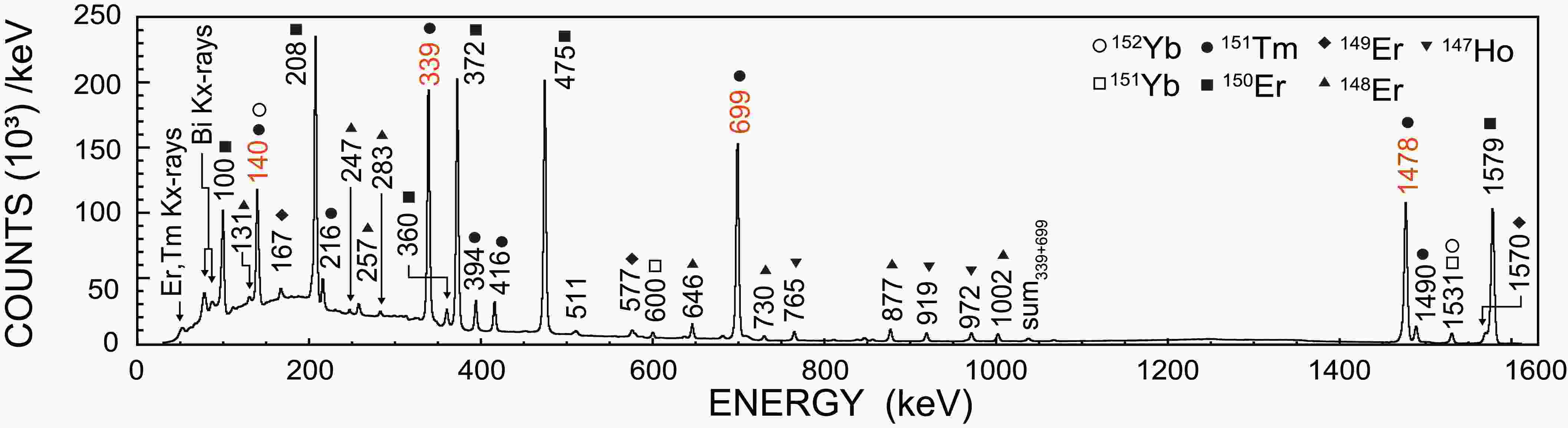
The background-subtracted spectrum of delayed γ rays within 2 μs after implantation is shown in Fig. 1. The most intense γ-ray peaks correspond to known transitions in 151Tm and 150Er [7, 19].
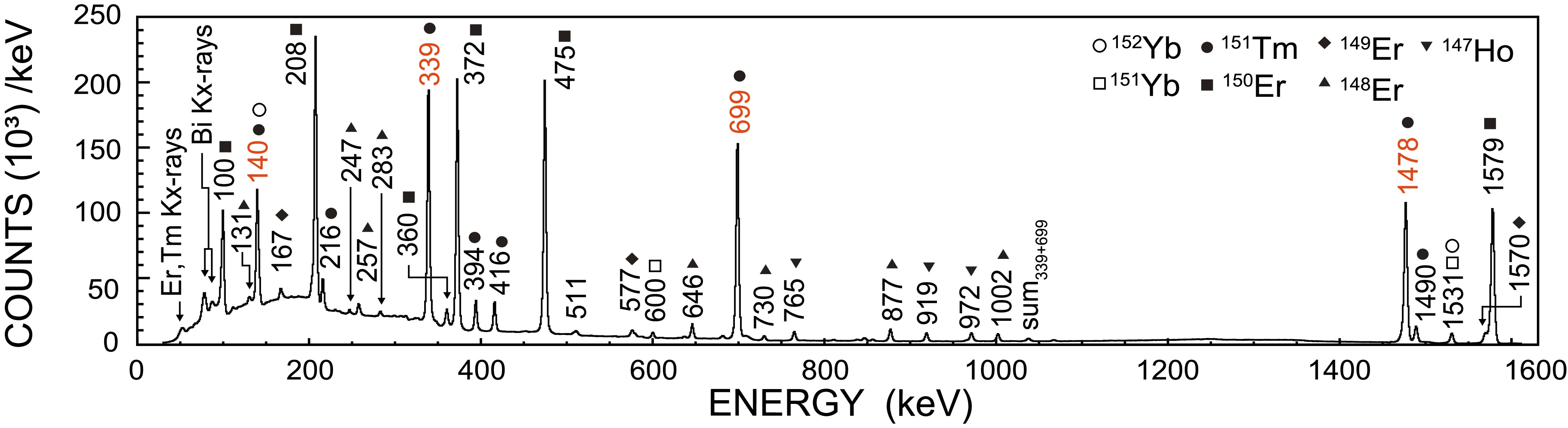
Figure 1. (color online) The background-subtracted delayed γ-ray spectrum was recorded by the clover detectors in the GREAT spectrometer within 2 μs after ER implantation. Prominent γ rays originating from known microsecond isomers in 147Ho, 148-150Er, 151Tm, and 151-152Yb are labeled. The four strongest γ rays of 140, 339, 699, and 1478 keV from the known
$ (27/2^-) $ isomer in 151Tm [8−19] are highlighted in red. A background spectrum from the time interval$ 2 \lt \Delta T(ER-\gamma) \lt 4 $ μs has been subtracted.Figure 2 shows the spectrum of delayed γ rays in 151Tm in coincidence with the 699- or 1478-keV transitions over the time interval
$ \Delta T[ER-\gamma(699,1478)] = 0-2 $ μs. Background spectra selected with the condition$ \Delta T[ER-\gamma(699,1478)] = 2-4 $ μs and with a gate on the Compton background adjacent to the gating peak were subtracted. This procedure reduces contributions from γ rays associated with long-lived isomers, such as the 140-keV transition from the 30-μs isomer in 152Yb [20]. Figure 2 confirms that the known isomeric γ rays of 140-, 339-, 699-, and 1478-keV are in coincidence. The time distribution$ \Delta T[ER-\gamma(699,1478)] $ is shown in the inset of Fig. 2. The half-life of the isomer was measured to be 445(30) ns, in good agreement with the literature value of 466(34) ns [19].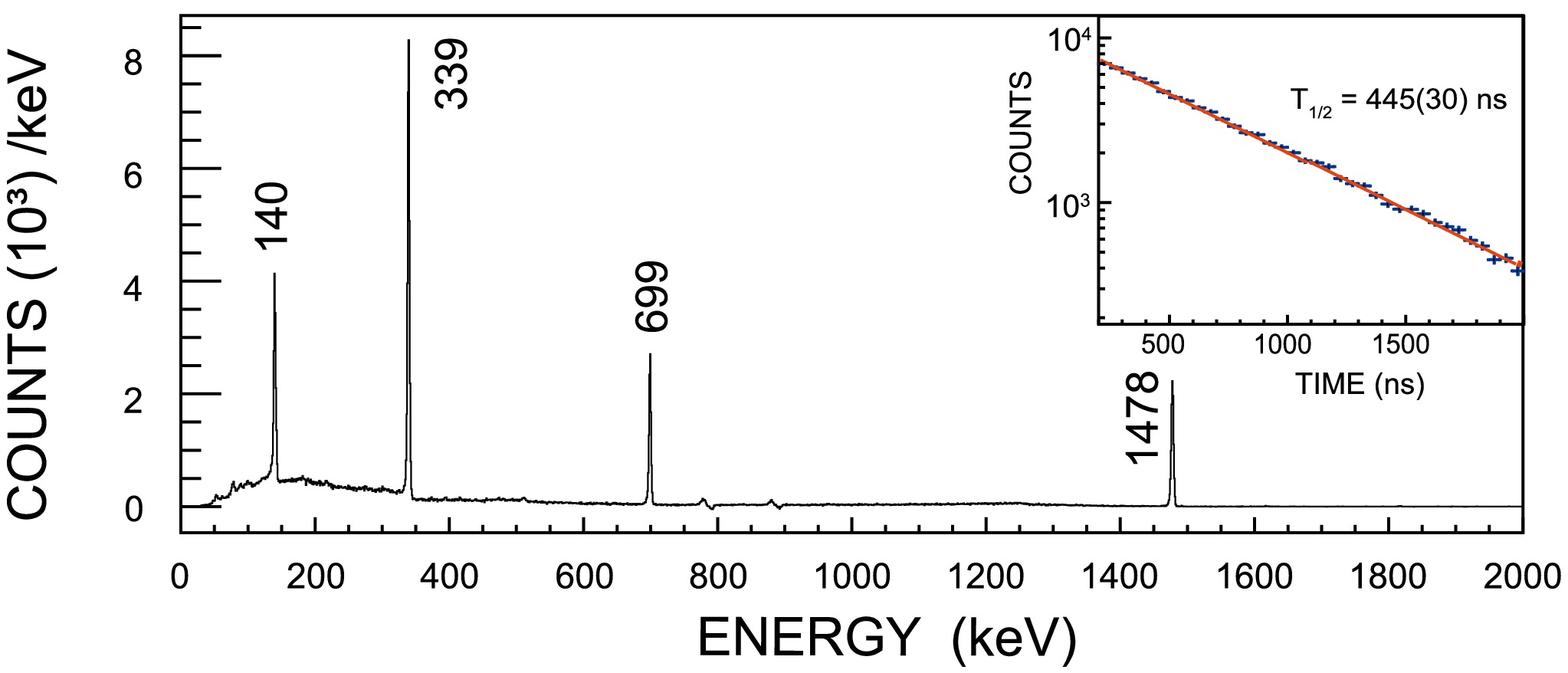
Figure 2. (color online) The background-subtracted delayed γ-ray spectrum from γ-γ coincidences in 151Tm is shown. The γ rays were gated on the 699- or 1478-keV γ rays detected with the Ge-clover detectors of the GREAT spectrometer. The inset shows the corresponding
$ \Delta T[ER-\gamma(699,1478)] $ time distribution. -
The background-subtracted spectrum of delayed γ rays within 2 μs after implantation is shown in Fig. 1. The most intense γ-ray peaks correspond to known transitions in 151Tm and 150Er [7, 19].
Figure 1. (color online) The background-subtracted delayed γ-ray spectrum was recorded by the clover detectors in the GREAT spectrometer within 2 μs after ER implantation. Prominent γ rays originating from known microsecond isomers in 147Ho, 148-150Er, 151Tm, and 151-152Yb are labeled. The four strongest γ rays of 140, 339, 699, and 1478 keV from the known
$ (27/2^-) $ isomer in 151Tm [8−19] are highlighted in red. A background spectrum from the time interval$ 2 \lt \Delta T(ER-\gamma) \lt 4 $ μs has been subtracted.Figure 2 shows the spectrum of delayed γ rays in 151Tm in coincidence with the 699- or 1478-keV transitions over the time interval
$ \Delta T[ER-\gamma(699,1478)] = 0-2 $ μs. Background spectra selected with the condition$ \Delta T[ER-\gamma(699,1478)] = 2-4 $ μs and with a gate on the Compton background adjacent to the gating peak were subtracted. This procedure reduces contributions from γ rays associated with long-lived isomers, such as the 140-keV transition from the 30-μs isomer in 152Yb [20]. Figure 2 confirms that the known isomeric γ rays of 140-, 339-, 699-, and 1478-keV are in coincidence. The time distribution$ \Delta T[ER-\gamma(699,1478)] $ is shown in the inset of Fig. 2. The half-life of the isomer was measured to be 445(30) ns, in good agreement with the literature value of 466(34) ns [19].
Figure 2. (color online) The background-subtracted delayed γ-ray spectrum from γ-γ coincidences in 151Tm is shown. The γ rays were gated on the 699- or 1478-keV γ rays detected with the Ge-clover detectors of the GREAT spectrometer. The inset shows the corresponding
$ \Delta T[ER-\gamma(699,1478)] $ time distribution. -
The background-subtracted spectrum of delayed γ rays within 2 μs after implantation is shown in Fig. 1. The most intense γ-ray peaks correspond to known transitions in 151Tm and 150Er [7, 19].
Figure 1. (color online) The background-subtracted delayed γ-ray spectrum was recorded by the clover detectors in the GREAT spectrometer within 2 μs after ER implantation. Prominent γ rays originating from known microsecond isomers in 147Ho, 148-150Er, 151Tm, and 151-152Yb are labeled. The four strongest γ rays of 140, 339, 699, and 1478 keV from the known
$ (27/2^-) $ isomer in 151Tm [8−19] are highlighted in red. A background spectrum from the time interval$ 2 \lt \Delta T(ER-\gamma) \lt 4 $ μs has been subtracted.Figure 2 shows the spectrum of delayed γ rays in 151Tm in coincidence with the 699- or 1478-keV transitions over the time interval
$ \Delta T[ER-\gamma(699,1478)] = 0-2 $ μs. Background spectra selected with the condition$ \Delta T[ER-\gamma(699,1478)] = 2-4 $ μs and with a gate on the Compton background adjacent to the gating peak were subtracted. This procedure reduces contributions from γ rays associated with long-lived isomers, such as the 140-keV transition from the 30-μs isomer in 152Yb [20]. Figure 2 confirms that the known isomeric γ rays of 140-, 339-, 699-, and 1478-keV are in coincidence. The time distribution$ \Delta T[ER-\gamma(699,1478)] $ is shown in the inset of Fig. 2. The half-life of the isomer was measured to be 445(30) ns, in good agreement with the literature value of 466(34) ns [19].
Figure 2. (color online) The background-subtracted delayed γ-ray spectrum from γ-γ coincidences in 151Tm is shown. The γ rays were gated on the 699- or 1478-keV γ rays detected with the Ge-clover detectors of the GREAT spectrometer. The inset shows the corresponding
$ \Delta T[ER-\gamma(699,1478)] $ time distribution. -
The background-subtracted spectrum of delayed γ rays within 2 μs after implantation is shown in Fig. 1. The most intense γ-ray peaks correspond to known transitions in 151Tm and 150Er [7, 19].
Figure 1. (color online) The background-subtracted delayed γ-ray spectrum was recorded by the clover detectors in the GREAT spectrometer within 2 μs after ER implantation. Prominent γ rays originating from known microsecond isomers in 147Ho, 148-150Er, 151Tm, and 151-152Yb are labeled. The four strongest γ rays of 140, 339, 699, and 1478 keV from the known
$ (27/2^-) $ isomer in 151Tm [8−19] are highlighted in red. A background spectrum from the time interval$ 2 \lt \Delta T(ER-\gamma) \lt 4 $ μs has been subtracted.Figure 2 shows the spectrum of delayed γ rays in 151Tm in coincidence with the 699- or 1478-keV transitions over the time interval
$ \Delta T[ER-\gamma(699,1478)] = 0-2 $ μs. Background spectra selected with the condition$ \Delta T[ER-\gamma(699,1478)] = 2-4 $ μs and with a gate on the Compton background adjacent to the gating peak were subtracted. This procedure reduces contributions from γ rays associated with long-lived isomers, such as the 140-keV transition from the 30-μs isomer in 152Yb [20]. Figure 2 confirms that the known isomeric γ rays of 140-, 339-, 699-, and 1478-keV are in coincidence. The time distribution$ \Delta T[ER-\gamma(699,1478)] $ is shown in the inset of Fig. 2. The half-life of the isomer was measured to be 445(30) ns, in good agreement with the literature value of 466(34) ns [19].
Figure 2. (color online) The background-subtracted delayed γ-ray spectrum from γ-γ coincidences in 151Tm is shown. The γ rays were gated on the 699- or 1478-keV γ rays detected with the Ge-clover detectors of the GREAT spectrometer. The inset shows the corresponding
$ \Delta T[ER-\gamma(699,1478)] $ time distribution. -
The background-subtracted spectrum of delayed γ rays within 2 μs after implantation is shown in Fig. 1. The most intense γ-ray peaks correspond to known transitions in 151Tm and 150Er [7, 19].
Figure 1. (color online) The background-subtracted delayed γ-ray spectrum was recorded by the clover detectors in the GREAT spectrometer within 2 μs after ER implantation. Prominent γ rays originating from known microsecond isomers in 147Ho, 148-150Er, 151Tm, and 151-152Yb are labeled. The four strongest γ rays of 140, 339, 699, and 1478 keV from the known
$ (27/2^-) $ isomer in 151Tm [8−19] are highlighted in red. A background spectrum from the time interval$ 2 \lt \Delta T(ER-\gamma) \lt 4 $ μs has been subtracted.Figure 2 shows the spectrum of delayed γ rays in 151Tm in coincidence with the 699- or 1478-keV transitions over the time interval
$ \Delta T[ER-\gamma(699,1478)] = 0-2 $ μs. Background spectra selected with the condition$ \Delta T[ER-\gamma(699,1478)] = 2-4 $ μs and with a gate on the Compton background adjacent to the gating peak were subtracted. This procedure reduces contributions from γ rays associated with long-lived isomers, such as the 140-keV transition from the 30-μs isomer in 152Yb [20]. Figure 2 confirms that the known isomeric γ rays of 140-, 339-, 699-, and 1478-keV are in coincidence. The time distribution$ \Delta T[ER-\gamma(699,1478)] $ is shown in the inset of Fig. 2. The half-life of the isomer was measured to be 445(30) ns, in good agreement with the literature value of 466(34) ns [19].
Figure 2. (color online) The background-subtracted delayed γ-ray spectrum from γ-γ coincidences in 151Tm is shown. The γ rays were gated on the 699- or 1478-keV γ rays detected with the Ge-clover detectors of the GREAT spectrometer. The inset shows the corresponding
$ \Delta T[ER-\gamma(699,1478)] $ time distribution. -
The background-subtracted spectrum of delayed γ rays within 2 μs after implantation is shown in Fig. 1. The most intense γ-ray peaks correspond to known transitions in 151Tm and 150Er [7, 19].
Figure 1. (color online) The background-subtracted delayed γ-ray spectrum was recorded by the clover detectors in the GREAT spectrometer within 2 μs after ER implantation. Prominent γ rays originating from known microsecond isomers in 147Ho, 148-150Er, 151Tm, and 151-152Yb are labeled. The four strongest γ rays of 140, 339, 699, and 1478 keV from the known
$ (27/2^-) $ isomer in 151Tm [8−19] are highlighted in red. A background spectrum from the time interval$ 2 \lt \Delta T(ER-\gamma) \lt 4 $ μs has been subtracted.Figure 2 shows the spectrum of delayed γ rays in 151Tm in coincidence with the 699- or 1478-keV transitions over the time interval
$ \Delta T[ER-\gamma(699,1478)] = 0-2 $ μs. Background spectra selected with the condition$ \Delta T[ER-\gamma(699,1478)] = 2-4 $ μs and with a gate on the Compton background adjacent to the gating peak were subtracted. This procedure reduces contributions from γ rays associated with long-lived isomers, such as the 140-keV transition from the 30-μs isomer in 152Yb [20]. Figure 2 confirms that the known isomeric γ rays of 140-, 339-, 699-, and 1478-keV are in coincidence. The time distribution$ \Delta T[ER-\gamma(699,1478)] $ is shown in the inset of Fig. 2. The half-life of the isomer was measured to be 445(30) ns, in good agreement with the literature value of 466(34) ns [19].
Figure 2. (color online) The background-subtracted delayed γ-ray spectrum from γ-γ coincidences in 151Tm is shown. The γ rays were gated on the 699- or 1478-keV γ rays detected with the Ge-clover detectors of the GREAT spectrometer. The inset shows the corresponding
$ \Delta T[ER-\gamma(699,1478)] $ time distribution. -
The background-subtracted spectrum of delayed γ rays within 2 μs after implantation is shown in Fig. 1. The most intense γ-ray peaks correspond to known transitions in 151Tm and 150Er [7, 19].
Figure 1. (color online) The background-subtracted delayed γ-ray spectrum was recorded by the clover detectors in the GREAT spectrometer within 2 μs after ER implantation. Prominent γ rays originating from known microsecond isomers in 147Ho, 148-150Er, 151Tm, and 151-152Yb are labeled. The four strongest γ rays of 140, 339, 699, and 1478 keV from the known
$ (27/2^-) $ isomer in 151Tm [8−19] are highlighted in red. A background spectrum from the time interval$ 2 \lt \Delta T(ER-\gamma) \lt 4 $ μs has been subtracted.Figure 2 shows the spectrum of delayed γ rays in 151Tm in coincidence with the 699- or 1478-keV transitions over the time interval
$ \Delta T[ER-\gamma(699,1478)] = 0-2 $ μs. Background spectra selected with the condition$ \Delta T[ER-\gamma(699,1478)] = 2-4 $ μs and with a gate on the Compton background adjacent to the gating peak were subtracted. This procedure reduces contributions from γ rays associated with long-lived isomers, such as the 140-keV transition from the 30-μs isomer in 152Yb [20]. Figure 2 confirms that the known isomeric γ rays of 140-, 339-, 699-, and 1478-keV are in coincidence. The time distribution$ \Delta T[ER-\gamma(699,1478)] $ is shown in the inset of Fig. 2. The half-life of the isomer was measured to be 445(30) ns, in good agreement with the literature value of 466(34) ns [19].
Figure 2. (color online) The background-subtracted delayed γ-ray spectrum from γ-γ coincidences in 151Tm is shown. The γ rays were gated on the 699- or 1478-keV γ rays detected with the Ge-clover detectors of the GREAT spectrometer. The inset shows the corresponding
$ \Delta T[ER-\gamma(699,1478)] $ time distribution. -
The background-subtracted spectrum of delayed γ rays within 2 μs after implantation is shown in Fig. 1. The most intense γ-ray peaks correspond to known transitions in 151Tm and 150Er [7, 19].
Figure 1. (color online) The background-subtracted delayed γ-ray spectrum was recorded by the clover detectors in the GREAT spectrometer within 2 μs after ER implantation. Prominent γ rays originating from known microsecond isomers in 147Ho, 148-150Er, 151Tm, and 151-152Yb are labeled. The four strongest γ rays of 140, 339, 699, and 1478 keV from the known
$ (27/2^-) $ isomer in 151Tm [8−19] are highlighted in red. A background spectrum from the time interval$ 2 \lt \Delta T(ER-\gamma) \lt 4 $ μs has been subtracted.Figure 2 shows the spectrum of delayed γ rays in 151Tm in coincidence with the 699- or 1478-keV transitions over the time interval
$ \Delta T[ER-\gamma(699,1478)] = 0-2 $ μs. Background spectra selected with the condition$ \Delta T[ER-\gamma(699,1478)] = 2-4 $ μs and with a gate on the Compton background adjacent to the gating peak were subtracted. This procedure reduces contributions from γ rays associated with long-lived isomers, such as the 140-keV transition from the 30-μs isomer in 152Yb [20]. Figure 2 confirms that the known isomeric γ rays of 140-, 339-, 699-, and 1478-keV are in coincidence. The time distribution$ \Delta T[ER-\gamma(699,1478)] $ is shown in the inset of Fig. 2. The half-life of the isomer was measured to be 445(30) ns, in good agreement with the literature value of 466(34) ns [19].
Figure 2. (color online) The background-subtracted delayed γ-ray spectrum from γ-γ coincidences in 151Tm is shown. The γ rays were gated on the 699- or 1478-keV γ rays detected with the Ge-clover detectors of the GREAT spectrometer. The inset shows the corresponding
$ \Delta T[ER-\gamma(699,1478)] $ time distribution. -
The background-subtracted spectrum of delayed γ rays within 2 μs after implantation is shown in Fig. 1. The most intense γ-ray peaks correspond to known transitions in 151Tm and 150Er [7, 19].
Figure 1. (color online) The background-subtracted delayed γ-ray spectrum was recorded by the clover detectors in the GREAT spectrometer within 2 μs after ER implantation. Prominent γ rays originating from known microsecond isomers in 147Ho, 148-150Er, 151Tm, and 151-152Yb are labeled. The four strongest γ rays of 140, 339, 699, and 1478 keV from the known
$ (27/2^-) $ isomer in 151Tm [8−19] are highlighted in red. A background spectrum from the time interval$ 2 \lt \Delta T(ER-\gamma) \lt 4 $ μs has been subtracted.Figure 2 shows the spectrum of delayed γ rays in 151Tm in coincidence with the 699- or 1478-keV transitions over the time interval
$ \Delta T[ER-\gamma(699,1478)] = 0-2 $ μs. Background spectra selected with the condition$ \Delta T[ER-\gamma(699,1478)] = 2-4 $ μs and with a gate on the Compton background adjacent to the gating peak were subtracted. This procedure reduces contributions from γ rays associated with long-lived isomers, such as the 140-keV transition from the 30-μs isomer in 152Yb [20]. Figure 2 confirms that the known isomeric γ rays of 140-, 339-, 699-, and 1478-keV are in coincidence. The time distribution$ \Delta T[ER-\gamma(699,1478)] $ is shown in the inset of Fig. 2. The half-life of the isomer was measured to be 445(30) ns, in good agreement with the literature value of 466(34) ns [19].
Figure 2. (color online) The background-subtracted delayed γ-ray spectrum from γ-γ coincidences in 151Tm is shown. The γ rays were gated on the 699- or 1478-keV γ rays detected with the Ge-clover detectors of the GREAT spectrometer. The inset shows the corresponding
$ \Delta T[ER-\gamma(699,1478)] $ time distribution. -
The background-subtracted spectrum of delayed γ rays within 2 μs after implantation is shown in Fig. 1. The most intense γ-ray peaks correspond to known transitions in 151Tm and 150Er [7, 19].
Figure 1. (color online) The background-subtracted delayed γ-ray spectrum was recorded by the clover detectors in the GREAT spectrometer within 2 μs after ER implantation. Prominent γ rays originating from known microsecond isomers in 147Ho, 148-150Er, 151Tm, and 151-152Yb are labeled. The four strongest γ rays of 140, 339, 699, and 1478 keV from the known
$ (27/2^-) $ isomer in 151Tm [8−19] are highlighted in red. A background spectrum from the time interval$ 2 \lt \Delta T(ER-\gamma) \lt 4 $ μs has been subtracted.Figure 2 shows the spectrum of delayed γ rays in 151Tm in coincidence with the 699- or 1478-keV transitions over the time interval
$ \Delta T[ER-\gamma(699,1478)] = 0-2 $ μs. Background spectra selected with the condition$ \Delta T[ER-\gamma(699,1478)] = 2-4 $ μs and with a gate on the Compton background adjacent to the gating peak were subtracted. This procedure reduces contributions from γ rays associated with long-lived isomers, such as the 140-keV transition from the 30-μs isomer in 152Yb [20]. Figure 2 confirms that the known isomeric γ rays of 140-, 339-, 699-, and 1478-keV are in coincidence. The time distribution$ \Delta T[ER-\gamma(699,1478)] $ is shown in the inset of Fig. 2. The half-life of the isomer was measured to be 445(30) ns, in good agreement with the literature value of 466(34) ns [19].
Figure 2. (color online) The background-subtracted delayed γ-ray spectrum from γ-γ coincidences in 151Tm is shown. The γ rays were gated on the 699- or 1478-keV γ rays detected with the Ge-clover detectors of the GREAT spectrometer. The inset shows the corresponding
$ \Delta T[ER-\gamma(699,1478)] $ time distribution. -
The background-subtracted spectrum of delayed γ rays within 2 μs after implantation is shown in Fig. 1. The most intense γ-ray peaks correspond to known transitions in 151Tm and 150Er [7, 19].
Figure 1. (color online) The background-subtracted delayed γ-ray spectrum was recorded by the clover detectors in the GREAT spectrometer within 2 μs after ER implantation. Prominent γ rays originating from known microsecond isomers in 147Ho, 148-150Er, 151Tm, and 151-152Yb are labeled. The four strongest γ rays of 140, 339, 699, and 1478 keV from the known
$ (27/2^-) $ isomer in 151Tm [8−19] are highlighted in red. A background spectrum from the time interval$ 2 \lt \Delta T(ER-\gamma) \lt 4 $ μs has been subtracted.Figure 2 shows the spectrum of delayed γ rays in 151Tm in coincidence with the 699- or 1478-keV transitions over the time interval
$ \Delta T[ER-\gamma(699,1478)] = 0-2 $ μs. Background spectra selected with the condition$ \Delta T[ER-\gamma(699,1478)] = 2-4 $ μs and with a gate on the Compton background adjacent to the gating peak were subtracted. This procedure reduces contributions from γ rays associated with long-lived isomers, such as the 140-keV transition from the 30-μs isomer in 152Yb [20]. Figure 2 confirms that the known isomeric γ rays of 140-, 339-, 699-, and 1478-keV are in coincidence. The time distribution$ \Delta T[ER-\gamma(699,1478)] $ is shown in the inset of Fig. 2. The half-life of the isomer was measured to be 445(30) ns, in good agreement with the literature value of 466(34) ns [19].
Figure 2. (color online) The background-subtracted delayed γ-ray spectrum from γ-γ coincidences in 151Tm is shown. The γ rays were gated on the 699- or 1478-keV γ rays detected with the Ge-clover detectors of the GREAT spectrometer. The inset shows the corresponding
$ \Delta T[ER-\gamma(699,1478)] $ time distribution. -
RIT analysis. To investigate high-spin states in 151Tm, we used the RIT technique. Figure 3 shows the background-subtracted spectrum recorded with JUROGAM and tagged by delayed γ-ray transitions (
$ 0< \Delta T(ER-\gamma(699,1478)) \lt 2 $ μs) that de-excite the$ (27/2^-) $ isomer detected by the GREAT clover detectors. More than 50 new γ-ray transitions in 151Tm were observed, although with reduced statistics due to losses from in-flight decay within the RITU separator.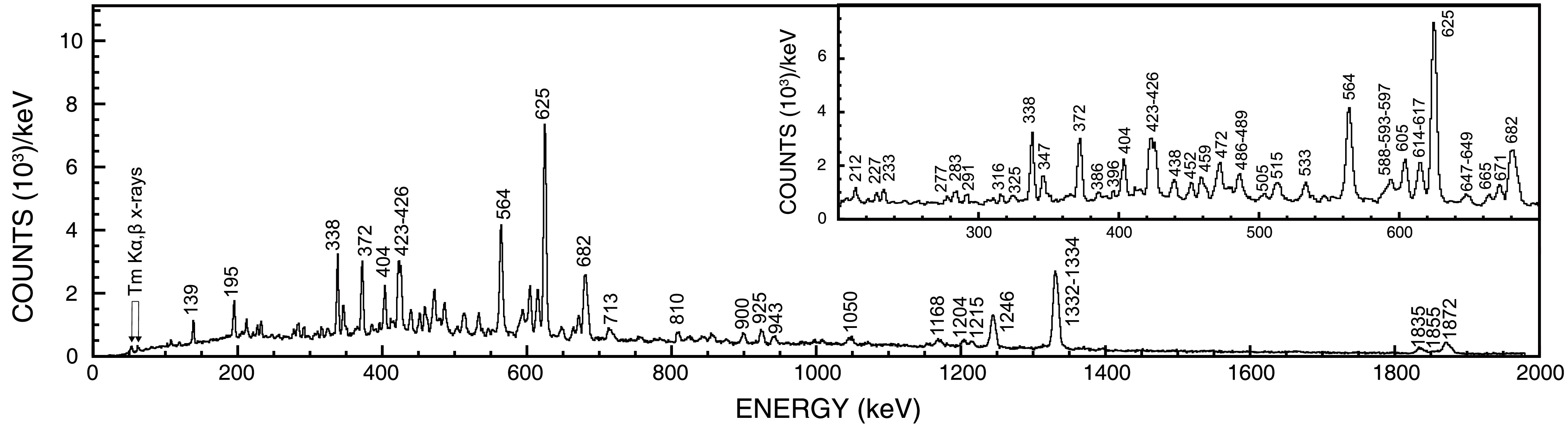
Figure 3. The background-subtracted RIT spectrum of 151Tm was measured with the JUROGAM detectors using gates on delayed γ-ray transitions (
$ 0 \lt \Delta T[ER-\gamma(699,1478)] \lt 2 \, $ μs ) following the 0.445 μs isomer and detected with the Ge-clover detectors of GREAT. Most γ-ray peaks are newly observed in 151Tm. The background spectrum was subtracted using gates on the nearby Compton background and the$ 2 \lt \Delta T[ER-\gamma(699,1478)] \lt 4 \, $ μs interval. The inset shows an expanded view of the 200−700 keV region.In-beam analysis. The new transitions observed using RIT were further confirmed by γ-γ and γ-γ-γ coincidence analyses of prompt in-beam data collected with JUROGAM. Representative coincidence spectra are shown in Fig. 4, and the established level scheme is given in Fig. 5. The experimental results for these γ-ray transitions are listed in Table 1. Six level sequences, labeled Seq. 1–6, were established, of which Seq. 3–6 are new. New levels were established on the basis of the relative intensities of the γ-ray transitions and their possible multipolarities.
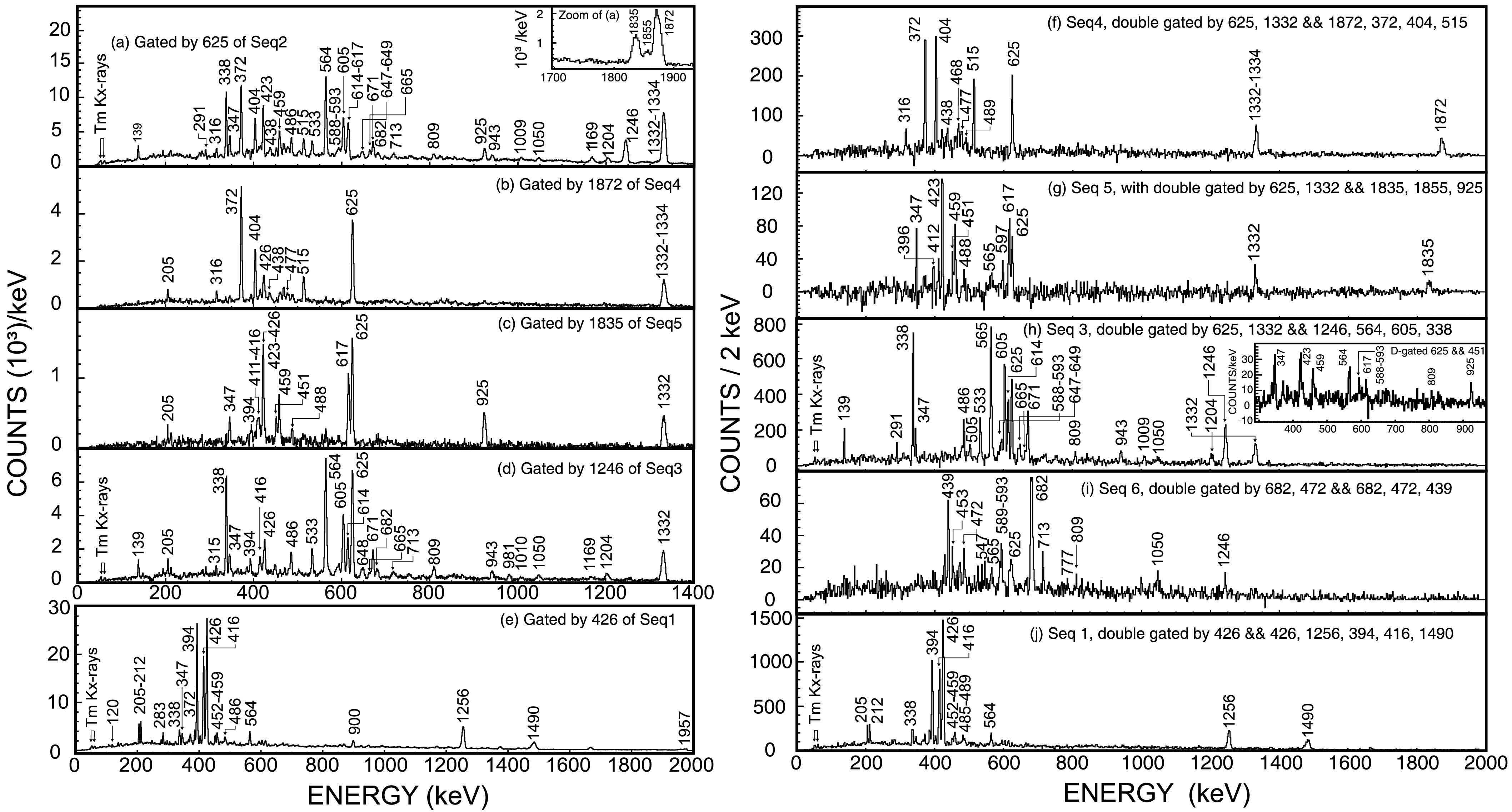
Figure 4. Single-gated spectra from γ-γ coincidences (a)–(e) and double-gated spectra from γ-γ-γ coincidences (f)–(j), measured using only JUROGAM. Most of the peaks are new transitions in 151Tm. The gating conditions are indicated, and the background was subtracted by gating on the Compton background near the gating peak.
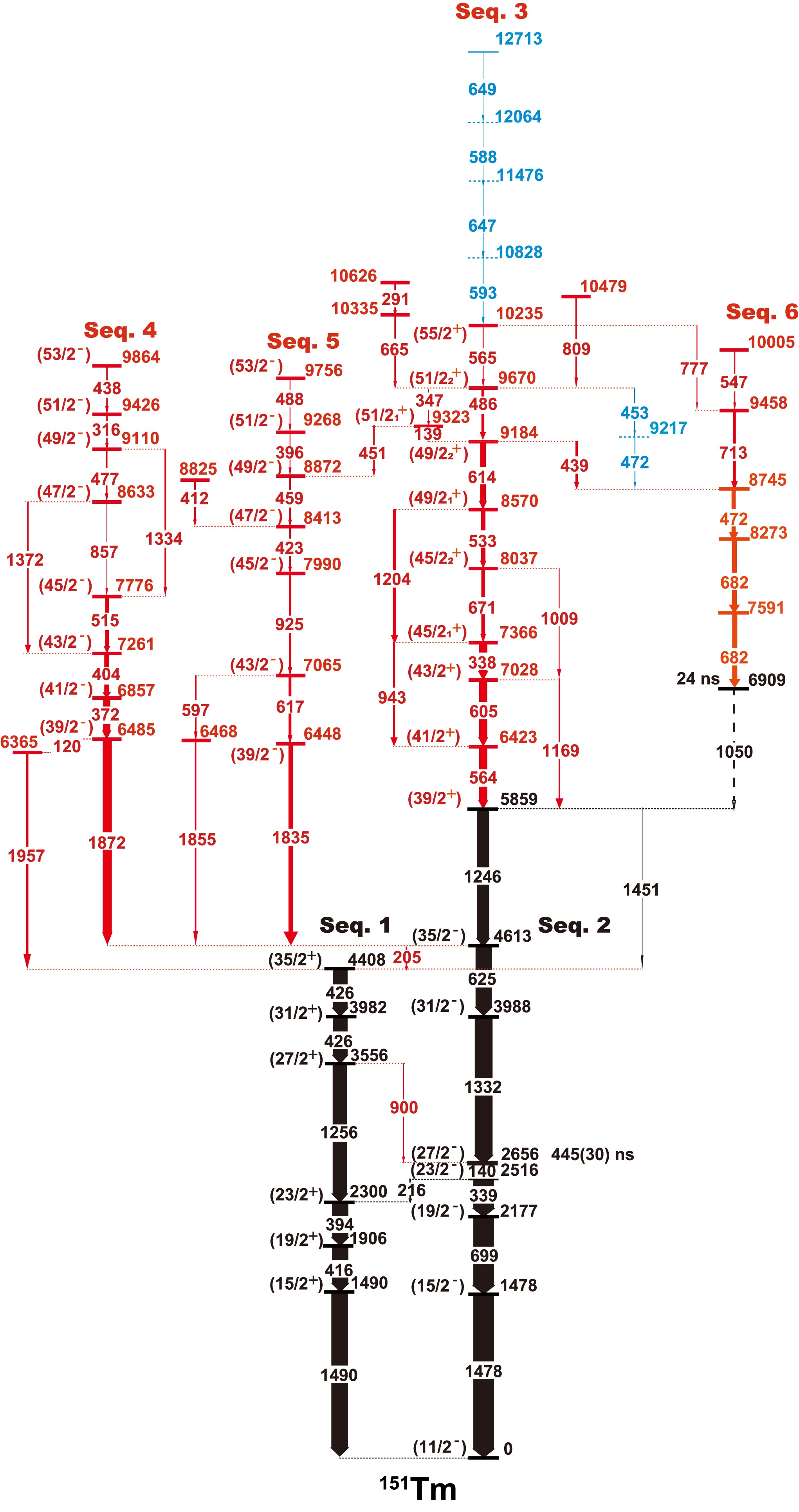
Figure 5. (color online) Level scheme of 151Tm. New transitions established in this work are shown in red or blue. The ordering of the γ rays shown in blue cannot be determined unambiguously because of limited statistics or their similar energies.
Eγ/keV* Iγ& I $ ^{\pi}_{i} \rightarrow I^{\pi}_{f} $ Ei $ \rightarrow $ EfRAC RAD ML# Seq. 1 1490 83.2(4.2) (15/2+)→(11/2-) 1490 → 0 1.20(0.09) (M2/E3) 416 84.4(4.2) (19/2+)→(15/2+) 1906 → 1490 1.11(0.08) (E2) 394 86.0(5.2) (23/2+)→(19/2+) 2300 → 1906 1.06(0.07) (E2) 1256 86.1(9.5) (27/2+)→(23/2+) 3556 → 2300 1.22(0.10) (E2) 426 92.7(6.8) (31/2+)→(27/2+) 3982 → 3556 1.17(0.09) (E2) 426 92.7(6.8) (35/2+)→(31/2+) 4408 → 3982 1.17(0.09) (E2) 205 6.5(0.6) (35/2+)→(35/2-) 4613 → 4408 0.68(0.25) (E1) 900 8.2(0.9) (27/2+)→(27/2-) 3556 → 2656 0.87(0.18) (E1) 216@ (23/2-)→(23/2+) 2516 → 2300 (E1) Seq. 2 1478@ (15/2-)→(11/2-) 1478 → 0 (E2) 699@ (19/2-)→(15/2-) 2177 → 1478 (E2) 339@ (23/2-)→(19/2-) 2516 → 2177 (E2) 140@ (27/2-)→(23/2-) 2656 → 2516 E2 1332 96.4(8.2) (31/2-)→(27/2-) 3988 → 2656 1.31(0.10) (E2) 625 100.0(5.4) (35/2-)→(31/2-) 4613 → 3988 1.28(0.12) 1.13(0.11) (E2) Seq. 3 1246 46.8(2.5) (39/2+)→(35/2-) 5859 → 4613 1.18(0.12) 1.17(0.24) (M2/E3) 564 39.5(7.6) (41/2+)→(39/2+) 6423 → 5859 0.92(0.18) (M1/E2) 605 34.3(1.9) (43/2+)→(41/2+) 7028 → 6423 0.67(0.08) 0.87(0.17) (M1/E2) 338 29.0(1.5) (45/2 $ _{1}^{+} $ )→(43/2+)7366 → 7028 0.87(0.09) 0.76(0.13) (M1/E2) 671 13.4(1.3) (45/2 $ _{2}^{+} $ )→(45/2$ _{1}^{+} $ )8037 → 7366 1.25(0.23) (E2) 533 9.2(1.0) (49/2 $ _{1}^{+} $ )→(45/2$ _{2}^{+} $ )8570 → 8037 1.49(0.24) (E2) 614 16.1(1.0) (49/2 $ _{2}^{+} $ )→(49/2$ _{1}^{+} $ )9184 → 8570 1.41(0.21) (E2) 139 6.5(0.4) (51/2 $ _{1}^{+} $ )→(49/2$ _{2}^{+} $ )9323 → 9184 0.67(0.25) 0.55(0.18) (M1/E2) 347 9.7(1.3) (51/2 $ _{2}^{+} $ )→(51/2$ _{1}^{+} $ )9670 → 9323 1.36(0.18) (E2) 486 10.6(1.8) (51/2 $ _{2}^{+} $ )→(49/2$ _{2}^{+} $ )9670 → 9184 0.82(0.13) (M1/E2) 565 11.5(7.6) (55/2+)→(51/2 $ _{2}^{+} $ )10235 → 9670 1.28(0.18) (E2) 593 $ <4 $ 10828 → 10235 647 $ <2 $ 11475 → 10828 588 $ <2 $ 12063 → 11475 649 $ <2 $ 12712 → 12063 809 $ <4 $ 10479 → 9670 1169 6.6(0.5) (43/2+)→(39/2+) 7028 → 5859 1.42(0.19) (E2) 943 5.1(0.6) (45/2 $ _{1}^{+} $ )→(41/2+)7366 → 6423 1.45(0.16) (E2) 1010 3.3(0.8) (45/2 $ _{2}^{+} $ )→(43/2+)8037 → 7028 0.61(0.31) (M1/E2) 1204 10.2(0.6) (49/2 $ _{1}^{+} $ )→(45/2$ _{1}^{+} $ )8570 → 7366 1.72(0.24) (E2) Seq. 4 1872 34.5(3.5) (39/2-)→(35/2-) 6485 → 4613 1.51(0.11) 1.64(0.13) (E2) 372 28.4(1.6) (41/2-)→(39/2-) 6857 → 6485 0.65(0.07) 0.64(0.06) (M1/E2) 404 18.2(1.1) (43/2-)→(41/2-) 7261 → 6857 0.61(0.12) 0.67(0.09) (M1/E2) 515 9.1(1.0) (45/2-)→(43/2-) 7776 → 7261 0.51(0.12) (M1/E2) 857 $ <2 $ (47/2-)→(45/2-) 8633 → 7776 (M1/E2) 1372 3.7(0.8) (47/2-)→(43/2-) 8633 → 7261 1.34(0.31) (E2) 1334 4.6(1.4) (49/2-)→(45/2-) 9110 → 7776 (E2) 477 5.9(1.0) (49/2-)→(47/2-) 9110 → 8632 0.61(0.24) (M1/E2) 316 5.5(0.5) (51/2-)→(49/2-) 9426 → 9110 0.57(0.19) (M1/E2) 438 3.6(0.7) (53/2-)→(51/2-) 9864 → 9426 0.62(0.21) (M1/E2) 1957 $ <2 $ 6365 → 4408 120 $ <2 $ 6485 → 6365 Seq. 5 1835 12.3(3.5) (39/2-)→(35/2-) 6448 → 4613 1.47(0.20) 1.44(0.35) (E2) 1855 4.8 (2.2) 6468 → 4613 617 10.3(0.8) (43/2-)→(39/2-) 7065 → 6448 1.26(0.22) (E2) 597 3.6(1.1) 7065 → 6468 925 11.3(0.7) (45/2-)→(43/2-) 7990 → 7065 0.60(0.19) 0.75(0.24) (M1/E2) 423 9.7(1.2) (47/2-)→(45/2-) 8413 → 7990 0.48(0.07) (M1/E2) 459 7.2(0.4) (49/2-)→(47/2-) 8872 → 8413 0.73(0.24) (M1/E2) 396 2.9(0.2) (51/2-)→(49/2-) 9268 → 8872 0.68(0.16) (M1/E2) 488 2.1(0.3) (53/2-)→(51/2-) 9756 → 9268 0.71(0.20) (M1/E2) 451 5.1(0.3) (51/2+)→(49/2-) 9323 → 8872 0.79(0.26) (E1) Seq. 6$ 1050 6909 → 5859 682 20.3(4.0) 7591 → 6909 682 20.3(4.0) 8273 → 7591 472 11.8(3.1) 8745 → 8273 713 3.4(0.3) 9458 → 8745 547 $ <2 $ 10005 → 9458 472 $ <2 $ 9217 → 8745 453 $ <2 $ 9670 → 9217 439 5.2(1.4) 9184 → 8745 777 $ <2 $ 10235 → 9458 * Due to the Doppler shift and Doppler broadening of in-beam γ peaks [21], the resolution for γ-ray energies is adopted as 1 keV.
& The relative intensities are normalized to the known 625-keV transition of Seq.2 with I$ _{\gamma} $ = 100.0.
# Multipolarity assignments are based on$ R_{AD,AC} $ values in Section III.C and the theoretical interpretation in Section IV.
@ The delayed γ rays below the$ (27/2^-) $ isomer. Their intensities are not compared with those of prompt γ rays in the table.
$ Seq.6 is built above the known 24-ns isomer, see the text.Table 1. γ-ray energies Eγ, relative intensities Iγ, initial-to-final level energies Ei
$ \rightarrow $ Ef, angular correlation (anisotropy) ratios RAC, angular distribution ratios RAD, and multipolarity assignments of the transitions in 151Tm. The 625- and 1332-keV transitions of Seq. 2 are shown in bold because they are used as reference transitions for RAC,AD.Sequences 1 and 2 were previously reported in Ref. [8−19] and are confirmed in this work, as shown in Figs. 4(a, e, j).
Sequence 3 has the highest intensity at high spins in 151Tm and is established on top of the known 1246-keV transition, which feeds the 4613-keV level of Seq. 2. Representative coincidence spectra for Seq. 3 are shown in Figs. 4(d, h).
Three new transitions at 1872-, 1855-, and 1835-keV can be seen in the 625-keV gated spectrum in the inset of Fig. 4(a), but they are not mutually coincident, as shown in Figs. 4(b, c, f, g).
Based on the γ-γ and γ-γ-γ coincidence analyses for these transitions in Figs. 4(b, c, f, g), two new sequences, labeled Seq. 4 and Seq. 5, were established. As illustrated in the inset of Fig. 4(h), the 9323-keV level in Seq. 3 also decays through the 451-keV interband transition to the 8872-keV level in Seq. 5.
Sequence 6, consisting of the 682-, 682-, 472-, 713-, and 547-keV transitions, is tentatively constructed above the known 24-ns isomer at 6909 keV [19]. Because the velocity of the ERs is approximately 1 cm/ns (corresponding to a ~500 ns flight through the RITU separator), the
$ \gamma-\gamma $ coincidences between transitions above and below the 24-ns isomer are not efficiently detected by the JUROGAM array (the 1050-keV transition is indicated by a dashed arrow in Fig. 5). Consequently, the transitions of Seq.6 exhibit only partial intensities in the coincidence spectrum with the 625-keV gate in Fig. 4(a), whereas the transitions above the 24-ns isomer have full intensities in the RIT spectrum (e.g., the 682-keV transitions in Fig. 3). -
RIT analysis. To investigate high-spin states in 151Tm, we used the RIT technique. Figure 3 shows the background-subtracted spectrum recorded with JUROGAM and tagged by delayed γ-ray transitions (
$ 0< \Delta T(ER-\gamma(699,1478)) \lt 2 $ μs) that de-excite the$ (27/2^-) $ isomer detected by the GREAT clover detectors. More than 50 new γ-ray transitions in 151Tm were observed, although with reduced statistics due to losses from in-flight decay within the RITU separator.
Figure 3. The background-subtracted RIT spectrum of 151Tm was measured with the JUROGAM detectors using gates on delayed γ-ray transitions (
$ 0 \lt \Delta T[ER-\gamma(699,1478)] \lt 2 \, $ μs ) following the 0.445 μs isomer and detected with the Ge-clover detectors of GREAT. Most γ-ray peaks are newly observed in 151Tm. The background spectrum was subtracted using gates on the nearby Compton background and the$ 2 \lt \Delta T[ER-\gamma(699,1478)] \lt 4 \, $ μs interval. The inset shows an expanded view of the 200−700 keV region.In-beam analysis. The new transitions observed using RIT were further confirmed by γ-γ and γ-γ-γ coincidence analyses of prompt in-beam data collected with JUROGAM. Representative coincidence spectra are shown in Fig. 4, and the established level scheme is given in Fig. 5. The experimental results for these γ-ray transitions are listed in Table 1. Six level sequences, labeled Seq. 1–6, were established, of which Seq. 3–6 are new. New levels were established on the basis of the relative intensities of the γ-ray transitions and their possible multipolarities.
Figure 4. Single-gated spectra from γ-γ coincidences (a)–(e) and double-gated spectra from γ-γ-γ coincidences (f)–(j), measured using only JUROGAM. Most of the peaks are new transitions in 151Tm. The gating conditions are indicated, and the background was subtracted by gating on the Compton background near the gating peak.
Figure 5. (color online) Level scheme of 151Tm. New transitions established in this work are shown in red or blue. The ordering of the γ rays shown in blue cannot be determined unambiguously because of limited statistics or their similar energies.
Eγ/keV* Iγ& I $ ^{\pi}_{i} \rightarrow I^{\pi}_{f} $ Ei $ \rightarrow $ EfRAC RAD ML# Seq. 1 1490 83.2(4.2) (15/2+)→(11/2-) 1490 → 0 1.20(0.09) (M2/E3) 416 84.4(4.2) (19/2+)→(15/2+) 1906 → 1490 1.11(0.08) (E2) 394 86.0(5.2) (23/2+)→(19/2+) 2300 → 1906 1.06(0.07) (E2) 1256 86.1(9.5) (27/2+)→(23/2+) 3556 → 2300 1.22(0.10) (E2) 426 92.7(6.8) (31/2+)→(27/2+) 3982 → 3556 1.17(0.09) (E2) 426 92.7(6.8) (35/2+)→(31/2+) 4408 → 3982 1.17(0.09) (E2) 205 6.5(0.6) (35/2+)→(35/2-) 4613 → 4408 0.68(0.25) (E1) 900 8.2(0.9) (27/2+)→(27/2-) 3556 → 2656 0.87(0.18) (E1) 216@ (23/2-)→(23/2+) 2516 → 2300 (E1) Seq. 2 1478@ (15/2-)→(11/2-) 1478 → 0 (E2) 699@ (19/2-)→(15/2-) 2177 → 1478 (E2) 339@ (23/2-)→(19/2-) 2516 → 2177 (E2) 140@ (27/2-)→(23/2-) 2656 → 2516 E2 1332 96.4(8.2) (31/2-)→(27/2-) 3988 → 2656 1.31(0.10) (E2) 625 100.0(5.4) (35/2-)→(31/2-) 4613 → 3988 1.28(0.12) 1.13(0.11) (E2) Seq. 3 1246 46.8(2.5) (39/2+)→(35/2-) 5859 → 4613 1.18(0.12) 1.17(0.24) (M2/E3) 564 39.5(7.6) (41/2+)→(39/2+) 6423 → 5859 0.92(0.18) (M1/E2) 605 34.3(1.9) (43/2+)→(41/2+) 7028 → 6423 0.67(0.08) 0.87(0.17) (M1/E2) 338 29.0(1.5) (45/2 $ _{1}^{+} $ )→(43/2+)7366 → 7028 0.87(0.09) 0.76(0.13) (M1/E2) 671 13.4(1.3) (45/2 $ _{2}^{+} $ )→(45/2$ _{1}^{+} $ )8037 → 7366 1.25(0.23) (E2) 533 9.2(1.0) (49/2 $ _{1}^{+} $ )→(45/2$ _{2}^{+} $ )8570 → 8037 1.49(0.24) (E2) 614 16.1(1.0) (49/2 $ _{2}^{+} $ )→(49/2$ _{1}^{+} $ )9184 → 8570 1.41(0.21) (E2) 139 6.5(0.4) (51/2 $ _{1}^{+} $ )→(49/2$ _{2}^{+} $ )9323 → 9184 0.67(0.25) 0.55(0.18) (M1/E2) 347 9.7(1.3) (51/2 $ _{2}^{+} $ )→(51/2$ _{1}^{+} $ )9670 → 9323 1.36(0.18) (E2) 486 10.6(1.8) (51/2 $ _{2}^{+} $ )→(49/2$ _{2}^{+} $ )9670 → 9184 0.82(0.13) (M1/E2) 565 11.5(7.6) (55/2+)→(51/2 $ _{2}^{+} $ )10235 → 9670 1.28(0.18) (E2) 593 $ <4 $ 10828 → 10235 647 $ <2 $ 11475 → 10828 588 $ <2 $ 12063 → 11475 649 $ <2 $ 12712 → 12063 809 $ <4 $ 10479 → 9670 1169 6.6(0.5) (43/2+)→(39/2+) 7028 → 5859 1.42(0.19) (E2) 943 5.1(0.6) (45/2 $ _{1}^{+} $ )→(41/2+)7366 → 6423 1.45(0.16) (E2) 1010 3.3(0.8) (45/2 $ _{2}^{+} $ )→(43/2+)8037 → 7028 0.61(0.31) (M1/E2) 1204 10.2(0.6) (49/2 $ _{1}^{+} $ )→(45/2$ _{1}^{+} $ )8570 → 7366 1.72(0.24) (E2) Seq. 4 1872 34.5(3.5) (39/2-)→(35/2-) 6485 → 4613 1.51(0.11) 1.64(0.13) (E2) 372 28.4(1.6) (41/2-)→(39/2-) 6857 → 6485 0.65(0.07) 0.64(0.06) (M1/E2) 404 18.2(1.1) (43/2-)→(41/2-) 7261 → 6857 0.61(0.12) 0.67(0.09) (M1/E2) 515 9.1(1.0) (45/2-)→(43/2-) 7776 → 7261 0.51(0.12) (M1/E2) 857 $ <2 $ (47/2-)→(45/2-) 8633 → 7776 (M1/E2) 1372 3.7(0.8) (47/2-)→(43/2-) 8633 → 7261 1.34(0.31) (E2) 1334 4.6(1.4) (49/2-)→(45/2-) 9110 → 7776 (E2) 477 5.9(1.0) (49/2-)→(47/2-) 9110 → 8632 0.61(0.24) (M1/E2) 316 5.5(0.5) (51/2-)→(49/2-) 9426 → 9110 0.57(0.19) (M1/E2) 438 3.6(0.7) (53/2-)→(51/2-) 9864 → 9426 0.62(0.21) (M1/E2) 1957 $ <2 $ 6365 → 4408 120 $ <2 $ 6485 → 6365 Seq. 5 1835 12.3(3.5) (39/2-)→(35/2-) 6448 → 4613 1.47(0.20) 1.44(0.35) (E2) 1855 4.8 (2.2) 6468 → 4613 617 10.3(0.8) (43/2-)→(39/2-) 7065 → 6448 1.26(0.22) (E2) 597 3.6(1.1) 7065 → 6468 925 11.3(0.7) (45/2-)→(43/2-) 7990 → 7065 0.60(0.19) 0.75(0.24) (M1/E2) 423 9.7(1.2) (47/2-)→(45/2-) 8413 → 7990 0.48(0.07) (M1/E2) 459 7.2(0.4) (49/2-)→(47/2-) 8872 → 8413 0.73(0.24) (M1/E2) 396 2.9(0.2) (51/2-)→(49/2-) 9268 → 8872 0.68(0.16) (M1/E2) 488 2.1(0.3) (53/2-)→(51/2-) 9756 → 9268 0.71(0.20) (M1/E2) 451 5.1(0.3) (51/2+)→(49/2-) 9323 → 8872 0.79(0.26) (E1) Seq. 6$ 1050 6909 → 5859 682 20.3(4.0) 7591 → 6909 682 20.3(4.0) 8273 → 7591 472 11.8(3.1) 8745 → 8273 713 3.4(0.3) 9458 → 8745 547 $ <2 $ 10005 → 9458 472 $ <2 $ 9217 → 8745 453 $ <2 $ 9670 → 9217 439 5.2(1.4) 9184 → 8745 777 $ <2 $ 10235 → 9458 * Due to the Doppler shift and Doppler broadening of in-beam γ peaks [21], the resolution for γ-ray energies is adopted as 1 keV.
& The relative intensities are normalized to the known 625-keV transition of Seq.2 with I$ _{\gamma} $ = 100.0.
# Multipolarity assignments are based on$ R_{AD,AC} $ values in Section III.C and the theoretical interpretation in Section IV.
@ The delayed γ rays below the$ (27/2^-) $ isomer. Their intensities are not compared with those of prompt γ rays in the table.
$ Seq.6 is built above the known 24-ns isomer, see the text.Table 1. γ-ray energies Eγ, relative intensities Iγ, initial-to-final level energies Ei
$ \rightarrow $ Ef, angular correlation (anisotropy) ratios RAC, angular distribution ratios RAD, and multipolarity assignments of the transitions in 151Tm. The 625- and 1332-keV transitions of Seq. 2 are shown in bold because they are used as reference transitions for RAC,AD.Sequences 1 and 2 were previously reported in Ref. [8−19] and are confirmed in this work, as shown in Figs. 4(a, e, j).
Sequence 3 has the highest intensity at high spins in 151Tm and is established on top of the known 1246-keV transition, which feeds the 4613-keV level of Seq. 2. Representative coincidence spectra for Seq. 3 are shown in Figs. 4(d, h).
Three new transitions at 1872-, 1855-, and 1835-keV can be seen in the 625-keV gated spectrum in the inset of Fig. 4(a), but they are not mutually coincident, as shown in Figs. 4(b, c, f, g).
Based on the γ-γ and γ-γ-γ coincidence analyses for these transitions in Figs. 4(b, c, f, g), two new sequences, labeled Seq. 4 and Seq. 5, were established. As illustrated in the inset of Fig. 4(h), the 9323-keV level in Seq. 3 also decays through the 451-keV interband transition to the 8872-keV level in Seq. 5.
Sequence 6, consisting of the 682-, 682-, 472-, 713-, and 547-keV transitions, is tentatively constructed above the known 24-ns isomer at 6909 keV [19]. Because the velocity of the ERs is approximately 1 cm/ns (corresponding to a ~500 ns flight through the RITU separator), the
$ \gamma-\gamma $ coincidences between transitions above and below the 24-ns isomer are not efficiently detected by the JUROGAM array (the 1050-keV transition is indicated by a dashed arrow in Fig. 5). Consequently, the transitions of Seq.6 exhibit only partial intensities in the coincidence spectrum with the 625-keV gate in Fig. 4(a), whereas the transitions above the 24-ns isomer have full intensities in the RIT spectrum (e.g., the 682-keV transitions in Fig. 3). -
RIT analysis. To investigate high-spin states in 151Tm, we used the RIT technique. Figure 3 shows the background-subtracted spectrum recorded with JUROGAM and tagged by delayed γ-ray transitions (
$ 0< \Delta T(ER-\gamma(699,1478)) \lt 2 $ μs) that de-excite the$ (27/2^-) $ isomer detected by the GREAT clover detectors. More than 50 new γ-ray transitions in 151Tm were observed, although with reduced statistics due to losses from in-flight decay within the RITU separator.
Figure 3. The background-subtracted RIT spectrum of 151Tm was measured with the JUROGAM detectors using gates on delayed γ-ray transitions (
$ 0 \lt \Delta T[ER-\gamma(699,1478)] \lt 2 \, $ μs ) following the 0.445 μs isomer and detected with the Ge-clover detectors of GREAT. Most γ-ray peaks are newly observed in 151Tm. The background spectrum was subtracted using gates on the nearby Compton background and the$ 2 \lt \Delta T[ER-\gamma(699,1478)] \lt 4 \, $ μs interval. The inset shows an expanded view of the 200−700 keV region.In-beam analysis. The new transitions observed using RIT were further confirmed by γ-γ and γ-γ-γ coincidence analyses of prompt in-beam data collected with JUROGAM. Representative coincidence spectra are shown in Fig. 4, and the established level scheme is given in Fig. 5. The experimental results for these γ-ray transitions are listed in Table 1. Six level sequences, labeled Seq. 1–6, were established, of which Seq. 3–6 are new. New levels were established on the basis of the relative intensities of the γ-ray transitions and their possible multipolarities.
Figure 4. Single-gated spectra from γ-γ coincidences (a)–(e) and double-gated spectra from γ-γ-γ coincidences (f)–(j), measured using only JUROGAM. Most of the peaks are new transitions in 151Tm. The gating conditions are indicated, and the background was subtracted by gating on the Compton background near the gating peak.
Figure 5. (color online) Level scheme of 151Tm. New transitions established in this work are shown in red or blue. The ordering of the γ rays shown in blue cannot be determined unambiguously because of limited statistics or their similar energies.
Eγ/keV* Iγ& I $ ^{\pi}_{i} \rightarrow I^{\pi}_{f} $ Ei $ \rightarrow $ EfRAC RAD ML# Seq. 1 1490 83.2(4.2) (15/2+)→(11/2-) 1490 → 0 1.20(0.09) (M2/E3) 416 84.4(4.2) (19/2+)→(15/2+) 1906 → 1490 1.11(0.08) (E2) 394 86.0(5.2) (23/2+)→(19/2+) 2300 → 1906 1.06(0.07) (E2) 1256 86.1(9.5) (27/2+)→(23/2+) 3556 → 2300 1.22(0.10) (E2) 426 92.7(6.8) (31/2+)→(27/2+) 3982 → 3556 1.17(0.09) (E2) 426 92.7(6.8) (35/2+)→(31/2+) 4408 → 3982 1.17(0.09) (E2) 205 6.5(0.6) (35/2+)→(35/2-) 4613 → 4408 0.68(0.25) (E1) 900 8.2(0.9) (27/2+)→(27/2-) 3556 → 2656 0.87(0.18) (E1) 216@ (23/2-)→(23/2+) 2516 → 2300 (E1) Seq. 2 1478@ (15/2-)→(11/2-) 1478 → 0 (E2) 699@ (19/2-)→(15/2-) 2177 → 1478 (E2) 339@ (23/2-)→(19/2-) 2516 → 2177 (E2) 140@ (27/2-)→(23/2-) 2656 → 2516 E2 1332 96.4(8.2) (31/2-)→(27/2-) 3988 → 2656 1.31(0.10) (E2) 625 100.0(5.4) (35/2-)→(31/2-) 4613 → 3988 1.28(0.12) 1.13(0.11) (E2) Seq. 3 1246 46.8(2.5) (39/2+)→(35/2-) 5859 → 4613 1.18(0.12) 1.17(0.24) (M2/E3) 564 39.5(7.6) (41/2+)→(39/2+) 6423 → 5859 0.92(0.18) (M1/E2) 605 34.3(1.9) (43/2+)→(41/2+) 7028 → 6423 0.67(0.08) 0.87(0.17) (M1/E2) 338 29.0(1.5) (45/2 $ _{1}^{+} $ )→(43/2+)7366 → 7028 0.87(0.09) 0.76(0.13) (M1/E2) 671 13.4(1.3) (45/2 $ _{2}^{+} $ )→(45/2$ _{1}^{+} $ )8037 → 7366 1.25(0.23) (E2) 533 9.2(1.0) (49/2 $ _{1}^{+} $ )→(45/2$ _{2}^{+} $ )8570 → 8037 1.49(0.24) (E2) 614 16.1(1.0) (49/2 $ _{2}^{+} $ )→(49/2$ _{1}^{+} $ )9184 → 8570 1.41(0.21) (E2) 139 6.5(0.4) (51/2 $ _{1}^{+} $ )→(49/2$ _{2}^{+} $ )9323 → 9184 0.67(0.25) 0.55(0.18) (M1/E2) 347 9.7(1.3) (51/2 $ _{2}^{+} $ )→(51/2$ _{1}^{+} $ )9670 → 9323 1.36(0.18) (E2) 486 10.6(1.8) (51/2 $ _{2}^{+} $ )→(49/2$ _{2}^{+} $ )9670 → 9184 0.82(0.13) (M1/E2) 565 11.5(7.6) (55/2+)→(51/2 $ _{2}^{+} $ )10235 → 9670 1.28(0.18) (E2) 593 $ <4 $ 10828 → 10235 647 $ <2 $ 11475 → 10828 588 $ <2 $ 12063 → 11475 649 $ <2 $ 12712 → 12063 809 $ <4 $ 10479 → 9670 1169 6.6(0.5) (43/2+)→(39/2+) 7028 → 5859 1.42(0.19) (E2) 943 5.1(0.6) (45/2 $ _{1}^{+} $ )→(41/2+)7366 → 6423 1.45(0.16) (E2) 1010 3.3(0.8) (45/2 $ _{2}^{+} $ )→(43/2+)8037 → 7028 0.61(0.31) (M1/E2) 1204 10.2(0.6) (49/2 $ _{1}^{+} $ )→(45/2$ _{1}^{+} $ )8570 → 7366 1.72(0.24) (E2) Seq. 4 1872 34.5(3.5) (39/2-)→(35/2-) 6485 → 4613 1.51(0.11) 1.64(0.13) (E2) 372 28.4(1.6) (41/2-)→(39/2-) 6857 → 6485 0.65(0.07) 0.64(0.06) (M1/E2) 404 18.2(1.1) (43/2-)→(41/2-) 7261 → 6857 0.61(0.12) 0.67(0.09) (M1/E2) 515 9.1(1.0) (45/2-)→(43/2-) 7776 → 7261 0.51(0.12) (M1/E2) 857 $ <2 $ (47/2-)→(45/2-) 8633 → 7776 (M1/E2) 1372 3.7(0.8) (47/2-)→(43/2-) 8633 → 7261 1.34(0.31) (E2) 1334 4.6(1.4) (49/2-)→(45/2-) 9110 → 7776 (E2) 477 5.9(1.0) (49/2-)→(47/2-) 9110 → 8632 0.61(0.24) (M1/E2) 316 5.5(0.5) (51/2-)→(49/2-) 9426 → 9110 0.57(0.19) (M1/E2) 438 3.6(0.7) (53/2-)→(51/2-) 9864 → 9426 0.62(0.21) (M1/E2) 1957 $ <2 $ 6365 → 4408 120 $ <2 $ 6485 → 6365 Seq. 5 1835 12.3(3.5) (39/2-)→(35/2-) 6448 → 4613 1.47(0.20) 1.44(0.35) (E2) 1855 4.8 (2.2) 6468 → 4613 617 10.3(0.8) (43/2-)→(39/2-) 7065 → 6448 1.26(0.22) (E2) 597 3.6(1.1) 7065 → 6468 925 11.3(0.7) (45/2-)→(43/2-) 7990 → 7065 0.60(0.19) 0.75(0.24) (M1/E2) 423 9.7(1.2) (47/2-)→(45/2-) 8413 → 7990 0.48(0.07) (M1/E2) 459 7.2(0.4) (49/2-)→(47/2-) 8872 → 8413 0.73(0.24) (M1/E2) 396 2.9(0.2) (51/2-)→(49/2-) 9268 → 8872 0.68(0.16) (M1/E2) 488 2.1(0.3) (53/2-)→(51/2-) 9756 → 9268 0.71(0.20) (M1/E2) 451 5.1(0.3) (51/2+)→(49/2-) 9323 → 8872 0.79(0.26) (E1) Seq. 6$ 1050 6909 → 5859 682 20.3(4.0) 7591 → 6909 682 20.3(4.0) 8273 → 7591 472 11.8(3.1) 8745 → 8273 713 3.4(0.3) 9458 → 8745 547 $ <2 $ 10005 → 9458 472 $ <2 $ 9217 → 8745 453 $ <2 $ 9670 → 9217 439 5.2(1.4) 9184 → 8745 777 $ <2 $ 10235 → 9458 * Due to the Doppler shift and Doppler broadening of in-beam γ peaks [21], the resolution for γ-ray energies is adopted as 1 keV.
& The relative intensities are normalized to the known 625-keV transition of Seq.2 with I$ _{\gamma} $ = 100.0.
# Multipolarity assignments are based on$ R_{AD,AC} $ values in Section III.C and the theoretical interpretation in Section IV.
@ The delayed γ rays below the$ (27/2^-) $ isomer. Their intensities are not compared with those of prompt γ rays in the table.
$ Seq.6 is built above the known 24-ns isomer, see the text.Table 1. γ-ray energies Eγ, relative intensities Iγ, initial-to-final level energies Ei
$ \rightarrow $ Ef, angular correlation (anisotropy) ratios RAC, angular distribution ratios RAD, and multipolarity assignments of the transitions in 151Tm. The 625- and 1332-keV transitions of Seq. 2 are shown in bold because they are used as reference transitions for RAC,AD.Sequences 1 and 2 were previously reported in Ref. [8−19] and are confirmed in this work, as shown in Figs. 4(a, e, j).
Sequence 3 has the highest intensity at high spins in 151Tm and is established on top of the known 1246-keV transition, which feeds the 4613-keV level of Seq. 2. Representative coincidence spectra for Seq. 3 are shown in Figs. 4(d, h).
Three new transitions at 1872-, 1855-, and 1835-keV can be seen in the 625-keV gated spectrum in the inset of Fig. 4(a), but they are not mutually coincident, as shown in Figs. 4(b, c, f, g).
Based on the γ-γ and γ-γ-γ coincidence analyses for these transitions in Figs. 4(b, c, f, g), two new sequences, labeled Seq. 4 and Seq. 5, were established. As illustrated in the inset of Fig. 4(h), the 9323-keV level in Seq. 3 also decays through the 451-keV interband transition to the 8872-keV level in Seq. 5.
Sequence 6, consisting of the 682-, 682-, 472-, 713-, and 547-keV transitions, is tentatively constructed above the known 24-ns isomer at 6909 keV [19]. Because the velocity of the ERs is approximately 1 cm/ns (corresponding to a ~500 ns flight through the RITU separator), the
$ \gamma-\gamma $ coincidences between transitions above and below the 24-ns isomer are not efficiently detected by the JUROGAM array (the 1050-keV transition is indicated by a dashed arrow in Fig. 5). Consequently, the transitions of Seq.6 exhibit only partial intensities in the coincidence spectrum with the 625-keV gate in Fig. 4(a), whereas the transitions above the 24-ns isomer have full intensities in the RIT spectrum (e.g., the 682-keV transitions in Fig. 3). -
RIT analysis. To investigate high-spin states in 151Tm, we used the RIT technique. Figure 3 shows the background-subtracted spectrum recorded with JUROGAM and tagged by delayed γ-ray transitions (
$ 0< \Delta T(ER-\gamma(699,1478)) \lt 2 $ μs) that de-excite the$ (27/2^-) $ isomer detected by the GREAT clover detectors. More than 50 new γ-ray transitions in 151Tm were observed, although with reduced statistics due to losses from in-flight decay within the RITU separator.
Figure 3. The background-subtracted RIT spectrum of 151Tm was measured with the JUROGAM detectors using gates on delayed γ-ray transitions (
$ 0 \lt \Delta T[ER-\gamma(699,1478)] \lt 2 \, $ μs ) following the 0.445 μs isomer and detected with the Ge-clover detectors of GREAT. Most γ-ray peaks are newly observed in 151Tm. The background spectrum was subtracted using gates on the nearby Compton background and the$ 2 \lt \Delta T[ER-\gamma(699,1478)] \lt 4 \, $ μs interval. The inset shows an expanded view of the 200−700 keV region.In-beam analysis. The new transitions observed using RIT were further confirmed by γ-γ and γ-γ-γ coincidence analyses of prompt in-beam data collected with JUROGAM. Representative coincidence spectra are shown in Fig. 4, and the established level scheme is given in Fig. 5. The experimental results for these γ-ray transitions are listed in Table 1. Six level sequences, labeled Seq. 1–6, were established, of which Seq. 3–6 are new. New levels were established on the basis of the relative intensities of the γ-ray transitions and their possible multipolarities.
Figure 4. Single-gated spectra from γ-γ coincidences (a)–(e) and double-gated spectra from γ-γ-γ coincidences (f)–(j), measured using only JUROGAM. Most of the peaks are new transitions in 151Tm. The gating conditions are indicated, and the background was subtracted by gating on the Compton background near the gating peak.
Figure 5. (color online) Level scheme of 151Tm. New transitions established in this work are shown in red or blue. The ordering of the γ rays shown in blue cannot be determined unambiguously because of limited statistics or their similar energies.
Eγ/keV* Iγ& I $ ^{\pi}_{i} \rightarrow I^{\pi}_{f} $ Ei $ \rightarrow $ EfRAC RAD ML# Seq. 1 1490 83.2(4.2) (15/2+)→(11/2-) 1490 → 0 1.20(0.09) (M2/E3) 416 84.4(4.2) (19/2+)→(15/2+) 1906 → 1490 1.11(0.08) (E2) 394 86.0(5.2) (23/2+)→(19/2+) 2300 → 1906 1.06(0.07) (E2) 1256 86.1(9.5) (27/2+)→(23/2+) 3556 → 2300 1.22(0.10) (E2) 426 92.7(6.8) (31/2+)→(27/2+) 3982 → 3556 1.17(0.09) (E2) 426 92.7(6.8) (35/2+)→(31/2+) 4408 → 3982 1.17(0.09) (E2) 205 6.5(0.6) (35/2+)→(35/2-) 4613 → 4408 0.68(0.25) (E1) 900 8.2(0.9) (27/2+)→(27/2-) 3556 → 2656 0.87(0.18) (E1) 216@ (23/2-)→(23/2+) 2516 → 2300 (E1) Seq. 2 1478@ (15/2-)→(11/2-) 1478 → 0 (E2) 699@ (19/2-)→(15/2-) 2177 → 1478 (E2) 339@ (23/2-)→(19/2-) 2516 → 2177 (E2) 140@ (27/2-)→(23/2-) 2656 → 2516 E2 1332 96.4(8.2) (31/2-)→(27/2-) 3988 → 2656 1.31(0.10) (E2) 625 100.0(5.4) (35/2-)→(31/2-) 4613 → 3988 1.28(0.12) 1.13(0.11) (E2) Seq. 3 1246 46.8(2.5) (39/2+)→(35/2-) 5859 → 4613 1.18(0.12) 1.17(0.24) (M2/E3) 564 39.5(7.6) (41/2+)→(39/2+) 6423 → 5859 0.92(0.18) (M1/E2) 605 34.3(1.9) (43/2+)→(41/2+) 7028 → 6423 0.67(0.08) 0.87(0.17) (M1/E2) 338 29.0(1.5) (45/2 $ _{1}^{+} $ )→(43/2+)7366 → 7028 0.87(0.09) 0.76(0.13) (M1/E2) 671 13.4(1.3) (45/2 $ _{2}^{+} $ )→(45/2$ _{1}^{+} $ )8037 → 7366 1.25(0.23) (E2) 533 9.2(1.0) (49/2 $ _{1}^{+} $ )→(45/2$ _{2}^{+} $ )8570 → 8037 1.49(0.24) (E2) 614 16.1(1.0) (49/2 $ _{2}^{+} $ )→(49/2$ _{1}^{+} $ )9184 → 8570 1.41(0.21) (E2) 139 6.5(0.4) (51/2 $ _{1}^{+} $ )→(49/2$ _{2}^{+} $ )9323 → 9184 0.67(0.25) 0.55(0.18) (M1/E2) 347 9.7(1.3) (51/2 $ _{2}^{+} $ )→(51/2$ _{1}^{+} $ )9670 → 9323 1.36(0.18) (E2) 486 10.6(1.8) (51/2 $ _{2}^{+} $ )→(49/2$ _{2}^{+} $ )9670 → 9184 0.82(0.13) (M1/E2) 565 11.5(7.6) (55/2+)→(51/2 $ _{2}^{+} $ )10235 → 9670 1.28(0.18) (E2) 593 $ <4 $ 10828 → 10235 647 $ <2 $ 11475 → 10828 588 $ <2 $ 12063 → 11475 649 $ <2 $ 12712 → 12063 809 $ <4 $ 10479 → 9670 1169 6.6(0.5) (43/2+)→(39/2+) 7028 → 5859 1.42(0.19) (E2) 943 5.1(0.6) (45/2 $ _{1}^{+} $ )→(41/2+)7366 → 6423 1.45(0.16) (E2) 1010 3.3(0.8) (45/2 $ _{2}^{+} $ )→(43/2+)8037 → 7028 0.61(0.31) (M1/E2) 1204 10.2(0.6) (49/2 $ _{1}^{+} $ )→(45/2$ _{1}^{+} $ )8570 → 7366 1.72(0.24) (E2) Seq. 4 1872 34.5(3.5) (39/2-)→(35/2-) 6485 → 4613 1.51(0.11) 1.64(0.13) (E2) 372 28.4(1.6) (41/2-)→(39/2-) 6857 → 6485 0.65(0.07) 0.64(0.06) (M1/E2) 404 18.2(1.1) (43/2-)→(41/2-) 7261 → 6857 0.61(0.12) 0.67(0.09) (M1/E2) 515 9.1(1.0) (45/2-)→(43/2-) 7776 → 7261 0.51(0.12) (M1/E2) 857 $ <2 $ (47/2-)→(45/2-) 8633 → 7776 (M1/E2) 1372 3.7(0.8) (47/2-)→(43/2-) 8633 → 7261 1.34(0.31) (E2) 1334 4.6(1.4) (49/2-)→(45/2-) 9110 → 7776 (E2) 477 5.9(1.0) (49/2-)→(47/2-) 9110 → 8632 0.61(0.24) (M1/E2) 316 5.5(0.5) (51/2-)→(49/2-) 9426 → 9110 0.57(0.19) (M1/E2) 438 3.6(0.7) (53/2-)→(51/2-) 9864 → 9426 0.62(0.21) (M1/E2) 1957 $ <2 $ 6365 → 4408 120 $ <2 $ 6485 → 6365 Seq. 5 1835 12.3(3.5) (39/2-)→(35/2-) 6448 → 4613 1.47(0.20) 1.44(0.35) (E2) 1855 4.8 (2.2) 6468 → 4613 617 10.3(0.8) (43/2-)→(39/2-) 7065 → 6448 1.26(0.22) (E2) 597 3.6(1.1) 7065 → 6468 925 11.3(0.7) (45/2-)→(43/2-) 7990 → 7065 0.60(0.19) 0.75(0.24) (M1/E2) 423 9.7(1.2) (47/2-)→(45/2-) 8413 → 7990 0.48(0.07) (M1/E2) 459 7.2(0.4) (49/2-)→(47/2-) 8872 → 8413 0.73(0.24) (M1/E2) 396 2.9(0.2) (51/2-)→(49/2-) 9268 → 8872 0.68(0.16) (M1/E2) 488 2.1(0.3) (53/2-)→(51/2-) 9756 → 9268 0.71(0.20) (M1/E2) 451 5.1(0.3) (51/2+)→(49/2-) 9323 → 8872 0.79(0.26) (E1) Seq. 6$ 1050 6909 → 5859 682 20.3(4.0) 7591 → 6909 682 20.3(4.0) 8273 → 7591 472 11.8(3.1) 8745 → 8273 713 3.4(0.3) 9458 → 8745 547 $ <2 $ 10005 → 9458 472 $ <2 $ 9217 → 8745 453 $ <2 $ 9670 → 9217 439 5.2(1.4) 9184 → 8745 777 $ <2 $ 10235 → 9458 * Due to the Doppler shift and Doppler broadening of in-beam γ peaks [21], the resolution for γ-ray energies is adopted as 1 keV.
& The relative intensities are normalized to the known 625-keV transition of Seq.2 with I$ _{\gamma} $ = 100.0.
# Multipolarity assignments are based on$ R_{AD,AC} $ values in Section III.C and the theoretical interpretation in Section IV.
@ The delayed γ rays below the$ (27/2^-) $ isomer. Their intensities are not compared with those of prompt γ rays in the table.
$ Seq.6 is built above the known 24-ns isomer, see the text.Table 1. γ-ray energies Eγ, relative intensities Iγ, initial-to-final level energies Ei
$ \rightarrow $ Ef, angular correlation (anisotropy) ratios RAC, angular distribution ratios RAD, and multipolarity assignments of the transitions in 151Tm. The 625- and 1332-keV transitions of Seq. 2 are shown in bold because they are used as reference transitions for RAC,AD.Sequences 1 and 2 were previously reported in Ref. [8−19] and are confirmed in this work, as shown in Figs. 4(a, e, j).
Sequence 3 has the highest intensity at high spins in 151Tm and is established on top of the known 1246-keV transition, which feeds the 4613-keV level of Seq. 2. Representative coincidence spectra for Seq. 3 are shown in Figs. 4(d, h).
Three new transitions at 1872-, 1855-, and 1835-keV can be seen in the 625-keV gated spectrum in the inset of Fig. 4(a), but they are not mutually coincident, as shown in Figs. 4(b, c, f, g).
Based on the γ-γ and γ-γ-γ coincidence analyses for these transitions in Figs. 4(b, c, f, g), two new sequences, labeled Seq. 4 and Seq. 5, were established. As illustrated in the inset of Fig. 4(h), the 9323-keV level in Seq. 3 also decays through the 451-keV interband transition to the 8872-keV level in Seq. 5.
Sequence 6, consisting of the 682-, 682-, 472-, 713-, and 547-keV transitions, is tentatively constructed above the known 24-ns isomer at 6909 keV [19]. Because the velocity of the ERs is approximately 1 cm/ns (corresponding to a ~500 ns flight through the RITU separator), the
$ \gamma-\gamma $ coincidences between transitions above and below the 24-ns isomer are not efficiently detected by the JUROGAM array (the 1050-keV transition is indicated by a dashed arrow in Fig. 5). Consequently, the transitions of Seq.6 exhibit only partial intensities in the coincidence spectrum with the 625-keV gate in Fig. 4(a), whereas the transitions above the 24-ns isomer have full intensities in the RIT spectrum (e.g., the 682-keV transitions in Fig. 3). -
RIT analysis. To investigate high-spin states in 151Tm, we used the RIT technique. Figure 3 shows the background-subtracted spectrum recorded with JUROGAM and tagged by delayed γ-ray transitions (
$ 0< \Delta T(ER-\gamma(699,1478)) \lt 2 $ μs) that de-excite the$ (27/2^-) $ isomer detected by the GREAT clover detectors. More than 50 new γ-ray transitions in 151Tm were observed, although with reduced statistics due to losses from in-flight decay within the RITU separator.
Figure 3. The background-subtracted RIT spectrum of 151Tm was measured with the JUROGAM detectors using gates on delayed γ-ray transitions (
$ 0 \lt \Delta T[ER-\gamma(699,1478)] \lt 2 \, $ μs ) following the 0.445 μs isomer and detected with the Ge-clover detectors of GREAT. Most γ-ray peaks are newly observed in 151Tm. The background spectrum was subtracted using gates on the nearby Compton background and the$ 2 \lt \Delta T[ER-\gamma(699,1478)] \lt 4 \, $ μs interval. The inset shows an expanded view of the 200−700 keV region.In-beam analysis. The new transitions observed using RIT were further confirmed by γ-γ and γ-γ-γ coincidence analyses of prompt in-beam data collected with JUROGAM. Representative coincidence spectra are shown in Fig. 4, and the established level scheme is given in Fig. 5. The experimental results for these γ-ray transitions are listed in Table 1. Six level sequences, labeled Seq. 1–6, were established, of which Seq. 3–6 are new. New levels were established on the basis of the relative intensities of the γ-ray transitions and their possible multipolarities.
Figure 4. Single-gated spectra from γ-γ coincidences (a)–(e) and double-gated spectra from γ-γ-γ coincidences (f)–(j), measured using only JUROGAM. Most of the peaks are new transitions in 151Tm. The gating conditions are indicated, and the background was subtracted by gating on the Compton background near the gating peak.
Figure 5. (color online) Level scheme of 151Tm. New transitions established in this work are shown in red or blue. The ordering of the γ rays shown in blue cannot be determined unambiguously because of limited statistics or their similar energies.
Eγ/keV* Iγ& I $ ^{\pi}_{i} \rightarrow I^{\pi}_{f} $ Ei $ \rightarrow $ EfRAC RAD ML# Seq. 1 1490 83.2(4.2) (15/2+)→(11/2-) 1490 → 0 1.20(0.09) (M2/E3) 416 84.4(4.2) (19/2+)→(15/2+) 1906 → 1490 1.11(0.08) (E2) 394 86.0(5.2) (23/2+)→(19/2+) 2300 → 1906 1.06(0.07) (E2) 1256 86.1(9.5) (27/2+)→(23/2+) 3556 → 2300 1.22(0.10) (E2) 426 92.7(6.8) (31/2+)→(27/2+) 3982 → 3556 1.17(0.09) (E2) 426 92.7(6.8) (35/2+)→(31/2+) 4408 → 3982 1.17(0.09) (E2) 205 6.5(0.6) (35/2+)→(35/2-) 4613 → 4408 0.68(0.25) (E1) 900 8.2(0.9) (27/2+)→(27/2-) 3556 → 2656 0.87(0.18) (E1) 216@ (23/2-)→(23/2+) 2516 → 2300 (E1) Seq. 2 1478@ (15/2-)→(11/2-) 1478 → 0 (E2) 699@ (19/2-)→(15/2-) 2177 → 1478 (E2) 339@ (23/2-)→(19/2-) 2516 → 2177 (E2) 140@ (27/2-)→(23/2-) 2656 → 2516 E2 1332 96.4(8.2) (31/2-)→(27/2-) 3988 → 2656 1.31(0.10) (E2) 625 100.0(5.4) (35/2-)→(31/2-) 4613 → 3988 1.28(0.12) 1.13(0.11) (E2) Seq. 3 1246 46.8(2.5) (39/2+)→(35/2-) 5859 → 4613 1.18(0.12) 1.17(0.24) (M2/E3) 564 39.5(7.6) (41/2+)→(39/2+) 6423 → 5859 0.92(0.18) (M1/E2) 605 34.3(1.9) (43/2+)→(41/2+) 7028 → 6423 0.67(0.08) 0.87(0.17) (M1/E2) 338 29.0(1.5) (45/2 $ _{1}^{+} $ )→(43/2+)7366 → 7028 0.87(0.09) 0.76(0.13) (M1/E2) 671 13.4(1.3) (45/2 $ _{2}^{+} $ )→(45/2$ _{1}^{+} $ )8037 → 7366 1.25(0.23) (E2) 533 9.2(1.0) (49/2 $ _{1}^{+} $ )→(45/2$ _{2}^{+} $ )8570 → 8037 1.49(0.24) (E2) 614 16.1(1.0) (49/2 $ _{2}^{+} $ )→(49/2$ _{1}^{+} $ )9184 → 8570 1.41(0.21) (E2) 139 6.5(0.4) (51/2 $ _{1}^{+} $ )→(49/2$ _{2}^{+} $ )9323 → 9184 0.67(0.25) 0.55(0.18) (M1/E2) 347 9.7(1.3) (51/2 $ _{2}^{+} $ )→(51/2$ _{1}^{+} $ )9670 → 9323 1.36(0.18) (E2) 486 10.6(1.8) (51/2 $ _{2}^{+} $ )→(49/2$ _{2}^{+} $ )9670 → 9184 0.82(0.13) (M1/E2) 565 11.5(7.6) (55/2+)→(51/2 $ _{2}^{+} $ )10235 → 9670 1.28(0.18) (E2) 593 $ <4 $ 10828 → 10235 647 $ <2 $ 11475 → 10828 588 $ <2 $ 12063 → 11475 649 $ <2 $ 12712 → 12063 809 $ <4 $ 10479 → 9670 1169 6.6(0.5) (43/2+)→(39/2+) 7028 → 5859 1.42(0.19) (E2) 943 5.1(0.6) (45/2 $ _{1}^{+} $ )→(41/2+)7366 → 6423 1.45(0.16) (E2) 1010 3.3(0.8) (45/2 $ _{2}^{+} $ )→(43/2+)8037 → 7028 0.61(0.31) (M1/E2) 1204 10.2(0.6) (49/2 $ _{1}^{+} $ )→(45/2$ _{1}^{+} $ )8570 → 7366 1.72(0.24) (E2) Seq. 4 1872 34.5(3.5) (39/2-)→(35/2-) 6485 → 4613 1.51(0.11) 1.64(0.13) (E2) 372 28.4(1.6) (41/2-)→(39/2-) 6857 → 6485 0.65(0.07) 0.64(0.06) (M1/E2) 404 18.2(1.1) (43/2-)→(41/2-) 7261 → 6857 0.61(0.12) 0.67(0.09) (M1/E2) 515 9.1(1.0) (45/2-)→(43/2-) 7776 → 7261 0.51(0.12) (M1/E2) 857 $ <2 $ (47/2-)→(45/2-) 8633 → 7776 (M1/E2) 1372 3.7(0.8) (47/2-)→(43/2-) 8633 → 7261 1.34(0.31) (E2) 1334 4.6(1.4) (49/2-)→(45/2-) 9110 → 7776 (E2) 477 5.9(1.0) (49/2-)→(47/2-) 9110 → 8632 0.61(0.24) (M1/E2) 316 5.5(0.5) (51/2-)→(49/2-) 9426 → 9110 0.57(0.19) (M1/E2) 438 3.6(0.7) (53/2-)→(51/2-) 9864 → 9426 0.62(0.21) (M1/E2) 1957 $ <2 $ 6365 → 4408 120 $ <2 $ 6485 → 6365 Seq. 5 1835 12.3(3.5) (39/2-)→(35/2-) 6448 → 4613 1.47(0.20) 1.44(0.35) (E2) 1855 4.8 (2.2) 6468 → 4613 617 10.3(0.8) (43/2-)→(39/2-) 7065 → 6448 1.26(0.22) (E2) 597 3.6(1.1) 7065 → 6468 925 11.3(0.7) (45/2-)→(43/2-) 7990 → 7065 0.60(0.19) 0.75(0.24) (M1/E2) 423 9.7(1.2) (47/2-)→(45/2-) 8413 → 7990 0.48(0.07) (M1/E2) 459 7.2(0.4) (49/2-)→(47/2-) 8872 → 8413 0.73(0.24) (M1/E2) 396 2.9(0.2) (51/2-)→(49/2-) 9268 → 8872 0.68(0.16) (M1/E2) 488 2.1(0.3) (53/2-)→(51/2-) 9756 → 9268 0.71(0.20) (M1/E2) 451 5.1(0.3) (51/2+)→(49/2-) 9323 → 8872 0.79(0.26) (E1) Seq. 6$ 1050 6909 → 5859 682 20.3(4.0) 7591 → 6909 682 20.3(4.0) 8273 → 7591 472 11.8(3.1) 8745 → 8273 713 3.4(0.3) 9458 → 8745 547 $ <2 $ 10005 → 9458 472 $ <2 $ 9217 → 8745 453 $ <2 $ 9670 → 9217 439 5.2(1.4) 9184 → 8745 777 $ <2 $ 10235 → 9458 * Due to the Doppler shift and Doppler broadening of in-beam γ peaks [21], the resolution for γ-ray energies is adopted as 1 keV.
& The relative intensities are normalized to the known 625-keV transition of Seq.2 with I$ _{\gamma} $ = 100.0.
# Multipolarity assignments are based on$ R_{AD,AC} $ values in Section III.C and the theoretical interpretation in Section IV.
@ The delayed γ rays below the$ (27/2^-) $ isomer. Their intensities are not compared with those of prompt γ rays in the table.
$ Seq.6 is built above the known 24-ns isomer, see the text.Table 1. γ-ray energies Eγ, relative intensities Iγ, initial-to-final level energies Ei
$ \rightarrow $ Ef, angular correlation (anisotropy) ratios RAC, angular distribution ratios RAD, and multipolarity assignments of the transitions in 151Tm. The 625- and 1332-keV transitions of Seq. 2 are shown in bold because they are used as reference transitions for RAC,AD.Sequences 1 and 2 were previously reported in Ref. [8−19] and are confirmed in this work, as shown in Figs. 4(a, e, j).
Sequence 3 has the highest intensity at high spins in 151Tm and is established on top of the known 1246-keV transition, which feeds the 4613-keV level of Seq. 2. Representative coincidence spectra for Seq. 3 are shown in Figs. 4(d, h).
Three new transitions at 1872-, 1855-, and 1835-keV can be seen in the 625-keV gated spectrum in the inset of Fig. 4(a), but they are not mutually coincident, as shown in Figs. 4(b, c, f, g).
Based on the γ-γ and γ-γ-γ coincidence analyses for these transitions in Figs. 4(b, c, f, g), two new sequences, labeled Seq. 4 and Seq. 5, were established. As illustrated in the inset of Fig. 4(h), the 9323-keV level in Seq. 3 also decays through the 451-keV interband transition to the 8872-keV level in Seq. 5.
Sequence 6, consisting of the 682-, 682-, 472-, 713-, and 547-keV transitions, is tentatively constructed above the known 24-ns isomer at 6909 keV [19]. Because the velocity of the ERs is approximately 1 cm/ns (corresponding to a ~500 ns flight through the RITU separator), the
$ \gamma-\gamma $ coincidences between transitions above and below the 24-ns isomer are not efficiently detected by the JUROGAM array (the 1050-keV transition is indicated by a dashed arrow in Fig. 5). Consequently, the transitions of Seq.6 exhibit only partial intensities in the coincidence spectrum with the 625-keV gate in Fig. 4(a), whereas the transitions above the 24-ns isomer have full intensities in the RIT spectrum (e.g., the 682-keV transitions in Fig. 3). -
RIT analysis. To investigate high-spin states in 151Tm, we used the RIT technique. Figure 3 shows the background-subtracted spectrum recorded with JUROGAM and tagged by delayed γ-ray transitions (
$ 0< \Delta T(ER-\gamma(699,1478)) \lt 2 $ μs) that de-excite the$ (27/2^-) $ isomer detected by the GREAT clover detectors. More than 50 new γ-ray transitions in 151Tm were observed, although with reduced statistics due to losses from in-flight decay within the RITU separator.
Figure 3. The background-subtracted RIT spectrum of 151Tm was measured with the JUROGAM detectors using gates on delayed γ-ray transitions (
$ 0 \lt \Delta T[ER-\gamma(699,1478)] \lt 2 \, $ μs ) following the 0.445 μs isomer and detected with the Ge-clover detectors of GREAT. Most γ-ray peaks are newly observed in 151Tm. The background spectrum was subtracted using gates on the nearby Compton background and the$ 2 \lt \Delta T[ER-\gamma(699,1478)] \lt 4 \, $ μs interval. The inset shows an expanded view of the 200−700 keV region.In-beam analysis. The new transitions observed using RIT were further confirmed by γ-γ and γ-γ-γ coincidence analyses of prompt in-beam data collected with JUROGAM. Representative coincidence spectra are shown in Fig. 4, and the established level scheme is given in Fig. 5. The experimental results for these γ-ray transitions are listed in Table 1. Six level sequences, labeled Seq. 1–6, were established, of which Seq. 3–6 are new. New levels were established on the basis of the relative intensities of the γ-ray transitions and their possible multipolarities.
Figure 4. Single-gated spectra from γ-γ coincidences (a)–(e) and double-gated spectra from γ-γ-γ coincidences (f)–(j), measured using only JUROGAM. Most of the peaks are new transitions in 151Tm. The gating conditions are indicated, and the background was subtracted by gating on the Compton background near the gating peak.
Figure 5. (color online) Level scheme of 151Tm. New transitions established in this work are shown in red or blue. The ordering of the γ rays shown in blue cannot be determined unambiguously because of limited statistics or their similar energies.
Eγ/keV* Iγ& I $ ^{\pi}_{i} \rightarrow I^{\pi}_{f} $ Ei $ \rightarrow $ EfRAC RAD ML# Seq. 1 1490 83.2(4.2) (15/2+)→(11/2-) 1490 → 0 1.20(0.09) (M2/E3) 416 84.4(4.2) (19/2+)→(15/2+) 1906 → 1490 1.11(0.08) (E2) 394 86.0(5.2) (23/2+)→(19/2+) 2300 → 1906 1.06(0.07) (E2) 1256 86.1(9.5) (27/2+)→(23/2+) 3556 → 2300 1.22(0.10) (E2) 426 92.7(6.8) (31/2+)→(27/2+) 3982 → 3556 1.17(0.09) (E2) 426 92.7(6.8) (35/2+)→(31/2+) 4408 → 3982 1.17(0.09) (E2) 205 6.5(0.6) (35/2+)→(35/2-) 4613 → 4408 0.68(0.25) (E1) 900 8.2(0.9) (27/2+)→(27/2-) 3556 → 2656 0.87(0.18) (E1) 216@ (23/2-)→(23/2+) 2516 → 2300 (E1) Seq. 2 1478@ (15/2-)→(11/2-) 1478 → 0 (E2) 699@ (19/2-)→(15/2-) 2177 → 1478 (E2) 339@ (23/2-)→(19/2-) 2516 → 2177 (E2) 140@ (27/2-)→(23/2-) 2656 → 2516 E2 1332 96.4(8.2) (31/2-)→(27/2-) 3988 → 2656 1.31(0.10) (E2) 625 100.0(5.4) (35/2-)→(31/2-) 4613 → 3988 1.28(0.12) 1.13(0.11) (E2) Seq. 3 1246 46.8(2.5) (39/2+)→(35/2-) 5859 → 4613 1.18(0.12) 1.17(0.24) (M2/E3) 564 39.5(7.6) (41/2+)→(39/2+) 6423 → 5859 0.92(0.18) (M1/E2) 605 34.3(1.9) (43/2+)→(41/2+) 7028 → 6423 0.67(0.08) 0.87(0.17) (M1/E2) 338 29.0(1.5) (45/2 $ _{1}^{+} $ )→(43/2+)7366 → 7028 0.87(0.09) 0.76(0.13) (M1/E2) 671 13.4(1.3) (45/2 $ _{2}^{+} $ )→(45/2$ _{1}^{+} $ )8037 → 7366 1.25(0.23) (E2) 533 9.2(1.0) (49/2 $ _{1}^{+} $ )→(45/2$ _{2}^{+} $ )8570 → 8037 1.49(0.24) (E2) 614 16.1(1.0) (49/2 $ _{2}^{+} $ )→(49/2$ _{1}^{+} $ )9184 → 8570 1.41(0.21) (E2) 139 6.5(0.4) (51/2 $ _{1}^{+} $ )→(49/2$ _{2}^{+} $ )9323 → 9184 0.67(0.25) 0.55(0.18) (M1/E2) 347 9.7(1.3) (51/2 $ _{2}^{+} $ )→(51/2$ _{1}^{+} $ )9670 → 9323 1.36(0.18) (E2) 486 10.6(1.8) (51/2 $ _{2}^{+} $ )→(49/2$ _{2}^{+} $ )9670 → 9184 0.82(0.13) (M1/E2) 565 11.5(7.6) (55/2+)→(51/2 $ _{2}^{+} $ )10235 → 9670 1.28(0.18) (E2) 593 $ <4 $ 10828 → 10235 647 $ <2 $ 11475 → 10828 588 $ <2 $ 12063 → 11475 649 $ <2 $ 12712 → 12063 809 $ <4 $ 10479 → 9670 1169 6.6(0.5) (43/2+)→(39/2+) 7028 → 5859 1.42(0.19) (E2) 943 5.1(0.6) (45/2 $ _{1}^{+} $ )→(41/2+)7366 → 6423 1.45(0.16) (E2) 1010 3.3(0.8) (45/2 $ _{2}^{+} $ )→(43/2+)8037 → 7028 0.61(0.31) (M1/E2) 1204 10.2(0.6) (49/2 $ _{1}^{+} $ )→(45/2$ _{1}^{+} $ )8570 → 7366 1.72(0.24) (E2) Seq. 4 1872 34.5(3.5) (39/2-)→(35/2-) 6485 → 4613 1.51(0.11) 1.64(0.13) (E2) 372 28.4(1.6) (41/2-)→(39/2-) 6857 → 6485 0.65(0.07) 0.64(0.06) (M1/E2) 404 18.2(1.1) (43/2-)→(41/2-) 7261 → 6857 0.61(0.12) 0.67(0.09) (M1/E2) 515 9.1(1.0) (45/2-)→(43/2-) 7776 → 7261 0.51(0.12) (M1/E2) 857 $ <2 $ (47/2-)→(45/2-) 8633 → 7776 (M1/E2) 1372 3.7(0.8) (47/2-)→(43/2-) 8633 → 7261 1.34(0.31) (E2) 1334 4.6(1.4) (49/2-)→(45/2-) 9110 → 7776 (E2) 477 5.9(1.0) (49/2-)→(47/2-) 9110 → 8632 0.61(0.24) (M1/E2) 316 5.5(0.5) (51/2-)→(49/2-) 9426 → 9110 0.57(0.19) (M1/E2) 438 3.6(0.7) (53/2-)→(51/2-) 9864 → 9426 0.62(0.21) (M1/E2) 1957 $ <2 $ 6365 → 4408 120 $ <2 $ 6485 → 6365 Seq. 5 1835 12.3(3.5) (39/2-)→(35/2-) 6448 → 4613 1.47(0.20) 1.44(0.35) (E2) 1855 4.8 (2.2) 6468 → 4613 617 10.3(0.8) (43/2-)→(39/2-) 7065 → 6448 1.26(0.22) (E2) 597 3.6(1.1) 7065 → 6468 925 11.3(0.7) (45/2-)→(43/2-) 7990 → 7065 0.60(0.19) 0.75(0.24) (M1/E2) 423 9.7(1.2) (47/2-)→(45/2-) 8413 → 7990 0.48(0.07) (M1/E2) 459 7.2(0.4) (49/2-)→(47/2-) 8872 → 8413 0.73(0.24) (M1/E2) 396 2.9(0.2) (51/2-)→(49/2-) 9268 → 8872 0.68(0.16) (M1/E2) 488 2.1(0.3) (53/2-)→(51/2-) 9756 → 9268 0.71(0.20) (M1/E2) 451 5.1(0.3) (51/2+)→(49/2-) 9323 → 8872 0.79(0.26) (E1) Seq. 6$ 1050 6909 → 5859 682 20.3(4.0) 7591 → 6909 682 20.3(4.0) 8273 → 7591 472 11.8(3.1) 8745 → 8273 713 3.4(0.3) 9458 → 8745 547 $ <2 $ 10005 → 9458 472 $ <2 $ 9217 → 8745 453 $ <2 $ 9670 → 9217 439 5.2(1.4) 9184 → 8745 777 $ <2 $ 10235 → 9458 * Due to the Doppler shift and Doppler broadening of in-beam γ peaks [21], the resolution for γ-ray energies is adopted as 1 keV.
& The relative intensities are normalized to the known 625-keV transition of Seq.2 with I$ _{\gamma} $ = 100.0.
# Multipolarity assignments are based on$ R_{AD,AC} $ values in Section III.C and the theoretical interpretation in Section IV.
@ The delayed γ rays below the$ (27/2^-) $ isomer. Their intensities are not compared with those of prompt γ rays in the table.
$ Seq.6 is built above the known 24-ns isomer, see the text.Table 1. γ-ray energies Eγ, relative intensities Iγ, initial-to-final level energies Ei
$ \rightarrow $ Ef, angular correlation (anisotropy) ratios RAC, angular distribution ratios RAD, and multipolarity assignments of the transitions in 151Tm. The 625- and 1332-keV transitions of Seq. 2 are shown in bold because they are used as reference transitions for RAC,AD.Sequences 1 and 2 were previously reported in Ref. [8−19] and are confirmed in this work, as shown in Figs. 4(a, e, j).
Sequence 3 has the highest intensity at high spins in 151Tm and is established on top of the known 1246-keV transition, which feeds the 4613-keV level of Seq. 2. Representative coincidence spectra for Seq. 3 are shown in Figs. 4(d, h).
Three new transitions at 1872-, 1855-, and 1835-keV can be seen in the 625-keV gated spectrum in the inset of Fig. 4(a), but they are not mutually coincident, as shown in Figs. 4(b, c, f, g).
Based on the γ-γ and γ-γ-γ coincidence analyses for these transitions in Figs. 4(b, c, f, g), two new sequences, labeled Seq. 4 and Seq. 5, were established. As illustrated in the inset of Fig. 4(h), the 9323-keV level in Seq. 3 also decays through the 451-keV interband transition to the 8872-keV level in Seq. 5.
Sequence 6, consisting of the 682-, 682-, 472-, 713-, and 547-keV transitions, is tentatively constructed above the known 24-ns isomer at 6909 keV [19]. Because the velocity of the ERs is approximately 1 cm/ns (corresponding to a ~500 ns flight through the RITU separator), the
$ \gamma-\gamma $ coincidences between transitions above and below the 24-ns isomer are not efficiently detected by the JUROGAM array (the 1050-keV transition is indicated by a dashed arrow in Fig. 5). Consequently, the transitions of Seq.6 exhibit only partial intensities in the coincidence spectrum with the 625-keV gate in Fig. 4(a), whereas the transitions above the 24-ns isomer have full intensities in the RIT spectrum (e.g., the 682-keV transitions in Fig. 3). -
RIT analysis. To investigate high-spin states in 151Tm, we used the RIT technique. Figure 3 shows the background-subtracted spectrum recorded with JUROGAM and tagged by delayed γ-ray transitions (
$ 0< \Delta T(ER-\gamma(699,1478)) \lt 2 $ μs) that de-excite the$ (27/2^-) $ isomer detected by the GREAT clover detectors. More than 50 new γ-ray transitions in 151Tm were observed, although with reduced statistics due to losses from in-flight decay within the RITU separator.
Figure 3. The background-subtracted RIT spectrum of 151Tm was measured with the JUROGAM detectors using gates on delayed γ-ray transitions (
$ 0 \lt \Delta T[ER-\gamma(699,1478)] \lt 2 \, $ μs ) following the 0.445 μs isomer and detected with the Ge-clover detectors of GREAT. Most γ-ray peaks are newly observed in 151Tm. The background spectrum was subtracted using gates on the nearby Compton background and the$ 2 \lt \Delta T[ER-\gamma(699,1478)] \lt 4 \, $ μs interval. The inset shows an expanded view of the 200−700 keV region.In-beam analysis. The new transitions observed using RIT were further confirmed by γ-γ and γ-γ-γ coincidence analyses of prompt in-beam data collected with JUROGAM. Representative coincidence spectra are shown in Fig. 4, and the established level scheme is given in Fig. 5. The experimental results for these γ-ray transitions are listed in Table 1. Six level sequences, labeled Seq. 1–6, were established, of which Seq. 3–6 are new. New levels were established on the basis of the relative intensities of the γ-ray transitions and their possible multipolarities.
Figure 4. Single-gated spectra from γ-γ coincidences (a)–(e) and double-gated spectra from γ-γ-γ coincidences (f)–(j), measured using only JUROGAM. Most of the peaks are new transitions in 151Tm. The gating conditions are indicated, and the background was subtracted by gating on the Compton background near the gating peak.
Figure 5. (color online) Level scheme of 151Tm. New transitions established in this work are shown in red or blue. The ordering of the γ rays shown in blue cannot be determined unambiguously because of limited statistics or their similar energies.
Eγ/keV* Iγ& I $ ^{\pi}_{i} \rightarrow I^{\pi}_{f} $ Ei $ \rightarrow $ EfRAC RAD ML# Seq. 1 1490 83.2(4.2) (15/2+)→(11/2-) 1490 → 0 1.20(0.09) (M2/E3) 416 84.4(4.2) (19/2+)→(15/2+) 1906 → 1490 1.11(0.08) (E2) 394 86.0(5.2) (23/2+)→(19/2+) 2300 → 1906 1.06(0.07) (E2) 1256 86.1(9.5) (27/2+)→(23/2+) 3556 → 2300 1.22(0.10) (E2) 426 92.7(6.8) (31/2+)→(27/2+) 3982 → 3556 1.17(0.09) (E2) 426 92.7(6.8) (35/2+)→(31/2+) 4408 → 3982 1.17(0.09) (E2) 205 6.5(0.6) (35/2+)→(35/2-) 4613 → 4408 0.68(0.25) (E1) 900 8.2(0.9) (27/2+)→(27/2-) 3556 → 2656 0.87(0.18) (E1) 216@ (23/2-)→(23/2+) 2516 → 2300 (E1) Seq. 2 1478@ (15/2-)→(11/2-) 1478 → 0 (E2) 699@ (19/2-)→(15/2-) 2177 → 1478 (E2) 339@ (23/2-)→(19/2-) 2516 → 2177 (E2) 140@ (27/2-)→(23/2-) 2656 → 2516 E2 1332 96.4(8.2) (31/2-)→(27/2-) 3988 → 2656 1.31(0.10) (E2) 625 100.0(5.4) (35/2-)→(31/2-) 4613 → 3988 1.28(0.12) 1.13(0.11) (E2) Seq. 3 1246 46.8(2.5) (39/2+)→(35/2-) 5859 → 4613 1.18(0.12) 1.17(0.24) (M2/E3) 564 39.5(7.6) (41/2+)→(39/2+) 6423 → 5859 0.92(0.18) (M1/E2) 605 34.3(1.9) (43/2+)→(41/2+) 7028 → 6423 0.67(0.08) 0.87(0.17) (M1/E2) 338 29.0(1.5) (45/2 $ _{1}^{+} $ )→(43/2+)7366 → 7028 0.87(0.09) 0.76(0.13) (M1/E2) 671 13.4(1.3) (45/2 $ _{2}^{+} $ )→(45/2$ _{1}^{+} $ )8037 → 7366 1.25(0.23) (E2) 533 9.2(1.0) (49/2 $ _{1}^{+} $ )→(45/2$ _{2}^{+} $ )8570 → 8037 1.49(0.24) (E2) 614 16.1(1.0) (49/2 $ _{2}^{+} $ )→(49/2$ _{1}^{+} $ )9184 → 8570 1.41(0.21) (E2) 139 6.5(0.4) (51/2 $ _{1}^{+} $ )→(49/2$ _{2}^{+} $ )9323 → 9184 0.67(0.25) 0.55(0.18) (M1/E2) 347 9.7(1.3) (51/2 $ _{2}^{+} $ )→(51/2$ _{1}^{+} $ )9670 → 9323 1.36(0.18) (E2) 486 10.6(1.8) (51/2 $ _{2}^{+} $ )→(49/2$ _{2}^{+} $ )9670 → 9184 0.82(0.13) (M1/E2) 565 11.5(7.6) (55/2+)→(51/2 $ _{2}^{+} $ )10235 → 9670 1.28(0.18) (E2) 593 $ <4 $ 10828 → 10235 647 $ <2 $ 11475 → 10828 588 $ <2 $ 12063 → 11475 649 $ <2 $ 12712 → 12063 809 $ <4 $ 10479 → 9670 1169 6.6(0.5) (43/2+)→(39/2+) 7028 → 5859 1.42(0.19) (E2) 943 5.1(0.6) (45/2 $ _{1}^{+} $ )→(41/2+)7366 → 6423 1.45(0.16) (E2) 1010 3.3(0.8) (45/2 $ _{2}^{+} $ )→(43/2+)8037 → 7028 0.61(0.31) (M1/E2) 1204 10.2(0.6) (49/2 $ _{1}^{+} $ )→(45/2$ _{1}^{+} $ )8570 → 7366 1.72(0.24) (E2) Seq. 4 1872 34.5(3.5) (39/2-)→(35/2-) 6485 → 4613 1.51(0.11) 1.64(0.13) (E2) 372 28.4(1.6) (41/2-)→(39/2-) 6857 → 6485 0.65(0.07) 0.64(0.06) (M1/E2) 404 18.2(1.1) (43/2-)→(41/2-) 7261 → 6857 0.61(0.12) 0.67(0.09) (M1/E2) 515 9.1(1.0) (45/2-)→(43/2-) 7776 → 7261 0.51(0.12) (M1/E2) 857 $ <2 $ (47/2-)→(45/2-) 8633 → 7776 (M1/E2) 1372 3.7(0.8) (47/2-)→(43/2-) 8633 → 7261 1.34(0.31) (E2) 1334 4.6(1.4) (49/2-)→(45/2-) 9110 → 7776 (E2) 477 5.9(1.0) (49/2-)→(47/2-) 9110 → 8632 0.61(0.24) (M1/E2) 316 5.5(0.5) (51/2-)→(49/2-) 9426 → 9110 0.57(0.19) (M1/E2) 438 3.6(0.7) (53/2-)→(51/2-) 9864 → 9426 0.62(0.21) (M1/E2) 1957 $ <2 $ 6365 → 4408 120 $ <2 $ 6485 → 6365 Seq. 5 1835 12.3(3.5) (39/2-)→(35/2-) 6448 → 4613 1.47(0.20) 1.44(0.35) (E2) 1855 4.8 (2.2) 6468 → 4613 617 10.3(0.8) (43/2-)→(39/2-) 7065 → 6448 1.26(0.22) (E2) 597 3.6(1.1) 7065 → 6468 925 11.3(0.7) (45/2-)→(43/2-) 7990 → 7065 0.60(0.19) 0.75(0.24) (M1/E2) 423 9.7(1.2) (47/2-)→(45/2-) 8413 → 7990 0.48(0.07) (M1/E2) 459 7.2(0.4) (49/2-)→(47/2-) 8872 → 8413 0.73(0.24) (M1/E2) 396 2.9(0.2) (51/2-)→(49/2-) 9268 → 8872 0.68(0.16) (M1/E2) 488 2.1(0.3) (53/2-)→(51/2-) 9756 → 9268 0.71(0.20) (M1/E2) 451 5.1(0.3) (51/2+)→(49/2-) 9323 → 8872 0.79(0.26) (E1) Seq. 6$ 1050 6909 → 5859 682 20.3(4.0) 7591 → 6909 682 20.3(4.0) 8273 → 7591 472 11.8(3.1) 8745 → 8273 713 3.4(0.3) 9458 → 8745 547 $ <2 $ 10005 → 9458 472 $ <2 $ 9217 → 8745 453 $ <2 $ 9670 → 9217 439 5.2(1.4) 9184 → 8745 777 $ <2 $ 10235 → 9458 * Due to the Doppler shift and Doppler broadening of in-beam γ peaks [21], the resolution for γ-ray energies is adopted as 1 keV.
& The relative intensities are normalized to the known 625-keV transition of Seq.2 with I$ _{\gamma} $ = 100.0.
# Multipolarity assignments are based on$ R_{AD,AC} $ values in Section III.C and the theoretical interpretation in Section IV.
@ The delayed γ rays below the$ (27/2^-) $ isomer. Their intensities are not compared with those of prompt γ rays in the table.
$ Seq.6 is built above the known 24-ns isomer, see the text.Table 1. γ-ray energies Eγ, relative intensities Iγ, initial-to-final level energies Ei
$ \rightarrow $ Ef, angular correlation (anisotropy) ratios RAC, angular distribution ratios RAD, and multipolarity assignments of the transitions in 151Tm. The 625- and 1332-keV transitions of Seq. 2 are shown in bold because they are used as reference transitions for RAC,AD.Sequences 1 and 2 were previously reported in Ref. [8−19] and are confirmed in this work, as shown in Figs. 4(a, e, j).
Sequence 3 has the highest intensity at high spins in 151Tm and is established on top of the known 1246-keV transition, which feeds the 4613-keV level of Seq. 2. Representative coincidence spectra for Seq. 3 are shown in Figs. 4(d, h).
Three new transitions at 1872-, 1855-, and 1835-keV can be seen in the 625-keV gated spectrum in the inset of Fig. 4(a), but they are not mutually coincident, as shown in Figs. 4(b, c, f, g).
Based on the γ-γ and γ-γ-γ coincidence analyses for these transitions in Figs. 4(b, c, f, g), two new sequences, labeled Seq. 4 and Seq. 5, were established. As illustrated in the inset of Fig. 4(h), the 9323-keV level in Seq. 3 also decays through the 451-keV interband transition to the 8872-keV level in Seq. 5.
Sequence 6, consisting of the 682-, 682-, 472-, 713-, and 547-keV transitions, is tentatively constructed above the known 24-ns isomer at 6909 keV [19]. Because the velocity of the ERs is approximately 1 cm/ns (corresponding to a ~500 ns flight through the RITU separator), the
$ \gamma-\gamma $ coincidences between transitions above and below the 24-ns isomer are not efficiently detected by the JUROGAM array (the 1050-keV transition is indicated by a dashed arrow in Fig. 5). Consequently, the transitions of Seq.6 exhibit only partial intensities in the coincidence spectrum with the 625-keV gate in Fig. 4(a), whereas the transitions above the 24-ns isomer have full intensities in the RIT spectrum (e.g., the 682-keV transitions in Fig. 3). -
RIT analysis. To investigate high-spin states in 151Tm, we used the RIT technique. Figure 3 shows the background-subtracted spectrum recorded with JUROGAM and tagged by delayed γ-ray transitions (
$ 0< \Delta T(ER-\gamma(699,1478)) \lt 2 $ μs) that de-excite the$ (27/2^-) $ isomer detected by the GREAT clover detectors. More than 50 new γ-ray transitions in 151Tm were observed, although with reduced statistics due to losses from in-flight decay within the RITU separator.
Figure 3. The background-subtracted RIT spectrum of 151Tm was measured with the JUROGAM detectors using gates on delayed γ-ray transitions (
$ 0 \lt \Delta T[ER-\gamma(699,1478)] \lt 2 \, $ μs ) following the 0.445 μs isomer and detected with the Ge-clover detectors of GREAT. Most γ-ray peaks are newly observed in 151Tm. The background spectrum was subtracted using gates on the nearby Compton background and the$ 2 \lt \Delta T[ER-\gamma(699,1478)] \lt 4 \, $ μs interval. The inset shows an expanded view of the 200−700 keV region.In-beam analysis. The new transitions observed using RIT were further confirmed by γ-γ and γ-γ-γ coincidence analyses of prompt in-beam data collected with JUROGAM. Representative coincidence spectra are shown in Fig. 4, and the established level scheme is given in Fig. 5. The experimental results for these γ-ray transitions are listed in Table 1. Six level sequences, labeled Seq. 1–6, were established, of which Seq. 3–6 are new. New levels were established on the basis of the relative intensities of the γ-ray transitions and their possible multipolarities.
Figure 4. Single-gated spectra from γ-γ coincidences (a)–(e) and double-gated spectra from γ-γ-γ coincidences (f)–(j), measured using only JUROGAM. Most of the peaks are new transitions in 151Tm. The gating conditions are indicated, and the background was subtracted by gating on the Compton background near the gating peak.
Figure 5. (color online) Level scheme of 151Tm. New transitions established in this work are shown in red or blue. The ordering of the γ rays shown in blue cannot be determined unambiguously because of limited statistics or their similar energies.
Eγ/keV* Iγ& I $ ^{\pi}_{i} \rightarrow I^{\pi}_{f} $ Ei $ \rightarrow $ EfRAC RAD ML# Seq. 1 1490 83.2(4.2) (15/2+)→(11/2-) 1490 → 0 1.20(0.09) (M2/E3) 416 84.4(4.2) (19/2+)→(15/2+) 1906 → 1490 1.11(0.08) (E2) 394 86.0(5.2) (23/2+)→(19/2+) 2300 → 1906 1.06(0.07) (E2) 1256 86.1(9.5) (27/2+)→(23/2+) 3556 → 2300 1.22(0.10) (E2) 426 92.7(6.8) (31/2+)→(27/2+) 3982 → 3556 1.17(0.09) (E2) 426 92.7(6.8) (35/2+)→(31/2+) 4408 → 3982 1.17(0.09) (E2) 205 6.5(0.6) (35/2+)→(35/2-) 4613 → 4408 0.68(0.25) (E1) 900 8.2(0.9) (27/2+)→(27/2-) 3556 → 2656 0.87(0.18) (E1) 216@ (23/2-)→(23/2+) 2516 → 2300 (E1) Seq. 2 1478@ (15/2-)→(11/2-) 1478 → 0 (E2) 699@ (19/2-)→(15/2-) 2177 → 1478 (E2) 339@ (23/2-)→(19/2-) 2516 → 2177 (E2) 140@ (27/2-)→(23/2-) 2656 → 2516 E2 1332 96.4(8.2) (31/2-)→(27/2-) 3988 → 2656 1.31(0.10) (E2) 625 100.0(5.4) (35/2-)→(31/2-) 4613 → 3988 1.28(0.12) 1.13(0.11) (E2) Seq. 3 1246 46.8(2.5) (39/2+)→(35/2-) 5859 → 4613 1.18(0.12) 1.17(0.24) (M2/E3) 564 39.5(7.6) (41/2+)→(39/2+) 6423 → 5859 0.92(0.18) (M1/E2) 605 34.3(1.9) (43/2+)→(41/2+) 7028 → 6423 0.67(0.08) 0.87(0.17) (M1/E2) 338 29.0(1.5) (45/2 $ _{1}^{+} $ )→(43/2+)7366 → 7028 0.87(0.09) 0.76(0.13) (M1/E2) 671 13.4(1.3) (45/2 $ _{2}^{+} $ )→(45/2$ _{1}^{+} $ )8037 → 7366 1.25(0.23) (E2) 533 9.2(1.0) (49/2 $ _{1}^{+} $ )→(45/2$ _{2}^{+} $ )8570 → 8037 1.49(0.24) (E2) 614 16.1(1.0) (49/2 $ _{2}^{+} $ )→(49/2$ _{1}^{+} $ )9184 → 8570 1.41(0.21) (E2) 139 6.5(0.4) (51/2 $ _{1}^{+} $ )→(49/2$ _{2}^{+} $ )9323 → 9184 0.67(0.25) 0.55(0.18) (M1/E2) 347 9.7(1.3) (51/2 $ _{2}^{+} $ )→(51/2$ _{1}^{+} $ )9670 → 9323 1.36(0.18) (E2) 486 10.6(1.8) (51/2 $ _{2}^{+} $ )→(49/2$ _{2}^{+} $ )9670 → 9184 0.82(0.13) (M1/E2) 565 11.5(7.6) (55/2+)→(51/2 $ _{2}^{+} $ )10235 → 9670 1.28(0.18) (E2) 593 $ <4 $ 10828 → 10235 647 $ <2 $ 11475 → 10828 588 $ <2 $ 12063 → 11475 649 $ <2 $ 12712 → 12063 809 $ <4 $ 10479 → 9670 1169 6.6(0.5) (43/2+)→(39/2+) 7028 → 5859 1.42(0.19) (E2) 943 5.1(0.6) (45/2 $ _{1}^{+} $ )→(41/2+)7366 → 6423 1.45(0.16) (E2) 1010 3.3(0.8) (45/2 $ _{2}^{+} $ )→(43/2+)8037 → 7028 0.61(0.31) (M1/E2) 1204 10.2(0.6) (49/2 $ _{1}^{+} $ )→(45/2$ _{1}^{+} $ )8570 → 7366 1.72(0.24) (E2) Seq. 4 1872 34.5(3.5) (39/2-)→(35/2-) 6485 → 4613 1.51(0.11) 1.64(0.13) (E2) 372 28.4(1.6) (41/2-)→(39/2-) 6857 → 6485 0.65(0.07) 0.64(0.06) (M1/E2) 404 18.2(1.1) (43/2-)→(41/2-) 7261 → 6857 0.61(0.12) 0.67(0.09) (M1/E2) 515 9.1(1.0) (45/2-)→(43/2-) 7776 → 7261 0.51(0.12) (M1/E2) 857 $ <2 $ (47/2-)→(45/2-) 8633 → 7776 (M1/E2) 1372 3.7(0.8) (47/2-)→(43/2-) 8633 → 7261 1.34(0.31) (E2) 1334 4.6(1.4) (49/2-)→(45/2-) 9110 → 7776 (E2) 477 5.9(1.0) (49/2-)→(47/2-) 9110 → 8632 0.61(0.24) (M1/E2) 316 5.5(0.5) (51/2-)→(49/2-) 9426 → 9110 0.57(0.19) (M1/E2) 438 3.6(0.7) (53/2-)→(51/2-) 9864 → 9426 0.62(0.21) (M1/E2) 1957 $ <2 $ 6365 → 4408 120 $ <2 $ 6485 → 6365 Seq. 5 1835 12.3(3.5) (39/2-)→(35/2-) 6448 → 4613 1.47(0.20) 1.44(0.35) (E2) 1855 4.8 (2.2) 6468 → 4613 617 10.3(0.8) (43/2-)→(39/2-) 7065 → 6448 1.26(0.22) (E2) 597 3.6(1.1) 7065 → 6468 925 11.3(0.7) (45/2-)→(43/2-) 7990 → 7065 0.60(0.19) 0.75(0.24) (M1/E2) 423 9.7(1.2) (47/2-)→(45/2-) 8413 → 7990 0.48(0.07) (M1/E2) 459 7.2(0.4) (49/2-)→(47/2-) 8872 → 8413 0.73(0.24) (M1/E2) 396 2.9(0.2) (51/2-)→(49/2-) 9268 → 8872 0.68(0.16) (M1/E2) 488 2.1(0.3) (53/2-)→(51/2-) 9756 → 9268 0.71(0.20) (M1/E2) 451 5.1(0.3) (51/2+)→(49/2-) 9323 → 8872 0.79(0.26) (E1) Seq. 6$ 1050 6909 → 5859 682 20.3(4.0) 7591 → 6909 682 20.3(4.0) 8273 → 7591 472 11.8(3.1) 8745 → 8273 713 3.4(0.3) 9458 → 8745 547 $ <2 $ 10005 → 9458 472 $ <2 $ 9217 → 8745 453 $ <2 $ 9670 → 9217 439 5.2(1.4) 9184 → 8745 777 $ <2 $ 10235 → 9458 * Due to the Doppler shift and Doppler broadening of in-beam γ peaks [21], the resolution for γ-ray energies is adopted as 1 keV.
& The relative intensities are normalized to the known 625-keV transition of Seq.2 with I$ _{\gamma} $ = 100.0.
# Multipolarity assignments are based on$ R_{AD,AC} $ values in Section III.C and the theoretical interpretation in Section IV.
@ The delayed γ rays below the$ (27/2^-) $ isomer. Their intensities are not compared with those of prompt γ rays in the table.
$ Seq.6 is built above the known 24-ns isomer, see the text.Table 1. γ-ray energies Eγ, relative intensities Iγ, initial-to-final level energies Ei
$ \rightarrow $ Ef, angular correlation (anisotropy) ratios RAC, angular distribution ratios RAD, and multipolarity assignments of the transitions in 151Tm. The 625- and 1332-keV transitions of Seq. 2 are shown in bold because they are used as reference transitions for RAC,AD.Sequences 1 and 2 were previously reported in Ref. [8−19] and are confirmed in this work, as shown in Figs. 4(a, e, j).
Sequence 3 has the highest intensity at high spins in 151Tm and is established on top of the known 1246-keV transition, which feeds the 4613-keV level of Seq. 2. Representative coincidence spectra for Seq. 3 are shown in Figs. 4(d, h).
Three new transitions at 1872-, 1855-, and 1835-keV can be seen in the 625-keV gated spectrum in the inset of Fig. 4(a), but they are not mutually coincident, as shown in Figs. 4(b, c, f, g).
Based on the γ-γ and γ-γ-γ coincidence analyses for these transitions in Figs. 4(b, c, f, g), two new sequences, labeled Seq. 4 and Seq. 5, were established. As illustrated in the inset of Fig. 4(h), the 9323-keV level in Seq. 3 also decays through the 451-keV interband transition to the 8872-keV level in Seq. 5.
Sequence 6, consisting of the 682-, 682-, 472-, 713-, and 547-keV transitions, is tentatively constructed above the known 24-ns isomer at 6909 keV [19]. Because the velocity of the ERs is approximately 1 cm/ns (corresponding to a ~500 ns flight through the RITU separator), the
$ \gamma-\gamma $ coincidences between transitions above and below the 24-ns isomer are not efficiently detected by the JUROGAM array (the 1050-keV transition is indicated by a dashed arrow in Fig. 5). Consequently, the transitions of Seq.6 exhibit only partial intensities in the coincidence spectrum with the 625-keV gate in Fig. 4(a), whereas the transitions above the 24-ns isomer have full intensities in the RIT spectrum (e.g., the 682-keV transitions in Fig. 3). -
RIT analysis. To investigate high-spin states in 151Tm, we used the RIT technique. Figure 3 shows the background-subtracted spectrum recorded with JUROGAM and tagged by delayed γ-ray transitions (
$ 0< \Delta T(ER-\gamma(699,1478)) \lt 2 $ μs) that de-excite the$ (27/2^-) $ isomer detected by the GREAT clover detectors. More than 50 new γ-ray transitions in 151Tm were observed, although with reduced statistics due to losses from in-flight decay within the RITU separator.
Figure 3. The background-subtracted RIT spectrum of 151Tm was measured with the JUROGAM detectors using gates on delayed γ-ray transitions (
$ 0 \lt \Delta T[ER-\gamma(699,1478)] \lt 2 \, $ μs ) following the 0.445 μs isomer and detected with the Ge-clover detectors of GREAT. Most γ-ray peaks are newly observed in 151Tm. The background spectrum was subtracted using gates on the nearby Compton background and the$ 2 \lt \Delta T[ER-\gamma(699,1478)] \lt 4 \, $ μs interval. The inset shows an expanded view of the 200−700 keV region.In-beam analysis. The new transitions observed using RIT were further confirmed by γ-γ and γ-γ-γ coincidence analyses of prompt in-beam data collected with JUROGAM. Representative coincidence spectra are shown in Fig. 4, and the established level scheme is given in Fig. 5. The experimental results for these γ-ray transitions are listed in Table 1. Six level sequences, labeled Seq. 1–6, were established, of which Seq. 3–6 are new. New levels were established on the basis of the relative intensities of the γ-ray transitions and their possible multipolarities.
Figure 4. Single-gated spectra from γ-γ coincidences (a)–(e) and double-gated spectra from γ-γ-γ coincidences (f)–(j), measured using only JUROGAM. Most of the peaks are new transitions in 151Tm. The gating conditions are indicated, and the background was subtracted by gating on the Compton background near the gating peak.
Figure 5. (color online) Level scheme of 151Tm. New transitions established in this work are shown in red or blue. The ordering of the γ rays shown in blue cannot be determined unambiguously because of limited statistics or their similar energies.
Eγ/keV* Iγ& I $ ^{\pi}_{i} \rightarrow I^{\pi}_{f} $ Ei $ \rightarrow $ EfRAC RAD ML# Seq. 1 1490 83.2(4.2) (15/2+)→(11/2-) 1490 → 0 1.20(0.09) (M2/E3) 416 84.4(4.2) (19/2+)→(15/2+) 1906 → 1490 1.11(0.08) (E2) 394 86.0(5.2) (23/2+)→(19/2+) 2300 → 1906 1.06(0.07) (E2) 1256 86.1(9.5) (27/2+)→(23/2+) 3556 → 2300 1.22(0.10) (E2) 426 92.7(6.8) (31/2+)→(27/2+) 3982 → 3556 1.17(0.09) (E2) 426 92.7(6.8) (35/2+)→(31/2+) 4408 → 3982 1.17(0.09) (E2) 205 6.5(0.6) (35/2+)→(35/2-) 4613 → 4408 0.68(0.25) (E1) 900 8.2(0.9) (27/2+)→(27/2-) 3556 → 2656 0.87(0.18) (E1) 216@ (23/2-)→(23/2+) 2516 → 2300 (E1) Seq. 2 1478@ (15/2-)→(11/2-) 1478 → 0 (E2) 699@ (19/2-)→(15/2-) 2177 → 1478 (E2) 339@ (23/2-)→(19/2-) 2516 → 2177 (E2) 140@ (27/2-)→(23/2-) 2656 → 2516 E2 1332 96.4(8.2) (31/2-)→(27/2-) 3988 → 2656 1.31(0.10) (E2) 625 100.0(5.4) (35/2-)→(31/2-) 4613 → 3988 1.28(0.12) 1.13(0.11) (E2) Seq. 3 1246 46.8(2.5) (39/2+)→(35/2-) 5859 → 4613 1.18(0.12) 1.17(0.24) (M2/E3) 564 39.5(7.6) (41/2+)→(39/2+) 6423 → 5859 0.92(0.18) (M1/E2) 605 34.3(1.9) (43/2+)→(41/2+) 7028 → 6423 0.67(0.08) 0.87(0.17) (M1/E2) 338 29.0(1.5) (45/2 $ _{1}^{+} $ )→(43/2+)7366 → 7028 0.87(0.09) 0.76(0.13) (M1/E2) 671 13.4(1.3) (45/2 $ _{2}^{+} $ )→(45/2$ _{1}^{+} $ )8037 → 7366 1.25(0.23) (E2) 533 9.2(1.0) (49/2 $ _{1}^{+} $ )→(45/2$ _{2}^{+} $ )8570 → 8037 1.49(0.24) (E2) 614 16.1(1.0) (49/2 $ _{2}^{+} $ )→(49/2$ _{1}^{+} $ )9184 → 8570 1.41(0.21) (E2) 139 6.5(0.4) (51/2 $ _{1}^{+} $ )→(49/2$ _{2}^{+} $ )9323 → 9184 0.67(0.25) 0.55(0.18) (M1/E2) 347 9.7(1.3) (51/2 $ _{2}^{+} $ )→(51/2$ _{1}^{+} $ )9670 → 9323 1.36(0.18) (E2) 486 10.6(1.8) (51/2 $ _{2}^{+} $ )→(49/2$ _{2}^{+} $ )9670 → 9184 0.82(0.13) (M1/E2) 565 11.5(7.6) (55/2+)→(51/2 $ _{2}^{+} $ )10235 → 9670 1.28(0.18) (E2) 593 $ <4 $ 10828 → 10235 647 $ <2 $ 11475 → 10828 588 $ <2 $ 12063 → 11475 649 $ <2 $ 12712 → 12063 809 $ <4 $ 10479 → 9670 1169 6.6(0.5) (43/2+)→(39/2+) 7028 → 5859 1.42(0.19) (E2) 943 5.1(0.6) (45/2 $ _{1}^{+} $ )→(41/2+)7366 → 6423 1.45(0.16) (E2) 1010 3.3(0.8) (45/2 $ _{2}^{+} $ )→(43/2+)8037 → 7028 0.61(0.31) (M1/E2) 1204 10.2(0.6) (49/2 $ _{1}^{+} $ )→(45/2$ _{1}^{+} $ )8570 → 7366 1.72(0.24) (E2) Seq. 4 1872 34.5(3.5) (39/2-)→(35/2-) 6485 → 4613 1.51(0.11) 1.64(0.13) (E2) 372 28.4(1.6) (41/2-)→(39/2-) 6857 → 6485 0.65(0.07) 0.64(0.06) (M1/E2) 404 18.2(1.1) (43/2-)→(41/2-) 7261 → 6857 0.61(0.12) 0.67(0.09) (M1/E2) 515 9.1(1.0) (45/2-)→(43/2-) 7776 → 7261 0.51(0.12) (M1/E2) 857 $ <2 $ (47/2-)→(45/2-) 8633 → 7776 (M1/E2) 1372 3.7(0.8) (47/2-)→(43/2-) 8633 → 7261 1.34(0.31) (E2) 1334 4.6(1.4) (49/2-)→(45/2-) 9110 → 7776 (E2) 477 5.9(1.0) (49/2-)→(47/2-) 9110 → 8632 0.61(0.24) (M1/E2) 316 5.5(0.5) (51/2-)→(49/2-) 9426 → 9110 0.57(0.19) (M1/E2) 438 3.6(0.7) (53/2-)→(51/2-) 9864 → 9426 0.62(0.21) (M1/E2) 1957 $ <2 $ 6365 → 4408 120 $ <2 $ 6485 → 6365 Seq. 5 1835 12.3(3.5) (39/2-)→(35/2-) 6448 → 4613 1.47(0.20) 1.44(0.35) (E2) 1855 4.8 (2.2) 6468 → 4613 617 10.3(0.8) (43/2-)→(39/2-) 7065 → 6448 1.26(0.22) (E2) 597 3.6(1.1) 7065 → 6468 925 11.3(0.7) (45/2-)→(43/2-) 7990 → 7065 0.60(0.19) 0.75(0.24) (M1/E2) 423 9.7(1.2) (47/2-)→(45/2-) 8413 → 7990 0.48(0.07) (M1/E2) 459 7.2(0.4) (49/2-)→(47/2-) 8872 → 8413 0.73(0.24) (M1/E2) 396 2.9(0.2) (51/2-)→(49/2-) 9268 → 8872 0.68(0.16) (M1/E2) 488 2.1(0.3) (53/2-)→(51/2-) 9756 → 9268 0.71(0.20) (M1/E2) 451 5.1(0.3) (51/2+)→(49/2-) 9323 → 8872 0.79(0.26) (E1) Seq. 6$ 1050 6909 → 5859 682 20.3(4.0) 7591 → 6909 682 20.3(4.0) 8273 → 7591 472 11.8(3.1) 8745 → 8273 713 3.4(0.3) 9458 → 8745 547 $ <2 $ 10005 → 9458 472 $ <2 $ 9217 → 8745 453 $ <2 $ 9670 → 9217 439 5.2(1.4) 9184 → 8745 777 $ <2 $ 10235 → 9458 * Due to the Doppler shift and Doppler broadening of in-beam γ peaks [21], the resolution for γ-ray energies is adopted as 1 keV.
& The relative intensities are normalized to the known 625-keV transition of Seq.2 with I$ _{\gamma} $ = 100.0.
# Multipolarity assignments are based on$ R_{AD,AC} $ values in Section III.C and the theoretical interpretation in Section IV.
@ The delayed γ rays below the$ (27/2^-) $ isomer. Their intensities are not compared with those of prompt γ rays in the table.
$ Seq.6 is built above the known 24-ns isomer, see the text.Table 1. γ-ray energies Eγ, relative intensities Iγ, initial-to-final level energies Ei
$ \rightarrow $ Ef, angular correlation (anisotropy) ratios RAC, angular distribution ratios RAD, and multipolarity assignments of the transitions in 151Tm. The 625- and 1332-keV transitions of Seq. 2 are shown in bold because they are used as reference transitions for RAC,AD.Sequences 1 and 2 were previously reported in Ref. [8−19] and are confirmed in this work, as shown in Figs. 4(a, e, j).
Sequence 3 has the highest intensity at high spins in 151Tm and is established on top of the known 1246-keV transition, which feeds the 4613-keV level of Seq. 2. Representative coincidence spectra for Seq. 3 are shown in Figs. 4(d, h).
Three new transitions at 1872-, 1855-, and 1835-keV can be seen in the 625-keV gated spectrum in the inset of Fig. 4(a), but they are not mutually coincident, as shown in Figs. 4(b, c, f, g).
Based on the γ-γ and γ-γ-γ coincidence analyses for these transitions in Figs. 4(b, c, f, g), two new sequences, labeled Seq. 4 and Seq. 5, were established. As illustrated in the inset of Fig. 4(h), the 9323-keV level in Seq. 3 also decays through the 451-keV interband transition to the 8872-keV level in Seq. 5.
Sequence 6, consisting of the 682-, 682-, 472-, 713-, and 547-keV transitions, is tentatively constructed above the known 24-ns isomer at 6909 keV [19]. Because the velocity of the ERs is approximately 1 cm/ns (corresponding to a ~500 ns flight through the RITU separator), the
$ \gamma-\gamma $ coincidences between transitions above and below the 24-ns isomer are not efficiently detected by the JUROGAM array (the 1050-keV transition is indicated by a dashed arrow in Fig. 5). Consequently, the transitions of Seq.6 exhibit only partial intensities in the coincidence spectrum with the 625-keV gate in Fig. 4(a), whereas the transitions above the 24-ns isomer have full intensities in the RIT spectrum (e.g., the 682-keV transitions in Fig. 3). -
RIT analysis. To investigate high-spin states in 151Tm, we used the RIT technique. Figure 3 shows the background-subtracted spectrum recorded with JUROGAM and tagged by delayed γ-ray transitions (
$ 0< \Delta T(ER-\gamma(699,1478)) \lt 2 $ μs) that de-excite the$ (27/2^-) $ isomer detected by the GREAT clover detectors. More than 50 new γ-ray transitions in 151Tm were observed, although with reduced statistics due to losses from in-flight decay within the RITU separator.
Figure 3. The background-subtracted RIT spectrum of 151Tm was measured with the JUROGAM detectors using gates on delayed γ-ray transitions (
$ 0 \lt \Delta T[ER-\gamma(699,1478)] \lt 2 \, $ μs ) following the 0.445 μs isomer and detected with the Ge-clover detectors of GREAT. Most γ-ray peaks are newly observed in 151Tm. The background spectrum was subtracted using gates on the nearby Compton background and the$ 2 \lt \Delta T[ER-\gamma(699,1478)] \lt 4 \, $ μs interval. The inset shows an expanded view of the 200−700 keV region.In-beam analysis. The new transitions observed using RIT were further confirmed by γ-γ and γ-γ-γ coincidence analyses of prompt in-beam data collected with JUROGAM. Representative coincidence spectra are shown in Fig. 4, and the established level scheme is given in Fig. 5. The experimental results for these γ-ray transitions are listed in Table 1. Six level sequences, labeled Seq. 1–6, were established, of which Seq. 3–6 are new. New levels were established on the basis of the relative intensities of the γ-ray transitions and their possible multipolarities.
Figure 4. Single-gated spectra from γ-γ coincidences (a)–(e) and double-gated spectra from γ-γ-γ coincidences (f)–(j), measured using only JUROGAM. Most of the peaks are new transitions in 151Tm. The gating conditions are indicated, and the background was subtracted by gating on the Compton background near the gating peak.
Figure 5. (color online) Level scheme of 151Tm. New transitions established in this work are shown in red or blue. The ordering of the γ rays shown in blue cannot be determined unambiguously because of limited statistics or their similar energies.
Eγ/keV* Iγ& I $ ^{\pi}_{i} \rightarrow I^{\pi}_{f} $ Ei $ \rightarrow $ EfRAC RAD ML# Seq. 1 1490 83.2(4.2) (15/2+)→(11/2-) 1490 → 0 1.20(0.09) (M2/E3) 416 84.4(4.2) (19/2+)→(15/2+) 1906 → 1490 1.11(0.08) (E2) 394 86.0(5.2) (23/2+)→(19/2+) 2300 → 1906 1.06(0.07) (E2) 1256 86.1(9.5) (27/2+)→(23/2+) 3556 → 2300 1.22(0.10) (E2) 426 92.7(6.8) (31/2+)→(27/2+) 3982 → 3556 1.17(0.09) (E2) 426 92.7(6.8) (35/2+)→(31/2+) 4408 → 3982 1.17(0.09) (E2) 205 6.5(0.6) (35/2+)→(35/2-) 4613 → 4408 0.68(0.25) (E1) 900 8.2(0.9) (27/2+)→(27/2-) 3556 → 2656 0.87(0.18) (E1) 216@ (23/2-)→(23/2+) 2516 → 2300 (E1) Seq. 2 1478@ (15/2-)→(11/2-) 1478 → 0 (E2) 699@ (19/2-)→(15/2-) 2177 → 1478 (E2) 339@ (23/2-)→(19/2-) 2516 → 2177 (E2) 140@ (27/2-)→(23/2-) 2656 → 2516 E2 1332 96.4(8.2) (31/2-)→(27/2-) 3988 → 2656 1.31(0.10) (E2) 625 100.0(5.4) (35/2-)→(31/2-) 4613 → 3988 1.28(0.12) 1.13(0.11) (E2) Seq. 3 1246 46.8(2.5) (39/2+)→(35/2-) 5859 → 4613 1.18(0.12) 1.17(0.24) (M2/E3) 564 39.5(7.6) (41/2+)→(39/2+) 6423 → 5859 0.92(0.18) (M1/E2) 605 34.3(1.9) (43/2+)→(41/2+) 7028 → 6423 0.67(0.08) 0.87(0.17) (M1/E2) 338 29.0(1.5) (45/2 $ _{1}^{+} $ )→(43/2+)7366 → 7028 0.87(0.09) 0.76(0.13) (M1/E2) 671 13.4(1.3) (45/2 $ _{2}^{+} $ )→(45/2$ _{1}^{+} $ )8037 → 7366 1.25(0.23) (E2) 533 9.2(1.0) (49/2 $ _{1}^{+} $ )→(45/2$ _{2}^{+} $ )8570 → 8037 1.49(0.24) (E2) 614 16.1(1.0) (49/2 $ _{2}^{+} $ )→(49/2$ _{1}^{+} $ )9184 → 8570 1.41(0.21) (E2) 139 6.5(0.4) (51/2 $ _{1}^{+} $ )→(49/2$ _{2}^{+} $ )9323 → 9184 0.67(0.25) 0.55(0.18) (M1/E2) 347 9.7(1.3) (51/2 $ _{2}^{+} $ )→(51/2$ _{1}^{+} $ )9670 → 9323 1.36(0.18) (E2) 486 10.6(1.8) (51/2 $ _{2}^{+} $ )→(49/2$ _{2}^{+} $ )9670 → 9184 0.82(0.13) (M1/E2) 565 11.5(7.6) (55/2+)→(51/2 $ _{2}^{+} $ )10235 → 9670 1.28(0.18) (E2) 593 $ <4 $ 10828 → 10235 647 $ <2 $ 11475 → 10828 588 $ <2 $ 12063 → 11475 649 $ <2 $ 12712 → 12063 809 $ <4 $ 10479 → 9670 1169 6.6(0.5) (43/2+)→(39/2+) 7028 → 5859 1.42(0.19) (E2) 943 5.1(0.6) (45/2 $ _{1}^{+} $ )→(41/2+)7366 → 6423 1.45(0.16) (E2) 1010 3.3(0.8) (45/2 $ _{2}^{+} $ )→(43/2+)8037 → 7028 0.61(0.31) (M1/E2) 1204 10.2(0.6) (49/2 $ _{1}^{+} $ )→(45/2$ _{1}^{+} $ )8570 → 7366 1.72(0.24) (E2) Seq. 4 1872 34.5(3.5) (39/2-)→(35/2-) 6485 → 4613 1.51(0.11) 1.64(0.13) (E2) 372 28.4(1.6) (41/2-)→(39/2-) 6857 → 6485 0.65(0.07) 0.64(0.06) (M1/E2) 404 18.2(1.1) (43/2-)→(41/2-) 7261 → 6857 0.61(0.12) 0.67(0.09) (M1/E2) 515 9.1(1.0) (45/2-)→(43/2-) 7776 → 7261 0.51(0.12) (M1/E2) 857 $ <2 $ (47/2-)→(45/2-) 8633 → 7776 (M1/E2) 1372 3.7(0.8) (47/2-)→(43/2-) 8633 → 7261 1.34(0.31) (E2) 1334 4.6(1.4) (49/2-)→(45/2-) 9110 → 7776 (E2) 477 5.9(1.0) (49/2-)→(47/2-) 9110 → 8632 0.61(0.24) (M1/E2) 316 5.5(0.5) (51/2-)→(49/2-) 9426 → 9110 0.57(0.19) (M1/E2) 438 3.6(0.7) (53/2-)→(51/2-) 9864 → 9426 0.62(0.21) (M1/E2) 1957 $ <2 $ 6365 → 4408 120 $ <2 $ 6485 → 6365 Seq. 5 1835 12.3(3.5) (39/2-)→(35/2-) 6448 → 4613 1.47(0.20) 1.44(0.35) (E2) 1855 4.8 (2.2) 6468 → 4613 617 10.3(0.8) (43/2-)→(39/2-) 7065 → 6448 1.26(0.22) (E2) 597 3.6(1.1) 7065 → 6468 925 11.3(0.7) (45/2-)→(43/2-) 7990 → 7065 0.60(0.19) 0.75(0.24) (M1/E2) 423 9.7(1.2) (47/2-)→(45/2-) 8413 → 7990 0.48(0.07) (M1/E2) 459 7.2(0.4) (49/2-)→(47/2-) 8872 → 8413 0.73(0.24) (M1/E2) 396 2.9(0.2) (51/2-)→(49/2-) 9268 → 8872 0.68(0.16) (M1/E2) 488 2.1(0.3) (53/2-)→(51/2-) 9756 → 9268 0.71(0.20) (M1/E2) 451 5.1(0.3) (51/2+)→(49/2-) 9323 → 8872 0.79(0.26) (E1) Seq. 6$ 1050 6909 → 5859 682 20.3(4.0) 7591 → 6909 682 20.3(4.0) 8273 → 7591 472 11.8(3.1) 8745 → 8273 713 3.4(0.3) 9458 → 8745 547 $ <2 $ 10005 → 9458 472 $ <2 $ 9217 → 8745 453 $ <2 $ 9670 → 9217 439 5.2(1.4) 9184 → 8745 777 $ <2 $ 10235 → 9458 * Due to the Doppler shift and Doppler broadening of in-beam γ peaks [21], the resolution for γ-ray energies is adopted as 1 keV.
& The relative intensities are normalized to the known 625-keV transition of Seq.2 with I$ _{\gamma} $ = 100.0.
# Multipolarity assignments are based on$ R_{AD,AC} $ values in Section III.C and the theoretical interpretation in Section IV.
@ The delayed γ rays below the$ (27/2^-) $ isomer. Their intensities are not compared with those of prompt γ rays in the table.
$ Seq.6 is built above the known 24-ns isomer, see the text.Table 1. γ-ray energies Eγ, relative intensities Iγ, initial-to-final level energies Ei
$ \rightarrow $ Ef, angular correlation (anisotropy) ratios RAC, angular distribution ratios RAD, and multipolarity assignments of the transitions in 151Tm. The 625- and 1332-keV transitions of Seq. 2 are shown in bold because they are used as reference transitions for RAC,AD.Sequences 1 and 2 were previously reported in Ref. [8−19] and are confirmed in this work, as shown in Figs. 4(a, e, j).
Sequence 3 has the highest intensity at high spins in 151Tm and is established on top of the known 1246-keV transition, which feeds the 4613-keV level of Seq. 2. Representative coincidence spectra for Seq. 3 are shown in Figs. 4(d, h).
Three new transitions at 1872-, 1855-, and 1835-keV can be seen in the 625-keV gated spectrum in the inset of Fig. 4(a), but they are not mutually coincident, as shown in Figs. 4(b, c, f, g).
Based on the γ-γ and γ-γ-γ coincidence analyses for these transitions in Figs. 4(b, c, f, g), two new sequences, labeled Seq. 4 and Seq. 5, were established. As illustrated in the inset of Fig. 4(h), the 9323-keV level in Seq. 3 also decays through the 451-keV interband transition to the 8872-keV level in Seq. 5.
Sequence 6, consisting of the 682-, 682-, 472-, 713-, and 547-keV transitions, is tentatively constructed above the known 24-ns isomer at 6909 keV [19]. Because the velocity of the ERs is approximately 1 cm/ns (corresponding to a ~500 ns flight through the RITU separator), the
$ \gamma-\gamma $ coincidences between transitions above and below the 24-ns isomer are not efficiently detected by the JUROGAM array (the 1050-keV transition is indicated by a dashed arrow in Fig. 5). Consequently, the transitions of Seq.6 exhibit only partial intensities in the coincidence spectrum with the 625-keV gate in Fig. 4(a), whereas the transitions above the 24-ns isomer have full intensities in the RIT spectrum (e.g., the 682-keV transitions in Fig. 3). -
RIT analysis. To investigate high-spin states in 151Tm, we used the RIT technique. Figure 3 shows the background-subtracted spectrum recorded with JUROGAM and tagged by delayed γ-ray transitions (
$ 0< \Delta T(ER-\gamma(699,1478)) \lt 2 $ μs) that de-excite the$ (27/2^-) $ isomer detected by the GREAT clover detectors. More than 50 new γ-ray transitions in 151Tm were observed, although with reduced statistics due to losses from in-flight decay within the RITU separator.
Figure 3. The background-subtracted RIT spectrum of 151Tm was measured with the JUROGAM detectors using gates on delayed γ-ray transitions (
$ 0 \lt \Delta T[ER-\gamma(699,1478)] \lt 2 \, $ μs ) following the 0.445 μs isomer and detected with the Ge-clover detectors of GREAT. Most γ-ray peaks are newly observed in 151Tm. The background spectrum was subtracted using gates on the nearby Compton background and the$ 2 \lt \Delta T[ER-\gamma(699,1478)] \lt 4 \, $ μs interval. The inset shows an expanded view of the 200−700 keV region.In-beam analysis. The new transitions observed using RIT were further confirmed by γ-γ and γ-γ-γ coincidence analyses of prompt in-beam data collected with JUROGAM. Representative coincidence spectra are shown in Fig. 4, and the established level scheme is given in Fig. 5. The experimental results for these γ-ray transitions are listed in Table 1. Six level sequences, labeled Seq. 1–6, were established, of which Seq. 3–6 are new. New levels were established on the basis of the relative intensities of the γ-ray transitions and their possible multipolarities.
Figure 4. Single-gated spectra from γ-γ coincidences (a)–(e) and double-gated spectra from γ-γ-γ coincidences (f)–(j), measured using only JUROGAM. Most of the peaks are new transitions in 151Tm. The gating conditions are indicated, and the background was subtracted by gating on the Compton background near the gating peak.
Figure 5. (color online) Level scheme of 151Tm. New transitions established in this work are shown in red or blue. The ordering of the γ rays shown in blue cannot be determined unambiguously because of limited statistics or their similar energies.
Eγ/keV* Iγ& I $ ^{\pi}_{i} \rightarrow I^{\pi}_{f} $ Ei $ \rightarrow $ EfRAC RAD ML# Seq. 1 1490 83.2(4.2) (15/2+)→(11/2-) 1490 → 0 1.20(0.09) (M2/E3) 416 84.4(4.2) (19/2+)→(15/2+) 1906 → 1490 1.11(0.08) (E2) 394 86.0(5.2) (23/2+)→(19/2+) 2300 → 1906 1.06(0.07) (E2) 1256 86.1(9.5) (27/2+)→(23/2+) 3556 → 2300 1.22(0.10) (E2) 426 92.7(6.8) (31/2+)→(27/2+) 3982 → 3556 1.17(0.09) (E2) 426 92.7(6.8) (35/2+)→(31/2+) 4408 → 3982 1.17(0.09) (E2) 205 6.5(0.6) (35/2+)→(35/2-) 4613 → 4408 0.68(0.25) (E1) 900 8.2(0.9) (27/2+)→(27/2-) 3556 → 2656 0.87(0.18) (E1) 216@ (23/2-)→(23/2+) 2516 → 2300 (E1) Seq. 2 1478@ (15/2-)→(11/2-) 1478 → 0 (E2) 699@ (19/2-)→(15/2-) 2177 → 1478 (E2) 339@ (23/2-)→(19/2-) 2516 → 2177 (E2) 140@ (27/2-)→(23/2-) 2656 → 2516 E2 1332 96.4(8.2) (31/2-)→(27/2-) 3988 → 2656 1.31(0.10) (E2) 625 100.0(5.4) (35/2-)→(31/2-) 4613 → 3988 1.28(0.12) 1.13(0.11) (E2) Seq. 3 1246 46.8(2.5) (39/2+)→(35/2-) 5859 → 4613 1.18(0.12) 1.17(0.24) (M2/E3) 564 39.5(7.6) (41/2+)→(39/2+) 6423 → 5859 0.92(0.18) (M1/E2) 605 34.3(1.9) (43/2+)→(41/2+) 7028 → 6423 0.67(0.08) 0.87(0.17) (M1/E2) 338 29.0(1.5) (45/2 $ _{1}^{+} $ )→(43/2+)7366 → 7028 0.87(0.09) 0.76(0.13) (M1/E2) 671 13.4(1.3) (45/2 $ _{2}^{+} $ )→(45/2$ _{1}^{+} $ )8037 → 7366 1.25(0.23) (E2) 533 9.2(1.0) (49/2 $ _{1}^{+} $ )→(45/2$ _{2}^{+} $ )8570 → 8037 1.49(0.24) (E2) 614 16.1(1.0) (49/2 $ _{2}^{+} $ )→(49/2$ _{1}^{+} $ )9184 → 8570 1.41(0.21) (E2) 139 6.5(0.4) (51/2 $ _{1}^{+} $ )→(49/2$ _{2}^{+} $ )9323 → 9184 0.67(0.25) 0.55(0.18) (M1/E2) 347 9.7(1.3) (51/2 $ _{2}^{+} $ )→(51/2$ _{1}^{+} $ )9670 → 9323 1.36(0.18) (E2) 486 10.6(1.8) (51/2 $ _{2}^{+} $ )→(49/2$ _{2}^{+} $ )9670 → 9184 0.82(0.13) (M1/E2) 565 11.5(7.6) (55/2+)→(51/2 $ _{2}^{+} $ )10235 → 9670 1.28(0.18) (E2) 593 $ <4 $ 10828 → 10235 647 $ <2 $ 11475 → 10828 588 $ <2 $ 12063 → 11475 649 $ <2 $ 12712 → 12063 809 $ <4 $ 10479 → 9670 1169 6.6(0.5) (43/2+)→(39/2+) 7028 → 5859 1.42(0.19) (E2) 943 5.1(0.6) (45/2 $ _{1}^{+} $ )→(41/2+)7366 → 6423 1.45(0.16) (E2) 1010 3.3(0.8) (45/2 $ _{2}^{+} $ )→(43/2+)8037 → 7028 0.61(0.31) (M1/E2) 1204 10.2(0.6) (49/2 $ _{1}^{+} $ )→(45/2$ _{1}^{+} $ )8570 → 7366 1.72(0.24) (E2) Seq. 4 1872 34.5(3.5) (39/2-)→(35/2-) 6485 → 4613 1.51(0.11) 1.64(0.13) (E2) 372 28.4(1.6) (41/2-)→(39/2-) 6857 → 6485 0.65(0.07) 0.64(0.06) (M1/E2) 404 18.2(1.1) (43/2-)→(41/2-) 7261 → 6857 0.61(0.12) 0.67(0.09) (M1/E2) 515 9.1(1.0) (45/2-)→(43/2-) 7776 → 7261 0.51(0.12) (M1/E2) 857 $ <2 $ (47/2-)→(45/2-) 8633 → 7776 (M1/E2) 1372 3.7(0.8) (47/2-)→(43/2-) 8633 → 7261 1.34(0.31) (E2) 1334 4.6(1.4) (49/2-)→(45/2-) 9110 → 7776 (E2) 477 5.9(1.0) (49/2-)→(47/2-) 9110 → 8632 0.61(0.24) (M1/E2) 316 5.5(0.5) (51/2-)→(49/2-) 9426 → 9110 0.57(0.19) (M1/E2) 438 3.6(0.7) (53/2-)→(51/2-) 9864 → 9426 0.62(0.21) (M1/E2) 1957 $ <2 $ 6365 → 4408 120 $ <2 $ 6485 → 6365 Seq. 5 1835 12.3(3.5) (39/2-)→(35/2-) 6448 → 4613 1.47(0.20) 1.44(0.35) (E2) 1855 4.8 (2.2) 6468 → 4613 617 10.3(0.8) (43/2-)→(39/2-) 7065 → 6448 1.26(0.22) (E2) 597 3.6(1.1) 7065 → 6468 925 11.3(0.7) (45/2-)→(43/2-) 7990 → 7065 0.60(0.19) 0.75(0.24) (M1/E2) 423 9.7(1.2) (47/2-)→(45/2-) 8413 → 7990 0.48(0.07) (M1/E2) 459 7.2(0.4) (49/2-)→(47/2-) 8872 → 8413 0.73(0.24) (M1/E2) 396 2.9(0.2) (51/2-)→(49/2-) 9268 → 8872 0.68(0.16) (M1/E2) 488 2.1(0.3) (53/2-)→(51/2-) 9756 → 9268 0.71(0.20) (M1/E2) 451 5.1(0.3) (51/2+)→(49/2-) 9323 → 8872 0.79(0.26) (E1) Seq. 6$ 1050 6909 → 5859 682 20.3(4.0) 7591 → 6909 682 20.3(4.0) 8273 → 7591 472 11.8(3.1) 8745 → 8273 713 3.4(0.3) 9458 → 8745 547 $ <2 $ 10005 → 9458 472 $ <2 $ 9217 → 8745 453 $ <2 $ 9670 → 9217 439 5.2(1.4) 9184 → 8745 777 $ <2 $ 10235 → 9458 * Due to the Doppler shift and Doppler broadening of in-beam γ peaks [21], the resolution for γ-ray energies is adopted as 1 keV.
& The relative intensities are normalized to the known 625-keV transition of Seq.2 with I$ _{\gamma} $ = 100.0.
# Multipolarity assignments are based on$ R_{AD,AC} $ values in Section III.C and the theoretical interpretation in Section IV.
@ The delayed γ rays below the$ (27/2^-) $ isomer. Their intensities are not compared with those of prompt γ rays in the table.
$ Seq.6 is built above the known 24-ns isomer, see the text.Table 1. γ-ray energies Eγ, relative intensities Iγ, initial-to-final level energies Ei
$ \rightarrow $ Ef, angular correlation (anisotropy) ratios RAC, angular distribution ratios RAD, and multipolarity assignments of the transitions in 151Tm. The 625- and 1332-keV transitions of Seq. 2 are shown in bold because they are used as reference transitions for RAC,AD.Sequences 1 and 2 were previously reported in Ref. [8−19] and are confirmed in this work, as shown in Figs. 4(a, e, j).
Sequence 3 has the highest intensity at high spins in 151Tm and is established on top of the known 1246-keV transition, which feeds the 4613-keV level of Seq. 2. Representative coincidence spectra for Seq. 3 are shown in Figs. 4(d, h).
Three new transitions at 1872-, 1855-, and 1835-keV can be seen in the 625-keV gated spectrum in the inset of Fig. 4(a), but they are not mutually coincident, as shown in Figs. 4(b, c, f, g).
Based on the γ-γ and γ-γ-γ coincidence analyses for these transitions in Figs. 4(b, c, f, g), two new sequences, labeled Seq. 4 and Seq. 5, were established. As illustrated in the inset of Fig. 4(h), the 9323-keV level in Seq. 3 also decays through the 451-keV interband transition to the 8872-keV level in Seq. 5.
Sequence 6, consisting of the 682-, 682-, 472-, 713-, and 547-keV transitions, is tentatively constructed above the known 24-ns isomer at 6909 keV [19]. Because the velocity of the ERs is approximately 1 cm/ns (corresponding to a ~500 ns flight through the RITU separator), the
$ \gamma-\gamma $ coincidences between transitions above and below the 24-ns isomer are not efficiently detected by the JUROGAM array (the 1050-keV transition is indicated by a dashed arrow in Fig. 5). Consequently, the transitions of Seq.6 exhibit only partial intensities in the coincidence spectrum with the 625-keV gate in Fig. 4(a), whereas the transitions above the 24-ns isomer have full intensities in the RIT spectrum (e.g., the 682-keV transitions in Fig. 3). -
To investigate the multipolarities of prompt γ-ray transitions, their angular distribution (AD) and angular correlation (AC) were measured in this work. The angular distributions for the transitions [22] were extracted under RIT conditions, and representative distributions are shown in Fig. 6.
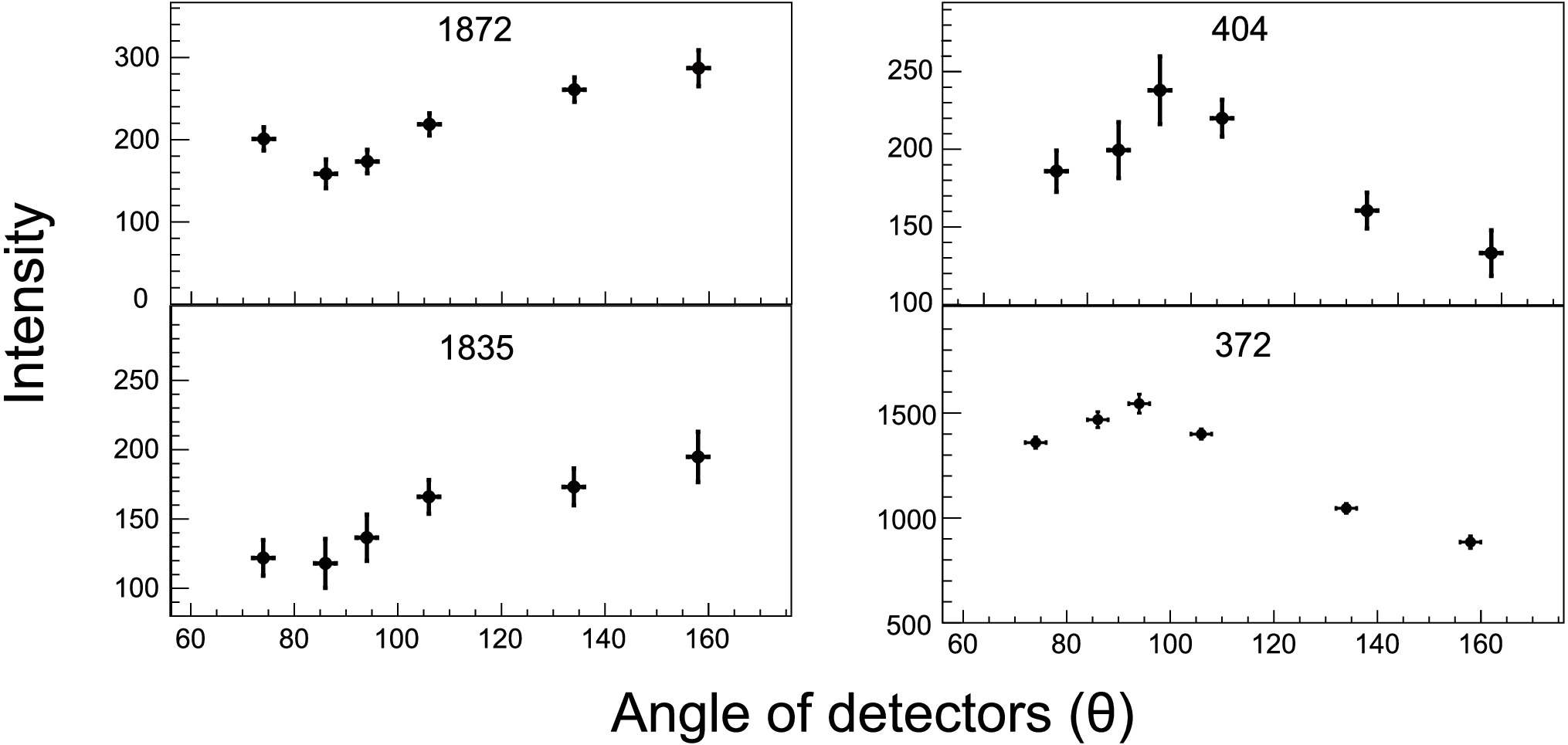
Figure 6. Representative angular distributions of γ-ray transitions extracted from RIT. The γ-ray energies (in keV) are indicated in each panel.
The angular distribution ratio was defined as follows:
$ R_{\rm{AD}} = \frac{I_\gamma ({133.57^{\circ} \ {\rm{or}}\ 157.6^{\circ}} )}{I_\gamma ({85.84^{\circ} \ {\rm{or}}\ 94.16^{\circ}})},$
(1) where the intensities of the γ rays (
$ I_\gamma $ ) were obtained using isomer tagging, sorted into small-angle (133.57° and 157.6°) and large-angle (85.84° and 94.16°) spectra, and normalized to the respective efficiencies of the two detector groups.On the basis of strong transitions with known multipolarities in 148Er [23], 150Er [7] and 151Tm [19], typical
$ R_{\rm{AD}} $ values for dipole and stretched quadrupole transitions in this work are found to be ~0.7 and ~1.24, respectively. These values were used as references for other γ rays (i.e., the dashed line in Fig. 7).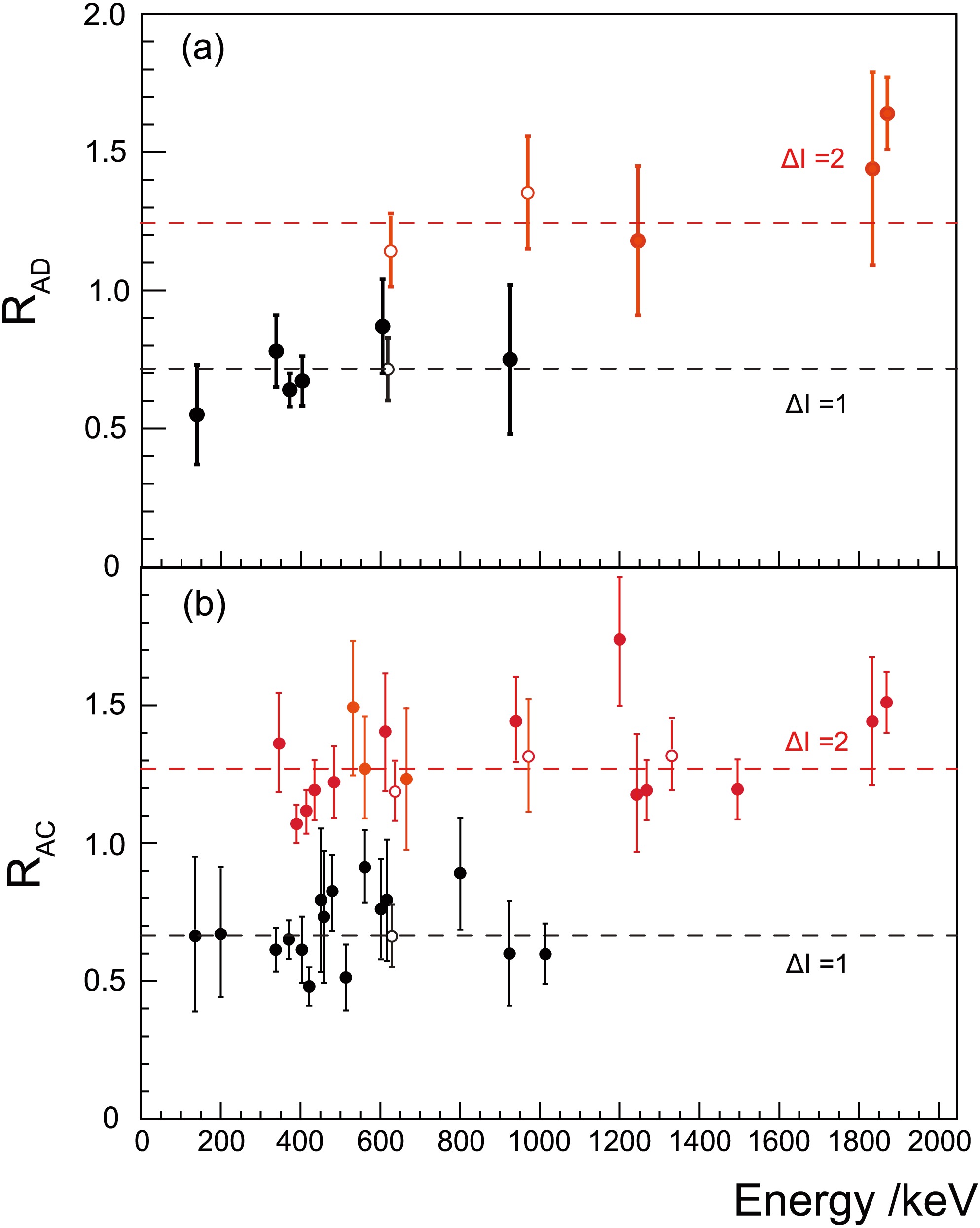
Figure 7. (color online) The
$ R_{AD} $ and$ R_{AC} $ ratios deduced in this work are shown. Reference values are indicated by open circles and horizontal dashed lines.We note that, because of unresolved peaks (e.g., the 614- and 617-keV peaks) or low intensities (e.g., transitions in Seq. 1) in the RIT spectrum, extracting
$ R_{AD} $ values for such transitions is impractical.Therefore, an alternative method based on two-point angular-correlation (anisotropy) ratios [24], denoted as
$ R_{AC} $ , was used.$ R_{\rm{AC}} = \frac{I_\mathrm{\gamma} ({\rm{at}}\ 133.57^{\circ} \ {\rm{or}}\ 157.6^{\circ},\text{gated on all angles} )}{I_\mathrm{\gamma} ({\rm{at}}\ 85.84^{\circ} \ {\rm{or}}\ 94.16^{\circ},\text{gated on all angles})}, $
(2) where the
$ I_{\gamma} $ values were extracted from two asymmetric γ-γ coincidence matrices, with γ rays measured by Ge detectors at 133.57° or 157.6° and$ 85.84^\circ $ or$ 94.16^\circ $ on one axis and by all detectors on the other.Typical
$ R_{AC} $ values for known dipole and stretched quadrupole transitions in this work were ~0.7 and ~1.28, respectively. The corresponding results are shown in Table 1 and Fig. 7. Although the$ R_\mathrm{AD,AC} $ values for quadrupole transitions were distinct, those for E1 and M1/E2 transitions could not be distinguished. Therefore, the multipolarity assignments are guided by the theoretical interpretation in Section IV. -
To investigate the multipolarities of prompt γ-ray transitions, their angular distribution (AD) and angular correlation (AC) were measured in this work. The angular distributions for the transitions [22] were extracted under RIT conditions, and representative distributions are shown in Fig. 6.
Figure 6. Representative angular distributions of γ-ray transitions extracted from RIT. The γ-ray energies (in keV) are indicated in each panel.
The angular distribution ratio was defined as follows:
$ R_{\rm{AD}} = \frac{I_\gamma ({133.57^{\circ} \ {\rm{or}}\ 157.6^{\circ}} )}{I_\gamma ({85.84^{\circ} \ {\rm{or}}\ 94.16^{\circ}})},$
(1) where the intensities of the γ rays (
$ I_\gamma $ ) were obtained using isomer tagging, sorted into small-angle (133.57° and 157.6°) and large-angle (85.84° and 94.16°) spectra, and normalized to the respective efficiencies of the two detector groups.On the basis of strong transitions with known multipolarities in 148Er [23], 150Er [7] and 151Tm [19], typical
$ R_{\rm{AD}} $ values for dipole and stretched quadrupole transitions in this work are found to be ~0.7 and ~1.24, respectively. These values were used as references for other γ rays (i.e., the dashed line in Fig. 7).
Figure 7. (color online) The
$ R_{AD} $ and$ R_{AC} $ ratios deduced in this work are shown. Reference values are indicated by open circles and horizontal dashed lines.We note that, because of unresolved peaks (e.g., the 614- and 617-keV peaks) or low intensities (e.g., transitions in Seq. 1) in the RIT spectrum, extracting
$ R_{AD} $ values for such transitions is impractical.Therefore, an alternative method based on two-point angular-correlation (anisotropy) ratios [24], denoted as
$ R_{AC} $ , was used.$ R_{\rm{AC}} = \frac{I_\mathrm{\gamma} ({\rm{at}}\ 133.57^{\circ} \ {\rm{or}}\ 157.6^{\circ},\text{gated on all angles} )}{I_\mathrm{\gamma} ({\rm{at}}\ 85.84^{\circ} \ {\rm{or}}\ 94.16^{\circ},\text{gated on all angles})}, $
(2) where the
$ I_{\gamma} $ values were extracted from two asymmetric γ-γ coincidence matrices, with γ rays measured by Ge detectors at 133.57° or 157.6° and$ 85.84^\circ $ or$ 94.16^\circ $ on one axis and by all detectors on the other.Typical
$ R_{AC} $ values for known dipole and stretched quadrupole transitions in this work were ~0.7 and ~1.28, respectively. The corresponding results are shown in Table 1 and Fig. 7. Although the$ R_\mathrm{AD,AC} $ values for quadrupole transitions were distinct, those for E1 and M1/E2 transitions could not be distinguished. Therefore, the multipolarity assignments are guided by the theoretical interpretation in Section IV. -
To investigate the multipolarities of prompt γ-ray transitions, their angular distribution (AD) and angular correlation (AC) were measured in this work. The angular distributions for the transitions [22] were extracted under RIT conditions, and representative distributions are shown in Fig. 6.
Figure 6. Representative angular distributions of γ-ray transitions extracted from RIT. The γ-ray energies (in keV) are indicated in each panel.
The angular distribution ratio was defined as follows:
$ R_{\rm{AD}} = \frac{I_\gamma ({133.57^{\circ} \ {\rm{or}}\ 157.6^{\circ}} )}{I_\gamma ({85.84^{\circ} \ {\rm{or}}\ 94.16^{\circ}})},$
(1) where the intensities of the γ rays (
$ I_\gamma $ ) were obtained using isomer tagging, sorted into small-angle (133.57° and 157.6°) and large-angle (85.84° and 94.16°) spectra, and normalized to the respective efficiencies of the two detector groups.On the basis of strong transitions with known multipolarities in 148Er [23], 150Er [7] and 151Tm [19], typical
$ R_{\rm{AD}} $ values for dipole and stretched quadrupole transitions in this work are found to be ~0.7 and ~1.24, respectively. These values were used as references for other γ rays (i.e., the dashed line in Fig. 7).
Figure 7. (color online) The
$ R_{AD} $ and$ R_{AC} $ ratios deduced in this work are shown. Reference values are indicated by open circles and horizontal dashed lines.We note that, because of unresolved peaks (e.g., the 614- and 617-keV peaks) or low intensities (e.g., transitions in Seq. 1) in the RIT spectrum, extracting
$ R_{AD} $ values for such transitions is impractical.Therefore, an alternative method based on two-point angular-correlation (anisotropy) ratios [24], denoted as
$ R_{AC} $ , was used.$ R_{\rm{AC}} = \frac{I_\mathrm{\gamma} ({\rm{at}}\ 133.57^{\circ} \ {\rm{or}}\ 157.6^{\circ},\text{gated on all angles} )}{I_\mathrm{\gamma} ({\rm{at}}\ 85.84^{\circ} \ {\rm{or}}\ 94.16^{\circ},\text{gated on all angles})}, $
(2) where the
$ I_{\gamma} $ values were extracted from two asymmetric γ-γ coincidence matrices, with γ rays measured by Ge detectors at 133.57° or 157.6° and$ 85.84^\circ $ or$ 94.16^\circ $ on one axis and by all detectors on the other.Typical
$ R_{AC} $ values for known dipole and stretched quadrupole transitions in this work were ~0.7 and ~1.28, respectively. The corresponding results are shown in Table 1 and Fig. 7. Although the$ R_\mathrm{AD,AC} $ values for quadrupole transitions were distinct, those for E1 and M1/E2 transitions could not be distinguished. Therefore, the multipolarity assignments are guided by the theoretical interpretation in Section IV. -
To investigate the multipolarities of prompt γ-ray transitions, their angular distribution (AD) and angular correlation (AC) were measured in this work. The angular distributions for the transitions [22] were extracted under RIT conditions, and representative distributions are shown in Fig. 6.
Figure 6. Representative angular distributions of γ-ray transitions extracted from RIT. The γ-ray energies (in keV) are indicated in each panel.
The angular distribution ratio was defined as follows:
$ R_{\rm{AD}} = \frac{I_\gamma ({133.57^{\circ} \ {\rm{or}}\ 157.6^{\circ}} )}{I_\gamma ({85.84^{\circ} \ {\rm{or}}\ 94.16^{\circ}})},$
(1) where the intensities of the γ rays (
$ I_\gamma $ ) were obtained using isomer tagging, sorted into small-angle (133.57° and 157.6°) and large-angle (85.84° and 94.16°) spectra, and normalized to the respective efficiencies of the two detector groups.On the basis of strong transitions with known multipolarities in 148Er [23], 150Er [7] and 151Tm [19], typical
$ R_{\rm{AD}} $ values for dipole and stretched quadrupole transitions in this work are found to be ~0.7 and ~1.24, respectively. These values were used as references for other γ rays (i.e., the dashed line in Fig. 7).
Figure 7. (color online) The
$ R_{AD} $ and$ R_{AC} $ ratios deduced in this work are shown. Reference values are indicated by open circles and horizontal dashed lines.We note that, because of unresolved peaks (e.g., the 614- and 617-keV peaks) or low intensities (e.g., transitions in Seq. 1) in the RIT spectrum, extracting
$ R_{AD} $ values for such transitions is impractical.Therefore, an alternative method based on two-point angular-correlation (anisotropy) ratios [24], denoted as
$ R_{AC} $ , was used.$ R_{\rm{AC}} = \frac{I_\mathrm{\gamma} ({\rm{at}}\ 133.57^{\circ} \ {\rm{or}}\ 157.6^{\circ},\text{gated on all angles} )}{I_\mathrm{\gamma} ({\rm{at}}\ 85.84^{\circ} \ {\rm{or}}\ 94.16^{\circ},\text{gated on all angles})}, $
(2) where the
$ I_{\gamma} $ values were extracted from two asymmetric γ-γ coincidence matrices, with γ rays measured by Ge detectors at 133.57° or 157.6° and$ 85.84^\circ $ or$ 94.16^\circ $ on one axis and by all detectors on the other.Typical
$ R_{AC} $ values for known dipole and stretched quadrupole transitions in this work were ~0.7 and ~1.28, respectively. The corresponding results are shown in Table 1 and Fig. 7. Although the$ R_\mathrm{AD,AC} $ values for quadrupole transitions were distinct, those for E1 and M1/E2 transitions could not be distinguished. Therefore, the multipolarity assignments are guided by the theoretical interpretation in Section IV. -
To investigate the multipolarities of prompt γ-ray transitions, their angular distribution (AD) and angular correlation (AC) were measured in this work. The angular distributions for the transitions [22] were extracted under RIT conditions, and representative distributions are shown in Fig. 6.
Figure 6. Representative angular distributions of γ-ray transitions extracted from RIT. The γ-ray energies (in keV) are indicated in each panel.
The angular distribution ratio was defined as follows:
$ R_{\rm{AD}} = \frac{I_\gamma ({133.57^{\circ} \ {\rm{or}}\ 157.6^{\circ}} )}{I_\gamma ({85.84^{\circ} \ {\rm{or}}\ 94.16^{\circ}})},$
(1) where the intensities of the γ rays (
$ I_\gamma $ ) were obtained using isomer tagging, sorted into small-angle (133.57° and 157.6°) and large-angle (85.84° and 94.16°) spectra, and normalized to the respective efficiencies of the two detector groups.On the basis of strong transitions with known multipolarities in 148Er [23], 150Er [7] and 151Tm [19], typical
$ R_{\rm{AD}} $ values for dipole and stretched quadrupole transitions in this work are found to be ~0.7 and ~1.24, respectively. These values were used as references for other γ rays (i.e., the dashed line in Fig. 7).
Figure 7. (color online) The
$ R_{AD} $ and$ R_{AC} $ ratios deduced in this work are shown. Reference values are indicated by open circles and horizontal dashed lines.We note that, because of unresolved peaks (e.g., the 614- and 617-keV peaks) or low intensities (e.g., transitions in Seq. 1) in the RIT spectrum, extracting
$ R_{AD} $ values for such transitions is impractical.Therefore, an alternative method based on two-point angular-correlation (anisotropy) ratios [24], denoted as
$ R_{AC} $ , was used.$ R_{\rm{AC}} = \frac{I_\mathrm{\gamma} ({\rm{at}}\ 133.57^{\circ} \ {\rm{or}}\ 157.6^{\circ},\text{gated on all angles} )}{I_\mathrm{\gamma} ({\rm{at}}\ 85.84^{\circ} \ {\rm{or}}\ 94.16^{\circ},\text{gated on all angles})}, $
(2) where the
$ I_{\gamma} $ values were extracted from two asymmetric γ-γ coincidence matrices, with γ rays measured by Ge detectors at 133.57° or 157.6° and$ 85.84^\circ $ or$ 94.16^\circ $ on one axis and by all detectors on the other.Typical
$ R_{AC} $ values for known dipole and stretched quadrupole transitions in this work were ~0.7 and ~1.28, respectively. The corresponding results are shown in Table 1 and Fig. 7. Although the$ R_\mathrm{AD,AC} $ values for quadrupole transitions were distinct, those for E1 and M1/E2 transitions could not be distinguished. Therefore, the multipolarity assignments are guided by the theoretical interpretation in Section IV. -
To investigate the multipolarities of prompt γ-ray transitions, their angular distribution (AD) and angular correlation (AC) were measured in this work. The angular distributions for the transitions [22] were extracted under RIT conditions, and representative distributions are shown in Fig. 6.
Figure 6. Representative angular distributions of γ-ray transitions extracted from RIT. The γ-ray energies (in keV) are indicated in each panel.
The angular distribution ratio was defined as follows:
$ R_{\rm{AD}} = \frac{I_\gamma ({133.57^{\circ} \ {\rm{or}}\ 157.6^{\circ}} )}{I_\gamma ({85.84^{\circ} \ {\rm{or}}\ 94.16^{\circ}})},$
(1) where the intensities of the γ rays (
$ I_\gamma $ ) were obtained using isomer tagging, sorted into small-angle (133.57° and 157.6°) and large-angle (85.84° and 94.16°) spectra, and normalized to the respective efficiencies of the two detector groups.On the basis of strong transitions with known multipolarities in 148Er [23], 150Er [7] and 151Tm [19], typical
$ R_{\rm{AD}} $ values for dipole and stretched quadrupole transitions in this work are found to be ~0.7 and ~1.24, respectively. These values were used as references for other γ rays (i.e., the dashed line in Fig. 7).
Figure 7. (color online) The
$ R_{AD} $ and$ R_{AC} $ ratios deduced in this work are shown. Reference values are indicated by open circles and horizontal dashed lines.We note that, because of unresolved peaks (e.g., the 614- and 617-keV peaks) or low intensities (e.g., transitions in Seq. 1) in the RIT spectrum, extracting
$ R_{AD} $ values for such transitions is impractical.Therefore, an alternative method based on two-point angular-correlation (anisotropy) ratios [24], denoted as
$ R_{AC} $ , was used.$ R_{\rm{AC}} = \frac{I_\mathrm{\gamma} ({\rm{at}}\ 133.57^{\circ} \ {\rm{or}}\ 157.6^{\circ},\text{gated on all angles} )}{I_\mathrm{\gamma} ({\rm{at}}\ 85.84^{\circ} \ {\rm{or}}\ 94.16^{\circ},\text{gated on all angles})}, $
(2) where the
$ I_{\gamma} $ values were extracted from two asymmetric γ-γ coincidence matrices, with γ rays measured by Ge detectors at 133.57° or 157.6° and$ 85.84^\circ $ or$ 94.16^\circ $ on one axis and by all detectors on the other.Typical
$ R_{AC} $ values for known dipole and stretched quadrupole transitions in this work were ~0.7 and ~1.28, respectively. The corresponding results are shown in Table 1 and Fig. 7. Although the$ R_\mathrm{AD,AC} $ values for quadrupole transitions were distinct, those for E1 and M1/E2 transitions could not be distinguished. Therefore, the multipolarity assignments are guided by the theoretical interpretation in Section IV. -
To investigate the multipolarities of prompt γ-ray transitions, their angular distribution (AD) and angular correlation (AC) were measured in this work. The angular distributions for the transitions [22] were extracted under RIT conditions, and representative distributions are shown in Fig. 6.
Figure 6. Representative angular distributions of γ-ray transitions extracted from RIT. The γ-ray energies (in keV) are indicated in each panel.
The angular distribution ratio was defined as follows:
$ R_{\rm{AD}} = \frac{I_\gamma ({133.57^{\circ} \ {\rm{or}}\ 157.6^{\circ}} )}{I_\gamma ({85.84^{\circ} \ {\rm{or}}\ 94.16^{\circ}})},$
(1) where the intensities of the γ rays (
$ I_\gamma $ ) were obtained using isomer tagging, sorted into small-angle (133.57° and 157.6°) and large-angle (85.84° and 94.16°) spectra, and normalized to the respective efficiencies of the two detector groups.On the basis of strong transitions with known multipolarities in 148Er [23], 150Er [7] and 151Tm [19], typical
$ R_{\rm{AD}} $ values for dipole and stretched quadrupole transitions in this work are found to be ~0.7 and ~1.24, respectively. These values were used as references for other γ rays (i.e., the dashed line in Fig. 7).
Figure 7. (color online) The
$ R_{AD} $ and$ R_{AC} $ ratios deduced in this work are shown. Reference values are indicated by open circles and horizontal dashed lines.We note that, because of unresolved peaks (e.g., the 614- and 617-keV peaks) or low intensities (e.g., transitions in Seq. 1) in the RIT spectrum, extracting
$ R_{AD} $ values for such transitions is impractical.Therefore, an alternative method based on two-point angular-correlation (anisotropy) ratios [24], denoted as
$ R_{AC} $ , was used.$ R_{\rm{AC}} = \frac{I_\mathrm{\gamma} ({\rm{at}}\ 133.57^{\circ} \ {\rm{or}}\ 157.6^{\circ},\text{gated on all angles} )}{I_\mathrm{\gamma} ({\rm{at}}\ 85.84^{\circ} \ {\rm{or}}\ 94.16^{\circ},\text{gated on all angles})}, $
(2) where the
$ I_{\gamma} $ values were extracted from two asymmetric γ-γ coincidence matrices, with γ rays measured by Ge detectors at 133.57° or 157.6° and$ 85.84^\circ $ or$ 94.16^\circ $ on one axis and by all detectors on the other.Typical
$ R_{AC} $ values for known dipole and stretched quadrupole transitions in this work were ~0.7 and ~1.28, respectively. The corresponding results are shown in Table 1 and Fig. 7. Although the$ R_\mathrm{AD,AC} $ values for quadrupole transitions were distinct, those for E1 and M1/E2 transitions could not be distinguished. Therefore, the multipolarity assignments are guided by the theoretical interpretation in Section IV. -
To investigate the multipolarities of prompt γ-ray transitions, their angular distribution (AD) and angular correlation (AC) were measured in this work. The angular distributions for the transitions [22] were extracted under RIT conditions, and representative distributions are shown in Fig. 6.
Figure 6. Representative angular distributions of γ-ray transitions extracted from RIT. The γ-ray energies (in keV) are indicated in each panel.
The angular distribution ratio was defined as follows:
$ R_{\rm{AD}} = \frac{I_\gamma ({133.57^{\circ} \ {\rm{or}}\ 157.6^{\circ}} )}{I_\gamma ({85.84^{\circ} \ {\rm{or}}\ 94.16^{\circ}})},$
(1) where the intensities of the γ rays (
$ I_\gamma $ ) were obtained using isomer tagging, sorted into small-angle (133.57° and 157.6°) and large-angle (85.84° and 94.16°) spectra, and normalized to the respective efficiencies of the two detector groups.On the basis of strong transitions with known multipolarities in 148Er [23], 150Er [7] and 151Tm [19], typical
$ R_{\rm{AD}} $ values for dipole and stretched quadrupole transitions in this work are found to be ~0.7 and ~1.24, respectively. These values were used as references for other γ rays (i.e., the dashed line in Fig. 7).
Figure 7. (color online) The
$ R_{AD} $ and$ R_{AC} $ ratios deduced in this work are shown. Reference values are indicated by open circles and horizontal dashed lines.We note that, because of unresolved peaks (e.g., the 614- and 617-keV peaks) or low intensities (e.g., transitions in Seq. 1) in the RIT spectrum, extracting
$ R_{AD} $ values for such transitions is impractical.Therefore, an alternative method based on two-point angular-correlation (anisotropy) ratios [24], denoted as
$ R_{AC} $ , was used.$ R_{\rm{AC}} = \frac{I_\mathrm{\gamma} ({\rm{at}}\ 133.57^{\circ} \ {\rm{or}}\ 157.6^{\circ},\text{gated on all angles} )}{I_\mathrm{\gamma} ({\rm{at}}\ 85.84^{\circ} \ {\rm{or}}\ 94.16^{\circ},\text{gated on all angles})}, $
(2) where the
$ I_{\gamma} $ values were extracted from two asymmetric γ-γ coincidence matrices, with γ rays measured by Ge detectors at 133.57° or 157.6° and$ 85.84^\circ $ or$ 94.16^\circ $ on one axis and by all detectors on the other.Typical
$ R_{AC} $ values for known dipole and stretched quadrupole transitions in this work were ~0.7 and ~1.28, respectively. The corresponding results are shown in Table 1 and Fig. 7. Although the$ R_\mathrm{AD,AC} $ values for quadrupole transitions were distinct, those for E1 and M1/E2 transitions could not be distinguished. Therefore, the multipolarity assignments are guided by the theoretical interpretation in Section IV. -
To investigate the multipolarities of prompt γ-ray transitions, their angular distribution (AD) and angular correlation (AC) were measured in this work. The angular distributions for the transitions [22] were extracted under RIT conditions, and representative distributions are shown in Fig. 6.
Figure 6. Representative angular distributions of γ-ray transitions extracted from RIT. The γ-ray energies (in keV) are indicated in each panel.
The angular distribution ratio was defined as follows:
$ R_{\rm{AD}} = \frac{I_\gamma ({133.57^{\circ} \ {\rm{or}}\ 157.6^{\circ}} )}{I_\gamma ({85.84^{\circ} \ {\rm{or}}\ 94.16^{\circ}})},$
(1) where the intensities of the γ rays (
$ I_\gamma $ ) were obtained using isomer tagging, sorted into small-angle (133.57° and 157.6°) and large-angle (85.84° and 94.16°) spectra, and normalized to the respective efficiencies of the two detector groups.On the basis of strong transitions with known multipolarities in 148Er [23], 150Er [7] and 151Tm [19], typical
$ R_{\rm{AD}} $ values for dipole and stretched quadrupole transitions in this work are found to be ~0.7 and ~1.24, respectively. These values were used as references for other γ rays (i.e., the dashed line in Fig. 7).
Figure 7. (color online) The
$ R_{AD} $ and$ R_{AC} $ ratios deduced in this work are shown. Reference values are indicated by open circles and horizontal dashed lines.We note that, because of unresolved peaks (e.g., the 614- and 617-keV peaks) or low intensities (e.g., transitions in Seq. 1) in the RIT spectrum, extracting
$ R_{AD} $ values for such transitions is impractical.Therefore, an alternative method based on two-point angular-correlation (anisotropy) ratios [24], denoted as
$ R_{AC} $ , was used.$ R_{\rm{AC}} = \frac{I_\mathrm{\gamma} ({\rm{at}}\ 133.57^{\circ} \ {\rm{or}}\ 157.6^{\circ},\text{gated on all angles} )}{I_\mathrm{\gamma} ({\rm{at}}\ 85.84^{\circ} \ {\rm{or}}\ 94.16^{\circ},\text{gated on all angles})}, $
(2) where the
$ I_{\gamma} $ values were extracted from two asymmetric γ-γ coincidence matrices, with γ rays measured by Ge detectors at 133.57° or 157.6° and$ 85.84^\circ $ or$ 94.16^\circ $ on one axis and by all detectors on the other.Typical
$ R_{AC} $ values for known dipole and stretched quadrupole transitions in this work were ~0.7 and ~1.28, respectively. The corresponding results are shown in Table 1 and Fig. 7. Although the$ R_\mathrm{AD,AC} $ values for quadrupole transitions were distinct, those for E1 and M1/E2 transitions could not be distinguished. Therefore, the multipolarity assignments are guided by the theoretical interpretation in Section IV. -
To investigate the multipolarities of prompt γ-ray transitions, their angular distribution (AD) and angular correlation (AC) were measured in this work. The angular distributions for the transitions [22] were extracted under RIT conditions, and representative distributions are shown in Fig. 6.
Figure 6. Representative angular distributions of γ-ray transitions extracted from RIT. The γ-ray energies (in keV) are indicated in each panel.
The angular distribution ratio was defined as follows:
$ R_{\rm{AD}} = \frac{I_\gamma ({133.57^{\circ} \ {\rm{or}}\ 157.6^{\circ}} )}{I_\gamma ({85.84^{\circ} \ {\rm{or}}\ 94.16^{\circ}})},$
(1) where the intensities of the γ rays (
$ I_\gamma $ ) were obtained using isomer tagging, sorted into small-angle (133.57° and 157.6°) and large-angle (85.84° and 94.16°) spectra, and normalized to the respective efficiencies of the two detector groups.On the basis of strong transitions with known multipolarities in 148Er [23], 150Er [7] and 151Tm [19], typical
$ R_{\rm{AD}} $ values for dipole and stretched quadrupole transitions in this work are found to be ~0.7 and ~1.24, respectively. These values were used as references for other γ rays (i.e., the dashed line in Fig. 7).
Figure 7. (color online) The
$ R_{AD} $ and$ R_{AC} $ ratios deduced in this work are shown. Reference values are indicated by open circles and horizontal dashed lines.We note that, because of unresolved peaks (e.g., the 614- and 617-keV peaks) or low intensities (e.g., transitions in Seq. 1) in the RIT spectrum, extracting
$ R_{AD} $ values for such transitions is impractical.Therefore, an alternative method based on two-point angular-correlation (anisotropy) ratios [24], denoted as
$ R_{AC} $ , was used.$ R_{\rm{AC}} = \frac{I_\mathrm{\gamma} ({\rm{at}}\ 133.57^{\circ} \ {\rm{or}}\ 157.6^{\circ},\text{gated on all angles} )}{I_\mathrm{\gamma} ({\rm{at}}\ 85.84^{\circ} \ {\rm{or}}\ 94.16^{\circ},\text{gated on all angles})}, $
(2) where the
$ I_{\gamma} $ values were extracted from two asymmetric γ-γ coincidence matrices, with γ rays measured by Ge detectors at 133.57° or 157.6° and$ 85.84^\circ $ or$ 94.16^\circ $ on one axis and by all detectors on the other.Typical
$ R_{AC} $ values for known dipole and stretched quadrupole transitions in this work were ~0.7 and ~1.28, respectively. The corresponding results are shown in Table 1 and Fig. 7. Although the$ R_\mathrm{AD,AC} $ values for quadrupole transitions were distinct, those for E1 and M1/E2 transitions could not be distinguished. Therefore, the multipolarity assignments are guided by the theoretical interpretation in Section IV. -
To investigate the multipolarities of prompt γ-ray transitions, their angular distribution (AD) and angular correlation (AC) were measured in this work. The angular distributions for the transitions [22] were extracted under RIT conditions, and representative distributions are shown in Fig. 6.
Figure 6. Representative angular distributions of γ-ray transitions extracted from RIT. The γ-ray energies (in keV) are indicated in each panel.
The angular distribution ratio was defined as follows:
$ R_{\rm{AD}} = \frac{I_\gamma ({133.57^{\circ} \ {\rm{or}}\ 157.6^{\circ}} )}{I_\gamma ({85.84^{\circ} \ {\rm{or}}\ 94.16^{\circ}})},$
(1) where the intensities of the γ rays (
$ I_\gamma $ ) were obtained using isomer tagging, sorted into small-angle (133.57° and 157.6°) and large-angle (85.84° and 94.16°) spectra, and normalized to the respective efficiencies of the two detector groups.On the basis of strong transitions with known multipolarities in 148Er [23], 150Er [7] and 151Tm [19], typical
$ R_{\rm{AD}} $ values for dipole and stretched quadrupole transitions in this work are found to be ~0.7 and ~1.24, respectively. These values were used as references for other γ rays (i.e., the dashed line in Fig. 7).
Figure 7. (color online) The
$ R_{AD} $ and$ R_{AC} $ ratios deduced in this work are shown. Reference values are indicated by open circles and horizontal dashed lines.We note that, because of unresolved peaks (e.g., the 614- and 617-keV peaks) or low intensities (e.g., transitions in Seq. 1) in the RIT spectrum, extracting
$ R_{AD} $ values for such transitions is impractical.Therefore, an alternative method based on two-point angular-correlation (anisotropy) ratios [24], denoted as
$ R_{AC} $ , was used.$ R_{\rm{AC}} = \frac{I_\mathrm{\gamma} ({\rm{at}}\ 133.57^{\circ} \ {\rm{or}}\ 157.6^{\circ},\text{gated on all angles} )}{I_\mathrm{\gamma} ({\rm{at}}\ 85.84^{\circ} \ {\rm{or}}\ 94.16^{\circ},\text{gated on all angles})}, $
(2) where the
$ I_{\gamma} $ values were extracted from two asymmetric γ-γ coincidence matrices, with γ rays measured by Ge detectors at 133.57° or 157.6° and$ 85.84^\circ $ or$ 94.16^\circ $ on one axis and by all detectors on the other.Typical
$ R_{AC} $ values for known dipole and stretched quadrupole transitions in this work were ~0.7 and ~1.28, respectively. The corresponding results are shown in Table 1 and Fig. 7. Although the$ R_\mathrm{AD,AC} $ values for quadrupole transitions were distinct, those for E1 and M1/E2 transitions could not be distinguished. Therefore, the multipolarity assignments are guided by the theoretical interpretation in Section IV. -
To interpret the level structure of
$ ^{151}_{\phantom{1}69} $ Tm82, configuration-interaction shell-model (CISM) calculations [25, 26] were performed. As shown in Fig. 8, we considered five proton orbitals between Z = 50 and 82, collectively denoted as$ gdsh $ ($ 0g_{7/2}, 1d_{5/2}, 0h_{11/2}, 2s_{1/2}, 1d_{3/2} $ ). Owing to limitations in computational resources, the number of protons allowed to be excited across the$ Z = 64 $ subshell was restricted to four (denoted as$ \pi(p-h) $ ). The neutron model space was limited to neutron orbitals below N = 82 (i.e., without neutron excitation across the N = 82 shell gap).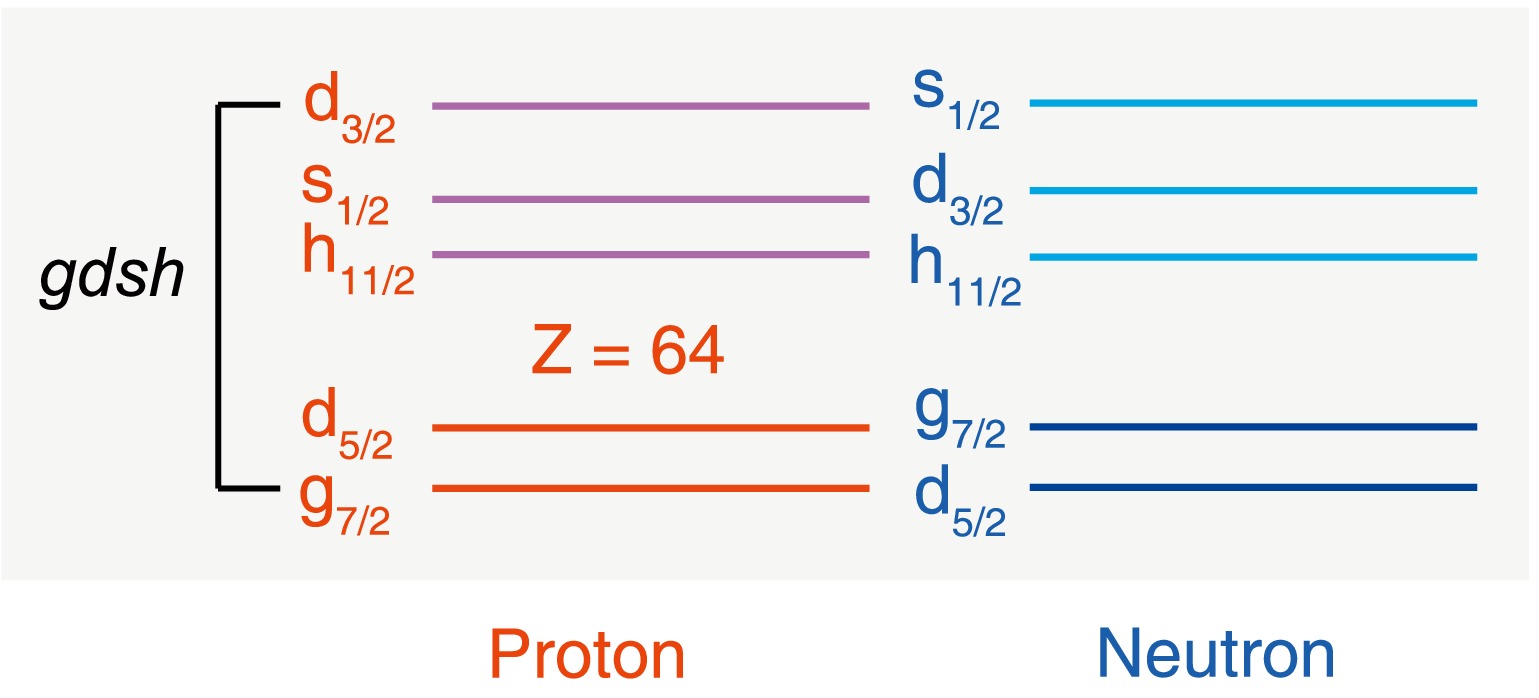
Figure 8. (color online) Schematic diagram of proton and neutron single-particle orbits.
In the present work, the effective Hamiltonian [26] was constructed using the monopole-based universal interaction
$ V_{{\rm{MU}}} $ [27] together with the M3Y-type spin-orbit interaction [28] ($ V_{{\rm{MU}}} $ +LS). To reflect the experimentally observed changes in the SPEs in the range of Z = 50−70, the SPEs of the corresponding proton$ 0h_{11/2} $ ,$ 2s_{1/2} $ , and$ 1d_{3/2} $ orbitals were lowered by 300 keV. The present calculations were performed using the code KSHELL [29]. The comparison between the experimental levels and calculated excitation energies is presented in Section A, while the orbital occupancy numbers are listed in Tables 2 and 3.$ J^{\pi} $ Protons per orbital Partitions (%) $ 0g_{7/2} $ $ 1d_{5/2} $ $ 1d_{3/2} $ $ 2s_{1/2} $ $ 0h_{11/2} $ CISM_P0 $ 15/2^{+} $ 8 6 1 0 4 31 8 4 1 0 6 9 $ 19/2^{+} $ 8 6 1 0 4 29 8 4 1 0 6 8 $ 23/2^{+} $ 8 6 1 0 4 34 8 4 1 0 6 10 $ 27/2^{+} $ 8 6 1 0 4 50 8 4 1 0 6 11 $ 31/2^{+} $ 8 6 1 0 4 55 8 4 1 0 6 10 $ 35/2^{+} $ 8 6 1 0 4 60 8 4 1 0 6 10 CISM_N0 $ 11/2^{-} $ 8 6 2 0 3 17 8 6 0 0 5 13 $ 15/2^{-} $ 8 6 2 0 3 18 8 6 0 0 5 14 $ 19/2^{-} $ 8 6 0 0 5 19 8 6 2 0 3 19 $ 23/2^{-} $ 8 6 0 0 5 21 8 6 2 0 3 20 $ 27/2^{-} $ 8 6 0 0 5 21 8 6 2 0 3 19 $ 31/2^{-} $ 8 6 2 0 3 20 8 6 0 0 5 17 $ 35/2^{-} $ 8 6 0 0 5 40 8 4 2 0 5 20 Table 2. The two strongest wave-function components and their partitions for the low-lying levels within CISM.
$ J^{\pi} $ Protons per orbital Partitions (%) $ 0g_{7/2} $ $ 1d_{5/2} $ $ 1d_{3/2} $ $ 2s_{1/2} $ $ 0h_{11/2} $ CISM_P1 $ 39/2^{+} $ 7 6 2 0 4 44 7 6 0 0 6 18 $ 41/2^{+} $ 8 5 2 0 4 46 8 5 0 0 6 23 $ 43/2^{+} $ 7 6 2 0 4 51 8 4 1 0 6 11 $ 45/2^{+}_1 $ 7 5 1 0 6 62 7 5 3 0 4 10 $ 45/2^{+}_2 $ 7 5 1 0 6 48 7 5 3 0 4 23 $ 49/2^{+}_1 $ 7 5 1 0 6 76 7 4 2 0 6 6 $ 49/2^{+}_2 $ 7 5 1 0 6 79 7 3 3 0 6 6 $ 51/2^{+}_1 $ 7 5 1 0 6 78 7 4 2 0 6 8 $ 51/2^{+}_2 $ 7 4 2 0 6 80 7 5 1 0 6 7 $ 53/2^{+} $ 7 4 2 0 6 90 7 4 1 1 6 4 $ 55/2^{+} $ 7 4 2 0 6 90 7 4 1 1 6 4 CISM_N1 $ 39/2^{-} $ 8 5 1 0 5 67 8 4 2 0 5 7 $ 41/2^{-} $ 8 5 1 0 5 77 8 3 3 0 5 3 $ 43/2^{-} $ 8 5 1 0 5 75 8 3 3 0 5 5 $ 45/2^{-} $ 7 6 1 0 5 74 7 4 3 0 5 8 $ 47/2^{-} $ 7 5 2 0 5 46 7 5 0 0 7 27 $ 49/2^{-} $ 7 5 2 0 5 84 7 4 2 1 5 4 $ 51/2^{-} $ 7 5 2 0 5 88 7 3 2 0 7 3 $ 53/2^{-} $ 7 4 1 0 7 82 7 4 3 0 5 11 CISM_N2 $ 39/2^{-} $ 8 5 1 0 5 71 8 4 2 0 5 5 $ 41/2^{-} $ 8 5 1 0 5 70 8 3 1 0 7 4 $ 43/2^{-} $ 7 6 1 0 5 64 7 5 2 0 5 10 $ 45/2^{-} $ 7 5 2 0 5 62 7 5 0 0 7 11 $ 47/2^{-} $ 8 4 2 0 5 76 7 4 1 0 7 5 $ 49/2^{-} $ 7 5 2 0 5 77 7 5 1 1 5 8 $ 51/2^{-} $ 7 5 1 1 5 71 7 4 2 1 5 7 $ 53/2^{-} $ 7 4 3 0 5 70 7 4 1 0 7 12 Table 3. The two dominant components of the wave functions and their partitions for the high-spin levels in CISM.
-
To interpret the level structure of
$ ^{151}_{\phantom{1}69} $ Tm82, configuration-interaction shell-model (CISM) calculations [25, 26] were performed. As shown in Fig. 8, we considered five proton orbitals between Z = 50 and 82, collectively denoted as$ gdsh $ ($ 0g_{7/2}, 1d_{5/2}, 0h_{11/2}, 2s_{1/2}, 1d_{3/2} $ ). Owing to limitations in computational resources, the number of protons allowed to be excited across the$ Z = 64 $ subshell was restricted to four (denoted as$ \pi(p-h) $ ). The neutron model space was limited to neutron orbitals below N = 82 (i.e., without neutron excitation across the N = 82 shell gap).
Figure 8. (color online) Schematic diagram of proton and neutron single-particle orbits.
In the present work, the effective Hamiltonian [26] was constructed using the monopole-based universal interaction
$ V_{{\rm{MU}}} $ [27] together with the M3Y-type spin-orbit interaction [28] ($ V_{{\rm{MU}}} $ +LS). To reflect the experimentally observed changes in the SPEs in the range of Z = 50−70, the SPEs of the corresponding proton$ 0h_{11/2} $ ,$ 2s_{1/2} $ , and$ 1d_{3/2} $ orbitals were lowered by 300 keV. The present calculations were performed using the code KSHELL [29]. The comparison between the experimental levels and calculated excitation energies is presented in Section A, while the orbital occupancy numbers are listed in Tables 2 and 3.$ J^{\pi} $ Protons per orbital Partitions (%) $ 0g_{7/2} $ $ 1d_{5/2} $ $ 1d_{3/2} $ $ 2s_{1/2} $ $ 0h_{11/2} $ CISM_P0 $ 15/2^{+} $ 8 6 1 0 4 31 8 4 1 0 6 9 $ 19/2^{+} $ 8 6 1 0 4 29 8 4 1 0 6 8 $ 23/2^{+} $ 8 6 1 0 4 34 8 4 1 0 6 10 $ 27/2^{+} $ 8 6 1 0 4 50 8 4 1 0 6 11 $ 31/2^{+} $ 8 6 1 0 4 55 8 4 1 0 6 10 $ 35/2^{+} $ 8 6 1 0 4 60 8 4 1 0 6 10 CISM_N0 $ 11/2^{-} $ 8 6 2 0 3 17 8 6 0 0 5 13 $ 15/2^{-} $ 8 6 2 0 3 18 8 6 0 0 5 14 $ 19/2^{-} $ 8 6 0 0 5 19 8 6 2 0 3 19 $ 23/2^{-} $ 8 6 0 0 5 21 8 6 2 0 3 20 $ 27/2^{-} $ 8 6 0 0 5 21 8 6 2 0 3 19 $ 31/2^{-} $ 8 6 2 0 3 20 8 6 0 0 5 17 $ 35/2^{-} $ 8 6 0 0 5 40 8 4 2 0 5 20 Table 2. The two strongest wave-function components and their partitions for the low-lying levels within CISM.
$ J^{\pi} $ Protons per orbital Partitions (%) $ 0g_{7/2} $ $ 1d_{5/2} $ $ 1d_{3/2} $ $ 2s_{1/2} $ $ 0h_{11/2} $ CISM_P1 $ 39/2^{+} $ 7 6 2 0 4 44 7 6 0 0 6 18 $ 41/2^{+} $ 8 5 2 0 4 46 8 5 0 0 6 23 $ 43/2^{+} $ 7 6 2 0 4 51 8 4 1 0 6 11 $ 45/2^{+}_1 $ 7 5 1 0 6 62 7 5 3 0 4 10 $ 45/2^{+}_2 $ 7 5 1 0 6 48 7 5 3 0 4 23 $ 49/2^{+}_1 $ 7 5 1 0 6 76 7 4 2 0 6 6 $ 49/2^{+}_2 $ 7 5 1 0 6 79 7 3 3 0 6 6 $ 51/2^{+}_1 $ 7 5 1 0 6 78 7 4 2 0 6 8 $ 51/2^{+}_2 $ 7 4 2 0 6 80 7 5 1 0 6 7 $ 53/2^{+} $ 7 4 2 0 6 90 7 4 1 1 6 4 $ 55/2^{+} $ 7 4 2 0 6 90 7 4 1 1 6 4 CISM_N1 $ 39/2^{-} $ 8 5 1 0 5 67 8 4 2 0 5 7 $ 41/2^{-} $ 8 5 1 0 5 77 8 3 3 0 5 3 $ 43/2^{-} $ 8 5 1 0 5 75 8 3 3 0 5 5 $ 45/2^{-} $ 7 6 1 0 5 74 7 4 3 0 5 8 $ 47/2^{-} $ 7 5 2 0 5 46 7 5 0 0 7 27 $ 49/2^{-} $ 7 5 2 0 5 84 7 4 2 1 5 4 $ 51/2^{-} $ 7 5 2 0 5 88 7 3 2 0 7 3 $ 53/2^{-} $ 7 4 1 0 7 82 7 4 3 0 5 11 CISM_N2 $ 39/2^{-} $ 8 5 1 0 5 71 8 4 2 0 5 5 $ 41/2^{-} $ 8 5 1 0 5 70 8 3 1 0 7 4 $ 43/2^{-} $ 7 6 1 0 5 64 7 5 2 0 5 10 $ 45/2^{-} $ 7 5 2 0 5 62 7 5 0 0 7 11 $ 47/2^{-} $ 8 4 2 0 5 76 7 4 1 0 7 5 $ 49/2^{-} $ 7 5 2 0 5 77 7 5 1 1 5 8 $ 51/2^{-} $ 7 5 1 1 5 71 7 4 2 1 5 7 $ 53/2^{-} $ 7 4 3 0 5 70 7 4 1 0 7 12 Table 3. The two dominant components of the wave functions and their partitions for the high-spin levels in CISM.
-
To interpret the level structure of
$ ^{151}_{\phantom{1}69} $ Tm82, configuration-interaction shell-model (CISM) calculations [25, 26] were performed. As shown in Fig. 8, we considered five proton orbitals between Z = 50 and 82, collectively denoted as$ gdsh $ ($ 0g_{7/2}, 1d_{5/2}, 0h_{11/2}, 2s_{1/2}, 1d_{3/2} $ ). Owing to limitations in computational resources, the number of protons allowed to be excited across the$ Z = 64 $ subshell was restricted to four (denoted as$ \pi(p-h) $ ). The neutron model space was limited to neutron orbitals below N = 82 (i.e., without neutron excitation across the N = 82 shell gap).
Figure 8. (color online) Schematic diagram of proton and neutron single-particle orbits.
In the present work, the effective Hamiltonian [26] was constructed using the monopole-based universal interaction
$ V_{{\rm{MU}}} $ [27] together with the M3Y-type spin-orbit interaction [28] ($ V_{{\rm{MU}}} $ +LS). To reflect the experimentally observed changes in the SPEs in the range of Z = 50−70, the SPEs of the corresponding proton$ 0h_{11/2} $ ,$ 2s_{1/2} $ , and$ 1d_{3/2} $ orbitals were lowered by 300 keV. The present calculations were performed using the code KSHELL [29]. The comparison between the experimental levels and calculated excitation energies is presented in Section A, while the orbital occupancy numbers are listed in Tables 2 and 3.$ J^{\pi} $ Protons per orbital Partitions (%) $ 0g_{7/2} $ $ 1d_{5/2} $ $ 1d_{3/2} $ $ 2s_{1/2} $ $ 0h_{11/2} $ CISM_P0 $ 15/2^{+} $ 8 6 1 0 4 31 8 4 1 0 6 9 $ 19/2^{+} $ 8 6 1 0 4 29 8 4 1 0 6 8 $ 23/2^{+} $ 8 6 1 0 4 34 8 4 1 0 6 10 $ 27/2^{+} $ 8 6 1 0 4 50 8 4 1 0 6 11 $ 31/2^{+} $ 8 6 1 0 4 55 8 4 1 0 6 10 $ 35/2^{+} $ 8 6 1 0 4 60 8 4 1 0 6 10 CISM_N0 $ 11/2^{-} $ 8 6 2 0 3 17 8 6 0 0 5 13 $ 15/2^{-} $ 8 6 2 0 3 18 8 6 0 0 5 14 $ 19/2^{-} $ 8 6 0 0 5 19 8 6 2 0 3 19 $ 23/2^{-} $ 8 6 0 0 5 21 8 6 2 0 3 20 $ 27/2^{-} $ 8 6 0 0 5 21 8 6 2 0 3 19 $ 31/2^{-} $ 8 6 2 0 3 20 8 6 0 0 5 17 $ 35/2^{-} $ 8 6 0 0 5 40 8 4 2 0 5 20 Table 2. The two strongest wave-function components and their partitions for the low-lying levels within CISM.
$ J^{\pi} $ Protons per orbital Partitions (%) $ 0g_{7/2} $ $ 1d_{5/2} $ $ 1d_{3/2} $ $ 2s_{1/2} $ $ 0h_{11/2} $ CISM_P1 $ 39/2^{+} $ 7 6 2 0 4 44 7 6 0 0 6 18 $ 41/2^{+} $ 8 5 2 0 4 46 8 5 0 0 6 23 $ 43/2^{+} $ 7 6 2 0 4 51 8 4 1 0 6 11 $ 45/2^{+}_1 $ 7 5 1 0 6 62 7 5 3 0 4 10 $ 45/2^{+}_2 $ 7 5 1 0 6 48 7 5 3 0 4 23 $ 49/2^{+}_1 $ 7 5 1 0 6 76 7 4 2 0 6 6 $ 49/2^{+}_2 $ 7 5 1 0 6 79 7 3 3 0 6 6 $ 51/2^{+}_1 $ 7 5 1 0 6 78 7 4 2 0 6 8 $ 51/2^{+}_2 $ 7 4 2 0 6 80 7 5 1 0 6 7 $ 53/2^{+} $ 7 4 2 0 6 90 7 4 1 1 6 4 $ 55/2^{+} $ 7 4 2 0 6 90 7 4 1 1 6 4 CISM_N1 $ 39/2^{-} $ 8 5 1 0 5 67 8 4 2 0 5 7 $ 41/2^{-} $ 8 5 1 0 5 77 8 3 3 0 5 3 $ 43/2^{-} $ 8 5 1 0 5 75 8 3 3 0 5 5 $ 45/2^{-} $ 7 6 1 0 5 74 7 4 3 0 5 8 $ 47/2^{-} $ 7 5 2 0 5 46 7 5 0 0 7 27 $ 49/2^{-} $ 7 5 2 0 5 84 7 4 2 1 5 4 $ 51/2^{-} $ 7 5 2 0 5 88 7 3 2 0 7 3 $ 53/2^{-} $ 7 4 1 0 7 82 7 4 3 0 5 11 CISM_N2 $ 39/2^{-} $ 8 5 1 0 5 71 8 4 2 0 5 5 $ 41/2^{-} $ 8 5 1 0 5 70 8 3 1 0 7 4 $ 43/2^{-} $ 7 6 1 0 5 64 7 5 2 0 5 10 $ 45/2^{-} $ 7 5 2 0 5 62 7 5 0 0 7 11 $ 47/2^{-} $ 8 4 2 0 5 76 7 4 1 0 7 5 $ 49/2^{-} $ 7 5 2 0 5 77 7 5 1 1 5 8 $ 51/2^{-} $ 7 5 1 1 5 71 7 4 2 1 5 7 $ 53/2^{-} $ 7 4 3 0 5 70 7 4 1 0 7 12 Table 3. The two dominant components of the wave functions and their partitions for the high-spin levels in CISM.
-
To interpret the level structure of
$ ^{151}_{\phantom{1}69} $ Tm82, configuration-interaction shell-model (CISM) calculations [25, 26] were performed. As shown in Fig. 8, we considered five proton orbitals between Z = 50 and 82, collectively denoted as$ gdsh $ ($ 0g_{7/2}, 1d_{5/2}, 0h_{11/2}, 2s_{1/2}, 1d_{3/2} $ ). Owing to limitations in computational resources, the number of protons allowed to be excited across the$ Z = 64 $ subshell was restricted to four (denoted as$ \pi(p-h) $ ). The neutron model space was limited to neutron orbitals below N = 82 (i.e., without neutron excitation across the N = 82 shell gap).
Figure 8. (color online) Schematic diagram of proton and neutron single-particle orbits.
In the present work, the effective Hamiltonian [26] was constructed using the monopole-based universal interaction
$ V_{{\rm{MU}}} $ [27] together with the M3Y-type spin-orbit interaction [28] ($ V_{{\rm{MU}}} $ +LS). To reflect the experimentally observed changes in the SPEs in the range of Z = 50−70, the SPEs of the corresponding proton$ 0h_{11/2} $ ,$ 2s_{1/2} $ , and$ 1d_{3/2} $ orbitals were lowered by 300 keV. The present calculations were performed using the code KSHELL [29]. The comparison between the experimental levels and calculated excitation energies is presented in Section A, while the orbital occupancy numbers are listed in Tables 2 and 3.$ J^{\pi} $ Protons per orbital Partitions (%) $ 0g_{7/2} $ $ 1d_{5/2} $ $ 1d_{3/2} $ $ 2s_{1/2} $ $ 0h_{11/2} $ CISM_P0 $ 15/2^{+} $ 8 6 1 0 4 31 8 4 1 0 6 9 $ 19/2^{+} $ 8 6 1 0 4 29 8 4 1 0 6 8 $ 23/2^{+} $ 8 6 1 0 4 34 8 4 1 0 6 10 $ 27/2^{+} $ 8 6 1 0 4 50 8 4 1 0 6 11 $ 31/2^{+} $ 8 6 1 0 4 55 8 4 1 0 6 10 $ 35/2^{+} $ 8 6 1 0 4 60 8 4 1 0 6 10 CISM_N0 $ 11/2^{-} $ 8 6 2 0 3 17 8 6 0 0 5 13 $ 15/2^{-} $ 8 6 2 0 3 18 8 6 0 0 5 14 $ 19/2^{-} $ 8 6 0 0 5 19 8 6 2 0 3 19 $ 23/2^{-} $ 8 6 0 0 5 21 8 6 2 0 3 20 $ 27/2^{-} $ 8 6 0 0 5 21 8 6 2 0 3 19 $ 31/2^{-} $ 8 6 2 0 3 20 8 6 0 0 5 17 $ 35/2^{-} $ 8 6 0 0 5 40 8 4 2 0 5 20 Table 2. The two strongest wave-function components and their partitions for the low-lying levels within CISM.
$ J^{\pi} $ Protons per orbital Partitions (%) $ 0g_{7/2} $ $ 1d_{5/2} $ $ 1d_{3/2} $ $ 2s_{1/2} $ $ 0h_{11/2} $ CISM_P1 $ 39/2^{+} $ 7 6 2 0 4 44 7 6 0 0 6 18 $ 41/2^{+} $ 8 5 2 0 4 46 8 5 0 0 6 23 $ 43/2^{+} $ 7 6 2 0 4 51 8 4 1 0 6 11 $ 45/2^{+}_1 $ 7 5 1 0 6 62 7 5 3 0 4 10 $ 45/2^{+}_2 $ 7 5 1 0 6 48 7 5 3 0 4 23 $ 49/2^{+}_1 $ 7 5 1 0 6 76 7 4 2 0 6 6 $ 49/2^{+}_2 $ 7 5 1 0 6 79 7 3 3 0 6 6 $ 51/2^{+}_1 $ 7 5 1 0 6 78 7 4 2 0 6 8 $ 51/2^{+}_2 $ 7 4 2 0 6 80 7 5 1 0 6 7 $ 53/2^{+} $ 7 4 2 0 6 90 7 4 1 1 6 4 $ 55/2^{+} $ 7 4 2 0 6 90 7 4 1 1 6 4 CISM_N1 $ 39/2^{-} $ 8 5 1 0 5 67 8 4 2 0 5 7 $ 41/2^{-} $ 8 5 1 0 5 77 8 3 3 0 5 3 $ 43/2^{-} $ 8 5 1 0 5 75 8 3 3 0 5 5 $ 45/2^{-} $ 7 6 1 0 5 74 7 4 3 0 5 8 $ 47/2^{-} $ 7 5 2 0 5 46 7 5 0 0 7 27 $ 49/2^{-} $ 7 5 2 0 5 84 7 4 2 1 5 4 $ 51/2^{-} $ 7 5 2 0 5 88 7 3 2 0 7 3 $ 53/2^{-} $ 7 4 1 0 7 82 7 4 3 0 5 11 CISM_N2 $ 39/2^{-} $ 8 5 1 0 5 71 8 4 2 0 5 5 $ 41/2^{-} $ 8 5 1 0 5 70 8 3 1 0 7 4 $ 43/2^{-} $ 7 6 1 0 5 64 7 5 2 0 5 10 $ 45/2^{-} $ 7 5 2 0 5 62 7 5 0 0 7 11 $ 47/2^{-} $ 8 4 2 0 5 76 7 4 1 0 7 5 $ 49/2^{-} $ 7 5 2 0 5 77 7 5 1 1 5 8 $ 51/2^{-} $ 7 5 1 1 5 71 7 4 2 1 5 7 $ 53/2^{-} $ 7 4 3 0 5 70 7 4 1 0 7 12 Table 3. The two dominant components of the wave functions and their partitions for the high-spin levels in CISM.
-
To interpret the level structure of
$ ^{151}_{\phantom{1}69} $ Tm82, configuration-interaction shell-model (CISM) calculations [25, 26] were performed. As shown in Fig. 8, we considered five proton orbitals between Z = 50 and 82, collectively denoted as$ gdsh $ ($ 0g_{7/2}, 1d_{5/2}, 0h_{11/2}, 2s_{1/2}, 1d_{3/2} $ ). Owing to limitations in computational resources, the number of protons allowed to be excited across the$ Z = 64 $ subshell was restricted to four (denoted as$ \pi(p-h) $ ). The neutron model space was limited to neutron orbitals below N = 82 (i.e., without neutron excitation across the N = 82 shell gap).
Figure 8. (color online) Schematic diagram of proton and neutron single-particle orbits.
In the present work, the effective Hamiltonian [26] was constructed using the monopole-based universal interaction
$ V_{{\rm{MU}}} $ [27] together with the M3Y-type spin-orbit interaction [28] ($ V_{{\rm{MU}}} $ +LS). To reflect the experimentally observed changes in the SPEs in the range of Z = 50−70, the SPEs of the corresponding proton$ 0h_{11/2} $ ,$ 2s_{1/2} $ , and$ 1d_{3/2} $ orbitals were lowered by 300 keV. The present calculations were performed using the code KSHELL [29]. The comparison between the experimental levels and calculated excitation energies is presented in Section A, while the orbital occupancy numbers are listed in Tables 2 and 3.$ J^{\pi} $ Protons per orbital Partitions (%) $ 0g_{7/2} $ $ 1d_{5/2} $ $ 1d_{3/2} $ $ 2s_{1/2} $ $ 0h_{11/2} $ CISM_P0 $ 15/2^{+} $ 8 6 1 0 4 31 8 4 1 0 6 9 $ 19/2^{+} $ 8 6 1 0 4 29 8 4 1 0 6 8 $ 23/2^{+} $ 8 6 1 0 4 34 8 4 1 0 6 10 $ 27/2^{+} $ 8 6 1 0 4 50 8 4 1 0 6 11 $ 31/2^{+} $ 8 6 1 0 4 55 8 4 1 0 6 10 $ 35/2^{+} $ 8 6 1 0 4 60 8 4 1 0 6 10 CISM_N0 $ 11/2^{-} $ 8 6 2 0 3 17 8 6 0 0 5 13 $ 15/2^{-} $ 8 6 2 0 3 18 8 6 0 0 5 14 $ 19/2^{-} $ 8 6 0 0 5 19 8 6 2 0 3 19 $ 23/2^{-} $ 8 6 0 0 5 21 8 6 2 0 3 20 $ 27/2^{-} $ 8 6 0 0 5 21 8 6 2 0 3 19 $ 31/2^{-} $ 8 6 2 0 3 20 8 6 0 0 5 17 $ 35/2^{-} $ 8 6 0 0 5 40 8 4 2 0 5 20 Table 2. The two strongest wave-function components and their partitions for the low-lying levels within CISM.
$ J^{\pi} $ Protons per orbital Partitions (%) $ 0g_{7/2} $ $ 1d_{5/2} $ $ 1d_{3/2} $ $ 2s_{1/2} $ $ 0h_{11/2} $ CISM_P1 $ 39/2^{+} $ 7 6 2 0 4 44 7 6 0 0 6 18 $ 41/2^{+} $ 8 5 2 0 4 46 8 5 0 0 6 23 $ 43/2^{+} $ 7 6 2 0 4 51 8 4 1 0 6 11 $ 45/2^{+}_1 $ 7 5 1 0 6 62 7 5 3 0 4 10 $ 45/2^{+}_2 $ 7 5 1 0 6 48 7 5 3 0 4 23 $ 49/2^{+}_1 $ 7 5 1 0 6 76 7 4 2 0 6 6 $ 49/2^{+}_2 $ 7 5 1 0 6 79 7 3 3 0 6 6 $ 51/2^{+}_1 $ 7 5 1 0 6 78 7 4 2 0 6 8 $ 51/2^{+}_2 $ 7 4 2 0 6 80 7 5 1 0 6 7 $ 53/2^{+} $ 7 4 2 0 6 90 7 4 1 1 6 4 $ 55/2^{+} $ 7 4 2 0 6 90 7 4 1 1 6 4 CISM_N1 $ 39/2^{-} $ 8 5 1 0 5 67 8 4 2 0 5 7 $ 41/2^{-} $ 8 5 1 0 5 77 8 3 3 0 5 3 $ 43/2^{-} $ 8 5 1 0 5 75 8 3 3 0 5 5 $ 45/2^{-} $ 7 6 1 0 5 74 7 4 3 0 5 8 $ 47/2^{-} $ 7 5 2 0 5 46 7 5 0 0 7 27 $ 49/2^{-} $ 7 5 2 0 5 84 7 4 2 1 5 4 $ 51/2^{-} $ 7 5 2 0 5 88 7 3 2 0 7 3 $ 53/2^{-} $ 7 4 1 0 7 82 7 4 3 0 5 11 CISM_N2 $ 39/2^{-} $ 8 5 1 0 5 71 8 4 2 0 5 5 $ 41/2^{-} $ 8 5 1 0 5 70 8 3 1 0 7 4 $ 43/2^{-} $ 7 6 1 0 5 64 7 5 2 0 5 10 $ 45/2^{-} $ 7 5 2 0 5 62 7 5 0 0 7 11 $ 47/2^{-} $ 8 4 2 0 5 76 7 4 1 0 7 5 $ 49/2^{-} $ 7 5 2 0 5 77 7 5 1 1 5 8 $ 51/2^{-} $ 7 5 1 1 5 71 7 4 2 1 5 7 $ 53/2^{-} $ 7 4 3 0 5 70 7 4 1 0 7 12 Table 3. The two dominant components of the wave functions and their partitions for the high-spin levels in CISM.
-
To interpret the level structure of
$ ^{151}_{\phantom{1}69} $ Tm82, configuration-interaction shell-model (CISM) calculations [25, 26] were performed. As shown in Fig. 8, we considered five proton orbitals between Z = 50 and 82, collectively denoted as$ gdsh $ ($ 0g_{7/2}, 1d_{5/2}, 0h_{11/2}, 2s_{1/2}, 1d_{3/2} $ ). Owing to limitations in computational resources, the number of protons allowed to be excited across the$ Z = 64 $ subshell was restricted to four (denoted as$ \pi(p-h) $ ). The neutron model space was limited to neutron orbitals below N = 82 (i.e., without neutron excitation across the N = 82 shell gap).
Figure 8. (color online) Schematic diagram of proton and neutron single-particle orbits.
In the present work, the effective Hamiltonian [26] was constructed using the monopole-based universal interaction
$ V_{{\rm{MU}}} $ [27] together with the M3Y-type spin-orbit interaction [28] ($ V_{{\rm{MU}}} $ +LS). To reflect the experimentally observed changes in the SPEs in the range of Z = 50−70, the SPEs of the corresponding proton$ 0h_{11/2} $ ,$ 2s_{1/2} $ , and$ 1d_{3/2} $ orbitals were lowered by 300 keV. The present calculations were performed using the code KSHELL [29]. The comparison between the experimental levels and calculated excitation energies is presented in Section A, while the orbital occupancy numbers are listed in Tables 2 and 3.$ J^{\pi} $ Protons per orbital Partitions (%) $ 0g_{7/2} $ $ 1d_{5/2} $ $ 1d_{3/2} $ $ 2s_{1/2} $ $ 0h_{11/2} $ CISM_P0 $ 15/2^{+} $ 8 6 1 0 4 31 8 4 1 0 6 9 $ 19/2^{+} $ 8 6 1 0 4 29 8 4 1 0 6 8 $ 23/2^{+} $ 8 6 1 0 4 34 8 4 1 0 6 10 $ 27/2^{+} $ 8 6 1 0 4 50 8 4 1 0 6 11 $ 31/2^{+} $ 8 6 1 0 4 55 8 4 1 0 6 10 $ 35/2^{+} $ 8 6 1 0 4 60 8 4 1 0 6 10 CISM_N0 $ 11/2^{-} $ 8 6 2 0 3 17 8 6 0 0 5 13 $ 15/2^{-} $ 8 6 2 0 3 18 8 6 0 0 5 14 $ 19/2^{-} $ 8 6 0 0 5 19 8 6 2 0 3 19 $ 23/2^{-} $ 8 6 0 0 5 21 8 6 2 0 3 20 $ 27/2^{-} $ 8 6 0 0 5 21 8 6 2 0 3 19 $ 31/2^{-} $ 8 6 2 0 3 20 8 6 0 0 5 17 $ 35/2^{-} $ 8 6 0 0 5 40 8 4 2 0 5 20 Table 2. The two strongest wave-function components and their partitions for the low-lying levels within CISM.
$ J^{\pi} $ Protons per orbital Partitions (%) $ 0g_{7/2} $ $ 1d_{5/2} $ $ 1d_{3/2} $ $ 2s_{1/2} $ $ 0h_{11/2} $ CISM_P1 $ 39/2^{+} $ 7 6 2 0 4 44 7 6 0 0 6 18 $ 41/2^{+} $ 8 5 2 0 4 46 8 5 0 0 6 23 $ 43/2^{+} $ 7 6 2 0 4 51 8 4 1 0 6 11 $ 45/2^{+}_1 $ 7 5 1 0 6 62 7 5 3 0 4 10 $ 45/2^{+}_2 $ 7 5 1 0 6 48 7 5 3 0 4 23 $ 49/2^{+}_1 $ 7 5 1 0 6 76 7 4 2 0 6 6 $ 49/2^{+}_2 $ 7 5 1 0 6 79 7 3 3 0 6 6 $ 51/2^{+}_1 $ 7 5 1 0 6 78 7 4 2 0 6 8 $ 51/2^{+}_2 $ 7 4 2 0 6 80 7 5 1 0 6 7 $ 53/2^{+} $ 7 4 2 0 6 90 7 4 1 1 6 4 $ 55/2^{+} $ 7 4 2 0 6 90 7 4 1 1 6 4 CISM_N1 $ 39/2^{-} $ 8 5 1 0 5 67 8 4 2 0 5 7 $ 41/2^{-} $ 8 5 1 0 5 77 8 3 3 0 5 3 $ 43/2^{-} $ 8 5 1 0 5 75 8 3 3 0 5 5 $ 45/2^{-} $ 7 6 1 0 5 74 7 4 3 0 5 8 $ 47/2^{-} $ 7 5 2 0 5 46 7 5 0 0 7 27 $ 49/2^{-} $ 7 5 2 0 5 84 7 4 2 1 5 4 $ 51/2^{-} $ 7 5 2 0 5 88 7 3 2 0 7 3 $ 53/2^{-} $ 7 4 1 0 7 82 7 4 3 0 5 11 CISM_N2 $ 39/2^{-} $ 8 5 1 0 5 71 8 4 2 0 5 5 $ 41/2^{-} $ 8 5 1 0 5 70 8 3 1 0 7 4 $ 43/2^{-} $ 7 6 1 0 5 64 7 5 2 0 5 10 $ 45/2^{-} $ 7 5 2 0 5 62 7 5 0 0 7 11 $ 47/2^{-} $ 8 4 2 0 5 76 7 4 1 0 7 5 $ 49/2^{-} $ 7 5 2 0 5 77 7 5 1 1 5 8 $ 51/2^{-} $ 7 5 1 1 5 71 7 4 2 1 5 7 $ 53/2^{-} $ 7 4 3 0 5 70 7 4 1 0 7 12 Table 3. The two dominant components of the wave functions and their partitions for the high-spin levels in CISM.
-
To interpret the level structure of
$ ^{151}_{\phantom{1}69} $ Tm82, configuration-interaction shell-model (CISM) calculations [25, 26] were performed. As shown in Fig. 8, we considered five proton orbitals between Z = 50 and 82, collectively denoted as$ gdsh $ ($ 0g_{7/2}, 1d_{5/2}, 0h_{11/2}, 2s_{1/2}, 1d_{3/2} $ ). Owing to limitations in computational resources, the number of protons allowed to be excited across the$ Z = 64 $ subshell was restricted to four (denoted as$ \pi(p-h) $ ). The neutron model space was limited to neutron orbitals below N = 82 (i.e., without neutron excitation across the N = 82 shell gap).
Figure 8. (color online) Schematic diagram of proton and neutron single-particle orbits.
In the present work, the effective Hamiltonian [26] was constructed using the monopole-based universal interaction
$ V_{{\rm{MU}}} $ [27] together with the M3Y-type spin-orbit interaction [28] ($ V_{{\rm{MU}}} $ +LS). To reflect the experimentally observed changes in the SPEs in the range of Z = 50−70, the SPEs of the corresponding proton$ 0h_{11/2} $ ,$ 2s_{1/2} $ , and$ 1d_{3/2} $ orbitals were lowered by 300 keV. The present calculations were performed using the code KSHELL [29]. The comparison between the experimental levels and calculated excitation energies is presented in Section A, while the orbital occupancy numbers are listed in Tables 2 and 3.$ J^{\pi} $ Protons per orbital Partitions (%) $ 0g_{7/2} $ $ 1d_{5/2} $ $ 1d_{3/2} $ $ 2s_{1/2} $ $ 0h_{11/2} $ CISM_P0 $ 15/2^{+} $ 8 6 1 0 4 31 8 4 1 0 6 9 $ 19/2^{+} $ 8 6 1 0 4 29 8 4 1 0 6 8 $ 23/2^{+} $ 8 6 1 0 4 34 8 4 1 0 6 10 $ 27/2^{+} $ 8 6 1 0 4 50 8 4 1 0 6 11 $ 31/2^{+} $ 8 6 1 0 4 55 8 4 1 0 6 10 $ 35/2^{+} $ 8 6 1 0 4 60 8 4 1 0 6 10 CISM_N0 $ 11/2^{-} $ 8 6 2 0 3 17 8 6 0 0 5 13 $ 15/2^{-} $ 8 6 2 0 3 18 8 6 0 0 5 14 $ 19/2^{-} $ 8 6 0 0 5 19 8 6 2 0 3 19 $ 23/2^{-} $ 8 6 0 0 5 21 8 6 2 0 3 20 $ 27/2^{-} $ 8 6 0 0 5 21 8 6 2 0 3 19 $ 31/2^{-} $ 8 6 2 0 3 20 8 6 0 0 5 17 $ 35/2^{-} $ 8 6 0 0 5 40 8 4 2 0 5 20 Table 2. The two strongest wave-function components and their partitions for the low-lying levels within CISM.
$ J^{\pi} $ Protons per orbital Partitions (%) $ 0g_{7/2} $ $ 1d_{5/2} $ $ 1d_{3/2} $ $ 2s_{1/2} $ $ 0h_{11/2} $ CISM_P1 $ 39/2^{+} $ 7 6 2 0 4 44 7 6 0 0 6 18 $ 41/2^{+} $ 8 5 2 0 4 46 8 5 0 0 6 23 $ 43/2^{+} $ 7 6 2 0 4 51 8 4 1 0 6 11 $ 45/2^{+}_1 $ 7 5 1 0 6 62 7 5 3 0 4 10 $ 45/2^{+}_2 $ 7 5 1 0 6 48 7 5 3 0 4 23 $ 49/2^{+}_1 $ 7 5 1 0 6 76 7 4 2 0 6 6 $ 49/2^{+}_2 $ 7 5 1 0 6 79 7 3 3 0 6 6 $ 51/2^{+}_1 $ 7 5 1 0 6 78 7 4 2 0 6 8 $ 51/2^{+}_2 $ 7 4 2 0 6 80 7 5 1 0 6 7 $ 53/2^{+} $ 7 4 2 0 6 90 7 4 1 1 6 4 $ 55/2^{+} $ 7 4 2 0 6 90 7 4 1 1 6 4 CISM_N1 $ 39/2^{-} $ 8 5 1 0 5 67 8 4 2 0 5 7 $ 41/2^{-} $ 8 5 1 0 5 77 8 3 3 0 5 3 $ 43/2^{-} $ 8 5 1 0 5 75 8 3 3 0 5 5 $ 45/2^{-} $ 7 6 1 0 5 74 7 4 3 0 5 8 $ 47/2^{-} $ 7 5 2 0 5 46 7 5 0 0 7 27 $ 49/2^{-} $ 7 5 2 0 5 84 7 4 2 1 5 4 $ 51/2^{-} $ 7 5 2 0 5 88 7 3 2 0 7 3 $ 53/2^{-} $ 7 4 1 0 7 82 7 4 3 0 5 11 CISM_N2 $ 39/2^{-} $ 8 5 1 0 5 71 8 4 2 0 5 5 $ 41/2^{-} $ 8 5 1 0 5 70 8 3 1 0 7 4 $ 43/2^{-} $ 7 6 1 0 5 64 7 5 2 0 5 10 $ 45/2^{-} $ 7 5 2 0 5 62 7 5 0 0 7 11 $ 47/2^{-} $ 8 4 2 0 5 76 7 4 1 0 7 5 $ 49/2^{-} $ 7 5 2 0 5 77 7 5 1 1 5 8 $ 51/2^{-} $ 7 5 1 1 5 71 7 4 2 1 5 7 $ 53/2^{-} $ 7 4 3 0 5 70 7 4 1 0 7 12 Table 3. The two dominant components of the wave functions and their partitions for the high-spin levels in CISM.
-
To interpret the level structure of
$ ^{151}_{\phantom{1}69} $ Tm82, configuration-interaction shell-model (CISM) calculations [25, 26] were performed. As shown in Fig. 8, we considered five proton orbitals between Z = 50 and 82, collectively denoted as$ gdsh $ ($ 0g_{7/2}, 1d_{5/2}, 0h_{11/2}, 2s_{1/2}, 1d_{3/2} $ ). Owing to limitations in computational resources, the number of protons allowed to be excited across the$ Z = 64 $ subshell was restricted to four (denoted as$ \pi(p-h) $ ). The neutron model space was limited to neutron orbitals below N = 82 (i.e., without neutron excitation across the N = 82 shell gap).
Figure 8. (color online) Schematic diagram of proton and neutron single-particle orbits.
In the present work, the effective Hamiltonian [26] was constructed using the monopole-based universal interaction
$ V_{{\rm{MU}}} $ [27] together with the M3Y-type spin-orbit interaction [28] ($ V_{{\rm{MU}}} $ +LS). To reflect the experimentally observed changes in the SPEs in the range of Z = 50−70, the SPEs of the corresponding proton$ 0h_{11/2} $ ,$ 2s_{1/2} $ , and$ 1d_{3/2} $ orbitals were lowered by 300 keV. The present calculations were performed using the code KSHELL [29]. The comparison between the experimental levels and calculated excitation energies is presented in Section A, while the orbital occupancy numbers are listed in Tables 2 and 3.$ J^{\pi} $ Protons per orbital Partitions (%) $ 0g_{7/2} $ $ 1d_{5/2} $ $ 1d_{3/2} $ $ 2s_{1/2} $ $ 0h_{11/2} $ CISM_P0 $ 15/2^{+} $ 8 6 1 0 4 31 8 4 1 0 6 9 $ 19/2^{+} $ 8 6 1 0 4 29 8 4 1 0 6 8 $ 23/2^{+} $ 8 6 1 0 4 34 8 4 1 0 6 10 $ 27/2^{+} $ 8 6 1 0 4 50 8 4 1 0 6 11 $ 31/2^{+} $ 8 6 1 0 4 55 8 4 1 0 6 10 $ 35/2^{+} $ 8 6 1 0 4 60 8 4 1 0 6 10 CISM_N0 $ 11/2^{-} $ 8 6 2 0 3 17 8 6 0 0 5 13 $ 15/2^{-} $ 8 6 2 0 3 18 8 6 0 0 5 14 $ 19/2^{-} $ 8 6 0 0 5 19 8 6 2 0 3 19 $ 23/2^{-} $ 8 6 0 0 5 21 8 6 2 0 3 20 $ 27/2^{-} $ 8 6 0 0 5 21 8 6 2 0 3 19 $ 31/2^{-} $ 8 6 2 0 3 20 8 6 0 0 5 17 $ 35/2^{-} $ 8 6 0 0 5 40 8 4 2 0 5 20 Table 2. The two strongest wave-function components and their partitions for the low-lying levels within CISM.
$ J^{\pi} $ Protons per orbital Partitions (%) $ 0g_{7/2} $ $ 1d_{5/2} $ $ 1d_{3/2} $ $ 2s_{1/2} $ $ 0h_{11/2} $ CISM_P1 $ 39/2^{+} $ 7 6 2 0 4 44 7 6 0 0 6 18 $ 41/2^{+} $ 8 5 2 0 4 46 8 5 0 0 6 23 $ 43/2^{+} $ 7 6 2 0 4 51 8 4 1 0 6 11 $ 45/2^{+}_1 $ 7 5 1 0 6 62 7 5 3 0 4 10 $ 45/2^{+}_2 $ 7 5 1 0 6 48 7 5 3 0 4 23 $ 49/2^{+}_1 $ 7 5 1 0 6 76 7 4 2 0 6 6 $ 49/2^{+}_2 $ 7 5 1 0 6 79 7 3 3 0 6 6 $ 51/2^{+}_1 $ 7 5 1 0 6 78 7 4 2 0 6 8 $ 51/2^{+}_2 $ 7 4 2 0 6 80 7 5 1 0 6 7 $ 53/2^{+} $ 7 4 2 0 6 90 7 4 1 1 6 4 $ 55/2^{+} $ 7 4 2 0 6 90 7 4 1 1 6 4 CISM_N1 $ 39/2^{-} $ 8 5 1 0 5 67 8 4 2 0 5 7 $ 41/2^{-} $ 8 5 1 0 5 77 8 3 3 0 5 3 $ 43/2^{-} $ 8 5 1 0 5 75 8 3 3 0 5 5 $ 45/2^{-} $ 7 6 1 0 5 74 7 4 3 0 5 8 $ 47/2^{-} $ 7 5 2 0 5 46 7 5 0 0 7 27 $ 49/2^{-} $ 7 5 2 0 5 84 7 4 2 1 5 4 $ 51/2^{-} $ 7 5 2 0 5 88 7 3 2 0 7 3 $ 53/2^{-} $ 7 4 1 0 7 82 7 4 3 0 5 11 CISM_N2 $ 39/2^{-} $ 8 5 1 0 5 71 8 4 2 0 5 5 $ 41/2^{-} $ 8 5 1 0 5 70 8 3 1 0 7 4 $ 43/2^{-} $ 7 6 1 0 5 64 7 5 2 0 5 10 $ 45/2^{-} $ 7 5 2 0 5 62 7 5 0 0 7 11 $ 47/2^{-} $ 8 4 2 0 5 76 7 4 1 0 7 5 $ 49/2^{-} $ 7 5 2 0 5 77 7 5 1 1 5 8 $ 51/2^{-} $ 7 5 1 1 5 71 7 4 2 1 5 7 $ 53/2^{-} $ 7 4 3 0 5 70 7 4 1 0 7 12 Table 3. The two dominant components of the wave functions and their partitions for the high-spin levels in CISM.
-
To interpret the level structure of
$ ^{151}_{\phantom{1}69} $ Tm82, configuration-interaction shell-model (CISM) calculations [25, 26] were performed. As shown in Fig. 8, we considered five proton orbitals between Z = 50 and 82, collectively denoted as$ gdsh $ ($ 0g_{7/2}, 1d_{5/2}, 0h_{11/2}, 2s_{1/2}, 1d_{3/2} $ ). Owing to limitations in computational resources, the number of protons allowed to be excited across the$ Z = 64 $ subshell was restricted to four (denoted as$ \pi(p-h) $ ). The neutron model space was limited to neutron orbitals below N = 82 (i.e., without neutron excitation across the N = 82 shell gap).
Figure 8. (color online) Schematic diagram of proton and neutron single-particle orbits.
In the present work, the effective Hamiltonian [26] was constructed using the monopole-based universal interaction
$ V_{{\rm{MU}}} $ [27] together with the M3Y-type spin-orbit interaction [28] ($ V_{{\rm{MU}}} $ +LS). To reflect the experimentally observed changes in the SPEs in the range of Z = 50−70, the SPEs of the corresponding proton$ 0h_{11/2} $ ,$ 2s_{1/2} $ , and$ 1d_{3/2} $ orbitals were lowered by 300 keV. The present calculations were performed using the code KSHELL [29]. The comparison between the experimental levels and calculated excitation energies is presented in Section A, while the orbital occupancy numbers are listed in Tables 2 and 3.$ J^{\pi} $ Protons per orbital Partitions (%) $ 0g_{7/2} $ $ 1d_{5/2} $ $ 1d_{3/2} $ $ 2s_{1/2} $ $ 0h_{11/2} $ CISM_P0 $ 15/2^{+} $ 8 6 1 0 4 31 8 4 1 0 6 9 $ 19/2^{+} $ 8 6 1 0 4 29 8 4 1 0 6 8 $ 23/2^{+} $ 8 6 1 0 4 34 8 4 1 0 6 10 $ 27/2^{+} $ 8 6 1 0 4 50 8 4 1 0 6 11 $ 31/2^{+} $ 8 6 1 0 4 55 8 4 1 0 6 10 $ 35/2^{+} $ 8 6 1 0 4 60 8 4 1 0 6 10 CISM_N0 $ 11/2^{-} $ 8 6 2 0 3 17 8 6 0 0 5 13 $ 15/2^{-} $ 8 6 2 0 3 18 8 6 0 0 5 14 $ 19/2^{-} $ 8 6 0 0 5 19 8 6 2 0 3 19 $ 23/2^{-} $ 8 6 0 0 5 21 8 6 2 0 3 20 $ 27/2^{-} $ 8 6 0 0 5 21 8 6 2 0 3 19 $ 31/2^{-} $ 8 6 2 0 3 20 8 6 0 0 5 17 $ 35/2^{-} $ 8 6 0 0 5 40 8 4 2 0 5 20 Table 2. The two strongest wave-function components and their partitions for the low-lying levels within CISM.
$ J^{\pi} $ Protons per orbital Partitions (%) $ 0g_{7/2} $ $ 1d_{5/2} $ $ 1d_{3/2} $ $ 2s_{1/2} $ $ 0h_{11/2} $ CISM_P1 $ 39/2^{+} $ 7 6 2 0 4 44 7 6 0 0 6 18 $ 41/2^{+} $ 8 5 2 0 4 46 8 5 0 0 6 23 $ 43/2^{+} $ 7 6 2 0 4 51 8 4 1 0 6 11 $ 45/2^{+}_1 $ 7 5 1 0 6 62 7 5 3 0 4 10 $ 45/2^{+}_2 $ 7 5 1 0 6 48 7 5 3 0 4 23 $ 49/2^{+}_1 $ 7 5 1 0 6 76 7 4 2 0 6 6 $ 49/2^{+}_2 $ 7 5 1 0 6 79 7 3 3 0 6 6 $ 51/2^{+}_1 $ 7 5 1 0 6 78 7 4 2 0 6 8 $ 51/2^{+}_2 $ 7 4 2 0 6 80 7 5 1 0 6 7 $ 53/2^{+} $ 7 4 2 0 6 90 7 4 1 1 6 4 $ 55/2^{+} $ 7 4 2 0 6 90 7 4 1 1 6 4 CISM_N1 $ 39/2^{-} $ 8 5 1 0 5 67 8 4 2 0 5 7 $ 41/2^{-} $ 8 5 1 0 5 77 8 3 3 0 5 3 $ 43/2^{-} $ 8 5 1 0 5 75 8 3 3 0 5 5 $ 45/2^{-} $ 7 6 1 0 5 74 7 4 3 0 5 8 $ 47/2^{-} $ 7 5 2 0 5 46 7 5 0 0 7 27 $ 49/2^{-} $ 7 5 2 0 5 84 7 4 2 1 5 4 $ 51/2^{-} $ 7 5 2 0 5 88 7 3 2 0 7 3 $ 53/2^{-} $ 7 4 1 0 7 82 7 4 3 0 5 11 CISM_N2 $ 39/2^{-} $ 8 5 1 0 5 71 8 4 2 0 5 5 $ 41/2^{-} $ 8 5 1 0 5 70 8 3 1 0 7 4 $ 43/2^{-} $ 7 6 1 0 5 64 7 5 2 0 5 10 $ 45/2^{-} $ 7 5 2 0 5 62 7 5 0 0 7 11 $ 47/2^{-} $ 8 4 2 0 5 76 7 4 1 0 7 5 $ 49/2^{-} $ 7 5 2 0 5 77 7 5 1 1 5 8 $ 51/2^{-} $ 7 5 1 1 5 71 7 4 2 1 5 7 $ 53/2^{-} $ 7 4 3 0 5 70 7 4 1 0 7 12 Table 3. The two dominant components of the wave functions and their partitions for the high-spin levels in CISM.
-
To interpret the level structure of
$ ^{151}_{\phantom{1}69} $ Tm82, configuration-interaction shell-model (CISM) calculations [25, 26] were performed. As shown in Fig. 8, we considered five proton orbitals between Z = 50 and 82, collectively denoted as$ gdsh $ ($ 0g_{7/2}, 1d_{5/2}, 0h_{11/2}, 2s_{1/2}, 1d_{3/2} $ ). Owing to limitations in computational resources, the number of protons allowed to be excited across the$ Z = 64 $ subshell was restricted to four (denoted as$ \pi(p-h) $ ). The neutron model space was limited to neutron orbitals below N = 82 (i.e., without neutron excitation across the N = 82 shell gap).
Figure 8. (color online) Schematic diagram of proton and neutron single-particle orbits.
In the present work, the effective Hamiltonian [26] was constructed using the monopole-based universal interaction
$ V_{{\rm{MU}}} $ [27] together with the M3Y-type spin-orbit interaction [28] ($ V_{{\rm{MU}}} $ +LS). To reflect the experimentally observed changes in the SPEs in the range of Z = 50−70, the SPEs of the corresponding proton$ 0h_{11/2} $ ,$ 2s_{1/2} $ , and$ 1d_{3/2} $ orbitals were lowered by 300 keV. The present calculations were performed using the code KSHELL [29]. The comparison between the experimental levels and calculated excitation energies is presented in Section A, while the orbital occupancy numbers are listed in Tables 2 and 3.$ J^{\pi} $ Protons per orbital Partitions (%) $ 0g_{7/2} $ $ 1d_{5/2} $ $ 1d_{3/2} $ $ 2s_{1/2} $ $ 0h_{11/2} $ CISM_P0 $ 15/2^{+} $ 8 6 1 0 4 31 8 4 1 0 6 9 $ 19/2^{+} $ 8 6 1 0 4 29 8 4 1 0 6 8 $ 23/2^{+} $ 8 6 1 0 4 34 8 4 1 0 6 10 $ 27/2^{+} $ 8 6 1 0 4 50 8 4 1 0 6 11 $ 31/2^{+} $ 8 6 1 0 4 55 8 4 1 0 6 10 $ 35/2^{+} $ 8 6 1 0 4 60 8 4 1 0 6 10 CISM_N0 $ 11/2^{-} $ 8 6 2 0 3 17 8 6 0 0 5 13 $ 15/2^{-} $ 8 6 2 0 3 18 8 6 0 0 5 14 $ 19/2^{-} $ 8 6 0 0 5 19 8 6 2 0 3 19 $ 23/2^{-} $ 8 6 0 0 5 21 8 6 2 0 3 20 $ 27/2^{-} $ 8 6 0 0 5 21 8 6 2 0 3 19 $ 31/2^{-} $ 8 6 2 0 3 20 8 6 0 0 5 17 $ 35/2^{-} $ 8 6 0 0 5 40 8 4 2 0 5 20 Table 2. The two strongest wave-function components and their partitions for the low-lying levels within CISM.
$ J^{\pi} $ Protons per orbital Partitions (%) $ 0g_{7/2} $ $ 1d_{5/2} $ $ 1d_{3/2} $ $ 2s_{1/2} $ $ 0h_{11/2} $ CISM_P1 $ 39/2^{+} $ 7 6 2 0 4 44 7 6 0 0 6 18 $ 41/2^{+} $ 8 5 2 0 4 46 8 5 0 0 6 23 $ 43/2^{+} $ 7 6 2 0 4 51 8 4 1 0 6 11 $ 45/2^{+}_1 $ 7 5 1 0 6 62 7 5 3 0 4 10 $ 45/2^{+}_2 $ 7 5 1 0 6 48 7 5 3 0 4 23 $ 49/2^{+}_1 $ 7 5 1 0 6 76 7 4 2 0 6 6 $ 49/2^{+}_2 $ 7 5 1 0 6 79 7 3 3 0 6 6 $ 51/2^{+}_1 $ 7 5 1 0 6 78 7 4 2 0 6 8 $ 51/2^{+}_2 $ 7 4 2 0 6 80 7 5 1 0 6 7 $ 53/2^{+} $ 7 4 2 0 6 90 7 4 1 1 6 4 $ 55/2^{+} $ 7 4 2 0 6 90 7 4 1 1 6 4 CISM_N1 $ 39/2^{-} $ 8 5 1 0 5 67 8 4 2 0 5 7 $ 41/2^{-} $ 8 5 1 0 5 77 8 3 3 0 5 3 $ 43/2^{-} $ 8 5 1 0 5 75 8 3 3 0 5 5 $ 45/2^{-} $ 7 6 1 0 5 74 7 4 3 0 5 8 $ 47/2^{-} $ 7 5 2 0 5 46 7 5 0 0 7 27 $ 49/2^{-} $ 7 5 2 0 5 84 7 4 2 1 5 4 $ 51/2^{-} $ 7 5 2 0 5 88 7 3 2 0 7 3 $ 53/2^{-} $ 7 4 1 0 7 82 7 4 3 0 5 11 CISM_N2 $ 39/2^{-} $ 8 5 1 0 5 71 8 4 2 0 5 5 $ 41/2^{-} $ 8 5 1 0 5 70 8 3 1 0 7 4 $ 43/2^{-} $ 7 6 1 0 5 64 7 5 2 0 5 10 $ 45/2^{-} $ 7 5 2 0 5 62 7 5 0 0 7 11 $ 47/2^{-} $ 8 4 2 0 5 76 7 4 1 0 7 5 $ 49/2^{-} $ 7 5 2 0 5 77 7 5 1 1 5 8 $ 51/2^{-} $ 7 5 1 1 5 71 7 4 2 1 5 7 $ 53/2^{-} $ 7 4 3 0 5 70 7 4 1 0 7 12 Table 3. The two dominant components of the wave functions and their partitions for the high-spin levels in CISM.
-
To interpret the level structure of
$ ^{151}_{\phantom{1}69} $ Tm82, configuration-interaction shell-model (CISM) calculations [25, 26] were performed. As shown in Fig. 8, we considered five proton orbitals between Z = 50 and 82, collectively denoted as$ gdsh $ ($ 0g_{7/2}, 1d_{5/2}, 0h_{11/2}, 2s_{1/2}, 1d_{3/2} $ ). Owing to limitations in computational resources, the number of protons allowed to be excited across the$ Z = 64 $ subshell was restricted to four (denoted as$ \pi(p-h) $ ). The neutron model space was limited to neutron orbitals below N = 82 (i.e., without neutron excitation across the N = 82 shell gap).
Figure 8. (color online) Schematic diagram of proton and neutron single-particle orbits.
In the present work, the effective Hamiltonian [26] was constructed using the monopole-based universal interaction
$ V_{{\rm{MU}}} $ [27] together with the M3Y-type spin-orbit interaction [28] ($ V_{{\rm{MU}}} $ +LS). To reflect the experimentally observed changes in the SPEs in the range of Z = 50−70, the SPEs of the corresponding proton$ 0h_{11/2} $ ,$ 2s_{1/2} $ , and$ 1d_{3/2} $ orbitals were lowered by 300 keV. The present calculations were performed using the code KSHELL [29]. The comparison between the experimental levels and calculated excitation energies is presented in Section A, while the orbital occupancy numbers are listed in Tables 2 and 3.$ J^{\pi} $ Protons per orbital Partitions (%) $ 0g_{7/2} $ $ 1d_{5/2} $ $ 1d_{3/2} $ $ 2s_{1/2} $ $ 0h_{11/2} $ CISM_P0 $ 15/2^{+} $ 8 6 1 0 4 31 8 4 1 0 6 9 $ 19/2^{+} $ 8 6 1 0 4 29 8 4 1 0 6 8 $ 23/2^{+} $ 8 6 1 0 4 34 8 4 1 0 6 10 $ 27/2^{+} $ 8 6 1 0 4 50 8 4 1 0 6 11 $ 31/2^{+} $ 8 6 1 0 4 55 8 4 1 0 6 10 $ 35/2^{+} $ 8 6 1 0 4 60 8 4 1 0 6 10 CISM_N0 $ 11/2^{-} $ 8 6 2 0 3 17 8 6 0 0 5 13 $ 15/2^{-} $ 8 6 2 0 3 18 8 6 0 0 5 14 $ 19/2^{-} $ 8 6 0 0 5 19 8 6 2 0 3 19 $ 23/2^{-} $ 8 6 0 0 5 21 8 6 2 0 3 20 $ 27/2^{-} $ 8 6 0 0 5 21 8 6 2 0 3 19 $ 31/2^{-} $ 8 6 2 0 3 20 8 6 0 0 5 17 $ 35/2^{-} $ 8 6 0 0 5 40 8 4 2 0 5 20 Table 2. The two strongest wave-function components and their partitions for the low-lying levels within CISM.
$ J^{\pi} $ Protons per orbital Partitions (%) $ 0g_{7/2} $ $ 1d_{5/2} $ $ 1d_{3/2} $ $ 2s_{1/2} $ $ 0h_{11/2} $ CISM_P1 $ 39/2^{+} $ 7 6 2 0 4 44 7 6 0 0 6 18 $ 41/2^{+} $ 8 5 2 0 4 46 8 5 0 0 6 23 $ 43/2^{+} $ 7 6 2 0 4 51 8 4 1 0 6 11 $ 45/2^{+}_1 $ 7 5 1 0 6 62 7 5 3 0 4 10 $ 45/2^{+}_2 $ 7 5 1 0 6 48 7 5 3 0 4 23 $ 49/2^{+}_1 $ 7 5 1 0 6 76 7 4 2 0 6 6 $ 49/2^{+}_2 $ 7 5 1 0 6 79 7 3 3 0 6 6 $ 51/2^{+}_1 $ 7 5 1 0 6 78 7 4 2 0 6 8 $ 51/2^{+}_2 $ 7 4 2 0 6 80 7 5 1 0 6 7 $ 53/2^{+} $ 7 4 2 0 6 90 7 4 1 1 6 4 $ 55/2^{+} $ 7 4 2 0 6 90 7 4 1 1 6 4 CISM_N1 $ 39/2^{-} $ 8 5 1 0 5 67 8 4 2 0 5 7 $ 41/2^{-} $ 8 5 1 0 5 77 8 3 3 0 5 3 $ 43/2^{-} $ 8 5 1 0 5 75 8 3 3 0 5 5 $ 45/2^{-} $ 7 6 1 0 5 74 7 4 3 0 5 8 $ 47/2^{-} $ 7 5 2 0 5 46 7 5 0 0 7 27 $ 49/2^{-} $ 7 5 2 0 5 84 7 4 2 1 5 4 $ 51/2^{-} $ 7 5 2 0 5 88 7 3 2 0 7 3 $ 53/2^{-} $ 7 4 1 0 7 82 7 4 3 0 5 11 CISM_N2 $ 39/2^{-} $ 8 5 1 0 5 71 8 4 2 0 5 5 $ 41/2^{-} $ 8 5 1 0 5 70 8 3 1 0 7 4 $ 43/2^{-} $ 7 6 1 0 5 64 7 5 2 0 5 10 $ 45/2^{-} $ 7 5 2 0 5 62 7 5 0 0 7 11 $ 47/2^{-} $ 8 4 2 0 5 76 7 4 1 0 7 5 $ 49/2^{-} $ 7 5 2 0 5 77 7 5 1 1 5 8 $ 51/2^{-} $ 7 5 1 1 5 71 7 4 2 1 5 7 $ 53/2^{-} $ 7 4 3 0 5 70 7 4 1 0 7 12 Table 3. The two dominant components of the wave functions and their partitions for the high-spin levels in CISM.
-
SEQS. 1−2 In Seq. 2, the level sequence from
$ (11/2^-)_{\rm g.s.} $ to$ (35/2^-) $ exhibits a typical seniority pattern of the valence proton$ \pi (h_{11/2})^{5} $ configuration [30, 31]. These states can be described by seniority quantum numbers ν = 1, 3, 5, which represent the number of unpaired protons in the single-j orbital$ 0h_{11/2} $ . This seniority pattern of Seq. 2 was well reproduced in the low-lying states of 150Er, 151Tm, and 152Yb [30]. As shown in Fig. 9, the single-j shell model calculations agree with the experimental levels of Seq. 2 within a 500-keV deviation. When the mixing components of pair scattering and proton$ p-h $ excitations across the Z = 64 subshell are considered, the differences between the experimental results and CISM calculations are less than 200 keV.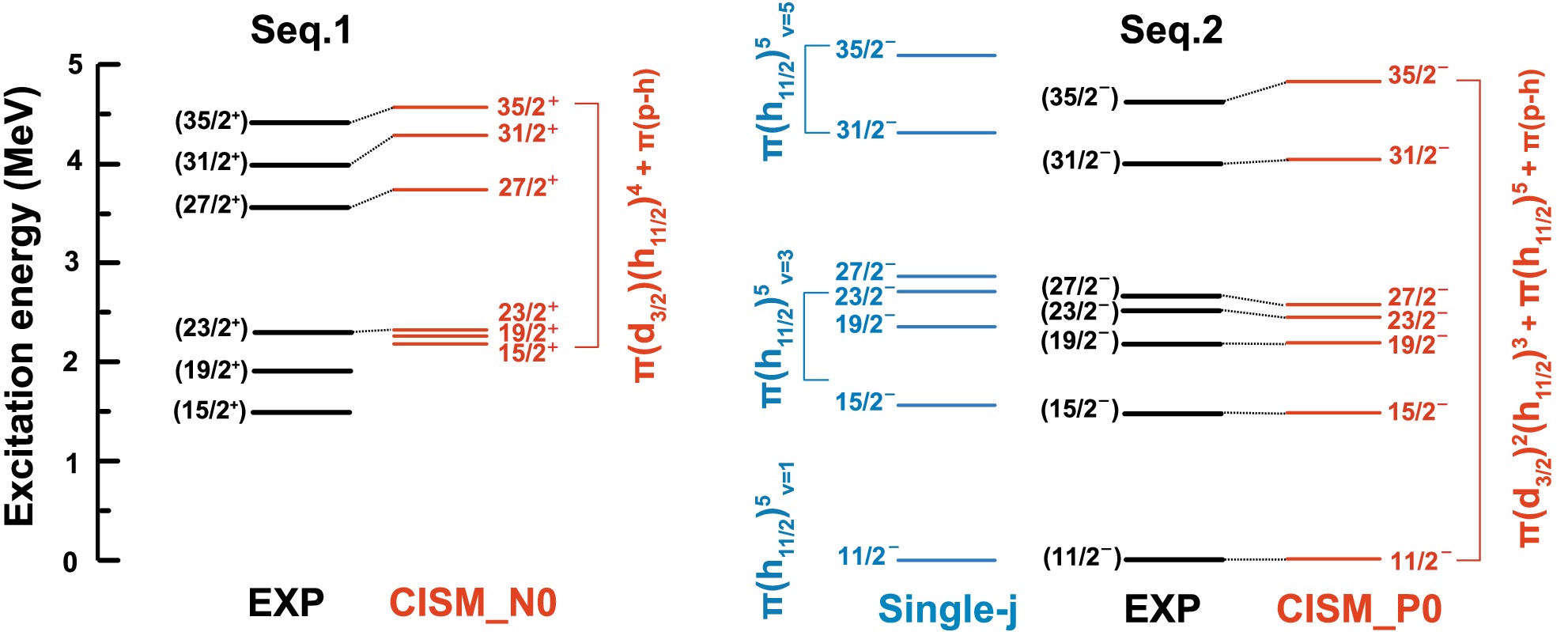
Figure 9. (color online) A comparison is presented between the experimental level energies of Seqs. 1 and 2 and theoretical calculations for the low-lying states. The CISM calculations are indicated in red, and their occupancy numbers are listed in Table 2. The single-j shell-model calculations are taken from Ref. [30] and are indicated in blue.
In Seq. 1, the positive-parity level sequence from
$ (15/2^+) $ to$ (35/2^+) $ has$ \pi d_{3/2} \otimes \pi [(h_{11/2})^4_{\nu=2,4}]_{6^+,8^+,10^+,12^+,14^+,16^+} $ configurations. As shown in Fig. 9, the CISM calculations are roughly 100–300 keV higher than the observed levels from$ (23/2^+) $ to$ (35/2^+) $ , but show a significant deviation (~0.7 MeV) for the$ (15/2^+) $ state due to the collective octupole nature of the$ 3^- $ core state in 150Er [7]. The transitions from$ 15/2^+ $ to$ 11/2^- $ were also found in 147Tb, 149Ho, and 151Tm [6, 19, 32]. It is well known that such collective octupole excitations are beyond the scope of shell model description. Based on the empirical shell-model description of the$ [\pi h_{11/2} \otimes s_{1/2}]_{5^-} $ level in 150Er [7], the considerable energy shift (~0.4 MeV) for the$ (19/2^+) $ state in CISM can be explained by possible configuration mixing with$ \pi s_{1/2} \otimes \pi [(h_{11/2})^4_{\nu=2}]_{10^+} $ .SEQ. 3 Since
$ {35/2^-} $ is the fully aligned state of the$ [\pi (h_{11/2})^5] $ configuration, the states above it in Seq.3 likely involve p-h excitations of the$ ^{146}_{\phantom{1}64} $ Gd82 core. In the A ~ 150 region, the Z = 64 proton subshell gap is approximately 2 MeV [1], while the N = 82 neutron shell gap is close to 4 MeV [2]. Therefore, high-spin states involving proton excitation across the Z = 64 subshell closure are expected to remain yrast immediately above the$ [\pi (h_{11/2})^5]_{35/2^-} $ state.The first state in Seq. 3 at 5859 keV may be of this type. It was assigned as (37/2) in previous research [19]. The spin assignment of the 5859-keV level is changed from 37/2 to 39/2 because the ADO ratio measured in the present work indicates that the 1246-keV transition has quadrupole character. According to the systematics presented in Fig. 10, it can be assigned as the fully aligned five-quasiparticle (5qp)
$ [\pi (h_{11/2}^4g_{7/2}^{-1})]_{39/2^+} $ state. The corresponding 4qp state with the configuration$ \pi (h_{11/2}^3g_{7/2}^{-1}) $ is known in 146Gd (7165 keV) and 148Dy (6263 keV) [7], and was newly established in 150Er (6155 keV) [33].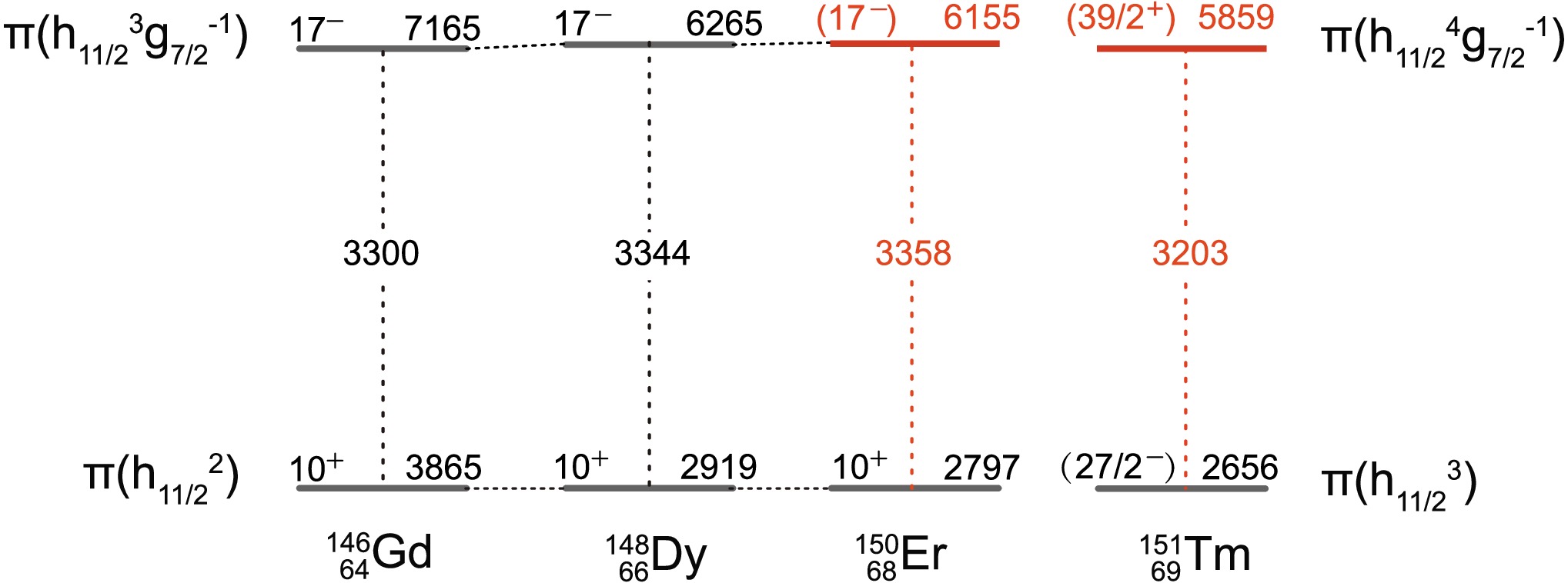
Figure 10. (color online) Systematics of the energy differences between the fully aligned 4qp [
$ \pi (h_{11/2}^3g_{7/2}^{-1})_{17^-} $ ] and 2qp [$ \pi (h_{11/2}^2)_{10^+} $ ] states in 146Gd, 148Dy, and 150Er, and between the 5qp [$ \pi (h_{11/2}^4g_{7/2}^{-1})_{39/2^+} $ ] and 3qp [$ \pi (h_{11/2}^3)_{27/2^-} $ ] states in 151Tm. The corresponding 5qp states in 147Tb and 149Ho have not been identified, whereas the$ (17^-) $ state in 150Er [33] and the$ (39/2^+) $ state in 151Tm were assigned in this experiment and are marked in red.As shown in Fig. 10, the energy differences between the 4qp and 2qp states are ~3300 keV in the neighboring even-mass N = 82 isotones. This energy difference can be regarded as the excitation of one proton from the
$ g_{7/2} $ to the$ h_{11/2} $ orbital. The systematics are expected to remain robust because the Z=64 subshell and the pairing gap are stable in these isotones. For the assumed 5qp state$ \pi (h_{11/2}^4g_{7/2}^{-1})_{39/2^+} $ at 5859 keV in 151Tm, it may originate from the coupling of the$ 17^- $ state in 150Er with a proton in the$ h_{11/2} $ orbital when the Pauli principle is considered. The corresponding energy difference between the 5qp and 3qp states is 3203 keV, which follows the systematics and supports the above configuration assignment for the$ (39/2^+) $ state. The 1246-keV linking transition to the$ (35/2^-) $ state of Seq. 2 is expected to have an M2 character, which is also consistent with its RAC,AD values of ~1.2 ($ \Delta I $ = 2) in Table 1.The higher-spin states from
$ (41/2^+) $ to$ (51/2^+) $ in Seq.3 are then interpreted as 7- or 9-qp configurations involving the excitation of one or two protons from the$ g_{7/2}d_{5/2} $ to the$ h_{11/2}d_{3/2}s_{1/2} $ orbitals. The calculated levels with positive parity are labelled as CISM_P1 in Fig. 11. Their occupation numbers are listed in Table 3. The levels above the$ (39/2^+) $ state are assigned as multiplets of proton p-h excitations across the Z=64 subshell closure. After angular-momentum exhaustion in the$ h_{11/2} $ orbital, the other orbitals in the gdsh model space have the same parity. Thus, the$ \Delta I $ =1 transitions connecting these levels have M1/E2 character, consistent with their$ R_{AC} $ and$ R_{AD} $ values in Section III.C. The calculated excitation energies of the$ (39/2^+) $ to$ (43/2^+) $ states of CISM_P1 are in reasonable agreement with experiment, lying about 300 keV higher than the observed levels. They are dominated by the$ \pi(1p-1h) $ excitations across the$ Z=64 $ subshell with$ J_{max}=(43/2^+) $ . However, for the states above$ (43/2^+) $ , the deviation becomes larger. The$ (45/2_1^+) $ level at 7366 keV and the$ (49/2_1^+) $ level at 8570 keV are about 800 keV lower than the CISM_P1 calculations. The states above$ (51/2_1^+) $ in CISM_P1 deviate substantially, lying ~1 MeV higher than the experimental levels. This discrepancy indicates that these states might be associated with the$ N=82 $ neutron excitations and is discussed below together with the high-spin levels in Seq. 4−5.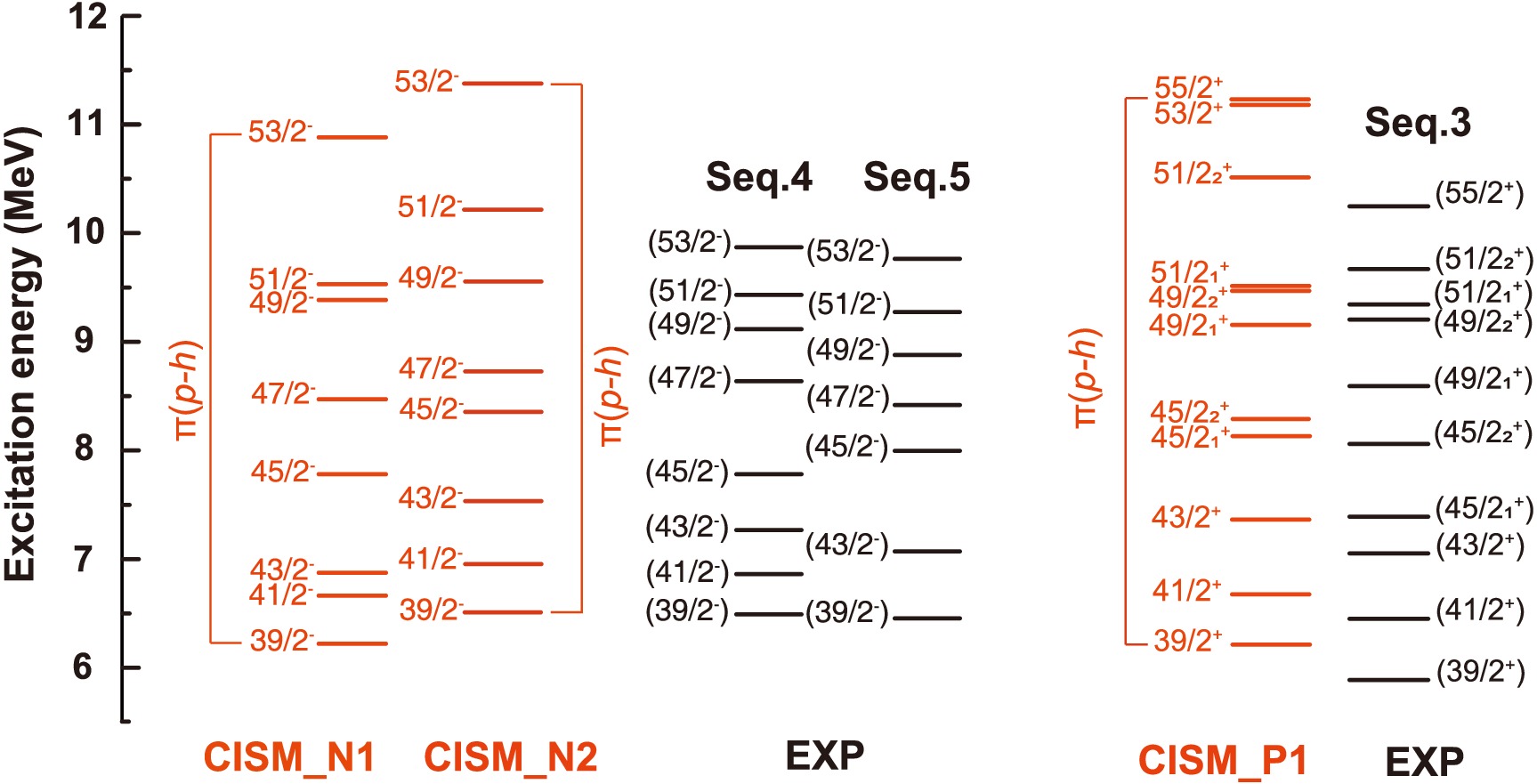
Figure 11. (color online) CISM calculations compared with the experimental levels of Seq. 3–5 in 151Tm. The calculated levels and their configurations are indicated in red.
SEQ. 4−5 The CISM calculations for the states from
$ 39/2^- $ to$ 53/2^- $ are presented in Fig. 11. For 2p-2h excitations across the Z = 64 gap in 151Tm, the maximum spin is$ 51/2 $ , corresponding to the$ \pi (h_{11/2})^{5}\otimes \pi (d_{3/2}s_{1/2})(g_{7/2}^{-1}d_{5/2}^{-1}) $ configuration.For the states above
$ 51/2^- $ , additional proton excitations across the Z = 64 gap would give rise to a large energy gap (~1.5 MeV) between the$ 53/2^- $ and$ 51/2^- $ states in CISM (similar to the states above$ (51/2^+) $ in Seq.3), which deviates significantly from the experimental observation. Therefore, for the states above$ 51/2 $ in Seq.3-5, configurations originating from proton excitations across the Z = 64 gap may not be yrast, as the angular momenta of protons in the$ h_{11/2} $ orbital are exhausted. Thus, neutron excitations across the N = 82 gap might be necessary, and further shell model calculations including neutron excitations are needed.SEQ. 6 Since the 1050-keV de-exciting transition (following the 24-ns isomer at 6909 keV) is not fully detected, the spin parities of the levels in Seq.6 are not assigned and are not compared with CISM calculations. As shown in Fig. 5, the final states at 9458 keV and 8745 keV in Seq. 6 are connected to the initial states (i.e.,
$ (51/2^+_2) $ at 9670 keV and$ (49/2^+_2) $ at 9184 keV) in Seq. 3. The final states at 9458 keV and 8745 keV in Seq. 6 may be associated with neutron core excitations, similar to their initial states in Seq. 3. -
SEQS. 1−2 In Seq. 2, the level sequence from
$ (11/2^-)_{\rm g.s.} $ to$ (35/2^-) $ exhibits a typical seniority pattern of the valence proton$ \pi (h_{11/2})^{5} $ configuration [30, 31]. These states can be described by seniority quantum numbers ν = 1, 3, 5, which represent the number of unpaired protons in the single-j orbital$ 0h_{11/2} $ . This seniority pattern of Seq. 2 was well reproduced in the low-lying states of 150Er, 151Tm, and 152Yb [30]. As shown in Fig. 9, the single-j shell model calculations agree with the experimental levels of Seq. 2 within a 500-keV deviation. When the mixing components of pair scattering and proton$ p-h $ excitations across the Z = 64 subshell are considered, the differences between the experimental results and CISM calculations are less than 200 keV.
Figure 9. (color online) A comparison is presented between the experimental level energies of Seqs. 1 and 2 and theoretical calculations for the low-lying states. The CISM calculations are indicated in red, and their occupancy numbers are listed in Table 2. The single-j shell-model calculations are taken from Ref. [30] and are indicated in blue.
In Seq. 1, the positive-parity level sequence from
$ (15/2^+) $ to$ (35/2^+) $ has$ \pi d_{3/2} \otimes \pi [(h_{11/2})^4_{\nu=2,4}]_{6^+,8^+,10^+,12^+,14^+,16^+} $ configurations. As shown in Fig. 9, the CISM calculations are roughly 100–300 keV higher than the observed levels from$ (23/2^+) $ to$ (35/2^+) $ , but show a significant deviation (~0.7 MeV) for the$ (15/2^+) $ state due to the collective octupole nature of the$ 3^- $ core state in 150Er [7]. The transitions from$ 15/2^+ $ to$ 11/2^- $ were also found in 147Tb, 149Ho, and 151Tm [6, 19, 32]. It is well known that such collective octupole excitations are beyond the scope of shell model description. Based on the empirical shell-model description of the$ [\pi h_{11/2} \otimes s_{1/2}]_{5^-} $ level in 150Er [7], the considerable energy shift (~0.4 MeV) for the$ (19/2^+) $ state in CISM can be explained by possible configuration mixing with$ \pi s_{1/2} \otimes \pi [(h_{11/2})^4_{\nu=2}]_{10^+} $ .SEQ. 3 Since
$ {35/2^-} $ is the fully aligned state of the$ [\pi (h_{11/2})^5] $ configuration, the states above it in Seq.3 likely involve p-h excitations of the$ ^{146}_{\phantom{1}64} $ Gd82 core. In the A ~ 150 region, the Z = 64 proton subshell gap is approximately 2 MeV [1], while the N = 82 neutron shell gap is close to 4 MeV [2]. Therefore, high-spin states involving proton excitation across the Z = 64 subshell closure are expected to remain yrast immediately above the$ [\pi (h_{11/2})^5]_{35/2^-} $ state.The first state in Seq. 3 at 5859 keV may be of this type. It was assigned as (37/2) in previous research [19]. The spin assignment of the 5859-keV level is changed from 37/2 to 39/2 because the ADO ratio measured in the present work indicates that the 1246-keV transition has quadrupole character. According to the systematics presented in Fig. 10, it can be assigned as the fully aligned five-quasiparticle (5qp)
$ [\pi (h_{11/2}^4g_{7/2}^{-1})]_{39/2^+} $ state. The corresponding 4qp state with the configuration$ \pi (h_{11/2}^3g_{7/2}^{-1}) $ is known in 146Gd (7165 keV) and 148Dy (6263 keV) [7], and was newly established in 150Er (6155 keV) [33].
Figure 10. (color online) Systematics of the energy differences between the fully aligned 4qp [
$ \pi (h_{11/2}^3g_{7/2}^{-1})_{17^-} $ ] and 2qp [$ \pi (h_{11/2}^2)_{10^+} $ ] states in 146Gd, 148Dy, and 150Er, and between the 5qp [$ \pi (h_{11/2}^4g_{7/2}^{-1})_{39/2^+} $ ] and 3qp [$ \pi (h_{11/2}^3)_{27/2^-} $ ] states in 151Tm. The corresponding 5qp states in 147Tb and 149Ho have not been identified, whereas the$ (17^-) $ state in 150Er [33] and the$ (39/2^+) $ state in 151Tm were assigned in this experiment and are marked in red.As shown in Fig. 10, the energy differences between the 4qp and 2qp states are ~3300 keV in the neighboring even-mass N = 82 isotones. This energy difference can be regarded as the excitation of one proton from the
$ g_{7/2} $ to the$ h_{11/2} $ orbital. The systematics are expected to remain robust because the Z=64 subshell and the pairing gap are stable in these isotones. For the assumed 5qp state$ \pi (h_{11/2}^4g_{7/2}^{-1})_{39/2^+} $ at 5859 keV in 151Tm, it may originate from the coupling of the$ 17^- $ state in 150Er with a proton in the$ h_{11/2} $ orbital when the Pauli principle is considered. The corresponding energy difference between the 5qp and 3qp states is 3203 keV, which follows the systematics and supports the above configuration assignment for the$ (39/2^+) $ state. The 1246-keV linking transition to the$ (35/2^-) $ state of Seq. 2 is expected to have an M2 character, which is also consistent with its RAC,AD values of ~1.2 ($ \Delta I $ = 2) in Table 1.The higher-spin states from
$ (41/2^+) $ to$ (51/2^+) $ in Seq.3 are then interpreted as 7- or 9-qp configurations involving the excitation of one or two protons from the$ g_{7/2}d_{5/2} $ to the$ h_{11/2}d_{3/2}s_{1/2} $ orbitals. The calculated levels with positive parity are labelled as CISM_P1 in Fig. 11. Their occupation numbers are listed in Table 3. The levels above the$ (39/2^+) $ state are assigned as multiplets of proton p-h excitations across the Z=64 subshell closure. After angular-momentum exhaustion in the$ h_{11/2} $ orbital, the other orbitals in the gdsh model space have the same parity. Thus, the$ \Delta I $ =1 transitions connecting these levels have M1/E2 character, consistent with their$ R_{AC} $ and$ R_{AD} $ values in Section III.C. The calculated excitation energies of the$ (39/2^+) $ to$ (43/2^+) $ states of CISM_P1 are in reasonable agreement with experiment, lying about 300 keV higher than the observed levels. They are dominated by the$ \pi(1p-1h) $ excitations across the$ Z=64 $ subshell with$ J_{max}=(43/2^+) $ . However, for the states above$ (43/2^+) $ , the deviation becomes larger. The$ (45/2_1^+) $ level at 7366 keV and the$ (49/2_1^+) $ level at 8570 keV are about 800 keV lower than the CISM_P1 calculations. The states above$ (51/2_1^+) $ in CISM_P1 deviate substantially, lying ~1 MeV higher than the experimental levels. This discrepancy indicates that these states might be associated with the$ N=82 $ neutron excitations and is discussed below together with the high-spin levels in Seq. 4−5.
Figure 11. (color online) CISM calculations compared with the experimental levels of Seq. 3–5 in 151Tm. The calculated levels and their configurations are indicated in red.
SEQ. 4−5 The CISM calculations for the states from
$ 39/2^- $ to$ 53/2^- $ are presented in Fig. 11. For 2p-2h excitations across the Z = 64 gap in 151Tm, the maximum spin is$ 51/2 $ , corresponding to the$ \pi (h_{11/2})^{5}\otimes \pi (d_{3/2}s_{1/2})(g_{7/2}^{-1}d_{5/2}^{-1}) $ configuration.For the states above
$ 51/2^- $ , additional proton excitations across the Z = 64 gap would give rise to a large energy gap (~1.5 MeV) between the$ 53/2^- $ and$ 51/2^- $ states in CISM (similar to the states above$ (51/2^+) $ in Seq.3), which deviates significantly from the experimental observation. Therefore, for the states above$ 51/2 $ in Seq.3-5, configurations originating from proton excitations across the Z = 64 gap may not be yrast, as the angular momenta of protons in the$ h_{11/2} $ orbital are exhausted. Thus, neutron excitations across the N = 82 gap might be necessary, and further shell model calculations including neutron excitations are needed.SEQ. 6 Since the 1050-keV de-exciting transition (following the 24-ns isomer at 6909 keV) is not fully detected, the spin parities of the levels in Seq.6 are not assigned and are not compared with CISM calculations. As shown in Fig. 5, the final states at 9458 keV and 8745 keV in Seq. 6 are connected to the initial states (i.e.,
$ (51/2^+_2) $ at 9670 keV and$ (49/2^+_2) $ at 9184 keV) in Seq. 3. The final states at 9458 keV and 8745 keV in Seq. 6 may be associated with neutron core excitations, similar to their initial states in Seq. 3. -
SEQS. 1−2 In Seq. 2, the level sequence from
$ (11/2^-)_{\rm g.s.} $ to$ (35/2^-) $ exhibits a typical seniority pattern of the valence proton$ \pi (h_{11/2})^{5} $ configuration [30, 31]. These states can be described by seniority quantum numbers ν = 1, 3, 5, which represent the number of unpaired protons in the single-j orbital$ 0h_{11/2} $ . This seniority pattern of Seq. 2 was well reproduced in the low-lying states of 150Er, 151Tm, and 152Yb [30]. As shown in Fig. 9, the single-j shell model calculations agree with the experimental levels of Seq. 2 within a 500-keV deviation. When the mixing components of pair scattering and proton$ p-h $ excitations across the Z = 64 subshell are considered, the differences between the experimental results and CISM calculations are less than 200 keV.
Figure 9. (color online) A comparison is presented between the experimental level energies of Seqs. 1 and 2 and theoretical calculations for the low-lying states. The CISM calculations are indicated in red, and their occupancy numbers are listed in Table 2. The single-j shell-model calculations are taken from Ref. [30] and are indicated in blue.
In Seq. 1, the positive-parity level sequence from
$ (15/2^+) $ to$ (35/2^+) $ has$ \pi d_{3/2} \otimes \pi [(h_{11/2})^4_{\nu=2,4}]_{6^+,8^+,10^+,12^+,14^+,16^+} $ configurations. As shown in Fig. 9, the CISM calculations are roughly 100–300 keV higher than the observed levels from$ (23/2^+) $ to$ (35/2^+) $ , but show a significant deviation (~0.7 MeV) for the$ (15/2^+) $ state due to the collective octupole nature of the$ 3^- $ core state in 150Er [7]. The transitions from$ 15/2^+ $ to$ 11/2^- $ were also found in 147Tb, 149Ho, and 151Tm [6, 19, 32]. It is well known that such collective octupole excitations are beyond the scope of shell model description. Based on the empirical shell-model description of the$ [\pi h_{11/2} \otimes s_{1/2}]_{5^-} $ level in 150Er [7], the considerable energy shift (~0.4 MeV) for the$ (19/2^+) $ state in CISM can be explained by possible configuration mixing with$ \pi s_{1/2} \otimes \pi [(h_{11/2})^4_{\nu=2}]_{10^+} $ .SEQ. 3 Since
$ {35/2^-} $ is the fully aligned state of the$ [\pi (h_{11/2})^5] $ configuration, the states above it in Seq.3 likely involve p-h excitations of the$ ^{146}_{\phantom{1}64} $ Gd82 core. In the A ~ 150 region, the Z = 64 proton subshell gap is approximately 2 MeV [1], while the N = 82 neutron shell gap is close to 4 MeV [2]. Therefore, high-spin states involving proton excitation across the Z = 64 subshell closure are expected to remain yrast immediately above the$ [\pi (h_{11/2})^5]_{35/2^-} $ state.The first state in Seq. 3 at 5859 keV may be of this type. It was assigned as (37/2) in previous research [19]. The spin assignment of the 5859-keV level is changed from 37/2 to 39/2 because the ADO ratio measured in the present work indicates that the 1246-keV transition has quadrupole character. According to the systematics presented in Fig. 10, it can be assigned as the fully aligned five-quasiparticle (5qp)
$ [\pi (h_{11/2}^4g_{7/2}^{-1})]_{39/2^+} $ state. The corresponding 4qp state with the configuration$ \pi (h_{11/2}^3g_{7/2}^{-1}) $ is known in 146Gd (7165 keV) and 148Dy (6263 keV) [7], and was newly established in 150Er (6155 keV) [33].
Figure 10. (color online) Systematics of the energy differences between the fully aligned 4qp [
$ \pi (h_{11/2}^3g_{7/2}^{-1})_{17^-} $ ] and 2qp [$ \pi (h_{11/2}^2)_{10^+} $ ] states in 146Gd, 148Dy, and 150Er, and between the 5qp [$ \pi (h_{11/2}^4g_{7/2}^{-1})_{39/2^+} $ ] and 3qp [$ \pi (h_{11/2}^3)_{27/2^-} $ ] states in 151Tm. The corresponding 5qp states in 147Tb and 149Ho have not been identified, whereas the$ (17^-) $ state in 150Er [33] and the$ (39/2^+) $ state in 151Tm were assigned in this experiment and are marked in red.As shown in Fig. 10, the energy differences between the 4qp and 2qp states are ~3300 keV in the neighboring even-mass N = 82 isotones. This energy difference can be regarded as the excitation of one proton from the
$ g_{7/2} $ to the$ h_{11/2} $ orbital. The systematics are expected to remain robust because the Z=64 subshell and the pairing gap are stable in these isotones. For the assumed 5qp state$ \pi (h_{11/2}^4g_{7/2}^{-1})_{39/2^+} $ at 5859 keV in 151Tm, it may originate from the coupling of the$ 17^- $ state in 150Er with a proton in the$ h_{11/2} $ orbital when the Pauli principle is considered. The corresponding energy difference between the 5qp and 3qp states is 3203 keV, which follows the systematics and supports the above configuration assignment for the$ (39/2^+) $ state. The 1246-keV linking transition to the$ (35/2^-) $ state of Seq. 2 is expected to have an M2 character, which is also consistent with its RAC,AD values of ~1.2 ($ \Delta I $ = 2) in Table 1.The higher-spin states from
$ (41/2^+) $ to$ (51/2^+) $ in Seq.3 are then interpreted as 7- or 9-qp configurations involving the excitation of one or two protons from the$ g_{7/2}d_{5/2} $ to the$ h_{11/2}d_{3/2}s_{1/2} $ orbitals. The calculated levels with positive parity are labelled as CISM_P1 in Fig. 11. Their occupation numbers are listed in Table 3. The levels above the$ (39/2^+) $ state are assigned as multiplets of proton p-h excitations across the Z=64 subshell closure. After angular-momentum exhaustion in the$ h_{11/2} $ orbital, the other orbitals in the gdsh model space have the same parity. Thus, the$ \Delta I $ =1 transitions connecting these levels have M1/E2 character, consistent with their$ R_{AC} $ and$ R_{AD} $ values in Section III.C. The calculated excitation energies of the$ (39/2^+) $ to$ (43/2^+) $ states of CISM_P1 are in reasonable agreement with experiment, lying about 300 keV higher than the observed levels. They are dominated by the$ \pi(1p-1h) $ excitations across the$ Z=64 $ subshell with$ J_{max}=(43/2^+) $ . However, for the states above$ (43/2^+) $ , the deviation becomes larger. The$ (45/2_1^+) $ level at 7366 keV and the$ (49/2_1^+) $ level at 8570 keV are about 800 keV lower than the CISM_P1 calculations. The states above$ (51/2_1^+) $ in CISM_P1 deviate substantially, lying ~1 MeV higher than the experimental levels. This discrepancy indicates that these states might be associated with the$ N=82 $ neutron excitations and is discussed below together with the high-spin levels in Seq. 4−5.
Figure 11. (color online) CISM calculations compared with the experimental levels of Seq. 3–5 in 151Tm. The calculated levels and their configurations are indicated in red.
SEQ. 4−5 The CISM calculations for the states from
$ 39/2^- $ to$ 53/2^- $ are presented in Fig. 11. For 2p-2h excitations across the Z = 64 gap in 151Tm, the maximum spin is$ 51/2 $ , corresponding to the$ \pi (h_{11/2})^{5}\otimes \pi (d_{3/2}s_{1/2})(g_{7/2}^{-1}d_{5/2}^{-1}) $ configuration.For the states above
$ 51/2^- $ , additional proton excitations across the Z = 64 gap would give rise to a large energy gap (~1.5 MeV) between the$ 53/2^- $ and$ 51/2^- $ states in CISM (similar to the states above$ (51/2^+) $ in Seq.3), which deviates significantly from the experimental observation. Therefore, for the states above$ 51/2 $ in Seq.3-5, configurations originating from proton excitations across the Z = 64 gap may not be yrast, as the angular momenta of protons in the$ h_{11/2} $ orbital are exhausted. Thus, neutron excitations across the N = 82 gap might be necessary, and further shell model calculations including neutron excitations are needed.SEQ. 6 Since the 1050-keV de-exciting transition (following the 24-ns isomer at 6909 keV) is not fully detected, the spin parities of the levels in Seq.6 are not assigned and are not compared with CISM calculations. As shown in Fig. 5, the final states at 9458 keV and 8745 keV in Seq. 6 are connected to the initial states (i.e.,
$ (51/2^+_2) $ at 9670 keV and$ (49/2^+_2) $ at 9184 keV) in Seq. 3. The final states at 9458 keV and 8745 keV in Seq. 6 may be associated with neutron core excitations, similar to their initial states in Seq. 3. -
SEQS. 1−2 In Seq. 2, the level sequence from
$ (11/2^-)_{\rm g.s.} $ to$ (35/2^-) $ exhibits a typical seniority pattern of the valence proton$ \pi (h_{11/2})^{5} $ configuration [30, 31]. These states can be described by seniority quantum numbers ν = 1, 3, 5, which represent the number of unpaired protons in the single-j orbital$ 0h_{11/2} $ . This seniority pattern of Seq. 2 was well reproduced in the low-lying states of 150Er, 151Tm, and 152Yb [30]. As shown in Fig. 9, the single-j shell model calculations agree with the experimental levels of Seq. 2 within a 500-keV deviation. When the mixing components of pair scattering and proton$ p-h $ excitations across the Z = 64 subshell are considered, the differences between the experimental results and CISM calculations are less than 200 keV.
Figure 9. (color online) A comparison is presented between the experimental level energies of Seqs. 1 and 2 and theoretical calculations for the low-lying states. The CISM calculations are indicated in red, and their occupancy numbers are listed in Table 2. The single-j shell-model calculations are taken from Ref. [30] and are indicated in blue.
In Seq. 1, the positive-parity level sequence from
$ (15/2^+) $ to$ (35/2^+) $ has$ \pi d_{3/2} \otimes \pi [(h_{11/2})^4_{\nu=2,4}]_{6^+,8^+,10^+,12^+,14^+,16^+} $ configurations. As shown in Fig. 9, the CISM calculations are roughly 100–300 keV higher than the observed levels from$ (23/2^+) $ to$ (35/2^+) $ , but show a significant deviation (~0.7 MeV) for the$ (15/2^+) $ state due to the collective octupole nature of the$ 3^- $ core state in 150Er [7]. The transitions from$ 15/2^+ $ to$ 11/2^- $ were also found in 147Tb, 149Ho, and 151Tm [6, 19, 32]. It is well known that such collective octupole excitations are beyond the scope of shell model description. Based on the empirical shell-model description of the$ [\pi h_{11/2} \otimes s_{1/2}]_{5^-} $ level in 150Er [7], the considerable energy shift (~0.4 MeV) for the$ (19/2^+) $ state in CISM can be explained by possible configuration mixing with$ \pi s_{1/2} \otimes \pi [(h_{11/2})^4_{\nu=2}]_{10^+} $ .SEQ. 3 Since
$ {35/2^-} $ is the fully aligned state of the$ [\pi (h_{11/2})^5] $ configuration, the states above it in Seq.3 likely involve p-h excitations of the$ ^{146}_{\phantom{1}64} $ Gd82 core. In the A ~ 150 region, the Z = 64 proton subshell gap is approximately 2 MeV [1], while the N = 82 neutron shell gap is close to 4 MeV [2]. Therefore, high-spin states involving proton excitation across the Z = 64 subshell closure are expected to remain yrast immediately above the$ [\pi (h_{11/2})^5]_{35/2^-} $ state.The first state in Seq. 3 at 5859 keV may be of this type. It was assigned as (37/2) in previous research [19]. The spin assignment of the 5859-keV level is changed from 37/2 to 39/2 because the ADO ratio measured in the present work indicates that the 1246-keV transition has quadrupole character. According to the systematics presented in Fig. 10, it can be assigned as the fully aligned five-quasiparticle (5qp)
$ [\pi (h_{11/2}^4g_{7/2}^{-1})]_{39/2^+} $ state. The corresponding 4qp state with the configuration$ \pi (h_{11/2}^3g_{7/2}^{-1}) $ is known in 146Gd (7165 keV) and 148Dy (6263 keV) [7], and was newly established in 150Er (6155 keV) [33].
Figure 10. (color online) Systematics of the energy differences between the fully aligned 4qp [
$ \pi (h_{11/2}^3g_{7/2}^{-1})_{17^-} $ ] and 2qp [$ \pi (h_{11/2}^2)_{10^+} $ ] states in 146Gd, 148Dy, and 150Er, and between the 5qp [$ \pi (h_{11/2}^4g_{7/2}^{-1})_{39/2^+} $ ] and 3qp [$ \pi (h_{11/2}^3)_{27/2^-} $ ] states in 151Tm. The corresponding 5qp states in 147Tb and 149Ho have not been identified, whereas the$ (17^-) $ state in 150Er [33] and the$ (39/2^+) $ state in 151Tm were assigned in this experiment and are marked in red.As shown in Fig. 10, the energy differences between the 4qp and 2qp states are ~3300 keV in the neighboring even-mass N = 82 isotones. This energy difference can be regarded as the excitation of one proton from the
$ g_{7/2} $ to the$ h_{11/2} $ orbital. The systematics are expected to remain robust because the Z=64 subshell and the pairing gap are stable in these isotones. For the assumed 5qp state$ \pi (h_{11/2}^4g_{7/2}^{-1})_{39/2^+} $ at 5859 keV in 151Tm, it may originate from the coupling of the$ 17^- $ state in 150Er with a proton in the$ h_{11/2} $ orbital when the Pauli principle is considered. The corresponding energy difference between the 5qp and 3qp states is 3203 keV, which follows the systematics and supports the above configuration assignment for the$ (39/2^+) $ state. The 1246-keV linking transition to the$ (35/2^-) $ state of Seq. 2 is expected to have an M2 character, which is also consistent with its RAC,AD values of ~1.2 ($ \Delta I $ = 2) in Table 1.The higher-spin states from
$ (41/2^+) $ to$ (51/2^+) $ in Seq.3 are then interpreted as 7- or 9-qp configurations involving the excitation of one or two protons from the$ g_{7/2}d_{5/2} $ to the$ h_{11/2}d_{3/2}s_{1/2} $ orbitals. The calculated levels with positive parity are labelled as CISM_P1 in Fig. 11. Their occupation numbers are listed in Table 3. The levels above the$ (39/2^+) $ state are assigned as multiplets of proton p-h excitations across the Z=64 subshell closure. After angular-momentum exhaustion in the$ h_{11/2} $ orbital, the other orbitals in the gdsh model space have the same parity. Thus, the$ \Delta I $ =1 transitions connecting these levels have M1/E2 character, consistent with their$ R_{AC} $ and$ R_{AD} $ values in Section III.C. The calculated excitation energies of the$ (39/2^+) $ to$ (43/2^+) $ states of CISM_P1 are in reasonable agreement with experiment, lying about 300 keV higher than the observed levels. They are dominated by the$ \pi(1p-1h) $ excitations across the$ Z=64 $ subshell with$ J_{max}=(43/2^+) $ . However, for the states above$ (43/2^+) $ , the deviation becomes larger. The$ (45/2_1^+) $ level at 7366 keV and the$ (49/2_1^+) $ level at 8570 keV are about 800 keV lower than the CISM_P1 calculations. The states above$ (51/2_1^+) $ in CISM_P1 deviate substantially, lying ~1 MeV higher than the experimental levels. This discrepancy indicates that these states might be associated with the$ N=82 $ neutron excitations and is discussed below together with the high-spin levels in Seq. 4−5.
Figure 11. (color online) CISM calculations compared with the experimental levels of Seq. 3–5 in 151Tm. The calculated levels and their configurations are indicated in red.
SEQ. 4−5 The CISM calculations for the states from
$ 39/2^- $ to$ 53/2^- $ are presented in Fig. 11. For 2p-2h excitations across the Z = 64 gap in 151Tm, the maximum spin is$ 51/2 $ , corresponding to the$ \pi (h_{11/2})^{5}\otimes \pi (d_{3/2}s_{1/2})(g_{7/2}^{-1}d_{5/2}^{-1}) $ configuration.For the states above
$ 51/2^- $ , additional proton excitations across the Z = 64 gap would give rise to a large energy gap (~1.5 MeV) between the$ 53/2^- $ and$ 51/2^- $ states in CISM (similar to the states above$ (51/2^+) $ in Seq.3), which deviates significantly from the experimental observation. Therefore, for the states above$ 51/2 $ in Seq.3-5, configurations originating from proton excitations across the Z = 64 gap may not be yrast, as the angular momenta of protons in the$ h_{11/2} $ orbital are exhausted. Thus, neutron excitations across the N = 82 gap might be necessary, and further shell model calculations including neutron excitations are needed.SEQ. 6 Since the 1050-keV de-exciting transition (following the 24-ns isomer at 6909 keV) is not fully detected, the spin parities of the levels in Seq.6 are not assigned and are not compared with CISM calculations. As shown in Fig. 5, the final states at 9458 keV and 8745 keV in Seq. 6 are connected to the initial states (i.e.,
$ (51/2^+_2) $ at 9670 keV and$ (49/2^+_2) $ at 9184 keV) in Seq. 3. The final states at 9458 keV and 8745 keV in Seq. 6 may be associated with neutron core excitations, similar to their initial states in Seq. 3. -
SEQS. 1−2 In Seq. 2, the level sequence from
$ (11/2^-)_{\rm g.s.} $ to$ (35/2^-) $ exhibits a typical seniority pattern of the valence proton$ \pi (h_{11/2})^{5} $ configuration [30, 31]. These states can be described by seniority quantum numbers ν = 1, 3, 5, which represent the number of unpaired protons in the single-j orbital$ 0h_{11/2} $ . This seniority pattern of Seq. 2 was well reproduced in the low-lying states of 150Er, 151Tm, and 152Yb [30]. As shown in Fig. 9, the single-j shell model calculations agree with the experimental levels of Seq. 2 within a 500-keV deviation. When the mixing components of pair scattering and proton$ p-h $ excitations across the Z = 64 subshell are considered, the differences between the experimental results and CISM calculations are less than 200 keV.
Figure 9. (color online) A comparison is presented between the experimental level energies of Seqs. 1 and 2 and theoretical calculations for the low-lying states. The CISM calculations are indicated in red, and their occupancy numbers are listed in Table 2. The single-j shell-model calculations are taken from Ref. [30] and are indicated in blue.
In Seq. 1, the positive-parity level sequence from
$ (15/2^+) $ to$ (35/2^+) $ has$ \pi d_{3/2} \otimes \pi [(h_{11/2})^4_{\nu=2,4}]_{6^+,8^+,10^+,12^+,14^+,16^+} $ configurations. As shown in Fig. 9, the CISM calculations are roughly 100–300 keV higher than the observed levels from$ (23/2^+) $ to$ (35/2^+) $ , but show a significant deviation (~0.7 MeV) for the$ (15/2^+) $ state due to the collective octupole nature of the$ 3^- $ core state in 150Er [7]. The transitions from$ 15/2^+ $ to$ 11/2^- $ were also found in 147Tb, 149Ho, and 151Tm [6, 19, 32]. It is well known that such collective octupole excitations are beyond the scope of shell model description. Based on the empirical shell-model description of the$ [\pi h_{11/2} \otimes s_{1/2}]_{5^-} $ level in 150Er [7], the considerable energy shift (~0.4 MeV) for the$ (19/2^+) $ state in CISM can be explained by possible configuration mixing with$ \pi s_{1/2} \otimes \pi [(h_{11/2})^4_{\nu=2}]_{10^+} $ .SEQ. 3 Since
$ {35/2^-} $ is the fully aligned state of the$ [\pi (h_{11/2})^5] $ configuration, the states above it in Seq.3 likely involve p-h excitations of the$ ^{146}_{\phantom{1}64} $ Gd82 core. In the A ~ 150 region, the Z = 64 proton subshell gap is approximately 2 MeV [1], while the N = 82 neutron shell gap is close to 4 MeV [2]. Therefore, high-spin states involving proton excitation across the Z = 64 subshell closure are expected to remain yrast immediately above the$ [\pi (h_{11/2})^5]_{35/2^-} $ state.The first state in Seq. 3 at 5859 keV may be of this type. It was assigned as (37/2) in previous research [19]. The spin assignment of the 5859-keV level is changed from 37/2 to 39/2 because the ADO ratio measured in the present work indicates that the 1246-keV transition has quadrupole character. According to the systematics presented in Fig. 10, it can be assigned as the fully aligned five-quasiparticle (5qp)
$ [\pi (h_{11/2}^4g_{7/2}^{-1})]_{39/2^+} $ state. The corresponding 4qp state with the configuration$ \pi (h_{11/2}^3g_{7/2}^{-1}) $ is known in 146Gd (7165 keV) and 148Dy (6263 keV) [7], and was newly established in 150Er (6155 keV) [33].
Figure 10. (color online) Systematics of the energy differences between the fully aligned 4qp [
$ \pi (h_{11/2}^3g_{7/2}^{-1})_{17^-} $ ] and 2qp [$ \pi (h_{11/2}^2)_{10^+} $ ] states in 146Gd, 148Dy, and 150Er, and between the 5qp [$ \pi (h_{11/2}^4g_{7/2}^{-1})_{39/2^+} $ ] and 3qp [$ \pi (h_{11/2}^3)_{27/2^-} $ ] states in 151Tm. The corresponding 5qp states in 147Tb and 149Ho have not been identified, whereas the$ (17^-) $ state in 150Er [33] and the$ (39/2^+) $ state in 151Tm were assigned in this experiment and are marked in red.As shown in Fig. 10, the energy differences between the 4qp and 2qp states are ~3300 keV in the neighboring even-mass N = 82 isotones. This energy difference can be regarded as the excitation of one proton from the
$ g_{7/2} $ to the$ h_{11/2} $ orbital. The systematics are expected to remain robust because the Z=64 subshell and the pairing gap are stable in these isotones. For the assumed 5qp state$ \pi (h_{11/2}^4g_{7/2}^{-1})_{39/2^+} $ at 5859 keV in 151Tm, it may originate from the coupling of the$ 17^- $ state in 150Er with a proton in the$ h_{11/2} $ orbital when the Pauli principle is considered. The corresponding energy difference between the 5qp and 3qp states is 3203 keV, which follows the systematics and supports the above configuration assignment for the$ (39/2^+) $ state. The 1246-keV linking transition to the$ (35/2^-) $ state of Seq. 2 is expected to have an M2 character, which is also consistent with its RAC,AD values of ~1.2 ($ \Delta I $ = 2) in Table 1.The higher-spin states from
$ (41/2^+) $ to$ (51/2^+) $ in Seq.3 are then interpreted as 7- or 9-qp configurations involving the excitation of one or two protons from the$ g_{7/2}d_{5/2} $ to the$ h_{11/2}d_{3/2}s_{1/2} $ orbitals. The calculated levels with positive parity are labelled as CISM_P1 in Fig. 11. Their occupation numbers are listed in Table 3. The levels above the$ (39/2^+) $ state are assigned as multiplets of proton p-h excitations across the Z=64 subshell closure. After angular-momentum exhaustion in the$ h_{11/2} $ orbital, the other orbitals in the gdsh model space have the same parity. Thus, the$ \Delta I $ =1 transitions connecting these levels have M1/E2 character, consistent with their$ R_{AC} $ and$ R_{AD} $ values in Section III.C. The calculated excitation energies of the$ (39/2^+) $ to$ (43/2^+) $ states of CISM_P1 are in reasonable agreement with experiment, lying about 300 keV higher than the observed levels. They are dominated by the$ \pi(1p-1h) $ excitations across the$ Z=64 $ subshell with$ J_{max}=(43/2^+) $ . However, for the states above$ (43/2^+) $ , the deviation becomes larger. The$ (45/2_1^+) $ level at 7366 keV and the$ (49/2_1^+) $ level at 8570 keV are about 800 keV lower than the CISM_P1 calculations. The states above$ (51/2_1^+) $ in CISM_P1 deviate substantially, lying ~1 MeV higher than the experimental levels. This discrepancy indicates that these states might be associated with the$ N=82 $ neutron excitations and is discussed below together with the high-spin levels in Seq. 4−5.
Figure 11. (color online) CISM calculations compared with the experimental levels of Seq. 3–5 in 151Tm. The calculated levels and their configurations are indicated in red.
SEQ. 4−5 The CISM calculations for the states from
$ 39/2^- $ to$ 53/2^- $ are presented in Fig. 11. For 2p-2h excitations across the Z = 64 gap in 151Tm, the maximum spin is$ 51/2 $ , corresponding to the$ \pi (h_{11/2})^{5}\otimes \pi (d_{3/2}s_{1/2})(g_{7/2}^{-1}d_{5/2}^{-1}) $ configuration.For the states above
$ 51/2^- $ , additional proton excitations across the Z = 64 gap would give rise to a large energy gap (~1.5 MeV) between the$ 53/2^- $ and$ 51/2^- $ states in CISM (similar to the states above$ (51/2^+) $ in Seq.3), which deviates significantly from the experimental observation. Therefore, for the states above$ 51/2 $ in Seq.3-5, configurations originating from proton excitations across the Z = 64 gap may not be yrast, as the angular momenta of protons in the$ h_{11/2} $ orbital are exhausted. Thus, neutron excitations across the N = 82 gap might be necessary, and further shell model calculations including neutron excitations are needed.SEQ. 6 Since the 1050-keV de-exciting transition (following the 24-ns isomer at 6909 keV) is not fully detected, the spin parities of the levels in Seq.6 are not assigned and are not compared with CISM calculations. As shown in Fig. 5, the final states at 9458 keV and 8745 keV in Seq. 6 are connected to the initial states (i.e.,
$ (51/2^+_2) $ at 9670 keV and$ (49/2^+_2) $ at 9184 keV) in Seq. 3. The final states at 9458 keV and 8745 keV in Seq. 6 may be associated with neutron core excitations, similar to their initial states in Seq. 3. -
SEQS. 1−2 In Seq. 2, the level sequence from
$ (11/2^-)_{\rm g.s.} $ to$ (35/2^-) $ exhibits a typical seniority pattern of the valence proton$ \pi (h_{11/2})^{5} $ configuration [30, 31]. These states can be described by seniority quantum numbers ν = 1, 3, 5, which represent the number of unpaired protons in the single-j orbital$ 0h_{11/2} $ . This seniority pattern of Seq. 2 was well reproduced in the low-lying states of 150Er, 151Tm, and 152Yb [30]. As shown in Fig. 9, the single-j shell model calculations agree with the experimental levels of Seq. 2 within a 500-keV deviation. When the mixing components of pair scattering and proton$ p-h $ excitations across the Z = 64 subshell are considered, the differences between the experimental results and CISM calculations are less than 200 keV.
Figure 9. (color online) A comparison is presented between the experimental level energies of Seqs. 1 and 2 and theoretical calculations for the low-lying states. The CISM calculations are indicated in red, and their occupancy numbers are listed in Table 2. The single-j shell-model calculations are taken from Ref. [30] and are indicated in blue.
In Seq. 1, the positive-parity level sequence from
$ (15/2^+) $ to$ (35/2^+) $ has$ \pi d_{3/2} \otimes \pi [(h_{11/2})^4_{\nu=2,4}]_{6^+,8^+,10^+,12^+,14^+,16^+} $ configurations. As shown in Fig. 9, the CISM calculations are roughly 100–300 keV higher than the observed levels from$ (23/2^+) $ to$ (35/2^+) $ , but show a significant deviation (~0.7 MeV) for the$ (15/2^+) $ state due to the collective octupole nature of the$ 3^- $ core state in 150Er [7]. The transitions from$ 15/2^+ $ to$ 11/2^- $ were also found in 147Tb, 149Ho, and 151Tm [6, 19, 32]. It is well known that such collective octupole excitations are beyond the scope of shell model description. Based on the empirical shell-model description of the$ [\pi h_{11/2} \otimes s_{1/2}]_{5^-} $ level in 150Er [7], the considerable energy shift (~0.4 MeV) for the$ (19/2^+) $ state in CISM can be explained by possible configuration mixing with$ \pi s_{1/2} \otimes \pi [(h_{11/2})^4_{\nu=2}]_{10^+} $ .SEQ. 3 Since
$ {35/2^-} $ is the fully aligned state of the$ [\pi (h_{11/2})^5] $ configuration, the states above it in Seq.3 likely involve p-h excitations of the$ ^{146}_{\phantom{1}64} $ Gd82 core. In the A ~ 150 region, the Z = 64 proton subshell gap is approximately 2 MeV [1], while the N = 82 neutron shell gap is close to 4 MeV [2]. Therefore, high-spin states involving proton excitation across the Z = 64 subshell closure are expected to remain yrast immediately above the$ [\pi (h_{11/2})^5]_{35/2^-} $ state.The first state in Seq. 3 at 5859 keV may be of this type. It was assigned as (37/2) in previous research [19]. The spin assignment of the 5859-keV level is changed from 37/2 to 39/2 because the ADO ratio measured in the present work indicates that the 1246-keV transition has quadrupole character. According to the systematics presented in Fig. 10, it can be assigned as the fully aligned five-quasiparticle (5qp)
$ [\pi (h_{11/2}^4g_{7/2}^{-1})]_{39/2^+} $ state. The corresponding 4qp state with the configuration$ \pi (h_{11/2}^3g_{7/2}^{-1}) $ is known in 146Gd (7165 keV) and 148Dy (6263 keV) [7], and was newly established in 150Er (6155 keV) [33].
Figure 10. (color online) Systematics of the energy differences between the fully aligned 4qp [
$ \pi (h_{11/2}^3g_{7/2}^{-1})_{17^-} $ ] and 2qp [$ \pi (h_{11/2}^2)_{10^+} $ ] states in 146Gd, 148Dy, and 150Er, and between the 5qp [$ \pi (h_{11/2}^4g_{7/2}^{-1})_{39/2^+} $ ] and 3qp [$ \pi (h_{11/2}^3)_{27/2^-} $ ] states in 151Tm. The corresponding 5qp states in 147Tb and 149Ho have not been identified, whereas the$ (17^-) $ state in 150Er [33] and the$ (39/2^+) $ state in 151Tm were assigned in this experiment and are marked in red.As shown in Fig. 10, the energy differences between the 4qp and 2qp states are ~3300 keV in the neighboring even-mass N = 82 isotones. This energy difference can be regarded as the excitation of one proton from the
$ g_{7/2} $ to the$ h_{11/2} $ orbital. The systematics are expected to remain robust because the Z=64 subshell and the pairing gap are stable in these isotones. For the assumed 5qp state$ \pi (h_{11/2}^4g_{7/2}^{-1})_{39/2^+} $ at 5859 keV in 151Tm, it may originate from the coupling of the$ 17^- $ state in 150Er with a proton in the$ h_{11/2} $ orbital when the Pauli principle is considered. The corresponding energy difference between the 5qp and 3qp states is 3203 keV, which follows the systematics and supports the above configuration assignment for the$ (39/2^+) $ state. The 1246-keV linking transition to the$ (35/2^-) $ state of Seq. 2 is expected to have an M2 character, which is also consistent with its RAC,AD values of ~1.2 ($ \Delta I $ = 2) in Table 1.The higher-spin states from
$ (41/2^+) $ to$ (51/2^+) $ in Seq.3 are then interpreted as 7- or 9-qp configurations involving the excitation of one or two protons from the$ g_{7/2}d_{5/2} $ to the$ h_{11/2}d_{3/2}s_{1/2} $ orbitals. The calculated levels with positive parity are labelled as CISM_P1 in Fig. 11. Their occupation numbers are listed in Table 3. The levels above the$ (39/2^+) $ state are assigned as multiplets of proton p-h excitations across the Z=64 subshell closure. After angular-momentum exhaustion in the$ h_{11/2} $ orbital, the other orbitals in the gdsh model space have the same parity. Thus, the$ \Delta I $ =1 transitions connecting these levels have M1/E2 character, consistent with their$ R_{AC} $ and$ R_{AD} $ values in Section III.C. The calculated excitation energies of the$ (39/2^+) $ to$ (43/2^+) $ states of CISM_P1 are in reasonable agreement with experiment, lying about 300 keV higher than the observed levels. They are dominated by the$ \pi(1p-1h) $ excitations across the$ Z=64 $ subshell with$ J_{max}=(43/2^+) $ . However, for the states above$ (43/2^+) $ , the deviation becomes larger. The$ (45/2_1^+) $ level at 7366 keV and the$ (49/2_1^+) $ level at 8570 keV are about 800 keV lower than the CISM_P1 calculations. The states above$ (51/2_1^+) $ in CISM_P1 deviate substantially, lying ~1 MeV higher than the experimental levels. This discrepancy indicates that these states might be associated with the$ N=82 $ neutron excitations and is discussed below together with the high-spin levels in Seq. 4−5.
Figure 11. (color online) CISM calculations compared with the experimental levels of Seq. 3–5 in 151Tm. The calculated levels and their configurations are indicated in red.
SEQ. 4−5 The CISM calculations for the states from
$ 39/2^- $ to$ 53/2^- $ are presented in Fig. 11. For 2p-2h excitations across the Z = 64 gap in 151Tm, the maximum spin is$ 51/2 $ , corresponding to the$ \pi (h_{11/2})^{5}\otimes \pi (d_{3/2}s_{1/2})(g_{7/2}^{-1}d_{5/2}^{-1}) $ configuration.For the states above
$ 51/2^- $ , additional proton excitations across the Z = 64 gap would give rise to a large energy gap (~1.5 MeV) between the$ 53/2^- $ and$ 51/2^- $ states in CISM (similar to the states above$ (51/2^+) $ in Seq.3), which deviates significantly from the experimental observation. Therefore, for the states above$ 51/2 $ in Seq.3-5, configurations originating from proton excitations across the Z = 64 gap may not be yrast, as the angular momenta of protons in the$ h_{11/2} $ orbital are exhausted. Thus, neutron excitations across the N = 82 gap might be necessary, and further shell model calculations including neutron excitations are needed.SEQ. 6 Since the 1050-keV de-exciting transition (following the 24-ns isomer at 6909 keV) is not fully detected, the spin parities of the levels in Seq.6 are not assigned and are not compared with CISM calculations. As shown in Fig. 5, the final states at 9458 keV and 8745 keV in Seq. 6 are connected to the initial states (i.e.,
$ (51/2^+_2) $ at 9670 keV and$ (49/2^+_2) $ at 9184 keV) in Seq. 3. The final states at 9458 keV and 8745 keV in Seq. 6 may be associated with neutron core excitations, similar to their initial states in Seq. 3. -
SEQS. 1−2 In Seq. 2, the level sequence from
$ (11/2^-)_{\rm g.s.} $ to$ (35/2^-) $ exhibits a typical seniority pattern of the valence proton$ \pi (h_{11/2})^{5} $ configuration [30, 31]. These states can be described by seniority quantum numbers ν = 1, 3, 5, which represent the number of unpaired protons in the single-j orbital$ 0h_{11/2} $ . This seniority pattern of Seq. 2 was well reproduced in the low-lying states of 150Er, 151Tm, and 152Yb [30]. As shown in Fig. 9, the single-j shell model calculations agree with the experimental levels of Seq. 2 within a 500-keV deviation. When the mixing components of pair scattering and proton$ p-h $ excitations across the Z = 64 subshell are considered, the differences between the experimental results and CISM calculations are less than 200 keV.
Figure 9. (color online) A comparison is presented between the experimental level energies of Seqs. 1 and 2 and theoretical calculations for the low-lying states. The CISM calculations are indicated in red, and their occupancy numbers are listed in Table 2. The single-j shell-model calculations are taken from Ref. [30] and are indicated in blue.
In Seq. 1, the positive-parity level sequence from
$ (15/2^+) $ to$ (35/2^+) $ has$ \pi d_{3/2} \otimes \pi [(h_{11/2})^4_{\nu=2,4}]_{6^+,8^+,10^+,12^+,14^+,16^+} $ configurations. As shown in Fig. 9, the CISM calculations are roughly 100–300 keV higher than the observed levels from$ (23/2^+) $ to$ (35/2^+) $ , but show a significant deviation (~0.7 MeV) for the$ (15/2^+) $ state due to the collective octupole nature of the$ 3^- $ core state in 150Er [7]. The transitions from$ 15/2^+ $ to$ 11/2^- $ were also found in 147Tb, 149Ho, and 151Tm [6, 19, 32]. It is well known that such collective octupole excitations are beyond the scope of shell model description. Based on the empirical shell-model description of the$ [\pi h_{11/2} \otimes s_{1/2}]_{5^-} $ level in 150Er [7], the considerable energy shift (~0.4 MeV) for the$ (19/2^+) $ state in CISM can be explained by possible configuration mixing with$ \pi s_{1/2} \otimes \pi [(h_{11/2})^4_{\nu=2}]_{10^+} $ .SEQ. 3 Since
$ {35/2^-} $ is the fully aligned state of the$ [\pi (h_{11/2})^5] $ configuration, the states above it in Seq.3 likely involve p-h excitations of the$ ^{146}_{\phantom{1}64} $ Gd82 core. In the A ~ 150 region, the Z = 64 proton subshell gap is approximately 2 MeV [1], while the N = 82 neutron shell gap is close to 4 MeV [2]. Therefore, high-spin states involving proton excitation across the Z = 64 subshell closure are expected to remain yrast immediately above the$ [\pi (h_{11/2})^5]_{35/2^-} $ state.The first state in Seq. 3 at 5859 keV may be of this type. It was assigned as (37/2) in previous research [19]. The spin assignment of the 5859-keV level is changed from 37/2 to 39/2 because the ADO ratio measured in the present work indicates that the 1246-keV transition has quadrupole character. According to the systematics presented in Fig. 10, it can be assigned as the fully aligned five-quasiparticle (5qp)
$ [\pi (h_{11/2}^4g_{7/2}^{-1})]_{39/2^+} $ state. The corresponding 4qp state with the configuration$ \pi (h_{11/2}^3g_{7/2}^{-1}) $ is known in 146Gd (7165 keV) and 148Dy (6263 keV) [7], and was newly established in 150Er (6155 keV) [33].
Figure 10. (color online) Systematics of the energy differences between the fully aligned 4qp [
$ \pi (h_{11/2}^3g_{7/2}^{-1})_{17^-} $ ] and 2qp [$ \pi (h_{11/2}^2)_{10^+} $ ] states in 146Gd, 148Dy, and 150Er, and between the 5qp [$ \pi (h_{11/2}^4g_{7/2}^{-1})_{39/2^+} $ ] and 3qp [$ \pi (h_{11/2}^3)_{27/2^-} $ ] states in 151Tm. The corresponding 5qp states in 147Tb and 149Ho have not been identified, whereas the$ (17^-) $ state in 150Er [33] and the$ (39/2^+) $ state in 151Tm were assigned in this experiment and are marked in red.As shown in Fig. 10, the energy differences between the 4qp and 2qp states are ~3300 keV in the neighboring even-mass N = 82 isotones. This energy difference can be regarded as the excitation of one proton from the
$ g_{7/2} $ to the$ h_{11/2} $ orbital. The systematics are expected to remain robust because the Z=64 subshell and the pairing gap are stable in these isotones. For the assumed 5qp state$ \pi (h_{11/2}^4g_{7/2}^{-1})_{39/2^+} $ at 5859 keV in 151Tm, it may originate from the coupling of the$ 17^- $ state in 150Er with a proton in the$ h_{11/2} $ orbital when the Pauli principle is considered. The corresponding energy difference between the 5qp and 3qp states is 3203 keV, which follows the systematics and supports the above configuration assignment for the$ (39/2^+) $ state. The 1246-keV linking transition to the$ (35/2^-) $ state of Seq. 2 is expected to have an M2 character, which is also consistent with its RAC,AD values of ~1.2 ($ \Delta I $ = 2) in Table 1.The higher-spin states from
$ (41/2^+) $ to$ (51/2^+) $ in Seq.3 are then interpreted as 7- or 9-qp configurations involving the excitation of one or two protons from the$ g_{7/2}d_{5/2} $ to the$ h_{11/2}d_{3/2}s_{1/2} $ orbitals. The calculated levels with positive parity are labelled as CISM_P1 in Fig. 11. Their occupation numbers are listed in Table 3. The levels above the$ (39/2^+) $ state are assigned as multiplets of proton p-h excitations across the Z=64 subshell closure. After angular-momentum exhaustion in the$ h_{11/2} $ orbital, the other orbitals in the gdsh model space have the same parity. Thus, the$ \Delta I $ =1 transitions connecting these levels have M1/E2 character, consistent with their$ R_{AC} $ and$ R_{AD} $ values in Section III.C. The calculated excitation energies of the$ (39/2^+) $ to$ (43/2^+) $ states of CISM_P1 are in reasonable agreement with experiment, lying about 300 keV higher than the observed levels. They are dominated by the$ \pi(1p-1h) $ excitations across the$ Z=64 $ subshell with$ J_{max}=(43/2^+) $ . However, for the states above$ (43/2^+) $ , the deviation becomes larger. The$ (45/2_1^+) $ level at 7366 keV and the$ (49/2_1^+) $ level at 8570 keV are about 800 keV lower than the CISM_P1 calculations. The states above$ (51/2_1^+) $ in CISM_P1 deviate substantially, lying ~1 MeV higher than the experimental levels. This discrepancy indicates that these states might be associated with the$ N=82 $ neutron excitations and is discussed below together with the high-spin levels in Seq. 4−5.
Figure 11. (color online) CISM calculations compared with the experimental levels of Seq. 3–5 in 151Tm. The calculated levels and their configurations are indicated in red.
SEQ. 4−5 The CISM calculations for the states from
$ 39/2^- $ to$ 53/2^- $ are presented in Fig. 11. For 2p-2h excitations across the Z = 64 gap in 151Tm, the maximum spin is$ 51/2 $ , corresponding to the$ \pi (h_{11/2})^{5}\otimes \pi (d_{3/2}s_{1/2})(g_{7/2}^{-1}d_{5/2}^{-1}) $ configuration.For the states above
$ 51/2^- $ , additional proton excitations across the Z = 64 gap would give rise to a large energy gap (~1.5 MeV) between the$ 53/2^- $ and$ 51/2^- $ states in CISM (similar to the states above$ (51/2^+) $ in Seq.3), which deviates significantly from the experimental observation. Therefore, for the states above$ 51/2 $ in Seq.3-5, configurations originating from proton excitations across the Z = 64 gap may not be yrast, as the angular momenta of protons in the$ h_{11/2} $ orbital are exhausted. Thus, neutron excitations across the N = 82 gap might be necessary, and further shell model calculations including neutron excitations are needed.SEQ. 6 Since the 1050-keV de-exciting transition (following the 24-ns isomer at 6909 keV) is not fully detected, the spin parities of the levels in Seq.6 are not assigned and are not compared with CISM calculations. As shown in Fig. 5, the final states at 9458 keV and 8745 keV in Seq. 6 are connected to the initial states (i.e.,
$ (51/2^+_2) $ at 9670 keV and$ (49/2^+_2) $ at 9184 keV) in Seq. 3. The final states at 9458 keV and 8745 keV in Seq. 6 may be associated with neutron core excitations, similar to their initial states in Seq. 3. -
SEQS. 1−2 In Seq. 2, the level sequence from
$ (11/2^-)_{\rm g.s.} $ to$ (35/2^-) $ exhibits a typical seniority pattern of the valence proton$ \pi (h_{11/2})^{5} $ configuration [30, 31]. These states can be described by seniority quantum numbers ν = 1, 3, 5, which represent the number of unpaired protons in the single-j orbital$ 0h_{11/2} $ . This seniority pattern of Seq. 2 was well reproduced in the low-lying states of 150Er, 151Tm, and 152Yb [30]. As shown in Fig. 9, the single-j shell model calculations agree with the experimental levels of Seq. 2 within a 500-keV deviation. When the mixing components of pair scattering and proton$ p-h $ excitations across the Z = 64 subshell are considered, the differences between the experimental results and CISM calculations are less than 200 keV.
Figure 9. (color online) A comparison is presented between the experimental level energies of Seqs. 1 and 2 and theoretical calculations for the low-lying states. The CISM calculations are indicated in red, and their occupancy numbers are listed in Table 2. The single-j shell-model calculations are taken from Ref. [30] and are indicated in blue.
In Seq. 1, the positive-parity level sequence from
$ (15/2^+) $ to$ (35/2^+) $ has$ \pi d_{3/2} \otimes \pi [(h_{11/2})^4_{\nu=2,4}]_{6^+,8^+,10^+,12^+,14^+,16^+} $ configurations. As shown in Fig. 9, the CISM calculations are roughly 100–300 keV higher than the observed levels from$ (23/2^+) $ to$ (35/2^+) $ , but show a significant deviation (~0.7 MeV) for the$ (15/2^+) $ state due to the collective octupole nature of the$ 3^- $ core state in 150Er [7]. The transitions from$ 15/2^+ $ to$ 11/2^- $ were also found in 147Tb, 149Ho, and 151Tm [6, 19, 32]. It is well known that such collective octupole excitations are beyond the scope of shell model description. Based on the empirical shell-model description of the$ [\pi h_{11/2} \otimes s_{1/2}]_{5^-} $ level in 150Er [7], the considerable energy shift (~0.4 MeV) for the$ (19/2^+) $ state in CISM can be explained by possible configuration mixing with$ \pi s_{1/2} \otimes \pi [(h_{11/2})^4_{\nu=2}]_{10^+} $ .SEQ. 3 Since
$ {35/2^-} $ is the fully aligned state of the$ [\pi (h_{11/2})^5] $ configuration, the states above it in Seq.3 likely involve p-h excitations of the$ ^{146}_{\phantom{1}64} $ Gd82 core. In the A ~ 150 region, the Z = 64 proton subshell gap is approximately 2 MeV [1], while the N = 82 neutron shell gap is close to 4 MeV [2]. Therefore, high-spin states involving proton excitation across the Z = 64 subshell closure are expected to remain yrast immediately above the$ [\pi (h_{11/2})^5]_{35/2^-} $ state.The first state in Seq. 3 at 5859 keV may be of this type. It was assigned as (37/2) in previous research [19]. The spin assignment of the 5859-keV level is changed from 37/2 to 39/2 because the ADO ratio measured in the present work indicates that the 1246-keV transition has quadrupole character. According to the systematics presented in Fig. 10, it can be assigned as the fully aligned five-quasiparticle (5qp)
$ [\pi (h_{11/2}^4g_{7/2}^{-1})]_{39/2^+} $ state. The corresponding 4qp state with the configuration$ \pi (h_{11/2}^3g_{7/2}^{-1}) $ is known in 146Gd (7165 keV) and 148Dy (6263 keV) [7], and was newly established in 150Er (6155 keV) [33].
Figure 10. (color online) Systematics of the energy differences between the fully aligned 4qp [
$ \pi (h_{11/2}^3g_{7/2}^{-1})_{17^-} $ ] and 2qp [$ \pi (h_{11/2}^2)_{10^+} $ ] states in 146Gd, 148Dy, and 150Er, and between the 5qp [$ \pi (h_{11/2}^4g_{7/2}^{-1})_{39/2^+} $ ] and 3qp [$ \pi (h_{11/2}^3)_{27/2^-} $ ] states in 151Tm. The corresponding 5qp states in 147Tb and 149Ho have not been identified, whereas the$ (17^-) $ state in 150Er [33] and the$ (39/2^+) $ state in 151Tm were assigned in this experiment and are marked in red.As shown in Fig. 10, the energy differences between the 4qp and 2qp states are ~3300 keV in the neighboring even-mass N = 82 isotones. This energy difference can be regarded as the excitation of one proton from the
$ g_{7/2} $ to the$ h_{11/2} $ orbital. The systematics are expected to remain robust because the Z=64 subshell and the pairing gap are stable in these isotones. For the assumed 5qp state$ \pi (h_{11/2}^4g_{7/2}^{-1})_{39/2^+} $ at 5859 keV in 151Tm, it may originate from the coupling of the$ 17^- $ state in 150Er with a proton in the$ h_{11/2} $ orbital when the Pauli principle is considered. The corresponding energy difference between the 5qp and 3qp states is 3203 keV, which follows the systematics and supports the above configuration assignment for the$ (39/2^+) $ state. The 1246-keV linking transition to the$ (35/2^-) $ state of Seq. 2 is expected to have an M2 character, which is also consistent with its RAC,AD values of ~1.2 ($ \Delta I $ = 2) in Table 1.The higher-spin states from
$ (41/2^+) $ to$ (51/2^+) $ in Seq.3 are then interpreted as 7- or 9-qp configurations involving the excitation of one or two protons from the$ g_{7/2}d_{5/2} $ to the$ h_{11/2}d_{3/2}s_{1/2} $ orbitals. The calculated levels with positive parity are labelled as CISM_P1 in Fig. 11. Their occupation numbers are listed in Table 3. The levels above the$ (39/2^+) $ state are assigned as multiplets of proton p-h excitations across the Z=64 subshell closure. After angular-momentum exhaustion in the$ h_{11/2} $ orbital, the other orbitals in the gdsh model space have the same parity. Thus, the$ \Delta I $ =1 transitions connecting these levels have M1/E2 character, consistent with their$ R_{AC} $ and$ R_{AD} $ values in Section III.C. The calculated excitation energies of the$ (39/2^+) $ to$ (43/2^+) $ states of CISM_P1 are in reasonable agreement with experiment, lying about 300 keV higher than the observed levels. They are dominated by the$ \pi(1p-1h) $ excitations across the$ Z=64 $ subshell with$ J_{max}=(43/2^+) $ . However, for the states above$ (43/2^+) $ , the deviation becomes larger. The$ (45/2_1^+) $ level at 7366 keV and the$ (49/2_1^+) $ level at 8570 keV are about 800 keV lower than the CISM_P1 calculations. The states above$ (51/2_1^+) $ in CISM_P1 deviate substantially, lying ~1 MeV higher than the experimental levels. This discrepancy indicates that these states might be associated with the$ N=82 $ neutron excitations and is discussed below together with the high-spin levels in Seq. 4−5.
Figure 11. (color online) CISM calculations compared with the experimental levels of Seq. 3–5 in 151Tm. The calculated levels and their configurations are indicated in red.
SEQ. 4−5 The CISM calculations for the states from
$ 39/2^- $ to$ 53/2^- $ are presented in Fig. 11. For 2p-2h excitations across the Z = 64 gap in 151Tm, the maximum spin is$ 51/2 $ , corresponding to the$ \pi (h_{11/2})^{5}\otimes \pi (d_{3/2}s_{1/2})(g_{7/2}^{-1}d_{5/2}^{-1}) $ configuration.For the states above
$ 51/2^- $ , additional proton excitations across the Z = 64 gap would give rise to a large energy gap (~1.5 MeV) between the$ 53/2^- $ and$ 51/2^- $ states in CISM (similar to the states above$ (51/2^+) $ in Seq.3), which deviates significantly from the experimental observation. Therefore, for the states above$ 51/2 $ in Seq.3-5, configurations originating from proton excitations across the Z = 64 gap may not be yrast, as the angular momenta of protons in the$ h_{11/2} $ orbital are exhausted. Thus, neutron excitations across the N = 82 gap might be necessary, and further shell model calculations including neutron excitations are needed.SEQ. 6 Since the 1050-keV de-exciting transition (following the 24-ns isomer at 6909 keV) is not fully detected, the spin parities of the levels in Seq.6 are not assigned and are not compared with CISM calculations. As shown in Fig. 5, the final states at 9458 keV and 8745 keV in Seq. 6 are connected to the initial states (i.e.,
$ (51/2^+_2) $ at 9670 keV and$ (49/2^+_2) $ at 9184 keV) in Seq. 3. The final states at 9458 keV and 8745 keV in Seq. 6 may be associated with neutron core excitations, similar to their initial states in Seq. 3. -
SEQS. 1−2 In Seq. 2, the level sequence from
$ (11/2^-)_{\rm g.s.} $ to$ (35/2^-) $ exhibits a typical seniority pattern of the valence proton$ \pi (h_{11/2})^{5} $ configuration [30, 31]. These states can be described by seniority quantum numbers ν = 1, 3, 5, which represent the number of unpaired protons in the single-j orbital$ 0h_{11/2} $ . This seniority pattern of Seq. 2 was well reproduced in the low-lying states of 150Er, 151Tm, and 152Yb [30]. As shown in Fig. 9, the single-j shell model calculations agree with the experimental levels of Seq. 2 within a 500-keV deviation. When the mixing components of pair scattering and proton$ p-h $ excitations across the Z = 64 subshell are considered, the differences between the experimental results and CISM calculations are less than 200 keV.
Figure 9. (color online) A comparison is presented between the experimental level energies of Seqs. 1 and 2 and theoretical calculations for the low-lying states. The CISM calculations are indicated in red, and their occupancy numbers are listed in Table 2. The single-j shell-model calculations are taken from Ref. [30] and are indicated in blue.
In Seq. 1, the positive-parity level sequence from
$ (15/2^+) $ to$ (35/2^+) $ has$ \pi d_{3/2} \otimes \pi [(h_{11/2})^4_{\nu=2,4}]_{6^+,8^+,10^+,12^+,14^+,16^+} $ configurations. As shown in Fig. 9, the CISM calculations are roughly 100–300 keV higher than the observed levels from$ (23/2^+) $ to$ (35/2^+) $ , but show a significant deviation (~0.7 MeV) for the$ (15/2^+) $ state due to the collective octupole nature of the$ 3^- $ core state in 150Er [7]. The transitions from$ 15/2^+ $ to$ 11/2^- $ were also found in 147Tb, 149Ho, and 151Tm [6, 19, 32]. It is well known that such collective octupole excitations are beyond the scope of shell model description. Based on the empirical shell-model description of the$ [\pi h_{11/2} \otimes s_{1/2}]_{5^-} $ level in 150Er [7], the considerable energy shift (~0.4 MeV) for the$ (19/2^+) $ state in CISM can be explained by possible configuration mixing with$ \pi s_{1/2} \otimes \pi [(h_{11/2})^4_{\nu=2}]_{10^+} $ .SEQ. 3 Since
$ {35/2^-} $ is the fully aligned state of the$ [\pi (h_{11/2})^5] $ configuration, the states above it in Seq.3 likely involve p-h excitations of the$ ^{146}_{\phantom{1}64} $ Gd82 core. In the A ~ 150 region, the Z = 64 proton subshell gap is approximately 2 MeV [1], while the N = 82 neutron shell gap is close to 4 MeV [2]. Therefore, high-spin states involving proton excitation across the Z = 64 subshell closure are expected to remain yrast immediately above the$ [\pi (h_{11/2})^5]_{35/2^-} $ state.The first state in Seq. 3 at 5859 keV may be of this type. It was assigned as (37/2) in previous research [19]. The spin assignment of the 5859-keV level is changed from 37/2 to 39/2 because the ADO ratio measured in the present work indicates that the 1246-keV transition has quadrupole character. According to the systematics presented in Fig. 10, it can be assigned as the fully aligned five-quasiparticle (5qp)
$ [\pi (h_{11/2}^4g_{7/2}^{-1})]_{39/2^+} $ state. The corresponding 4qp state with the configuration$ \pi (h_{11/2}^3g_{7/2}^{-1}) $ is known in 146Gd (7165 keV) and 148Dy (6263 keV) [7], and was newly established in 150Er (6155 keV) [33].
Figure 10. (color online) Systematics of the energy differences between the fully aligned 4qp [
$ \pi (h_{11/2}^3g_{7/2}^{-1})_{17^-} $ ] and 2qp [$ \pi (h_{11/2}^2)_{10^+} $ ] states in 146Gd, 148Dy, and 150Er, and between the 5qp [$ \pi (h_{11/2}^4g_{7/2}^{-1})_{39/2^+} $ ] and 3qp [$ \pi (h_{11/2}^3)_{27/2^-} $ ] states in 151Tm. The corresponding 5qp states in 147Tb and 149Ho have not been identified, whereas the$ (17^-) $ state in 150Er [33] and the$ (39/2^+) $ state in 151Tm were assigned in this experiment and are marked in red.As shown in Fig. 10, the energy differences between the 4qp and 2qp states are ~3300 keV in the neighboring even-mass N = 82 isotones. This energy difference can be regarded as the excitation of one proton from the
$ g_{7/2} $ to the$ h_{11/2} $ orbital. The systematics are expected to remain robust because the Z=64 subshell and the pairing gap are stable in these isotones. For the assumed 5qp state$ \pi (h_{11/2}^4g_{7/2}^{-1})_{39/2^+} $ at 5859 keV in 151Tm, it may originate from the coupling of the$ 17^- $ state in 150Er with a proton in the$ h_{11/2} $ orbital when the Pauli principle is considered. The corresponding energy difference between the 5qp and 3qp states is 3203 keV, which follows the systematics and supports the above configuration assignment for the$ (39/2^+) $ state. The 1246-keV linking transition to the$ (35/2^-) $ state of Seq. 2 is expected to have an M2 character, which is also consistent with its RAC,AD values of ~1.2 ($ \Delta I $ = 2) in Table 1.The higher-spin states from
$ (41/2^+) $ to$ (51/2^+) $ in Seq.3 are then interpreted as 7- or 9-qp configurations involving the excitation of one or two protons from the$ g_{7/2}d_{5/2} $ to the$ h_{11/2}d_{3/2}s_{1/2} $ orbitals. The calculated levels with positive parity are labelled as CISM_P1 in Fig. 11. Their occupation numbers are listed in Table 3. The levels above the$ (39/2^+) $ state are assigned as multiplets of proton p-h excitations across the Z=64 subshell closure. After angular-momentum exhaustion in the$ h_{11/2} $ orbital, the other orbitals in the gdsh model space have the same parity. Thus, the$ \Delta I $ =1 transitions connecting these levels have M1/E2 character, consistent with their$ R_{AC} $ and$ R_{AD} $ values in Section III.C. The calculated excitation energies of the$ (39/2^+) $ to$ (43/2^+) $ states of CISM_P1 are in reasonable agreement with experiment, lying about 300 keV higher than the observed levels. They are dominated by the$ \pi(1p-1h) $ excitations across the$ Z=64 $ subshell with$ J_{max}=(43/2^+) $ . However, for the states above$ (43/2^+) $ , the deviation becomes larger. The$ (45/2_1^+) $ level at 7366 keV and the$ (49/2_1^+) $ level at 8570 keV are about 800 keV lower than the CISM_P1 calculations. The states above$ (51/2_1^+) $ in CISM_P1 deviate substantially, lying ~1 MeV higher than the experimental levels. This discrepancy indicates that these states might be associated with the$ N=82 $ neutron excitations and is discussed below together with the high-spin levels in Seq. 4−5.
Figure 11. (color online) CISM calculations compared with the experimental levels of Seq. 3–5 in 151Tm. The calculated levels and their configurations are indicated in red.
SEQ. 4−5 The CISM calculations for the states from
$ 39/2^- $ to$ 53/2^- $ are presented in Fig. 11. For 2p-2h excitations across the Z = 64 gap in 151Tm, the maximum spin is$ 51/2 $ , corresponding to the$ \pi (h_{11/2})^{5}\otimes \pi (d_{3/2}s_{1/2})(g_{7/2}^{-1}d_{5/2}^{-1}) $ configuration.For the states above
$ 51/2^- $ , additional proton excitations across the Z = 64 gap would give rise to a large energy gap (~1.5 MeV) between the$ 53/2^- $ and$ 51/2^- $ states in CISM (similar to the states above$ (51/2^+) $ in Seq.3), which deviates significantly from the experimental observation. Therefore, for the states above$ 51/2 $ in Seq.3-5, configurations originating from proton excitations across the Z = 64 gap may not be yrast, as the angular momenta of protons in the$ h_{11/2} $ orbital are exhausted. Thus, neutron excitations across the N = 82 gap might be necessary, and further shell model calculations including neutron excitations are needed.SEQ. 6 Since the 1050-keV de-exciting transition (following the 24-ns isomer at 6909 keV) is not fully detected, the spin parities of the levels in Seq.6 are not assigned and are not compared with CISM calculations. As shown in Fig. 5, the final states at 9458 keV and 8745 keV in Seq. 6 are connected to the initial states (i.e.,
$ (51/2^+_2) $ at 9670 keV and$ (49/2^+_2) $ at 9184 keV) in Seq. 3. The final states at 9458 keV and 8745 keV in Seq. 6 may be associated with neutron core excitations, similar to their initial states in Seq. 3. -
SEQS. 1−2 In Seq. 2, the level sequence from
$ (11/2^-)_{\rm g.s.} $ to$ (35/2^-) $ exhibits a typical seniority pattern of the valence proton$ \pi (h_{11/2})^{5} $ configuration [30, 31]. These states can be described by seniority quantum numbers ν = 1, 3, 5, which represent the number of unpaired protons in the single-j orbital$ 0h_{11/2} $ . This seniority pattern of Seq. 2 was well reproduced in the low-lying states of 150Er, 151Tm, and 152Yb [30]. As shown in Fig. 9, the single-j shell model calculations agree with the experimental levels of Seq. 2 within a 500-keV deviation. When the mixing components of pair scattering and proton$ p-h $ excitations across the Z = 64 subshell are considered, the differences between the experimental results and CISM calculations are less than 200 keV.
Figure 9. (color online) A comparison is presented between the experimental level energies of Seqs. 1 and 2 and theoretical calculations for the low-lying states. The CISM calculations are indicated in red, and their occupancy numbers are listed in Table 2. The single-j shell-model calculations are taken from Ref. [30] and are indicated in blue.
In Seq. 1, the positive-parity level sequence from
$ (15/2^+) $ to$ (35/2^+) $ has$ \pi d_{3/2} \otimes \pi [(h_{11/2})^4_{\nu=2,4}]_{6^+,8^+,10^+,12^+,14^+,16^+} $ configurations. As shown in Fig. 9, the CISM calculations are roughly 100–300 keV higher than the observed levels from$ (23/2^+) $ to$ (35/2^+) $ , but show a significant deviation (~0.7 MeV) for the$ (15/2^+) $ state due to the collective octupole nature of the$ 3^- $ core state in 150Er [7]. The transitions from$ 15/2^+ $ to$ 11/2^- $ were also found in 147Tb, 149Ho, and 151Tm [6, 19, 32]. It is well known that such collective octupole excitations are beyond the scope of shell model description. Based on the empirical shell-model description of the$ [\pi h_{11/2} \otimes s_{1/2}]_{5^-} $ level in 150Er [7], the considerable energy shift (~0.4 MeV) for the$ (19/2^+) $ state in CISM can be explained by possible configuration mixing with$ \pi s_{1/2} \otimes \pi [(h_{11/2})^4_{\nu=2}]_{10^+} $ .SEQ. 3 Since
$ {35/2^-} $ is the fully aligned state of the$ [\pi (h_{11/2})^5] $ configuration, the states above it in Seq.3 likely involve p-h excitations of the$ ^{146}_{\phantom{1}64} $ Gd82 core. In the A ~ 150 region, the Z = 64 proton subshell gap is approximately 2 MeV [1], while the N = 82 neutron shell gap is close to 4 MeV [2]. Therefore, high-spin states involving proton excitation across the Z = 64 subshell closure are expected to remain yrast immediately above the$ [\pi (h_{11/2})^5]_{35/2^-} $ state.The first state in Seq. 3 at 5859 keV may be of this type. It was assigned as (37/2) in previous research [19]. The spin assignment of the 5859-keV level is changed from 37/2 to 39/2 because the ADO ratio measured in the present work indicates that the 1246-keV transition has quadrupole character. According to the systematics presented in Fig. 10, it can be assigned as the fully aligned five-quasiparticle (5qp)
$ [\pi (h_{11/2}^4g_{7/2}^{-1})]_{39/2^+} $ state. The corresponding 4qp state with the configuration$ \pi (h_{11/2}^3g_{7/2}^{-1}) $ is known in 146Gd (7165 keV) and 148Dy (6263 keV) [7], and was newly established in 150Er (6155 keV) [33].
Figure 10. (color online) Systematics of the energy differences between the fully aligned 4qp [
$ \pi (h_{11/2}^3g_{7/2}^{-1})_{17^-} $ ] and 2qp [$ \pi (h_{11/2}^2)_{10^+} $ ] states in 146Gd, 148Dy, and 150Er, and between the 5qp [$ \pi (h_{11/2}^4g_{7/2}^{-1})_{39/2^+} $ ] and 3qp [$ \pi (h_{11/2}^3)_{27/2^-} $ ] states in 151Tm. The corresponding 5qp states in 147Tb and 149Ho have not been identified, whereas the$ (17^-) $ state in 150Er [33] and the$ (39/2^+) $ state in 151Tm were assigned in this experiment and are marked in red.As shown in Fig. 10, the energy differences between the 4qp and 2qp states are ~3300 keV in the neighboring even-mass N = 82 isotones. This energy difference can be regarded as the excitation of one proton from the
$ g_{7/2} $ to the$ h_{11/2} $ orbital. The systematics are expected to remain robust because the Z=64 subshell and the pairing gap are stable in these isotones. For the assumed 5qp state$ \pi (h_{11/2}^4g_{7/2}^{-1})_{39/2^+} $ at 5859 keV in 151Tm, it may originate from the coupling of the$ 17^- $ state in 150Er with a proton in the$ h_{11/2} $ orbital when the Pauli principle is considered. The corresponding energy difference between the 5qp and 3qp states is 3203 keV, which follows the systematics and supports the above configuration assignment for the$ (39/2^+) $ state. The 1246-keV linking transition to the$ (35/2^-) $ state of Seq. 2 is expected to have an M2 character, which is also consistent with its RAC,AD values of ~1.2 ($ \Delta I $ = 2) in Table 1.The higher-spin states from
$ (41/2^+) $ to$ (51/2^+) $ in Seq.3 are then interpreted as 7- or 9-qp configurations involving the excitation of one or two protons from the$ g_{7/2}d_{5/2} $ to the$ h_{11/2}d_{3/2}s_{1/2} $ orbitals. The calculated levels with positive parity are labelled as CISM_P1 in Fig. 11. Their occupation numbers are listed in Table 3. The levels above the$ (39/2^+) $ state are assigned as multiplets of proton p-h excitations across the Z=64 subshell closure. After angular-momentum exhaustion in the$ h_{11/2} $ orbital, the other orbitals in the gdsh model space have the same parity. Thus, the$ \Delta I $ =1 transitions connecting these levels have M1/E2 character, consistent with their$ R_{AC} $ and$ R_{AD} $ values in Section III.C. The calculated excitation energies of the$ (39/2^+) $ to$ (43/2^+) $ states of CISM_P1 are in reasonable agreement with experiment, lying about 300 keV higher than the observed levels. They are dominated by the$ \pi(1p-1h) $ excitations across the$ Z=64 $ subshell with$ J_{max}=(43/2^+) $ . However, for the states above$ (43/2^+) $ , the deviation becomes larger. The$ (45/2_1^+) $ level at 7366 keV and the$ (49/2_1^+) $ level at 8570 keV are about 800 keV lower than the CISM_P1 calculations. The states above$ (51/2_1^+) $ in CISM_P1 deviate substantially, lying ~1 MeV higher than the experimental levels. This discrepancy indicates that these states might be associated with the$ N=82 $ neutron excitations and is discussed below together with the high-spin levels in Seq. 4−5.
Figure 11. (color online) CISM calculations compared with the experimental levels of Seq. 3–5 in 151Tm. The calculated levels and their configurations are indicated in red.
SEQ. 4−5 The CISM calculations for the states from
$ 39/2^- $ to$ 53/2^- $ are presented in Fig. 11. For 2p-2h excitations across the Z = 64 gap in 151Tm, the maximum spin is$ 51/2 $ , corresponding to the$ \pi (h_{11/2})^{5}\otimes \pi (d_{3/2}s_{1/2})(g_{7/2}^{-1}d_{5/2}^{-1}) $ configuration.For the states above
$ 51/2^- $ , additional proton excitations across the Z = 64 gap would give rise to a large energy gap (~1.5 MeV) between the$ 53/2^- $ and$ 51/2^- $ states in CISM (similar to the states above$ (51/2^+) $ in Seq.3), which deviates significantly from the experimental observation. Therefore, for the states above$ 51/2 $ in Seq.3-5, configurations originating from proton excitations across the Z = 64 gap may not be yrast, as the angular momenta of protons in the$ h_{11/2} $ orbital are exhausted. Thus, neutron excitations across the N = 82 gap might be necessary, and further shell model calculations including neutron excitations are needed.SEQ. 6 Since the 1050-keV de-exciting transition (following the 24-ns isomer at 6909 keV) is not fully detected, the spin parities of the levels in Seq.6 are not assigned and are not compared with CISM calculations. As shown in Fig. 5, the final states at 9458 keV and 8745 keV in Seq. 6 are connected to the initial states (i.e.,
$ (51/2^+_2) $ at 9670 keV and$ (49/2^+_2) $ at 9184 keV) in Seq. 3. The final states at 9458 keV and 8745 keV in Seq. 6 may be associated with neutron core excitations, similar to their initial states in Seq. 3. -
SEQS. 1−2 In Seq. 2, the level sequence from
$ (11/2^-)_{\rm g.s.} $ to$ (35/2^-) $ exhibits a typical seniority pattern of the valence proton$ \pi (h_{11/2})^{5} $ configuration [30, 31]. These states can be described by seniority quantum numbers ν = 1, 3, 5, which represent the number of unpaired protons in the single-j orbital$ 0h_{11/2} $ . This seniority pattern of Seq. 2 was well reproduced in the low-lying states of 150Er, 151Tm, and 152Yb [30]. As shown in Fig. 9, the single-j shell model calculations agree with the experimental levels of Seq. 2 within a 500-keV deviation. When the mixing components of pair scattering and proton$ p-h $ excitations across the Z = 64 subshell are considered, the differences between the experimental results and CISM calculations are less than 200 keV.
Figure 9. (color online) A comparison is presented between the experimental level energies of Seqs. 1 and 2 and theoretical calculations for the low-lying states. The CISM calculations are indicated in red, and their occupancy numbers are listed in Table 2. The single-j shell-model calculations are taken from Ref. [30] and are indicated in blue.
In Seq. 1, the positive-parity level sequence from
$ (15/2^+) $ to$ (35/2^+) $ has$ \pi d_{3/2} \otimes \pi [(h_{11/2})^4_{\nu=2,4}]_{6^+,8^+,10^+,12^+,14^+,16^+} $ configurations. As shown in Fig. 9, the CISM calculations are roughly 100–300 keV higher than the observed levels from$ (23/2^+) $ to$ (35/2^+) $ , but show a significant deviation (~0.7 MeV) for the$ (15/2^+) $ state due to the collective octupole nature of the$ 3^- $ core state in 150Er [7]. The transitions from$ 15/2^+ $ to$ 11/2^- $ were also found in 147Tb, 149Ho, and 151Tm [6, 19, 32]. It is well known that such collective octupole excitations are beyond the scope of shell model description. Based on the empirical shell-model description of the$ [\pi h_{11/2} \otimes s_{1/2}]_{5^-} $ level in 150Er [7], the considerable energy shift (~0.4 MeV) for the$ (19/2^+) $ state in CISM can be explained by possible configuration mixing with$ \pi s_{1/2} \otimes \pi [(h_{11/2})^4_{\nu=2}]_{10^+} $ .SEQ. 3 Since
$ {35/2^-} $ is the fully aligned state of the$ [\pi (h_{11/2})^5] $ configuration, the states above it in Seq.3 likely involve p-h excitations of the$ ^{146}_{\phantom{1}64} $ Gd82 core. In the A ~ 150 region, the Z = 64 proton subshell gap is approximately 2 MeV [1], while the N = 82 neutron shell gap is close to 4 MeV [2]. Therefore, high-spin states involving proton excitation across the Z = 64 subshell closure are expected to remain yrast immediately above the$ [\pi (h_{11/2})^5]_{35/2^-} $ state.The first state in Seq. 3 at 5859 keV may be of this type. It was assigned as (37/2) in previous research [19]. The spin assignment of the 5859-keV level is changed from 37/2 to 39/2 because the ADO ratio measured in the present work indicates that the 1246-keV transition has quadrupole character. According to the systematics presented in Fig. 10, it can be assigned as the fully aligned five-quasiparticle (5qp)
$ [\pi (h_{11/2}^4g_{7/2}^{-1})]_{39/2^+} $ state. The corresponding 4qp state with the configuration$ \pi (h_{11/2}^3g_{7/2}^{-1}) $ is known in 146Gd (7165 keV) and 148Dy (6263 keV) [7], and was newly established in 150Er (6155 keV) [33].
Figure 10. (color online) Systematics of the energy differences between the fully aligned 4qp [
$ \pi (h_{11/2}^3g_{7/2}^{-1})_{17^-} $ ] and 2qp [$ \pi (h_{11/2}^2)_{10^+} $ ] states in 146Gd, 148Dy, and 150Er, and between the 5qp [$ \pi (h_{11/2}^4g_{7/2}^{-1})_{39/2^+} $ ] and 3qp [$ \pi (h_{11/2}^3)_{27/2^-} $ ] states in 151Tm. The corresponding 5qp states in 147Tb and 149Ho have not been identified, whereas the$ (17^-) $ state in 150Er [33] and the$ (39/2^+) $ state in 151Tm were assigned in this experiment and are marked in red.As shown in Fig. 10, the energy differences between the 4qp and 2qp states are ~3300 keV in the neighboring even-mass N = 82 isotones. This energy difference can be regarded as the excitation of one proton from the
$ g_{7/2} $ to the$ h_{11/2} $ orbital. The systematics are expected to remain robust because the Z=64 subshell and the pairing gap are stable in these isotones. For the assumed 5qp state$ \pi (h_{11/2}^4g_{7/2}^{-1})_{39/2^+} $ at 5859 keV in 151Tm, it may originate from the coupling of the$ 17^- $ state in 150Er with a proton in the$ h_{11/2} $ orbital when the Pauli principle is considered. The corresponding energy difference between the 5qp and 3qp states is 3203 keV, which follows the systematics and supports the above configuration assignment for the$ (39/2^+) $ state. The 1246-keV linking transition to the$ (35/2^-) $ state of Seq. 2 is expected to have an M2 character, which is also consistent with its RAC,AD values of ~1.2 ($ \Delta I $ = 2) in Table 1.The higher-spin states from
$ (41/2^+) $ to$ (51/2^+) $ in Seq.3 are then interpreted as 7- or 9-qp configurations involving the excitation of one or two protons from the$ g_{7/2}d_{5/2} $ to the$ h_{11/2}d_{3/2}s_{1/2} $ orbitals. The calculated levels with positive parity are labelled as CISM_P1 in Fig. 11. Their occupation numbers are listed in Table 3. The levels above the$ (39/2^+) $ state are assigned as multiplets of proton p-h excitations across the Z=64 subshell closure. After angular-momentum exhaustion in the$ h_{11/2} $ orbital, the other orbitals in the gdsh model space have the same parity. Thus, the$ \Delta I $ =1 transitions connecting these levels have M1/E2 character, consistent with their$ R_{AC} $ and$ R_{AD} $ values in Section III.C. The calculated excitation energies of the$ (39/2^+) $ to$ (43/2^+) $ states of CISM_P1 are in reasonable agreement with experiment, lying about 300 keV higher than the observed levels. They are dominated by the$ \pi(1p-1h) $ excitations across the$ Z=64 $ subshell with$ J_{max}=(43/2^+) $ . However, for the states above$ (43/2^+) $ , the deviation becomes larger. The$ (45/2_1^+) $ level at 7366 keV and the$ (49/2_1^+) $ level at 8570 keV are about 800 keV lower than the CISM_P1 calculations. The states above$ (51/2_1^+) $ in CISM_P1 deviate substantially, lying ~1 MeV higher than the experimental levels. This discrepancy indicates that these states might be associated with the$ N=82 $ neutron excitations and is discussed below together with the high-spin levels in Seq. 4−5.
Figure 11. (color online) CISM calculations compared with the experimental levels of Seq. 3–5 in 151Tm. The calculated levels and their configurations are indicated in red.
SEQ. 4−5 The CISM calculations for the states from
$ 39/2^- $ to$ 53/2^- $ are presented in Fig. 11. For 2p-2h excitations across the Z = 64 gap in 151Tm, the maximum spin is$ 51/2 $ , corresponding to the$ \pi (h_{11/2})^{5}\otimes \pi (d_{3/2}s_{1/2})(g_{7/2}^{-1}d_{5/2}^{-1}) $ configuration.For the states above
$ 51/2^- $ , additional proton excitations across the Z = 64 gap would give rise to a large energy gap (~1.5 MeV) between the$ 53/2^- $ and$ 51/2^- $ states in CISM (similar to the states above$ (51/2^+) $ in Seq.3), which deviates significantly from the experimental observation. Therefore, for the states above$ 51/2 $ in Seq.3-5, configurations originating from proton excitations across the Z = 64 gap may not be yrast, as the angular momenta of protons in the$ h_{11/2} $ orbital are exhausted. Thus, neutron excitations across the N = 82 gap might be necessary, and further shell model calculations including neutron excitations are needed.SEQ. 6 Since the 1050-keV de-exciting transition (following the 24-ns isomer at 6909 keV) is not fully detected, the spin parities of the levels in Seq.6 are not assigned and are not compared with CISM calculations. As shown in Fig. 5, the final states at 9458 keV and 8745 keV in Seq. 6 are connected to the initial states (i.e.,
$ (51/2^+_2) $ at 9670 keV and$ (49/2^+_2) $ at 9184 keV) in Seq. 3. The final states at 9458 keV and 8745 keV in Seq. 6 may be associated with neutron core excitations, similar to their initial states in Seq. 3. -
In the
$ N=82 $ isotones with$ Z<64 $ , excited states of the$ \pi (g_{7/2}d_{5/2})^{Z-52}h_{11/2}^{2} $ and$ \pi (g_{7/2}d_{5/2})^{Z-50}\otimes \nu (f_{7/2})(h_{11/2})^{-1} $ configurations compete [13]. For nuclei with$ Z>64 $ , as the proton number increases from 65 to 69, the proton Fermi surface rises and the occupation number of the$ \pi h_{11/2} $ orbital increases, making proton excitations from the$ g_{7/2} $ and$ d_{5/2} $ orbitals to the$ h_{11/2} $ orbital more difficult. In addition, based on mass measurements extending to the Tm and Yb nuclei [2, 34, 35], the N = 82 neutron shell gap shows a rapid decrease (6.5→4.0 MeV) as the proton number increases from Z = 50→58 and a gradual decline (4.0→3.6 MeV) for Z = 59→70. The observed overall reduction in the shell gap suggests that N = 82 neutron excitations are progressively facilitated in the high-spin states of$ ^{151}_{\phantom{1}69} $ Tm82.In Section A, the angular momenta of the valence protons become exhausted after
$ \pi(2p-2h) $ excitation across the$ Z=64 $ subshell; neutron$ p-h $ excitations may then be involved in higher yrast levels with spins above (51/2). In Seqs. 3–5, the observed states above$ (51/2) $ are 1.5 MeV lower than the CISM levels calculated in the pure proton model space. Therefore, neutron excitations across the$ N=82 $ shell gap may be involved in these states. -
In the
$ N=82 $ isotones with$ Z<64 $ , excited states of the$ \pi (g_{7/2}d_{5/2})^{Z-52}h_{11/2}^{2} $ and$ \pi (g_{7/2}d_{5/2})^{Z-50}\otimes \nu (f_{7/2})(h_{11/2})^{-1} $ configurations compete [13]. For nuclei with$ Z>64 $ , as the proton number increases from 65 to 69, the proton Fermi surface rises and the occupation number of the$ \pi h_{11/2} $ orbital increases, making proton excitations from the$ g_{7/2} $ and$ d_{5/2} $ orbitals to the$ h_{11/2} $ orbital more difficult. In addition, based on mass measurements extending to the Tm and Yb nuclei [2, 34, 35], the N = 82 neutron shell gap shows a rapid decrease (6.5→4.0 MeV) as the proton number increases from Z = 50→58 and a gradual decline (4.0→3.6 MeV) for Z = 59→70. The observed overall reduction in the shell gap suggests that N = 82 neutron excitations are progressively facilitated in the high-spin states of$ ^{151}_{\phantom{1}69} $ Tm82.In Section A, the angular momenta of the valence protons become exhausted after
$ \pi(2p-2h) $ excitation across the$ Z=64 $ subshell; neutron$ p-h $ excitations may then be involved in higher yrast levels with spins above (51/2). In Seqs. 3–5, the observed states above$ (51/2) $ are 1.5 MeV lower than the CISM levels calculated in the pure proton model space. Therefore, neutron excitations across the$ N=82 $ shell gap may be involved in these states. -
In the
$ N=82 $ isotones with$ Z<64 $ , excited states of the$ \pi (g_{7/2}d_{5/2})^{Z-52}h_{11/2}^{2} $ and$ \pi (g_{7/2}d_{5/2})^{Z-50}\otimes \nu (f_{7/2})(h_{11/2})^{-1} $ configurations compete [13]. For nuclei with$ Z>64 $ , as the proton number increases from 65 to 69, the proton Fermi surface rises and the occupation number of the$ \pi h_{11/2} $ orbital increases, making proton excitations from the$ g_{7/2} $ and$ d_{5/2} $ orbitals to the$ h_{11/2} $ orbital more difficult. In addition, based on mass measurements extending to the Tm and Yb nuclei [2, 34, 35], the N = 82 neutron shell gap shows a rapid decrease (6.5→4.0 MeV) as the proton number increases from Z = 50→58 and a gradual decline (4.0→3.6 MeV) for Z = 59→70. The observed overall reduction in the shell gap suggests that N = 82 neutron excitations are progressively facilitated in the high-spin states of$ ^{151}_{\phantom{1}69} $ Tm82.In Section A, the angular momenta of the valence protons become exhausted after
$ \pi(2p-2h) $ excitation across the$ Z=64 $ subshell; neutron$ p-h $ excitations may then be involved in higher yrast levels with spins above (51/2). In Seqs. 3–5, the observed states above$ (51/2) $ are 1.5 MeV lower than the CISM levels calculated in the pure proton model space. Therefore, neutron excitations across the$ N=82 $ shell gap may be involved in these states. -
In the
$ N=82 $ isotones with$ Z<64 $ , excited states of the$ \pi (g_{7/2}d_{5/2})^{Z-52}h_{11/2}^{2} $ and$ \pi (g_{7/2}d_{5/2})^{Z-50}\otimes \nu (f_{7/2})(h_{11/2})^{-1} $ configurations compete [13]. For nuclei with$ Z>64 $ , as the proton number increases from 65 to 69, the proton Fermi surface rises and the occupation number of the$ \pi h_{11/2} $ orbital increases, making proton excitations from the$ g_{7/2} $ and$ d_{5/2} $ orbitals to the$ h_{11/2} $ orbital more difficult. In addition, based on mass measurements extending to the Tm and Yb nuclei [2, 34, 35], the N = 82 neutron shell gap shows a rapid decrease (6.5→4.0 MeV) as the proton number increases from Z = 50→58 and a gradual decline (4.0→3.6 MeV) for Z = 59→70. The observed overall reduction in the shell gap suggests that N = 82 neutron excitations are progressively facilitated in the high-spin states of$ ^{151}_{\phantom{1}69} $ Tm82.In Section A, the angular momenta of the valence protons become exhausted after
$ \pi(2p-2h) $ excitation across the$ Z=64 $ subshell; neutron$ p-h $ excitations may then be involved in higher yrast levels with spins above (51/2). In Seqs. 3–5, the observed states above$ (51/2) $ are 1.5 MeV lower than the CISM levels calculated in the pure proton model space. Therefore, neutron excitations across the$ N=82 $ shell gap may be involved in these states. -
In the
$ N=82 $ isotones with$ Z<64 $ , excited states of the$ \pi (g_{7/2}d_{5/2})^{Z-52}h_{11/2}^{2} $ and$ \pi (g_{7/2}d_{5/2})^{Z-50}\otimes \nu (f_{7/2})(h_{11/2})^{-1} $ configurations compete [13]. For nuclei with$ Z>64 $ , as the proton number increases from 65 to 69, the proton Fermi surface rises and the occupation number of the$ \pi h_{11/2} $ orbital increases, making proton excitations from the$ g_{7/2} $ and$ d_{5/2} $ orbitals to the$ h_{11/2} $ orbital more difficult. In addition, based on mass measurements extending to the Tm and Yb nuclei [2, 34, 35], the N = 82 neutron shell gap shows a rapid decrease (6.5→4.0 MeV) as the proton number increases from Z = 50→58 and a gradual decline (4.0→3.6 MeV) for Z = 59→70. The observed overall reduction in the shell gap suggests that N = 82 neutron excitations are progressively facilitated in the high-spin states of$ ^{151}_{\phantom{1}69} $ Tm82.In Section A, the angular momenta of the valence protons become exhausted after
$ \pi(2p-2h) $ excitation across the$ Z=64 $ subshell; neutron$ p-h $ excitations may then be involved in higher yrast levels with spins above (51/2). In Seqs. 3–5, the observed states above$ (51/2) $ are 1.5 MeV lower than the CISM levels calculated in the pure proton model space. Therefore, neutron excitations across the$ N=82 $ shell gap may be involved in these states. -
In the
$ N=82 $ isotones with$ Z<64 $ , excited states of the$ \pi (g_{7/2}d_{5/2})^{Z-52}h_{11/2}^{2} $ and$ \pi (g_{7/2}d_{5/2})^{Z-50}\otimes \nu (f_{7/2})(h_{11/2})^{-1} $ configurations compete [13]. For nuclei with$ Z>64 $ , as the proton number increases from 65 to 69, the proton Fermi surface rises and the occupation number of the$ \pi h_{11/2} $ orbital increases, making proton excitations from the$ g_{7/2} $ and$ d_{5/2} $ orbitals to the$ h_{11/2} $ orbital more difficult. In addition, based on mass measurements extending to the Tm and Yb nuclei [2, 34, 35], the N = 82 neutron shell gap shows a rapid decrease (6.5→4.0 MeV) as the proton number increases from Z = 50→58 and a gradual decline (4.0→3.6 MeV) for Z = 59→70. The observed overall reduction in the shell gap suggests that N = 82 neutron excitations are progressively facilitated in the high-spin states of$ ^{151}_{\phantom{1}69} $ Tm82.In Section A, the angular momenta of the valence protons become exhausted after
$ \pi(2p-2h) $ excitation across the$ Z=64 $ subshell; neutron$ p-h $ excitations may then be involved in higher yrast levels with spins above (51/2). In Seqs. 3–5, the observed states above$ (51/2) $ are 1.5 MeV lower than the CISM levels calculated in the pure proton model space. Therefore, neutron excitations across the$ N=82 $ shell gap may be involved in these states. -
In the
$ N=82 $ isotones with$ Z<64 $ , excited states of the$ \pi (g_{7/2}d_{5/2})^{Z-52}h_{11/2}^{2} $ and$ \pi (g_{7/2}d_{5/2})^{Z-50}\otimes \nu (f_{7/2})(h_{11/2})^{-1} $ configurations compete [13]. For nuclei with$ Z>64 $ , as the proton number increases from 65 to 69, the proton Fermi surface rises and the occupation number of the$ \pi h_{11/2} $ orbital increases, making proton excitations from the$ g_{7/2} $ and$ d_{5/2} $ orbitals to the$ h_{11/2} $ orbital more difficult. In addition, based on mass measurements extending to the Tm and Yb nuclei [2, 34, 35], the N = 82 neutron shell gap shows a rapid decrease (6.5→4.0 MeV) as the proton number increases from Z = 50→58 and a gradual decline (4.0→3.6 MeV) for Z = 59→70. The observed overall reduction in the shell gap suggests that N = 82 neutron excitations are progressively facilitated in the high-spin states of$ ^{151}_{\phantom{1}69} $ Tm82.In Section A, the angular momenta of the valence protons become exhausted after
$ \pi(2p-2h) $ excitation across the$ Z=64 $ subshell; neutron$ p-h $ excitations may then be involved in higher yrast levels with spins above (51/2). In Seqs. 3–5, the observed states above$ (51/2) $ are 1.5 MeV lower than the CISM levels calculated in the pure proton model space. Therefore, neutron excitations across the$ N=82 $ shell gap may be involved in these states. -
In the
$ N=82 $ isotones with$ Z<64 $ , excited states of the$ \pi (g_{7/2}d_{5/2})^{Z-52}h_{11/2}^{2} $ and$ \pi (g_{7/2}d_{5/2})^{Z-50}\otimes \nu (f_{7/2})(h_{11/2})^{-1} $ configurations compete [13]. For nuclei with$ Z>64 $ , as the proton number increases from 65 to 69, the proton Fermi surface rises and the occupation number of the$ \pi h_{11/2} $ orbital increases, making proton excitations from the$ g_{7/2} $ and$ d_{5/2} $ orbitals to the$ h_{11/2} $ orbital more difficult. In addition, based on mass measurements extending to the Tm and Yb nuclei [2, 34, 35], the N = 82 neutron shell gap shows a rapid decrease (6.5→4.0 MeV) as the proton number increases from Z = 50→58 and a gradual decline (4.0→3.6 MeV) for Z = 59→70. The observed overall reduction in the shell gap suggests that N = 82 neutron excitations are progressively facilitated in the high-spin states of$ ^{151}_{\phantom{1}69} $ Tm82.In Section A, the angular momenta of the valence protons become exhausted after
$ \pi(2p-2h) $ excitation across the$ Z=64 $ subshell; neutron$ p-h $ excitations may then be involved in higher yrast levels with spins above (51/2). In Seqs. 3–5, the observed states above$ (51/2) $ are 1.5 MeV lower than the CISM levels calculated in the pure proton model space. Therefore, neutron excitations across the$ N=82 $ shell gap may be involved in these states. -
In the
$ N=82 $ isotones with$ Z<64 $ , excited states of the$ \pi (g_{7/2}d_{5/2})^{Z-52}h_{11/2}^{2} $ and$ \pi (g_{7/2}d_{5/2})^{Z-50}\otimes \nu (f_{7/2})(h_{11/2})^{-1} $ configurations compete [13]. For nuclei with$ Z>64 $ , as the proton number increases from 65 to 69, the proton Fermi surface rises and the occupation number of the$ \pi h_{11/2} $ orbital increases, making proton excitations from the$ g_{7/2} $ and$ d_{5/2} $ orbitals to the$ h_{11/2} $ orbital more difficult. In addition, based on mass measurements extending to the Tm and Yb nuclei [2, 34, 35], the N = 82 neutron shell gap shows a rapid decrease (6.5→4.0 MeV) as the proton number increases from Z = 50→58 and a gradual decline (4.0→3.6 MeV) for Z = 59→70. The observed overall reduction in the shell gap suggests that N = 82 neutron excitations are progressively facilitated in the high-spin states of$ ^{151}_{\phantom{1}69} $ Tm82.In Section A, the angular momenta of the valence protons become exhausted after
$ \pi(2p-2h) $ excitation across the$ Z=64 $ subshell; neutron$ p-h $ excitations may then be involved in higher yrast levels with spins above (51/2). In Seqs. 3–5, the observed states above$ (51/2) $ are 1.5 MeV lower than the CISM levels calculated in the pure proton model space. Therefore, neutron excitations across the$ N=82 $ shell gap may be involved in these states. -
In the
$ N=82 $ isotones with$ Z<64 $ , excited states of the$ \pi (g_{7/2}d_{5/2})^{Z-52}h_{11/2}^{2} $ and$ \pi (g_{7/2}d_{5/2})^{Z-50}\otimes \nu (f_{7/2})(h_{11/2})^{-1} $ configurations compete [13]. For nuclei with$ Z>64 $ , as the proton number increases from 65 to 69, the proton Fermi surface rises and the occupation number of the$ \pi h_{11/2} $ orbital increases, making proton excitations from the$ g_{7/2} $ and$ d_{5/2} $ orbitals to the$ h_{11/2} $ orbital more difficult. In addition, based on mass measurements extending to the Tm and Yb nuclei [2, 34, 35], the N = 82 neutron shell gap shows a rapid decrease (6.5→4.0 MeV) as the proton number increases from Z = 50→58 and a gradual decline (4.0→3.6 MeV) for Z = 59→70. The observed overall reduction in the shell gap suggests that N = 82 neutron excitations are progressively facilitated in the high-spin states of$ ^{151}_{\phantom{1}69} $ Tm82.In Section A, the angular momenta of the valence protons become exhausted after
$ \pi(2p-2h) $ excitation across the$ Z=64 $ subshell; neutron$ p-h $ excitations may then be involved in higher yrast levels with spins above (51/2). In Seqs. 3–5, the observed states above$ (51/2) $ are 1.5 MeV lower than the CISM levels calculated in the pure proton model space. Therefore, neutron excitations across the$ N=82 $ shell gap may be involved in these states. -
In the
$ N=82 $ isotones with$ Z<64 $ , excited states of the$ \pi (g_{7/2}d_{5/2})^{Z-52}h_{11/2}^{2} $ and$ \pi (g_{7/2}d_{5/2})^{Z-50}\otimes \nu (f_{7/2})(h_{11/2})^{-1} $ configurations compete [13]. For nuclei with$ Z>64 $ , as the proton number increases from 65 to 69, the proton Fermi surface rises and the occupation number of the$ \pi h_{11/2} $ orbital increases, making proton excitations from the$ g_{7/2} $ and$ d_{5/2} $ orbitals to the$ h_{11/2} $ orbital more difficult. In addition, based on mass measurements extending to the Tm and Yb nuclei [2, 34, 35], the N = 82 neutron shell gap shows a rapid decrease (6.5→4.0 MeV) as the proton number increases from Z = 50→58 and a gradual decline (4.0→3.6 MeV) for Z = 59→70. The observed overall reduction in the shell gap suggests that N = 82 neutron excitations are progressively facilitated in the high-spin states of$ ^{151}_{\phantom{1}69} $ Tm82.In Section A, the angular momenta of the valence protons become exhausted after
$ \pi(2p-2h) $ excitation across the$ Z=64 $ subshell; neutron$ p-h $ excitations may then be involved in higher yrast levels with spins above (51/2). In Seqs. 3–5, the observed states above$ (51/2) $ are 1.5 MeV lower than the CISM levels calculated in the pure proton model space. Therefore, neutron excitations across the$ N=82 $ shell gap may be involved in these states. -
The semi-magic nucleus 151Tm was produced as a residue in the fusion-evaporation reaction 58Ni + 96Ru at 266 and 274 MeV. A high-spin level scheme was constructed by analyzing the γ-γ coincidence data obtained with the JUROGAM array. To identify the new transitions in 151Tm, we also used their coincidences with isomeric transitions detected by the focal-plane detectors of GREAT. The observed states were also compared with the results of CISM calculations. Most of the yrast states are well reproduced by these calculations. A contribution from neutron excitations across the N = 82 shell gap in the high-spin states (above
$ 51/2 $ ) of 151Tm is tentatively assigned, and further calculations of neutron excitations across the$ N=82 $ shell gap are needed. -
The semi-magic nucleus 151Tm was produced as a residue in the fusion-evaporation reaction 58Ni + 96Ru at 266 and 274 MeV. A high-spin level scheme was constructed by analyzing the γ-γ coincidence data obtained with the JUROGAM array. To identify the new transitions in 151Tm, we also used their coincidences with isomeric transitions detected by the focal-plane detectors of GREAT. The observed states were also compared with the results of CISM calculations. Most of the yrast states are well reproduced by these calculations. A contribution from neutron excitations across the N = 82 shell gap in the high-spin states (above
$ 51/2 $ ) of 151Tm is tentatively assigned, and further calculations of neutron excitations across the$ N=82 $ shell gap are needed. -
The semi-magic nucleus 151Tm was produced as a residue in the fusion-evaporation reaction 58Ni + 96Ru at 266 and 274 MeV. A high-spin level scheme was constructed by analyzing the γ-γ coincidence data obtained with the JUROGAM array. To identify the new transitions in 151Tm, we also used their coincidences with isomeric transitions detected by the focal-plane detectors of GREAT. The observed states were also compared with the results of CISM calculations. Most of the yrast states are well reproduced by these calculations. A contribution from neutron excitations across the N = 82 shell gap in the high-spin states (above
$ 51/2 $ ) of 151Tm is tentatively assigned, and further calculations of neutron excitations across the$ N=82 $ shell gap are needed. -
The semi-magic nucleus 151Tm was produced as a residue in the fusion-evaporation reaction 58Ni + 96Ru at 266 and 274 MeV. A high-spin level scheme was constructed by analyzing the γ-γ coincidence data obtained with the JUROGAM array. To identify the new transitions in 151Tm, we also used their coincidences with isomeric transitions detected by the focal-plane detectors of GREAT. The observed states were also compared with the results of CISM calculations. Most of the yrast states are well reproduced by these calculations. A contribution from neutron excitations across the N = 82 shell gap in the high-spin states (above
$ 51/2 $ ) of 151Tm is tentatively assigned, and further calculations of neutron excitations across the$ N=82 $ shell gap are needed. -
The semi-magic nucleus 151Tm was produced as a residue in the fusion-evaporation reaction 58Ni + 96Ru at 266 and 274 MeV. A high-spin level scheme was constructed by analyzing the γ-γ coincidence data obtained with the JUROGAM array. To identify the new transitions in 151Tm, we also used their coincidences with isomeric transitions detected by the focal-plane detectors of GREAT. The observed states were also compared with the results of CISM calculations. Most of the yrast states are well reproduced by these calculations. A contribution from neutron excitations across the N = 82 shell gap in the high-spin states (above
$ 51/2 $ ) of 151Tm is tentatively assigned, and further calculations of neutron excitations across the$ N=82 $ shell gap are needed. -
The semi-magic nucleus 151Tm was produced as a residue in the fusion-evaporation reaction 58Ni + 96Ru at 266 and 274 MeV. A high-spin level scheme was constructed by analyzing the γ-γ coincidence data obtained with the JUROGAM array. To identify the new transitions in 151Tm, we also used their coincidences with isomeric transitions detected by the focal-plane detectors of GREAT. The observed states were also compared with the results of CISM calculations. Most of the yrast states are well reproduced by these calculations. A contribution from neutron excitations across the N = 82 shell gap in the high-spin states (above
$ 51/2 $ ) of 151Tm is tentatively assigned, and further calculations of neutron excitations across the$ N=82 $ shell gap are needed. -
The semi-magic nucleus 151Tm was produced as a residue in the fusion-evaporation reaction 58Ni + 96Ru at 266 and 274 MeV. A high-spin level scheme was constructed by analyzing the γ-γ coincidence data obtained with the JUROGAM array. To identify the new transitions in 151Tm, we also used their coincidences with isomeric transitions detected by the focal-plane detectors of GREAT. The observed states were also compared with the results of CISM calculations. Most of the yrast states are well reproduced by these calculations. A contribution from neutron excitations across the N = 82 shell gap in the high-spin states (above
$ 51/2 $ ) of 151Tm is tentatively assigned, and further calculations of neutron excitations across the$ N=82 $ shell gap are needed. -
The semi-magic nucleus 151Tm was produced as a residue in the fusion-evaporation reaction 58Ni + 96Ru at 266 and 274 MeV. A high-spin level scheme was constructed by analyzing the γ-γ coincidence data obtained with the JUROGAM array. To identify the new transitions in 151Tm, we also used their coincidences with isomeric transitions detected by the focal-plane detectors of GREAT. The observed states were also compared with the results of CISM calculations. Most of the yrast states are well reproduced by these calculations. A contribution from neutron excitations across the N = 82 shell gap in the high-spin states (above
$ 51/2 $ ) of 151Tm is tentatively assigned, and further calculations of neutron excitations across the$ N=82 $ shell gap are needed. -
The semi-magic nucleus 151Tm was produced as a residue in the fusion-evaporation reaction 58Ni + 96Ru at 266 and 274 MeV. A high-spin level scheme was constructed by analyzing the γ-γ coincidence data obtained with the JUROGAM array. To identify the new transitions in 151Tm, we also used their coincidences with isomeric transitions detected by the focal-plane detectors of GREAT. The observed states were also compared with the results of CISM calculations. Most of the yrast states are well reproduced by these calculations. A contribution from neutron excitations across the N = 82 shell gap in the high-spin states (above
$ 51/2 $ ) of 151Tm is tentatively assigned, and further calculations of neutron excitations across the$ N=82 $ shell gap are needed. -
The semi-magic nucleus 151Tm was produced as a residue in the fusion-evaporation reaction 58Ni + 96Ru at 266 and 274 MeV. A high-spin level scheme was constructed by analyzing the γ-γ coincidence data obtained with the JUROGAM array. To identify the new transitions in 151Tm, we also used their coincidences with isomeric transitions detected by the focal-plane detectors of GREAT. The observed states were also compared with the results of CISM calculations. Most of the yrast states are well reproduced by these calculations. A contribution from neutron excitations across the N = 82 shell gap in the high-spin states (above
$ 51/2 $ ) of 151Tm is tentatively assigned, and further calculations of neutron excitations across the$ N=82 $ shell gap are needed. -
The semi-magic nucleus 151Tm was produced as a residue in the fusion-evaporation reaction 58Ni + 96Ru at 266 and 274 MeV. A high-spin level scheme was constructed by analyzing the γ-γ coincidence data obtained with the JUROGAM array. To identify the new transitions in 151Tm, we also used their coincidences with isomeric transitions detected by the focal-plane detectors of GREAT. The observed states were also compared with the results of CISM calculations. Most of the yrast states are well reproduced by these calculations. A contribution from neutron excitations across the N = 82 shell gap in the high-spin states (above
$ 51/2 $ ) of 151Tm is tentatively assigned, and further calculations of neutron excitations across the$ N=82 $ shell gap are needed. -
The authors thank the JYFL staff and the ion-source crew for delivering the stable 58Ni beam.
-
The authors thank the JYFL staff and the ion-source crew for delivering the stable 58Ni beam.
-
The authors thank the JYFL staff and the ion-source crew for delivering the stable 58Ni beam.
-
The authors thank the JYFL staff and the ion-source crew for delivering the stable 58Ni beam.
-
The authors thank the JYFL staff and the ion-source crew for delivering the stable 58Ni beam.
-
The authors thank the JYFL staff and the ion-source crew for delivering the stable 58Ni beam.
-
The authors thank the JYFL staff and the ion-source crew for delivering the stable 58Ni beam.
-
The authors thank the JYFL staff and the ion-source crew for delivering the stable 58Ni beam.
-
The authors thank the JYFL staff and the ion-source crew for delivering the stable 58Ni beam.
-
The authors thank the JYFL staff and the ion-source crew for delivering the stable 58Ni beam.
-
The authors thank the JYFL staff and the ion-source crew for delivering the stable 58Ni beam.
High-spin states of the semimagic nucleus ${}^{151}_{\phantom{1}69}{\rm{Tm}}_{82} $
- Received Date: 2026-04-27
- Available Online: 2026-09-15
Abstract: High-spin states of the semimagic nucleus $ ^{151}_{\phantom{1} 69}{\mathrm{Tm}}^{82} $ have been studied in the 96Ru(58Ni, 3p) reaction. The level scheme has been substantially extended to excitation energies of up to 12 MeV. More than 50 new γ-ray transitions and 40 new levels have been identified. Configuration Interaction Shell Model (CISM) calculations were performed in the full proton model space and compared with the experimental results. Four new sequences above the fully aligned $ [\pi (h_{11/2})^5]_{35/2^-} $ state have been established, including proton excitations across the Z = 64 subshell and possible neutron excitations across the N = 82 shell gap.



 DownLoad: