


 Abstract
 HTML
HTML Reference
 Related
 PDF
PDF


-
The three-body decay
$ D_s^+\to \eta \omega\pi^+ $ has been observed for the first time by BESIII Collaboration recently, with its total branching fraction$ {\cal{B}}=(0.54\pm0.12_{\rm{stat}}\pm0.04_{\rm{syst}}) $ % [1]. This numerical result aligns an earlier measurement by the CLEO Collaboration, which reported a branching fraction of$ (0.85\pm0.54_{\rm{stat}}\pm0.06_{\rm{syst}}) $ % in Ref. [2] for the same decay channel, but the BESIII measurement offers significantly improved precision. Given the quark structure of the initial and the final states in this$ D_s $ decay process, the Cabibbo-favored transition$ c\to s $ along with the$ W^+\to u\bar d $ will be the dominated process at quark level. The prospective intermediate states for this process could be the resonances$ a_0(980)^+ $ ,$ \rho(770)^+ $ ,$ b_1(1235)^+ $ , and$ \omega(1420) $ , etc., and their excited states which will decay into the$ \pi^+ \eta $ ,$ \omega\pi^+ $ and$ \omega\eta $ pairs in the final state, respectively [3]. The combination of$ \pi^+ $ and$ \omega\eta $ with the intermediate resonance$ \omega(1420) $ means a pure annihilation process for this$ D_s^+ $ decay. The union of ω and$ a_0(980)^+\to \pi^+ \eta $ for this decay is very similar to the decay process$ D_s^+\to \pi^0[a_0(980)^+\to]\pi^+ \eta $ , which has been measured by BESIII [4] and the branching fraction was found to be consistent with the triangle rescattering processes via the intermediate processes$ D_s^+\to \eta^{(\prime)}\rho^+ $ ,$ D_s^+\to K^* \bar{K} $ and$ D_s^+\to K \bar{K^*} $ [5−10]. But the branching fraction for$ D_s^+\to \omega a_0(980)^+ $ was found to be less than$ 3.4\times 10^{-4} $ in Ref. [10], due to the cancellation of the rescattering effects and the suppressed short-distance W annihilation contribution. Consequently, the dominated contributions for the decay$ D_s^+\to \eta\omega\pi^+ $ are expected to come from the combination of η and the resonances which will decay into$ \omega\pi^+ $ pair in the final state.The light meson pair of
$ \omega\pi $ which originating from the weak current of the matrix element$ \langle\omega\pi|V^\mu - A^\mu|0\rangle $ in the three-body hadronic D and B meson decays is related to the processes$ \tau\to \omega\pi\nu_\tau $ and$ e^+e^-\to \omega\pi $ . The G-parity conservation requires that the$ \omega\pi $ pair is determined mainly by the vector part$ V^\mu $ of the weak current [11], which is associated with the ρ family resonances as the intermediate states via the P-wave transition amplitudes [12]. The axial-vector part$ A^\mu $ of the weak current for$ \omega\pi $ system goes to the resonance$ b_1(1235) $ and its excited states. The state$ b_1(1235) $ , with the quantum numbers$ J^{PG}=1^{++} $ , is related to the second-class weak current classified in terms of parity and G parity [13]. The second-class weak current has been searched in τ decays in recent years, but no evidence has been observed [14, 15]. The decay amplitude for the$ b_1(1235)\to \omega\pi $ subprocess through S- and D-waves in relevant processes is proportional to the mass difference between u and d quarks [3], which makes the contribution of$ \omega\pi $ from the axial-vector resonance$ b_1(1235) $ accompanied by the second-class current highly suppressed.The ordinary decay mode for
$ \rho(770)\to \omega\pi $ is not allowed because of the pole mass of$ \rho(770) $ , which is apparently below the threshold of the$ \omega\pi $ pair [3]. But the Breit-Wigner (BW) [16] tail effect of$ \rho(770) $ , also known as the virtual contribution [17−20], was found indispensable to the production of$ \omega\pi $ pair in the processes of$ \tau \to \omega \pi \nu_\tau $ [21−24] and$ e^+e^- \to\omega\pi^0 $ [25−34]. The excited state$ \rho(1450) $ has been observed to decay into$ \omega\pi $ pair in B meson decays by the CLEO, Babar and Belle collaborations [35−37]. This state has been suggested as a$ 2S $ -hybrid mixture in Ref. [38] in view of its decay characters [39−41], but its mass is consistent with the$ 2S $ excitation of$ \rho(770) $ [42]. The further investigation of the interference between the$ \rho(1450) $ and its ground state will provide deeper insights into its nature.In addition to data for the
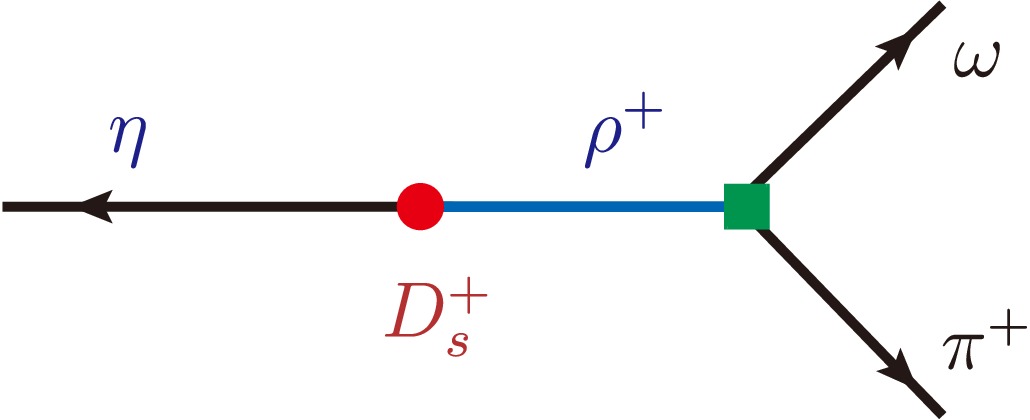
$ D_s^+\to \eta \omega\pi^+ $ decay, the absolute branching fractions of the decays$ D^0\to K^-\pi^+\omega $ ,$ D^0\to K^0_S\pi^0\omega $ , and$ D^+\to K^0_S\pi^+\omega $ have been determined by BESIII Collaboration recently in Ref. [43], with the results to be$ (3.392 \pm 0.044_{\rm{stat}} \pm 0.085_{\rm{syst}}) $ %,$ (0.848 \pm 0.046_{\rm{stat}} \pm 0.031_{\rm{syst}}) $ %, and$ (0.707 \pm 0.041_{\rm{stat}} \pm 0.029_{\rm{syst}}) $ %, respectively. To better understand these experimental results, we shall study the Cabibbo-favored three-body decays$ D_s^+\to \eta\omega\pi^+ $ ,$ D^+\to K^0_S\omega\pi^+ $ and$ D^0\to K^-\omega\pi^+ $ in this work, where the$ \omega\pi $ pair is attributed to the decays of intermediate states$ \rho(770)^+ $ and$ \rho(1450)^+ $ . The schematic diagram for the quasi-two body decay$ D_s^+\to \eta \rho^+\to \eta\omega\pi^+ $ is shown in Fig. 1. In its rest frame, the state$ D_s^+ $ will decay into the intermediate resonance$ \rho^+ $ along with the the bachelor state η, and then the$ \rho^+ $ decays into ω and$ \pi^+ $ via the strong interaction. The similar pattern will arise in$ D^{+} $ and$ D^0 $ decay processes, with the η replaced by$ K^0_S $ and$ K^- $ , respectively. The subprocesses$ \rho(770,1450)^+\to \omega\pi^+ $ in these decays will be introduced into their decay amplitudes in the isobar formalism [44−46] via the vector form factor$ F_{\omega\pi} $ . This form factor has been measured in the related processes of τ decay and$ e^+e^- $ annihilation.
Figure 1. (color online) Schematic view of the cascade decay
$ D_s^+\to \eta \rho^+\to \eta \omega\pi^+ $ , where$ \rho^+ $ stands for the intermediate states$ \rho(770,1450)^+ $ which decay into$ \omega\pi^+ $ in this work.The contributions of
$ \rho(770,1450)\to \omega\pi $ for the three-body decays$ B\to\bar{D}^{(*)} \omega\pi $ were studied in Ref. [47] very recently. The ρ family resonance contributions of kaon pair have been explored in Refs. [48−54] and in Refs. [55−58] for the three-body B and D meson decays, respectively. In Ref. [25], four resonances$ \rho(770) $ ,$ \rho(1450) $ ,$ \rho(1700) $ and$ \rho(2150) $ have been employed to parametrize the related transition form factor for$ \rho\to\omega\pi $ for the process$ e^+e^- \to \omega\pi^0 \to \pi^+\pi^-\pi^0\pi^0 $ in the energy range$ 1.05 $ -$ 2.00 $ GeV by SND Collaboration. But we will leave the contributions of$ \rho(1700, 2150)\to\omega\pi $ to future studies for the relevant decays, in view of that the masses of$ \rho(1700, 2150) $ are very close to or even beyond the masses of the initial$ D^{+,0} $ and$ D^+_{s} $ mesons, the contributions of$ \omega\pi $ from$ \rho(1700, 2150) $ are unimportant comparing with that from$ \rho(770) $ and$ \rho(1450) $ [25], and in addition, the excited ρ states around$ 2 $ GeV are not well understood [34, 59].Due to the c-quark mass, the heavy quark expansion tools and the factorization approaches, which have been successfully used in hadronic B meson decays for decades, encounter significant challenges when applied to the two-body or three-body hadronic D meson decays. In this context, model independent methods, such as the topological-diagram approach [60−66] and factorization-assisted topological-amplitude approach [67−70] have been adopted in various D decay studies. In Ref. [55], we construct a theoretical framework for quasi-two-body D meson decays with the help of electromagnetic form factors, with which we studied the contributions of
$ \rho(770,1450)\to K\bar{K} $ for the three-body D decays within the flavour SU(3) symmetry. In this work we adopt the method in [55] and investigate the concerned decays within the quasi-two-body framework [55, 71, 72], while neglect the interaction between$ \omega\pi $ system and the corresponding bachelor state in relevant decay processes.This paper is organized as follows. In Sec. II, we take
$ D^0 \to K^-[\rho(770)^+\to] \omega\pi^+ $ as an example to derive the differential branching fractions for the quasi-two-body D meson decay processes. In Sec. III, we present our numerical results for the branching fractions of the quasi-two-body decays$ D_s^+\to\eta[\rho^+\to]\omega\pi^+ $ ,$ D^+\to K^0_S[\rho^+\to]\omega\pi^+ $ and$ D^0\to K^-[\rho^+\to]\omega\pi^+ $ , along with some necessary discussions. Summary of this work is given in Sec. IV. -
Recently, the three-body decay
$ D_s^+\to \eta \omega\pi^+ $ was observed for the first time by BESIII Collaboration, with its total branching fraction$ {\cal{B}}=(0.54\pm0.12_{\rm{stat}}\pm0.04_{\rm{syst}}) $ % [1]. This numerical result aligns with an earlier measurement by the CLEO Collaboration, which reported a branching fraction of$ (0.85\pm0.54_{\rm{stat}}\pm0.06_{\rm{syst}}) $ % in Ref. [2] for the same decay channel, but the BESIII measurement offers a significantly improved precision. Given the quark structure of the initial and final states in this$ D_s $ decay process, the Cabibbo-favored transition$ c\to s $ along with$ W^+\to u\bar d $ will be the dominant process at the quark level. The prospective intermediate states for this process could be the resonances$ a_0(980)^+ $ ,$ \rho(770)^+ $ ,$ b_1(1235)^+ $ ,$ \omega(1420) $ , etc., and their excited states which will decay into the$ \pi^+ \eta $ ,$ \omega\pi^+ $ , and$ \omega\eta $ pairs in the final state [3]. The combination of$ \pi^+ $ and$ \omega\eta $ with the intermediate resonance$ \omega(1420) $ implies a pure annihilation process for this$ D_s^+ $ decay. The union of ω and$ a_0(980)^+\to \pi^+ \eta $ for this decay is very similar to the decay process$ D_s^+\to \pi^0[a_0(980)^+\to]\pi^+ \eta $ , which has been measured by BESIII [4], and the branching fraction was found to be consistent with the triangle rescattering processes via the intermediate processes$ D_s^+\to \eta^{(\prime)}\rho^+ $ ,$ D_s^+\to K^* \bar{K} $ , and$ D_s^+\to K \bar{K^*} $ [5−10]. However, the branching fraction for$ D_s^+\to \omega a_0(980)^+ $ was found to be less than$ 3.4\times 10^{-4} $ in Ref. [10] owing to the cancellation of the rescattering effects and suppressed contribution of the short-distance W annihilation. Consequently, the dominant contributions for the decay$ D_s^+\to \eta\omega\pi^+ $ are expected to arise from the combination of η and the resonances, which will decay into the$ \omega\pi^+ $ pair in the final state.The light meson pair of
$ \omega\pi $ , which originates from the weak current of the matrix element$ \langle\omega\pi|V^\mu - A^\mu|0\rangle $ in the three-body hadronic D and B meson decays, is related to the processes$ \tau\to \omega\pi\nu_\tau $ and$ e^+e^-\to \omega\pi $ . The G-parity conservation requires that the$ \omega\pi $ pair is determined mainly by the vector part$ V^\mu $ of the weak current [11], which is associated with the ρ family resonances as the intermediate state via the P-wave transition amplitudes [12]. The axial-vector part$ A^\mu $ of the weak current for the$ \omega\pi $ system corresponds to the resonance$ b_1(1235) $ and its excited states. The state$ b_1(1235) $ , with the quantum numbers$ J^{PG}=1^{++} $ , is related to the second-class weak current classified in terms of the parity and G parity [13]. The second-class weak current has been investigated in τ decays in recent years, but no evidence has been observed [14, 15]. The decay amplitude for the$ b_1(1235)\to \omega\pi $ subprocess through S- and D-waves in the relevant processes is proportional to the mass difference between the u and d quarks [3], which significantly suppresses the contribution of$ \omega\pi $ from the axial-vector resonance$ b_1(1235) $ accompanied by the second-class current.The ordinary decay mode for
$ \rho(770)\to \omega\pi $ is not allowed because of the pole mass of$ \rho(770) $ , which is apparently below the threshold of the$ \omega\pi $ pair [3]. However, the Breit-Wigner (BW) [16] tail effect of$ \rho(770) $ , also known as the virtual contribution [17−20], was found indispensable to the production of the$ \omega\pi $ pair in the processes of$ \tau \to \omega \pi \nu_\tau $ [21−24] and$ e^+e^- \to\omega\pi^0 $ [25−34]. The excited state$ \rho(1450) $ has been observed to decay into the$ \omega\pi $ pair in B meson decays by the CLEO, BaBar, and Belle Collaborations [35−37]. This state has been suggested as a$ 2S $ -hybrid mixture in Ref. [38] considering its decay characters [39−41], but its mass is consistent with that in the$ 2S $ excitation of$ \rho(770) $ [42]. The further investigation of the interference between the$ \rho(1450) $ and its ground state will provide deeper insights into its nature.In addition to the data for the
$ D_s^+\to \eta \omega\pi^+ $ decay, the absolute branching fractions of the decays$ D^0\to K^-\pi^+\omega $ ,$ D^0\to K^0_S\pi^0\omega $ , and$ D^+\to K^0_S\pi^+\omega $ were recently determined by the BESIII Collaboration and reported in Ref. [43], with the results as$ (3.392 \pm 0.044_{\rm{stat}} \pm 0.085_{\rm{syst}}) $ %,$ (0.848 \pm 0.046_{\rm{stat}} \pm 0.031_{\rm{syst}}) $ %, and$ (0.707 \pm 0.041_{\rm{stat}} \pm 0.029_{\rm{syst}}) $ %, respectively. To better understand these experimental results, we investigated the Cabibbo-favored three-body decays$ D_s^+\to \eta\omega\pi^+ $ ,$ D^+\to K^0_S\omega\pi^+ $ , and$ D^0\to K^-\omega\pi^+ $ in this study, where the$ \omega\pi $ pair is attributed to the decays of the intermediate states$ \rho(770)^+ $ and$ \rho(1450)^+ $ . The schematic for the quasi-two body decay$ D_s^+\to \eta \rho^+\to \eta\omega\pi^+ $ is shown in Fig. 1. In its rest frame, the state$ D_s^+ $ will decay into the intermediate resonance$ \rho^+ $ along with the bachelor state η. Subsequently,$ \rho^+ $ decays into ω and$ \pi^+ $ via the strong interaction. A similar pattern will arise in the$ D^{+} $ and$ D^0 $ decay processes, with η replaced by$ K^0_S $ and$ K^- $ , respectively. The subprocesses$ \rho(770,1450)^+\to \omega\pi^+ $ in these decays will be introduced into their decay amplitudes in the isobar formalism [44−46] via the vector form factor$ F_{\omega\pi} $ . This form factor has been measured in the processes related to τ decay and$ e^+e^- $ annihilation.
Figure 1. (color online) Schematic of the cascade decay
$ D_s^+\to \eta \rho^+\to \eta \omega\pi^+ $ , where$ \rho^+ $ denotes the intermediate states$ \rho(770,1450)^+ $ that decayed into$ \omega\pi^+ $ in this study.The contributions of
$ \rho(770,1450)\to \omega\pi $ to the three-body decays$ B\to\bar{D}^{(*)} \omega\pi $ were recently studied in Ref. [47]. The ρ family resonance contributions of the kaon pair have been explored in Refs. [48−54] and in Refs. [55−58] for the three-body B and D meson decays, respectively. In Ref. [25], four resonances, namely,$ \rho(770) $ ,$ \rho(1450) $ ,$ \rho(1700) $ , and$ \rho(2150) $ , were employed to parametrize the related transition form factor for$ \rho\to\omega\pi $ for the process$ e^+e^- \to \omega\pi^0 \to \pi^+\pi^-\pi^0\pi^0 $ in the energy range$ 1.05 $ −$ 2.00 $ GeV by the SND Collaboration. However, we will examine the contributions of$ \rho(1700, 2150)\to\omega\pi $ to the relevant decays in future studies considering that the masses of$ \rho(1700, 2150) $ are very close to or even exceed the masses of the initial$ D^{+,0} $ and$ D^+_{s} $ mesons, the contributions to$ \omega\pi $ from$ \rho(1700, 2150) $ are unimportant when compared with those of$ \rho(770) $ and$ \rho(1450) $ [25], and in addition, the excited ρ states around$ 2 $ GeV are not well understood [34, 59].Owing to the c-quark mass, the heavy quark expansion tools and factorization approaches, which have been successfully used in hadronic B meson decays for decades, encounter significant challenges when applied to the two-body or three-body hadronic D meson decays. In this context, methods that do not rely on models, such as the topological-diagram approach [60−66] and factorization-assisted topological-amplitude approach [67−70], have been adopted in various D decay studies. In Ref. [55], we constructed a theoretical framework for quasi-two-body D meson decays with the help of electromagnetic form factors, with which we studied the contributions of
$ \rho(770,1450)\to K\bar{K} $ for the three-body D decays within the flavour SU(3) symmetry. In this study, we adopted the method in [55] and investigated the pertinent decays within the quasi-two-body framework [55, 71, 72], while neglecting the interaction between the$ \omega\pi $ system and the corresponding bachelor state in the relevant decay processes.This paper is organized as follows: in Sec. II, we take
$ D^0 \to K^-[\rho(770)^+\to] \omega\pi^+ $ as an example to derive the differential branching fractions for the quasi-two-body D meson decay processes. In Sec. III, we present our numerical results for the branching fractions of the quasi-two-body decays$ D_s^+\to\eta[\rho^+\to]\omega\pi^+ $ ,$ D^+\to K^0_S[\rho^+\to]\omega\pi^+ $ , and$ D^0\to K^-[\rho^+\to]\omega\pi^+ $ , along with necessary discussions. Finally, Sec. IV summarizes this study. -
In this section, we use the decay
$ D^0 \to K^-[\rho(770)^+\to ] \omega\pi^+ $ as an example to derive the differential branching fraction for the quasi-two-body D meson decay processes. Shrinking the subprocess$ \rho(770)^+\to \omega\pi^+ $ to the meson$ \rho(770)^+ $ will yield the two-body decay$ D^0 \to K^-\rho(770)^+ $ . The related effective weak Hamiltonian for D decays is written as [73]$ \begin{aligned}[b] {\cal{H}}_{\rm{eff}} =\;& \frac{G_F}{\sqrt2}\bigg[\sum\limits_{q=d,s} \lambda_q (C_1 O_1+ C_2 O_2) \\ & -\lambda_b \sum^{6}_{i=3}C_i O_i - \lambda_b C_{8g} O_{8g}\bigg], \end{aligned} $
(1) where the Fermi coupling constant
$ G_F=1.1663788(6)\times 10^{-5} $ GeV$ ^{-2} $ [3]; the product of the Cabbibo-Kobayashi-Maskawa (CKM) [74, 75] matrix elements$ \lambda_q=V^*_{cq}V_{uq} $ and$ \lambda_b=V^*_{cb}V_{ub} $ ; C denotes the Wilson coefficients at the scale μ;$ O_1 $ and$ O_2 $ are the current-current operators;$ O_3 $ and$ O_4 $ are the QCD penguin operators; and$ O_{8g} $ is the chromomagnetic dipole operator. The total decay amplitude for the process of a D meson decays into a pseudoscalar (P) plus a vector (V), which can be described using the typical topological diagram amplitudes$ T_{P,V}, C_{P,V}, E_{P,V} $ , and$ A_{P,V} $ according to the diagrams shown in Fig. 2, as well as the additional penguin amplitudes in the factorization-assisted topological-amplitude approach [68] and topological-diagram approach [62−65]. The detailed discussions on these topological diagram amplitudes are available in Refs. [62−65, 68].
Figure 2. Typical topological diagrams for the concerned decays at quark level, where ρ stands for the intermediate states
$ \rho(770,1450)^+ $ , h for$ \eta, K^0_S $ or$ K^- $ , and the symbol$ \otimes $ stands for the weak vertex in this work.The decay amplitude for
$ D^0 \to K^-\rho(770)^+ $ is dominated by the color-favored tree amplitude$ T_P^{2B} $ with the$ D^0 \to K^- $ transition, as shown in Fig. 2-(a), where the superscript$ 2B $ represents a two-body decay process. We have the amplitude$ T_P^{2B} $ as [63, 64, 68]$ \begin{aligned}[b] T_P^{2B} &= \frac{G_F}{\sqrt2} V^*_{cs}V_{ud} \left[ \frac{C_1}{3}+C_2 \right] f_\rho m_\rho F_1^{D\to \bar K}(m^2_\rho) 2 \epsilon_\rho \cdot p_D\; \\ &= {\cal{M}}_T^{2B} \epsilon_\rho \cdot p_D, \end{aligned} $
(2) where the subscript ρ denotes the resonance
$ \rho(770) $ ;$ F_1^{D\to \bar K}(m^2_\rho) $ is the transition form factor for the$ D^0 \to K^- $ process. Beyond the dominant amplitude$ T_P^{2B} $ , a W-exchange nonfactorizable contribution of the amplitude$ E^{2B}_V $ in the topological diagram Fig. 2-(c) exists, which can be parametrized as$ E^{2B}_V={\cal{M}}^{2B}_E\epsilon_\rho \cdot p_D $ . In addition, we have [68]$ \begin{aligned} {\cal{M}}^{2B}_E&= \frac{G_F}{\sqrt2} V^*_{cs}V_{ud} C_2 \chi^E_q e^{i \phi^E_q} f_D m_D \left[ f_K/f_\pi \right], \end{aligned} $
(3) in the factorization-assisted topological-amplitude approach, where
$ \chi^E_q=0.25 $ and$ \phi^E_q=1.73 $ [68] are two parameters that characterize the strength and strong phase of the corresponding amplitude;$ f_\rho $ ,$ f_D $ ,$ f_K $ , and$ f_\pi $ are the decay constants for$ \rho(770) $ ,$ D^0 $ , kaon, and pion, respectively. In addition to the amplitudes$ T_P^{2B} $ and$ E^{2B}_V $ , we need [68]$ \begin{aligned}[b] C^{2B}_V=\;&{\cal{M}}^{2B}_C\epsilon_\rho \cdot p_D =\frac{G_F}{\sqrt2} V^*_{cs}V_{ud} \left[C_1+C_2(1/3+\chi^C_V e^{i \phi^C_V})\right] \\ &\times f_K m_\rho A^{D\to \rho}_0(m^2_K)2\,\epsilon_\rho \cdot p_D, \end{aligned} $
(4) $ \begin{aligned}[b] A^{2B} &={\cal{M}}^{2B}_A\epsilon_\rho \cdot p_D \\ &=\frac{G_F}{\sqrt2} V^*_{cs}V_{ud} C_1 \chi^A_q e^{i \phi^A_q} f_D m_D \left[ f_{\eta^{(\prime)}}/f_\pi \right]\epsilon_\rho \cdot p_D,\;\; \end{aligned} $
(5) in the numerical calculations of the decays
$ D^+\to K^0_S\rho(770)^+ $ and$ D_s^+\to\eta \rho(770)^+ $ according to the topological diagrams Fig. 2-(b) and -(d), respectively. The remaining parameters are set as$ \chi^C_V=-0.53 $ ,$ \phi^C_V=-0.25 $ ,$ \chi^A_q=0.11 $ , and$ \phi^A_q=-0.35 $ by referring to [68].For the two-body
$ D^0 \to K^-\rho(770)^+ $ decay, the Lorentz-invariant total decay amplitude is$ {\cal{A}}^{2B}={\cal{M}}^{2B} \epsilon_\rho \cdot p_D =({\cal{M}}_T^{2B}+{\cal{M}}^{2B}_E)\epsilon_\rho \cdot p_D. $
(6) By utilizing the partial decay rate
$ {\rm d}\Gamma=\frac{1}{32\pi^2}|{\cal{A}}|^2 \frac{\big|\overrightarrow{q}\big|}{m^2_D} {\rm d}\Omega $
(7) in Review of Particle Physics [3] along with the formula
$ \sum\limits_{\lambda=0,\pm} \varepsilon^{*\mu}{(p,\lambda)}\varepsilon^{\nu}{(p,\lambda)} =-g^{\mu\nu} + \frac{p^\mu p^\nu}{p^2}, $
(8) it is trivial to obtain the partial decay width
$ \Gamma(D^0 \to K^-\rho(770)^+)=\frac{\big| \overrightarrow{q}\big|^3}{8\pi m^2_\rho}\big|{\cal{M}}^{2B}\big|^2 . $
(9) The magnitude of the momentum
$ |\overrightarrow{q}| $ for$ \rho(770)^+ $ or$ K^- $ is$ \begin{aligned} \left| \overrightarrow{q} \right|= \;\frac{1}{2 m_D} \sqrt{\left[m^2_{D}-(m_\rho+m_{K})^2\right]\left[m^2_{D}-(m_\rho-m_{K})^2\right]},\;\;\; \end{aligned} $
(10) in the rest frame of the
$ D^0 $ meson, and$ m_{i} $ (with$ i=\{D^0, \rho(770)^+, K^-\} $ ) denotes the masses of the relevant particles above.By connecting the subprocess
$ \rho(770)^+\to \pi^+\pi^0 $ and two-body mode$ D^0 \to K^-\rho(770)^+ $ , we obtain the quasi-two-body decay$ D^0 \to K^-\rho(770)^+\to K^- \pi^+\pi^0 $ . Its decay amplitude can be written as [55]$ {\cal{A}}^{Q2B}={\cal{M}}^{Q2B} \epsilon_\rho \cdot p_D \frac{1}{{\cal{D}}^\rho_{\rm{BW}}} g_{\rho\pi\pi} \epsilon_\rho\cdot(p_{\pi^+}-p_{\pi^0}). $
(11) Here, the BW denominator
$ {\cal{D}}^\rho_{\rm{BW}}=m^2_\rho-s-{\rm i} m_\rho\Gamma_\rho(s) $ for the$ \rho(770)^+ $ propagator, and the related s-dependent width is$ \Gamma_{\rho}(s) =\Gamma_\rho\frac{m_\rho}{\sqrt s} \frac{ \left| \overrightarrow{q_\pi} \right|^3}{ \left| \overrightarrow{q_{\pi0}}\right|^3} X^2(\left| \overrightarrow{q_\pi} \right| r^\rho_{\rm{BW}}). $
(12) The Blatt-Weisskopf barrier factor for ρ family resonances is given by [76]
$ \begin{aligned} X(z)=\sqrt{\frac{1+z^2_0}{1+z^2}}\,, \end{aligned} $
(13) where
$ \left| \overrightarrow{q_\pi} \right|=\frac{1}{2}\sqrt{s-4m_\pi^2} $ ,$ \left| \overrightarrow{q_{\pi0}}\right| $ is$ \left| \overrightarrow{q_\pi} \right| $ at$ s=m^2_\rho $ , and the barrier radius is$ r^\rho_{\rm{BW}}=1.5 $ GeV$ ^{-1} $ [77]. Note that the amplitude$ {\cal{M}}^{Q2B} $ can be obtained from the related amplitude$ {\cal{M}}^{2B} $ with the replacement$ m_\rho\to \sqrt{s} $ . By using Eq. (8), the decay amplitude$ {\cal{A}}^{Q2B} $ of Eq. (11) is reduced to$ {\cal{A}}^{Q2B}={\cal{M}}^{Q2B} \frac{g_{\rho\pi\pi}}{{\cal{D}}^\rho_{\rm{BW}}} \big|\overrightarrow{p_1}\big|\cdot\big|\overrightarrow{p_3}\big|\cos\theta, $
(14) where
$ \begin{aligned} \big|\overrightarrow{p_1}\big| &= \frac{1}{2}\sqrt{s-4m_\pi^2}, \\ \big|\overrightarrow{p_3}\big| &= \frac{1}{2 \sqrt{s}} \sqrt{\left[m^2_{D}-(\sqrt{s}+m_{K})^2\right]\left[m^2_{D}-(\sqrt{s}-m_{K})^2\right]},\\ \end{aligned} $
(15) are the momenta for the final states
$ \pi^+ $ and$ K^- $ , respectively, in the rest frame of the pion pair in the$ D^0 \to K^- \pi^+\pi^0 $ decay, and θ is the angle between$ \pi^0 $ and$ K^- $ in the same frame for the pion pair. After the integration of$ \cos\theta $ , it is trivial to obtain the partial decay width [3]$ \begin{aligned} \frac{{\rm d}\Gamma}{{\rm d}s}=\frac{\big|\overrightarrow{p_1}\big|^3 \big|\overrightarrow{p_3}\big|^3}{48\pi^3 m_D^3} \left|{\cal{M}}^{Q2B} \frac{g_{\rho\pi\pi}}{{\cal{D}}^\rho_{\rm{BW}}} \right|^2 , \end{aligned} $
(16) for the quasi-two-body decay
$ D^0 \to K^-[\rho(770)^+\to] \pi^+\pi^0 $ . We can further define the pion electromagnetic form factor of the$ \rho(770) $ component as [78, 79]$ F_\pi(s)=\frac{f_\rho g_{\rho\pi\pi}}{\sqrt2\, m_\rho}\frac{m^2_\rho}{{\cal{D}}^\rho_{\rm{BW}}}, $
(17) and rewrite Eq. (16) as
$ \begin{aligned} \frac{{\rm d}\Gamma}{{\rm d}s}=\frac{\big|\overrightarrow{p_1}\big|^3 \big|\overrightarrow{p_3}\big|^3}{24\pi^3 m_D^3} \left|{\cal{M}}^{Q2B}\right|^2_{f_\rho m_\rho\to F_\pi} , \end{aligned} $
(18) which is the same expression as that in Ref. [55].
To calculate the quasi-two-body decay
$ D^0 \to K^-[\rho(770)^+\to] \omega\pi^+ $ , we introduce the effective Lagrangian [80−82]$ {\cal{L}}_{\rho\omega\pi}=g_{\rho\omega\pi} \epsilon_{\mu\nu\alpha\beta}\partial^{\mu}\rho^{\nu}\partial^{\alpha}\omega^{\beta}\pi $
(19) to describe the ρ and
$ \omega\pi $ coupling. The related form factor$ F_{\omega\pi}(s) $ is expressed as [83−85]$ \begin{aligned} \langle \omega(p_a,\lambda)\pi(p_b)| j_\mu(0) | 0 \rangle = i \epsilon_{\mu\nu\alpha\beta}\varepsilon^{\nu}(p_a, \lambda)p_b^\alpha p^\beta F_{\omega\pi}(s),\;\; \end{aligned} $
(20) where
$ j_\mu $ is the isovector part of the electromagnetic current; λ and ε are the polarization and polarization vector for ω, respectively;$ p_a(p_b) $ is the momentum for$ \omega(\pi) $ , and the momentum$ p=p_a+p_b $ for the resonance$ \rho(770)^+ $ . The form factor$ F_{\omega\pi}(s) $ in the vector meson dominance model is parametrized as [26, 29, 32, 86]$ F_{\omega\pi}(s) = \frac{g_{\rho\omega\pi}}{f_\rho} \sum\limits_{\rho_i} \frac{A_i {\rm e}^{{\rm i} \phi_i} m_{\rho_i}^2 }{D_{\rho_i}(s)}\,, $
(21) where the summation is over the isovector resonances
$ \rho_i=\{\rho(770), \rho(1450), \rho(1700), ...\} $ in the ρ family, with$ m_{\rho_i} $ as their masses.$ A_i $ and$ \phi_i $ are the weights and phases for these resonances, respectively, and we can assign$ A=1 $ and$ \phi=0 $ for$ \rho(770) $ . Technically, the contributions from the excitations of$ \omega(782) $ should also be included in Eq. (21), but their weights were found to be negligibly small [87].The decay amplitude for the quasi-two-body process
$ D^0 \to K^-[\rho(770)^+\to] \omega\pi^+ $ is primarily written as$ {\cal{A}}_{\omega\pi}={\cal{M}}_{\omega\pi} \epsilon_\rho \cdot p_D \frac{1}{{\cal{D}}_{\rm{BW}}} g_{\rho\omega\pi} \epsilon_{\mu\nu\alpha\beta} \epsilon^\mu_\rho\varepsilon^{\nu}_\omega p_b^\alpha p^\beta. $
(22) By using the relation [47]
$ \begin{aligned} \sum\limits_{\lambda=0,\pm}\vert\epsilon_{\mu\nu\alpha\beta}p_{3}^\mu\varepsilon^{\nu}(p_\omega, \lambda) p_\pi^\alpha p^\beta\vert^2 = s\,\vert\overrightarrow{p_\omega}\vert^2 \vert\overrightarrow{p_3}\vert^2 (1-\cos^2{\theta}), \end{aligned} $
(23) we obtain the partial decay width [3]
$ \frac{{\rm d}\Gamma}{{\rm d}s}=\frac{s\big|\overrightarrow{p_\omega}\big|^3 \big|\overrightarrow{p_3}\big|^3}{96\pi^3 m_D^3} \left|{\cal{M}}_{\omega\pi} \frac{g_{\rho\omega\pi}}{{\cal{D}}_{\rm{BW}}} \right|^2 , $
(24) for the quasi-two-body decay
$ D^0 \to K^-[\rho(770)^+\to] \omega\pi^+ $ after the integration of$ \cos\theta $ . Then, we can define an auxiliary electromagnetic form factor$ \begin{aligned} f_{\omega\pi}=f^2_\rho/m_\rho F_{\omega\pi}=f_\rho m_\rho g_{\rho\omega\pi}/{{\cal{D}}_{\rm{BW}}}, \end{aligned} $
(25) and rewrite Eq. (24) as
$ \frac{{\rm d}\Gamma}{{\rm d}s}=\frac{s\big|\overrightarrow{p_\omega}\big|^3 \big|\overrightarrow{p_3}\big|^3}{96\pi^3 m_D^3} \left|{\cal{M}}_{\omega\pi}\right|^2_{f_\rho m_\rho\to f_{\omega\pi}} . $
(26) Note that this expression is slightly different from that of the differential branching fraction in Ref. [47] for
$ B\to\bar{D}^{(*)} \omega\pi $ decays. This discrepancy arises from the difference in the definitions of the quasi-two-body decay amplitudes between the perturbative QCD approach [47] and the present study.We need to stress that
$ {\cal{D}}_{\rm{BW}}=m^2_\rho-s-{\rm i}\sqrt{s}\,\Gamma_\rho(s) $ for$ \rho(770)^+ $ in Eq. (22) is different from$ {{\cal{D}}^\rho_{\rm{BW}}} $ in Eq. (11). The former has the expression [25, 26]$ \begin{aligned} \Gamma_{\rho(770)}(s)= \Gamma_{\rho(770)}\frac{m^2_{\rho(770)}}{s} \left(\frac{\vert\overrightarrow{p_1}\vert} {\vert\overrightarrow{p_1}\vert_{s=m^2_{\rho(770)} } }\right)^{3} +\frac{g_{\rho\omega\pi}^2}{12\pi} \vert\overrightarrow{p_\omega}\vert^3, \end{aligned} $
(27) for the energy-dependent width of the resonance
$ \rho(770) $ , with$ \vert\overrightarrow{p_\omega}\vert =\frac{1}{2\sqrt s} \sqrt{\left[s-(m_\omega+m_{\pi})^2\right]\left[s-(m_\omega-m_{\pi})^2\right]}\,. $
(28) In addition to
$ \Gamma_{\rho(770)}(s) $ , we employ the expression$ \begin{aligned}[b] \Gamma_{\rho(1450)}(s) =\Gamma_{\rho(1450)} \Bigl[ {\mathcal B}_{\rho(1450) \to \omega\pi} \Bigl(\frac {q_{\omega}(s)} {q_{\omega}(m^2_{\rho(1450)})}\Bigr)^3 \end{aligned} $
$ \begin{aligned}[b] +(1-{\mathcal B}_{\rho(1450) \to \omega\pi}) \frac {m^2_{\rho(1450)}} {s} \Bigl(\frac {q_{\pi}(s)} {q_{\pi}(m^2_{\rho(1450)})}\Bigr)^3\Bigr]\;\; \end{aligned} $
(29) for the energy-dependent width of the excited resonance
$ \rho(1450) $ , as used in Ref. [27] for the process$ e^+ e^-\to \omega\pi^0\to\pi^0\pi^0\gamma $ by the CMD-2 Collaboration, where$ {\mathcal B}_{\rho(1450) \to \omega\pi} $ is the branching ratio of the$ \rho(1450) \to \omega\pi $ decay;$ \Gamma_{\rho(770)} $ and$ \Gamma_{\rho(1450)} $ are the full widths for$ \rho(770) $ and$ \rho(1450) $ , respectively. -
In this section, we take the decay
$ D^0 \to K^-[\rho(770)^+\to] \omega\pi^+ $ as an example to derive the differential branching fraction for the quasi-two-body D meson decay processes. If the subprocess$ \rho(770)^+\to \omega\pi^+ $ was shrunk to the meson$ \rho(770)^+ $ , we will have the two-body decay$ D^0 \to K^-\rho(770)^+ $ . The related effective weak Hamiltonian for D decays is written as [73]$ \begin{aligned}[b] {\cal{H}}_{\rm{eff}} =\;& \frac{G_F}{\sqrt2}\bigg[\sum\limits_{q=d,s} \lambda_q (C_1 O_1+ C_2 O_2) \\ & -\lambda_b \sum^{6}_{i=3}C_i O_i - \lambda_b C_{8g} O_{8g}\bigg], \end{aligned} $

(1) where the Fermi coupling constant
$ G_F=1.1663788(6)\times10^{-5} $ GeV$ ^{-2} $ [3], the product of the Cabbibo-Kobayashi-Maskawa (CKM) [74, 75] matrix elements$ \lambda_q=V^*_{cq}V_{uq} $ and$ \lambda_b=V^*_{cb}V_{ub} $ , the C's are Wilson coefficients at scale μ, and the$ O_1 $ and$ O_2 $ are current-current operators,$ O_3 $ -$ O_4 $ are QCD penguin operators, and$ O_{8g} $ is chromomagnetic dipole operator. Then the total decay amplitude for the process of a D meson decays into a pseudoscalar (P) plus a vector (V) can be described with typical topological diagram amplitudes$ T_{P,V}, C_{P,V}, E_{P,V} $ and$ A_{P,V} $ according to the diagrams shown in Fig. 2, as well as additional penguin amplitudes in the factorization-assisted topological-amplitude approach [68] and the topological-diagram approach [62−65]. One is referred to the Refs. [62−65, 68] for the detailed discussions on these the topological diagram amplitudes.
Figure 2. Typical topological diagrams for the concerned decays at quark level, where ρ stands for the intermediate states
$ \rho(770,1450)^+ $ , h for$ \eta, K^0_S $ or$ K^- $ , and the symbol$ \otimes $ stands for the weak vertex in this work.The decay amplitude for
$ D^0 \to K^-\rho(770)^+ $ is dominated by the color-favored tree amplitude$ T_P^{2B} $ with the$ D^0 \to K^- $ transition as shown in Fig. 2-(a), where the superscript$ 2B $ stands for a two-body decay process. We have the amplitude$ T_P^{2B} $ as [63, 64, 68]$ \begin{aligned}[b] T_P^{2B} &= \frac{G_F}{\sqrt2} V^*_{cs}V_{ud} \left[ \frac{C_1}{3}+C_2 \right] f_\rho m_\rho F_1^{D\to \bar K}(m^2_\rho) 2 \epsilon_\rho \cdot p_D\; \\ &= {\cal{M}}_T^{2B} \epsilon_\rho \cdot p_D, \end{aligned} $

(2) where the subscript ρ stands for the resonance
$ \rho(770) $ here, the$ F_1^{D\to \bar K}(m^2_\rho) $ is the transition form factor for$ D^0 \to K^- $ process. Beyond the dominated amplitude$ T_P^{2B} $ , there is a W-exchange nonfactorizable contribution from the amplitude$ E^{2B}_V $ from the topological diagram Fig. 2-(c), which can be parametrized as the form$ E^{2B}_V={\cal{M}}^{2B}_E\epsilon_\rho \cdot p_D $ , and we have [68]$ \begin{aligned} {\cal{M}}^{2B}_E&= \frac{G_F}{\sqrt2} V^*_{cs}V_{ud} C_2 \chi^E_q e^{i \phi^E_q} f_D m_D \left[ f_K/f_\pi \right], \end{aligned} $

(3) in the factorization-assisted topological-amplitude approach, with
$ \chi^E_q=0.25 $ and$ \phi^E_q=1.73 $ [68] are two parameters which characterize the strength and strong phase of the corresponding amplitude, and the decay constants$ f_\rho $ ,$ f_D $ ,$ f_K $ and$ f_\pi $ for the$ \rho(770) $ ,$ D^0 $ , kaon and pion, respectively. In addition to the amplitudes$ T_P^{2B} $ and$ E^{2B}_V $ , we also need [68]$ \begin{aligned}[b] C^{2B}_V=\;&{\cal{M}}^{2B}_C\epsilon_\rho \cdot p_D =\frac{G_F}{\sqrt2} V^*_{cs}V_{ud} \left[C_1+C_2(1/3+\chi^C_V e^{i \phi^C_V})\right] \\ &\times f_K m_\rho A^{D\to \rho}_0(m^2_K)2\,\epsilon_\rho \cdot p_D, \end{aligned} $

(4) $ \begin{aligned}[b] A^{2B} &={\cal{M}}^{2B}_A\epsilon_\rho \cdot p_D \\ &=\frac{G_F}{\sqrt2} V^*_{cs}V_{ud} C_1 \chi^A_q e^{i \phi^A_q} f_D m_D \left[ f_{\eta^{(\prime)}}/f_\pi \right]\epsilon_\rho \cdot p_D,\;\; \end{aligned} $

(5) in the numerical calculations of the decays
$ D^+\to K^0_S\rho(770)^+ $ and$ D_s^+\to\eta \rho(770)^+ $ according to the topological diagrams Fig. 2-(b) and -(d), respectively. With the parameters$ \chi^C_V=-0.53 $ ,$ \phi^C_V=-0.25 $ ,$ \chi^A_q=0.11 $ and$ \phi^A_q=-0.35 $ found in [68].For the two-body
$ D^0 \to K^-\rho(770)^+ $ decay, the Lorentz-invariant total decay amplitude is$ {\cal{A}}^{2B}={\cal{M}}^{2B} \epsilon_\rho \cdot p_D =({\cal{M}}_T^{2B}+{\cal{M}}^{2B}_E)\epsilon_\rho \cdot p_D. $

(6) Utilizing the partial decay rate
$ d\Gamma=\frac{1}{32\pi^2}|{\cal{A}}|^2 \frac{\big|\overrightarrow{q}\big|}{m^2_D} d\Omega $

(7) in Review of Particle Physics [3], along with the formula
$ \sum\limits_{\lambda=0,\pm} \varepsilon^{*\mu}{(p,\lambda)}\varepsilon^{\nu}{(p,\lambda)} =-g^{\mu\nu} + \frac{p^\mu p^\nu}{p^2}, $

(8) it is trivial to get the partial decay width
$ \Gamma(D^0 \to K^-\rho(770)^+)=\frac{\big| \overrightarrow{q}\big|^3}{8\pi m^2_\rho}\big|{\cal{M}}^{2B}\big|^2 . $

(9) The magnitude of the momentum
$ |\overrightarrow{q}| $ for$ \rho(770)^+ $ or$ K^- $ is$ \begin{aligned} \left| \overrightarrow{q} \right|= \;\frac{1}{2 m_D} \sqrt{\left[m^2_{D}-(m_\rho+m_{K})^2\right]\left[m^2_{D}-(m_\rho-m_{K})^2\right]},\;\;\; \end{aligned} $

(10) in the rest frame of
$ D^0 $ meson, and the$ m_{i} $ 's (with$ i=\{D^0, \rho(770)^+, K^-\} $ ) are the masses for relevant particles above.By connecting subprocess
$ \rho(770)^+\to \pi^+\pi^0 $ and the two-body mode$ D^0 \to K^-\rho(770)^+ $ together, we will get the quasi-two-body decay$ D^0 \to K^-\rho(770)^+\to K^- \pi^+\pi^0 $ . Its decay amplitude can be written as [55]$ {\cal{A}}^{Q2B}={\cal{M}}^{Q2B} \epsilon_\rho \cdot p_D \frac{1}{{\cal{D}}^\rho_{\rm{BW}}} g_{\rho\pi\pi} \epsilon_\rho\cdot(p_{\pi^+}-p_{\pi^0}). $

(11) Where the BW denominator
$ {\cal{D}}^\rho_{\rm{BW}}=m^2_\rho-s-im_\rho\Gamma_\rho(s) $ for the$ \rho(770)^+ $ propagator, and the related s-dependent width is$ \Gamma_{\rho}(s) =\Gamma_\rho\frac{m_\rho}{\sqrt s} \frac{ \left| \overrightarrow{q_\pi} \right|^3}{ \left| \overrightarrow{q_{\pi0}}\right|^3} X^2(\left| \overrightarrow{q_\pi} \right| r^\rho_{\rm{BW}}). $

(12) The Blatt-Weisskopf barrier factor for ρ family resonances is given by [76]
$ \begin{aligned} X(z)=\sqrt{\frac{1+z^2_0}{1+z^2}}\,, \end{aligned} $

(13) where
$ \left| \overrightarrow{q_\pi} \right|=\frac{1}{2}\sqrt{s-4m_\pi^2} $ ,$ \left| \overrightarrow{q_{\pi0}}\right| $ is$ \left| \overrightarrow{q_\pi} \right| $ at$ s=m^2_\rho $ , and the barrier radius is$ r^\rho_{\rm{BW}}=1.5 $ GeV$ ^{-1} $ [77]. One should note that the amplitude$ {\cal{M}}^{Q2B} $ could be obtained from the related amplitude$ {\cal{M}}^{2B} $ with the replacement$ m_\rho\to \sqrt{s} $ . With the help of Eq. (8), the decay amplitude$ {\cal{A}}^{Q2B} $ of Eq. (11) is reduced to$ {\cal{A}}^{Q2B}={\cal{M}}^{Q2B} \frac{g_{\rho\pi\pi}}{{\cal{D}}^\rho_{\rm{BW}}} \big|\overrightarrow{p_1}\big|\cdot\big|\overrightarrow{p_3}\big|\cos\theta, $

(14) where
$ \begin{aligned} \big|\overrightarrow{p_1}\big| &= \frac{1}{2}\sqrt{s-4m_\pi^2}, \\ \big|\overrightarrow{p_3}\big| &= \frac{1}{2 \sqrt{s}} \sqrt{\left[m^2_{D}-(\sqrt{s}+m_{K})^2\right]\left[m^2_{D}-(\sqrt{s}-m_{K})^2\right]},\\ \end{aligned} $

(15) are the momenta for final states
$ \pi^+ $ and$ K^- $ , respectively, in the rest frame of the pion pair in the$ D^0 \to K^- \pi^+\pi^0 $ decay, and θ is the angle between$ \pi^0 $ and$ K^- $ in the same frame for pion pair. After the integration of$ \cos\theta $ , it's trivial to arrive the partial decay width [3]$ \begin{aligned} \frac{d\Gamma}{ds}=\frac{\big|\overrightarrow{p_1}\big|^3 \big|\overrightarrow{p_3}\big|^3}{48\pi^3 m_D^3} \left|{\cal{M}}^{Q2B} \frac{g_{\rho\pi\pi}}{{\cal{D}}^\rho_{\rm{BW}}} \right|^2 , \end{aligned} $

(16) for the quasi-two-body decay
$ D^0 \to K^-[\rho(770)^+\to] \pi^+\pi^0 $ . We can further define the pion electromagnetic form factor of the$ \rho(770) $ component as [78, 79]$ F_\pi(s)=\frac{f_\rho g_{\rho\pi\pi}}{\sqrt2\, m_\rho}\frac{m^2_\rho}{{\cal{D}}^\rho_{\rm{BW}}}, $

(17) and rewrite the Eq. (16) as
$ \begin{aligned} \frac{d\Gamma}{ds}=\frac{\big|\overrightarrow{p_1}\big|^3 \big|\overrightarrow{p_3}\big|^3}{24\pi^3 m_D^3} \left|{\cal{M}}^{Q2B}\right|^2_{f_\rho m_\rho\to F_\pi} , \end{aligned} $

(18) which is the same expression as it in Ref. [55].
To calculate the quasi-two-body decay
$ D^0 \to K^-[\rho(770)^+\to] \omega\pi^+ $ , we introduce the effective Lagrangian [80−82]$ {\cal{L}}_{\rho\omega\pi}=g_{\rho\omega\pi} \epsilon_{\mu\nu\alpha\beta}\partial^{\mu}\rho^{\nu}\partial^{\alpha}\omega^{\beta}\pi $

(19) to describe the ρ and
$ \omega\pi $ coupling. The related form factor$ F_{\omega\pi}(s) $ is expressed as [83−85]$ \begin{aligned} \langle \omega(p_a,\lambda)\pi(p_b)| j_\mu(0) | 0 \rangle = i \epsilon_{\mu\nu\alpha\beta}\varepsilon^{\nu}(p_a, \lambda)p_b^\alpha p^\beta F_{\omega\pi}(s),\;\; \end{aligned} $

(20) where
$ j_\mu $ is the isovector part of the electromagnetic current, λ and ε are the polarization and polarization vector for ω, respectively,$ p_a(p_b) $ is the momentum for$ \omega(\pi) $ , and the momentum$ p=p_a+p_b $ for the resonance$ \rho(770)^+ $ . The form factor$ F_{\omega\pi}(s) $ in the vector meson dominance model is parametrized as [26, 29, 32, 86]$ F_{\omega\pi}(s) = \frac{g_{\rho\omega\pi}}{f_\rho} \sum\limits_{\rho_i} \frac{A_i e^{i \phi_i} m_{\rho_i}^2 }{D_{\rho_i}(s)}\,, $

(21) where the summation is over the isovector resonances
$ \rho_i=\{\rho(770), \rho(1450), \rho(1700), ...\} $ in ρ family, with$ m_{\rho_i} $ their masses. The$ A_i $ and$ \phi_i $ are the weights and phases for these resonances, respectively, and we can assign$ A=1 $ and$ \phi=0 $ for$ \rho(770) $ . Technically, the contributions from the excitations of$ \omega(782) $ should also be include in Eq. (21), but their weights were found to be negligibly small [87].The decay amplitude for the quasi-two-body process
$ D^0 \to K^-[\rho(770)^+\to] \omega\pi^+ $ is primarily written as$ {\cal{A}}_{\omega\pi}={\cal{M}}_{\omega\pi} \epsilon_\rho \cdot p_D \frac{1}{{\cal{D}}_{\rm{BW}}} g_{\rho\omega\pi} \epsilon_{\mu\nu\alpha\beta} \epsilon^\mu_\rho\varepsilon^{\nu}_\omega p_b^\alpha p^\beta. $

(22) With the help of the relation [47]
$ \begin{aligned} \sum\limits_{\lambda=0,\pm}\vert\epsilon_{\mu\nu\alpha\beta}p_{3}^\mu\varepsilon^{\nu}(p_\omega, \lambda) p_\pi^\alpha p^\beta\vert^2 = s\,\vert\overrightarrow{p_\omega}\vert^2 \vert\overrightarrow{p_3}\vert^2 (1-\cos^2{\theta}), \end{aligned} $

(23) we have the partial decay width [3]
$ \frac{d\Gamma}{ds}=\frac{s\big|\overrightarrow{p_\omega}\big|^3 \big|\overrightarrow{p_3}\big|^3}{96\pi^3 m_D^3} \left|{\cal{M}}_{\omega\pi} \frac{g_{\rho\omega\pi}}{{\cal{D}}_{\rm{BW}}} \right|^2 , $

(24) for the quasi-two-body decay
$ D^0 \to K^-[\rho(770)^+\to] \omega\pi^+ $ after the integration of$ \cos\theta $ . Then we can define an auxiliary electromagnetic form factor$ \begin{aligned} f_{\omega\pi}=f^2_\rho/m_\rho F_{\omega\pi}=f_\rho m_\rho g_{\rho\omega\pi}/{{\cal{D}}_{\rm{BW}}}, \end{aligned} $

(25) and rewrite the Eq. (24) as
$ \frac{d\Gamma}{ds}=\frac{s\big|\overrightarrow{p_\omega}\big|^3 \big|\overrightarrow{p_3}\big|^3}{96\pi^3 m_D^3} \left|{\cal{M}}_{\omega\pi}\right|^2_{f_\rho m_\rho\to f_{\omega\pi}} . $

(26) One should note that this expression is a little different from the differential branching fraction in Ref. [47] for
$ B\to\bar{D}^{(*)} \omega\pi $ decays. This discrepancy arises from the different definitions for the quasi-two-body decay amplitudes between the perturbative QCD approach [47] and the present paper.We need to stress that the
$ {\cal{D}}_{\rm{BW}}=m^2_\rho-s-i\sqrt{s}\,\Gamma_\rho(s) $ for the$ \rho(770)^+ $ in Eq. (22) is different from the$ {{\cal{D}}^\rho_{\rm{BW}}} $ in Eq. (11). The former has the expression [25, 26]$ \begin{aligned} \Gamma_{\rho(770)}(s)= \Gamma_{\rho(770)}\frac{m^2_{\rho(770)}}{s} \left(\frac{\vert\overrightarrow{p_1}\vert} {\vert\overrightarrow{p_1}\vert_{s=m^2_{\rho(770)} } }\right)^{3} +\frac{g_{\rho\omega\pi}^2}{12\pi} \vert\overrightarrow{p_\omega}\vert^3, \end{aligned} $

(27) for the energy-dependent width for the resonance
$ \rho(770) $ , with the$ \vert\overrightarrow{p_\omega}\vert =\frac{1}{2\sqrt s} \sqrt{\left[s-(m_\omega+m_{\pi})^2\right]\left[s-(m_\omega-m_{\pi})^2\right]}\,. $

(28) In addition to the
$ \Gamma_{\rho(770)}(s) $ , we employ the expression$ \begin{aligned}[b] \Gamma_{\rho(1450)}(s) =\Gamma_{\rho(1450)} \Bigl[ {\mathcal B}_{\rho(1450) \to \omega\pi} \Bigl(\frac {q_{\omega}(s)} {q_{\omega}(m^2_{\rho(1450)})}\Bigr)^3 \end{aligned} $

$ \begin{aligned}[b] +(1-{\mathcal B}_{\rho(1450) \to \omega\pi}) \frac {m^2_{\rho(1450)}} {s} \Bigl(\frac {q_{\pi}(s)} {q_{\pi}(m^2_{\rho(1450)})}\Bigr)^3\Bigr]\;\; \end{aligned} $

(29) for the excited resonance
$ \rho(1450) $ for its energy-dependent width as it was adopted in Ref. [27] for the process$ e^+ e^-\to\omega\pi^0\to\pi^0\pi^0\gamma $ by CMD-2 Collaboration, where$ {\mathcal B}_{\rho(1450) \to \omega\pi} $ is the branching ratio of the$ \rho(1450) \to \omega\pi $ decay,$ \Gamma_{\rho(770)} $ and$ \Gamma_{\rho(1450)} $ are the full widths for$ \rho(770) $ and$ \rho(1450) $ , respectively. -
The key input in this work is the coupling constant
$ g_{\rho\omega\pi} $ in Eq. (21) for the subprocess$ \rho(770)\to\omega\pi $ ; its value can be estimated with the relation$ g_{\rho\omega\pi}\approx3g_{\rho\pi\pi}^2/(8\pi^2F_\pi) $ [88] with$ F_\pi=92 $ MeV [3] and can also be calculated from the decay width of$ \omega\to\pi^0\gamma $ [3]. In the numerical calculation of this work, we adopt the value$ g_{\rho\omega\pi}=16.0\pm2.0 $ GeV$ ^{-1} $ [47] by taking into account the corresponding fitted and theoretical values in Refs. [12, 22, 26, 31, 32, 89−91] for it. In view of the expression of$ F_{\omega\pi}(s) $ , we have a constraint [47]$ A_1= \frac{g_{\rho(1450)\omega\pi}f_{\rho(1450)}m_{\rho(770)}} {g_{\rho(770)\omega\pi}f_{\rho(770)}m_{\rho(1450)}} $

(30) for the weight
$ A_1 $ for subprocess$ \rho(1450)\to \omega\pi $ in Eq. (21). With the measured result$ f^2_{\rho(1450)}{\cal{B}}(\rho(1450)\to\omega\pi)= 0.011\pm0.003 $ GeV$ ^2 $ [35], we have$ A_1=0.171\pm0.036 $ [47].In the quasi-two body decay
$ D_s^+\to \eta [\rho^+\to]\omega \pi $ , the mixing between η and$ \eta^{\prime} $ are taking into account. The physical η and$ \eta^\prime $ states are related to the quark flavor basis [92, 93]$ \left(\begin{array}{c} \eta \\ \eta^{\prime} \end{array} \right) = \left(\begin{array}{*{20}{c}} \cos{\phi} & -\sin{\phi} \\ \sin{\phi} & \cos{\phi} \\ \end{array} \right) \left(\begin{array}{c} \eta_q \\ \eta_s \end{array} \right), $

(31) the meson η is made from
$ \eta_q=(u\bar u+d\bar d)/\sqrt2 $ and$ \eta_s=s\bar s $ at quark level in early studies with the mixing angle$ \phi=39.3^{\circ}\pm1.0^{\circ} $ and the decay constants$ f_{\eta_q}=(1.07\pm0.02)f_\pi $ and$ f_{\eta_s}=(1.34\pm0.06)f_\pi $ [92, 93]. Recently, the mixing angle ϕ has been measured by KLOE [94, 95], LHCb [96] and BESIII [97, 98] collaborations. In this work, we adopt the angle$ \phi=(40.0\pm2.0_{\rm{stat}}\pm0.6_{\rm{syst}})^{\circ} $ presented by BESIII in Ref. [98] for the η-$ \eta^\prime $ mixing very recently.The three-parameter fit formulae for the
$ D\to \bar K $ and$ D_s\to \eta_s $ transition form factors are parametrized as [99]$ \begin{aligned} F_1^{D\to\bar K}(s) &= \frac{0.78}{(1 - s / 2.11^2)(1 - 0.24\, s / 2.11^2)}\,, \end{aligned} $

(32) $ \begin{aligned} F_1^{D_s\to \eta_s}(s)&= \frac{0.78}{(1 - s / 2.11^2)(1 - 0.23\, s / 2.11^2)}\,. \end{aligned} $

(33) Besides, we need the form factor [99]
$ A_0^{D\to \rho}(s) = \frac{0.66}{(1 - s / 1.87^2)(1 - 0.36\, s / 1.87^2)} $

(34) for the
$ D^+\to K^0_S\rho^+ $ decay. The result$ F_1^{D\to\bar K}(0)=0.78 $ in [99] agree well with the lattice determination$ F_1^{D\to\bar K}(0)= 0.765(31) $ [100]. The form factor for$ D_s \to \eta $ has been measured by BESIII recently with the results$ f^{\eta}_{+,0}(0)|V_{cs}| = 0.452\pm0.010_{\rm{stat}}\pm0.007_{\rm{syst}} $ [101], and$ f^\eta_1(0)|V_{cs}| = 0.4519\pm0.0071_{\rm{stat}}\pm0.0065_{\rm{syst}} $ [98] in the$ D^+_s\to \eta^{(\prime)} \mu^+\nu_\mu $ and$ D_s^+ \to \eta^{(\prime)} e^+ \nu_e $ decays, respectively. In Ref. [102], the corresponding form factors were determined to be$ f^{\eta}_+(0) = 0.442 \pm 0.022_{\rm{stat}} \pm 0.017_{\rm{syst}} $ . Given the mixing angle ϕ [98] and$ |V_{cs}| $ [3], the result$ F_1^{D_s\to\eta_s}(0)=0.78 $ in Eq. (33) is in consistent with the measurements in Refs. [98, 101, 102] presented by BESIII Collaboration.In the numerical calculation, we adopt the mean lives
$ \tau_{D^\pm}=(1033\pm5)\times 10^{-15} $ s,$ \tau_{D^0}=(410.3\pm1.0)\times 10^{-15} $ s and$ \tau_{D^\pm_s}=(501.2\pm2.2)\times 10^{-15} $ s for$ D_{(s)} $ mesons [3]. The decay constants for$ \rho(770) $ and its excited state$ \rho(1450) $ used in this work are$ f_{\rho(770)}=0.216\pm0.003 $ GeV [103] and$ f_{\rho(1450)}=0.185^{+0.030}_{-0.035} $ GeV [104, 105]. The masses for particles in concern decays, the decay constants for kaon and pion, the full widths for resonances$ \rho(770) $ and$ \rho(1450) $ (in units of GeV), the CKM matrix elements$ |V_{ud}| $ and$ |V_{cs}| $ [3], and the decay constants$ f_{D} $ and$ f_{D_s} $ for$ D_{(s)} $ [106, 107] are presented in Table 1.$ m_{D^{\pm}}=1.870 $ 

$ m_{D^{0}}=1.865 $ 

$ m_{D^{\pm}_s}=1.968 $ 

$ m_{\pi^{\pm}}=0.140 $ 

$ m_{\omega}=0.783 $ 

$ m_{K^{\pm}}=0.494 $ 

$ m_{K^{0}}=0.498 $ 

$ m_{\eta}=0.548 $ 

$ f_{\pi}=0.130 $ 

$ f_{K}=0.156 $ 

$ f_{D}=0.212 $ 

$ f_{D_s}=0.250 $ 

$ m_{\rho(770)}=0.775 $ 

$ \Gamma_{\rho(770)}=0.147 $ 

$ m_{\rho(1450)}=1.465\pm0.025 $ 

$ \Gamma_{\rho(1450)}=0.400\pm0.060 $ 

$ |V_{ud}|=0.97367\pm0.00032 $ 

$ |V_{cs}|=0.975\pm0.006 $ 

To verify the reliability of the parameters used in this work, we calculate the branching ratios for the quasi-two-body decays, involving
$ D_s^+\to\eta[\rho(770)^+\to]\pi^+\pi^0 $ ,$ D^+\to K^0_S[\rho(770)^+\to]\pi^+\pi^0 $ , and$ D^0\to K^-[\rho(770)^+\to]\pi^+\pi^0 $ , and compare them with the experimental results in Ref. [3]. Utilizing the differential branching fraction of Eq. (18), it is trivial to obtain the branching fractions for the quasi-two-body decays$ D_s^+\to\eta[\rho(770)^+\to]\pi^+\pi^0 $ ,$ D^+\to K^0_S[\rho(770)^+\to]\pi^+\pi^0 $ and$ D^0\to K^-[\rho(770)^+\to]\pi^+\pi^0 $ as shown in Table 2, as well as the corresponding two-body data from Review of Particle Physics [3]. For our numerical results of the relevant quasi-two-body in Table 2, the first source of the error corresponds to the uncertainties of the decay constant$ f_{\rho(770)}=0.216\pm0.003 $ GeV [103], the uncertainties of CKM matrix elements$ |V_{ud}| $ and$ |V_{cs}| $ in Table 1 contribute to the second source of error. One can find that these errors are quite small when comparing with their corresponding central values. For the$ D_s $ decay, the uncertainty of mixing angle ϕ contributes the third error. We neglect the errors arising from the uncertainties of other parameters due to the tiny contributions. In view of$ {\cal{B}}(\rho^+\to \pi^+\pi^0)$ ≈100% [3], our results in Table 2 for the decays$ D_s^+\to\eta [\rho(770)^+\to]\pi^+\pi^0 $ and$ D^0\to K^-[\rho(770)^+\to] \pi^+\pi^0 $ are in consistent with the data. However, for the decay$ D^+\to K^0_S[\rho(770)^+\to]\pi^+\pi^0 $ , our result deviates from the experimental measurement by more than$ 4\sigma $ . One should note that our results for the$ D^+ $ decay agrees with that in Ref. [68]. This indicates that further investigations should be required to understand the branching ratio for$ D^+\to K^0_S \pi^+\pi^0 $ .Decay modes $ {\cal{B}} $ 

Data [3] $ D_s^+\to\eta [\rho(770)^+\to]\pi^+\pi^0 $ 

$ (7.11\pm0.20\pm0.09\pm0.47) $ %

$ (8.9\pm0.8) $ %

$ D^+\to K^0_S[\rho(770)^+\to]\pi^+\pi^0 $ 

$ (3.67\pm0.10\pm0.05) $ %

$ (6.14^{+0.60}_{-0.35}) $ %

$ D^0\to K^-[\rho(770)^+\to]\pi^+\pi^0 $ 

$ (9.12\pm0.25\pm0.11) $ %

$ (11.2\pm0.7) $ %

Table 2. The branching fractions for the concerned quasi-two-body
$ D_{(s)} $ decays with the subprocess$ \rho(770)^+\to\pi^+\pi^0 $ , and the corresponding two-body data from Review of Particle Physics [3].Now we investigate the contributions of
$ \rho(770,1450)\to \omega\pi $ to relevant quasi-two-body$ D_{(s)} $ decays. With the help of the Eq. (26), we obtain the branching fractions for the decays$ D_s^+\to\eta[\rho^+\to]\omega\pi^+ $ ,$ D^+\to K^0_S[\rho^+\to]\omega\pi^+ $ and$ D^0\to K^-[\rho^+\to]\omega\pi^+ $ in Table 3, with the intermediate$ \rho^+\in \{\rho(770)^+, \rho(1450)^+, \rho(770)^+\&\rho(1450)^+\} $ . For these predicted branching fractions in Table 3, the first source of the error corresponds to the uncertainties of$ g_{\rho\omega\pi}=16.0\pm2.0 $ GeV$ ^{-1} $ and$ A_1=0.171\pm0.036 $ , the second error comes from the uncertainties of the decay constants for$ \rho(770) $ and$ \rho(1450) $ , the mass$ m_{\rho(1450)}=1.465\pm0.025 $ GeV and full width$ \Gamma_{\rho(1450)}=0.400\pm0.060 $ GeV for$ \rho(1450) $ . For those three decay channels with the meson η in their final states in Table 3, the uncertainty of the mixing angle ϕ will contribute the third error. There are other errors for the predictions, which come from the uncertainties of masses and decay constants of the initial and final states, from the uncertainties of the CKM matrix elements, etc., are very small and have been neglected.Decay modes $ {\cal{B}} $ 

$ D_s^+\to\eta [\rho(770)^+\to]\omega\pi^+ $ 

$ (1.90\pm0.35\pm0.05\pm0.14)\times10^{-3} $ 

$ D_s^+\to\eta [\rho(1450)^+\to]\omega\pi^+ $ 

$ (0.39\pm0.16\pm0.14\pm0.03)\times10^{-3} $ 

$ D_s^+\to\eta [\rho(770\&1450)^+\to]\omega\pi^+ $ 

$ (2.89\pm0.63\pm0.29\pm0.20)\times10^{-3} $ 

$ D^+\to K^0_S[\rho(770)^+\to]\omega\pi^+ $ 

$ (1.03\pm0.20\pm0.03)\times10^{-3} $ 

$ D^+\to K^0_S[\rho(1450)^+\to]\omega\pi^+ $ 

$ (0.16\pm0.07\pm0.06)\times10^{-3} $ 

$ D^+\to K^0_S[\rho(770\&1450)^+\to]\omega\pi^+ $ 

$ (1.53\pm0.34\pm0.15)\times10^{-3} $ 

$ D^0\to K^-[\rho(770)^+\to]\omega\pi^+ $ 

$ (1.96\pm0.38\pm0.05)\times10^{-3} $ 

$ D^0\to K^-[\rho(1450)^+\to]\omega\pi^+ $ 

$ (0.28\pm0.12\pm0.10)\times10^{-3} $ 

$ D^0\to K^-[\rho(770\&1450)^+\to]\omega\pi^+ $ 

$ (2.86\pm0.63\pm0.31)\times10^{-3} $ 

Three-body modes Data [3] $ D_s^+\to\eta \omega\pi^+ $ 

$ (5.4\pm1.3)\times10^{-3} $ 

$ D^+\to K^0_S \omega\pi^+ $ 

$ (7.1\pm0.5)\times10^{-3} $ 

$ D^0\to K^- \omega\pi^+ $ 

$ (3.39\pm0.10)\times10^{-2} $ 

Table 3. The predicted branching fractions for the relevant quasi-two-body
$ D_{(s)} $ decays with the subprocesses$ \rho(770,1450)^+\to \omega\pi^+ $ along with the experimental measurements in [3] for the related three-body decay processes.The parameters
$ \chi^{E,A}_q $ ,$ \phi^{E,A}_q $ ,$ \chi^C_V $ and$ \phi^C_V $ in Eqs. (3)-(5) were fitted for the two-body D decays with a light pseudoscalar and a ground vector meson as their final states. In principle these parameters are not really appropriate to the decays with$ \rho(1450) $ as the intermediate state. But one should note that, these parameters do not exist in the dominated decay amplitudes for relevant decay processes in this work. In order to check the impact of these parameters on the branching fractions with the intermediate state$ \rho(1450) $ , we take$ D_s^+\to\eta [\rho(1450)^+\to]\omega\pi^+ $ as an example. When we vary the related parameters with the$ 50 $ % uncertainties of their values for this decay channel, we obtain its branching fraction as$ {\cal{B}}=(0.39\pm0.03)\times10^{-3} $ . Which means the effects of these parameters would be tiny by comparing it with the corresponding errors in Table 3 for$ D_s^+\to\eta [\rho(1450)^+\to]\omega\pi^+ $ decay. The form factor$ A_0^{D\to \rho} $ in Eq. (34) is for the$ D\to \rho(770) $ transition. While for the decay$ D^+\to K^0_S[\rho(1450)^+\to]\omega\pi^+ $ , the form factor$ A_0 $ for$ D\to \rho(1450) $ transition is needed. According to the discussions in Ref. [104] with the same intermediate state$ \rho(1450) $ in quasi-two-body B meson decays, we adopt$ A_0^{D\to \rho(1450)}\approx f_{\rho(1450)}/f_{\rho(770)}A_0^{D\to \rho(770)} $ , in view of the lack of the form factor$ A_0^{D\to \rho(1450)} $ in literature. When we invest this form factor a$ 20 $ % uncertainty of its central value, we will have the branching fraction$ (0.16\pm0.03)\times10^{-3} $ for the$ D^+\to K^0_S[\rho(1450)^+\to]\omega\pi^+ $ decay. Apparently, the error is not large.In Ref. [1], the branching fraction for the tree-body decay
$ D_s^+\to\eta\omega\pi^+ $ was measured to be$ (0.54\pm0.12_{\rm{stat}}\pm0.04_{\rm{syst}}) $ %; by comparing this data with the corresponding prediction$ (2.89\pm0.72)\times10^{-3} $ in Table 3 for$ D_s^+\to\eta [\rho(770\&1450)^+\to]\omega\pi^+ $ , we conclude that the tree-body decay$ D_s^+\to\eta\omega\pi^+ $ is dominated by the contribution from the subprocess$ \rho(770\&1450)^+\to\omega\pi^+ $ , roughly contributing to half of the total branching fraction when employing the phase difference$ \phi_1=\pi $ between the intermediate states$ \rho(770) $ and$ \rho(1450) $ [22, 26, 27, 29, 31, 32]. But in Ref. [47], with the choice of$ \phi_1=\pi $ , the shapes of predicted differential branching fractions for$ B^0 \to {D}^{*-}\rho^+\to {D}^{*-}\omega\pi^+ $ were found do not agree very well with the distribution of$ \omega\pi $ measured by Belle Collaboration in [37] for$ B^0 \to {D}^{*-}\omega\pi^+ $ decay. The interference between the subprocesses$ \rho(770)^+\to\omega\pi^+ $ and$ \rho(1450)^+\to\omega\pi^+ $ is seriously affected by the phase difference$ \phi_1=\pi $ for the$ D_s^+\to\eta\omega\pi^+ $ decay. We switch the phase difference$ \phi_1 $ from zero to$ 2\pi $ and find that we will obtain the maximum branching fraction$ {\cal{B}}=3.67\times10^{-3} $ as the central value for$ D_s^+\to\eta [\rho(770\&1450)^+\to]\omega\pi^+ $ when we choose$ \phi_1=1.35\pi $ , then the prediction is roughly$ 68 $ % of the measured total branching fraction for$ D_s^+\to\eta\omega\pi^+ $ presented by BESIII in [1].One could argue that as a virtual bound state [17, 18] the intermediate state
$ \rho(770)^+ $ could not completely exhibit its properties in the quasi-two-body decay$ D_s^+\to\eta [\rho(770)^+\to]\omega\pi^+ $ . It is true that the invariant masses of the$ \omega\pi $ pair exclude the region around the$ \rho(770) $ pole mass. However, as we show in the Fig. 3 the width of$ \rho(770) $ renders its contribution quite sizable in the energy region of interest of three-body$ D_{(s)} $ decays. It is important to consider explicitly the subthreshold resonances, even if they contribute via the tail of their energy distribution, in the amplitude analysis of experimental studies. The differential branching fractions shown in Fig. 3 for the quasi-two-body decay$ D_s^+\to\eta [\rho^+\to]\omega\pi^+ $ with$ \rho^+= \{\rho(770)^+, \rho(1450)^+, \rho(770)^++\rho(1450)^+\} $ are not typical curves like$ \rho(770,1450)\to \pi\pi $ in three-body B meson decays [104]. The peaks of the dash line for$ \rho(770)^+\to\omega\pi^+ $ and dot line for$ \rho(1450)^+\to\omega\pi^+ $ in Fig. 3 arise from BW expressions for the involved resonances and mainly from the phase space factor in Eq. (26).
Figure 3. The differential branching fractions for the quasi-two-body decays
$ D_s^+\to\eta [\rho^+\to]\omega\pi^+ $ , with the intermediate$ \rho^+= \{\rho(770)^+, \rho(1450)^+, \rho(770)^+\&\rho(1450)^+\} $ .The absolute branching fraction for the three-body decay
$ D^+\to K^0_S\pi^+\omega $ was determined to be$ (0.707 \pm 0.041_{\rm{stat}} \pm 0.029_{\rm{syst}}) $ % by BESIII in Ref. [43], which is$ 4.6 $ times larger than the prediction$ (1.53\pm0.37)\times10^{-3} $ in Table 3 for the quasi-two-body decay$ D^+\to K^0_S[\rho(770\&1450)^+\to]\omega\pi^+ $ . We need to stress that the contribution weight of$ D^+\to K^0_S[\rho(770\&1450)^+\to] \omega\pi^+ $ in the corresponding three-body decay could be enhanced by improving the calculation method employed in this work, since our prediction for$ D^+\to K^0_S [\rho(770)^+\to] \pi^+\pi^0 $ in Table 2 is just around half of the data in [3]. Which also means the branching fraction for$ D^+\to K^0_S[\rho(770\&1450)^+\to]\omega\pi^+ $ could be twice of the corresponding prediction in Table 3. In addition, the$ D^+\to b_1(1235) $ transition with a emitted$ K^0_S $ , could generate the$ \omega\pi^+ $ pair from$ b_1(1235) $ for$ D^+\to K^0_S\pi^+\omega $ decay. The$ \omega\pi^+ $ pair generated from the$ D^+\to b_1(1235) $ transition is not like it from the matrix element$ \langle\omega\pi|V^\mu - A^\mu|0\rangle $ in$ D_s^+\to\eta \omega\pi^+ $ decay, whose amplitude is just proportional to the mass difference between u and d quarks. The measurement of$ {\mathcal B}(D^+\to b_{1}(1235)^0e^{+}\nu_{e})\times {\mathcal B} (b_1(1235)^0\to \omega \pi^0) = (1.16\pm0.44_{\rm{stat}}\pm0.16_{\rm{syst}})\times10^{-4} $ by BESIII [108] hinting possible contribution of$ b_1(1235)^+\to \omega \pi^+ $ for$ D^+\to K^0_S\pi^+\omega $ decay. But we know the contribution shouldn't be large since we have the theoretical estimation$ 1.7\times 10^{-3} $ as the branching fraction for$ D^+\to \bar{K}^0 b_1(1235)^+ $ [109].The input parameters for the quasi-two-body D meson decays were updated in Ref. [70] very recently. With those updated inputs in [70], the quasi-two-body decay branching fractions for the
$ D_s^+\to\eta \rho(770)^+ $ and$ D^0\to K^-\rho(770)^+ $ agree well with these corresponding results in Tables 2-3 with the subprocesses$ \rho(770)^+\to\pi^+\pi^0 $ and$ \rho(770)^+\to\omega\pi^+ $ , respectively. While the branching fractions for the quasi-two-body decays$ D^+\to K^0_S [\rho(770)^+\to] \pi^+\pi^0 $ and$ D^+\to K^0_S[\rho(770\&1450)^+\to]\omega\pi^+ $ will be increased to$ (4.45\pm0.14) $ % and$ (2.63\pm0.64)\times 10^{-3} $ , respectively. And the latter numerical value is about$ 37 $ % of the total branching fraction of$ D^+\to K^0_S\pi^+\omega $ in [43]. For this three-body decay$ D^+ \to K^0_S\pi^+\omega $ , one also has the contribution from$ D^+ \to \bar{K}^{*0}\pi^+ $ with the subprocess$ \bar{K}^{*0}\to K^0_S\omega $ . When we take into account the branching fraction$ (1.04\pm0.12) $ % for$ D^+ \to \bar{K}^{*0}\pi^+ $ along with$ \bar{K}^{*0}\to K^-\pi^+ $ [3] and the discussions for the virtual contributions of$ K^* $ in [110], we can't expect a large contribution from$ D^+ \to \bar{K}^{*0}\pi^+\to K^0_S\omega \pi^+ $ for this three-body decay process. In addition, the cascade decay$ D^+\to K^*(892)^+\omega\to K^0_S\pi^+\omega $ is a doubly Cabibbo suppressed model. Then we are pretty sure that the quasi-two-body process$ D^+\to K^0_S[\rho(770\&1450)^+\to]\omega\pi^+ $ should be the most important one for the three-body decay$ D^+ \to K^0_S\pi^+\omega $ .The branching fraction for the decay
$ D^0\to K^-[\rho(770\&1450)^+\to]\omega\pi^+ $ is predicted to be$ (2.86\pm0.70)\times10^{-3} $ in this work, which is less than a tenth of the measurement$ (3.392 \pm 0.044_{\rm{stat}} \pm 0.085_{\rm{syst}}) $ % for three-body decay$ D^0\to K^-\pi^+\omega $ in Ref. [43]. The data$ (6.5\pm3.0)\times10^{-3} $ for$ D^0\to \bar{K}^*(892)^0\omega $ with the subprocesses$ \bar{K}^*(892)^0 \to K^-\pi^+ $ and$ \omega \to \pi^+\pi^-\pi^0 $ is about twice of our result for$ D^0\to K^-[\rho(770\&1450)^+\to]\omega\pi^+ $ in this work. Actually, the three-body decay$ D^0\to K^-\pi^+\omega $ is very different from the process$ D_s^+\to\eta \omega\pi^+ $ , the former has very rich intermediate states. One has the resonances$ \bar{K}^*(892,1410,1680)^0, \bar{K}_{0,2}^*(1430)^0 $ ,$ {K}^*(892,1410,1680)^-, {K}_1(1270)^- $ and$ \rho(770,1450)^+ $ decaying into$ K^-\pi^+ $ ,$ K^- \omega $ and$ \pi^+\omega $ , respectively, in this three-body decay$ D^0\to K^-\pi^+\omega $ . The analyses of the complete resonance contributions for the decay process$ D^0\to K^-\pi^+\omega $ is beyond the scope of this work, we shall leave them to the future studies. -
The key input in this study is the coupling constant
$ g_{\rho\omega\pi} $ in Eq. (21) for the subprocess$ \rho(770)\to\omega\pi $ ; its value can be estimated from the relation$ g_{\rho\omega\pi}\approx3g_{\rho\pi\pi}^2/(8\pi^2F_\pi) $ [88] with$ F_\pi=92 $ MeV [3] and can also be calculated from the decay width of$ \omega\to\pi^0\gamma $ [3]. In the numerical calculation in this study, we used the value$ g_{\rho\omega\pi}= 16.0\pm2.0 $ GeV$ ^{-1} $ [47] by considering the corresponding fitted and theoretical values in Refs. [12, 22, 26, 31, 32, 89−91]. Based on the expression for$ F_{\omega\pi}(s) $ , we have the constraint [47]$ A_1= \frac{g_{\rho(1450)\omega\pi}f_{\rho(1450)}m_{\rho(770)}} {g_{\rho(770)\omega\pi}f_{\rho(770)}m_{\rho(1450)}}, $
(30) for the weight
$ A_1 $ for the subprocess$ \rho(1450)\to \omega\pi $ in Eq. (21). With the measured result$ f^2_{\rho(1450)}{\cal{B}}(\rho(1450)\to\omega\pi)= 0.011\pm0.003 $ GeV$ ^2 $ [35], we have$ A_1=0.171\pm0.036 $ [47].In the quasi-two body decay
$ D_s^+\to \eta [\rho^+\to]\omega \pi $ , the mixing between η and$ \eta^{\prime} $ is considered. The physical η and$ \eta^\prime $ states are related to the quark flavor basis [92, 93]$ \left(\begin{array}{c} \eta \\ \eta^{\prime} \end{array} \right) = \left(\begin{array}{*{20}{c}} \cos{\phi} & -\sin{\phi} \\ \sin{\phi} & \cos{\phi} \\ \end{array} \right) \left(\begin{array}{c} \eta_q \\ \eta_s \end{array} \right), $
(31) The meson η was obtained from
$ \eta_q=(u\bar u+d\bar d)/\sqrt2 $ and$ \eta_s=s\bar s $ at the quark level in early studies by using the mixing angle$ \phi=39.3^{\circ}\pm1.0^{\circ} $ and decay constants$ f_{\eta_q}=(1.07\pm0.02)f_\pi $ and$ f_{\eta_s}=(1.34\pm0.06)f_\pi $ [92, 93]. Recently, the mixing angle ϕ was measured by the KLOE [94, 95], LHCb [96], and BESIII [97, 98] Collaborations. In this study, we used the angle$ \phi=(40.0\pm2.0_{\rm{stat}}\pm0.6_{\rm{syst}})^{\circ} $ that was recently reported by BESIII in Ref. [98] for the η-$ \eta^\prime $ mixing.The three-parameter fitting formulae for the
$ D\to \bar K $ and$ D_s\to \eta_s $ transition form factors are parametrized as [99]$ \begin{aligned} F_1^{D\to\bar K}(s) &= \frac{0.78}{(1 - s / 2.11^2)(1 - 0.24\, s / 2.11^2)}\,, \end{aligned} $
(32) $ \begin{aligned} F_1^{D_s\to \eta_s}(s)&= \frac{0.78}{(1 - s / 2.11^2)(1 - 0.23\, s / 2.11^2)}\,. \end{aligned} $
(33) In addition, we need the form factor [99]
$ A_0^{D\to \rho}(s) = \frac{0.66}{(1 - s / 1.87^2)(1 - 0.36\, s / 1.87^2)} $
(34) for the
$ D^+\to K^0_S\rho^+ $ decay. The result$ F_1^{D\to\bar K}(0)=0.78 $ in [99] agrees well with the lattice determination$ F_1^{D\to\bar K}(0)= 0.765(31) $ [100]. The form factor for$ D_s \to \eta $ was recently measured by BESIII, and the results were$ f^{\eta}_{+,0}(0)|V_{cs}| = 0.452\pm0.010_{\rm{stat}}\pm0.007_{\rm{syst}} $ [101] and$ f^\eta_1(0)|V_{cs}| = 0.4519\pm0.0071_{\rm{stat}}\pm0.0065_{\rm{syst}} $ [98] in the$ D^+_s\to \eta^{(\prime)} \mu^+\nu_\mu $ and$ D_s^+ \to \eta^{(\prime)} e^+ \nu_e $ decays, respectively. In Ref. [102], the corresponding form factors were determined to be$ f^{\eta}_+(0) = 0.442 \pm 0.022_{\rm{stat}} \pm 0.017_{\rm{syst}} $ . Given the mixing angle ϕ [98] and$ |V_{cs}| $ [3], the result$ F_1^{D_s\to\eta_s}(0)=0.78 $ in Eq. (33) is consistent with the measurements in Refs. [98, 101, 102] presented by BESIII Collaboration.In the numerical calculation, we applied the mean lives
$ \tau_{D^\pm}=(1033\pm5)\times 10^{-15} $ s,$ \tau_{D^0}=(410.3\pm1.0)\times 10^{-15} $ s, and$ \tau_{D^\pm_s}=(501.2\pm2.2)\times 10^{-15} $ s for the$ D_{(s)} $ mesons [3]. The decay constants for$ \rho(770) $ and its excited state$ \rho(1450) $ used in this study are$ f_{\rho(770)}=0.216\pm0.003 $ GeV [103] and$ f_{\rho(1450)}=0.185^{+0.030}_{-0.035} $ GeV [104, 105]. The masses of the particles in the decays of interest, decay constants for kaon and pion, full widths of the resonances$ \rho(770) $ and$ \rho(1450) $ (in units of GeV), CKM matrix elements$ |V_{ud}| $ and$ |V_{cs}| $ [3], and decay constants$ f_{D} $ and$ f_{D_s} $ for$ D_{(s)} $ [106, 107] are presented in Table 1.$ m_{D^{\pm}}=1.870 $ $ m_{D^{0}}=1.865 $ $ m_{D^{\pm}_s}=1.968 $ $ m_{\pi^{\pm}}=0.140 $ $ m_{\omega}=0.783 $ $ m_{K^{\pm}}=0.494 $ $ m_{K^{0}}=0.498 $ $ m_{\eta}=0.548 $ $ f_{\pi}=0.130 $ $ f_{K}=0.156 $ $ f_{D}=0.212 $ $ f_{D_s}=0.250 $ $ m_{\rho(770)}=0.775 $ $ \Gamma_{\rho(770)}=0.147 $ $ m_{\rho(1450)}=1.465\pm0.025 $ $ \Gamma_{\rho(1450)}=0.400\pm0.060 $ $ |V_{ud}|=0.97367\pm0.00032 $ $ |V_{cs}|=0.975\pm0.006 $ To verify the reliability of the parameters used in this study, we calculated the branching ratios for the quasi-two-body decays, involving
$ D_s^+\to\eta[\rho(770)^+\to]\pi^+\pi^0 $ ,$ D^+\to K^0_S[\rho(770)^+\to]\pi^+\pi^0 $ , and$ D^0\to K^-[\rho(770)^+\to]\pi^+\pi^0 $ , and compared them with the experimental results in Ref. [3]. By utilizing the differential branching fraction of Eq. (18), obtaining the branching fractions for the quasi-two-body decays$ D_s^+\to\eta[\rho(770)^+\to]\pi^+\pi^0 $ ,$ D^+\to K^0_S[\rho(770)^+\to ]\pi^+\pi^0 $ , and$ D^0\to K^-[\rho(770)^+\to]\pi^+\pi^0 $ , shown in Table 2, is a trivial problem. The table also shows the corresponding two-body data from Review of Particle Physics [3]. In our numerical results of the relevant quasi-two-body in Table 2, the first source of the error corresponds to the uncertainties in the decay constant$ f_{\rho(770)}=0.216\pm0.003 $ GeV [103], whereas the uncertainties in the CKM matrix elements$ |V_{ud}| $ and$ |V_{cs}| $ in Table 1 contribute to the second source of error. It can be seen that these errors are much smaller than their corresponding central values. For the$ D_s $ decay, the uncertainty in the mixing angle ϕ contributes the third error. We neglected the errors arising from the uncertainties in the other parameters because of their very small contributions. Considering$ {\cal{B}}(\rho^+\to \pi^+\pi^0)$ ≈100% [3], our results in Table 2 for the decays$ D_s^+\to \eta [\rho(770)^+\to]\pi^+\pi^0 $ and$ D^0\to K^-[\rho(770)^+\to] \pi^+\pi^0 $ are consistent with the data. However, for the decay$ D^+\to K^0_S[\rho(770)^+\to]\pi^+\pi^0 $ , our result deviates from the experimental measurement by more than$ 4\sigma $ . Note that our results for the$ D^+ $ decay agree with those in Ref. [68]. This indicates that further investigations are required to understand the branching ratio for$ D^+\to K^0_S \pi^+\pi^0 $ .Decay mode $ {\cal{B}} $ Data [3] $ D_s^+\to\eta [\rho(770)^+\to]\pi^+\pi^0 $ $ (7.11\pm0.20\pm0.09\pm0.47) $ %$ (8.9\pm0.8) $ %$ D^+\to K^0_S[\rho(770)^+\to]\pi^+\pi^0 $ $ (3.67\pm0.10\pm0.05) $ %$ (6.14^{+0.60}_{-0.35}) $ %$ D^0\to K^-[\rho(770)^+\to]\pi^+\pi^0 $ $ (9.12\pm0.25\pm0.11) $ %$ (11.2\pm0.7) $ %Table 2. Branching fractions for the concerned quasi-two-body
$ D_{(s)} $ decays with the subprocess$ \rho(770)^+\to\pi^+\pi^0 $ , and the corresponding two-body data from Review of Particle Physics [3].Next, we investigated the contributions of
$ \rho(770, 1450)\to \omega\pi $ to the relevant quasi-two-body$ D_{(s)} $ decays. By using Eq. (26), we obtain the branching fractions for the decays$ D_s^+\to\eta[\rho^+\to]\omega\pi^+ $ ,$ D^+\to K^0_S[\rho^+\to]\omega\pi^+ $ , and$ D^0\to K^-[\rho^+\to]\omega\pi^+ $ in Table 3, with the intermediate$ \rho^+\in \{\rho(770)^+, \rho(1450)^+, \rho(770)^+\&\rho(1450)^+\} $ . For these predicted branching fractions in Table 3, the first source of the error relates to the uncertainties in$ g_{\rho\omega\pi}=16.0\pm2.0 $ GeV$ ^{-1} $ and$ A_1=0.171\pm0.036 $ . The second error originates from the uncertainties in the decay constants for$ \rho(770) $ and$ \rho(1450) $ , mass$ m_{\rho(1450)}=1.465\pm0.025 $ GeV, and full width$ \Gamma_{\rho(1450)}=0.400\pm0.060 $ GeV for$ \rho(1450) $ . For these three decay channels with the meson η in their final states in Table 3, the uncertainty in the mixing angle ϕ will contribute the third error. The other errors in the predictions, originating from the uncertainties in the masses and decay constants of the initial and final states, uncertainties in the CKM matrix elements, etc., are very small and have been neglected.Decay mode $ {\cal{B}} $ $ D_s^+\to\eta [\rho(770)^+\to]\omega\pi^+ $ $ (1.90\pm0.35\pm0.05\pm0.14)\times10^{-3} $ $ D_s^+\to\eta [\rho(1450)^+\to]\omega\pi^+ $ $ (0.39\pm0.16\pm0.14\pm0.03)\times10^{-3} $ $ D_s^+\to\eta [\rho(770\&1450)^+\to]\omega\pi^+ $ $ (2.89\pm0.63\pm0.29\pm0.20)\times10^{-3} $ $ D^+\to K^0_S[\rho(770)^+\to]\omega\pi^+ $ $ (1.03\pm0.20\pm0.03)\times10^{-3} $ $ D^+\to K^0_S[\rho(1450)^+\to]\omega\pi^+ $ $ (0.16\pm0.07\pm0.06)\times10^{-3} $ $ D^+\to K^0_S[\rho(770\&1450)^+\to]\omega\pi^+ $ $ (1.53\pm0.34\pm0.15)\times10^{-3} $ $ D^0\to K^-[\rho(770)^+\to]\omega\pi^+ $ $ (1.96\pm0.38\pm0.05)\times10^{-3} $ $ D^0\to K^-[\rho(1450)^+\to]\omega\pi^+ $ $ (0.28\pm0.12\pm0.10)\times10^{-3} $ $ D^0\to K^-[\rho(770\&1450)^+\to]\omega\pi^+ $ $ (2.86\pm0.63\pm0.31)\times10^{-3} $ Three-body mode Data [3] $ D_s^+\to\eta \omega\pi^+ $ $ (5.4\pm1.3)\times10^{-3} $ $ D^+\to K^0_S \omega\pi^+ $ $ (7.1\pm0.5)\times10^{-3} $ $ D^0\to K^- \omega\pi^+ $ $ (3.39\pm0.10)\times10^{-2} $ Table 3. Predicted branching fractions for the relevant quasi-two-body
$ D_{(s)} $ decays with the subprocesses$ \rho(770,1450)^+\to \omega\pi^+ $ along with the experimental measurements in [3] for the related three-body decay processes.The parameters
$ \chi^{E,A}_q $ ,$ \phi^{E,A}_q $ ,$ \chi^C_V $ , and$ \phi^C_V $ in Eqs. (3)−(5) were fitted for the two-body D decays, with a light pseudoscalar and ground vector meson as their final states. In principle, these parameters are not really appropriate to the decays with$ \rho(1450) $ as the intermediate state. However, note that these parameters do not exist in the dominant decay amplitudes for the relevant decay processes in this study. To identify the effects of these parameters on the branching fractions with the intermediate state$ \rho(1450) $ , we take$ D_s^+\to\eta [\rho(1450)^+\to]\omega\pi^+ $ as an example. When we vary the related parameters with$ 50 $ % uncertainties in their values for this decay channel, we obtain the branching fraction as$ {\cal{B}}=(0.39\pm0.03)\times10^{-3} $ . This means the effects of these parameters would be very small when compared with those of the corresponding errors in Table 3 for the$ D_s^+\to\eta [\rho(1450)^+\to]\omega\pi^+ $ decay. The form factor$ A_0^{D\to \rho} $ in Eq. (34) is for the$ D\to \rho(770) $ transition. In addition, for the decay$ D^+\to K^0_S[\rho(1450)^+\to ]\omega\pi^+ $ , the form factor$ A_0 $ for the$ D\to \rho(1450) $ transition is needed. According to the discussions in Ref. [104] for the same intermediate state$ \rho(1450) $ in quasi-two-body B meson decays, we used$ A_0^{D\to \rho(1450)}\approx f_{\rho(1450)}/f_{\rho(770)}A_0^{D\to \rho(770)} $ considering the lack of information regarding the form factor$ A_0^{D\to \rho(1450)} $ in literature. By applying this form factor with a$ 20 $ % uncertainty of its central value, we obtain the branching fraction$ (0.16\pm0.03)\times10^{-3} $ for the$ D^+\to K^0_S[\rho(1450)^+\to]\omega\pi^+ $ decay. Apparently, the error is not large.In Ref. [1], the branching fraction for the three-body decay
$ D_s^+\to\eta\omega\pi^+ $ was measured to be$ (0.54\pm0.12_{\rm{stat}}\pm 0.04_{\rm{syst}}) $ %; by comparing this value with the corresponding prediction$ (2.89\pm0.72)\times10^{-3} $ in Table 3 for$ D_s^+\to \eta [\rho(770\&1450)^+\to]\omega\pi^+ $ , we conclude that the three-body decay$ D_s^+\to\eta\omega\pi^+ $ is dominated by the contribution from the subprocess$ \rho(770\&1450)^+\to\omega\pi^+ $ , roughly contributing to half of the total branching fraction when employing the phase difference$ \phi_1=\pi $ between the intermediate states$ \rho(770) $ and$ \rho(1450) $ [22, 26, 27, 29, 31, 32]. However, in Ref. [47], with$ \phi_1=\pi $ , the shapes of the predicted differential branching fractions for$ B^0 \to {D}^{*-}\rho^+\to {D}^{*-}\omega\pi^+ $ did not show a good agreement with the distribution of$ \omega\pi $ measured by the Belle Collaboration in [37] for the$ B^0 \to {D}^{*-}\omega\pi^+ $ decay. The interference between the subprocesses$ \rho(770)^+\to\omega\pi^+ $ and$ \rho(1450)^+\to \omega\pi^+ $ is seriously affected by the phase difference$ \phi_1=\pi $ for the$ D_s^+\to\eta\omega\pi^+ $ decay. We switched the phase difference$ \phi_1 $ from zero to$ 2\pi $ and found that we could obtain the maximum branching fraction$ {\cal{B}}= 3.67\times10^{-3} $ as the central value for$ D_s^+\to\eta [\rho(770\& 1450)^+\to ]\omega\pi^+ $ by selecting$ \phi_1=1.35\pi $ . The prediction in this case is roughly$ 68 $ % of the measured total branching fraction for$ D_s^+\to\eta\omega\pi^+ $ presented by BESIII in [1].One could argue that as a virtual bound state [17, 18], the intermediate state
$ \rho(770)^+ $ cannot completely exhibit its properties in the quasi-two-body decay$ D_s^+\to \eta [\rho(770)^+\to]\omega\pi^+ $ . It is true that the invariant masses of the$ \omega\pi $ pair exclude the region around the$ \rho(770) $ pole mass. However, as shown in Fig. 3, the width of$ \rho(770) $ renders its contribution quite sizable in the energy region of interest of three-body$ D_{(s)} $ decays. It is important to explicitly consider the subthreshold resonances in amplitude analysis in experimental studies, even if they contribute via the tail of their energy distribution. The differential branching fractions shown in Fig. 3 for the quasi-two-body decay$ D_s^+\to\eta [\rho^+\to]\omega\pi^+ $ with$ \rho^+= \{\rho(770)^+, \rho(1450)^+, \rho(770)^++\rho(1450)^+\} $ are not typical curves such as those in$ \rho(770,1450)\to \pi\pi $ in three-body B meson decays [104]. The peaks of the dashed line for$ \rho(770)^+\to \omega\pi^+ $ and dotted line for$ \rho(1450)^+\to\omega\pi^+ $ in Fig. 3 arise from the BW expressions for the involved resonances and mainly from the phase space factor in Eq. (26).
Figure 3. The differential branching fractions for the quasi-two-body decays
$ D_s^+\to\eta [\rho^+\to]\omega\pi^+ $ , with the intermediate$ \rho^+= \{\rho(770)^+, \rho(1450)^+, \rho(770)^+\&\rho(1450)^+\} $ .The absolute branching fraction for the three-body decay
$ D^+\to K^0_S\pi^+\omega $ was determined to be$ (0.707 \pm 0.041_{\rm{stat}} \pm 0.029_{\rm{syst}}) $ % by BESIII in Ref. [43], which is$ 4.6 $ times larger than the prediction$ (1.53\pm0.37)\times10^{-3} $ in Table 3 for the quasi-two-body decay$ D^+\to K^0_S[\rho(770\& 1450)^+\to]\omega\pi^+$ . We need to stress that the contribution weight of$ D^+\to K^0_S[\rho(770\&1450)^+\to] \omega\pi^+ $ in the corresponding three-body decay could be enhanced by improving the calculation method employed in this study, as our prediction for$ D^+\to K^0_S [\rho(770)^+\to] \pi^+\pi^0 $ in Table 2 is just approximately half of the value in [3]. This also means the branching fraction for$ D^+\to K^0_S[\rho(770\&1450)^+\to]\omega\pi^+ $ could be twice the corresponding prediction in Table 3. In addition, the$ D^+\to b_1(1235) $ transition with an emitted$ K^0_S $ could generate the$ \omega\pi^+ $ pair from$ b_1(1235) $ for the$ D^+\to K^0_S\pi^+\omega $ decay. The$ \omega\pi^+ $ pair generated from the$ D^+\to b_1(1235) $ transition is unlike that from the matrix element$ \langle\omega\pi|V^\mu - A^\mu|0\rangle $ in$ D_s^+\to\eta \omega\pi^+ $ decay, where the amplitude is proportional to the mass difference between the u and d quarks. The measurement of$ {\mathcal B}(D^+\to b_{1}(1235)^0e^{+}\nu_{e})\times {\mathcal B} (b_1(1235)^0\to \omega \pi^0) = (1.16\pm 0.44_{\rm{stat}}\pm 0.16_{\rm{syst}})\times 10^{-4} $ by BESIII [108] suggests a possible contribution of$ b_1(1235)^+\to \omega \pi^+ $ to the$ D^+\to K^0_S\pi^+\omega $ decay. However, we know that the contribution would not be large because we have the theoretical estimation$ 1.7\times 10^{-3} $ as the branching fraction for$ D^+\to \bar{K}^0 b_1(1235)^+ $ [109].The input parameters for the quasi-two-body D meson decays were updated very recently in Ref. [70]. With the updated inputs in [70], the quasi-two-body decay branching fractions for
$ D_s^+\to\eta \rho(770)^+ $ and$ D^0\to K^-\rho(770)^+ $ agree well with the corresponding results in Tables 2−3 with the subprocesses$ \rho(770)^+\to\pi^+\pi^0 $ and$ \rho(770)^+\to \omega\pi^+ $ , respectively. In addition, the branching fractions for the quasi-two-body decays$ D^+\to K^0_S [\rho(770)^+\to] \pi^+\pi^0 $ and$ D^+\to K^0_S[\rho(770\&1450)^+\to]\omega\pi^+ $ will increase to$ (4.45\pm 0.14) $ % and$ (2.63\pm0.64)\times 10^{-3} $ , respectively. The latter numerical value is approximately$ 37 $ % of the total branching fraction of$ D^+\to K^0_S\pi^+\omega $ in [43]. For this three-body decay$ D^+ \to K^0_S\pi^+\omega $ , the contribution of$ D^+ \to \bar{K}^{*0}\pi^+ $ with the subprocess$ \bar{K}^{*0}\to K^0_S\omega $ must also be considered. When we apply the branching fraction$ (1.04\pm0.12) $ % to$ D^+ \to \bar{K}^{*0}\pi^+ $ along with$ \bar{K}^{*0}\to K^-\pi^+ $ [3] and the discussions for the virtual contributions of$ K^* $ in [110], we cannot expect a large contribution of$ D^+ \to \bar{K}^{*0}\pi^+\to K^0_S\omega \pi^+ $ to this three-body decay process. In addition, the cascade decay$ D^+\to K^*(892)^+\omega\to K^0_S\pi^+\omega $ is a doubly Cabibbo suppressed model. This establishes the quasi-two-body process$ D^+\to K^0_S[\rho(770\&1450)^+\to]\omega\pi^+ $ as the most important process for the three-body decay$ D^+ \to K^0_S\pi^+\omega $ .The branching fraction for the decay
$ D^0\to K^-[\rho(770 \& 1450)^+\to]\omega\pi^+ $ was predicted to be$ (2.86\pm0.70)\times 10^{-3} $ in this study, which is less than a tenth of the measurement$ (3.392 \pm 0.044_{\rm{stat}} \pm 0.085_{\rm{syst}}) $ % for the three-body decay$ D^0\to K^-\pi^+\omega $ in Ref. [43]. The value$ (6.5\pm3.0)\times10^{-3} $ for$ D^0\to \bar{K}^*(892)^0\omega $ with the subprocesses$ \bar{K}^*(892)^0 \to K^-\pi^+ $ and$ \omega \to \pi^+\pi^-\pi^0 $ is approximately twice our result for$ D^0\to K^-[\rho(770\&1450)^+\to]\omega\pi^+ $ in this study. Actually, the three-body decay$ D^0\to K^-\pi^+\omega $ is very different from the process$ D_s^+\to\eta \omega\pi^+ $ , as the former has very rich intermediate states. The resonances$ \bar{K}^*(892,1410,1680)^0,\; \bar{K}_{0,2}^*(1430)^0 $ ,$ {K}^*(892,1410, 1680)^-, {K}_1(1270)^- $ , and$ \rho(770,1450)^+ $ decay into$ K^-\pi^+ $ ,$ K^- \omega $ , and$ \pi^+\omega $ , respectively, in this three-body decay$ D^0\to K^-\pi^+\omega $ . The analyses of the complete resonance contributions for the decay process$ D^0\to K^-\pi^+\omega $ are beyond the scope of this study and will be addressed in future studies. -
The Cabibbo-favored three-body decays
$ D_s^+\to \eta \omega\pi^+ $ ,$ D^+\to K^0_S\pi^+\omega $ , and$ D^0\to K^-\pi^+\omega $ were recently observed by the BESIII Collaboration, but an amplitude analysis was not conducted. To better understand the relevant experimental measurements, we studied the contributions of the subprocesses$ \rho(770,1450)^+\to \omega\pi^+ $ in these three-body D meson decays by introducing them into the decay amplitudes of the relevant decay channels via the vector form factor$ F_{\omega\pi}(s) $ , which has been measured in the related processes of τ decay and$ e^+e^- $ annihilation.With the parameters
$ g_{\rho\omega\pi}=16.0\pm2.0 $ GeV$ ^{-1} $ and$ A_1=0.171\pm0.036 $ for the vector form factor$ F_{\omega\pi} $ , we predicted the branching fractions for the first time for the quasi-two-body decays$ D_s^+\to\eta[\rho^+\to]\omega\pi^+ $ ,$ D^+\to K^0_S [\rho^+\to]\omega\pi^+ $ , and$ D^0\to K^-[\rho^+\to]\omega\pi^+ $ with the intermediate$ \rho^+ = \{\rho(770)^+, \rho(1450)^+, \rho(770)^++\rho(1450)^+\} $ . By comparing our predictions with the experimental data, we found that the contributions of the subprocess$ \rho(770)^+\to \omega\pi^+ $ are significant in the three-body decays$ D_s^+\to\eta \omega\pi^+ $ ,$ D^+\to K^0_S \omega\pi^+ $ , and$ D^0\to K^- \omega\pi^+ $ , notwithstanding the contributions originating from the Breit-Wigner tail effect of$ \rho(770)^+ $ . The interference effects between the resonances$ \rho(770)^+ $ and$ \rho(1450)^+ $ enhance the P-wave resonance contributions for the$ \omega\pi^+ $ pair in these three-body decays. The numerical results of this study suggest that the dominant resonance contributions for the three-body decays$ D_s^+\to\eta \omega\pi^+ $ and$ D^+\to K^0_S \omega\pi^+ $ originate from the P-wave intermediate states$ \rho(770)^+ $ ,$ \rho(1450)^+ $ decaying into the$ \omega\pi^+ $ pair and their interference effects. -
The Cabibbo-favored three-body decays
$ D_s^+\to \eta \omega\pi^+ $ ,$ D^+\to K^0_S\pi^+\omega $ and$ D^0\to K^-\pi^+\omega $ have been observed by BESIII Collaboration recently, but without any amplitude analysis. In order to understand better the relevant experimental measurements, we studied the contributions of the subprocesses$ \rho(770,1450)^+\to \omega\pi^+ $ in these three-body D meson decays by introducing them into the decay amplitudes of the relevant decay channels via the vector form factor$ F_{\omega\pi}(s) $ , which has been measured in the related processes of τ decay and$ e^+e^- $ annihilation.With the parameters
$ g_{\rho\omega\pi}=16.0\pm2.0 $ GeV$ ^{-1} $ and$ A_1=0.171\pm0.036 $ for the vector form factor$ F_{\omega\pi} $ , we predicted the branching fractions for the first time for the quasi-two-body decays$ D_s^+\to\eta[\rho^+\to]\omega\pi^+ $ ,$ D^+\to K^0_S [\rho^+\to]\omega\pi^+ $ and$ D^0\to K^-[\rho^+\to]\omega\pi^+ $ with the intermediate$ \rho^+ = \{\rho(770)^+, \rho(1450)^+, \rho(770)^++\rho(1450)^+\} $ . By comparing our predictions with the experimental data, we found that the contributions from the subprocess$ \rho(770)^+\to\omega\pi^+ $ are significant in these three-body decays$ D_s^+\to\eta \omega\pi^+ $ ,$ D^+\to K^0_S \omega\pi^+ $ and$ D^0\to K^- \omega\pi^+ $ , notwithstanding the contributions originating from the Breit-Wigner tail effect of$ \rho(770)^+ $ . The interference effects between the resonances$ \rho(770)^+ $ and$ \rho(1450)^+ $ make the P-wave resonance contributions for$ \omega\pi^+ $ pair enhanced in these three-body decays. The numerical results of this study suggest that the dominant resonance contributions for the three-body decays$ D_s^+\to\eta \omega\pi^+ $ and$ D^+\to K^0_S \omega\pi^+ $ are originated from the P-wave intermediate states$ \rho(770)^+ $ ,$ \rho(1450)^+ $ decaying into$ \omega\pi^+ $ pair and their interference effects.
Contributions of ρ(770,1450)→ωπ to Cabibbo-favored D→hωπ decays
- Received Date: 2025-08-19
- Available Online: 2026-02-15
Abstract: Recently, the BESIII Collaboration observed the three-body decays $ D_s^+\to \eta \omega\pi^+ $, $ D^+\to K^0_S\pi^+\omega $, and $ D^0\to K^-\pi^+\omega $. In this study, we investigate the contributions of the subprocesses $ \rho^+\to \omega\pi^+ $ in these Cabibbo-favored decays $ D \to h\omega\pi $, with $ \rho^+= \{\rho(770)^+, \rho(1450)^+, \rho(770)^+\&\rho(1450)^+\} $ and $ h=\{ \eta, K^0_S, K^-\} $, by introducing these subprocesses into the decay amplitudes of the relevant decay processes via the vector form factor $ F_{\omega\pi} $, which has been measured in the related τ and $ e^+e^- $ processes. We provide the first theoretical predictions for the branching fractions of the quasi-two-body decays $ D_s^+\to\eta[\rho^+\to]\omega\pi^+ $, $ D^+\to K^0_S[\rho^+\to]\omega\pi^+ $, and $ D^0\to K^-[\rho^+\to]\omega\pi^+ $. Our findings reveal that the contributions from the subprocess $ \rho(770)^+\to\omega\pi^+ $ are significant in these observed three-body decays $ D_s^+\to\eta \omega\pi^+ $, $ D^+\to K^0_S \omega\pi^+ $, and $ D^0\to K^- \omega\pi^+ $, notwithstanding the contributions originating from the Breit-Wigner tail effect of $ \rho(770)^+ $. The numerical results of this study suggest that the dominant resonance contributions for the three-body decays $ D_s^+\to\eta \omega\pi^+ $ and $ D^+\to K^0_S \omega\pi^+ $ originate from the P-wave intermediate states $ \rho(770)^+ $, $ \rho(1450)^+ $ and their interference effects.



 DownLoad: