


 Abstract
 HTML
HTML Reference
 Related
 PDF
PDF



-
Singularities are a fundamental prediction of general relativity, and their existence has been rigorously established by the classical singularity theorems [1−3]. However, singularities inevitably lead to pathological behavior in spacetimes [4]. Efforts to resolve the singularity problem have focused on circumventing some of the assumptions in the singularity theorems [5] or exploring quantum effects that may avoid singularities [6, 7].
In fact, singularities can be defined in different ways [4]. The most common definitions include curvature singularities and geodesic incompleteness. A curvature singularity usually means that curvature invariants diverge somewhere. Among all such invariants, seventeen curvature invariants, called Zakhary-Mcintosh (ZM) invariants, form a complete set [8−11]. For spherically symmetric spacetimes, it has been shown [12] that the Kretschmann scalar
$ K=R_{abcd}R^{abcd} $ and the Ricci square$ R_{ab}R^{ab} $ are sufficient to determine whether all seventeen ZM invariants are finite or infinite. Geodesic incompleteness refers to the fact that the affine parameter along a timelike or null geodesic cannot be extended to arbitrarily large values in either the future or past direction.The two definitions are consistent in many cases, such as the central singularities in the Schwarzschild black hole and the Kerr black hole. However, counterexamples have been found. For the well-known C-metric [13−15], a conical singularity exists while all polynomial curvature scalars remain finite. Conversely, spacetimes with curvature singularities have been found to be geodesically complete [16]. This may seem surprising, since the metric usually cannot exist where a curvature singularity appears. In fact, a regular metric can generate a spacetime with curvature singularities, and a series of such solutions has been explicitly constructed [16]. Unlike the usual curvature singularity, where the metric cannot be defined, the metric is well defined where the curvature diverges. In such spacetimes, particles or light can reach or pass through the singularity. These spacetimes should be distinguished from regular black holes, where the metric is regular everywhere and no central singularities are present [17−22].
Despite the controversial definitions of singularities, it is of interest to explore their physical implications. If a particle passes through a curvature singularity, it is natural to ask whether observational effects would arise. Any real particle is an extended body rather than a point. It is well known that extended bodies in a gravitational field experience tidal forces. The tidal force is an effect of spacetime curvature and plays an important role in astrophysics. It is closely related to gravitational waves [23]. Meanwhile, a star may be disrupted by the tidal forces produced by a black hole [24], an event known as a tidal disruption event (TDE). TDEs may power bright flares in ultraviolet [25] and optical [26] radiation. In addition, analyses suggest that tidal accelerations can describe relativistic flow formation [27−29]. In previous works, tidal effects have been studied for numerous exact solutions to Einstein's equations, including the Schwarzschild spacetime [30−32], the Reissner-Nordström spacetime [33, 34], the Kerr spacetime [35−37], and regular black holes [38, 39].
In this paper, we reveal that the relationships among regular metrics, curvature singularities, and tidal accelerations are far more complex and subtle. It is commonly believed that infinite curvature would result in infinite tidal forces, and vice versa. In Section II, we explicitly demonstrate that tidal acceleration can become infinite even on the Earth's surface, provided that the particle approaches the speed of light sufficiently closely. This is essentially the "Lorentz boost" effect in a gravitational field, which was previously studied in [40, 41], although the tidal effects were discussed only implicitly. We demonstrate that an extended particle moving tangentially will experience infinite tidal forces in the radial direction when its speed relative to static observers is arbitrarily close to the speed of light. In Section III, we compute the tidal acceleration in a spherically symmetric spacetime that is geodesically complete but contains a central singularity. We show that the tidal acceleration diverges at the central singularity, indicating that the curvature singularity may prevent the particle from reaching the origin. In addition, we find that the tidal acceleration of null geodesics similarly diverges at the origin. In Section IV, we revisit a wormhole spacetime generated by a spherically symmetric electric field [42]. For
$ \delta_1\neq \delta_c $ , this solution exhibits a curvature singularity at the throat of the wormhole. Although there is an apparent coordinate singularity at the throat, the authors claim that the spacetime is geodesically complete based on the analysis of geodesic behavior around the throat. We explicitly demonstrate that no well-defined metric exists at the throat, thereby proving geodesic incompleteness. Furthermore, we show that the tidal acceleration experienced by a particle approaching the singularity is always divergent. Concluding remarks are presented in Section V. -
Consider a static, spherically symmetric spacetime described by the metric
$ {\rm d} s^2=-f(r){\rm d}t^2+\frac{1}{f(r)}{\rm d}r^2+r^2{\rm d}\theta^2+r^2\sin^2\theta {\rm d}\phi^2 \,. $
(1) The static observer has four-velocity
$ U^a=\frac{1}{\sqrt{f(r)}}\left(\frac{\partial}{\partial {t}}\right)^{{a}} \,. $
(2) Let
$ Z^a $ denote the unit tangent to a family of timelike geodesics, and let$ W^a $ be a deviation vector field along the geodesics satisfying$ Z^b \nabla_b W^a=W^b \nabla_b Z^a $ . Here,$ W^a $ represents the displacement to an infinitesimally nearby geodesic in the family. The relative acceleration between neighboring geodesics is then given by$ A^a=Z^c \nabla_c(Z^b \nabla_b W^a) \,, $
(3) from which the familiar expression follows [4]
$ A^a=R_{bcd} ^{\quad a} W^bZ^cZ^d \,, $
(4) where
$ R_{bcd} ^{\quad a} $ is the Riemann tensor. Although$ Z^a $ and$ W^a $ are defined as vector fields in Eq. (3), they become local quantities in Eq. (4), since Eq. (4) applies at any individual spacetime point. Equation Eq. (4) shows that the relative acceleration is caused by spacetime curvature. Thus,$ A^a $ is also called the tidal gravitational acceleration. For example, given two nearby point particles in a curved spacetime connected by the deviation vector$ W^a $ , we can use Eq. (4) to calculate their tidal acceleration or, equivalently, the tidal force by multiplying by the mass of one particle. Equation Eq. (3) makes it clear that the tidal acceleration can be computed point by point without knowledge of the particle's trajectory.From Eq. (4), we observe that extreme tidal acceleration can arise not only from large components of the curvature but also from large components of
$ Z^a $ . This occurs when the speed relative to the static observer approaches the speed of light. In the following, we show explicitly that tangential motion can result in infinite tidal accelerations, whereas radial motion cannot.Let
$ Z^a $ be tangent to a fiducial geodesic. Since the spacetime is spherically symmetric, it is sufficient to consider a geodesic moving in the equatorial plane$ \theta=\pi/2 $ . Then$ Z^a $ takes the following general form at a point p:$ \begin{aligned}[b]\left.Z^a\right|_p =& \frac{\gamma}{\sqrt{f(r)}}\left.\left(\frac{\partial}{\partial {t}}\right)^{{a}}\right|_p+\sqrt{\gamma^2(1-u_{\phi}^2)-1}\sqrt{f(r)}\left.\left(\frac{\partial}{\partial {r}}\right)^{{a}}\right|_p \\& +\frac{\gamma u_{\phi}}{r}\left.\left(\frac{\partial}{\partial {\phi}}\right)^{{a}}\right|_p\,. \end{aligned}$
(5) Note that
$ \gamma\equiv-Z^aU_a $ and$ Z^aZ_a=-1 $ . Thus, γ is the familiar Lorentz factor,$ \gamma=1/\sqrt{1-u^2} $ , where$ u<1 $ is the 3-velocity measured by the static observer. The expression for$ Z^r $ requires$ \gamma^2(1-u_{\phi}^2)\geqslant 1 $ , i.e.,$ u\geqslant u_{\phi} $ .We then construct an orthonormal tetrad along the geodesic.
$ (e_0)^a \equiv Z^a, $
(6) $ \begin{aligned}[b](e_1)^a \equiv& \sqrt{ \left(\frac{1}{u_{\phi}^2+1/\gamma^2}-1 \right)\frac{1}{f(r)}}\left(\frac{\partial}{\partial {t}}\right)^{{a}} \\& +\sqrt{\frac{f(r)}{u_{\phi}^2+1/\gamma^2}}\left(\frac{\partial}{\partial {r}}\right)^{{a}},\end{aligned} $
(7) $ (e_2)^a \equiv \frac{1}{r}\left(\frac{\partial}{\partial {\theta}}\right)^{{a}}, $
(8) $ \begin{aligned}[b] (e_3)^a \equiv & \frac{u_{\phi}\gamma}{\sqrt{f(r) \left( u_{\phi}^2+1/\gamma^2 \right)}}\left(\frac{\partial}{\partial {t}}\right)^{{a}} \\& +\gamma u_{\phi}\sqrt{ \left(\frac{1}{u_{\phi}^2+1/\gamma^2}-1 \right) f(r)}\left(\frac{\partial}{\partial {r}}\right)^{{a}} \\ & +\frac{\sqrt{\gamma^2u_{\phi}^2+1}}{r}\left(\frac{\partial}{\partial {\phi}}\right)^{{a}}. \end{aligned} $
(9) The separation vector can be written as
$ W^a=W^i(e_i)^a,\ \ \ i=1,2,3, $
(10) where the components satisfy the normalization condition
$ \left( W^1 \right)^2+ \left( W^2 \right)^2+ \left( W^3 \right)^2=1\,. $
(11) Here and in what follows, we omit the subscript p for
$ W^a $ and for any other vector. However, one should keep in mind that these vectors are defined only at a spacetime point. It is straightforward to verify that$ Z^aW_a=0 $ and$ W^aW_a=1 $ . In fact, the normalization of$ W^a $ is not a necessary requirement. Our choice is merely for convenience, as our goal is to determine whether the tidal acceleration diverges. When the specific value of the acceleration is of interest, one simply multiplies the final result by the proper length of the separation. A straightforward calculation then shows that the tidal acceleration$ A^a $ has the form$ \begin{aligned}[b] A^a =\; & R_{bcd} ^{\quad a}W^bZ^cZ^d \\ =\;& \left[\frac{\gamma^2u_{\phi}^2}{2r}f'(r)-\frac{f''(r)}{2} \left(\gamma^2u_{\phi}^2+1 \right) \right] W^1(e_1)^a \\& +\left\{\frac{\gamma^2u_{\phi}^2}{r^2} \left[ f(r)-1 \right]-\frac{f'(r)}{2r} \left(\gamma^2u_{\phi}^2+1 \right)\right\}W^2(e_2)^a \\ & -\frac{f'(r)}{2r}W^3(e_3)^a. \end{aligned} $
(12) For the Schwarzschild solution,
$ f(r)=1-2M_e/r $ , we obtain$ \begin{aligned}[b]&|A| \sqrt{A^aA_a} \\ =& \frac{M_e}{r^3}\sqrt{ \left(2+3\gamma^2 u_{\phi}^2 \right)^2 \left( W^1 \right)^2+ \left(1+3\gamma^2 u_{\phi}^2 \right)^2 \left( W^2 \right)^2+ \left( W^3 \right)^2} .\end{aligned} $
(13) It is clear that when
$ u_{\phi}=0 $ , i.e., when the particle moves purely in the radial direction, the magnitude of$ A^a $ is independent of the particle's speed and therefore remains finite. In contrast, as long as$ Z^a $ has a non-radial component,$ |A| $ can diverge for particles moving arbitrarily close to the speed of light.Furthermore, the Kretschmann scalar of Schwarzschild spacetime is
$ K \equiv R_{abcd}R^{abcd} = \frac{48M^2}{r^6}\,. $
(14) Combining Eqs. (13) and (14), we obtain
$ \sqrt{\frac{K}{48}}\leqslant |A| \leqslant \sqrt{\frac{K}{48}} \left(2+\frac{3\gamma^2u_{\phi}^2}{r^2} \right) \,. $
(15) The lower bound is attained when
$ W^a = (e_3)^a $ , and the upper bound is attained when$ W^a = (e_1)^a $ . Thus,$ |A| $ reaches its maximum value when the separation vector points in the radial direction. This implies that, on the surface of the Earth, the maximum tidal force always occurs along the radial direction, independent of the particle's motion.Given a fixed γ, corresponding to a fixed energy measured by the static observer, one may ask how the particle must move to maximize
$ |A| $ . Eq. (15) indicates that, for fixed γ, the maximum of$ |A| $ occurs when$ u_\phi $ takes its maximum value. According to the discussion below Eq. (5), the maximum value of$ u_\phi $ is u, which corresponds to purely tangential motion (parallel to the surface of the Earth). Therefore, the tidal acceleration is maximized when the particle moves tangentially while the separation vector lies in the radial direction.Finally, note that the lower bound of
$ |A| $ is proportional to$ \sqrt K $ . Hence, near the central singularity of a Schwarzschild black hole, the tidal acceleration inevitably diverges, regardless of the particle's motion.Now we use Newtonian gravity to demonstrate the reasonableness of Eq. (13). In Newtonian gravity, the gravitational acceleration on Earth is given by
$ g=\frac{M}{r^2}\,, $
(16) where we have set the gravitational constant
$ G=1 $ . Consider two points separated along the radial direction by a distance$ \Delta r $ ($ \ll r $ ). The difference in their accelerations is then$ \Delta g=2\frac{M}{r^3}\Delta r \,. $
(17) Since
$ \Delta g $ represents the relative acceleration between the two particles, it can be identified as the tidal acceleration. When the two particles are radially aligned, we have$ u_\phi=W^2=W^3=0 $ and$ W^1=1 $ in Eq. (13). Multiplying Eq. (13) by$ \Delta r $ then reduces it precisely to Eq. (17).We now estimate the tidal acceleration experienced by a proton accelerated to ultrarelativistic speeds near the Earth's surface. Assume that
$ u=u_{\phi} $ and$ W^a=(e_1)^a $ . In the high-Lorentz-factor regime ($ \gamma\gg 1 $ ), the magnitude of the tidal acceleration in SI units scales as$ |A| = G\frac{M_e}{r^3} \left(2+\frac{3u^2}{1-u^2} \right) = G\frac{M_e}{r^3} \left(3\gamma^2-1 \right) \sim G\frac{M_e\gamma^2}{r^3} \,. $
(18) This quantity is the tidal acceleration per unit length. The tidal force on a proton is then estimated as
$ F\sim m_p|A|r_p= G\frac{M_e\gamma^2}{r^3} m_p r_p \,, $
(19) where
$ m_p $ and$ r_p $ are the mass and radius of the proton, respectively. In the Large Hadron Collider (LHC), protons can reach$ 99.999999\% $ of the speed of light, corresponding to$ \gamma\sim 7000 $ . Substituting$ m_p\sim 10^{-27}\;{\rm{kg}} $ ,$ r_p\sim 10^{-15}{\rm{m}} $ , the mass of the Earth$ M_e\sim 10^{24}\;{\rm{kg}} $ , and the radius of the Earth$ r\sim 10^6\;{\rm{m}} $ , we obtain$ F\sim 10^{-40} {\rm{N}} \,. $
(20) According to [43], the local force acting on the struck quark in a proton is on the order of
$ 3\ {\rm{GeV}}/{\rm{fm}}\sim 10^5 \;{\rm{N}} $ . Although the force is amplified by a factor of$ \gamma^2\sim 10^7 $ due to the Lorentz boost, it remains negligible and is far too small to disrupt the proton. Particles with much higher energies have been observed in cosmic rays. Protons in cosmic rays can reach energies up to$ 10^{20}\;{\rm{eV}} $ , corresponding to a Lorentz factor of$ \gamma\sim10^{11} $ . Even in this case, the resulting tidal force is only$ F\sim10^{-25}\;{\rm{N}} $ , which remains far too small to be significant. Nevertheless, we expect that tidal forces on elementary particles may have detectable effects in future experiments or observations. -
In the previous section, we showed that ultrarelativistic particles can experience extremely large tidal forces even in a weak gravitational field. In this section, we investigate an alternative mechanism that gives rise to divergent tidal forces. This mechanism relies on a curvature singularity rather than on the particle's speed.
Computing the Kretschmann curvature from metric (1) yields
$ K=R_{abcd}R^{abcd}=\frac{4-8 f+4f^2+4r^2f'^2+r^4f''^2}{r^4} \,. $
(21) We consider a regular metric at the coordinate origin
$ r=0 $ , which may be written in the form$ f(r)=1+C_1 r +C_2 r^2+C_3r^3+{\cal{O}} \left( r^4 \right) \,. $
(22) Note that the leading term must be exactly unity to avoid introducing a conical singularity at the origin (
$ r=0 $ ). Then Eq. (21) becomes$ K=\frac{8 C_1^2}{r^2}+\frac{24C_1 C_2}{r}+{\cal{O}} \left( r^0 \right) \,. $
(23) Thus, the necessary and sufficient condition for K to diverge is
$ C_1\neq0 $ . In this case, the metric is regular at$ r=0 $ , whereas the curvature is singular.The stress-energy tensor
$ T_{ab} $ can be obtained from Einstein's equations, and the energy density measured by static observers is given by$ \rho=T_{ab}U^aU^b=-\frac{C_1}{4\pi r}-\frac{3C_2}{8\pi}+ {\cal{O}} \left( r \right) \,. $
(24) Thus, the energy density also diverges at the origin, as does K.
We now determine whether a particle passing through the origin can experience infinite tidal acceleration. Without loss of generality, we consider a particle moving in the equatorial plane
$ \theta=\pi/2 $ with the four-velocity$ Z^a=\dot t \left(\frac{\partial}{\partial {t}}\right)^{{a}}+\dot r\left(\frac{\partial}{\partial {r}}\right)^{{a}}+\dot\phi\left(\frac{\partial}{\partial {\phi}}\right)^{{a}} \,, $
(25) where the dot denotes differentiation with respect to the particle's proper time. Conservation of energy and angular momentum yields
$ E =-Z_a\left(\frac{\partial}{\partial {t}}\right)^{{a}} \,, $
(26) $ L = Z_a\left(\frac{\partial}{\partial {\phi}}\right)^{{a}} \,. $
(27) Together with the normalization condition
$ Z^aZ_a=-1 $ , we can solve for the components of$ Z^a $ as$ \dot t = \frac{E}{f(r)}, $
(28) $ \dot \phi = \frac{L}{r^2}, $
(29) $ \dot r^2 = E^2-V(r),\ \ V(r) \equiv f(r) \left(1+\frac{L^2}{r^2} \right). $
(30) We choose the orthonormal tetrad to be
$ \begin{aligned}[b](e_0)^a \equiv Z^a =& \frac{E}{f(r)}\left(\frac{\partial}{\partial {t}}\right)^{{a}}-\sqrt{E^2-V(r)}\left(\frac{\partial}{\partial {r}}\right)^{{a}}\\& +\frac{L}{r^2}\left(\frac{\partial}{\partial {\phi}}\right)^{{a}},\end{aligned} $
(31) $ \begin{aligned}[b](e_1)^a \equiv&\frac{E L}{f(r) \sqrt{L^2+r^2}}\left(\frac{\partial}{\partial {t}}\right)^{{a}}-L \sqrt{\frac{E^2-V(r)}{L^2+r^2}}\left(\frac{\partial}{\partial {r}}\right)^{{a}}\\& +\frac{\sqrt{L^2+r^2}}{r^2}\left(\frac{\partial}{\partial {\phi}}\right)^{{a}},\end{aligned} $
(32) $ (e_2)^a \equiv \frac{1}{r}\left(\frac{\partial}{\partial {\theta}}\right)^{{a}}, $
(33) $ \begin{aligned}[b](e_3)^a \equiv& -\frac{1}{f(r)}\sqrt{\frac{f(r) \left[ E^2-V(r) \right]}{V(r)}}\left(\frac{\partial}{\partial {t}}\right)^{{a}} \\& +\frac{Er}{\sqrt{r^2+L^2}}\left(\frac{\partial}{\partial {r}}\right)^{{a}}.\end{aligned} $
(34) We take the deviation vector to be
$ W^a = W^i(e_i)^a,\ \ \ \sum\limits_{i=1}^3 \left( W^i \right)^2 = 1 \,, $
(35) which satisfies
$ W^aW_a=1 $ and$ W^aZ_a=0 $ . The tidal acceleration is then calculated as$ A^a = \sum\limits_{i=1}^3\tilde{A}^iW^i(e_i)^a,\ \ |A| = \sqrt{\sum\limits_{i=1}^3 \left( \tilde{A}^iW^i \right)^2},\ \ \ i=1,2,3 \,, $
(36) $ \tilde{A}^1 = -\frac{f'(r)}{2r}, $
(37) $ \tilde{A}^2 = -\frac{f'(r)}{2r}-L^2\frac{rf'(r)+2 \left[1-f(r) \right]}{2r^4}, $
(38) $ \tilde{A}^3 = -\frac{f''(r)}{2}+L^2\frac{f'(r)-rf''(r)}{2r^3}. $
(39) The finiteness of
$ |A| $ for any$ W^a $ in Eq. (35) is equivalent to the finiteness of$ \tilde{A}^1, \tilde{A}^2, \tilde{A}^3 $ .We first consider radial motion, i.e.,
$ L=0 $ . For the regular metric given in Eq. (22), a straightforward computation yields$ \begin{aligned}[b]&\tilde{A}^1 = \tilde{A}^2 = -\frac{f'(r)}{2r} = -\frac{C_1}{2r}+{\cal{O}} \left( r^0 \right),\\& \tilde{A}^3 = -\frac{f''(r)}{2} = -C_2+{\cal{O}} \left( r \right).\end{aligned} $
(40) If the Kretschmann curvature K is finite, i.e.,
$ C_1=0 $ , as found above, then$ |A| $ is finite at the origin.If
$ C_1\neq 0 $ , both K and$ |A| $ diverge at the origin. Thus, for a particle moving in the radial direction, a divergent K at the origin always implies a divergent$ |A| $ .We now turn to non-radial motion with
$ L\neq 0 $ . Recall Eq. (30)$ \dot r^2=E^2-V(r),\ \ \ V(r)=f(r) \left(1+\frac{L^2}{r^2} \right) \,. $
(41) Since
$ f(r)>0 $ , the particle cannot reach the origin because of the infinite potential at$ r=0 $ . However, if L is chosen to be sufficiently small, the particle can approach the origin arbitrarily closely. Since we are interested in the region near the origin, it is sufficient to use the approximation$ f\approx 1 $ . Denote by$ \epsilon $ the minimum distance from the origin that the particle can reach. Noting that$ \dot r=0 $ when$ r=\epsilon $ , we have$ \epsilon=\sqrt{\frac{1}{E^2-1}}L \,. $
(42) For
$ C_1=0 $ , that is, for finite K, Eq. (36) becomes$ \begin{aligned}[b] &\tilde{A}^1|_{r= \epsilon} = -C_2+{\cal{O}} \left( \epsilon \right)\ ,\\ &\tilde{A}^2|_{r= \epsilon} = \left[-C_2+{\cal{O}} \left( \epsilon \right) \right]+L^2 \left[-\frac{C_3}{2 \epsilon}+{\cal{O}} \left( \epsilon^0 \right) \right] \sim C_2,\\ &\tilde{A}^3|_{r= \epsilon} = \left[-C_2+{\cal{O}} \left( \epsilon \right) \right]+L^2 \left[-\frac{3C_3}{2 \epsilon}+{\cal{O}} \left( \epsilon^0 \right) \right] \sim -C_2. \end{aligned} $
(43) It follows immediately that
$ |A| $ is finite.For
$ C_1\neq 0 $ (i.e., when K diverges at$ r=0 $ ), we have$ \begin{align} &\tilde{A}^1|_{r= \epsilon} = -\frac{C_1}{2 \epsilon}+{\cal{O}} \left( \epsilon^0 \right)\, ,\\ &\tilde{A}^2|_{r= \epsilon} = \left[-\frac{C_1}{2 \epsilon}+{\cal{O}} \left( \epsilon^0 \right) \right]+L^2 \left[\frac{C_1}{2 \epsilon^3}-\frac{C_3}{2 \epsilon}+{\cal{O}} \left( \epsilon^0 \right) \right] \sim \frac{C_1}{ \epsilon},\\ &\tilde{A}^3|_{r= \epsilon} = \left[-C_2+{\cal{O}} \left( \epsilon \right) \right]+L^2 \left[\frac{C_1}{2 \epsilon^3}-\frac{3C_3}{2 \epsilon}+{\cal{O}} \left( \epsilon^0 \right) \right] \sim \frac{C_1}{ \epsilon}. \end{align} $
(44) Since
$ \epsilon\sim L $ by Eq. (42),$ |A| $ is infinite at$ r=0 $ whenever K is infinite.In summary, for a static spherically symmetric spacetime with a regular metric given in Eq. (22), a finite Kretschmann scalar K ensures that the tidal acceleration remains finite at the origin. Conversely, a divergent K indicates that the tidal acceleration is also infinite.
-
The regular black hole solution with a nonlinear electrodynamics source, as analyzed in [16], is described by the metric function
$ f(r)=1-\frac{2m r}{q^2+r^2} \,, $
(45) where m and q represent the black hole's mass and electric charge, respectively. This metric function ensures both regularity at
$ r=0 $ and asymptotic flatness at infinity. A Taylor expansion about$ r=0 $ gives$ f(r\sim 0)=1-\frac{2mr}{q^2}+\frac{2m r^3}{q^4}+{\cal{O}}(r^5) \,. $
(46) Thus, this metric is regular at
$ r=0 $ , with$ C_1=-\dfrac{2m}{q^2} $ . The Kretschmann curvature is$ K=\frac{16 m^2 \left(16 m^4 r^4-32 m^3 q^2 r^3+29 m^2 q^4 r^2-12 m q^6 r+2 q^8\right)}{r^2 \left(q^2-2 m r\right)^6} \,, $
(47) which diverges at
$ r=0 $ , as expected.We first consider radial motion (
$ L=0 $ ). Eq. (30) becomes$ \dot r^2=E^2-\left( 1-\frac{2m r}{q^2+r^2}\right) \,. $
(48) Thus, the particle can reach and pass through the origin. According to Eq. (40), the tidal acceleration diverges at the origin as
$ \tilde{A}^1 = \tilde{A}^2 \sim -\frac{m}{q^2r} \,. $
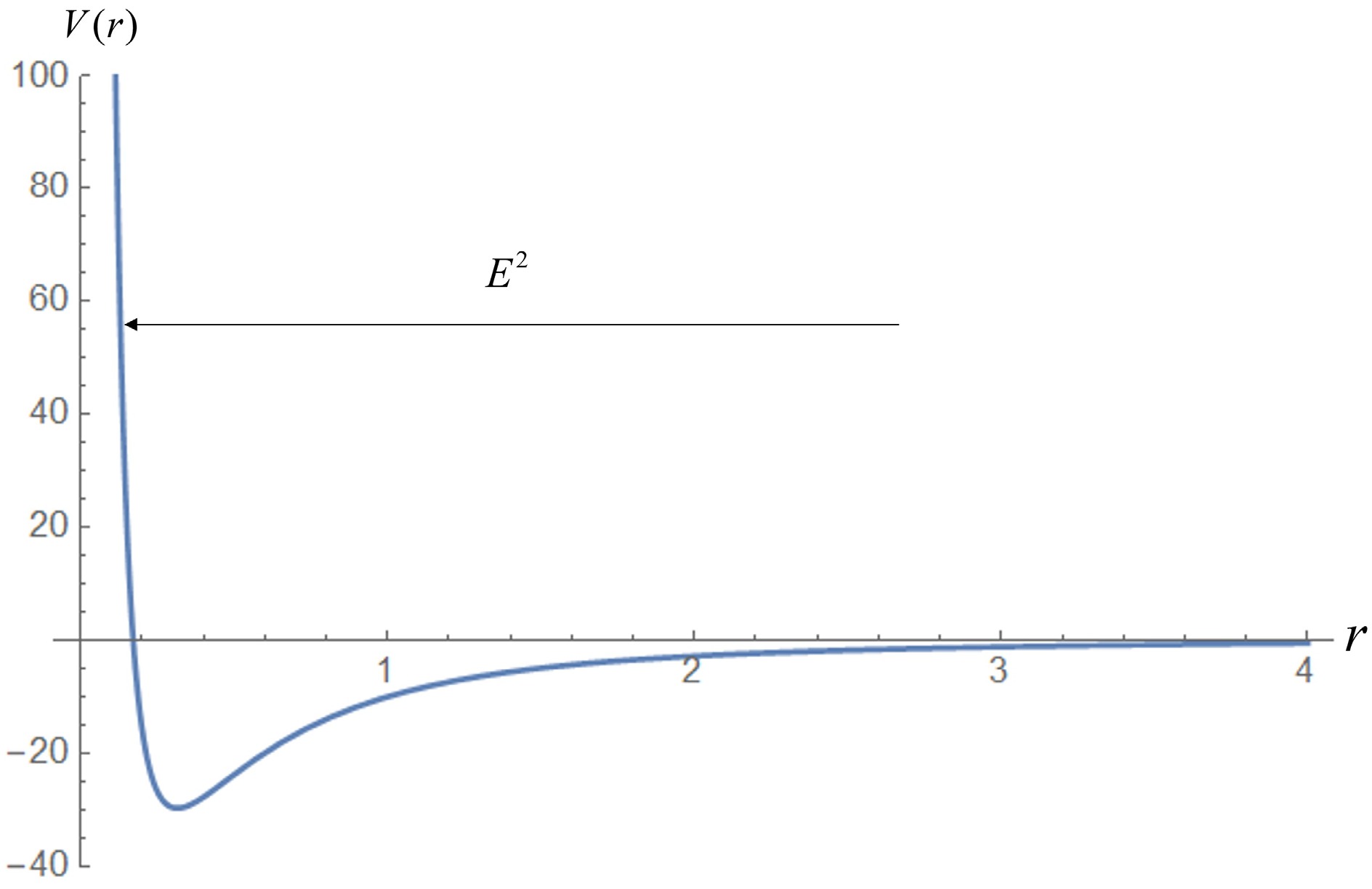
(49) For non-radial motion, the effective potential in Eq. (41) is shown in Fig. 1. It indicates that an infinite potential barrier always exists at
$ r=0 $ ; therefore, no particle can reach the origin. According to Eqs. (42) and (44),$ A^1,A^2,A^3 $ diverge as$ 1/\epsilon $ .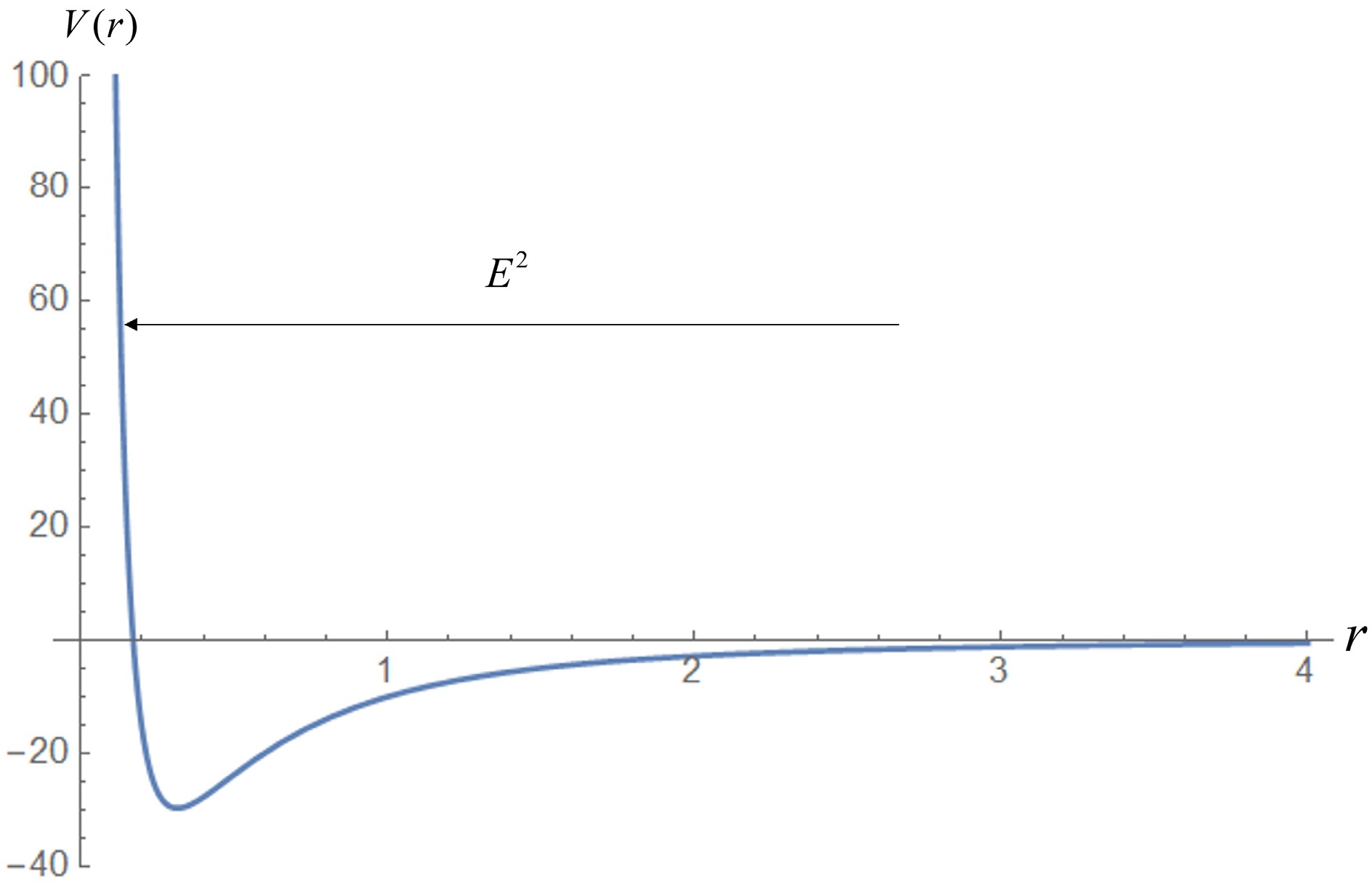
Figure 1. (color online) For nonradial motion, the potential
$ V(r) $ diverges as r approaches 0. -
We now examine the geodesic deviation of null geodesics. Let
$ k^a $ be the tangent vector to a null geodesic in the equatorial plane. By replacing$ Z^a $ with$ k^a $ in Eqs. (26) and (27), we define the conserved energy E and angular momentum L for the null geodesic. Together with the null condition$ k^ak_a=0 $ , this yields$ k^a = \frac{E}{f(r)}\left(\frac{\partial}{\partial {t}}\right)^{{a}}-\sqrt{E^2-f(r)\frac{L^2}{r^2}} \left(\frac{\partial}{\partial {r}}\right)^{{a}}+\frac{L}{r^2}\left(\frac{\partial}{\partial {\phi}}\right)^{{a}} \,. $
(50) As in the timelike case, the tidal acceleration of null geodesics is defined by
$ A^a=k^c \nabla_c(k^b \nabla_b W^a) \,, $
(51) where
$ W^a $ denotes the deviation vector satisfying$ {\cal L}_k W^a=0 $ and$ k^aW_a=0 $ . It follows from Eq. (51) that$ A^a=R_{bcd} ^{\quad a} W^bk^ck^d \,. $
(52) Equation (51) shows that
$ A^a $ represents the relative acceleration of two nearby null geodesics. Unlike timelike geodesics, null geodesics exhibit purely relative acceleration without an associated "tidal force" interpretation.For a radial null geodesic (
$ L=0 $ ), we see$ A^a = R_{bcd} ^{\quad a} W^bk^ck^d = \frac{f''(r)}{2}W^bk_bk^a = 0. $
(53) For
$ L\neq0 $ , define two spacelike vector fields$ (e_1)^a = \frac{1}{r}\left(\frac{\partial}{\partial {\theta}}\right)^{{a}}, $
(54) $ (e_2)^a = -\frac{r}{Lf(r)}\sqrt{E^2-f(r)\frac{L^2}{r^2}}\left(\frac{\partial}{\partial {t}}\right)^{{a}}+\frac{E r}{L}\left(\frac{\partial}{\partial {r}}\right)^{{a}} \,, $
(55) which satisfy
$ k^a(e_i)_a = 0,\qquad(e_i)^a(e_j)_a = \delta_{ij}\,, \qquad i,j=1,2 \,. $
(56) Thus,
$ \{(e_1)^a,(e_2)^a\} $ span a two-dimensional subspace orthogonal to$ k^a $ . A general deviation vector can be expressed as$ W^a=\alpha (e_1)^a+\beta (e_2)^a \,. $
(57) For the regular metric in the form given in Eq. (22), we have
$ \begin{aligned}[b] A^a =\;& \tilde{A}^1\alpha(e_1)^a+\tilde{A}^2\beta(e_2)^a\\ =\;& \frac{L^2}{2}\left\{-\frac{rf'(r)-2f(r)+2}{r^4}\alpha(e_1)^a \right.\\& +\left.\frac{f'(r)-rf''(r)}{r^3}\beta(e_2)^a\right\}\,, \end{aligned} $
(58) $ \tilde{A}^1|_{r= \epsilon} = \frac{L^2}{2} \left[\frac{C_1}{ \epsilon^3}-\frac{C_3}{ \epsilon}+{\cal{O}} \left( r^0 \right) \right], $
(59) $ \tilde{A}^2|_{r= \epsilon} = \frac{L^2}{2} \left[-\frac{C_1}{ \epsilon^3}+\frac{3C_3}{ \epsilon}+{\cal{O}} \left( r^0 \right) \right]. $
(60) The radial equation
$ \dot r^2=E^2-f(r)\frac{L^2}{r^2} $
(61) gives the minimum distance from the origin as
$ \epsilon\sim L \,. $
(62) Therefore,
$ \tilde{A}^1,\ \tilde{A}^2 $ diverge near the origin as$ 1/\epsilon $ . -
In contrast to conventional spherically symmetric spacetimes with a central origin at
$ r=0 $ , wormhole geometries are characterized by a minimal surface called the throat. In this section, we explore the nature of the singularity at the throat. -
Olmo et al. investigated a spherically symmetric wormhole arising from the interplay between the electric field and Palatini gravity [42]. The corresponding metric has the form
$ {\rm{d}} s^2 = -A(x) {\rm{d}} t^2+\frac{1}{A(x)\sigma_+^2} {\rm{d}} x^2+r^2(x) {\rm{d}}\Omega^2, $
(63) where
$ A(x) = \frac{1}{\sigma_+}\left[1-\frac{r_S}{r}\frac{1+\delta_1G(r/r_c)}{\sigma_-^{1/2}}\right], $
(64) $ \delta_1 = \frac{1}{2r_S}\sqrt{\frac{r_q^3}{l_{ \epsilon}}},\ \ \ \ \ r_c = \sqrt{l_{ \epsilon}r_q}, $
(65) $ \sigma_{\pm} = 1\pm\frac{r_c^4}{r^4(x)}, $
(66) $ r^2(x) = \frac{x^2+\sqrt{x^4+4r_c^4}}{2}\,. $
(67) Here
$ r_S=2M_0 $ is the Schwarzschild radius, and the function$ G(z) $ takes the form$ G(z) = -\frac{1}{\delta_c}+\frac{\sqrt{z^4-1}}{2} \left[ f_{\frac{3}{4}}(z)+f_{\frac{7}{4}}(z) \right], $
(68) $ f_{\lambda}(z) = {}_2F_1 \left(\frac{1}{2},\ \lambda,\ \frac{3}{2},\ 1-z^4 \right), $
(69) where
$ \delta_c>0 $ is a constant.The throat of the wormhole is located at
$ r=r_c= \sqrt{l_\epsilon r_q} $ , where$ l_\epsilon $ characterizes the high-curvature corrections and$ r_q $ denotes the length scale associated with the electric charge. Note that$ x=0 $ at$ r=r_c $ .The Kretschmann scalar is given by
$ \begin{aligned}[b] K =& \frac{1}{4 r^4}\left\{8 A^2 \left[r^2 \left(\sigma _-'\right){}^2+2 \sigma _-^2\right]+r^4 \left(A'\right)^2 \left(\sigma _-'\right){}^2\right.\\& +\left. 16 A \sigma _- \left(r^2 A' \sigma _-'-2\right)+4 r^4 \sigma _- A' A'' \sigma _-'\right. \\ & +\left. 4 \sigma _-^2 \left[r^4 \left(A''\right)^2+4 r^2 \left(A'\right)^2\right]+16\right\} \,, \end{aligned} $
(70) where the prime denotes differentiation with respect to the radial coordinate,
$\dfrac{\partial {}}{\partial {r}}$ . Near the throat,$ A(x) $ exhibits the asymptotic behavior [42]$ \lim\limits_{r\to r_c}A(x) = \frac{N_q}{4N_c}\frac{\delta_1-\delta_c}{\delta_1\delta_c} \sqrt{\frac{r_c}{r-r_c}}+\frac{N_c-N_q}{2N_c} +{\cal{O}} \left(\sqrt{r-r_c} \right), $
(71) where
$ N_q $ is the number of charges defined by$ N_q=q/e $ , and$ N_c $ is a constant. Substitution of Eq. (71) into Eq. (70) yields$ \begin{aligned}[b] K =\; & \frac{\left(\delta _c-\delta _1\right)^2 r_S^2}{4 \delta _c^2 r_c^3 \left(r-r_c\right)^3}-\frac{5 \left(\delta _c-\delta _1\right)^2 r_S^2}{8\delta _c^2 r_c^4 \left(r-r_c\right)^2 }\\& +\frac{2 \left(\delta _c-\delta _1\right) r_S \left(2 \delta _1 r_S-3 r_c\right)}{3 \delta _c r_c^{9/2} \left(r-r_c\right)^{3/2}}-\frac{11 \left(\delta _c-\delta _1\right)^2 r_S^2}{8\delta _c^2 r_c^5 \left(r-r_c\right)} \\ & +\frac{\left(\delta _c-\delta _1\right) r_S \left(435 r_c-418 \delta _1 r_S\right)}{30 \delta _c r_c^{11/2} \sqrt{r-r_c}}+{\cal{O}} \left[ \left( r-r_c \right)^0 \right]. \end{aligned} $
(72) For
$ \delta_1=\delta_c $ , the metric function$ A(x) $ is regular at$ r=r_c $ , and K is finite. Thus, the metric is well-defined and free of curvature singularities at the throat. However, this special case is not the focus of our investigation.For
$ \delta_1\neq \delta_c $ , both$ A(x) $ and K diverge at the throat. Based on the behavior of radial geodesics near the throat, it has been claimed that the spacetime is geodesically complete and that particles can traverse the throat [42−45]. We find that this claim is not valid because the metric cannot be defined at the throat. The singular behavior of$ A(x) $ at the throat does not necessarily imply that$ r=r_c $ is a spacetime singularity. It may instead be a coordinate singularity, analogous to that at the horizon of the Schwarzschild black hole. If it were a coordinate singularity, it should be possible to find a coordinate transformation such that the new coordinates cover$ r=r_c $ and all metric components are regular. We consider the case in which$ \delta_1>\delta_c $ as an example to show that no such transformation exists. For this purpose, we first expand Eq. (67) around the throat ($ x=0 $ ) and find$ r=r_c+\frac{x^2}{4r_c}+{\cal{O}}(x^4)\,. $
(73) Then, near the throat, Eq. (71) becomes
$ A(x)\approx k x^{-1}\,, $
(74) where
$ k = \frac{N_q}{2N_c}\frac{\delta_1-\delta_c}{\delta_1\delta_c}r_c $
(75) Consequently, Eq. (63) can be written as
$ {\rm{d}} s^2 = -kx^{-1} {\rm{d}} t^2+\frac{x}{k \sigma_+^2} {\rm{d}} x^2 +r^2{\rm{d}}\Omega^2\,. $
(76) From Eq. (66), we see that
$ \sigma_+\approx 2 $ near the throat and can therefore be treated as a constant.We rewrite Eq. (76) as
$ {\rm{d}} s^2 = kx^{-1}\left( - {\rm{d}} t^2+\frac{x^2}{k^2 \sigma_+^2} {\rm{d}} x^2 \right) \,. $
(77) Here, we omit the angular components
$ (\theta,\phi) $ of the metric because they remain unaffected by the coordinate transformation. This reduction renders the relevant spacetime effectively two-dimensional.Define the null coordinates
$ u = t-\frac{1}{2k\sigma_+}x^{2} \,, $
(78) $ v = t+\frac{1}{2k\sigma_+}x^{2}\,. $
(79) In these coordinates, the metric takes the form
$ {\rm{d}} s^2=-\alpha \left(\frac{v-u}{2}\right)^{-1/2} {\rm{d}} u {\rm{d}} v \,, $
(80) where
$ \alpha=\sqrt{k/(2\sigma_+)} $ , which can be treated as a nonzero constant near the throat. Thus, without loss of generality, we take$ \alpha=1 $ in the following calculation. Clearly, the coordinate singularity at$ x=0 $ corresponds to$ u=v $ . As is evident from Eq. (80), the metric remains singular in these coordinates. If the metric is regular at the throat, we can always find another set of null coordinates$ (U,V) $ such that$ {\rm{d}} s^2=-F(U,V) {\rm{d}} U {\rm{d}} V \,, $
(81) where F is a regular, nonvanishing function. The two coordinate systems are related by the transformation
$ U = U(u,v)\,, $
(82) $ V = V(u,v)\,. $
(83) In the two-dimensional spacetime, there are only two null directions. Consequently, we have
$ \left(\frac{\partial}{\partial {U}}\right)^{{a}} // \left(\frac{\partial}{\partial {u}}\right)^{{a}}, \qquad \left(\frac{\partial}{\partial {V}}\right)^{{a}}// \left(\frac{\partial}{\partial {v}}\right)^{{a}} \,, $
(84) which implies
$ \partial_vU=\partial_uV=0 $ . Hence, the metric transforms as$ {\rm{d}} s^2=-F(U,V)U'(u)V'(v) {\rm{d}} u {\rm{d}} v \,. $
(85) Comparing this with Eq. (80), we obtain
$ F(U,V)U'(u)V'(v)=(v-u)^{-1/2} \,. $
(86) This can equivalently be expressed as
$ F(U,V)^{-2}[U'(u)V'(v)]^{-2}=v-u \,. $
(87) Since the right-hand side of Eq. (87) vanishes at the throat
$ u=v $ , we have$ U'(u)V'(u)\to \infty $
(88) for
$ -\infty<u<\infty $ . Clearly, no functions can satisfy this divergent behavior everywhere.Therefore, the coordinate singularity at
$ r=r_c $ cannot be eliminated by any coordinate transformation, implying that no metric can be defined at the throat. Consequently,$ r=r_c $ is a true spacetime singularity. Geodesics reach the singularity in finite proper time; thus, the spacetime is geodesically incomplete. For$ \delta_1\neq \delta_c $ , the wormhole structure does not exist because the spacetime terminates at$ r=r_c $ . -
Now spacetime is confined to the region
$ x>0 $ . Since the curvature diverges as$ x\to 0 $ , it is important to determine whether the tidal acceleration also diverges as a particle approaches$ x=0 $ .The equations of motion for a timelike geodesic in the equatorial plane are given by
$ \dot t = \frac{E}{A}, $
(89) $ \dot \phi = \frac{L}{r^2}, $
(90) $ \dot x^2 = \sigma_+^2 \left[ E^2-A \left(1+\frac{L^2}{r^2} \right) \right] = \sigma_+^2 \left[ E^2-V(r) \right]\,, $
(91) where
$ V (r)= A \left(1+\frac{L^2}{r^2} \right) = \frac{\left(\delta _1-\delta _c\right) r_S \left(r_c^2+L^2\right)}{4 \delta _c r_c^{5/2} \sqrt{r-r_c}}+{\cal{O}} \left[ \left( r-r_c \right)^0 \right]. $
(92) For
$ \delta_1<\delta_c $ ,$ V(r)<0 $ , so the potential becomes infinitely attractive at$ x=0 $ . Consequently, particles can readily reach the throat.For
$ \delta_1>\delta_c $ , the potential becomes infinitely repulsive at the throat, preventing particles from reaching it. Instead, an incoming particle is deflected and orbits the wormhole at a minimum radius$ r_m (>r_c) $ . Since$ \dot x $ vanishes at the turning point$ r=r_m $ , we can combine Eqs. (91) and (92) to obtain$ E^2=V(r_m)=A|_{r=r_m} \left(1+\frac{L^2}{r_m^2} \right)\sim \frac{1}{\sqrt{r_m-r_c}}+{\cal{O}} \left[ \left( r_m-r_c \right)^0 \right] \,, $
(93) which shows that
$ r_m-r_c\sim E^{-4} $ . Because the energy E is finite, the particle cannot approach the throat arbitrarily closely.Our goal is to determine whether the tidal acceleration becomes infinite near the throat. The four-velocity of a timelike particle is given by
$ Z^a = \frac{E}{A}\left(\frac{\partial}{\partial {t}}\right)^{{a}}-\sigma_+\sqrt{ E^2-V}\left(\frac{\partial}{\partial {x}}\right)^{{a}}+\frac{L}{r^2}\left(\frac{\partial}{\partial {\phi}}\right)^{{a}}\,. $
(94) We choose the separation vector
$ W^a $ as$ W^a = \frac{1}{r}\left(\frac{\partial}{\partial {\theta}}\right)^{{a}}. $
(95) We first analyze the case
$ \delta_1<\delta_c $ . As discussed previously, in this regime the particle can reach the throat. The tidal acceleration near the throat is given by$ A^a = \tilde{A}\ W^a \,, $
(96) $ \tilde{A} = \frac{\left(\delta _c-\delta _1\right) r_S \left(r_c^2+L^2\right)}{4 \delta _c r_c^{9/2} \sqrt{r-r_c}}+{\cal{O}} \left[ \left( r-r_c \right)^0 \right]\,. $
(97) It is evident that the tidal acceleration associated with the separation direction Eq. (95) diverges as
$ r\to r_c $ . In the case$ \delta_1>\delta_c $ , we have shown that a particle with finite energy cannot approach arbitrarily close to the throat. Consequently, its tidal acceleration remains finite for any deviation vector.An interesting result obtained in [44, 45] is that, despite the divergence of the tidal acceleration, the proper distance between two adjacent geodesics remains finite near the singularity. The authors also show that a scalar field propagating in this background is well behaved everywhere. These results indicate that the curvature singularity may not be highly destructive for extended bodies approaching it.
-
In this paper, we have explored the relations among geodesic completeness, curvature singularities, and tidal forces. Our key findings are as follows:
We demonstrated that the tidal force experienced by a particle can be extremely large even on Earth. To achieve this, the particle must move non-radially at ultrarelativistic speed. This result illustrates that ultrarelativistic particles can amplify the magnitude of the gravitational field. We found that the maximum tidal force experienced by a particle is always along the radial direction, regardless of the particle's velocity. Moreover, at fixed particle energy, purely tangential motion produces the largest tidal acceleration. For the Schwarzschild solution, we found a lower bound on the tidal acceleration that is proportional to the square root of the Kretschmann curvature. This result shows that although the Lorentz boost effect can make the tidal acceleration arbitrarily large, it cannot make it arbitrarily small in regimes of strong gravity.
For a class of spherically symmetric spacetimes with metrics that are regular at the origin but contain curvature singularities, we showed that a particle moving in the radial direction can pass through the origin and endure infinite tidal forces. For non-radial motions, by fine-tuning the angular momentum to arbitrarily small values, particles can approach arbitrarily close to the origin, where the tidal forces likewise diverge. If a photon travels strictly in the radial direction, its tidal acceleration associated with any deviation vector vanishes at the origin. Otherwise, the tidal acceleration for a photon diverges near the origin.
Finally, we reexamined a wormhole solution that was claimed to be geodesically complete and to possess a curvature singularity at its throat. Our analysis reveals that when
$ \delta_1\neq \delta_c $ , the coordinate singularity at the throat cannot be eliminated by a coordinate transformation, and thus the solution is geodesically incomplete. This incompleteness implies that the spacetime terminates at$ r=r_c $ , preventing the formation of a traversable wormhole geometry. We also demonstrated that particles always experience infinitely large tidal forces as they approach the singularity.We have shown that tidal forces can be significantly enhanced by the factor
$ \gamma^2 $ for ultrarelativistic particles. Although this effect is currently undetectable because of the energy limitations of particle colliders, ultrahigh-energy cosmic rays could make such tidal effects potentially observable in future experiments. Moreover, gravitational fields near ultracompact objects, such as neutron stars and black holes, are much stronger than those near Earth, implying observable effects related to the amplified tidal forces.Our analysis demonstrates that curvature singularities are generically accompanied by divergent tidal accelerations even in geodesically complete spacetimes. We have specifically examined this relationship through the Kretschmann scalar in spherically symmetric geometries. It would be worthwhile to extend the discussion to other curvature invariants in more general spacetime backgrounds.
Geodesic completeness, curvature singularities and infinite tidal forces
- Received Date: 2026-03-11
- Available Online: 2026-09-15
Abstract: We report new findings on the subtle relationships among geodesic completeness, curvature singularities, and tidal forces. It is well known that particles may encounter infinite tidal forces near a black hole singularity. However, we find that singularities are not the only source of tidal-force divergence. Even on the surface of the Earth, the tidal force experienced by a particle can become arbitrarily large if the particle moves arbitrarily close to the speed of light in a nonradial direction. For fixed particle energy, the maximum tidal acceleration occurs for motion parallel to the surface with separation vectors oriented radially. Recent discoveries of spacetimes in which the metric remains well defined at curvature singularities have suggested that geodesics might extend through such points. Taking into account the fact that any real particle is an extended body, we calculate the tidal force acting on a particle in a static and spherically symmetric spacetime. We explicitly show that an infinite tidal force always occurs near such a singularity. Therefore, no particle can actually reach the curvature singularity, even if the metric is well defined at that point. We also demonstrate that the tidal acceleration along a null geodesic at the coordinate origin is divergent. Finally, we examine a wormhole solution that possesses a curvature singularity at its throat and was previously asserted to be geodesically complete in the literature. However, we prove that no metric can be defined at the throat and that the spacetime is therefore geodesically incomplete.



 DownLoad: